MÁS ALLÁ DE LOS NÚMEROS
Growing Share of Infants Participating in WIC Are Breastfed
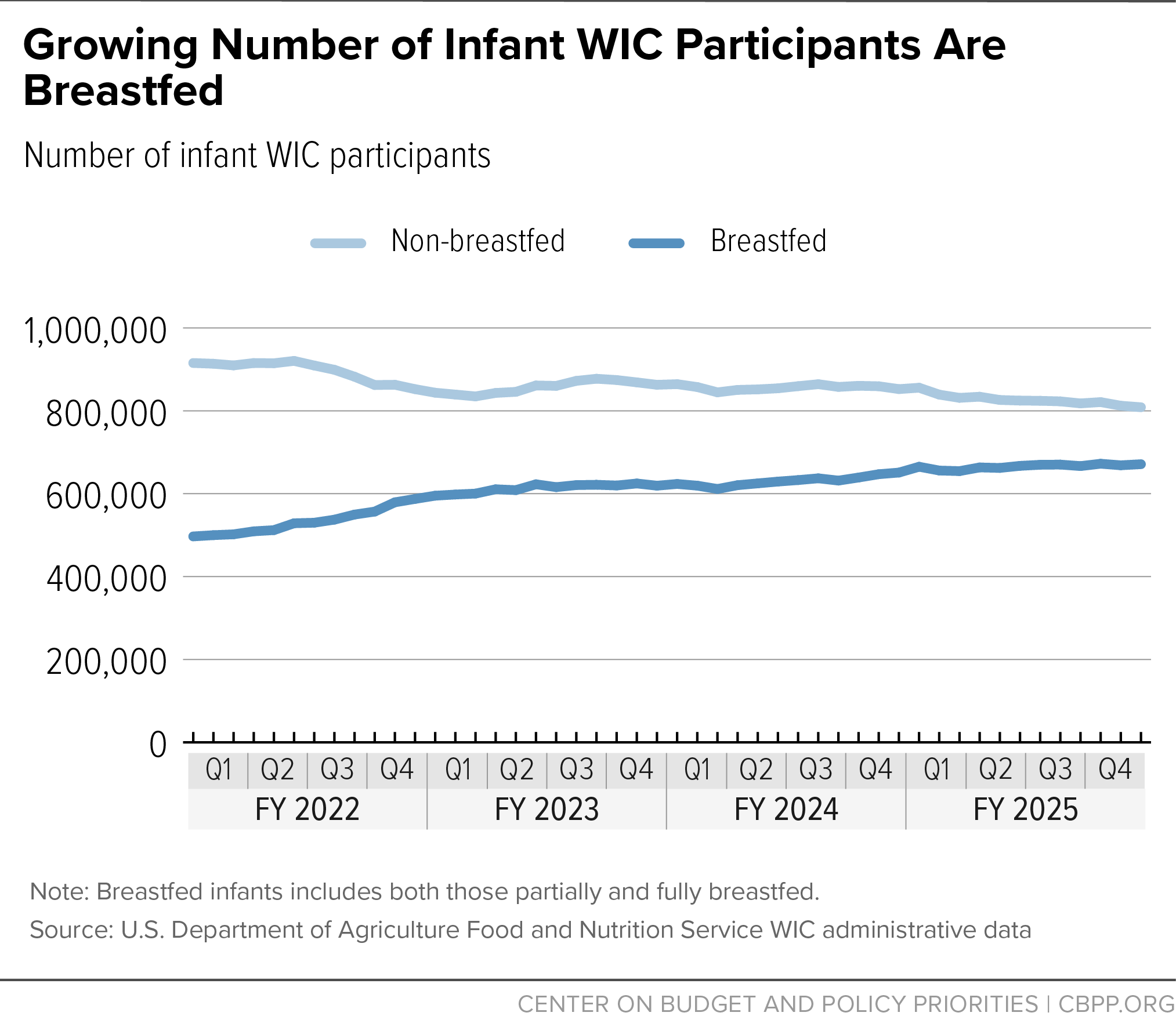
The number and share of infant participants in the WIC program who are breastfed have risen since 2022, a promising indicator that more parents are choosing to breastfeed, infants are breastfeeding for longer periods, or some combination of the two.
Health care providers and nutritionists widely promote breastfeeding as the optimal form of nutrition for infants, with health benefits for babies and their breastfeeding parents. WIC, the Special Supplemental Nutrition Program for Women, Infants, and Children, has a long history of educating parents about infant feeding, encouraging breastfeeding, and supporting participants to achieve their infant feeding goals.
These efforts helped increase the share of WIC participants who choose to initiate breastfeeding to 70 percent in 2022. But breastfeeding typically tapers off over time. In 2022 only 22.5 percent of 6- month-olds participating in WIC were still breastfed.
Between the first quarter of fiscal year 2022 and the last quarter of fiscal year 2025, the share of infants (babies under 1 year old) participating in WIC who were breastfed rose by 10 percentage points, Agriculture Department (USDA) administrative data show.
While the number of infants participating in WIC grew by 5 percent over this period, the number who were fully or partially breastfed (breastfeeding combined with formula) grew by 34.2 percent. The number who were not breastfed declined by 10.8 percent. These changes narrowed the gap between the number of breastfed and non-breastfed infants participating in WIC by about two-thirds, from about 413,000 to about 143,000. (See first graphic.)

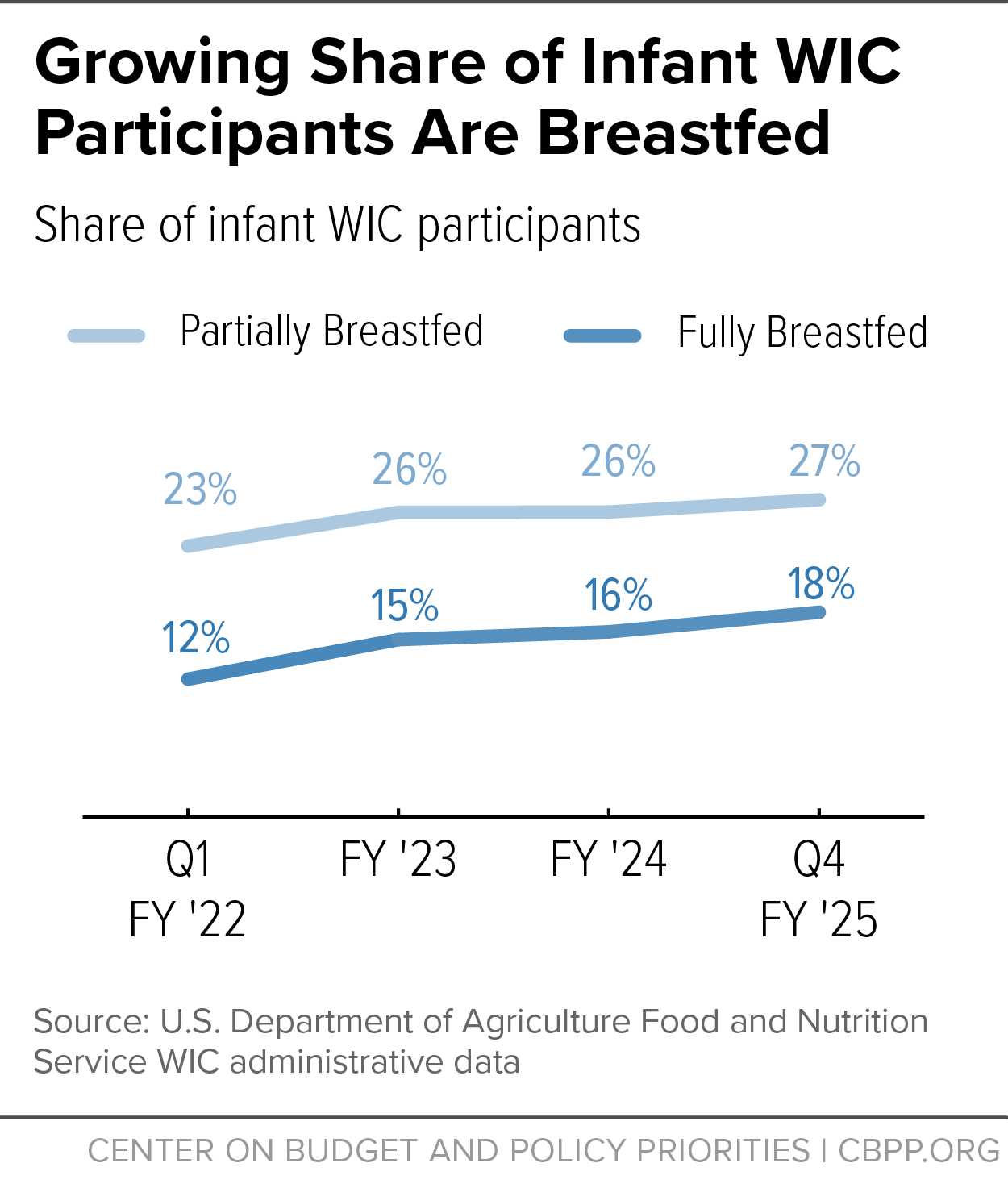
USDA administrative data also indicate whether infants participating in WIC are partially breastfed, meaning they also receive a tailored amount of formula (up to half of the amount provided to infants who are not breastfed), or fully breastfed, meaning they receive no infant formula from WIC. Over this period, the share who were partially breastfed rose by 4 percentage points, from 23 to 27 percent, while the share who were fully breastfed rose by even more — 6 percentage points, from 12 to 18 percent. (See second graphic.)
The increase in fully breastfed WIC infants is especially noteworthy because health care providers and nutritionists recommend exclusive breastfeeding until complementary foods are introduced. The increase shows notable progress toward achieving the Healthy People 2030 objective of increasing the proportion of infants who are exclusively breastfed through the first six months.

The widespread and acute infant formula shortage during much of fiscal year 2022 likely triggered the increase in infant breastfeeding. As parents across the country struggled to find formula, both the number and share of breastfeeding infants and parents participating in WIC grew.
At the time, it was unclear whether that increase would hold once formula was widely available again. But we now know that it did: as the shortage abated in fiscal year 2023, breastfeeding among WIC participants remained at its elevated level. Moreover, it continued to climb through fiscal year 2025, indicating that the shift might be sustainable.
Other factors may also be contributing to the increase. Operational changes by state and local WIC programs, such as offering telephone and video appointments and online education, have made the program more accessible to eligible families and provided more opportunities for breastfeeding education and support. Federal changes in WIC food benefits for breastfeeding participants, including a substantial increase in the fruit and vegetable benefit beginning in 2021 — along with increases in other WIC foods — have improved both the nutritional and economic value of the food package. The fruit and vegetable benefit, $11 monthly at the start of 2021, increased to $35 during the summer of 2021 and $47 in October 2021; it has been adjusted for inflation each year since and is currently $52 monthly.
A USDA breastfeeding campaign and new WIC Breastfeeding Curriculum for staff training are bolstering the sustained efforts by local WIC staff to help more participants choose to breastfeed and continue breastfeeding for longer periods.
While WIC assists breastfeeding participants with education, nutritious foods, and breast pumps, many parents face barriers such as lack of support from family members or health care providers and workplace policies that do not accommodate breastfeeding employees.
In addition, breastfeeding rates differ across race and ethnicity. In particular, various historical, social, and economic factors make it harder for some Black parents to overcome the substantial barriers to breastfeeding that all low-income families face. Black WIC participants initiate breastfeeding at lower rates than participants of other races and are less likely to continue breastfeeding for three months or longer. Thus, an increase in breastfeeding among Black parents would be especially promising, but data are not yet available to measure the 2022-2025 increases described here by race.
A sustained increase in breastfeeding could improve the health of WIC participants of any racial or ethnic group. Breastfeeding provides nutritional benefits, protects against several illnesses and allergies, and is associated with reductions in Sudden Infant Death Syndrome and obesity.
Linnea Sallack is an independent consultant formerly with the Altarum Institute and the California WIC program.