

WIC State Agencies Continue to Use Federal Flexibility to Streamline Enrollment
The Special Supplemental Nutrition Program for Women, Infants, and Children (WIC) provides nutritious foods, nutrition education, breastfeeding support, and referrals to health care and social services to pregnant and postpartum people with low incomes, infants, and children under age 5. Despite the well-documented benefits associated with WIC participation,[2] in recent years almost half (46.5 percent in 2022) of eligible people have not been enrolled, especially pregnant individuals and children aged 1 through 4.[3] To reach more eligible families with low incomes, state and local WIC agencies have adjusted their policies and practices to remove barriers to enrollment; these efforts were accelerated under COVID-19-related waivers of certain program rules and continued with waivers authorized by the 2021 American Rescue Plan Act (ARPA).[4] In 2023 the U.S. Department of Agriculture (USDA), which administers WIC, issued a policy memorandum to clarify available flexibilities for streamlining WIC certification and to encourage WIC state agencies to adopt them.[5]
This report compiles selected state WIC certification policies that CBPP collected from WIC state agencies during the summers of 2021 and 2022 and updated in the fall and winter of 2023-2024. Understanding which policies states have implemented can help federal policymakers update program rules — legislatively when WIC is reauthorized, or administratively — and assist state program administrators with implementing policies that simplify WIC enrollment and recertification procedures. Such simplifications make it easier for eligible families to get and stay enrolled and reduce the administrative burden on local staff. WIC state agencies can use this information to identify policies they might wish to adopt and connect with states that have implemented them.[6]
Many state agencies have implemented one or more policies that USDA’s 2023 policy memo on streamlining certification highlighted as available flexibilities to reduce barriers to participation.
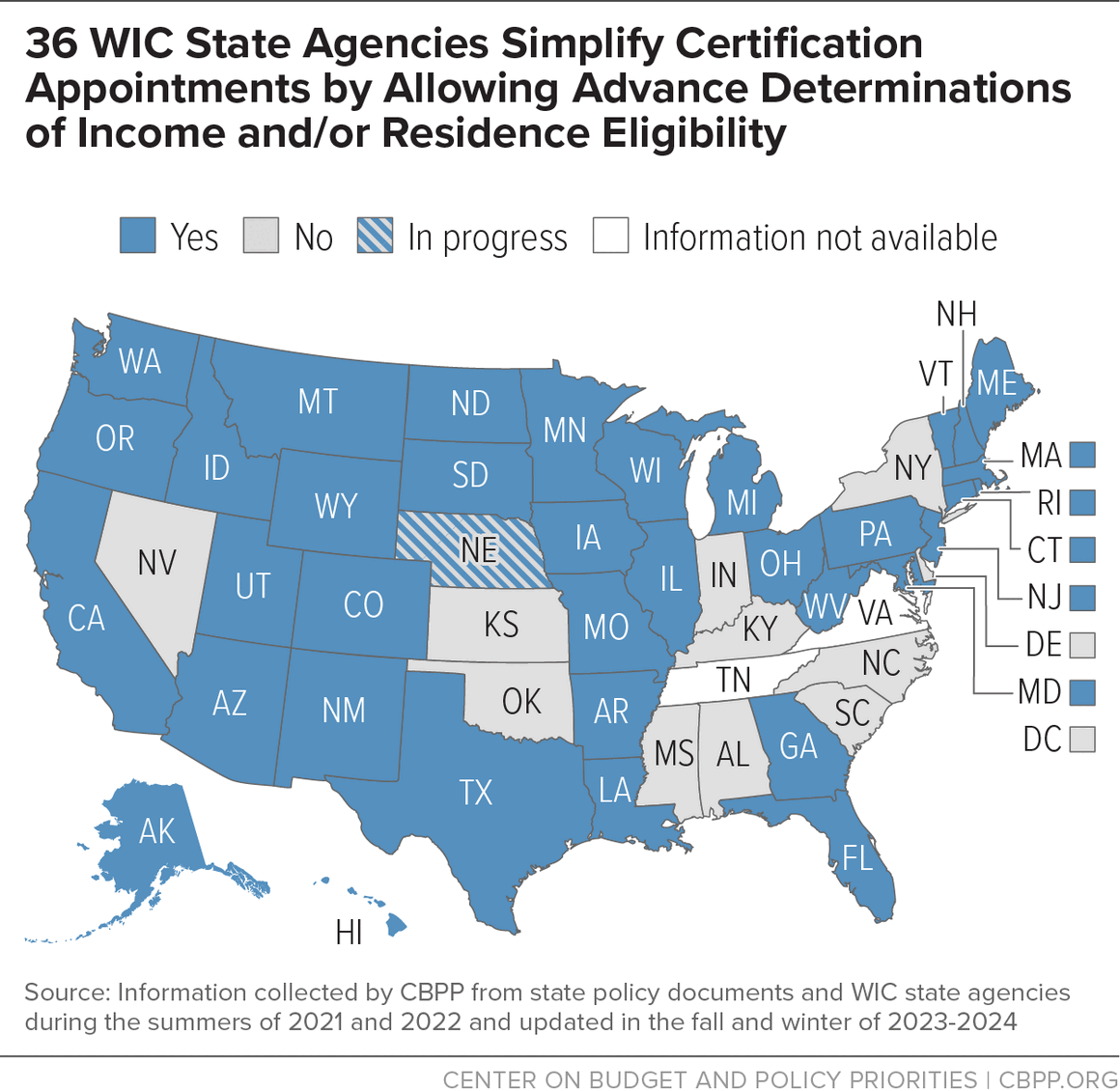
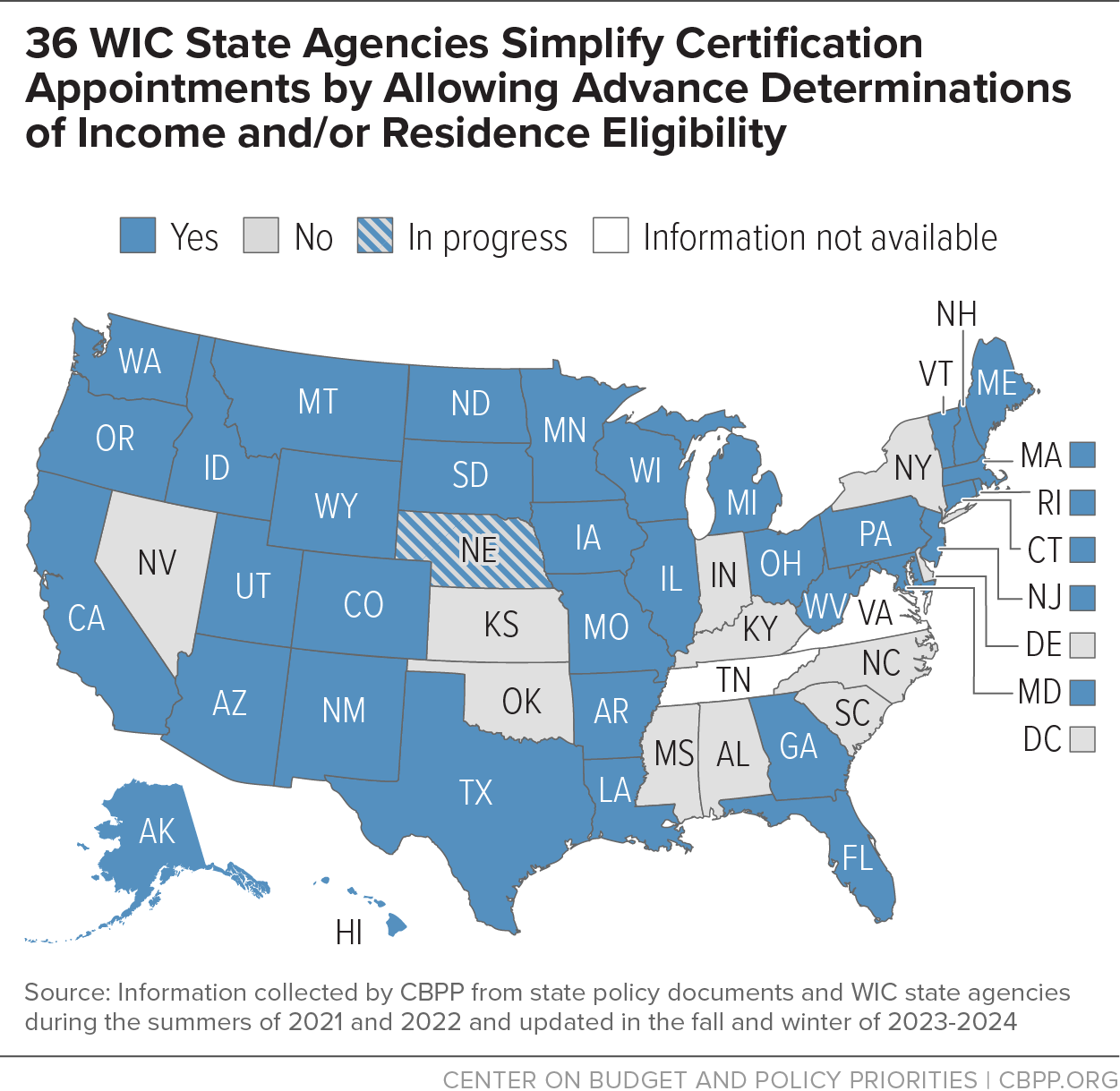
- Thirty-six WIC state agencies report having a policy allowing income and/or residence eligibility to be determined in advance of certification appointments; one additional state reports that it is in the process of implementing this policy. Checking income and residence eligibility in advance reduces both the duration of the certification appointment and the number of documents that applicants must provide.
- All but five WIC state agencies permit applicants to provide electronic documentation, either in person or transmitted by secure electronic methods, though the number and types of methods available for sharing documents vary widely.
- Forty-one WIC state agencies facilitate prompt enrollment of newborns by using the mother’s (or another household member’s) participation in Medicaid, the Supplemental Nutrition Assistance Program (SNAP), and/or Temporary Assistance for Needy Families (TANF) as the basis for eligibility; two additional states are in the process of implementing this policy. However, ten of these states do not include participation in SNAP, as permitted by USDA.
- Forty-six WIC state agencies accept documentation of a WIC applicant’s enrollment in Medicaid, SNAP, or TANF to document their residence and/or identity as well as their income; one additional state is implementing this policy.
- Forty-two WIC state agencies allow temporary 30-day certifications to give applicants more time to provide eligibility documents without delaying food benefits.
By adopting more of these flexibilities, WIC state agencies can build on the small but statistically significant increase in WIC coverage between 2021, when 51.3 percent of eligible people participated, and 2022, when the share rose to 53.5 percent.
In addition to the policy flexibilities described in the USDA memo, there are long-standing policies that allow state agencies to reduce certification barriers or expedite enrollment.
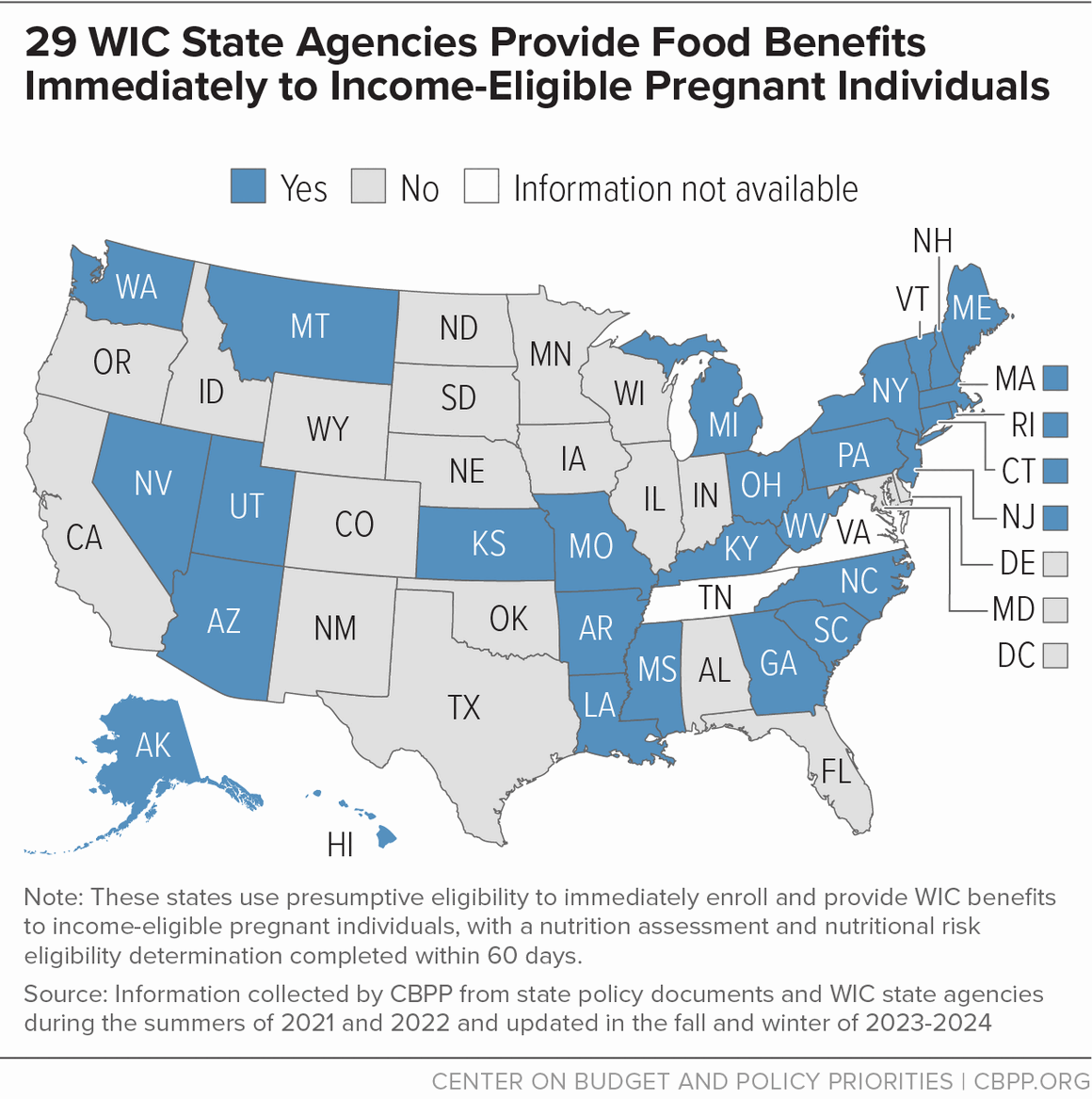
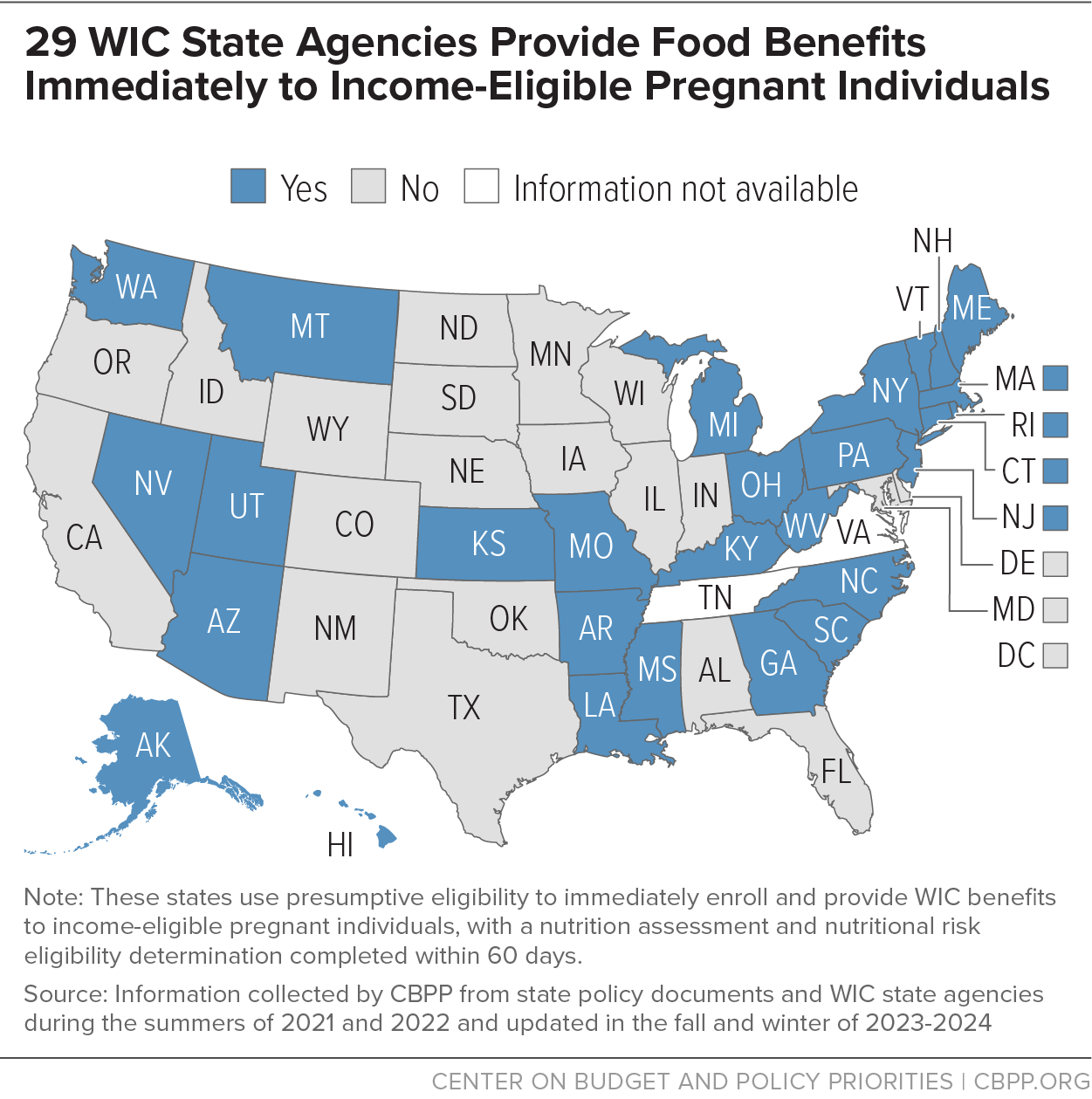
- Twenty-nine WIC state agencies allow for presumptive eligibility in advance of the nutrition assessment, so pregnant applicants can begin receiving food benefits as soon as they are determined to be income-eligible.
- Forty WIC state agencies have eliminated the requirement that households without any income provide a third-party statement verifying their income, which can prevent or delay vulnerable families from obtaining nutrition assistance during critical periods of prenatal, infant, and child development.
Thirty-four WIC state agencies exempt infants and children of working parents from being physically present for certification appointments. While many states currently have a waiver permitting certification to be done by telephone or videoconference for all applicants, those that adopt the flexibility to exempt infants and children of working parents can reduce the burden of certification appointments when waivers end.
All the policies described in this report are allowed under regular program rules, will remain available to states after the ARPA-related waivers expire, and can be adopted by states by amending their state plan, revising their policy manual, or both. More widespread adoption of all these policies would allow eligible individuals to receive benefits more easily and promptly, which could increase WIC enrollment and improve health outcomes. In addition, adopting these policies could reduce the administrative burden of certifying eligible individuals, which would free up appointment time for nutrition services and could help local agencies with staffing challenges.
Report Presents Updated Certification Policies and Practices
Eligibility for WIC benefits is assessed when applicants first apply and periodically thereafter. The program serves certain categories of applicants: infants and children under age 5, pregnant individuals, and postpartum individuals for up to one year. Additional WIC eligibility criteria include income, residence, and nutritional risk. Applicants are also required to provide identification. Eligible applicants are certified for up to one year.
While WIC programs operate under certain federal eligibility rules and policies, state and local WIC agencies have considerable flexibility to determine how they certify new applicants and recertify participants. WIC state agencies set policies and procedures for certifying eligibility, and local agencies or clinics implement these within the context of their staffing patterns and facilities. As a result, WIC agencies employ a wide range of certification options and a variety of processes.
During 2016, CBPP collected information about selected certification policies and practices for a report published in January 2017.[7] Since then, many state and local WIC agencies have changed their certification processes. Moreover, the COVID-19 pandemic required agencies to adopt new ways of certifying and serving participants. Increased use of technology and experience with remote appointments have increased flexibility and simplified certification processes while inspiring creative ways of gathering information.
As a result, many promising practices are emerging. Practices such as online applications and electronic referrals from health care providers streamline WIC enrollment, which helps both participants and staff. Increased coordination with health care providers reduces the need for families to provide duplicative information and for WIC staff to collect measurements and bloodwork, which contributes to streamlining the certification process and enhancing continuity of care.
To document some of the changes, CBPP has periodically asked the 50 geographic WIC state agencies to update the information about certification policies and practices published in the 2017 report and to respond to questions about additional items. The District of Columbia was also asked to provide the information starting in 2022. While other U.S. Territories and tribal organizations serve as state agencies operating the WIC program, their policies are not included in this report. The geographic state agencies serve the vast majority of WIC participants (98 percent in fiscal year 2023).
Nearly all states responded to requests for updates in 2021 and 2022 (47 of 50 in 2021 and 48 of 51 in 2022), and most (42 of 51) also provided updates in 2023-2024. This report summarizes the information they provided in three sections, each with a table of policies and practices across the state agencies. The range of certification processes listed here can be used as resources for federal stakeholders to understand their use and for state program administrators to connect with their peers to learn about different approaches.
Adjunctive Eligibility Simplifies Enrollment
To help ensure that low-income families with young children receive the full array of benefits and supports for which they are eligible, and to avoid duplicative administrative work, policymakers have streamlined enrollment across benefit programs through a policy known as adjunctive eligibility. Under federal law, applicants who are enrolled in Medicaid or SNAP or receive monthly TANF cash assistance payments meet WIC’s income requirement.[8] This long-standing policy simplifies WIC eligibility determinations for more than 3 in 4 applicants.[9] Nonetheless, 53 percent of WIC-eligible SNAP enrollees and 61 percent of WIC-eligible Medicaid enrollees did not participate in WIC in 2022.[10] Targeted outreach to these groups and robust referrals from health care providers are important ways of increasing WIC take-up.[11]
During the certification process, WIC agencies must first attempt to determine if the applicant is adjunctively income-eligible before performing a traditional income determination. State agencies must include procedures in their annual state plan for obtaining adjunctive eligibility information prior to the certification appointment.[12] While nearly all states accept an applicant’s paper documentation of Medicaid, SNAP, or TANF participation, such as an eligibility determination letter, they also use a variety of other options to check for participation. All WIC agencies have access to online portals, data, or automated phone systems set up by at least one of the other programs; 16 agencies have integrated a process to check for adjunctive eligibility into the WIC information system and three more are developing an integrated process. (See Table 1.)
USDA highlighted in its 2023 policy memo on streamlining certification that infants of participants who are enrolled in Medicaid and received WIC while pregnant are income-eligible for WIC. USDA encouraged state agencies to implement this policy to facilitate timely WIC enrollment of newborns. Forty-one states have already implemented this policy and two others are in the process of implementing it.[13] While most (38) of these states certify income-eligibility for infants of participants enrolled in Medicaid, fewer states (30) report permitting it for infants born into families enrolled in SNAP. (See Table 3.) Since the USDA memo clarifies that infants in families receiving SNAP or TANF are income-eligible, by adding this to their income eligibility policies states can facilitate timely enrollment of infants in families participating in SNAP or TANF but not Medicaid.
Nearly all WIC state agencies accept documentation of enrollment in Medicaid, SNAP, or TANF to document both income and residence if that program checks residence within the state as part of its eligibility process. Enrollment in these programs is also used to document identification in most states, which maximizes the benefit of checking for adjunctive eligibility. USDA encourages state agencies to permit one source to document multiple eligibility factors to make the process easier for both participants and staff.
Table 1 shows how state agencies direct local staff to check for adjunctive eligibility. It also includes state policies for using adjunctive eligibility documentation to document residence and/or identity in addition to income.
| TABLE 1 | ||||||
|---|---|---|---|---|---|---|
Certification Policies and Practices: Adjunctive Eligibility Documentation | ||||||
Legend:
| ||||||
| How does the state agency direct local agencies/clinics to check adjunctive eligibility? | ||||||
| Approval notice from agency that administers Medicaid, SNAP, TANF, and/or other applicable program1 | Call to automated phone system to check Medicaid, SNAP, TANF, and/or other applicable program1 | Online access to Medicaid portal/data | Online access to SNAP and/or TANF program portal(s)/data | Interface built into WIC eligibility system that checks Medicaid, SNAP, and/or TANF eligibility | Does the state allow documentation of adjunctive eligibility to document residence and/or identity in addition to income? | |
| Alabama | Yes | No | Yes | No | Yes | RES, ID2 |
| Alaska | Yes | Yes | Yes | Yes | No | RES, ID |
| Arizona | Yes | Yes | Yes | No | No | RES, ID |
| Arkansas | Yes | Yes | Yes | Yes | No | RES, ID |
| California5 | Yes | No | No | No | Yes | RES, ID |
| Colorado | Yes | Yes | Yes | Yes | No | RES, ID |
| Connecticut | Yes | Yes | Yes | No | No | RES, ID |
| Delaware | No | No | No | No | Yes | RES, ID |
| District of Columbia | Yes | Yes | Yes | Yes | No | No |
| Florida | Yes | No | Yes | No | Yes | RES |
| Georgia5 | Yes | No | Yes | Yes | Yes | RES |
| Hawai‘i | Yes | Yes | Yes | Yes | In process | In process |
| Idaho | Yes | Yes | Yes | Yes | Yes | No |
| Illinois | Yes | No | Yes | Yes | No | RES |
| Indiana | Yes | No | Yes | No | No | RES, ID |
| Iowa | Yes | No | Yes | No | No | RES, ID |
| Kansas4 | Yes | Yes | Yes | No | No | RES, ID |
| Kentucky | Yes | Yes | Yes | No | In process | RES, ID |
| Louisiana | Yes | Yes | Yes | Yes | No | RES, ID |
| Maine | Yes | Yes | Yes | No | No | RES, ID |
| Maryland5 | Yes | Yes | Yes | No | Yes | ID |
| Massachusetts | Yes | Yes | Yes | No | No | RES, ID |
| Michigan | Yes | Yes | Yes | No | Yes | RES, ID |
| Minnesota | Yes | Yes | Yes | Yes | No | RES, ID |
| Mississippi | Yes | Yes | Yes | No | No | NS |
| Missouri | Yes | No | No | No | Yes | RES, ID |
| Montana | Yes | No | Yes | Yes | No | RES, ID |
| Nebraska | Yes | Yes | Yes | No | No | ID |
| Nevada | Yes | No | Yes | Yes | No | RES, ID |
| New Hampshire | Yes | Yes | Yes | No3 | Yes | RES |
| New Jersey | Yes | Yes | No | Yes | Yes | ID |
| New Mexico | Yes | Yes | Yes | No | Yes | RES, ID |
| New York | Yes | Yes | Yes | No | No | RES, ID |
| North Carolina | Yes | Yes | Yes | Yes | Yes | RES, ID |
| North Dakota | Yes | Yes | Yes | No | No | RES |
| Ohio | Yes | Yes | Yes | Yes | No | ID |
| Oklahoma | Yes | Yes | Yes | No | No | RES, ID |
| Oregon | Yes | Yes | Yes | No | No | RES, ID |
| Pennsylvania5 | Yes | Yes | Yes | Yes | No | RES, ID |
| Rhode Island5 | Yes | Yes | Yes | Yes | No | RES, ID |
| South Carolina | Yes | Yes | Yes | No | Yes | RES, ID |
| South Dakota5 | Yes | Yes | Yes | Yes | Yes | RES, ID |
| Tennessee4 | -- | Yes | Yes | Yes | -- | -- |
| Texas | Yes | Yes | Yes | Yes | In process | RES, ID |
| Utah | Yes | No | Yes | No | No | RES, ID |
| Vermont5 | Yes | No | Yes | No | No | RES, ID |
| Virginia | Yes | Yes | Yes | Yes | -- | RES, ID |
| Washington | Yes | Yes | No | Participants can access | Yes (MED) | RES, ID |
| West Virginia | Yes | Yes | Yes | No | No | RES, ID |
| Wisconsin | Yes | Yes | Yes | In process | No | RES |
| Wyoming | Yes | No | Yes | Yes | No | ID |
1 Under federal rules, state agencies may accept documentation of the applicant’s participation in state-administered programs that routinely require documentation of income, provided that those programs have income eligibility limits at or below WIC’s. State agencies include other applicable programs in their annual WIC state plan. See 7 C.F.R. §246.7(d)(2)(vi)(B). | ||||||
States Have Broadened Options for Applicants to Document Eligibility
Federal rules allow WIC staff to accept documents that are shown in electronic form during in-person appointments or transmitted electronically, and USDA’s 2023 policy memo on streamlining certification requires WIC state agencies to develop policies for the secure use of online and/or electronic resources. Nearly all states include a policy on the use of electronic documents for certification in their policy manuals. But the options available to applicants for sharing electronic documents vary.
Prior to the pandemic, it was uncommon for WIC agencies to offer a mechanism to transmit documents electronically. But all states established such mechanisms as they transitioned to conducting certification appointments by telephone or video to protect participants and WIC staff after the onset of COVID-19. Now state policies allow for a range of methods for participants to rely on electronic documents before, during, or after certification appointments. Applicants (both individuals applying for the first time and those being recertified) can show documents on their telephones during in-person or video appointments, or they can send a photo or screenshot of a document via text message, email, or fax. A growing number of states are setting up secure methods for participants to upload documents, with 17 states reporting that they offer this option in 2023-2024. In some states, document uploading capability is part of an online application or is a feature within their WIC portals or mobile apps, while others offer standalone tools for uploading documents.
In a survey of more than 38,000 WIC participants conducted by 21 state agencies during the summer of 2023, 55 percent of participants reported using a method other than in-person to provide documents for certification appointments. Of these participants, 42 percent reported emailing documents with personal information to WIC, 35 percent reported uploading documents to a website, portal, or app, and 33 percent sent their documents using text messaging.[14]When asked to rate their comfort (on a scale of 1 = uncomfortable to 4 = comfortable) with the methods they had used to share their personal information with WIC, the average rating across all remote methods was 3.5, close to the 3.8 average rating for providing documents in person. While participants report comfort with sharing documents using methods other than in-person, it is important for state and local agencies to adopt measures to protect the confidentiality of the information provided without sacrificing ease of use.[15]
In its policy memo on streamlining certification, USDA encouraged WIC state agencies to “utilize tools at their disposal to collect information and documents in advance of certification appointments to identify any missing items and streamline the certification process.” The memo also encourages state agencies that can access applicable sources to assess whether a participant nearing the end of their certification period remains adjunctively income-eligible in advance of the participant’s recertification appointment. Thirty-six of the 48 state agencies permit local staff to determine income and/or residence eligibility in advance of the certification appointment, and one additional state is in the process of implementing this policy. (See Figure 1.) The period of time before the appointment in which states allow an advance determination ranges from the same day to up to 30 days. Thirty-three of the 41 WIC state agencies that responded in 2023-2024 to a question about checking for adjunctive eligibility before a recertification appointment have this policy in place, with most permitting staff to use available methods (such as an automated phone system or online portal) and allowing participants to submit documents by email or other methods.
By maximizing the use of electronic documents and adjunctive eligibility, especially in advance of certification appointments, additional states could reduce the duration of certification appointments, the number of documents that applicants must provide, and the number of applicants with incomplete documentation.
When applicants do not have all the required documentation, most state agencies permit a temporary 30-day certification to give them more time to provide eligibility documents without delaying food benefits. In its 2023 policy memo on streamlining certification, USDA strongly encourages state agencies to use existing flexibilities to minimize barriers to benefits, including granting a temporary 30-day certification period if an applicant can provide two of the three documents required to determine eligibility (identity, residency, and income). If a temporary certification period is initiated, the applicant must provide appropriate documentation within 30 days to continue receiving benefits. Flexible, electronic options for submitting the information without having to return to the clinic are important to help ensure participants with temporary certifications become fully certified.
Some state and local agencies monitor the number of temporary certifications as well as the number of these that become full certifications. If many participants are certified for only 30 days, this may indicate a need for staff training on maximizing the use of electronic documents. For example, by training staff to view and receive documents electronically, Maricopa County, Arizona lowered the share of certifications that were temporary because clients had not provided all required documents from 26 percent to 2 percent.[16] In addition, a high rate of temporary certifications that do not become full certifications may warrant more follow-up assistance to ensure that eligible and interested families are able to submit the documentation necessary to continue receiving benefits.[17]
Table 2 compiles state policies on use of electronic documents as well as policies on checking eligibility prior to certification appointments and on temporary certifications.
| TABLE 2 | ||||||||
|---|---|---|---|---|---|---|---|---|
Certification Policies and Practices: Electronic Eligibility Documentation, Checking Eligibility Prior to Certification Appointments, and Temporary Certifications | ||||||||
Legend:
| ||||||||
| Does the state provide direction on whether a local agency or clinic may accept electronic documents? | If yes, what options for sharing electronic documents are included? | Does the state allow for determining income and/or residence eligibility prior to the certification appointment? | If yes, how far in advance? | Does the state allow adjunctive eligibility to be checked before a recertification appointment? | If yes, do staff use available methods (e.g., online, phone) and can participants submit documents (e.g., upload, email)? | Does the state allow temporary certifications of up to 30 days for applicants who do not have income, identity, or residence documentation?1 | If yes, which documents can be missing? | |
| Alabama | Yes | EML | No | No | No | |||
| Alaska | Yes | EML, FAX, PHN, TXT | Yes | NS | Yes | STF, PPT | Yes | INC, RES, ID |
| Arizona | Yes | EML, UPL | Yes | NS | Yes | STF, PPT | Yes | INC, RES, ID |
| Arkansas | Yes | EML, PHN, TXT, OTH | Yes | OTH | Yes | STF, PPT | Yes | INC, RES, ID |
| California4 | Yes | EML, FAX, PHN, UPL, VID | Yes | NS | -- | Yes | INC, RES, ID | |
| Colorado | Yes | EML, FAX, TXT | Yes | ≤1 week | Yes | STF, PPT | Yes | INC, RES |
| Connecticut | Yes | EML, FAX, TXT | Yes | Same day | Yes | STF, PPT | Yes | INC, RES |
| Delaware | Yes | EML, MIS | No | Yes | PPT | Yes | INC, RES, ID | |
| District of Columbia | No | No | No | Yes | INC, RES, ID | |||
| Florida | Yes | EML, FAX, UPL | Yes | ≤30 days | Yes | STF | Yes | INC, RES, ID |
| Georgia4 | Yes | EML, UPL, PHN | Yes | ≤30 days | -- | Yes | INC, RES, ID | |
| Hawai‘i | Yes | EML, FAX, PHN, TXT | Yes | ≤30 days | Yes | STF, PPT | Yes | INC, RES, ID |
| Idaho | Yes | PHN, UPL | Yes | ≤30 days | Yes | STF, PPT | Yes | INC, RES, ID |
| Illinois | Yes | EML, PHN, TXT, VID | Yes | NS | Yes | STF, PPT | Yes | INC, RES, ID |
| Indiana5 | Yes | EML, FAX, PHN | No | -- | Yes | INC, RES, ID | ||
| Iowa | Yes | EML, FAX, PHN, TXT, UPL, VID | Yes | ≤30 days | Yes | STF | Yes | INC, RES |
| Kansas2 | Yes | EML, FAX, PHN, TXT | No | -- | Yes | INC, RES, ID | ||
| Kentucky | Yes | EML, FAX, PHN, OTH | No | Yes | PPT | Yes3 | INC, RES, ID2 | |
| Louisiana | Yes | EML, FAX, PHN, UPL | Yes | ≤30 days | Yes | STF | Yes | INC, RES, ID |
| Maine | Yes | EML, FAX, PHN, TXT, VID | Yes | ≤1 week | Yes | STF | Yes | INC, RES, ID |
| Maryland4 | Yes | EML, FAX, PHN, TXT, UPL, VID | Yes | ≤30 days | -- | Yes | INC, RES, ID | |
| Massachusetts | Yes | EML, FAX, PHN, TXT, UPL (In Process) | Yes | ≤30 days | Yes | STF, PPT | No | |
| Michigan | Yes | EML, FAX, PHN, TXT, VID | Yes | ≤30 days | Yes | STF | Yes | INC, RES, ID |
| Minnesota | Yes | NS | Yes | ≤21 days | Yes | STF, PPT | Yes | INC, RES, ID |
| Mississippi | No | No | Yes | STF | Yes | INC, RES, ID | ||
| Missouri | Yes | EML, FAX, PHN, TXT, UPL | Yes | ≤30 days | Yes | STF, PPT | Yes | INC, RES, ID |
| Montana | Yes | NS | Yes | ≤1 week | Yes | STF, PPT | Yes | INC, RES, ID |
| Nebraska | Yes | EML, TXT, UPL, VID | In process | No | No | |||
| Nevada | Yes | EML, TXT | No | Yes | STF, PPT | Yes | INC, RES, ID | |
| New Hampshire | Yes | EML, FAX, TXT | Yes | Same month as certification | Yes | STF, PPT | Yes | INC, RES, ID |
| New Jersey | Yes | EML, PHN, TXT, OTH | Yes | ≤30 days | Yes – In process | STF, PPT | No | |
| New Mexico | Yes | EML, FAX, UPL | Yes | ≤30 days | Yes | STF, PPT | Yes | INC, RES, ID |
| New York | Yes | EML,FAX, PHN, TXT, VID | No | No | Yes | INC, RES, ID | ||
| North Carolina | Yes | EML, PHN, TXT | No | No | No | |||
| North Dakota | Yes | EML, FAX, PHN, TXT | Yes | NS | Yes | STF, PPT | Yes | INC, RES |
| Ohio | No | Yes | NS | Yes | STF, PPT | No | ||
| Oklahoma | Yes | EML, FAX, PHN, TXT, UPL | No | No | Yes | INC, RES, ID | ||
| Oregon | Yes | EML, TXT, UPL, VID | Yes | ≤5 business days | Yes | STF, PPT | Yes | INC, RES, ID |
| Pennsylvania4 | Yes | NS | Yes | ≤1 week | -- | No | ||
| Rhode Island4 | Yes | EML, FAX, TXT | Yes | ≤30 days | -- | Yes | INC, RES, ID | |
| South Carolina | Yes | EML, FAX, PHN, TXT, UPL, VID | No | Yes | PPT | Yes | INC, RES, ID | |
| South Dakota4 | Yes | EML, FAX, PHN, TXT | Yes | ≤72 hours | -- | Yes | INC, RES, ID | |
| Tennessee2 | No | -- | -- | No | ||||
| Texas | Yes | EML, FAX, PHN, UPL, VID | Yes | ≤30 days | Yes | STF, PPT | Yes | INC, RES, ID |
| Utah | Yes | EML, PHN, TXT, VID, | Yes | ≤30 days | Yes | STF | Yes | INC, RES, ID |
| Vermont4 | Yes | EML, FAX, PHN | Yes | 1-2 days | -- | Yes | INC, RES, ID | |
| Virginia | No | -- | No | No | -- | |||
| Washington | Yes | VID | Yes | ≤30 days | Yes | STF | Yes | INC, RES, ID |
| West Virginia | Yes | EML, FAX, PHN, TXT | Yes | ≤30 days | Yes | STF, PPT | Yes | INC, RES, ID |
| Wisconsin | Yes | EML, FAX, PHN, TXT, UPL, VID, OTH | Yes | ≤10 days | Yes | STF, PPT | Yes | INC, RES, ID |
| Wyoming | Yes | EML, FAX | Yes | ≤30 days | Yes | STF, PPT | Yes | INC, RES, ID |
1 Federal rules permit temporary certification for up to 30 days for applicants who provide documentation for two of these three requirements. The missing documentation must be provided by the end of the temporary period for the applicant to be fully certified. | ||||||||
States Can Adopt Other Policies to Streamline Certification
There are other ways WIC state agencies can adjust their policies, and local agencies can adjust their practices, to make the certification process easier to navigate and less burdensome for both participants and staff. This section explains selected policies that could further those goals. States that wish to comprehensively assess their certification process to identify opportunities for modernization and streamlining can use CBPP’s toolkit, “Assessing Your WIC Certification Practices,” which offers approaches, examples, and resources.[18]
Exceptions to Attending Appointments in Person
Federal law permits WIC state agencies to exempt certain individuals from the requirement that applicants be physically present at certification appointments: infants or children receiving ongoing health care (after the initial certification), infants or children with working parents (after the initial certification and with a limit on how much time can elapse between in-person appointments), and newborn infants under 8 weeks old. For adults, exemptions from the physical presence requirement are limited to individuals with disabilities.[19]
Under waivers approved by the Food and Nutrition Service (FNS) during the pandemic, state agencies made remote appointments available to all applicants and participants to protect the health of families and WIC staff. Participants were offered telephone and video certification appointments and options for providing eligibility information without visiting a WIC office. In a 2021 survey of 26,000 participants across 12 states, participants reported that the quality of services they received during the pandemic was the same as (49.7 percent) or better than (37.7 percent) before the pandemic. Nearly half (45.4 percent) responded that they would prefer to continue remote WIC appointments when the pandemic ended.[20]
Waivers provided under ARPA have allowed WIC agencies to continue offering remote appointments. Responses from 38,000 participants in the 2023 multi-state survey were similar, with participants reporting a high level of satisfaction with services provided in person and those provided not in person; both rated an average of 3.7 out of 4 on a scale of 1 = very unsatisfied and 4 = very satisfied.[21]
Once the waivers expire, states can make it easier for parents and caretakers to schedule and keep appointments by offering telephone or video appointments for certification when a physical presence exemption applies, or for appointments that occur during a certification period.
For appointments when infants or children are not present, it is important to collaborate with health care providers to obtain measurements and blood test results to inform the nutrition assessment. While most state agencies received COVID waivers for obtaining measurements and bloodwork, many state and local agencies coordinated with health care providers to get this information to inform nutrition assessments during certification appointments conducted by phone or video. WIC participants appreciated this change. In the 2021 multi-state survey of WIC participants, 60 percent of respondents cited using measurements and blood tests from doctors’ visits as an advantage of WIC services during the pandemic.[22]
Under ARPA waivers, WIC agencies must obtain measurements when offering services remotely, but may delay doing so for up to 60 days after the certification appointment. To facilitate phone or video certification appointments, WIC agencies are exploring a variety of methods of obtaining applicants’ information from health care providers, including incorporating information from electronic health records into referrals and allowing providers to make referrals through health information exchanges.[23] When the relevant information cannot be obtained from a health care provider, WIC agencies sometimes offer “drop-in” visits for parents to bring their infant or child to the WIC site briefly for measurements and blood tests at a convenient time, either before or after a certification appointment is conducted remotely.
Expedited Enrollment for Pregnant Applicants
Federal WIC rules allow for pregnant individuals who meet program income standards to be immediately enrolled as presumptively eligible based on income eligibility, with a nutrition assessment and determination of nutritional risk eligibility completed within 60 days. Some WIC state agencies are using this option to establish presumptive eligibility for prenatal applicants with a nutrition assessment within 60 days or, in a few cases, 30 days.
As Figure 2 illustrates, 29 states have adopted a two-step process that may make it easier to enroll pregnant individuals as soon as they contact WIC to apply. This approach can facilitate delivering WIC’s food benefits to pregnant individuals earlier in pregnancy. For example, when a parent of a child participating in WIC shares that they are pregnant during an appointment for their child, they could be enrolled right away (assuming the family is already income-eligible) and begin to receive food benefits immediately. The nutrition assessment and risk determination could be scheduled one or two months later.
For a prenatal applicant who does not have a child participating in WIC, a two-step process may be less overwhelming than a single appointment. The first contact could focus on collecting demographic information, confirming income eligibility, making referrals for prenatal care or other support, assigning a food package, and providing education on WIC foods and how to shop for them. The second contact could focus on a nutrition assessment, nutrition and breastfeeding education, and the participant’s questions about shopping or using WIC foods. If the second contact is scheduled after a prenatal health care appointment, measurements and blood test results may be available for use in the nutrition assessment.
By enrolling pregnant individuals and providing food assistance as soon as they are determined to be income-eligible, WIC can reach them earlier in their pregnancy so they receive the maximum benefit from the program. Fewer than half (48.3 percent) of prenatal participants are enrolled in the first trimester of pregnancy, and the figures are lower for Asian (45.1 percent), Black (43.6 percent), and Pacific Islander (38.0 percent) prenatal participants than for white participants (50.1 percent). [24] More widespread adoption of presumptive eligibility offers an opportunity to enroll individuals with low income earlier in pregnancy, which may yield greater health and nutrition improvements.
Self-Declaration of Income
As permitted under federal law, nearly all WIC state agencies allow applicants to self-declare their income when they are unable to provide documentation.[25] This flexibility accommodates vulnerable families, such as those who are experiencing homelessness or have been affected by a natural disaster.
Families with no income are also likely to be experiencing substantial hardship. Federal rules allow them to self-declare their income and do not require WIC state agencies to obtain a third-party statement verifying their income.[26] Instead, federal guidance suggests inquiring about their circumstances and how they obtain basic necessities such as food, shelter, medical care, and clothing in order to correctly apply program rules about household size and income, as well as providing important referrals for assistance.[27] As in other circumstances, WIC staff may require third-party verification if they deem it necessary to confirm self-reported information, but third-party verification does not need to be obtained just because a household reports zero income.[28] Nonetheless, 11 state agencies require a third-party statement from all households that report having zero income.
Having periods without any income is not unusual for poor households. In a typical month in 2022, 20.5 percent of households receiving SNAP benefits — over 4.2 million households — had zero gross income.[29] There are many situations in which a family can manage on a temporary basis without income: they might be living in public or shared housing, getting food provisions at a food pantry, eating meals at a soup kitchen, or relying on other in-kind benefits. Requiring such families to find an official or entity to document the absence of income creates a special burden for families who are likely extremely fragile or facing a crisis. As a result, such a requirement can prevent or delay vulnerable families from accessing nutrition assistance during periods of prenatal, infant, and child development, when even short periods of food insecurity can have lasting consequences.[30] States can help deliver WIC’s essential foods promptly to families without income by utilizing the federal flexibility to eliminate the requirement to document lack of income.
Document Retention
State policies vary regarding how local WIC staff are instructed to handle documents that are shared with them to demonstrate eligibility. For applicants who meet eligibility requirements, about half of state agencies either do not have a document retention policy or have a policy of returning documents to applicants or discarding them. State agency policies requiring documents to be retained are most often limited to income documents.
Several WIC state agencies noted that they require copies of documents to be kept only for applicants found to be ineligible. This is likely a policy in other states, since these documents are important for potential fair hearing requests.
As use of electronic documents increases, applicants will provide fewer paper items, and policies for handling documents with confidential information will likely evolve. It will be increasingly important for state agencies to adopt clear policies for the processes used to collect the documents and for storage or deletion after they are used to determine eligibility. Such policies should balance protecting applicants’ privacy, reducing the duration of certification appointments, and using staff time efficiently.
Table 3 shows state agency policies related to income self-declaration, document retention, physical presence exemptions for infants and children, and presumptive eligibility for prenatal applicants.
| TABLE 3 | ||||||||
|---|---|---|---|---|---|---|---|---|
Certification Policies and Practices: Selected State Policies on Income Self-Declaration, Retaining Eligibility Documents, Physical Presence Exemptions, and Prenatal Presumptive Eligibility | ||||||||
Legend:
| ||||||||
| Does the state exempt infants and children of working parents from the physical presence at certification requirement? | Does the state allow prenatal applicants to be certified as presumptively eligible for up to 60 days? | Does the state allow infant adjunctive eligibility without additional income documentation based on parent enrollment in Medicaid or SNAP or family enrollment in TANF? | If yes, which program(s): MED, SNAP, and/or TANF? | Does the state require a third-party statement for zero-income households? | Does the state provide direction about keeping copies of residence, identity, and/or income documents? |
If yes, what type of document must be retained?1 | ||
| Alabama | No | No | Yes | MED, SNAP, TANF | No | No | ||
| Alaska | Yes | Yes | Yes | MED, SNAP, TANF | No | Yes | INC | |
| Arizona | Yes | Yes | Yes | TANF | No | Yes | DIS | |
| Arkansas | No | Yes | Yes | MED, SNAP, TANF | Yes | Yes | DIS | |
| California3 | Yes | No | Yes5 | MED, TANF5 | No | No | ||
| Colorado | Yes | No | Yes | MED | No | Yes | DIS | |
| Connecticut | Yes | Yes | Yes | MED, SNAP, TANF | No | Yes | DIS | |
| Delaware | Yes | No | Yes | MED, SNAP | No | Yes | INC | |
| District of Columbia | No | Yes | Yes | MED, SNAP, TANF | No | Yes | DIS | |
| Florida | No | No | Yes | MED | No | Yes | OTH | |
| Georgia3 | Yes | Yes | Yes5 | MED, SNAP, TANF5 | No | Yes | INC, ETR | |
| Hawai‘i | Yes | Yes | Yes | MED, SNAP, TANF | Yes | Yes | DIS | |
| Idaho | Yes | No | Yes | MED, SNAP, TANF | No | No | ||
| Illinois | Yes | No | Yes | MED, SNAP | No | Yes | OTH | |
| Indiana4 | No | No | No | Yes | DIS | |||
| Iowa | Yes | No | Yes | MED, SNAP | No | Yes | OTH | |
| Kansas2 | No | Yes | Yes5 | MED, TANF5 | No | No | ||
| Kentucky | Yes | Yes | Yes | MED, SNAP, TANF | No | No | ||
| Louisiana | No | Yes – for 30 days | Yes | MED, SNAP | Yes | Yes | DIS | |
| Maine | Yes | Yes – for 30 days | Yes | MED, SNAP, TANF | No | Yes | ELE | |
| Maryland3 | Yes | No | Yes5 | MED, SNAP, TANF5 | Yes | Yes | ETR | |
| Massachusetts | No | Yes | Yes | MED, SNAP, TANF | Yes | Yes | ETR | |
| Michigan | Yes | Yes | Yes | MED | No | Yes | ELE | |
| Minnesota | Yes | No | Yes | MED, SNAP, TANF | No | Yes | DIS | |
| Mississippi | No | Yes | Yes | MED, SNAP, TANF | Yes | Yes | ELE | |
| Missouri | Yes | Yes | Yes | MED, TANF | No | No | ||
| Montana | Yes | Yes – for 30 days | Yes | MED | No | Yes | ELE | |
| Nebraska | No | No | No | No | Yes | DIS | ||
| Nevada | Yes | Yes | Yes – In Process | No | Yes | DIS | ||
| New Hampshire | Yes | Yes | Yes | MED, SNAP, TANF | No | No | ||
| New Jersey | Yes | Yes | Yes – In process | MED | Yes | Yes | DIS | |
| New Mexico | No | No | Yes | MED, SNAP, TANF | No | Yes | ELE | |
| New York | Yes | Yes | Yes | MED, SNAP, TANF | No | Yes | DIS | |
| North Carolina | Yes | Yes | Yes | MED, SNAP, TANF | No | No | ||
| North Dakota | Yes | No | Yes | TANF | No | Yes | DIS | |
| Ohio | Yes | Yes | Yes | MED, SNAP, TANF | No | Yes | DIS | |
| Oklahoma | Yes | No | Yes | MED, SNAP, TANF | No | Yes | DIS | |
| Oregon | Yes | No | Yes | MED, SNAP, TANF | No | No | ||
| Pennsylvania3 | No | Yes | Yes5 | MED, TANF5 | No | Yes | DIS | |
| Rhode Island3 | Yes | Yes | Yes | Yes | -- | |||
| South Carolina | No | Yes | Yes | MED, SNAP, TANF | Yes | No | ||
| South Dakota3 | Yes | No | No | Yes | INC, ELE | |||
| Tennessee2 | No | -- | Yes | No | ||||
| Texas | No | No | No | No | Yes | INC, ELE | ||
| Utah | Yes | Yes | Yes | SNAP, TANF | No | Yes | DIS | |
| Vermont3 | Yes | Yes | No | Yes | DIS | |||
| Virginia | No | -- | Yes | MED, SNAP | Yes | Yes | INC, ELE | |
| Washington | Yes | Yes | No | No | Yes | DIS | ||
| West Virginia | No | Yes – for 30 days | Yes | MED, SNAP | No | Yes | OTH6 | |
| Wisconsin | Yes | No | Yes | MED, SNAP, TANF | No | Yes | DIS | |
| Wyoming | Yes | No | Yes | MED | No | Yes | DIS | |
1Some state agencies require eligibility documents to be retained only when applicants are determined to be ineligible. | ||||||||
Conclusion
State and local WIC agencies have the flexibility under federal rules to adjust their policies and practices to remove barriers to enrollment, which can help them reach more eligible families with low income and use staff time efficiently and effectively. The policies compiled here demonstrate that WIC administrators have made widespread use of these flexibilities. USDA encouraged further WIC state agency adoption of available flexibilities to streamline certification by highlighting several opportunities in its 2023 policy memo. In addition, operations under COVID and ARPA waivers have demonstrated how WIC can deliver important nutrition assistance and services in ways that are less burdensome to participants and staff.
When federal policymakers consider revisions to the law and rules that govern WIC, permanently adopting some of those temporary flexibilities that allow states to streamline and modernize the certification process could help more eligible families with low incomes enroll in WIC, especially earlier in pregnancy, and remain enrolled as infants become toddlers and preschoolers.
Even without federal changes, broader adoption of several of these policies — such as determining income and/or residence eligibility in advance of the certification appointment, allowing presumptive eligibility for prenatal individuals, allowing temporary 30-day certifications, and eliminating the requirement that zero-income households provide a third-party statement — could help states enroll more eligible families, putting children on a healthier course for life.
End Notes
[1] Lauren Hall contributed to an earlier version of this report.
[2] For more information about the research evidence on WIC’s effectiveness, see Steven Carlson and Zoë Neuberger, “WIC Works: Addressing the Nutrition and Health Needs of Low-Income Families for More Than Four Decades,” CBPP, updated January 27, 2021, www.cbpp.org/wicworks; U.S. Department of Agriculture, Food and Nutrition Service, “Reviewing the Evidence for Maternal Health and WIC,” report to Congress, July 2021, https://www.fns.usda.gov/wic/reviewing-evidence-maternal-health-and-wic; and Agency for Healthcare Research and Quality, “Maternal and Childhood Outcomes Associated with the Special Supplemental Nutrition Program for Women, Infants and Children (WIC),” research protocol, amended May 14, 2021, https://effectivehealthcare.ahrq.gov/products/outcomes-nutrition/protocol.
[3] Courtenay Kessler et al., “National- and State-Level Estimates of WIC Eligibility and WIC Program Reach in 2022: Final Report,” U.S. Department of Agriculture, Food and Nutrition Service, August 2024, https://fns-prod.azureedge.us/sites/default/files/resource-files/wic-eer-2022-report.pdf.
[4] P.L. 117-2.
[5] See U.S. Department of Agriculture, Food and Nutrition Service, “WIC Policy Memorandum #2023-6: Streamlining Certification – Documentation Guidance,” May 10, 2023,https://www.fns.usda.gov/wic/streamlining-certification-documentation-guidance.
[6] The National WIC Association helped solicit responses from WIC state agencies in a survey conducted during the fall of 2023. In early 2024, CBPP contacted WIC state agencies that did not complete the survey to request updates to information they had provided previously. Information was gathered from the 50 geographic state agencies and the District of Columbia WIC agency. Territories or tribal organizations can serve as state agencies operating the WIC program, but they were not surveyed. Linnea Sallack, an independent consultant formerly with the Altarum Institute and the California WIC program, helped compile and summarize state responses.
[7] Zoë Neuberger, “Modernizing and Streamlining WIC Eligibility Determination and Enrollment Processes,” CBPP, January 6, 2017, www.cbpp.org/wicstreamlining.
[8] Recipients of other TANF-funded benefits or services are not adjunctively income-eligible for WIC. See 7 C.F.R. §246.7(d)(2)(vi)(A)(2). State agencies are also permitted to accept documentation of participation in other state-administered programs that routinely document income and that have income eligibility limits at or below WIC’s. See 7 C.F.R. §246.7(d)(2)(vi)(B).
[9] In 2022, 80 percent of WIC applicants participated in Medicaid, SNAP, or TANF. See Polina Zvavitch et al., “WIC Participant and Program Characteristics 2022,” U.S. Department of Agriculture, Food and Nutrition Service, February 2024, Table 4.1, https://fns-prod.azureedge.us/sites/default/files/resource-files/wic-ppc-2022-report.pdf.
[10] Kessler et al., Table 5.1.
[11] Sonya Schwartz et al., “State Medicaid Agencies Can Partner with WIC Agencies to Improve the Health of Pregnant and Postpartum People, Infants, and Young Children,” CBPP, December 20, 2023, www.cbpp.org/medicaidwicopportunities.
[12] See 7 CFR §246.7(d)(2)(v).
[13] Information on this policy is not available for five states that did not respond to requests regarding their policies and do not have policy manuals publicly available to review.
[14] Danielle L. Lee et al., “Multi-State WIC Participant Satisfaction Survey,” National WIC Association, February 2024, https://media.nwica.org/2023%20multistate%20wic%20survey%201.pdf.
[15] For suggestions regarding protecting the privacy and confidentiality of data, see “Privacy and Security Considerations” in Hilary Dockray et al., “Launching New Digital Tools for WIC Participants — A Guide for WIC Agencies,” CBPP, Social Interest Solutions, and National WIC Association, February 25, 2019, p. 42, https://www.cbpp.org/research/food-assistance/launching-new-digital-tools-for-wic-participants#p3PrivacyAndSecurity.
[16] Zoë Neuberger, “WIC Case Study: Maricopa County, Arizona,” CBPP, https://www.cbpp.org/sites/default/files/atoms/files/8-30-19fa-casestudies-maricopa-county.pdf.
[17] For example, after Colorado conducted training on an existing policy allowing the use of electronic documents for certification, the share of temporary certifications made permanent with electronic documents rose from 43 percent to 65 percent. Zoë Neuberger, “WIC Case Study: Colorado,” CBPP, https://www.cbpp.org/sites/default/files/atoms/files/8-30-19fa-casestudies-colorado.pdf.
[18] CBPP, “Assessing Your WIC Certification Practices,” https://www.cbpp.org/wiccertificationtoolkit.
[19] See 7 CFR §246.7 (o)(2).
[20] Lorrene Ritchie et al., “Multi-State WIC Participant Satisfaction Survey: Learning from Program Adaptations During COVID,” National WIC Association, December 13, 2021, https://media.nwica.org/nwamulti-state-wic-participant-satisfaction-surveynationalreportfinal.pdf.
[21] Ritchie et al., op. cit.
[22] Ritchie et al., op. cit.
[23] Schwartz et al., op. cit.; see https://www.cbpp.org/research/food-assistance/state-medicaid-agencies-can-partner-with-wic-agencies-to-improve-the#strengthening-referrals-cbpp-anchor.
[24] Zvavitch et al., op. cit., Table 3.3.
[25] Under federal rules, the WIC agency must require the applicant to sign a statement specifying why they cannot provide documentation of income. See 7 C.F.R. § 246.7(d)(2)(v)(C).
[26] Unlike applicants who have income but no documentation of it, applicants with no income are not required to sign a statement specifying why they cannot provide documentation of income. See 7 C.F.R. § 246.7(d)(2)(v)(C).
[27] See Debra Whitford, “WIC Policy Memorandum #2013-3: Income Eligibility Guidance,” U.S. Department of Agriculture, April 26, 2013, https://fns-prod.azureedge.us/sites/default/files/2013-3-IncomeEligibilityGuidance.pdf.
[28] See 7 C.F.R. § 246.7(d)(2)(v)(D).
[29] Mia Monkovic, “Characteristics of Supplemental Nutrition Assistance Program Households: Fiscal Year 2022,” U.S. Department of Agriculture, June 2024, Table A.1, https://www.fns.usda.gov/research/snap/characteristics-fy22.
[30] Zoë Neuberger, “Nutrition Provisions in New House Build Back Better Legislation Could Substantially Reduce Children’s Food Hardship,” CBPP, November 5, 2021, https://www.cbpp.org/research/food-assistance/nutrition-provisions-in-new-house-build-back-better-legislation-could.