

More Housing Vouchers: Most Important Step to Help More People Afford Stable Homes
As the economy recovers from the COVID-19 crisis, high housing costs will continue to cause hardship for millions of renters with low incomes, raising their risks of housing instability and homelessness and undercutting their children’s chances of long-term success. The recovery legislation that policymakers will consider soon is a historic opportunity to address this problem. Providing Housing Choice Vouchers to more households — and ultimately to all who are eligible, as President Biden proposed during the presidential campaign — is by far the most important step they can take.
Housing vouchers are highly effective at reducing homelessness, housing instability, and overcrowding and at improving other outcomes for families and children, rigorous research shows. They are crucial to giving people with low incomes greater choice about where they live and to ensuring that initiatives to build or rehabilitate housing reach those who most need help. Vouchers can also make a major contribution to lifting people out of poverty and reducing racial inequity: the housing affordability challenges that vouchers address are heavily concentrated among people with the lowest incomes and, due to a long history of racial discrimination that has limited their economic and housing opportunities, people of color.
But due to inadequate funding, just 1 in 4 voucher-eligible families received any type of federal rental assistance even before the pandemic struck, and there are long waiting lists for vouchers in much of the country.
The inadequacy of the housing safety net leaves families struggling to keep a roof over their heads even in good economic times. And it is a major reason why adequate housing assistance wasn’t available in a timely way as need grew in the COVID-19 crisis.
One of policymakers’ top priorities in recovery legislation should be to provide vouchers to a larger share of families in need. Making more vouchers available would mean that fewer people would live in shelters or motels, on the street, or in overcrowded homes; fewer families, seniors, and people with disabilities would have to choose each month between paying the rent and buying needed medicine or food; and more children would have access to stable housing in neighborhoods their parents choose. Taken together, these benefits could substantially reduce low-income households’ exposure to hardship and improve their children’s chances of long-term success, while also preparing the nation to respond more promptly and humanely to housing needs during the next health or economic crisis.
Many Households With Low Incomes Struggle to Afford Stable, Adequate Housing
Millions of U.S. households with low incomes must pay very high shares of those incomes in order to afford housing. The costs can force families to divert resources from other basic needs and leave them one setback — such as a reduction in work hours or an unexpected bill — away from losing their homes. Many others live in housing that is overcrowded or substandard, in shelters, or on the streets. These housing problems are linked to cascading harm in other aspects of families’ lives, including adverse effects on children’s health, development, and educational success.
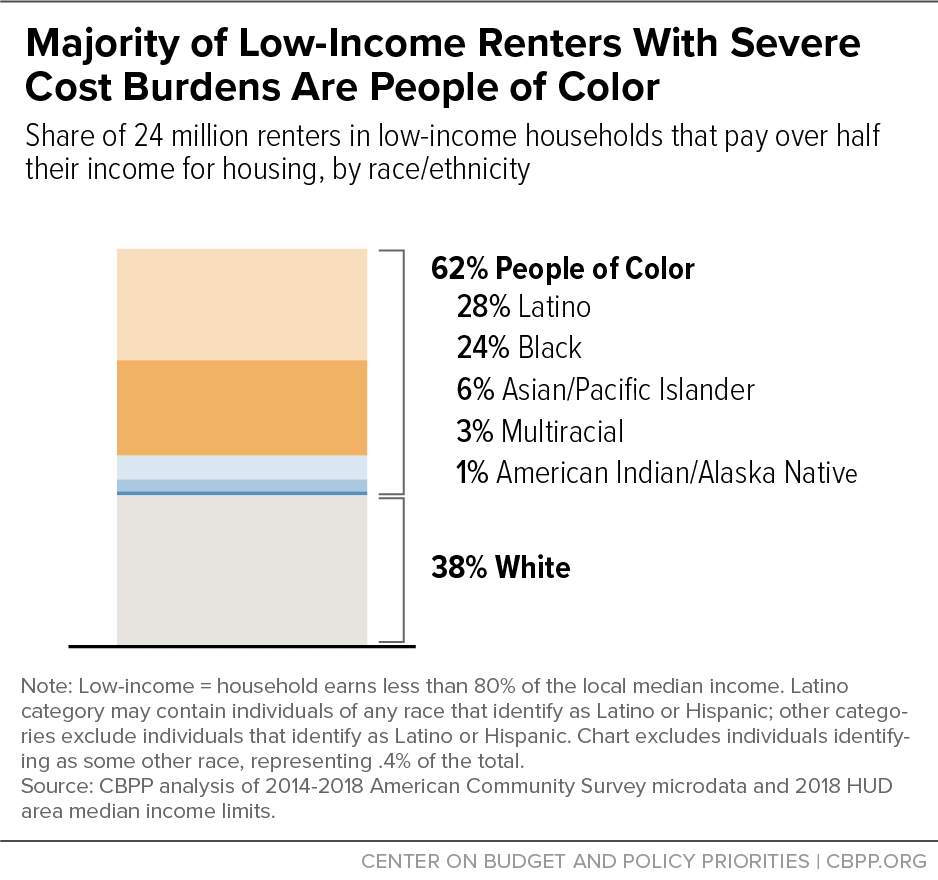
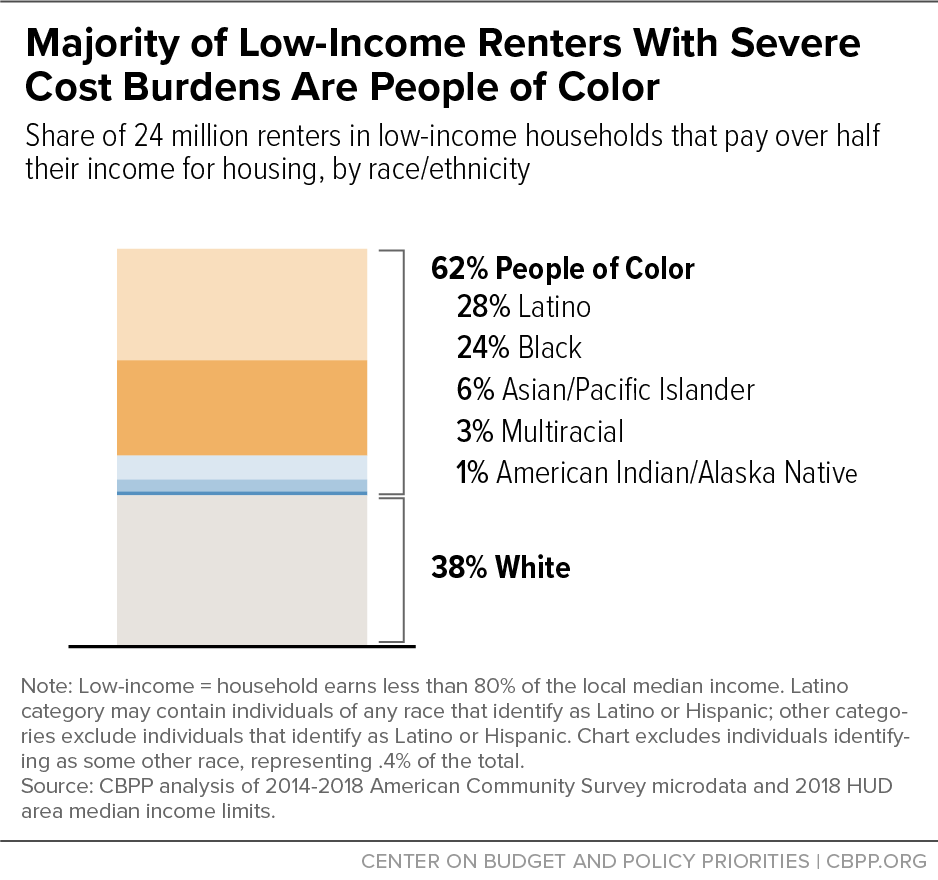
Housing affordability challenges are heavily concentrated among the lowest-income people and people of color. (See Figure 1.) Of 11.2 million renter households with severe cost burdens in 2018 — that is, they paid more than half of their income for housing — nearly all (99 percent) had low incomes, which the Department of Housing and Urban Development (HUD) defines as no higher than 80 percent of the local median. And close to three-fourths had extremely low incomes (up to the federal poverty line or 30 percent of the local median, whichever is higher). Many people cannot afford housing at all; 580,000 people experienced homelessness on a single night in January 2020. Due to a long history of racism — including racially discriminatory housing policies[1] — Black, Latino, and Native American people are disproportionately likely to face severe rent burdens and to experience homelessness.[2]
The low-income households that struggle to afford housing include large numbers of seniors, people with disabilities, and children. Because many jobs do not pay enough to enable workers to afford housing, and because housing costs have outpaced income growth,[3] some 5.7 million working renter households — nearly 1 in 5 of all working renter households — paid over half their income for housing in 2018.[4]
While media discussion of high housing costs sometimes focuses on coastal cities, difficulty affording housing is widespread across the United States among households with extremely low incomes. For example, in every state and each of the 50 largest metropolitan areas, some 56 to 86 percent of extremely low-income households pay more than half their income for housing, one analysis found.[5]
While housing affordability is a severe problem with far-reaching consequences, it’s one we know how to address. Housing Choice Vouchers and other federal rental assistance programs are highly effective at reducing homelessness, housing instability, and overcrowding. Unfortunately, these programs only reach about 1 in 4 eligible families due to funding limitations. This shortfall is one of the biggest gaps in the nation’s economic support system[6] and causes families with pressing housing needs to face long waiting lists, sometimes years long, to receive vouchers.
Inadequate Housing Safety Net Left Many Vulnerable to Pandemic and Slowed Nation’s Response
The inadequacy of the housing safety net left many people with low incomes vulnerable to the COVID-19 pandemic, as crowding and housing instability made it more difficult to maintain social distancing.[7] Latino people and non-Latino Black and Native American people are over three times more likely to be hospitalized due to COVID-19 compared to non-Latino white people, and COVID-19 deaths are disproportionately high for people of color,[8] outcomes that likely result in part from disparities in housing conditions. The pandemic has also hit hard among people living in congregate settings and institutions, including many low-income people with disabilities and seniors.[9]
In addition, the economic crisis caused many renters to lose jobs or earnings, making it more difficult or impossible for them to afford rent. These job and work hour losses fell most heavily on workers in low-wage industries and on people of color, who face long-standing inequities often stemming from structural racism in education and employment. Both groups were already more likely to struggle to afford housing.[10] By January 2021, an estimated 15.1 million adults living in rental housing — more than 1 in 5 adult renters — were not caught up on rent.[11] People who struggled to pay rent during the crisis included disproportionately high shares of people of color, renters with low incomes, and renters who had experienced a decrease in income.[12]
The response to housing needs during the crisis was slow and inadequate. Because the number of families with vouchers and other federal rental assistance is capped by available funding and because that funding doesn’t automatically expand to meet growing needs, large numbers of households were left waiting for policymakers to enact emergency rental assistance programs. Local, state, and federal eviction moratoriums have prevented many — though not all — families from losing their homes, but most families are still required to pay their rent and they accumulate debt if they can’t. Federal lawmakers provided some rental assistance funds in the March 2020 CARES Act, but did not enact large-scale funding for emergency rental assistance until late December 2020 — more than nine months after severe job losses began — with additional amounts included in the March 2021 American Rescue Plan Act.[13]
This assistance will make a crucial difference for many struggling renters, enabling them to pay down rental debt, cover future rent and utility payments, and in many cases avoid eviction when moratoriums are lifted. But the price of the slow response was hardship and stress for many months and for many people. Many in crowded homes, shelters, and institutional care settings were unnecessarily exposed to the coronavirus, contributing to preventable loss of life.
Moreover, the rental assistance that policymakers ultimately enacted falls short of the full amount needed to help people with low incomes afford housing. Because it is temporary, it won’t address the underlying problem where many people struggled to afford rent before the pandemic and will continue to struggle in its wake. And we won’t be prepared for the next crisis unless policymakers build on these emergency measures with more durable action to strengthen the nation’s system to help low-income people afford housing. That action should include making vouchers available to many more — and ultimately all — people who need them.
Vouchers Reduce Homelessness and Housing Instability Substantially, Improve Children’s Outcomes
Federal rental assistance — and especially Housing Choice Vouchers, the largest rental assistance program — offers a proven, evidence-based tool that could be scaled up to help people struggling to afford housing and prepare the nation for future crises. Vouchers help more than 2 million low-income households afford decent, stable housing, usually by helping them rent a modest unit of their choice in the private market. The family pays about 30 percent of its income for rent and utilities, a widely used standard for the amount a household can reasonably be expected to pay for housing. And the voucher covers the rest, up to a cap based on HUD estimates of typical market rents in the local area.[14]
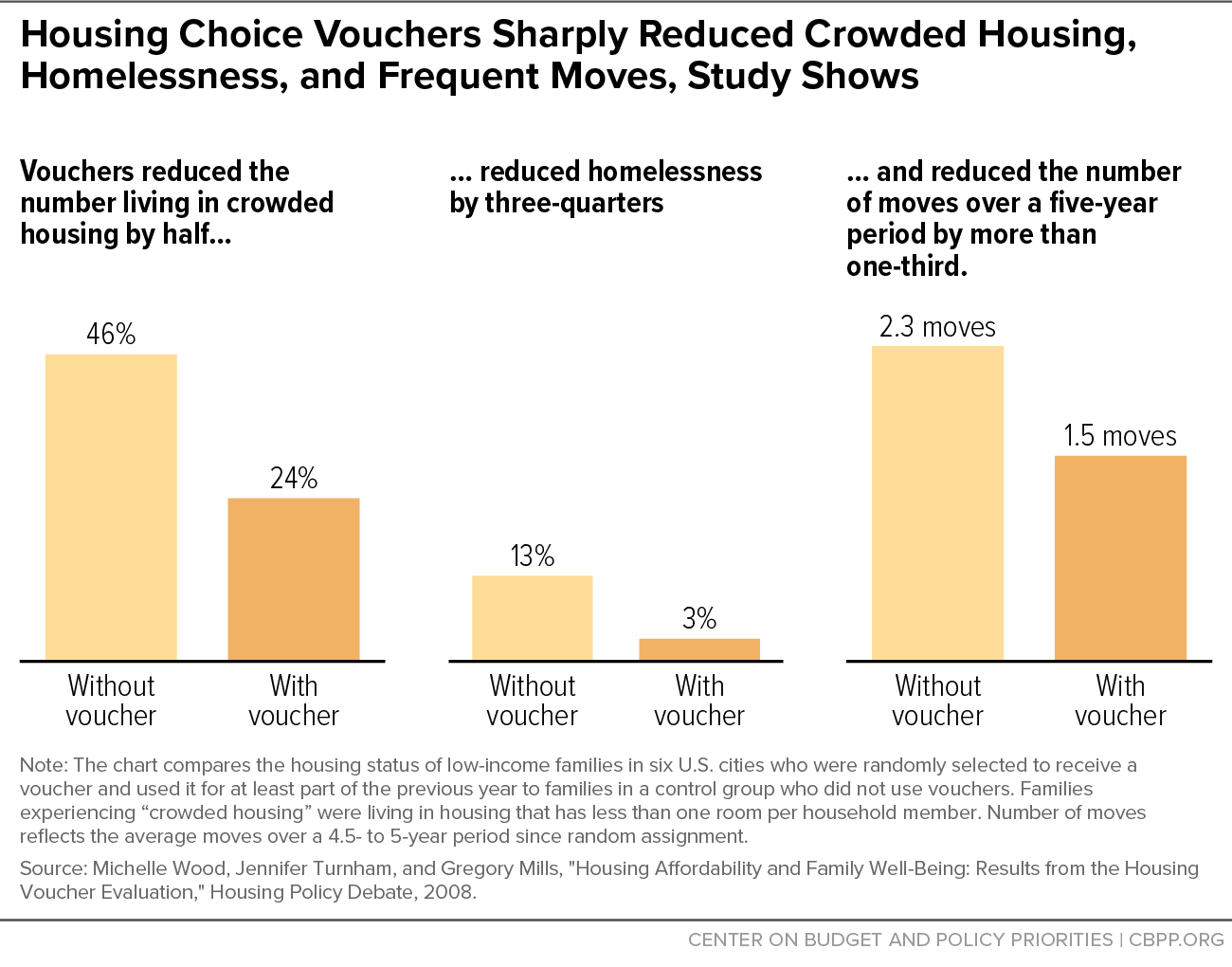
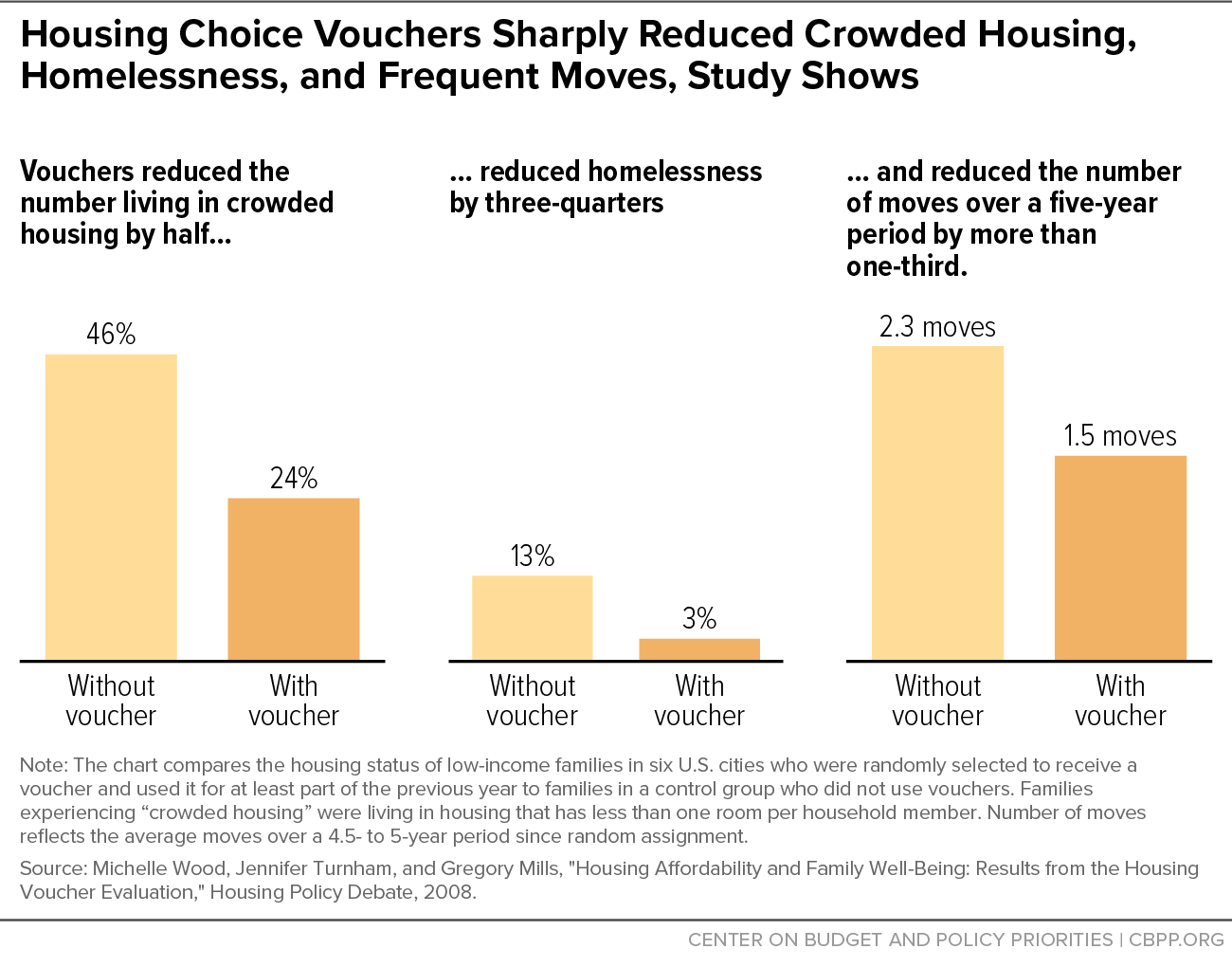
Vouchers are highly effective at helping low-income people afford adequate, stable housing. Rigorous research shows that vouchers sharply reduce homelessness, housing instability, and overcrowding.[15] (See Figure 2.) Stable housing has cascading benefits in other parts of the lives of low-income people. For example, children whose families were homeless and receive vouchers to rent housing change schools less frequently, are less likely to be placed in foster care, experience fewer sleep disruptions and behavioral problems, and are likelier to exhibit positive social behaviors such as offering to help others or treating younger children kindly, compared to a control group.[16] By lowering rental costs, vouchers also allow low-income people to spend more on other basic needs like food and medicine,[17] as well as on goods and services that enrich their children’s development.[18]
Vouchers can also play a critical role in advancing racial equity, since the housing problems they address are disproportionately concentrated among people of color. More than two-thirds of households participating in the voucher program are headed by a person of color.[19]
Vouchers have major additional benefits when they enable families to move to lower-poverty neighborhoods if they choose. A rigorous long-term study found that children whose families used vouchers to move from high- to low-poverty neighborhoods — which often have better-resourced, higher-performing schools — had substantially higher adult earnings and rates of college attendance and lower rates of single parenthood as young adults than similar children whose families stayed in poor neighborhoods.[20] Adults in these families experienced improved mental health, and lower rates of diabetes and extreme obesity, outcomes researchers concluded may stem in part from reduced stress due to reduced exposure to crime.[21]
Black children in families with below-poverty incomes that use vouchers are twice as likely to live in low-poverty neighborhoods compared to Black children overall in families with incomes below the poverty line — a significant outcome, since discrimination in housing and other areas has limited Black households’ access to lower-poverty communities.[22] Promising research indicates that well-designed services and supports can make vouchers much more effective than they are now at broadening housing choice.[23]

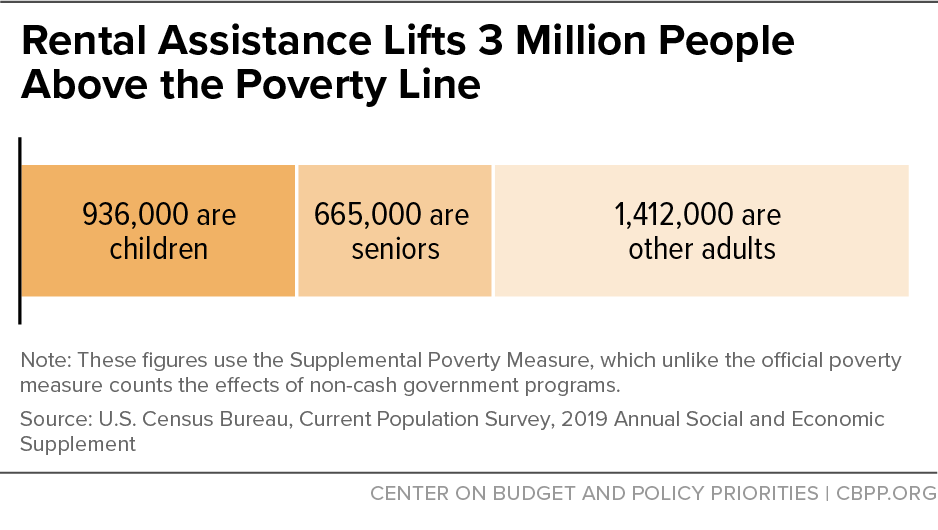
Vouchers are highly effective at helping not just families with children but people in a wide range of demographic groups. Targeted vouchers for veterans without homes played a central role in reducing veteran homelessness over the last decade.[24] And in 2018 vouchers and other federal rental assistance lifted 665,000 seniors above the poverty line, more than any other program except Social Security.[25] (See Figure 3.)
When combined with support services, rental assistance is highly effective at reducing homelessness among individuals with serious mental illness[26] and people with substance use disorders,[27] rigorous studies show. More broadly, vouchers are essential to helping people with disabilities and chronic health conditions (including mental and behavioral health conditions) to live independently in the community rather than in institutional settings.
Expanding Vouchers Would Help Struggling Renters and Better Prepare Nation for Future Crises
While vouchers deliver major benefits to millions of people nationwide, they could do much more if they were made available to the millions who are eligible but go without assistance due to inadequate funding. Among those who could benefit most would be the 24 million people in low-income renter households who pay more than half of their income for rent and utilities, including 8 million children, 3 million seniors, and 4 million people with disabilities.[28] (See Appendix tables 1 and 2 for data by state.) The recovery package that policymakers will consider should include a major voucher expansion, with the ultimate goal of making vouchers an entitlement — that is, available to every eligible household.
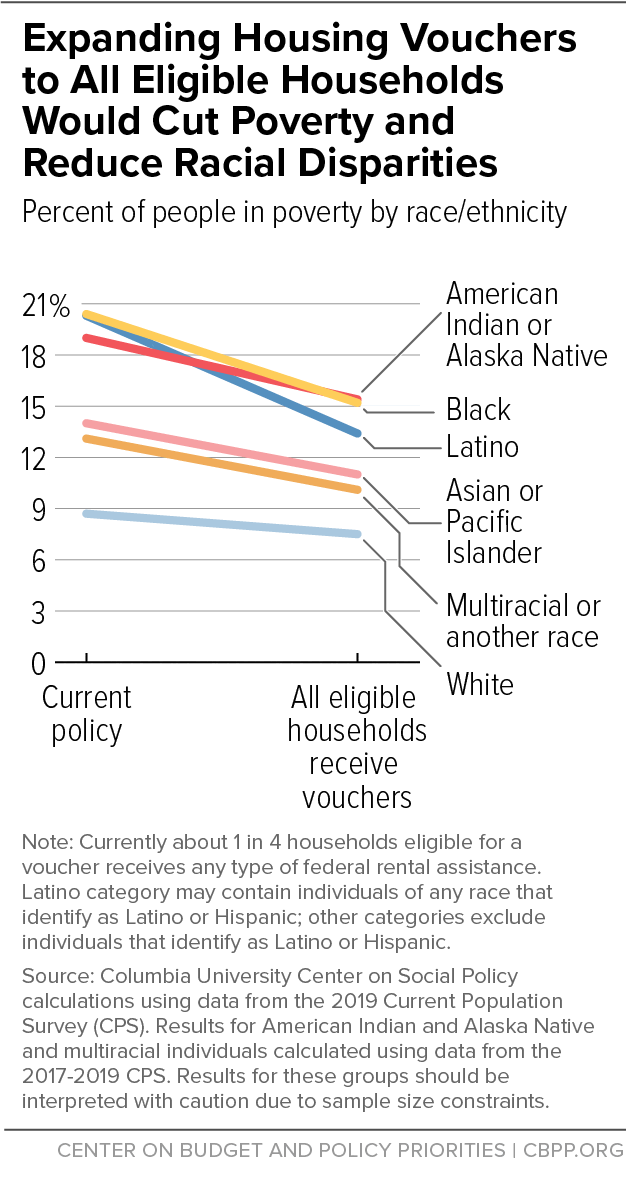
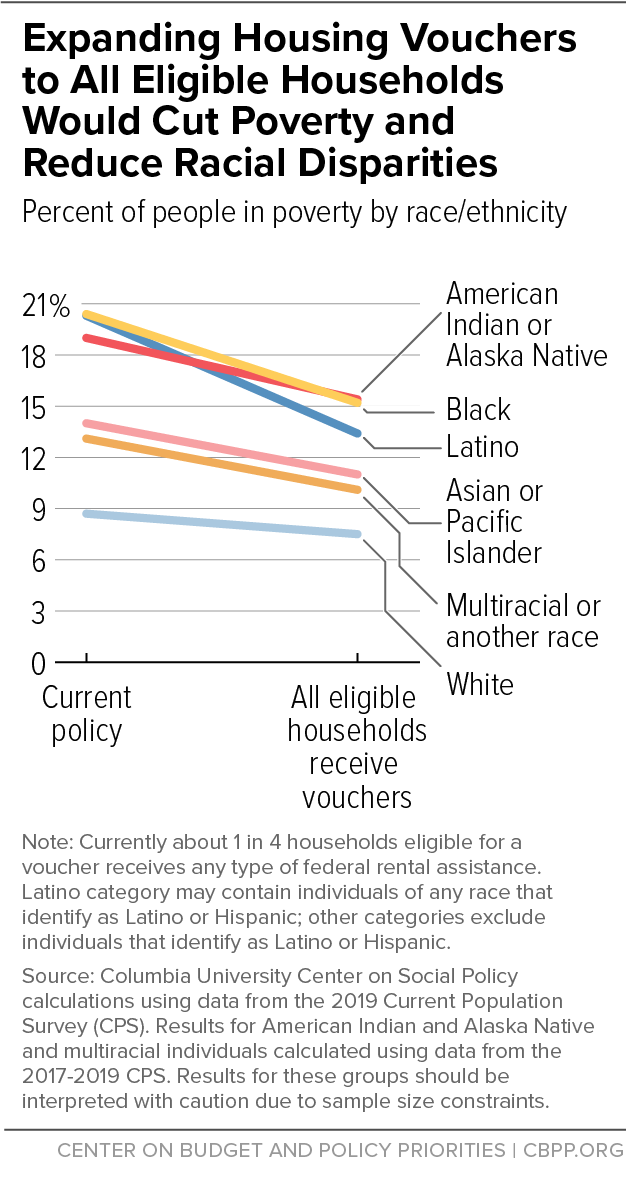
One study estimated that giving all eligible households vouchers would lift 9.3 million people above the poverty line and cut the child poverty rate by a third, as well as lower the gap in poverty rates between white and Black households by over a third and between white and Hispanic households by nearly half.[29] (See Figure 4.) If vouchers were available to many additional people, homelessness, housing instability, and crowding would also become far less common.
Voucher Expansion Should Be Phased In, Backed by Mandatory Funding
The voucher program could not be expanded to reach all (or even most) eligible households overnight, since it would take time for housing agencies to build administrative capacity and for rental markets to absorb the vouchers. But lawmakers could enact legislation expanding the program over time until it reaches everyone who is eligible. The Congressional Budget Office estimated in 2015 that phasing in a voucher entitlement over a ten-year period would help 8 million additional households and cost $410 billion, which would be $460 billion today after adjusting for inflation. It is possible that because of competing priorities policymakers will not be able to phase in a full entitlement through a recovery package, but even addressing a large share of the unmet need would do a great deal to reduce hardship for the nation’s lowest-income people.
To achieve a major expansion of the voucher program, policymakers would almost certainly need to change its funding mechanism. Today vouchers receive “discretionary” funding; lawmakers determine the funding level each year in appropriations bills. By contrast many federal programs — including most of the largest programs that help households with low incomes meet basic needs — receive “mandatory” funding set at levels determined by ongoing laws rather than by annual appropriations.
In the near term, policymakers should increase discretionary funding to provide vouchers to more families. The President’s 2022 budget request, commendably, includes funds for 200,000 new vouchers, and Congress should agree to this request. But it would be very hard to achieve a major, multiyear voucher expansion using discretionary funding. Congress and the President would have to go back and approve the increases each year in the phase-in period. It is quite difficult to plan for significant and sustained program increases of this magnitude through funding decisions made each year. Mandatory appropriations, on the other hand, would enable lawmakers to decide how much they wanted to invest in housing vouchers over a five- or ten-year period and enact a single law funding the program at those levels over the entire phase-in period. (They could still pass another law to make any needed adjustments later.)
Mandatory funding would also be essential to enabling the voucher program to expand automatically when people need more help. When workers using vouchers lose their jobs or see their hours cut, the voucher subsidy must grow to cover the wider gap between the market rent and the rent the worker can afford. When many workers lose earnings at once, as during a recession, mandatory funding could increase automatically to cover the added cost. And if ultimately everyone eligible for a voucher can receive one, then when the number of households eligible for help rises — as would also typically occur during a recession — the program can automatically adjust to the higher need. (This is how programs like SNAP and Medicaid generally work.)
Vouchers Essential for Housing Supply Investments to Reach Those in Need
While voucher expansion is the single most important step policymakers can take to help families afford housing, it is also important that they increase funding to build and rehabilitate affordable housing. A recovery package should, for example, include large-scale supplemental funding for renovation of existing public housing,[30] and for the National Housing Trust Fund (with the bulk of funds to expand housing options for people experiencing homelessness), and the Indian Housing Block Grant. The Administration proposed these types of investments in the American Jobs Plan announced on March 31, calling for $213 billion to build or renovate affordable housing — including $40 billion specifically for public housing. [31]
But only funding “supply-side” investments without adequately expanding vouchers will almost certainly leave out a large share of the families who most need help to afford housing, and will also risk constraining the housing choices available to low-income people, people of color, and people with disabilities. Although the Administration has not yet put forward its full plan to achieve the President’s goal of making vouchers available to all who are eligible, the Administration acknowledged the importance of making significant investment in vouchers in its fiscal year 2022 discretionary funding request, which includes funding for 200,000 new vouchers.
Voucher expansion will be crucial to efforts to address affordable housing needs. Vouchers alone will enable most households that need rental assistance to afford stable, adequate housing, without any supply-side investment to construct new units. In much of the country, rental markets are relatively soft, the number of housing units is generally adequate, and the primary housing problem facing low-income people is affordability of rent (driven mostly by the operating costs of units and debt service, not a hot housing market) and utility costs.[32] And most households that receive vouchers use them in the unit where they already live, allowing them to afford the rent without diverting resources from other basic needs and protecting them from eviction if their earnings drop or they face unexpected expenses (such as car repairs or a higher-than-expected utility bill).[33] Research has shown that vouchers are a more efficient way to reduce low-income families’ rents than programs that build new affordable housing when there is adequate supply, so providing vouchers to families for which a voucher is sufficient will usually be more cost effective than spending the same amount on construction subsidies.[34]
Supply-side investments do have an important role to play. In tight housing markets where the number of housing units is inadequate to meet demand, policymakers should make more units available through added subsidies for affordable housing construction (and through measures to reduce regulatory barriers to development, which the Biden jobs plan would also encourage). Funding for rehabilitation can also improve energy efficiency and upgrade housing that is unsafe or unhealthy. In addition, supply-side investments can make units available to assist particular populations, for example by increasing the number of units accessible to people with disabilities. And in some cases they can provide access to neighborhoods where it would otherwise be difficult for people with low incomes to rent homes.
But, unless a household also receives a voucher or other similar ongoing rental assistance, construction subsidies rarely produce housing with rents that are affordable for households with incomes around or below the poverty line. (These households make up most of the renters confronting severe housing affordability challenges.) One reason for this is that these households typically can’t afford rent set at a high enough level for an owner to cover the ongoing cost of operating and managing housing.[35] Consequently, even if development subsidies pay for the full cost of building housing, rents in the new units will generally be too high for lower-income families to afford without the added, ongoing help a voucher can provide.
The largest federal affordable housing development program, the Low-Income Housing Tax Credit (LIHTC), illustrates this. LIHTC allows rents to be set up to levels affordable to families with incomes at 60 percent of the local median, more than 200 percent of the poverty line in many areas. LIHTC developments house many families with incomes around or below the poverty line, but nearly all of those families either pay high shares of their income for rent or receive a voucher or similar rental assistance that enables them to afford the unit.[36] If policymakers expand LIHTC or other development subsidies but do not adequately expand rental assistance, there will be a serious risk that many of the families that struggle most to keep a roof over their heads will not be able to afford the new homes.
In addition, vouchers are essential to ensuring the federal housing investments allow low-income people to choose where they live. A housing investment package focused solely on development would limit the housing choices available to low-income renters (who are disproportionately people of color). Those families would receive help to rent a particular unit but would usually have to give up their subsidy if they need to move elsewhere (for example, to be close to a job opportunity, to a relative who can act as a caregiver, or to a school they would like their child to attend). Tying most rental subsidies to particular units would contrast sharply with subsidies like the mortgage interest deduction that help higher-income, disproportionately white households purchase homes where they choose.
This risk from limiting choice is compounded by a long history of discriminatory housing policies — reinforced by ongoing resistance to affordable housing development in many predominantly white neighborhoods[37] — which has contributed to the segregation of low-income people, especially Black families, into poorer communities with under-resourced schools and other disadvantages. It is critical that new housing investments not reinforce these patterns. One way to avoid this is to seek to locate new affordable housing developments in neighborhoods that offer residents good opportunities and quality public services. But coupling investments in affordable housing development with a major voucher expansion can help too, by making it easier for people with low incomes to move to a different neighborhood if they wish.
| APPENDIX TABLE 1 | |||||
|---|---|---|---|---|---|
Estimated Number of Low-Income Renters in Severely Cost-Burdened Households, by State | |||||
| State | Households | People | Children (Under 18) | People with disabilities | Seniors (62 and older) |
| Alabama | 153,000 | 318,000 | 110,000 | 58,000 | 27,000 |
| Alaska | 19,000 | 43,000 | 15,000 | 8,000 | 3,000 |
| Arizona | 220,000 | 496,000 | 170,000 | 77,000 | 53,000 |
| Arkansas | 88,000 | 186,000 | 65,000 | 42,000 | 17,000 |
| California | 1,684,000 | 4,203,000 | 1,351,000 | 553,000 | 479,000 |
| Colorado | 182,000 | 374,000 | 108,000 | 62,000 | 41,000 |
| Connecticut | 125,000 | 261,000 | 82,000 | 47,000 | 34,000 |
| Delaware | 26,000 | 57,000 | 18,000 | 8,000 | 5,000 |
| District of Columbia | 42,000 | 79,000 | 21,000 | 15,000 | 9,000 |
| Florida | 776,000 | 1,690,000 | 523,000 | 261,000 | 227,000 |
| Georgia | 348,000 | 790,000 | 287,000 | 123,000 | 69,000 |
| Hawai’i | 54,000 | 130,000 | 43,000 | 16,000 | 15,000 |
| Idaho | 42,000 | 83,000 | 25,000 | 17,000 | 9,000 |
| Illinois | 432,000 | 909,000 | 289,000 | 148,000 | 108,000 |
| Indiana | 194,000 | 404,000 | 135,000 | 81,000 | 39,000 |
| Iowa | 77,000 | 149,000 | 39,000 | 29,000 | 18,000 |
| Kansas | 79,000 | 156,000 | 48,000 | 34,000 | 19,000 |
| Kentucky | 134,000 | 290,000 | 103,000 | 67,000 | 24,000 |
| Louisiana | 172,000 | 367,000 | 132,000 | 62,000 | 31,000 |
| Maine | 34,000 | 60,000 | 16,000 | 18,000 | 8,000 |
| Maryland | 182,000 | 402,000 | 135,000 | 67,000 | 49,000 |
| Massachusetts | 248,000 | 499,000 | 137,000 | 101,000 | 72,000 |
| Michigan | 296,000 | 609,000 | 188,000 | 135,000 | 68,000 |
| Minnesota | 142,000 | 273,000 | 78,000 | 62,000 | 44,000 |
| Mississippi | 93,000 | 215,000 | 85,000 | 37,000 | 14,000 |
| Missouri | 177,000 | 355,000 | 113,000 | 79,000 | 38,000 |
| Montana | 29,000 | 51,000 | 13,000 | 11,000 | 7,000 |
| Nebraska | 51,000 | 99,000 | 31,000 | 20,000 | 14,000 |
| Nevada | 114,000 | 240,000 | 76,000 | 46,000 | 31,000 |
| New Hampshire | 34,000 | 62,000 | 16,000 | 16,000 | 11,000 |
| New Jersey | 317,000 | 727,000 | 239,000 | 111,000 | 99,000 |
| New Mexico | 64,000 | 135,000 | 46,000 | 25,000 | 13,000 |
| New York | 973,000 | 2,143,000 | 637,000 | 347,000 | 318,000 |
| North Carolina | 328,000 | 695,000 | 229,000 | 124,000 | 72,000 |
| North Dakota | 22,000 | 38,000 | 8,000 | 7,000 | 6,000 |
| Ohio | 377,000 | 761,000 | 253,000 | 173,000 | 85,000 |
| Oklahoma | 109,000 | 228,000 | 79,000 | 47,000 | 22,000 |
| Oregon | 155,000 | 311,000 | 88,000 | 69,000 | 41,000 |
| Pennsylvania | 404,000 | 804,000 | 237,000 | 184,000 | 110,000 |
| Rhode Island | 41,000 | 82,000 | 24,000 | 18,000 | 12,000 |
| South Carolina | 148,000 | 303,000 | 101,000 | 56,000 | 30,000 |
| South Dakota | 23,000 | 44,000 | 13,000 | 9,000 | 7,000 |
| Tennessee | 204,000 | 441,000 | 157,000 | 90,000 | 38,000 |
| Texas | 850,000 | 1,951,000 | 716,000 | 282,000 | 179,000 |
| Utah | 58,000 | 140,000 | 49,000 | 21,000 | 11,000 |
| Vermont | 17,000 | 29,000 | 6,000 | 8,000 | 5,000 |
| Virginia | 247,000 | 550,000 | 179,000 | 87,000 | 56,000 |
| Washington | 238,000 | 493,000 | 148,000 | 99,000 | 61,000 |
| West Virginia | 48,000 | 98,000 | 30,000 | 23,000 | 7,000 |
| Wisconsin | 168,000 | 322,000 | 91,000 | 73,000 | 48,000 |
| Wyoming | 14,000 | 26,000 | 7,000 | 5,000 | 3,000 |
| Total U.S. | 11,052,000 | 24,171,000 | 7,789,000 | 4,158,000 | 2,806,000 |
Notes: Low income = household earns less than 80% of the local median income. Severely cost-burdened = household pays more than 50% of their monthly income on rent and utilities. Figures are rounded to the nearest 1,000 and may not sum to totals due to rounding. People with disabilities include individuals of all ages. The American Community Survey (ACS) considers respondents to have a disability if they report at least one of six disability types included in the survey. For more detail on the six disability types see: https://www.census.gov/topics/health/disability/guidance/data-collection-acs.html Source: CBPP analysis of 2014-2018 ACS microdata and 2018 HUD area median income limits. | |||||
| APPENDIX TABLE 2 | |||||||
|---|---|---|---|---|---|---|---|
Estimated Number and Share of Low-Income Renters in Severely Cost-Burdened Households, by State and Race/Ethnicity | |||||||
| State | Total People | American Indian/Alaska Native | Asian/Pacific Islander | Black | Latino | Multiracial | White |
| Alabama | 318,000 | 0% | 1% | 52% | 7% | 2% | 37% |
| Alaska | 43,000 | 15% | 7% | 8% | 14% | 7% | 47% |
| Arizona | 496,000 | 4% | 3% | 8% | 43% | 3% | 38% |
| Arkansas | 186,000 | 1% | 2% | 35% | 9% | 3% | 52% |
| California | 4,203,000 | 0% | 11% | 9% | 50% | 3% | 26% |
| Colorado | 374,000 | 1% | 4% | 8% | 34% | 4% | 50% |
| Connecticut | 261,000 | 0% | 4% | 19% | 39% | 3% | 35% |
| Delaware | 57,000 | N/A | 3% | 37% | 19% | 3% | 36% |
| District of Columbia | 79,000 | N/A | 3% | 67% | 12% | 1% | 16% |
| Florida | 1,690,000 | 0% | 2% | 26% | 37% | 2% | 32% |
| Georgia | 790,000 | 0% | 3% | 52% | 14% | 3% | 28% |
| Hawai’i | 130,000 | N/A | 30% | 3% | 20% | 17% | 30% |
| Idaho | 83,000 | 1% | 1% | N/A | 18% | 3% | 75% |
| Illinois | 909,000 | 0% | 6% | 36% | 21% | 2% | 35% |
| Indiana | 404,000 | 0% | 3% | 27% | 11% | 4% | 55% |
| Iowa | 149,000 | N/A | 5% | 12% | 11% | 3% | 67% |
| Kansas | 156,000 | 1% | 4% | 17% | 18% | 5% | 56% |
| Kentucky | 290,000 | 0% | 2% | 18% | 7% | 4% | 69% |
| Louisiana | 367,000 | 0% | 1% | 59% | 7% | 2% | 30% |
| Maine | 60,000 | 2% | 1% | 6% | 3% | 6% | 82% |
| Maryland | 402,000 | 0% | 5% | 45% | 17% | 4% | 29% |
| Massachusetts | 499,000 | 0% | 9% | 13% | 28% | 3% | 46% |
| Michigan | 609,000 | 1% | 3% | 37% | 6% | 4% | 49% |
| Minnesota | 273,000 | 3% | 6% | 24% | 12% | 4% | 52% |
| Mississippi | 215,000 | N/A | 1% | 64% | 3% | 2% | 29% |
| Missouri | 355,000 | 0% | 2% | 29% | 6% | 4% | 58% |
| Montana | 51,000 | 12% | 2% | N/A | 5% | 3% | 78% |
| Nebraska | 99,000 | 2% | 3% | 17% | 18% | 4% | 55% |
| Nevada | 240,000 | 1% | 5% | 20% | 35% | 4% | 34% |
| New Hampshire | 62,000 | N/A | 4% | 4% | 10% | 3% | 80% |
| New Jersey | 727,000 | 0% | 7% | 22% | 39% | 2% | 29% |
| New Mexico | 135,000 | 10% | 1% | 3% | 56% | 2% | 28% |
| New York | 2,143,000 | 0% | 10% | 21% | 34% | 2% | 31% |
| North Carolina | 695,000 | 1% | 2% | 40% | 14% | 3% | 39% |
| North Dakota | 38,000 | 14% | N/A | N/A | 5% | 3% | 71% |
| Ohio | 761,000 | 0% | 3% | 32% | 7% | 5% | 53% |
| Oklahoma | 228,000 | 8% | 2% | 18% | 13% | 9% | 49% |
| Oregon | 311,000 | 1% | 5% | 5% | 20% | 6% | 63% |
| Pennsylvania | 804,000 | 0% | 4% | 23% | 19% | 3% | 50% |
| Rhode Island | 82,000 | N/A | 4% | 8% | 30% | 3% | 53% |
| South Carolina | 303,000 | 0% | 1% | 48% | 9% | 3% | 38% |
| South Dakota | 44,000 | 24% | 3% | 4% | 9% | 3% | 56% |
| Tennessee | 441,000 | 0% | 1% | 37% | 10% | 3% | 49% |
| Texas | 1,951,000 | 0% | 4% | 23% | 46% | 2% | 25% |
| Utah | 140,000 | 2% | 6% | 4% | 25% | 3% | 60% |
| Vermont | 29,000 | N/A | N/A | N/A | N/A | 2% | 87% |
| Virginia | 550,000 | 0% | 5% | 34% | 16% | 4% | 41% |
| Washington | 493,000 | 1% | 8% | 9% | 19% | 7% | 55% |
| West Virginia | 98,000 | N/A | 2% | 10% | 2% | 4% | 82% |
| Wisconsin | 322,000 | 1% | 4% | 23% | 12% | 4% | 56% |
| Wyoming | 26,000 | N/A | N/A | N/A | 18% | 5% | 73% |
| Total U.S. | 24,171,000 | 1% | 6% | 24% | 28% | 3% | 38% |
Notes: Low income = household earns less than 80% of the local median income. Severely cost-burdened = household pays more than 50% of their monthly income on rent and utilities. N/A indicates that reliable data are not available due to small sample size. Latino category may contain individuals of any race that identify as Latino or Hispanic; other categories exclude individuals that identify as Latino or Hispanic. Source: CBPP analysis of 2014-2018 American Community Survey microdata and 2018 HUD area median income limits. | |||||||
End Notes
[1] Richard Rothstein, The Color of Law: A Forgotten History of How Government Segregated America, Liveright, 2017.
[2] Meghan Henry et al., “The 2020 Annual Homeless Assessment Report (AHAR) to Congress,” U.S. Department of Housing and Urban Development, January 2021, https://www.huduser.gov/portal/sites/default/files/pdf/2020-AHAR-Part-1.pdf.
[3] Erik Gartland, “2019 Income-Rent Gap Underscores Need for Rental Assistance, Census Data Show,” Center on Budget and Policy Priorities, September 18, 2020, https://www.cbpp.org/blog/2019-income-rent-gap-underscores-need-for-rental-assistance-census-data-show.
[4] Joint Center for Housing Studies of Harvard University, “America’s Rental Housing 2020,” Appendix Table W-2, https://www.jchs.harvard.edu/americas-rental-housing-2020 “Working” is defined here as having been employed for at least one week during the prior 12 months.
[5] See appendices A and B in Andrew Aurand et al., “The Gap: A Shortage of Affordable Homes,” National Low-Income Housing Coalition, March 2021, https://reports.nlihc.org/sites/default/files/gap/Gap-Report_2021.pdf.
[6] Douglas Rice, Stephanie Schmit, and Hannah Mathews, “Child Care and Housing: Big Expenses With Too Little Help Available,” Center on Budget and Policy Priorities and Center for Law and Social Policy, April 26, 2019, https://www.cbpp.org/research/housing/child-care-and-housing-big-expenses-with-too-little-help-available.
[7] Emily A. Benfer et al, “Eviction, Health Inequity, and the Spread of COVID-19: Housing Policy as a Primary Pandemic Mitigation Strategy,” Journal of Urban Health, December 7, 2020, https://papers.ssrn.com/sol3/papers.cfm?abstract_id=3736457.
[8] Centers for Disease Control and Prevention (CDC), “COVID-19 Racial and Ethnic Health Disparities,” updated December 10, 2020, https://www.cdc.gov/coronavirus/2019-ncov/community/health-equity/racial-ethnic-disparities/index.html.
[9] Kaiser Family Foundation, “State COVID-19 Data and Policy Actions,” February 12, 2021, https://www.kff.org/coronavirus-covid-19/issue-brief/state-covid-19-data-and-policy-actions/#long-term-care-cases-deaths.
[10] Chad Stone and Matt Saenz, “Labor Market Weaker Than Headline Numbers Suggest,” Center on Budget and Policy Priorities, March 1, 2021, https://www.cbpp.org/research/economy/labor-market-weaker-than-headline-numbers-suggest.
[11] Claire Zippel, “Hardship Remains High, Latest Census Data Show,” Center on Budget and Policy Priorities, January 27, 2021, https://www.cbpp.org/blog/hardship-remains-high-latest-census-data-show.
[12] Center on Budget and Policy Priorities, “Struggling Families and Economy Need Robust, Bipartisan COVID Relief Agreement,” December 16, 2020, https://www.cbpp.org/research/economy/struggling-families-and-economy-need-robust-bipartisan-covid-relief-agreement.
[13] Douglas Rice and Ann Oliva, “Housing Assistance in American Rescue Plan Act Will Prevent Millions of Evictions, Help People Experiencing Homelessness,” Center on Budget and Policy Priorities, March 11, 2021, https://www.cbpp.org/research/housing/housing-assistance-in-american-rescue-plan-act-will-prevent-millions-of-evictions.
[14] Center on Budget and Policy Priorities, “Policy Basics: The Housing Choice Voucher Program,” updated April 12, 2021, https://www.cbpp.org/research/housing/the-housing-choice-voucher-program.
[15] Will Fischer, Douglas Rice, and Alicia Mazzara, “Research Shows Rental Assistance Reduces Hardship and Provides Platform to Expand Opportunity for Low-Income Families,” Center on Budget and Policy Priorities, December 5, 2019, https://www.cbpp.org/research/housing/research-shows-rental-assistance-reduces-hardship-and-provides-platform-to-expand.
[16] Daniel Gubits et al., “Family Options Study: 3-Year Impacts of Housing and Services Interventions for Homeless Families,” prepared for Department of Housing and Urban Development, October 2016, https://www.huduser.gov/portal/sites/default/files/pdf/Family-Options-Study-Full-Report.pdf.
[17] Fischer, Rice, and Mazzara, op. cit.
[18] Sandra J. Newman and C. Scott Holupka, “Housing affordability and investments in children,” Journal of Housing Economics, June 2014, https://www.sciencedirect.com/science/article/abs/pii/S1051137713000600.
[19] CBPP analysis of U.S. Department of Housing and Urban Development data.
[20] Raj Chetty, Nathaniel Hendren, and Lawrence Katz, “The Effects of Exposure to Better Neighborhoods on Children: New Evidence from the Moving to Opportunity Experiment,” American Economic Review, April 2016, pp. 855-902. (This study was first released in 2015, see http://www.equality-of-opportunity.org/images/mto_paper.pdf.)
[21] Jeffrey R. Kling et al., “Experimental Analysis of Neighborhood Effects,” Econometrica, January 2007; Lisa Sanbonmatsu et al., “Moving to Opportunity for Fair Housing Demonstration Program: Final Impacts Evaluation,” prepared for Department of Housing and Urban Development, November 2011, https://www.huduser.gov/portal/publications/pdf/MTOFHD_fullreport_v2.pdf.
[22] Barbara Sard et al., “Federal Policy Changes Can Help More Families with Housing Vouchers Live in Higher-Opportunity Areas,” Center on Budget and Policy Priorities, September 4, 2018, https://www.cbpp.org/research/housing/federal-policy-changes-can-help-more-families-with-housing-vouchers-live-in-higher.
[23] Peter Bergman et al., “Creating Moves to Opportunity: Experimental Evidence on Barriers to Neighborhood Choice,” National Bureau of Economic Research, August 2019, https://www.nber.org/papers/w26164.
[24] Douglas Rice, “Budget Exposes Trump Administration’s Empty Rhetoric on Homelessness, Fair Housing,” Center on Budget and Policy Priorities, February 18, 2020, https://www.cbpp.org/blog/budget-exposes-trump-administrations-empty-rhetoric-on-homelessness-fair-housing.
[25] Calculations use the federal government’s Supplemental Poverty Measure which, unlike the standard poverty measure, counts non-cash benefits as well as cash. Liana Fox, “The Supplemental Poverty Measure: 2018,” U.S. Census Bureau, October 2019, https://www.census.gov/content/dam/Census/library/publications/2019/demo/p60-268.pdf. This Census report estimates that another program, Supplemental Security Income (SSI), lifted 526,000 seniors above the poverty line in 2018. The data used for the report underreport benefits from some government programs and therefore understate their effect on poverty. Estimates that adjust for this underreporting are not yet available for 2018, but are likely to show SSI having an impact on poverty that is closer to — and conceivably above — the impact of rental assistance.
[26] Michael S. Hurlburt, Patricia A. Wood, and Richard L. Hough, “Providing Independent Housing for the Homeless Mentally Ill: A Novel Approach to Evaluating Long-Term Housing Patterns,” Journal of Community Psychology, Vol. 24, No. 3, 1996, https://onlinelibrary.wiley.com/doi/abs/10.1002/%28SICI%291520-6629%28199607%2924%3A3%3C291%3A%3AAID-JCOP8%3E3.0.CO%3B2-%23.
[27] Robert Rosenheck et al., “Cost-effectiveness of Supported Housing for Homeless Persons With Mental Illness,” Archives of General Psychiatry, September 2003, https://jamanetwork.com/journals/jamapsychiatry/fullarticle/207801; Maria J. O’Connell, Wesley Kasprow, and Robert A. Rosenheck, “Rates and Risk Factors for Homelessness After Successful Housing in a Sample of Formerly Homeless Veterans,” Psychiatric Services, Vol. 59, No. 3, March 2008, https://ps.psychiatryonline.org/doi/full/10.1176/ps.2008.59.3.268.
[28] These data are based on the American Community Survey, which considers respondents to have a disability if they report at least one of six disability types included in the survey: hearing difficulty, vision difficulty, cognitive difficulty, ambulatory difficulty, self-care difficulty, and independent living difficulty. Note that the federal government applies different definitions of disability for other purposes, such as for determining eligibility for Social Security Disability Insurance and non-discrimination protections under the Americans with Disabilities Act.
[29] Sophie Collyer et al., “Housing Vouchers and Tax Credits: Pairing the Proposals to Transform Section 8 with Expansions to the EITC and Child Tax Credit Could Cut the National Poverty Rate by Half,” Columbia University Center on Poverty and Social Policy, October 7, 2020, https://static1.squarespace.com/static/5743308460b5e922a25a6dc7/t/5f7dd00e12dfe51e169a7e83/1602080783936/Housing-Vouchers-Proposal-Poverty-Impacts-CPSP-2020.pdf.
[30] Will Fischer, Sonya Acosta, and Anna Bailey, “An Agenda for the Future of Public Housing,” Center on Budget and Policy Priorities, March 11, 2021, https://www.cbpp.org/research/housing/an-agenda-for-the-future-of-public-housing.
[31] The Biden jobs plan also calls for an expansion of Project-Based Rental Assistance (PBRA), which helps families afford housing in particular developments through long-term contracts with private owners. PBRA can help the lowest-income families afford housing, but so far the Administration has not indicated how much added PBRA funding it is proposing so it is not clear how many families would be helped. In addition, PBRA has significant shortcomings compared to vouchers, since it only assists families living in designated developments and generally requires them to give up their rental assistance if they wish to move somewhere else.
[32] Close to two-thirds of the nation’s population lives in counties where rental vacancy rates from 2014-2018 averaged more than 5 percent (which is often used as a benchmark to separate low-vacancy markets from high-vacancy ones). CBPP analysis of Census Bureau data.
[33] For example, one study of the impact of vouchers on families with children in six cities found that about one-third of families with vouchers would have been homeless or doubled up without the voucher and about two-thirds would have been renting their own unit. Gregory Mills et al., “Effects of Housing Vouchers on Welfare Families,” prepared for Department of Housing and Urban Development Office of Policy Development and Research, September 2006, https://www.huduser.gov/portal//Publications/pdf/hsgvouchers_1_2011.pdf
[34] Edgar O. Olsen, “The Cost-Effectiveness of Alternative Methods of Delivering Housing Subsidies,” University of Virginia, 2009, http://economics.virginia.edu/sites/economics.virginia.edu/files/papers/CESurvey2009.pdf; U.S. General Accounting Office, “Federal Housing Assistance: Comparing the Characteristics and Costs of Housing Programs,” January 2002, https://www.gao.gov/assets/240/233652.pdf.
[35] The average extremely low-income renter household had an income of $11,139 in 2018 and 30 percent of that amount would cover $280 a month for rent and utility costs. Many households — including those most at risk of homelessness — have much lower incomes and can afford even less in rent. But in 2019 the average market rental unit’s operating cost was $520 a month (and over $580 when the owner pays for utilities), according to National Apartment Association data. Paula Munger and Leah Cuffy, “Strong Performance to Close Record Economic Expansion: 2020 NAA Survey of Operating Income and Expenses in Rental Apartment Communities,” National Apartment Association, October 2020, https://www.naahq.org/sites/default/files/2020_ies_exec_summary_final.pdf.
[36] Megan Bolton, Elina Bravve, and Sheila Crowley, Aligning Federal Low-Income Housing Programs with Housing Need, National Low Income Housing Coalition, December 2014, https://nlihc.org/sites/default/files/Alignment_Report_1214.pdf; Katherine M. O’Regan and Keren M. Horn, “What Can We Learn About the Low-Income Housing Tax Credit Program by Looking at the Tenants?” Housing Policy Debate, Vol. 23, No. 3, 2013, https://www.tandfonline.com/doi/abs/10.1080/10511482.2013.772909.
[37] Katherine Levine Einstein, Maxwell Palmer, and David Glick, “Racial Disparities in Housing Politics: Evidence from Administrative Data,” Boston University, August 29, 2018, https://maxwellpalmer.com/research/racial_disparities_in_housing_politics.pdf; Jonathan Rothwell, “Land Use Politics, Housing Costs, and Segregation in California Cities,” Terner Center for Housing Innovation, September 2019, http://californialanduse.org/download/Land%20Use%20Politics%20Rothwell.pdf.