

The Housing Choice Voucher Program
Created in the 1970s, the “Section 8” Housing Choice Voucher Program is the nation’s largest source of rental assistance.
What Is the Housing Choice Voucher Program?
Individuals and families with low incomes use Housing Choice Vouchers to help pay for units they rent in privately owned housing. The program is federally funded and run by the Department of Housing and Urban Development (HUD) and a network of about 2,100 state and local public housing agencies.
Who Is Eligible for Vouchers?
Federal rules ensure that vouchers are targeted to the families who need them most. Seventy-five percent of new households admitted to the program each year must have “extremely low incomes,” defined as incomes up to the poverty line or 30 percent of the local median, whichever is higher. Other new households may have incomes up to 80 percent of the local median.
Housing agencies may set admissions preferences based on housing need or other criteria. Families that include a member whose immigration status makes them ineligible for housing vouchers can receive prorated assistance based on the number of family members who are eligible.
Most households with vouchers that can reasonably be expected to work, do work. In 2024, 65 percent of non-elderly, non-disabled households using vouchers were working or had worked recently.
How Does a Family Use a Voucher?
Once a family receives a voucher, it has at least 60 days to find housing, and housing agencies can extend that period. A family can use a voucher to help pay the rent for its current unit or a new unit. In either case, the housing agency must verify that the unit meets federal housing quality standards and that the rent is reasonable compared to market rents for similar units in the area.
A family with a voucher generally must contribute the higher of 30 percent of its income or a minimum rent of up to $50 for rent and utilities. The voucher covers the rest of those costs up to a limit (called a payment standard) set by the housing agency. The payment standard is based on HUD’s fair market rent estimates. Housing agencies may establish a higher payment standard as a reasonable accommodation for a person with a disability.

Are Vouchers Used Only to Rent Units That Tenants Select?
No. Up to 30 percent of vouchers (and more under some circumstances) can be used for subsidies — called project-based vouchers — that are tied to a particular property, rather than a particular family, and thus can help pay for the construction or rehabilitation of housing for people with low incomes. Some housing agencies may also allow families to use vouchers to help with mortgage payments, enabling them to purchase homes, although this option is not widely used.
How Are Vouchers Allocated to Housing Agencies?
Each agency has a cap on the number of vouchers it may administer. An agency’s number of “authorized vouchers” is essentially the sum of the vouchers the agency has been awarded since the start of the voucher program. Since 2003, most new vouchers that Congress has funded have been either “tenant protection” vouchers (which replace public housing that is demolished or sold, or other affordable housing units that lose federal subsidies) or “special purpose” vouchers (which are set aside for particular types of households, such as veterans experiencing homelessness or youth leaving foster care).
How Are Vouchers Funded?
Congress annually provides funding for vouchers through the appropriations process. Most agencies receive voucher renewal funding each year, based on the number and cost of the authorized vouchers in use during the prior year, adjusted for inflation. If Congress provides less renewal funding than agencies are due, each agency’s funding is reduced proportionately.
Funding for new vouchers and administrative costs is provided separately. Agencies participating in the Moving to Work demonstration are funded through special formulas.
How Effective Are Vouchers?
Research shows that vouchers sharply reduce homelessness and other hardships. They also give families more choices about where to live, including by expanding access to neighborhoods with more resources. These effects, in turn, are closely linked to educational, developmental, and health benefits that can improve adults’ well-being and children’s long-term outcomes, while reducing costs in other public programs.
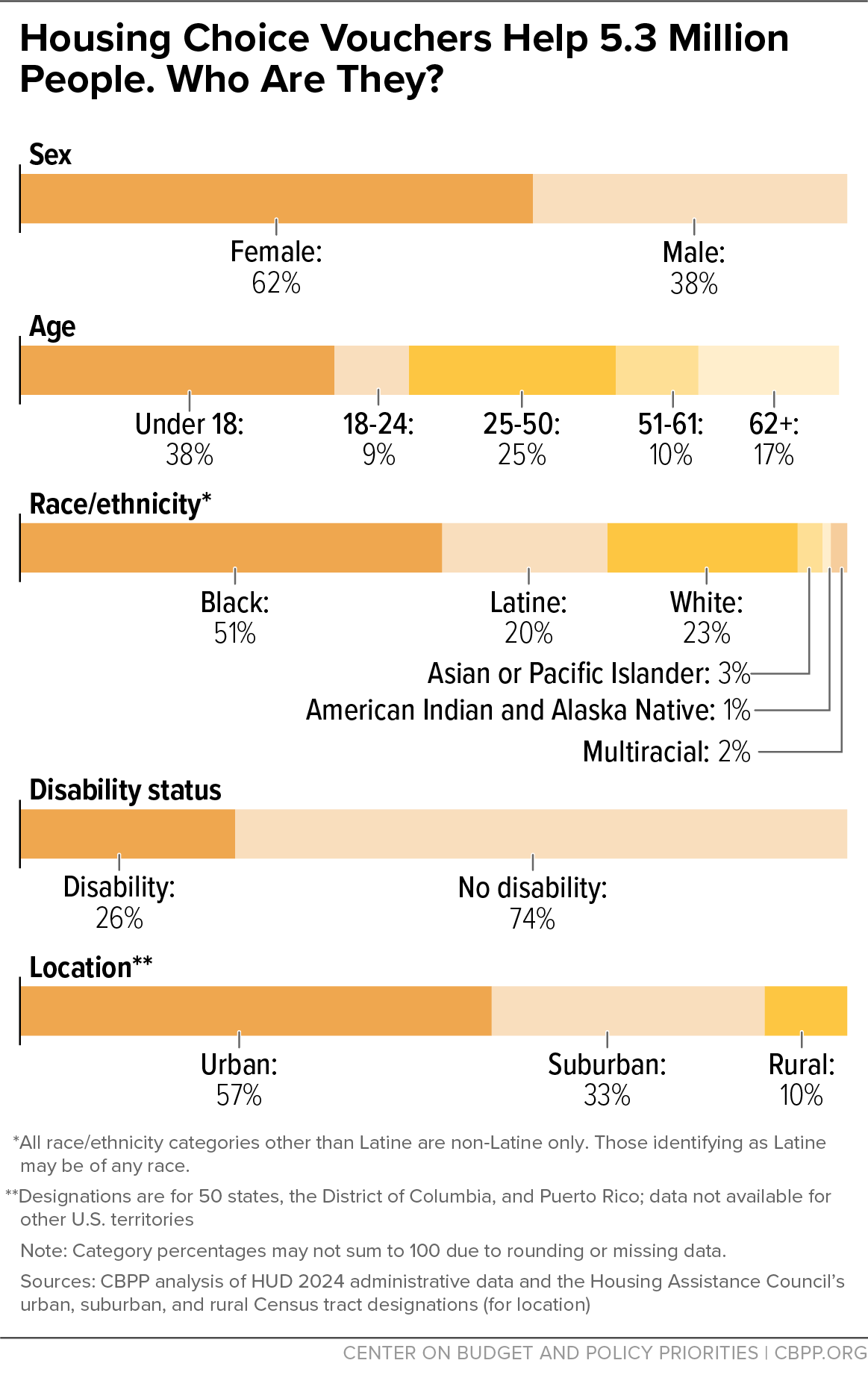
Moreover, vouchers enable more than 900,000 older adults and 1.4 million people with disabilities to live independently.