

House Republican Reconciliation Bill Would Harm Rural Households, Communities, and Economies
The House Republican reconciliation bill now before the Senate would harm rural households by taking away health coverage and food assistance to help finance tax cuts skewed toward the wealthy. Rural communities would be hurt as well, with local hospitals at greater risk of closure due to the loss of federal funding and local retailers facing a decline in business due to families’ loss of support. Thus, the bill — which President Trump has urged the Senate to pass — continues the pattern under this Administration of hurting the people the President pledged to help.[1]
The House bill would cut nearly $300 billion from the Supplemental Nutrition Assistance Program (SNAP) and cut at least $800 billion from Medicaid and the Affordable Care Act (ACA) marketplaces.[2] It would extend the expiring 2017 tax cuts, which provide the biggest gains to the wealthy, but would not extend the expiring enhanced premium tax credits, which help families afford marketplace coverage. Considering the bill as a whole, households with the lowest incomes would end up worse off relative to current law — they would lose significantly more from the cuts in health care and food assistance than they would gain from the tax cuts — while the wealthiest households would be better off, according to the Congressional Budget Office.[3]

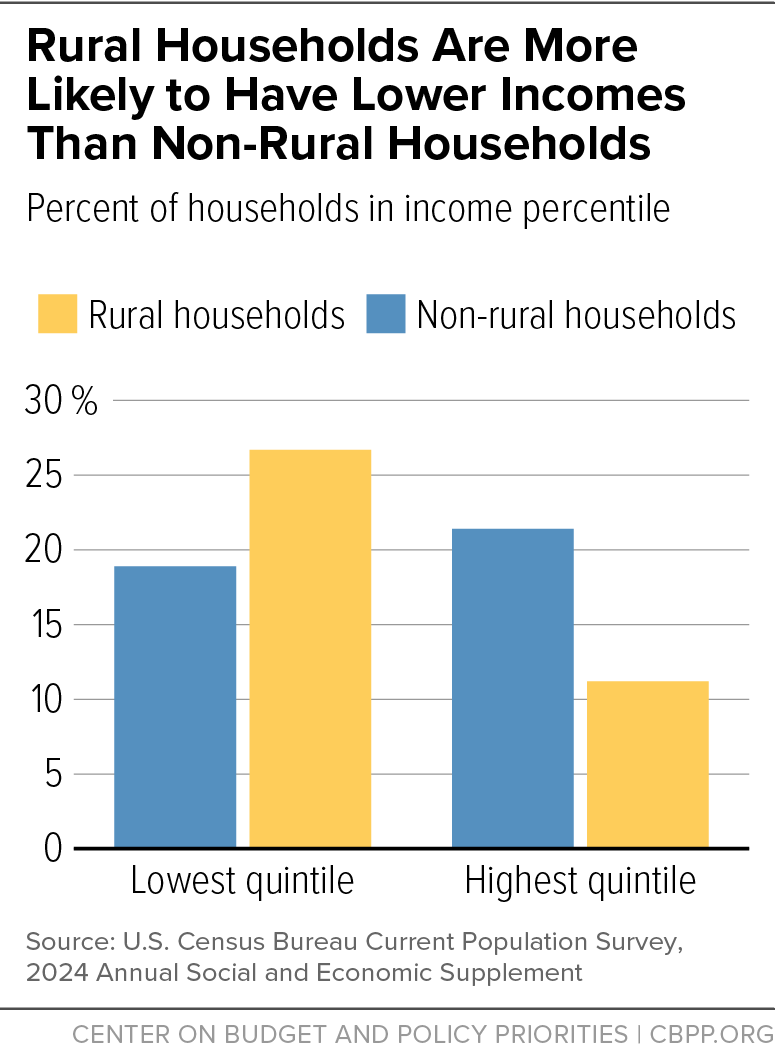
The bill would hurt rural communities disproportionately because rural residents have lower incomes and higher levels of material hardship, on average, and are more likely to receive health coverage through Medicaid and food assistance through SNAP. Households in rural areas are over-represented at the lower end of the income spectrum and under-represented at the top. (See Figure 1.) The House bill — with its tax cuts tilted to the top and its cuts in Medicaid and SNAP — would worsen these inequities.
Cuts to Health Care, Food Assistance Would Harm Rural Households
The House bill’s massive cuts in Medicaid and SNAP — the largest in the programs’ histories — would create serious challenges for the many rural residents who need help affording the essentials, like food and health care. Loss of health care or food assistance, whether due to work requirements or other changes in the House bill (such as shifting SNAP benefit costs to states, as described below), would increase the breadth and depth of poverty and hardship among rural residents, including children.
Uninsured rates in rural areas have fallen substantially under the ACA, as millions of rural residents have obtained coverage through Medicaid and the ACA marketplaces. More than 12 million rural residents — including 47 percent of children in rural areas — receive health care through Medicaid, which financed nearly half of all births in rural areas in 2023.[4] And about 3 million marketplace enrollees in the 32 states using HealthCare.gov in 2024 lived in rural areas.[5] When someone loses health care, they lose access to preventive and primary care (including preventive care visits that are crucial to children’s healthy growth and development), management of chronic conditions such as diabetes, and care for life-threatening conditions such as cancer. They also risk being driven into medical debt — a leading cause of financial hardship in rural areas[6] — and bankruptcy.
Some 6.6 million rural residents receive food assistance through SNAP.[7] SNAP participation rates are higher in rural areas (14.3 percent) than in metro areas (11.9 percent).[8] When people lose food assistance, they may be forced to skip meals or otherwise eat less because they don’t have enough money to afford groceries. Here, too, the damage can be long lasting; studies show food insecurity harms children’s health, development, and performance in school.[9]
Work Requirements Especially Harmful in Rural Areas
A key way the House bill would take away Medicaid and SNAP is by imposing harsh new work requirements for Medicaid and expanding already harsh work requirements for SNAP, which would take health coverage or food assistance away from people who can’t document that they are working or should qualify for an exemption. Research has shown that work requirements don’t improve employment; instead they terminate help to people who need it, including many who are working or should be exempt but get caught in bureaucratic red tape.[10]
Work requirements can be particularly harmful in rural communities, where unemployment is higher and jobs are often farther away and harder to reach.[11] Among other changes, the House bill would make it harder for states to exempt a rural community from SNAP work requirements when jobs there are scarce. Rural areas also have less robust public transportation systems and limited high-speed internet access, which can create barriers to gaining employment.
In addition, the majority of employment in rural areas is in the service sector,[12] where work hours are often uncertain and volatile.[13] Rural workers would risk losing health coverage or food assistance if they are unable to get enough work hours consistently to meet the bill’s stringent requirements.
Rural residents are also older than metro residents, on average, and older adults can face particular challenges maintaining steady employment, including health challenges. The House bill would subject many older adults through age 64 to work requirements in both Medicaid and SNAP.
Rural Economies Would Also Suffer
Widespread loss of health coverage and food assistance in rural areas would have damaging ripple effects across local economies.
The House bill’s Medicaid cuts, for example, would make it harder for rural hospitals and other health care providers to provide primary and acute care for their communities, affecting everyone, including people with private coverage. In recent decades, it’s become more challenging for these providers to stay afloat due to the declining rural population, lower incomes among rural residents, and lower levels of private insurance. Large cuts in Medicaid would reduce their revenue while increasing the number of uninsured patients they serve. These hospitals are often the only source of emergency, preventive, and specialized care (including obstetric and gynecological care) in rural areas; losing these services would create conditions for further population and economic decline.[14]
The bill’s SNAP cuts, by making it harder for SNAP participants in rural areas to buy groceries, would also hurt the retailers that serve them, which range from national retail chains to small, locally owned businesses, such as private groceries, convenience stores, and farm stands. For small businesses, SNAP is an important revenue source — particularly in higher-poverty areas, where SNAP purchases can account for a significant share of a retailer’s total sales. One analysis found that rural counties make up 77 percent of all counties where retailers are at greatest risk of harm from SNAP cuts due to their high SNAP participation and low number of SNAP retailers.[15]
Regressive Tax Cuts Would Do Little for Most Rural Households
The House bill would extend the expiring provisions of the 2017 tax law, which are heavily tilted to the wealthiest households, while adding new tax cuts on top, including for wealthy heirs and businesses. Families with low or moderate incomes would receive relatively little — the lowest-earning fifth of households, for example, would gain just $90, compared to nearly $65,000 for the top 1 percent — and the bill’s large cuts in Medicaid and SNAP would more than offset those small gains.[16] Given that rural households have lower incomes, this combination of high-end tax cuts and cuts in assistance would disproportionately harm rural communities.
President Trump’s sweeping tariffs will impose further burdens on rural residents. The tariffs will increase prices of imported goods; Wal-Mart and Best Buy, two major national chains that many rural households frequent, have already announced plans to raise prices.[17] Tariffs will also harm the agricultural sector of the economy, raising the prices that farmers must pay for inputs, such as machinery, and sparking retaliatory tariffs that will likely reduce demand for U.S. exports, a major income source for the sector.
End Notes
[1] Sharon Parrott, “Trump’s Budget Plan Continues Agenda of Hurting Those He Pledged to Help,” CBPP, May 2, 2025, https://www.cbpp.org/press/statements/trumps-budget-plan-continues-agenda-of-hurting-those-he-pledged-to-help.
[2] Katie Bergh, Dottie Rosenbaum, and Wesley Tharpe, “House Reconciliation Bill Proposes Deepest SNAP Cut in History, Would Take Food Assistance Away From Millions of Low-Income Families,” CBPP, May 28, 2025, https://www.cbpp.org/research/food-assistance/house-reconciliation-bill-proposes-deepest-snap-cut-in-history-would-take; Allison Orris et al., “House Republican Health Agenda Cuts Coverage, Raises People’s Costs,” CBPP, updated May 29, 2025, https://www.cbpp.org/research/health/house-republican-health-agenda-cuts-coverage-raises-peoples-costs.
[3] Congressional Budget Office, “Preliminary Analysis of the Distributional Effects of the One Big Beautiful Bill Act,” May 20, 2025, https://www.cbo.gov/publication/61422.
[4] Scott Hulver et al., “5 Key Facts About Medicaid and Hospitals,” KFF, March 5, 2025, https://www.kff.org/medicaid/issue-brief/5-key-facts-about-medicaid-and-hospitals/.
[5] KFF, “HealthCare.gov Marketplace Plan Selections by Rural Status,” 2025, https://www.kff.org/affordable-care-act/state-indicator/healthcare-gov-marketplace-plan-selections-by-rural-status-2/.
[6] Consumer Financial Protection Bureau, “Data Spotlight: Challenges in Rural Banking Access,” April 2022, https://files.consumerfinance.gov/f/documents/cfpb_data-spotlight_challenges-in-rural-banking_2022-04.pdf.
[7] Mia Monkovic, “Characteristics of Supplemental Nutrition Assistance Program Households: Fiscal Year 2022,” Food and Nutrition Service, Office of Policy Support, U.S. Department of Agriculture, June 2024, https://fns-prod.azureedge.us/sites/default/files/resource-files/ops-snap-fy22-characteristics.pdf.
[8] American Community Survey, U.S. Census Bureau, “Food Stamps/Supplemental Nutrition Assistance Program,” 2023, https://data.census.gov/table/ACSST1Y2023.S2201?q=s2201&g=010XXC0US_010XXH0US.
[9] Danielle Gallegos et al., “Food Insecurity and Child Development: A State-of-the-Art Review,” International Journal of Environmental Research and Public Health, Vol. 18, No. 17, August 26, 2021, https://pmc.ncbi.nlm.nih.gov/articles/PMC8431639/.
[10]Katie Bergh, Catlin Nchako, and Luis Nuñez, “Worsening SNAP’s Harsh Work Requirement Would Take Food Assistance Away From Millions of Low-Income People,” CBPP, April 30, 2025, https://www.cbpp.org/research/food-assistance/worsening-snaps-harsh-work-requirement-would-take-food-assistance-away; Lauren Harker, “Pain But No Gain: Arkansas’ Failed Medicaid Work-Reporting Requirements Should Not Be a Model,” CBPP, August 8, 2023, https://www.cbpp.org/research/health/pain-but-no-gain-arkansas-failed-medicaid-work-reporting-requirements-should-not-be; Gideon Lukens, “Research Note: Most Medicaid Enrollees Work, Refuting Proposals to Condition Medicaid on Unnecessary Work Requirements,” CBPP, November 12, 2024, https://www.cbpp.org/research/health/most-medicaid-enrollees-work-refuting-proposals-to-condition-medicaid-on.
[11] Emma Parker-Newton, “Medicaid Work Requirements Undermine Rural Healthcare,” National Health Law Program, April 7, 2025, https://healthlaw.org/resource/medicaid-work-requirements-undermine-rural-healthcare/.
[12] Thomas Hertz, “Service industries account for the largest share of rural and urban employment,” Economic Research Service, U.S. Department of Agriculture, March 25, 2016, https://ers.usda.gov/data-products/charts-of-note/chart-detail?chartId=78844.
[13] Elizabeth Ananat, Anna Gassman-Pines, and Olivia Howard, “Work requirements penalize workers in volatile occupations,” The Hamilton Project, May 22, 2025, https://www.hamiltonproject.org/publication/post/work-requirements-penalize-workers-in-volatile-occupations/.
[14] Carol A. Mills et al., “The impact of rural general hospital closures on communities—A systematic review of the literature,” The Journal of Rural Health, Vol. 40, Issue 2, November 20, 2023, https://onlinelibrary.wiley.com/doi/10.1111/jrh.12810.
[15] Kyle Ross and Kennedy Andara, “SNAP Cuts Are Likely To Harm More Than 27,000 Retailers Nationwide,” CAP, May 8, 2025, https://www.americanprogress.org/article/snap-cuts-are-likely-to-harm-more-than-27000-retailers-nationwide/.
[16] Brendan Duke, “How House Republican Agenda Boosts the Wealthy, Does Little (or Worse) for Low-Income Families,” CBPP, May 14, 2025, https://www.cbpp.org/blog/how-house-republican-agenda-boosts-the-wealthy-does-little-or-worse-for-low-income-families.
[17] Kathryn Palmer, “Which big retailers have signaled tariff-induced price hikes?” USA Today, updated May 23, 2025, https://www.usatoday.com/story/money/2025/05/21/raising-prices-tariffs-retail-walmart-best-buy/83745623007/.