

Worsening SNAP’s Harsh Work Requirement Would Take Food Assistance Away From Millions of Low-Income People
Families With Children, Older Adults, Veterans Among Those Who Would Be Harmed
As Republican lawmakers draft legislation to enact the deep cuts called for in their budget resolution, it appears increasingly likely that proposals to make SNAP’s existing harsh work requirement broader and more punitive will be included.[1] This could take food away from millions of people in low-income households who are struggling to find steady work or who face substantial barriers to employment, including families with children — despite some lawmakers falsely claiming this policy would not cut food assistance benefits.
Under one proposal from House Agriculture Committee member Dusty Johnson, we estimate about 6 million people would be at risk of losing their food assistance. In total, nearly 11 million people — about 1 in 4 SNAP participants, including more than 4 million children and more than half a million adults aged 65 or older and adults with disabilities — live in households that would be at risk of losing at least some of their food assistance if Rep. Johnson’s proposal were enacted.[2]
Estimates for how many people in each state and congressional district would be at risk of losing some or all of their food assistance under two of the policies included in this proposal — expanding SNAP’s work requirement to older adults up to age 65 and adults living with school-aged children — are included in the map and table below. (See Figure B and Table 1.[3])
The Congressional Budget Office (CBO) projected that many of those who would be at risk of losing their food assistance due to the Johnson proposal would indeed be cut off SNAP, estimating that 3 to 3.5 million fewer people would participate in SNAP in a typical month.[4] Because research consistently shows that SNAP’s work requirement does not increase employment or earnings, the vast majority of those losing SNAP due to the expansion of the work requirement — including older adults, parents, veterans, people experiencing homelessness, and young people who have aged out of foster care — would lose the assistance they need to afford groceries with no improvement in their job prospects or income.[5] Ending SNAP eligibility for these individuals would harm not only the adults subject to the requirement, but also the people they live with, including children and people with disabilities, by reducing food benefits for the entire household.
As damaging as these cuts would be, this proposal would yield less than half of the $230 billion in cuts the House Agriculture Committee has been instructed to make, according to CBO’s projection. That means to meet its instructions, the committee would have to combine the harsher work requirements with other harmful policies that would take food assistance away from even more people.[6]
With the risk of a recession rising and the Trump Administration’s tariff policies likely to increase the cost of groceries and other essentials, SNAP’s role in supporting people who are temporarily out of work or don’t earn enough to afford basic needs is especially critical. Taking food away from more people who don’t meet a harsh, red tape-laden work requirement or are unable to prove they qualify for an exemption would worsen food insecurity and hardship while undermining SNAP’s vital role as an economic stimulus.
SNAP’s Harsh Work Requirement Takes Food Assistance Away, Does Not Improve Employment Outcomes
Under current SNAP rules, most adults aged 18 through 54 without children in their household can receive food benefits for just three months in a three-year period unless they show compliance with a 20-hour-per-week work requirement or prove they qualify for an exemption, such as having a disability.[7]
Most SNAP participants who can work already do so or are temporarily between jobs. Among households who reported receiving SNAP at some point in 2023, included a non-disabled working-age adult, and did not include minor children, 82 percent had earnings in that year, Census data show.8] Work rates among SNAP households with working-age non-disabled adults and children are typically even higher; 91 percent of such households had earnings at some point during 2023.
Given these data, most working-age adults who receive SNAP are workers who supplement their low wages with SNAP or receive SNAP when they are temporarily out of work. Many SNAP participants work in low-paid jobs that have unpredictable hours, don’t offer benefits like paid sick leave, and are volatile, resulting in more frequent periods of joblessness.[9] (See Figure A). But finding a new job may take longer than SNAP’s three-month time limit allows, particularly in areas where jobs are scarce or during times of elevated unemployment. Looking for work does not count toward the 20-hour requirement.
Taking away food assistance through SNAP — which averages only $6.20 per person per day — when someone can’t document compliance with a work requirement will hurt workers who are between jobs, have employers who do not provide a consistent number of hours of work, or get caught up in the red tape of documenting their work hours, an inefficient and burdensome process.
Work requirements also take away food assistance from many people with disabilities because state eligibility workers without medical training don’t sufficiently screen participants for exemptions or because people are challenged by the red tape required to adequately document their health conditions. People who reported having a disability — who likely should have been exempt from the three-month time limit — lost SNAP at the same rate as people without a disability, one study found.[10]
Research using high-quality data and rigorous methodologies to isolate the causal effects of this policy consistently shows it does not increase employment or earnings.[11] Instead, its primary impact is taking food assistance away from people who are already struggling to meet their basic needs. One study found that this policy cut off more than half — 53 percent — of the people subject to it.[12]
Millions of Older Adults, Families With Children, Veterans, and Others at Risk of Losing Benefits
The Johnson proposal would dramatically expand SNAP’s punitive and ineffective three-month time limit by applying it to additional groups of people and essentially eliminating states’ long-standing ability to temporarily waive the time limit in areas with higher unemployment or insufficient jobs.
Not all people who would be newly at risk of losing food assistance would be cut off SNAP. Some would successfully document enough work hours to comply with the requirement or would be excused by their state because of a disability, pregnancy, or another exemption. But as CBO’s estimate suggests, millions of people would lose the food assistance they need to afford groceries.
Based on our analysis, the people who would be newly at risk of losing food assistance under the Johnson proposal include:
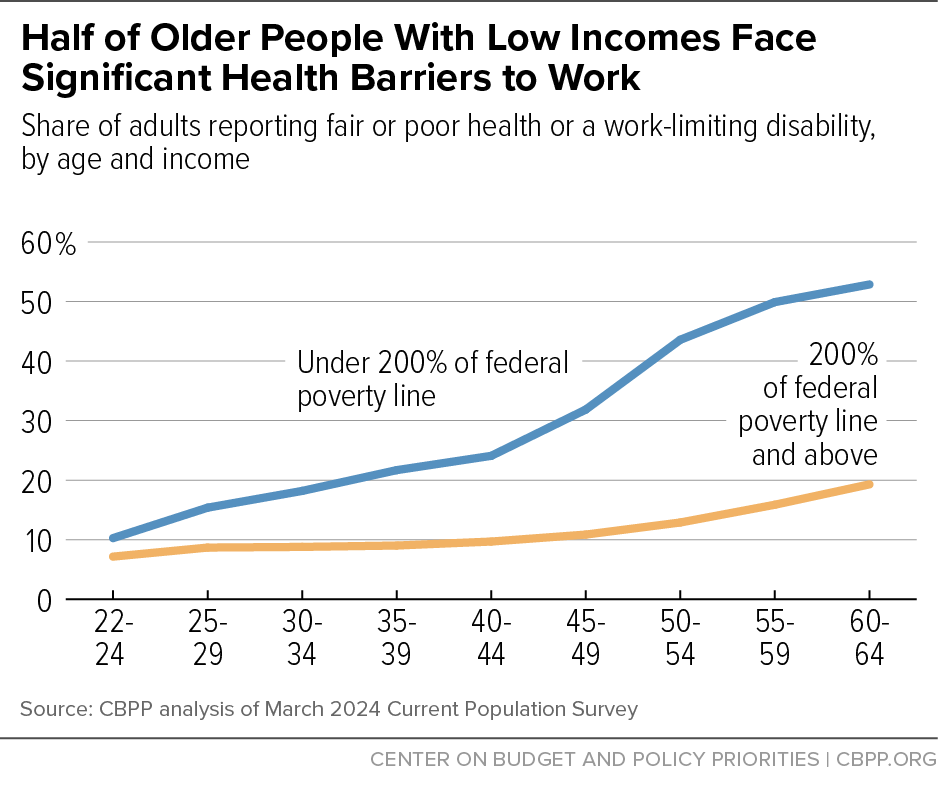
1.4 million older adults aged 55 through 64 without children in their homes. These older adults often face additional barriers to employment, such as age-related hiring discrimination, which may heighten their risk of being cut off SNAP. Additionally, more than half of low-income adults in this age range report a health barrier to work. (See Figure 1.) Estimates of how many of these 1.4 million older adults without children live in each state and congressional district are included in the map and table below. (See Figure B and Table 1).
The House Agriculture Committee Chair, Glenn “GT” Thompson, has indicated that he doesn’t support expanding the age range to “anything over 61.”[13] However, even this more limited policy would still put 1.1 million adults aged 55 through 61 at risk of being cut off SNAP.

More than 3 million adults who live with school-aged children. In addition to expanding the three-month time limit to adults up to age 65, the Johnson proposal would also impose this policy on more than 3 million adults, primarily parents and grandparents, who live with children aged 7 or older. Estimates of how many of these more than 3 million adults live in each state and congressional district are included in the map below. (See Figure B and Table 1.)
If an adult is cut off SNAP, food benefits are decreased for their entire household. As a result, the more than 4 million children aged 7 through 17 who live in these households would be at risk of living in a household without enough food assistance to feed the family.
For example, a household with a recently unemployed single parent and two school-aged children who has no current income and receives the maximum SNAP benefit would lose $232 per month in food assistance if the parent isn’t able to document steady work. After three months, the household’s benefits would drop from $768 per month to only $536, a 30 percent decrease.
Because the three-month time limit would apply to all adults in the household unless they are otherwise exempt, this proposal could harm two-parent households even more. If the family in the example above had two parents struggling to find work instead of one, the household’s benefits would drop from $975 per month to $536, a 45 percent decrease.
Veterans, people experiencing homelessness, and young people who have aged out of foster care. This proposal would impose the work requirement on veterans, people experiencing homelessness, and former foster youth by removing the current exemptions from the three-month time limit put in place until 2030 on a bipartisan basis in the Fiscal Responsibility Act of 2023. About 400,000 people in these populations are eligible for SNAP because of these exemptions, the Department of Agriculture (USDA) estimated.[14] Among the 1.2 million veterans who live in households that participate in SNAP, most do not report having a disability, are younger than 65, and do not live with children. Thus, a relatively large share could be subject to the three-month time limit under this proposal.[15]
About 1.6 million people living in areas without enough jobs. Since the creation of SNAP’s work requirement nearly 30 years ago, states have had the ability to temporarily waive the three-month time limit in areas with relatively high rates of unemployment or insufficient jobs. Over the decades, every state has used this flexibility at some point to respond to local labor market conditions.
The Johnson proposal would virtually eliminate this option, restricting waivers to individual counties where unemployment rates exceed 10 percent. Currently, only ten counties in the entire country would qualify for a waiver under this proposal. (See Figure 2.) Currently waived areas that are facing economic challenges, such as counties in eastern Kentucky hit by severe flooding or rural communities in Maine hit hard by the loss of major employers, would no longer qualify for waivers. Similarly, areas that tend to have relatively high unemployment rates but are not counties or county-equivalents, such as the currently waived areas of the Navajo Nation in Arizona and New Mexico, would no longer qualify for waivers.
Based on the share of people who are subject to the three-month time limit but live in a waived area in a typical year, about 1.6 million people would be at risk of losing food assistance due to this limit. These 18- through 54-year-olds without children in their homes would be cut off SNAP if they can’t find reliable employment after three months or secure an exemption, even though they live in an area that lacks sufficient jobs based on long-standing USDA criteria.
Substantially restricting waivers means that many people would lose food assistance for failing to comply with the work requirement even if jobs are scarce where they live. As noted above, looking for work does not count toward SNAP’s 20-hour work requirement, and many unemployed workers need more than three months to find a job even when unemployment rates are relatively low.[16]

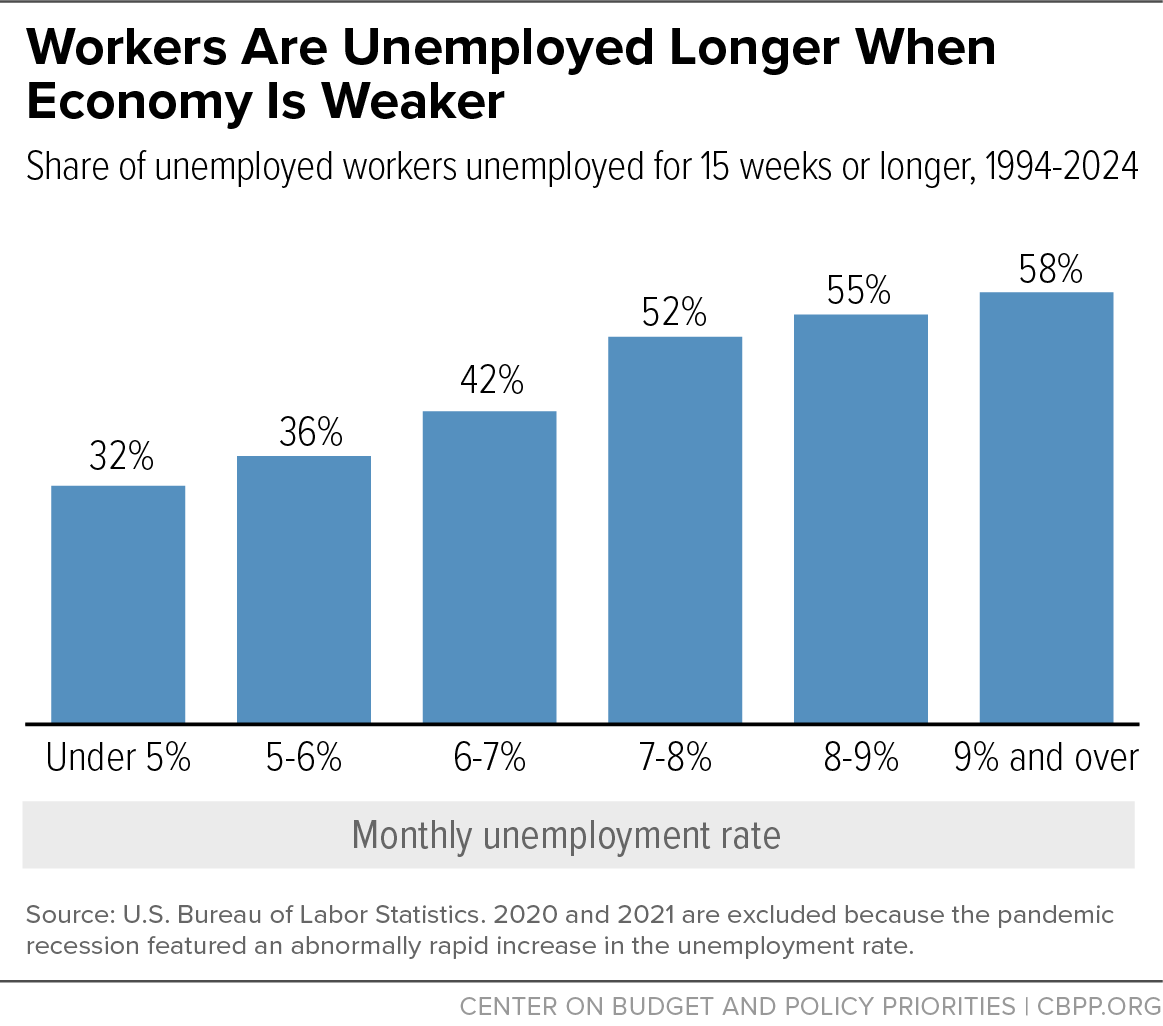
When unemployment is under 5 percent, nearly one-third of unemployed workers are out of work for 15 weeks or longer. When unemployment is above 7 percent, more than half of unemployed workers are out of work for 15 weeks or longer. (See Figure 3.) While these data represent all unemployed workers, people subject to SNAP’s harsh work requirement often face additional barriers to employment.


Economic Uncertainty Could Significantly Worsen the Impact of Expanded Work Requirement
Dramatically expanding the population subject to SNAP’s three-month time limit and curtailing states’ ability to temporarily waive this harsh policy would substantially worsen hunger and hardship even in times of relatively low unemployment. But with economic uncertainty and the risk of recession rising, now is a particularly bad time for Congress to pursue these harmful changes.
SNAP is a highly efficient and effective economic stimulus during economic downturns because low-income households quickly spend their SNAP dollars at stores in their community, bolstering local businesses and supporting jobs throughout the food supply chain. In fact, the Department of Agriculture’s Economic Research Service estimates that every $1 spent on SNAP food benefits generates $1.54 in economic activity in a weak economy.[17]
Cutting off food assistance to millions of SNAP participants if they can’t document compliance with a work requirement would increase food insecurity and hinder SNAP’s ability to stimulate the economy, particularly during recessions. Congress must reject these cuts and harmful changes to SNAP.
| TABLE 1 | ||||
|---|---|---|---|---|
Millions At Risk of Losing Food Assistance Under Proposed Expansion of SNAP’s Work Requirement Estimated average monthly number of: | ||||
| Adults at Risk of Losing SNAP: | Total People at Risk of Losing Some Amount of SNAP: | |||
| Ages 55 to 64 with no children, no disability | Ages 18 to 64 with school-age children, no disability | In households with adults ages 55 to 64 with no children, no disability | In households with adults ages 18 to 64 with school-age children, no disability | |
| Alabama | 22,000 | 54,000 | 28,000 | 137,000 |
| Alaska | 2,000 | 6,000 | 3,000 | 14,000 |
| Arizona | 37,000 | 62,000 | 44,000 | 147,000 |
| Arkansas | 8,000 | 19,000 | 11,000 | 49,000 |
| California | 201,000 | 286,000 | 243,000 | 645,000 |
| Colorado | 23,000 | 57,000 | 28,000 | 131,000 |
| Connecticut | 12,000 | 36,000 | 14,000 | 81,000 |
| Delaware | 5,000 | 11,000 | 6,000 | 31,000 |
| District of Columbia | 7,000 | 8,000 | 7,000 | 17,000 |
| Florida | 113,000 | 174,000 | 151,000 | 423,000 |
| Georgia | 50,000 | 156,000 | 58,000 | 382,000 |
| Guam | 2,000 | 3,000 | 2,000 | 8,000 |
| Hawai‘i | 7,000 | 11,000 | 8,000 | 22,000 |
| Idaho | 2,000 | 8,000 | 3,000 | 21,000 |
| Illinois | 65,000 | 164,000 | 75,000 | 397,000 |
| Indiana | 18,000 | 53,000 | 23,000 | 128,000 |
| Iowa | 10,000 | 19,000 | 11,000 | 47,000 |
| Kansas | 5,000 | 14,000 | 7,000 | 36,000 |
| Kentucky | 19,000 | 46,000 | 24,000 | 111,000 |
| Louisiana | 23,000 | 71,000 | 28,000 | 178,000 |
| Maine | 4,000 | 12,000 | 4,000 | 27,000 |
| Maryland | 26,000 | 45,000 | 29,000 | 100,000 |
| Massachusetts | 42,000 | 76,000 | 57,000 | 179,000 |
| Michigan | 39,000 | 113,000 | 52,000 | 252,000 |
| Minnesota | 11,000 | 34,000 | 14,000 | 92,000 |
| Mississippi | 8,000 | 35,000 | 10,000 | 91,000 |
| Missouri | 14,000 | 54,000 | 18,000 | 132,000 |
| Montana | 3,000 | 8,000 | 3,000 | 19,000 |
| Nebraska | 3,000 | 10,000 | 3,000 | 25,000 |
| Nevada | 19,000 | 38,000 | 22,000 | 87,000 |
| New Hampshire | 1,000 | 5,000 | 1,000 | 14,000 |
| New Jersey | 22,000 | 82,000 | 29,000 | 185,000 |
| New Mexico | 23,000 | 52,000 | 28,000 | 120,000 |
| New York | 125,000 | 221,000 | 158,000 | 512,000 |
| North Carolina | 47,000 | 127,000 | 58,000 | 317,000 |
| North Dakota | 1,000 | 4,000 | 1,000 | 11,000 |
| Ohio | 42,000 | 102,000 | 53,000 | 263,000 |
| Oklahoma | 18,000 | 54,000 | 25,000 | 131,000 |
| Oregon | 27,000 | 52,000 | 31,000 | 114,000 |
| Pennsylvania | 58,000 | 135,000 | 84,000 | 317,000 |
| Rhode Island | 4,000 | 8,000 | 4,000 | 17,000 |
| South Carolina | 17,000 | 44,000 | 22,000 | 121,000 |
| South Dakota | less than 1000 | 5,000 | 1,000 | 13,000 |
| Tennessee | 21,000 | 57,000 | 26,000 | 134,000 |
| Texas | 107,000 | 285,000 | 123,000 | 683,000 |
| Utah | 4,000 | 13,000 | 5,000 | 31,000 |
| Vermont | 2,000 | 6,000 | 3,000 | 13,000 |
| Virgin Islands | 1,000 | 3,000 | 1,000 | 6,000 |
| Virginia | 22,000 | 76,000 | 28,000 | 176,000 |
| Washington | 26,000 | 53,000 | 29,000 | 120,000 |
| West Virginia | 13,000 | 28,000 | 18,000 | 66,000 |
| Wisconsin | 26,000 | 45,000 | 30,000 | 114,000 |
| Wyoming | less than 1000 | 3,000 | less than 1000 | 7,000 |
| Total | 1,400,000 | 3,100,000 | 1,700,000 | 7,500,000 |
Note: “With school-age children” refers to households with children where all children are 7 or older. These estimates do not incorporate other proposals in H.R. 1528 that would significantly restrict states’ ability to request waivers of SNAP’s work requirement for areas with insufficient jobs and eliminate current exemptions for veterans, people experiencing homelessness, or youth who have aged out of foster care. The District of Columbia, Guam, and the Virgin Islands are considered states in SNAP. Puerto Rico, American Samoa, and the Commonwealth of the Northern Mariana Islands are not included in this table because they receive a nutrition assistance block grant in lieu of participating in SNAP. Source: State estimates based on CBPP analysis of SNAP quality control data for fiscal year 2022. | ||||
End Notes
[1] Samuel Benson and Grace Yarrow, “House Dems warn that SNAP cuts would scuttle farm bill hopes,” Politico, April 16, 2025, https://subscriber.politicopro.com/article/2025/04/house-dems-offer-ultimatum-cut-snap-and-theres-no-farm-bill-00292885.
[2] Figures here and below for the number of people at risk of losing SNAP food assistance under the bill are based on CBPP analysis of 1) the number of participants meeting the age and other characteristics of the populations that would be newly subject to the work requirement under U.S. Department of Agriculture 2022 SNAP Household Characteristics data, and 2) the number of participants potentially subject to the work requirement in areas with waivers under 7 C.F.R. 273.24(f) in a typical year. All figures are estimates of the average monthly number of participants. The number newly at risk of losing SNAP over the course of a year would be larger.
[3] See https://www.cbpp.org/sites/default/files/Congressional-district-data.pdf for table of congressional district data.
[4] See H.R. 1528 (119th) and Congressional Budget Office, “H.R. 1581, America Works Act of 2023,” September 6, 2023, https://www.cbo.gov/publication/59552.
[5] Lauren Bauer and Chloe N. East, “A primer on SNAP work requirements,” The Hamilton Project, April 2025, https://www.hamiltonproject.org/publication/paper/a-primer-on-snap-work-requirements.
[6] In 2023, CBO estimated that a nearly identical policy would save $90 billion to $120 billion over ten years, though H.R. 1528, the version introduced in 2025, could result in deeper cuts because it more significantly curtails states’ ability to waive the three-month time limit. Because any policy changes enacted in reconciliation legislation are unlikely to be implemented during the current fiscal year, we assume that House Agriculture Committee would need to meet the $230 billion target by making cuts over only nine years (2026-2034). As a result, this policy would likely result in less than half of the targeted $230 billion in savings.
[7] This policy has historically applied to adults aged 18 through 49; the age range was temporarily expanded to include adults aged 50 through 54 in the Fiscal Responsibility Act of 2023. Under current law, the expansion of the age range will end on October 1, 2030.
[8] CBPP Analysis of 2023 American Community Survey data.
[9] Joseph Llobrera and Lauren Hall, “SNAP Helps Millions of Workers in Low-Paying Jobs,” CBPP, updated July 30, 2024, https://www.cbpp.org/research/food-assistance/snap-helps-millions-of-workers-in-low-paying-jobs.
[10] Erin Brantley, Drishti Pillai, and Leighton Ku, “Association of Work Requirements With Supplemental Nutrition Assistance Program Participation by Race/Ethnicity and Disability Status, 2013-2017,” JAMA Network Open, Vol. 3, No. 6, June 2020, https://jamanetwork.com/journals/jamanetworkopen/fullarticle/2767673.
[11] Bauer and East, op cit.
[12] Colin Gray et al., “Employed in a SNAP: The Impact of Work Requirements on Program Participation and Labor Supply,” American Economic Association Journal, Vol. 15, No. 1, February 2023, https://www.aeaweb.org/articles?id=10.1257/pol.20200561.
[13] Skye Witley, “House GOP Budget Plan Tees Up Food Assistance Debate: Farm Brief,” Bloomberg Government, February 27, 2025, https://news.bgov.com/bloomberg-government-news/house-gop-budget-plan-tees-up-food-assistance-debate-farm-brief.
[14] Food and Nutrition Service, U.S. Department of Agriculture, “Supplemental Nutrition Assistance Program: Program Purpose and Work Requirement Provisions of the Fiscal Responsibility Act of 2023.” April 30, 2024, Federal Register Vol. 90, No. 84, p. 34372, https://www.govinfo.gov/content/pkg/FR-2024-04-30/pdf/2024-08338.pdf.
[15] Luiz Nuñez, “SNAP Helps 1.2 Million Veterans With Low Incomes, Including Thousands in Every State,” CBPP, updated April 2, 2025, https://www.cbpp.org/research/food-assistance/snap-helps-12-million-veterans-with-low-incomes-including-thousands-in.
[16] Brendan Duke, “Emerging Tax and Budget Bill Flunks the Rules of Fighting Recessions,” CBPP, April 24, 2025, https://www.cbpp.org/blog/emerging-tax-and-budget-bill-flunks-basic-rules-for-fighting-recessions.
[17] Patrick Canning and Brian Stacy, “The Supplemental Nutrition Assistance Program (SNAP) and the Economy: New Estimates of the SNAP Multiplier,” U.S. Department of Agriculture, July 2019, https://www.ers.usda.gov/publications/pub-details?pubid=93528.