MÁS ALLÁ DE LOS NÚMEROS
Emerging Tax and Budget Bill Flunks Basic Rules for Fighting Recessions
President Trump’s sweeping tariffs, which will put the tax rate on imported goods at its highest level since at least the 1930s, and their chaotic rollout have sparked volatility in the stock and bond markets and led many private-sector economists to warn of significantly diminished growth and a potential recession this year.
Some members of Congress have cited the rising uncertainty and deteriorating economic conditions as a reason to accelerate passage of the tax and budget bill making its way through Congress under the fast-track “reconciliation” process. But the emerging bill flunks the rules of good economic policy during a downturn. In particular, proposals to enact harsh work requirements in Medicaid and expand those in SNAP while requiring states to pay a larger share of program costs would further slow an already weak economy, as explained below.
Tariffs are a “negative supply shock” as higher prices on imported goods reduce our economy’s ability to efficiently produce goods and services. But they also serve as a negative demand shock, as the International Monetary Fund recently pointed out, since other countries retaliate by pulling back on purchases of U.S. goods while U.S. businesses and households pull back on spending because of economic uncertainty. This negative demand shock makes the economic contraction even larger than the inefficiencies the tariffs produce on their own.
The normal playbook during recessions is for policymakers to offset a demand shock by putting money in the hands of people with low or moderate incomes. That is because they are more likely than high-income people to spend it in order to meet their basic needs rather than save it, which does little to spur near-term growth to help the economy emerge from the downturn. But the emerging reconciliation bill does the opposite. By extending the expiring 2017 tax cuts, it would shower its biggest tax cuts on high-income people. Meanwhile, people with low or moderate incomes would likely be net losers due to the bill’s large cuts to Medicaid and SNAP, to say nothing of the higher prices they would face from the tariffs.
The bill also would likely fail as good anti-recessionary policy on two other grounds.
First, many Republicans in Congress have said they plan to enact harsh work requirements for Medicaid and expand SNAP’s existing work requirement in a reconciliation bill, which would take benefits away from people who cannot document they are meeting a work requirement or that they meet complicated exemption criteria. Most working-age adults who get health coverage from Medicaid or nutrition assistance from SNAP are already working or temporarily between jobs. And the empirical evidence shows that the requirements do not increase the share of recipients who are employed.
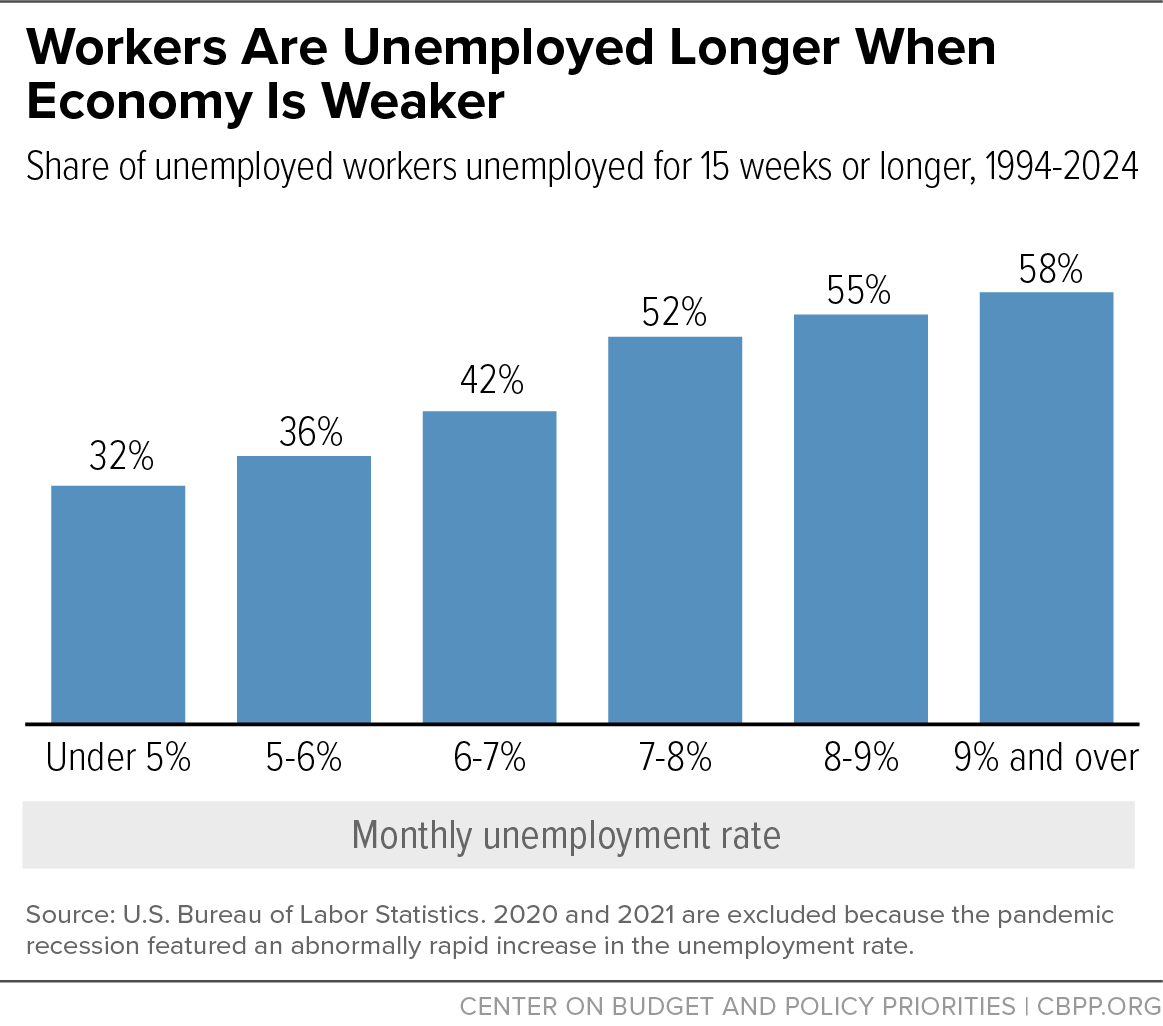
During a recession, when unemployment is elevated, work requirements make even less sense. They deny help buying groceries and getting health care to people who are searching for work but cannot find it because of the weak economy. Indeed, unemployed workers tend to remain unemployed much longer when the unemployment rate is higher.

Second, many congressional Republicans are considering shifting more of the cost of Medicaid to states, such as by shrinking federal funding for the Affordable Care Act’s coverage expansion to low-income adults. And they are considering requiring states to pay part of the cost of SNAP benefits for the first time.
These policies would crush state budgets — because of both the added permanent expenses and the temporarily high costs during a recession, when more people qualify for Medicaid coverage and food assistance. Indeed, state budgetary pressures worsen during a recession: states must balance their budgets even when revenues are dropping as people lose jobs and income (so they pay less in income taxes) and pull back on spending (so they pay less in sales taxes). Facing higher need, lower revenue, and balanced budget requirements, states will likely cut eligibility and/or benefits for Medicaid and SNAP to an even larger degree during recessions if cost-shift proposals are enacted. This means more people will go without health coverage, and more will lack adequate food.
Shifting more costs to states would also make an economic downturn deeper and longer by taking money out of the economy. Medicaid and SNAP now serve as “automatic stabilizers” for a weak economy because they automatically expand to assist people who lose jobs and income, thereby keeping money in the economy. Shifting their costs to states, which are more likely to scale back these programs during a downturn, undermines their role as automatic stabilizers and deepens recessions.
For these reasons, in recent downturns policymakers have done the opposite of imposing work requirements and requiring states to shoulder a larger share of federal program costs. During weak economies in 2003, 2009, and 2020, Republican and Democratic Presidents alike increased the federal Medicaid match rate. In 2020, President Trump and Congress (with a Republican Senate) suspended SNAP work requirements, and every state has at some point temporarily waived SNAP work requirements in areas that lack sufficient jobs. Indeed, a set of policy proposals by leading economists to make programs like SNAP and Medicaid better anti-recessionary tools recommends eliminating or limiting SNAP’s work requirements and automatically increasing the federal match rate for Medicaid during downturns.
Congress should stop its current approach, which could make a downturn — whether it occurs imminently or further in the future — worse, not better. As for the longer term, the Congressional Budget Office has concluded that the tax policies in the reconciliation bill will do essentially nothing to increase real economic growth over the next decade, while the tariffs will slow real growth. Instead, Congress should assert its constitutional power and responsibility over trade policy and turn off the Trump Administration’s tariffs while crafting a tax and budget bill that puts families with low or moderate incomes first — in both the short and long runs.