

2025 Budget Stakes: Rural Communities Would Be Hurt by Proposed Policies and Cuts
Republican proposals that Congress could consider this year would harm people living in rural areas. People in rural — defined here as non-metropolitan — areas tend to have lower incomes and higher rates of material hardship. A range of proposals, including a menu of spending cuts that House Republicans are reportedly considering, would take away or reduce health coverage, help buying groceries, and other critical assistance from people in rural communities.
Republican Proposals Could Harm People in Rural Communities
Proposals that would jeopardize assistance and services to people in rural communities include:
Cutting health coverage by capping federal Medicaid funding. Capping the amount of federal Medicaid funding each state receives, regardless of residents’ health care needs, would be particularly harmful in rural areas. Medicaid has long played an even larger role in providing health coverage and paying for care in rural areas than in metropolitan areas. For example, 47 percent of children in rural areas have Medicaid coverage, compared to 38 percent in metropolitan areas.
Taking away Medicaid coverage from people who gained it through the ACA. More than 12 million people in rural areas have health coverage through Medicaid. Reducing federal funding for the 40 states (and Washington, D.C.) that expanded Medicaid under the Affordable Care Act (ACA) would threaten health coverage for people in rural communities who gained it through the expansion. In 2023, the rural uninsured rate among non-elderly adults was 12 percent in expansion states, compared to 16 percent in non-expansion states. Cutting Medicaid coverage for rural residents would threaten their access to preventive and primary care, care for life-threatening conditions, and chronic disease management.
Threatening rural hospitals. Reversing the coverage gains from Medicaid expansion, capping federal funding, reducing the federal Medicaid matching rate, or limiting the financing options states use to fund Medicaid would make it harder for rural hospitals and other health care providers to provide essential primary and acute care for their communities. In recent decades, it’s become more challenging for them to stay afloat because of a declining rural population, lower incomes among rural residents, and lower levels of private insurance. Coverage gains under Medicaid expansion have helped many hospitals continue to operate, especially in rural areas, by increasing their Medicaid revenue and reducing the number of uninsured patients they serve. A rural hospital is 62 percent less likely to close on average if it is in an expansion state, so dismantling the expansion would put rural hospitals at serious risk of closure.
Raising costs for people enrolled in marketplace coverage. Improvements to premium tax credits first enacted in 2021 have helped millions of people afford private coverage in the ACA marketplaces, saving the typical couple making $42,000 a year $1,550 per year. But they are set to expire after 2025, and Congress needs to extend them to prevent disruptions in people’s coverage. If Congress lets the improvements expire, people in rural areas will face diminished health coverage and higher costs. About 2.9 million marketplace enrollees in the 32 states using HealthCare.gov in 2024 lived in rural areas. (Comparable data are not available in the 19 states using their own ACA marketplace, including in California and Pennsylvania, which have large numbers of rural residents.)
Forcing deep SNAP benefit cuts by radically altering SNAP’s funding structure or preventing benefit levels from keeping up with the cost of a healthy diet. People in rural areas would be particularly hard hit by any cuts in SNAP funding, since SNAP participation rates are higher in rural areas (14.3 percent) than in metropolitan areas (11.9 percent).
Under current SNAP rules, food assistance that’s sufficient to afford a very low cost but realistic, healthy diet is available to every household that qualifies and applies for help. This structure would be weakened by requiring states to pay a portion of SNAP benefit costs, which are currently 100 percent federally funded, for the first time. Shifting even a small share of SNAP benefit costs to states would strain state budgets and likely lead states to cut benefits or restrict eligibility, increasing hunger and poverty.
Also, reversing the recent update to the Thrifty Food Plan (on which SNAP benefit levels are based) or banning future updates would cut SNAP benefits for 40 million people, including 6.6 million in non-metropolitan areas. The latest Thrifty Food Plan update, in 2021, resulted in a modest but meaningful increase in benefits, which average $6.20 per person per day in 2025. This change was estimated to reduce rural poverty by about 10 percent when it took effect. Reversing the 2021 update would immediately cut benefits for all participants by over 20 percent (to $4.80 per person per day, on average) and cut SNAP by more than $250 billion over the decade.
Taking benefits away from people not meeting rigid work requirements. Harsh new work requirements for Medicaid or expanded work requirements for SNAP would also threaten benefits for individuals and families in rural areas. Not only do people in rural communities disproportionately count on programs like Medicaid and SNAP, but rural unemployment is often higher, work can be more variable, and work opportunities are often farther away and harder to reach. Rural residents are also older, on average, than non-rural residents, and older adults can face particular challenges maintaining steady employment, including health challenges. And workers in all communities would risk losing benefits simply because they couldn’t document they are meeting the required number of hours of work each and every month.
Alternative Path Would Help Families in Rural Communities Flourish

The extreme agenda represented by proposals like these, which would make millions of people in rural communities worse off while extending and expanding tax breaks for wealthy households and businesses, is the wrong direction for our nation. A far better path would be to ensure people in all communities have the resources they need to thrive.
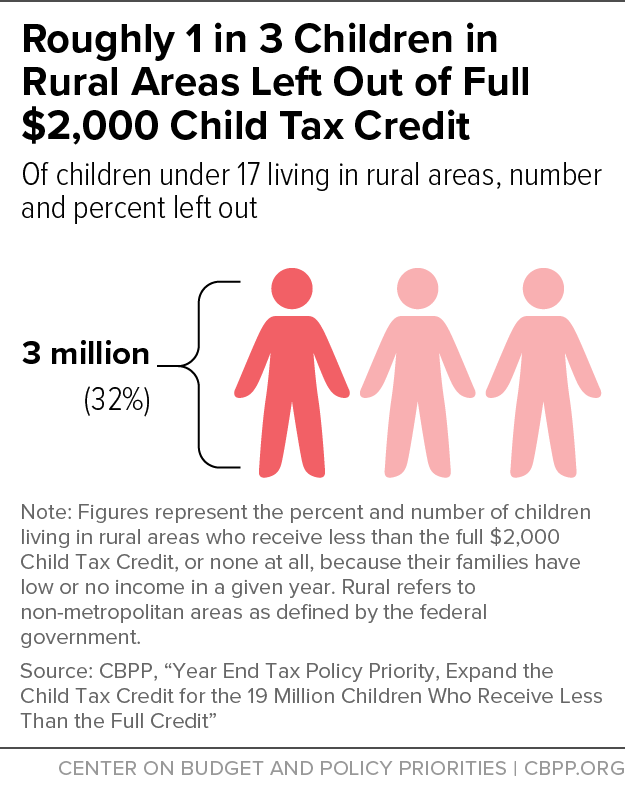
For example, Congress should close the Medicaid “coverage gap.” This would help uninsured adults with incomes below the poverty line, including 244,000 adults in rural areas, who are ineligible for Medicaid because their state hasn’t enacted the ACA Medicaid expansion. Congress could also help rural residents by expanding the Child Tax Credit. Roughly 1 in 3 children under age 17 in rural areas now receive less than the full credit because their families’ incomes are too low.