

Low-Income Disabled Youth Face Significant Challenges Upon Coming of Age
Many Lose Critical Income Support From Supplemental Security Income
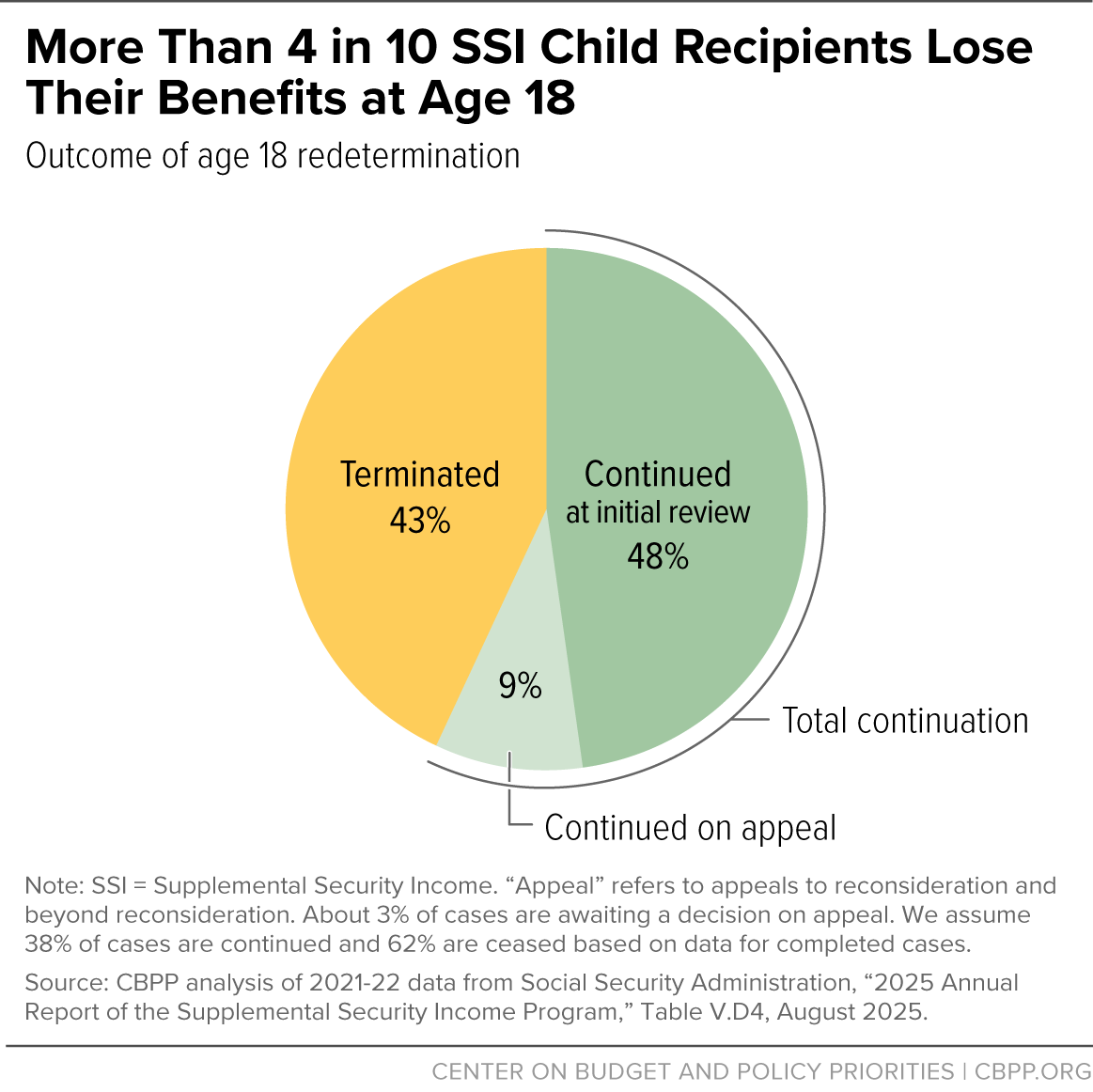
Children receiving Supplemental Security Income (SSI) face significant challenges as they reach adulthood, including ongoing health needs, limited family incomes and resources, and loss of benefits and other supports. More than 4 in 10 SSI youth lose their benefits when they turn 18 because they have not demonstrated that they meet SSI’s stringent adult definition of disability, even if they continue to have health conditions that limit their daily activities. (See Figure 1.) Around the same time, these young people often lose key supports — especially if they no longer qualify for SSI benefits — such as school-based services, health care, long-term services and supports, and foster homes. But there are ways to support young people with disabilities as they transition to adulthood, both by providing more work supports and incentives to SSI youth, and by improving access to economic security programs beyond SSI.
Young adults who received SSI as children must navigate a fragmented, unfamiliar system where necessary supports are often unavailable or difficult to access, particularly if their SSI benefits have been terminated. Economic security programs like the Supplemental Nutrition Assistance Program (SNAP) and the Earned Income Tax Credit (EITC) are largely unavailable to young people without dependents. Vocational rehabilitation, which is designed to help disabled people find employment, is underfunded and has long waiting lists. Young people with disabilities also face many barriers to work, including their medical conditions, employment discrimination, and — if they maintain benefits — SSI’s own policies and practices.
Given their significant hurdles, it is no surprise that young adults who received SSI as children — whether or not they continue to receive benefits — have worse outcomes than their peers. Children who receive SSI are doubly disadvantaged: they have disabilities and come from families with very low incomes and assets — two factors shown to limit adult prospects. Many SSI youth — especially those whose benefits are terminated — have poor outcomes and unmet needs as adults, such as unemployment, low pay, low levels of education, poor health, and involvement in the criminal legal system.
Researchers at the Social Security Administration (SSA) and elsewhere have carried out a series of demonstration projects intended to identify ways to improve outcomes for SSI youth — particularly employment outcomes. The interventions have yielded some short-term improvements that dissipated over the longer term.[1]
There are other ways to help support SSI youth as they transition to adulthood. These ideas include providing longer-term supports, simplifying SSI work incentives, and increasing SSI’s youth redetermination age. Another approach is to improve economic security programs beyond SSI, because to thrive as adults, young adults with disabilities need accessible and affordable housing, transportation, health care (often including long-term services and supports), and enough income to afford the basics.

Children Must Meet Strict Criteria to Keep SSI Benefits at Age 18
SSI provides critical income support for nearly 1 million children with disabilities.[2]Though 15 million children in the U.S. have special health care needs, just 7 percent of them receive SSI. [3] Only about half of children who apply for SSI meet the program’s strict eligibility standards.[4] The rest are rejected because their disabling conditions aren’t severe enough or because their families’ income and savings exceed the program’s low limits. Families of other children don’t apply — including some who would qualify — either because they don’t know about benefits or because the process for getting and maintaining them is too burdensome.
SSA reviews children’s medical and financial eligibility for SSI regularly throughout childhood, and then again for all children still receiving SSI at age 18, using the adult disability standard. These age 18 redeterminations are required by the Personal Responsibility and Work Opportunity Reconciliation Act of 1996. To qualify for SSI, both children and adults must have a “medically determinable physical or mental impairment” expected to last at least 12 months or result in death. For children, the impairment must also result in “marked and severe functional limitations” compared to typically developing peers. For adults, impairment must prevent self-supporting work — known as substantial gainful activity, which in 2025 means earning at least $1,620 a month, or $2,700 for those who are blind.
To qualify for SSI, an applicant must also have very low income and assets. For children, this includes any parental income or assets determined available to the child. Countable assets are limited to $2,000, or $3,000 for married couples or two-parent households for children. SSI’s benefits are modest, averaging $847 a month for a disabled child in August 2025 and topping out at a maximum of $967 for an individual in 2025.[5] Some 45 states and the District of Columbia supplement the federal SSI benefit, though some have cut those additional payments over the years.
Eligibility redeterminations at age 18 ultimately end benefits for more than 4 in 10 young adults. A little more than half (52 percent) had their benefits terminated in the initial age 18 redetermination; by the end of the appeals process, 43 percent were ultimately terminated in 2021-22, the most recent years for which nearly complete data are available.[6] (See Figure 1.) Some people whose benefits were terminated at age 18 later return to receiving benefits. One study showed that by age 28, about 15 percent of those terminated at age 18 are again receiving SSI, or — in relatively rare cases — Social Security Disability Insurance (SSDI) benefits.[7] SSDI is difficult for young adults to access, because it requires a substantial work history.
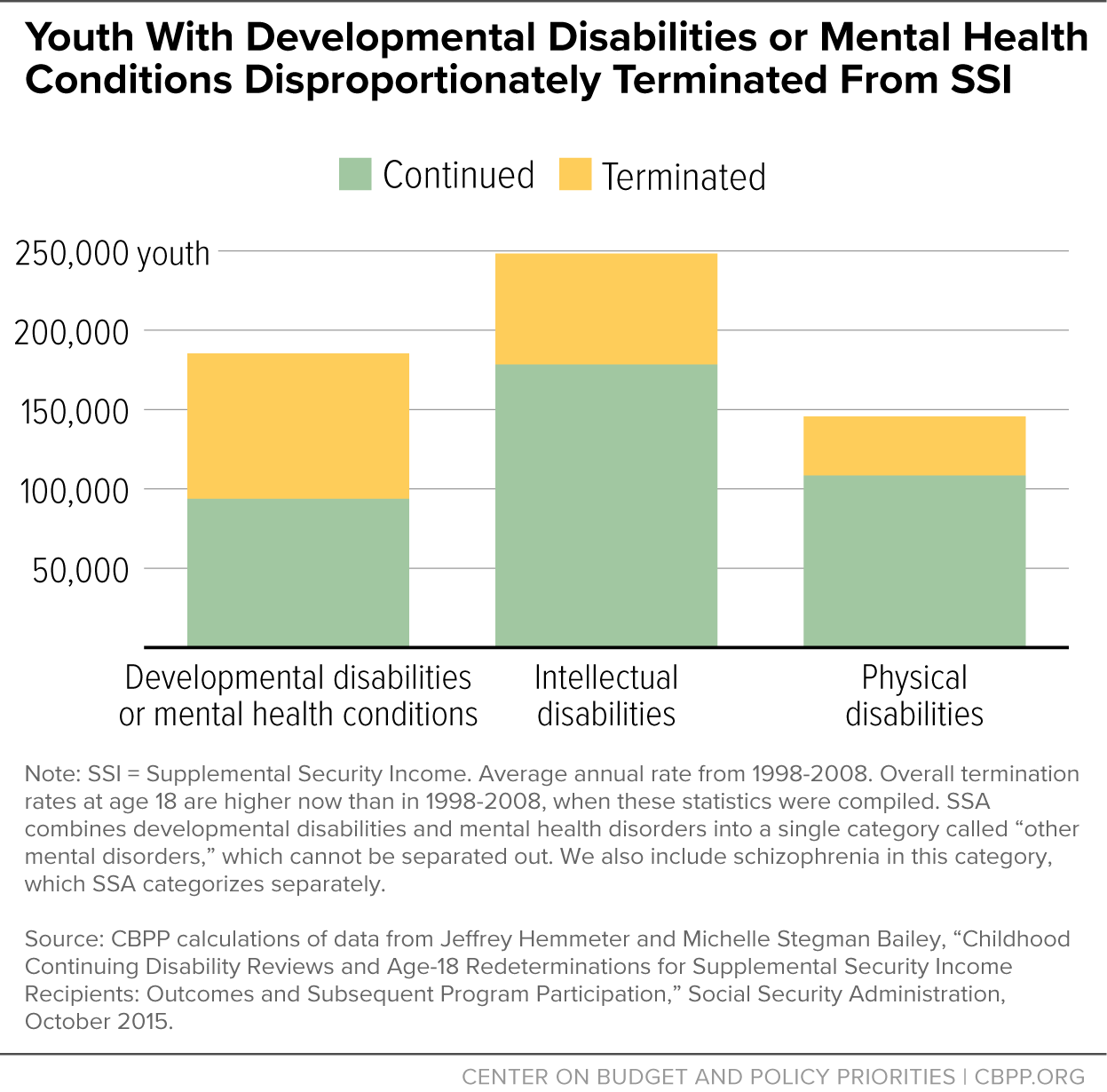
Termination rates at age 18 vary widely by diagnosis, as shown in the last published study on this topic from 2015. (See Figure 2.) They tend to be lower for more readily observable or easier-to-document medical conditions, such as physical disabilities. Only 13 percent of children with physical disabilities, such as disabilities of the nervous system and sense organs (such as blindness or deafness), lose eligibility at age 18.

The largest diagnostic group of SSI beneficiaries at age 18 (43 percent) have intellectual disabilities, a child-onset condition characterized by significant limitations in intellectual functioning and everyday life skills. Some 28 percent of these children have their benefits terminated at age 18.[8] But about half (51 percent) of children with developmental disabilities or mental health conditions — which SSA combines into a category called “other mental disorders” — are terminated at age 18.[9] Note that overall termination rates at age 18 are even higher now than when these statistics were compiled.[10]
The termination rate also varies by the age at which children became eligible for SSI. Less than a quarter of children who start receiving SSI before age 5 have their benefits terminated at age 18, compared to about half of those who start receiving benefits after age 5, according to a 2009 study.[11] Children who are diagnosed with disabilities at younger ages are more likely to be born with congenital conditions such as Down Syndrome or spina bifida, or to have more easily diagnosed disabilities, such as intellectual disability, blindness, or deafness.[12] These conditions tend to last a lifetime and to have similar definitions for children and adults.
Other factors also correlate with termination at age 18.[13] Youth who need prescription medications, help with personal care, or therapies are less likely to have their benefits terminated. In contrast, youth who have been suspended or expelled from school, dropped out, or have been arrested are more likely to have their benefits terminated. Youth with more employment experience are also more likely to have their benefits terminated. Finally, termination rates vary substantially by state, even though national standards are being applied.
SSI Youth Lose Key Supports Upon Coming of Age
Children receiving SSI lose key supports when they come of age, especially if they no longer qualify for SSI benefits.[14] These include school-based services, health care, long-term services and supports, and foster homes.
During childhood, youth with disabilities may receive a variety of services coordinated by the school system, which are legally required (though not always provided) for all qualifying children. As they reach adulthood, disabled youth lose the services and accommodations they receive under the Individuals with Disabilities Education Act (IDEA), which covers children through high school graduation or their 22nd birthdays, whichever comes first. These services may include school-based physical, occupational, and speech therapy; mental health support; assistive technology; and dedicated aides.
Most children receiving SSI automatically qualify for Medicaid, which provides both health insurance coverage and long-term services and supports for those whose disabilities limit their daily activities. While Medicaid benefits vary by state, some provide long-term services that include home- and community-based services, which support daily living outside an institutional setting. Young people who maintain SSI eligibility into adulthood can keep these valuable benefits. But those who don’t generally lose Medicaid when they reach age 19, particularly if they live in a state that has not taken up the option in the Affordable Care Act to expand Medicaid to reach a larger share of lower-income adults. Even in expansion states, youth who lose SSI may also lose their long-term services and supports, which can be necessary for maintaining employment and independent living.
Approximately 1 in 10 SSI youth turning 18 are in foster care.[15] These youth lose their homes and any formal support from their foster families upon reaching age 18, unless their state provides extended foster care.
Support Is Limited and Difficult for Young Adults to Access
Young adults who received SSI as children must navigate a fragmented, unfamiliar system where necessary economic security and employment supports are often unavailable or difficult to access, particularly for those terminated from SSI.
Two of the largest economic security programs — SNAP and the EITC — strictly limit eligibility and benefits for adults who are not raising children. [16] SNAP limits benefits for those without children and who do not receive disability benefits to just three months in any three-year period, unless employed or in job training. The EITC provides no benefits to workers under age 25. After that, workers with children receive much larger credits than those without. The maximum EITC was $4,213 for a filer with one child and $632 with no children in 2024.[17] Adults without children can qualify for rental assistance, but limited funding means most don’t receive support.[18] And state general assistance programs — once a last resort for people who are very poor and do not qualify for other cash assistance — are available in only half the states. Even in those states, eligibility and benefits are extremely limited.[19]
It can also be difficult for former SSI youth to access employment supports. The Workforce Innovation and Opportunity Act of 2014 (WIOA) expanded services for transitioning youth, requiring state vocational rehabilitation agencies to offer pre-employment services to students with disabilities. While more SSI youth received these services after implementation, availability and usage varies dramatically by state.[20] In many states, vocational rehabilitation agencies are underfunded and understaffed, undermining awareness of and access to services.[21] In addition, SSA cannot make automated referrals to vocational rehabilitation or other employment supports, which creates gaps in service delivery. Access to developmental disabilities services and mental health services also varies by state, and transitioning youth are often placed on long waiting lists.
Most SSI Youth Have Poor Outcomes as Adults
Children who receive SSI face two significant disadvantages as they reach adulthood: they are disabled, and they come from families with very low incomes and savings. Many children with disabilities have challenges that last long after they grow up, especially if their disabilities persist into adulthood. Poor health in childhood is associated with lower educational attainment, lower employment rates, lower earnings, lower wealth, and higher poverty rates.[22] The effects are particularly large for children with mental health conditions.[23] Most SSI youth — whether or not they receive benefits as adults — continue to have special health care needs and functional limitations as adults, and those challenges pose barriers to employment and independence.[24]
Additionally, children receiving SSI live with families with incomes in or near poverty, and a large body of research has found that children experiencing poverty have lower levels of educational attainment, lower earnings, higher likelihood of being arrested, and poorer health in adulthood.[25] These negative outcomes are especially pronounced for those who experience poverty in early childhood and those who remain in poverty for long periods during childhood.
Given their significant disadvantages and the barriers they face in adult life, it is no surprise that young adults who received SSI as children — whether or not they continue to receive benefits — have worse outcomes than their peers. Most young adults whose SSI benefits were terminated still face significant health limitations and struggle in the labor market.
Health
The substantial majority of young adults who received SSI as children report health issues that continue into adulthood. Over 70 percent who lose SSI benefits report having special health care needs, and nearly 80 percent report that their health conditions limit them compared to their peers, according to a study examining the results of the last major survey of child SSI recipients and their families from 2005.[26] (See Figure 3.) Forty-one percent of young adults terminated from SSI — and 75 percent of those who remain on SSI — report needing help with routine activities such as preparing meals, managing their finances, and managing their medication. Five percent of those terminated and 29 percent of those who remain require help with personal care tasks such as eating, bathing, and dressing. [27]

People terminated from SSI at age 18 tend to have worse access to health care than those who continue to receive benefits. Young adults terminated from SSI at age 18 experience unmet health care needs almost twice as frequently as those who continue to receive SSI.[28] Terminated youth are less likely to have health insurance, in part because many lose Medicaid coverage along with their SSI benefits.[29]
Income


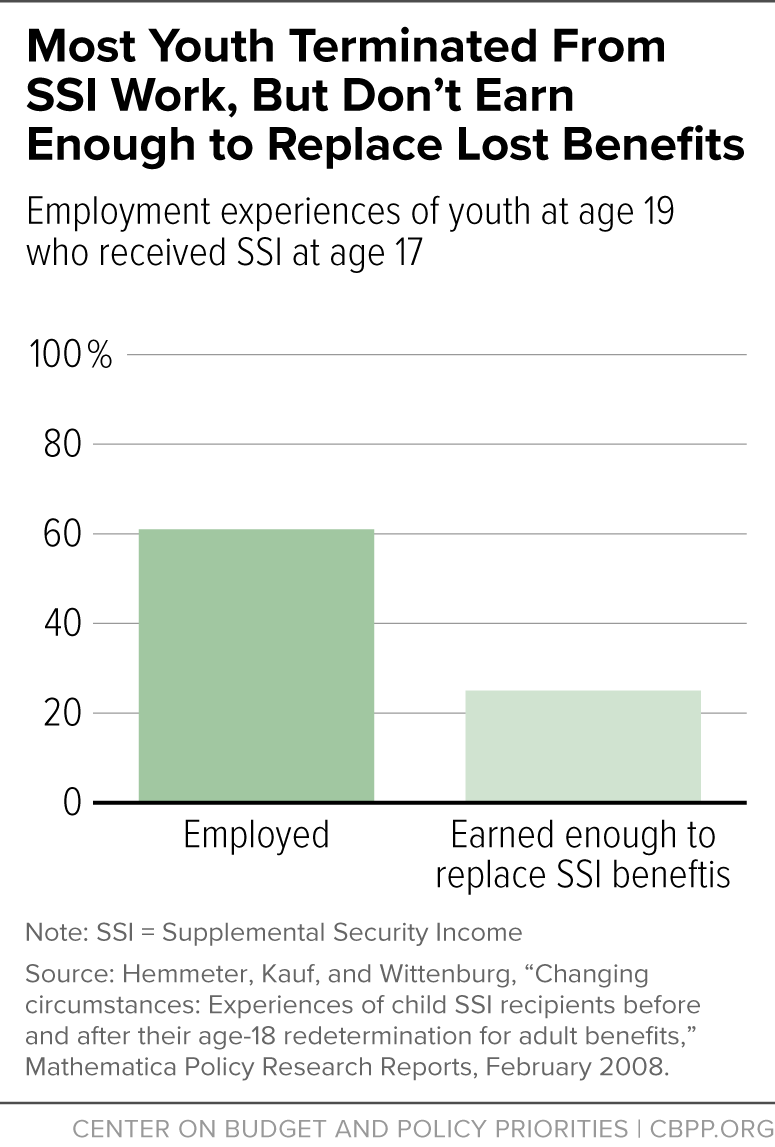
Young adults who received SSI as children typically have very low incomes, whether or not they maintain eligibility. Both groups have average incomes just above the poverty line.[30] Most youth terminated from SSI at age 18 work and earn more than youth who continue to receive SSI. However, the earnings of terminated youth are nonetheless generally very low and few earn enough to replace their lost SSI income. About 60 percent of terminated youth were working, compared to less than 30 percent who remained on SSI, according to one 2009 study.[31] However, only a quarter of terminated youth earned enough to replace their childhood SSI benefits. (See Figure 4.) Terminated youth recovered just one-third of their lost SSI income, on average, and experienced a significant loss of cumulative income over the 16 years following termination, according to another study, which also showed that terminated youth have lower earnings levels and less earnings growth than other disadvantaged yet non-disabled groups.[32]
Young adults whose SSI benefits are terminated tend to have more income instability than those who continue to receive SSI into adulthood and have benefits to serve as a steady source of income.[33] Most terminated youth continue to have functional limitations and face significant barriers to employment, making them vulnerable to income shocks and threatening their ability to consistently afford basic necessities.
About half of youth who no longer receive SSI as adults do not work, attend school, or participate in vocational rehabilitation, according to one 2007 study.[34] Among those terminated from SSI at 18 who either don’t work or earn less than their childhood SSI benefits, nearly half dropped out of high school, about a quarter have arrest records, and more than half had been suspended or expelled from school.[35] These negative events compound their difficulty in finding work as adults, as lower education attainment and involvement in the criminal legal system significantly harm employment prospects.[36]
Notably, people terminated from SSI at 18 are significantly more likely to be charged with crimes — particularly income-generating crimes, such as theft, burglary, fraud/forgery, or prostitution, according to a recent study.[37] Termination from SSI increases the likelihood of being charged with one of those crimes by 60 percent in the following two decades. In fact, terminated youth are twice as likely to be charged with one of these income-generating crimes than they are to be steadily employed at $15,000 a year (the rough equivalent of full-time work at the federal minimum wage). The study found that the costs of enforcement and incarceration associated with SSI removal are nearly as much as any savings from the termination of benefits.
SSI Policies Hinder More Than Help Youth Overcome Barriers to Work
Young people with disabilities face significant barriers in the workforce, including medical conditions, inflexible work arrangements, inaccessible work sites, employment discrimination, lack of transportation, and a persistent wage gap.[38] These challenges can be even greater for people of color and LGBTQ people.[39]
Unfortunately, SSI’s policies add to these barriers by discouraging work in several ways. To begin with, SSI exempts the first $65 per month of earnings when determining eligibility and benefit levels, after which SSI benefits are reduced by 50 cents for each $1 of earnings. The earnings exemption has not changed since 1972, even to account for inflation. Because the threshold is so low — just a few hours of minimum wage work in many jurisdictions — almost any work effort will result in benefit loss. Parents’ earnings can also count against a child’s SSI benefits, so added together with their parents’ earnings, teenagers who earn even small amounts may lose eligibility for benefits.
SSA’s administrative practices can also penalize people who attempt work. Working beneficiaries must update SSA monthly about any changes to their earnings, and most teens and young adults do not keep up with this burdensome paperwork.[40] As a result, their benefits are likely to be overpaid. This can happen even if they report their work promptly, because processing delays at SSA can also trigger overpayments. Overpayments typically continue for many months, totaling thousands of dollars. Once SSA discovers the error, beneficiaries must repay the overpaid amount out of their future SSI benefits. This “feeds the perception that work doesn’t pay and creates confusion, heartache, hardship, and hassle for both the individual and the Social Security Administration.”[41] SSA recently implemented a new payroll data exchange that will reduce the paperwork burden and processing delays that come from manual earnings reporting.[42] But the perception is likely to persist that working can be more trouble than it’s worth.
Another barrier to work is the fear of losing SSI benefits and Medicaid coverage.[43] Though this is not always the case, beneficiaries’ fears are grounded in the experiences of the hundreds of thousands of people whose benefits are suspended each year due to excess income.[44] SSI and Medicaid benefits are vital for the economic security and health of people with disabilities, so many beneficiaries avoid anything that might jeopardize them. Youth and their families also have legitimate fears about life after SSI, given the lack of adequate support for adults with disabilities in their communities.
While SSI does have work incentives, very few youth — even working youth — use them, indicating that the complicated set of policies is not working as intended. Only 1.5 percent of youth beneficiaries — less than half of student beneficiaries who work — use the Student Earned Income Exclusion, which allows them to earn more without losing benefits, perhaps because they are not aware of the more generous exclusion, or because they cannot keep up with the ongoing requirement to prove student status.[45] Almost no youth beneficiaries use Impairment Related Work Expenses to exclude work-related expenses from their countable income. Likewise, Section 301 — which permits beneficiaries to continue SSI and Medicaid during vocational rehabilitation, even if their benefits were terminated at age 18 — is underused due to its complexity and incompatibility with other policies.[46]
One reason most young beneficiaries and their families don’t use SSI’s work incentives is that they don’t know about them. In addition, they are complicated to understand.[47] Benefits counseling is difficult to access, especially after over a decade of budget cuts at SSA.[48] Disability beneficiaries who work or want to work can receive counseling from Work Incentives Planning and Assistance agencies, which receive modest funding that hasn’t increased over the past 20 years, even for inflation — but the onus is on SSI youth and their families to seek help. As a result, few youth use benefits counseling services. For example, an SSA demonstration project found that only 5 to 8 percent of transitioning youth in the control group did so, confirming previous qualitative research.[49] Moreover, benefits counseling does not appear to be particularly effective. Those who do receive benefits counseling still have extremely limited knowledge of SSA work incentives, a finding that is consistent with previous research on the adult disability beneficiary population.[50]
Efforts to Improve SSI Youth Outcomes Have Netted Short-Term Improvements
SSA, in cooperation with other agencies, has carried out a series of demonstration projects intended to identify ways to improve outcomes for SSI youth — particularly employment outcomes. The interventions have yielded some short-term improvements that have dissipated over the longer term. Independent researchers have also studied potential interventions with similar results.
In the Youth Transition Demonstration of 2006-12 (YTD), SSA partnered with local and state organizations such as universities, One-Stop Centers, schools, and municipal youth employment offices. YTD aimed to help youth with disabilities attain economic self-sufficiency, primarily by engaging them in competitive, integrated employment experiences.[51] Other services included school-based preparation; engaging youth in intensive planning; connecting with services like health care, education, transportation, and assistive technology; and facilitating family involvement. SSA also provided benefits counseling and waived certain program rules for participants for four years (or until age 22), allowing participants to keep more of their earnings, maintain their SSI benefits, save more money, and pursue education. The YTD projects had some positive short-term results, but as the supports were withdrawn, the effects generally dwindled. [52] The projects that yielded better results delivered more hours of services and focused the services on connecting youth with competitive, paid jobs.
The Promoting the Readiness of Minors in Supplemental Security Income (PROMISE) demonstration was a collaboration between the departments of Education, Health and Human Services, and Labor, and SSA. The intervention targeted SSI youth and their families, with the goal of improving health, education, and career outcomes and reducing reliance on SSI. Each site provided services from 2016 to 2018-19, including case management, benefits counseling, work-based learning, family involvement, and increased coordination among service providers. PROMISE aimed to improve coordination between services provided through IDEA, vocational rehabilitation, Medicaid, Job Corps, and other WIOA programs, and to increase use of those services for both SSI youth and their families. Participants maintained their SSI and Medicaid benefits throughout the demonstration.
Though PROMISE showed positive results in the interim evaluation, after five years, only two of the six programs improved employment rates, and three increased incomes by relatively small amounts.[53] Notably, that time period included the COVID pandemic, which negatively impacted the employment and education for disabled youth significantly more than their non-disabled peers.[54]
Another study by University of Chicago researchers hypothesized that SSI youth may have better outcomes in adulthood if their families anticipate and prepare for benefit termination.[55] The researchers informed families that their children were likely to lose SSI benefits at age 18. Most were not aware of the high probability of termination — in fact, more than half of parents thought there was no chance their children would stop receiving benefits.
But the new information did not increase investments in the children’s human capital, such as tutoring or job training. Instead, parents said they planned to work more to make up for the lost income. Researchers explained the lack of an effect on children by noting that most parents expected to support their disabled children in adulthood, that the potential loss of SSI decreases the likelihood of being able to afford investments like college education, and that families of SSI youth said they were already doing all they could to help their children succeed. The study concluded that information alone is unlikely to improve outcomes for terminated SSI youth.
Proposals to Improve SSI Youth Outcomes
While the results of past interventions have been disappointing, there are ways to support young people with disabilities as they transition to adulthood, both within SSI and through changes to other economic security programs.
Providing Longer-Term Supports
Since SSI demonstrations have shown positive results that diminish after services are withdrawn — consistent with studies of youth employment programs for the general population[56] — one question is whether these supports could be available for a longer period. For example, PROMISE services ended when youth were still transitioning to adulthood — ages 17 to 19 — and continued to face significant barriers to employment. Some disability experts propose that case management and other services remain available throughout young adulthood.[57]
State vocational rehabilitation (VR) agencies already provide supports for disabled people of all ages, including career assessment and counseling, assistive technology, job training, and financial assistance for vocational or post-secondary education. But since 1999, the Social Security Act has precluded SSA from directly referring beneficiaries to state VR programs. That year, Congress established a career development program called Ticket to Work for adult disability beneficiaries, and the law directed them to those services instead of to state VR agencies. But the law also prohibited direct referrals for youth, even though beneficiaries under age 18 are not eligible for Ticket services. SSA has acknowledged that “direct referrals to VR are the best and only realistic option for directly increasing connections to VR” for transitioning youth.[58] Past SSA budgets, in both the Trump and Biden Administrations, have proposed to allow SSA to make direct VR referrals. This would increase the likelihood that young adults get the employment services they need.
Simplifying SSI Work Incentives
Lack of knowledge and understanding prevents transitioning youth from responding to SSI’s complex work incentives. While some have proposed more or different benefits counseling services, this approach is not supported by evidence. This may be because overly complicated and burdensome policies cannot be effectively mitigated through counseling and coordination. Instead, a simpler set of work incentives could be easier for young adults to understand and navigate, increasing their take-up and effectiveness.
One obvious simplification would be to allow youth to earn an unlimited amount while maintaining their SSI benefits. For example, during President Trump’s first term, SSA’s budget proposed to automatically disregard all earned income for youth up to age 20, then gradually phase down earnings limits between ages 21 and 25. SSI youth aged 20 or younger would no longer need to report their earnings or their student status to qualify for these more generous exemptions. This change would allow SSI youth to work and earn more without fear of losing benefits. SSA could change or eliminate the Student Earned Income Exclusion limit without a change in law, and could significantly reduce reporting requirements by establishing a data exchange to confirm school enrollment.[59]
Increasing SSI’s Youth Redetermination Age
Increasing the age at which SSI youth are reviewed under the adult disability standard would allow them to maintain SSI income as they transition from high school toward further education, training, or employment, providing greater financial stability. Some have proposed increasing the age to 22 or even 26.[60] An older transition age would mirror other federal policies. IDEA allows students with disabilities to stay in school and receive special education services until age 22. The Chafee Foster Care Program for Successful Transition to Adulthood allows youth formerly in foster care to receive services up to age 21, or 23 in some jurisdictions. All young adults are eligible to continue to stay on their parents’ health insurance until age 26. In addition, research shows that young people’s brain development continues well into their 20s.[61]
Improving Economic Security Programs Beyond SSI
Young adults aging out of SSI often fall through the cracks in existing economic security, health care, and employment programs. To improve access to economic security programs, particularly for people with disabilities, policymakers should:
- expand EITC eligibility and benefits for younger workers and those not raising children;[62]
- expand SNAP eligibility for “able-bodied adults without dependents,” which include many people with work-limiting health conditions that fall short of SSA’s strict disability standard;[63]
- expand Medicaid in those states that have not yet done so, which would increase access to needed health care, improve health, reduce the financial burden of disability, and extend access to the long-term services and supports that many people with disabilities need to work;[64]
- fully fund vocational rehabilitation to provide more people with disabilities with tools to facilitate employment;[65] and
- ensure access to affordable and accessible housing and transportation.
Together, these measures would help young people with disabilities as they make a critical transition, so they can truly thrive in adulthood.
End Notes
[1] David Wittenburg and Gina Livermore, “Youth Transition,” in Lessons from SSA Demonstrations for Disability Policy and Future Research, edited by A. Nichols, J. Hemmeter, and D. Goetz Engler, Abt Associates, 2021.
[2] Social Security Administration (SSA), “Monthly Statistical Snapshot, August 2025,” August 2025, https://www.ssa.gov/policy/docs/quickfacts/stat_snapshot/; Kathleen Romig, “SSI: A Lifeline for Children with Disabilities,” CBPP, May 11, 2017, https://www.cbpp.org/research/social-security/ssi-a-lifeline-for-children-with-disabilities.
[3] Health Resources and Services Administration, “Children and Youth with Special Health Care Needs,” June 2022, https://mchb.hrsa.gov/sites/default/files/mchb/programs-impact/nsch-data-brief-children-youth-special-health-care-needs.pdf.
[4] SSA, “2025 SSI Annual Report,” Table V.C2., Disabled Child Claims: Disposition of Applications for SSI Disability Benefits by Year of Filing and Level of Decision, https://www.ssa.gov/OACT/ssir/SSI25/SingleYearTables/V_C2_InitialDecisions.html.
[5] SSA, “Monthly Statistical Snapshot, August 2025,” https://www.ssa.gov/policy/docs/quickfacts/stat_snapshot/2025-06.pdf.
[6] SSA, “2025 SSI Annual Report,” Table V.D4, https://www.ssa.gov/OACT/ssir/SSI25/V_D_Redet_CDRdata.html#453002.
[7] Jeffrey Hemmeter, “Supplemental Security Income Program Entry at Age 18 and Entrants’ Subsequent Earnings,” Social Security Bulletin, August 2015, https://www.ssa.gov/policy/docs/ssb/v75n3/v75n3p35.html.
[8] Jeffrey Hemmeter and Michelle Stegman Bailey, “Childhood Continuing Disability Reviews and Age-18 Redeterminations for Supplemental Security Income Recipients: Outcomes and Subsequent Program Participation,” SSA Research and Statistics Note No. 2015-03, October 2015, https://www.ssa.gov/policy/docs/rsnotes/rsn2015-03.html.
[9] SSA’s terminology for this group is inaccurate and the category itself is overly broad. However, the data cannot be separated out and we believe it is useful to include this data for comparison with the approval rates of other conditions. We also included schizophrenia in this category.
[10] Over the last several years (since 2021), the initial termination rate for the age 18 redetermination averaged 52 percent. In the 1998-2008 period examined in this study, it averaged 46 percent. SSA, “SSI Annual Report, 2025,” Table V.D4. https://www.ssa.gov/OACT/ssir/SSI25/V_D_Redet_CDRdata.html#453002 https://www.ssa.gov/OACT/ssir/SSI25/V_D_Redet_CDRdata.html#453002; SSA, “SSI Annual Report, 2010,” Table V.D3, https://www.ssa.gov/OACT/ssir/SSI10/Redet_CDRdata.html#342615.
[11] Jeffrey Hemmeter and Elaine Gilby, “The Age 18 Redetermination and Postredetermination Participation in SSI,” Social Security Bulletin, December 2009, https://www.ssa.gov/policy/docs/ssb/v69n4/v69n4p1.html.
[12] Jeffrey Hemmeter, Jacqueline Kauff, and David Wittenburg, “Changing circumstances: Experiences of child SSI recipients before and after their age-18 redetermination for adult benefits,” Journal of Vocational Rehabilitation, 2009.
[13] Pamela Loprest and David Wittenburg, “Choices, Challenges, and Options: Child SSI Recipients Preparing for the Transition to Adult Life,” The Urban Institute, 2005, https://www.urban.org/sites/default/files/publication/51821/411168-Choices-Challenges-and-Options.PDF.
[14] Laudan Y. Aron and Pamela J. Loprest, “Meeting the Needs of Children with Disabilities,” Urban Institute, 2007.
[15] Emilie Stoltzfus et al., “Children in Foster Care and Social Security Administration Benefits: Frequently Asked Questions,” Congressional Research Service, November 23, 2021, https://sgp.fas.org/crs/misc/R46975.pdf.
[16] Joseph Llobrera et al., “A Frayed and Fragmented System of Supports for Low-Income Adults Without Minor Children,” CBPP, January 28, 2021, https://www.cbpp.org/research/poverty-and-inequality/a-frayed-and-fragmented-system-of-supports-for-low-income-adults.
[17] CBPP, “Policy Basics: The Earned Income Tax Credit,” April 28, 2023, https://www.cbpp.org/research/federal-tax/the-earned-income-tax-credit.
[18] Erik Gartland, “Chart Book: Funding Limitations Create Widespread Unmet Need for Rental Assistance,” CBPP, February 15, 2022, https://www.cbpp.org/research/housing/funding-limitations-create-widespread-unmet-need-for-rental-assistance#families-with-children-and-non-elderly-cbpp-anchor.
[19] Liz Schott, “State General Assistance Programs Very Limited in Half the States and Nonexistent in Others, Despite Need,” CBPP, July 2, 2020, https://www.cbpp.org/research/family-income-support/state-general-assistance-programs-very-limited-in-half-the-states.
[20] Isabel Musse, Todd Honeycutt, and Jeffrey Hemmeter, “The Effects of the Workforce Innovation and Opportunity Act of 2014 on Vocational Rehabilitation Engagement, Employment, and Work Incentive Use Among Supplemental Security Income Recipients Aged 14–24,” Social Security Bulletin, November 2024, https://www.ssa.gov/policy/docs/ssb/v84n4/v84n4p27.html.
[21] Meredith Kolodner, “Problems Plague Vocational Rehabilitation,” Disability Scoop, September 21, 2016, https://www.disabilityscoop.com/2016/09/21/problems-plague-voc-rehab/22777/.
[22] Anne Case, Angela Fertig, and Christina Paxson, “The Lasting Impact of Childhood Health and Circumstance,” Journal of Health Economics, Vol. 24, No. 2, March 2005, http://www.sciencedirect.com/science/article/pii/S0167629604001262?via%3Dihub; Janet Currie et al., “Child Health and Young Adult Outcomes,” Journal of Human Resources, Vol. 45, No. 3, November 2008, http://www.nber.org/papers/w14482; James P. Smith, “The Impact of Childhood Health on Adult Labor Market Outcomes,” Review of Economics and Statistics, Vol. 91, No. 3, September 2009, https://www.ncbi.nlm.nih.gov/pmc/articles/PMC3625038/.
[23] Jason Fletcher, “Adolescent Depression and Adult Labor Market Outcomes,” NBER Working Paper No. 18216, July 2012, http://www.nber.org/papers/w18216; Jason Fletcher, “The Effects of Childhood ADHD on Adult Labor Market Outcomes,” NBER Working Paper No. 18689, January 2013, http://www.nber.org/papers/w18689; Mark Stabile and Sara Allin, “The Economic Costs of Childhood Disability,” The Future of Children, Spring 2012.
[24] Pamela J. Loprest and David C. Wittenburg, “Posttransition Experiences of Former Child SSI Recipients,” Social Service Review, December 2007, https://www.journals.uchicago.edu/doi/abs/10.1086/523877.
[25] National Academies of Science, Engineering, and Medicine, “The Consequences of Child Poverty,” A Roadmap to Reducing Child Poverty, 2019, https://www.ncbi.nlm.nih.gov/books/NBK547371/.
[26] Loprest and Wittenburg, 2007.
[27] Ibid.
[28] Jeffrey Hemmeter, “Health Related Unmet Needs of Supplemental Security Income Youth after the Age-18 Redetermination,” National Center for Biotechnology Information, August 2011, https://www.ncbi.nlm.nih.gov/pmc/articles/PMC3165185/.
[29] Hemmeter, 2011; Loprest and Wittenburg, 2007.
[30] Loprest and Wittenburg, 2007.
[31] Hemmeter et al., 2009.
[32] Manasi Deshpande, “Does Welfare Inhibit Success? The Long-Term Effects of Removing Low-Income Youth from Disability Insurance,” American Economic Review, Vol. 106, No. 11, February 2016, https://www.aeaweb.org/articles?id=10.1257/aer.20151129.
[33] Deshpande, 2016; Michael Levere, “The Labor Market Consequences of Receiving Disability Benefits During Childhood,” Journal of Human Resources, 2019.
[34] Loprest and Wittenburg, 2007.
[35] Hemmeter et al., 2009.
[36] Tazra Mitchell, “Promising Policies Could Reduce Economic Hardship, Expand Opportunity for Struggling Workers,” CBPP, April 24, 2018, https://www.cbpp.org/research/poverty-and-inequality/promising-policies-could-reduce-economic-hardship-expand-opportunity.
[37] Manasi Deshpande and Michael Mueller-Smith, “Does Welfare Prevent Crime? The Criminal Justice Outcomes of Youth Removed from SSI,” NBER Working Paper 29800, February 18, 2022, https://www.nber.org/system/files/working_papers/w29800/w29800.pdf.
[38] Dahlia Shaewitz and Michelle Yin, “Those with Disabilities Earn 37% Less on Average; Gap is Even Wider in Some States,” American Institutes for Research, December 14, 2014, https://www.air.org/news/press-release/those-disabilities-earn-37-less-average-gap-even-wider-some-states; Michelle Yin, “What the Pay Gap for Disabled Workers Costs Them and the Nation,” American Institutes for Research, January 14, 2015, https://www.air.org/resource/what-pay-gap-disabled-workers-costs-them-and-nation.
[39] Rachel Blick et al., “The Double Burden: Health Disparities among People of Color Living with Disabilities,” Ohio Disability and Health Program, The Ohio State University Nisonger Center, 2015, http://nisonger.osu.edu/sites/default/files/u4/the_double_burden_health_disparities_among_people_of_color_living_with_disabilities.pdf; Bianca D.M. Wilson et al., “Pathways Into Poverty: Lived Experiences Among LGBTQ People,” Williams Institute, University of California, Los Angeles School of Law, September 2020, https://williamsinstitute.law.ucla.edu/wp-content/uploads/Pathways-Overview-Sep-2020.pdf.
[40] SSA, “Major Causes of SSI Improper Payments,” https://www.ssa.gov/improperpayments/SSI_majorCauses.html.
[41] Jack Smalligan and Chantel Boyens, “Raising the Alarm on the Unintended Consequences of Social Security’s Return to Work Policies,” Urban Institute, March 9, 2023, https://www.urban.org/research/publication/raising-alarm-unintended-consequences-social-securitys-return-work-policies.
[42] SSA, “SSI spotlight on the Payroll Information Exchange (PIE) — 2025 Edition,” https://www.ssa.gov/ssi/spotlights/spot-pie.htm.
[43] Jennifer L. Schuster et al., “Barriers to Successful Transition for Young Adults Who Receive SSI and Their Families,” Career Development and Transition for Exceptional Individuals, Vol. 26, Issue 1, April 1, 2003, http://journals.sagepub.com/doi/pdf/10.1177/088572880302600104.
[44] SSA, “SSI Annual Statistical Report, 2021,” September 2022, https://www.ssa.gov/policy/docs/statcomps/ssi_asr/2021/sect11.html.
[45] Government Accountability Office (GAO), “Supplemental Security Income: SSA Could Strengthen Its Efforts to Encourage Employment for Transition-Age Youth,” May 2017, https://www.gao.gov/assets/690/684636.pdf.
[46] Consortium for Citizens with Disabilities (CCD), “Re: Request for Information Regarding Strategies to Improve Adult Outcomes for Youth Receiving Supplemental Security Income (SSI),” February 2, 2018, http://www.c-c-d.org/fichiers/CCD-Comments-SSA-SSI-Youth-RFI-Docket-No-SSA20170049-final.pdf; Sheryl A. Larson and Judy Geyer, “Delaying Application of SSI’s Substantial Gainful Activity Eligibility Criterion from Age 18 to 22,” Mathematica, April 30, 2021, https://www.dol.gov/sites/dolgov/files/ODEP/pdf/SSI_Youth_Larson_Final_Proposal.pdf.
[47] Loprest and Wittenburg, 2007.
[48] CCD, 2018. GAO, 2017.
[49] Arif Mamun et al., “Promoting readiness of minors in SSI (PROMISE) evaluation: Interim services and impact report,” Mathematica Policy Research, 2019; Rebekah Selekman et al., Promoting Readiness of Minors in SSI (PROMISE): Wisconsin PROMISE Process Analysis Report,” Mathematica Policy Research, July 2018.
[50] Ankita Patnaik et al., “Promoting Readiness of Minors in Supplemental Security Income (PROMISE): Youth and Family Outcomes Five Years After Enrollment,” Mathematica, December 29, 2022, https://www.ssa.gov/disabilityresearch/documents/PROMISE_Five_Year_ES.pdf.
[51] The interventions were based on Guideposts for Success, the best practices developed by the National Collaborative on Workforce and Disability for Youth, informed by an extensive review of research on promoting successful transitions to adult life by youth with disabilities. U.S. Department of Labor, “What All Youth Need to Successfully Transition into Adulthood ,” https://www.dol.gov/odep/categories/youth/index-guide.htm.
[52] These results show how the YTD interventions might work on volunteers, not how they might work if they were mandatory for all youth. Only 16 to 30 percent of youth at each site volunteered — about 5,000 youth total — and they were randomly assigned to treatment groups that participated in YTD projects or a control group that did not.
[53] Patnaik et al., 2022.
[54] Anna Hill, Ankita Patnaik, and Isabelle Musse, “How Did the COVID-19 Pandemic Affect the Education and Employment of Young People with Disabilities?” Mathematica, December 15, 2022, https://www.mathematica.org/publications/how-did-the-covid-19-pandemic-affect-the-education-and-employment-of-young-people-with-disabilities#.
[55] Manasi Deshpande and Rebecca Dizon-Ross, “The (Lack of) Anticipatory Effects of the Social Safety Net on Human Capital Investment,” December 27, 2022, https://www.povertyactionlab.org/sites/default/files/research-paper/WP_4254_Information-about-SSI-in-the-US_Dizon-Ross-et-all_Aug2022.pdf.
[56] Mathematica, 2023.
[57] Mamun et al. “Promoting Readiness of Minors in SSI (PROMISE) Evaluation: Interim Services and Impact Report,” Mathematica, 2019. Stapleton et al., "Transition to Economic Self-Sufficiency (TESS) Scholarships for Youth and Young Adults with Significant Disabilities,” Department of Labor, Office of Disability Employment Policy, April 2021.
[58] GAO, 2017.
[59] The Social Security Act, Sect. 1612(b)(1) gives the Commissioner considerable discretion is setting the amount of the earned income exclusion for younger SSI beneficiaries, including the “amount or otherwise.” The law stipulates that the beneficiary must be under age 22 and “a student regularly attending a school, college, or university, or a course of vocational or technical training designed to prepare him for gainful employment,” so eliminating the student requirement or including beneficiaries age 22 or older in the exclusion would require a change in law.
[60] Larson and Geyer, 2021; The National Alliance to Advance Adolescent Health/Got Transition, “Policy Brief on SSI: Recommendations to Assist Youth and Young Adults with Disabilities Aging Out of SSI,” July 2024, https://www.gottransition.org/resource/?policy-brief-ssi
[61] See, for example, Mariam Arain et al., “Maturation of the Adolescent Brain,” Neuropsychiatric Disease and Treatment, 2013, https://pmc.ncbi.nlm.nih.gov/articles/PMC3621648/.
[62] Chuck Marr et al., “Strengthening the EITC for Childless Workers Would Promote Work and Reduce Poverty,” CBPP, April 11, 2016, https://www.cbpp.org/research/federal-tax/strengthening-the-eitc-for-childless-workers-would-promote-work-and-reduce.
[63] The Republican megabill moved in the opposite direction, making SNAP even harder to access. CBPP, “By the Numbers: Harmful Republican Megabill Takes Food Assistance Away From Millions of People,” August 14, 2025, https://www.cbpp.org/research/food-assistance/by-the-numbers-harmful-republican-megabill-takes-food-assistance-away-from.
[64] The Republican megabill moved in the opposite direction, making Medicaid even harder to access. CBPP, “By the Numbers: Harmful Republican Megabill Will Take Health Coverage Away From Millions of People and Raise Families’ Costs,” August 27, 2025, https://www.cbpp.org/research/health/by-the-numbers-harmful-republican-megabill-will-take-health-coverage-away-from.
[65] The fate of the Rehabilitation Services Administration (RSA) is unclear after the Trump Administration announced its intention to fire nearly all its staff in October, which was quickly blocked by a judge, and then reversed by Congress in the continuing resolution law in November. After that bill expires on January 30, the Trump Administration will be allowed to fire RSA staff again if it chooses to do so. RSA staff are responsible for distributing federal funding for vocational rehabilitation and ensuring states use it to provide the supports and services disabled workers need to succeed. Keely Cat-Wells, “Federal Layoffs Threaten Disability Rights And Future Workforce,” Forbes, October 18, 2025, https://www.forbes.com/sites/keelycatwells/2025/10/18/federal-layoffs-threaten-disability-rights-and-future-workforce/.