

WIC Works: A Cost-Effective Investment in Improving Low-Income Families’ Nutrition and Health
Sound investments that reduce early childhood adversity can improve physical and mental health for a lifetime.[2] Extensive research finds that the Special Supplemental Nutrition Program for Women, Infants, and Children (WIC) is just such a cost-effective investment, improving the nutrition, development, and health of children and families with low incomes. Motivated by WIC’s effectiveness, Presidents and Congresses of both parties have provided sufficient funding since 1997 for WIC to serve all who are eligible and apply.
WIC provides nutritious foods, nutrition education, breastfeeding support, and referrals to health care and social services for new and expecting parents, infants, and children under 5. WIC has been part of the nation’s nutrition safety net for 50 years, and today it serves over 6 million adults, infants, and children in families with low incomes.
Over that 50-year period, researchers have thoroughly investigated WIC’s effects on key measures of child health such as birth weight, infant mortality, diet quality and nutrient intake, initiation and duration of breastfeeding, cognitive development and learning, immunization, use of health services, and childhood anemia. Comprehensive, systematic reviews of the research literature consistently demonstrate WIC’s effectiveness.[3]
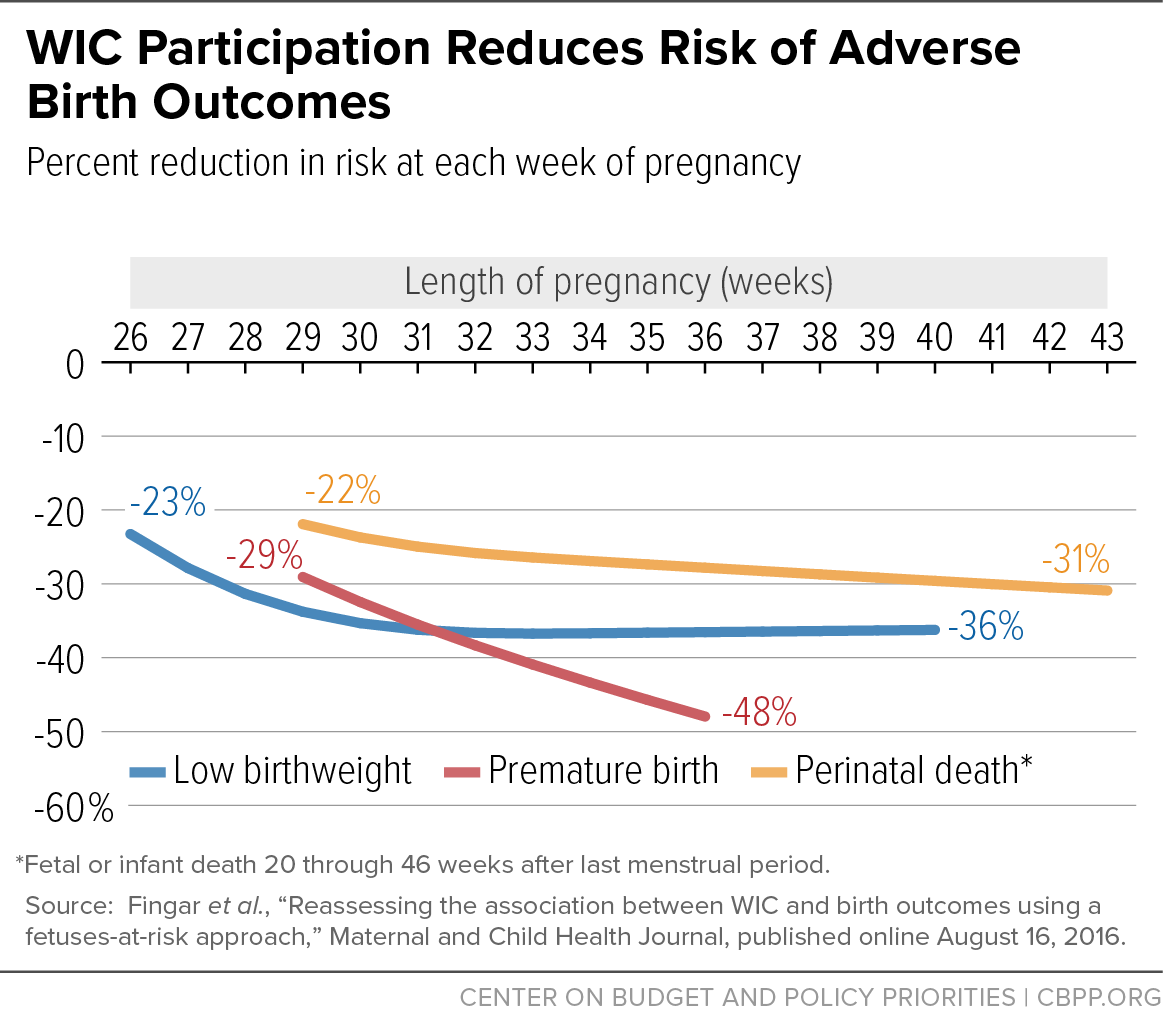
Healthier babies. Nutrition influences health at every stage of life. Individuals who participate in WIC during pregnancy give birth to healthier babies who are more likely to survive infancy. (See Figure 1.)
Figure 1 - More nutritious diets. WIC supports more nutritious diets and better infant feeding practices. WIC participants buy and eat more fruits, vegetables, whole grains, and low-fat dairy products, particularly now that the WIC food packages have been improved to more closely align to current dietary guidance and the cash value benefit for purchases of fruits and vegetables has been increased.
- More health care access. Children in families participating in WIC are just as likely to receive immunizations as children in more affluent families and are more likely to receive preventive medical care than children in low-income families who don’t participate in WIC.
- Stronger cognitive development. Children whose parent participated in WIC while pregnant scored higher on assessments of mental development at age 2 than similar children whose parent did not participate, and they later performed better on reading assessments while in school.
- Narrowed inequities. Participation in WIC may reduce racial and ethnic disparities in birth outcomes and breastfeeding.
- High participant satisfaction. WIC has worked to modernize participants’ experiences, including by offering electronic benefits and remote services. Participant satisfaction is generally high, with some participants highlighting the services provided in WIC clinics. Parents especially appreciate the higher fruit and vegetable benefits available since 2021 and report improvements in the quality of their child’s diet.
- Neighborhood food access. Improvements made to the WIC food packages since 2009 have contributed to healthier food environments in low-income neighborhoods, enhancing access to fruits, vegetables, and whole grains for all consumers regardless of whether they participate in WIC.

Poverty and adversity during early childhood can have lifelong consequences for physical, mental, and economic well-being. WIC supports sound nutrition and health at critical points in development — in utero, during infancy, as a toddler, and during the early childhood years. An extensive body of research showing that WIC participation improves children’s health and development highlights the importance of ensuring that all eligible parents and young children can get WIC benefits.
Why the Early Years Are So Important
It has long been recognized that children living in poverty, as a group, lag behind other children on a wide range of indicators of physical, mental, academic, and economic well-being.[4] They are more likely to have health, behavioral, learning, and emotional problems. This is especially true of children whose families experience deep poverty (defined as having income less than half of the poverty line), those who are poor during early childhood, and those who are poor for a long time.
Children living in poverty are also more likely to be food insecure, and food insecurity in households with children is associated with inadequate intake of several important nutrients, deficits in cognitive development, behavioral problems, and poor health.[5] Recent research shows that significant racial and ethnic disparities in childhood development emerge by the time children reach kindergarten.[6] Consistent with that, very young children living in food-insecure families are also more likely to have low academic scores and to exhibit problem behaviors when they enter kindergarten.[7]
Poverty in early childhood may be particularly harmful as poverty-related adversities impact the structure and function of the developing brain.[8] Researchers have noted that “[n]ot only does the astonishingly rapid development of young children’s brains leave them sensitive (and vulnerable) to environmental conditions, but the family context (as opposed to schools or peers) dominates children’s everyday lives.”[9]
One of the adversities that can arise in the family context is toxic stress, and there is evidence that physiological markers of stress are higher among children in poverty.[10] Mounting evidence suggests that toxic stress — activation of the body’s stress responses over a prolonged period — changes human biology.[11] A body under stress releases cortisol (a steroid hormone) into the bloodstream to help respond to the perceived threat, by increasing blood sugar, slowing non-essential functions, and providing energy. While cortisol is vital to keep people healthy during stressful situations, chronic exposure is associated with important changes in brain structures and neural, endocrine, and immune systems. Prenatal and early life stress has the broadest impact because all aspects of the brain are undergoing rapid development at that time.
The consequences of toxic stress and other forms of adversity during early childhood can extend well beyond childhood and affect physical, mental, and economic well-being throughout life.[12] Researchers at Harvard University’s Center on the Developing Child, for example, wrote that “[t]oxic stress experienced early in life and common precipitants of toxic stress — such as poverty, abuse or neglect, parental substance abuse or mental illness, and exposure to violence — can have a cumulative toll on an individual’s physical and mental health. The more adverse experiences in childhood, the greater the likelihood of developmental delays and other problems.”[13]
Urban Institute researchers have shown that children who are born into low-income families are more likely to drop out of high school, have teen premarital births, have inconsistent employment records, and be poor as adults.[14] Increases in family income have been linked to reduced risk for child maltreatment and child welfare system involvement, increased school achievement in middle childhood, and greater educational attainment in adolescence and early adulthood.[15] Research on the causal impact of childhood poverty reveals that family income early in childhood also appears to matter for a range of employment outcomes in adulthood, including earnings and work hours.[16]
Sound investments that reduce early childhood adversity can strengthen the foundations of physical and mental health, with lifelong consequences for educational achievement, economic security, and health.[17] According to the American Academy of Pediatrics, “[w]hen developing biological systems are strengthened by positive early experiences, children are more likely to thrive and grow up to be healthy, contributing adults. Sound health in early childhood provides a foundation for the construction of sturdy brain architecture and the achievement of a broad range of skills and learning capacities.”[18]
Nutrition influences health at every stage of life.[19] Good nutrition during pregnancy is especially important to support fetal development and protect the expectant parent from pregnancy-related risks of gestational diabetes, excessive weight gain, hypertension, and iron deficiency anemia. Nutrition may influence a pregnancy’s outcome, as well as the growth trajectory and immune system of the fetus and infant.[20] Good nutrition in early childhood can also foster healthy behaviors that may carry over into adulthood.
Low-income parents and their children may be especially susceptible to the risks of poor nutrition in the early stages of life. Lower socioeconomic status is associated with a wide range of early-life predictors of obesity.[21] And researchers have found substantial differences in the solid foods fed to babies from different socioeconomic classes. Babies in less educated and poorer households were more likely to be fed diets high in sugar and fat, while diets that more closely followed infant feeding guidelines were linked to higher education and higher incomes.[22]
WIC aims to improve the health and nutritional well-being of low-income families by intervening at critical times of growth and development, improving the life chances of millions of infants and children.
WIC’s Impacts on Pregnancy and Birth Outcomes
Numerous studies have shown that individuals who participate in WIC during pregnancy give birth to healthier babies who are more likely to survive infancy. Seminal Department of Agriculture (USDA) research early in WIC’s history found that prenatal WIC participation resulted in longer pregnancies, fewer premature births, lower incidence of moderately low and very low birth-weight infants, and fewer infant deaths.[23] While much has changed since those early years, the evidence remains strong that WIC helps improve birth outcomes. Study after study has shown that participation in WIC during pregnancy is associated with longer gestations, higher birth weights, and generally healthier infants, and that the effects tend to be largest for children born to the most disadvantaged parents.
WIC Helps Expectant Parents Give Birth to Healthier Infants
Early and continuing prenatal care can reduce the likelihood of stillbirth and adverse pregnancy outcomes. Health care professionals carefully monitor gestational age and birthweight because they are important indicators of an infant’s health and likely survival. Babies born early or with low birthweight (less than 2,500 grams, or about 5.5 pounds) are at higher risk of early death. Low-birth-weight babies who survive are more likely to experience cognitive and developmental delays and struggle with disabilities during their childhood and adolescence. They also face higher risks of chronic disease as adults.
WIC supports healthier pregnancies and births by providing the nutritious foods pregnant and postpartum adults and their babies need, referring expectant parents to essential prenatal medical care, and encouraging them to avoid unhealthy behaviors such as smoking.
The body of available evidence — subjected to comprehensive reviews on three separate occasions over the last 20 years — strongly suggests that people who participate in WIC give birth to healthier infants than eligible non-participants. A review of more than three dozen studies published between 1979 and 2004 concluded that WIC increased average birthweight, reduced the incidence of low birthweight, and improved several other key birth outcomes.[24] A subsequent review of the next generation of studies published through 2010 echoed this conclusion, noting consistent findings that WIC increased average birthweight and reduced the incidence of low and very low birthweight.[25] The most recent comprehensive review of research through 2021 concluded that WIC participation during pregnancy is likely to be associated with lower risk of adverse birth outcomes, reducing the risk of preterm births by 10 to 15 percent and low birthweight by 11 to 24 percent, and may be associated with lower risk of inadequate gestational weight gain and, specifically among Black participants, lower risk of stillbirth.[26]Researchers have also found that the revised WIC packages, which aligned more closely to current dietary guidance, were associated with a 17 percent reduction in preeclampsia and an 8 percent reduction in the number of pregnant people who gained more weight than recommended.[27]
More recently, an analysis of a large sample of Hispanic births in California concluded that participation in WIC reduces the chances of low birthweight (by 18 percent) and preterm births (by 13 percent).[28] Among expectant parents with limited prenatal care (fewer than five prenatal visits) those who participated in WIC were less likely to experience adverse outcomes, including preterm births; low (less than 7) APGAR scores; and neonatal intensive care admissions, ventilation support, and seizures.[29]
There is some evidence that participating in WIC may be most beneficial for those at high risk of adverse birth and infant health outcomes. An analysis of a unique combination of vital statistics, electronic health records, and other administrative data for over 155,000 births in one Pennsylvania county used measures of socioeconomic and environmental characteristics, parental health and reproductive history, and utilization of social services and health care to predict the risk of giving birth to a preterm, low-birthweight, or small-for-gestational-age baby. While participation in WIC was associated with overall reductions in the prevalence of these adverse outcomes, the largest reductions were among participants predicted to be at greatest risk of poor outcomes.[30]
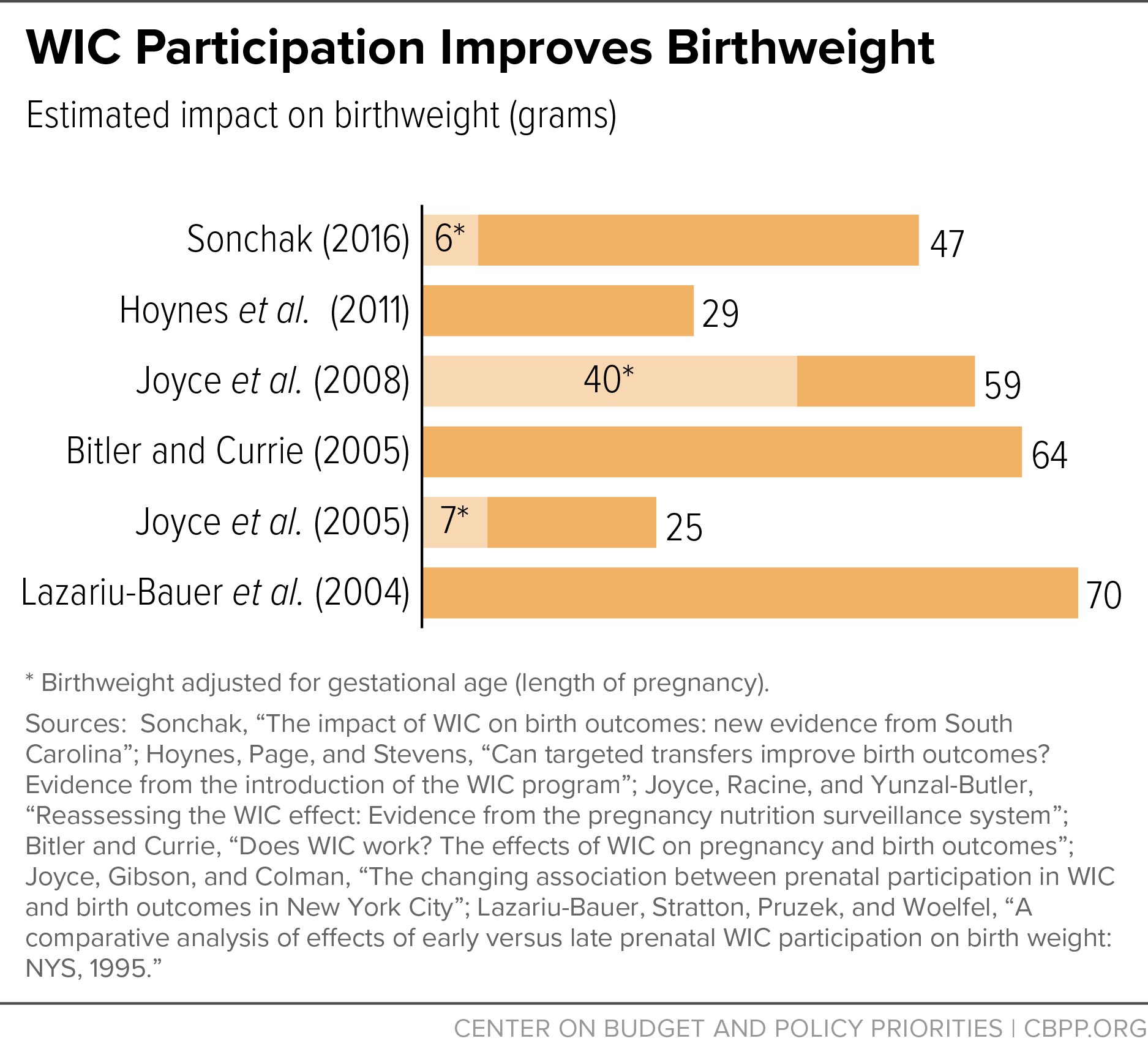
There has been less consensus on the size of WIC’s positive impact. A substantial body of research[31] has generally shown that WIC participation is associated with increases in birth weights ranging from about 25 to 80 grams. (See Figure 2.) While small, these increases are likely to be clinically relevant. As one group of researchers noted, “[s]mall WIC impacts on birth outcomes may be sufficient for program benefits to exceed costs, given the relatively modest program costs per pregnant mother and the substantial medical and other social savings associated with averting even a small number of poor birth outcomes.” [32] One influential study estimated that WIC reduced the probability of low birthweight by about 30 percent and the probability of very low birthweight (less than 1,500 grams or 3.3 pounds) by about half.[33] Few of these studies, however, account for the fact that those whose pregnancies last longer have more opportunity to enroll in WIC, so the positive outcomes seemingly associated with WIC participation may reflect the longer pregnancy. (See the Appendix for a discussion of gestational age bias.)
Studies that adjust for gestational age at birth often still find that WIC makes a positive, but more modest, difference. Two studies, for example, reported an 11 percent reduction in the incidence of small-for-gestational-age births.[34] A third study found infants participating in WIC to be about 6 percent less likely to be low birthweight and 5 percent less likely to be small for gestational age.[35] A fourth study found that Black people who participate in WIC are 5 percent less likely to deliver a low-birthweight infant and their infants are 5 percent less likely to be small for gestational age. [36]

Prenatal WIC Participation Lowers the Risk of Infant Mortality
Infant mortality — death in the first year after a live birth — takes a serious toll on families and is a broader indicator of the health and well-being of communities and the nation. Over 20,000 infants die in the U.S. each year, according to the most recent information from the Centers for Disease Control and Prevention (CDC). Infant mortality rates are more than twice as high among Black parents as white parents.[37] Many factors contribute to infant mortality, including the quality of health care and parental nutrition.
WIC can reduce the risk of infant mortality by connecting expectant parents to essential prenatal health care, promoting healthy eating through nutrition assessments and counseling, and providing healthy foods tailored to the specific needs of expectant parents and their babies.
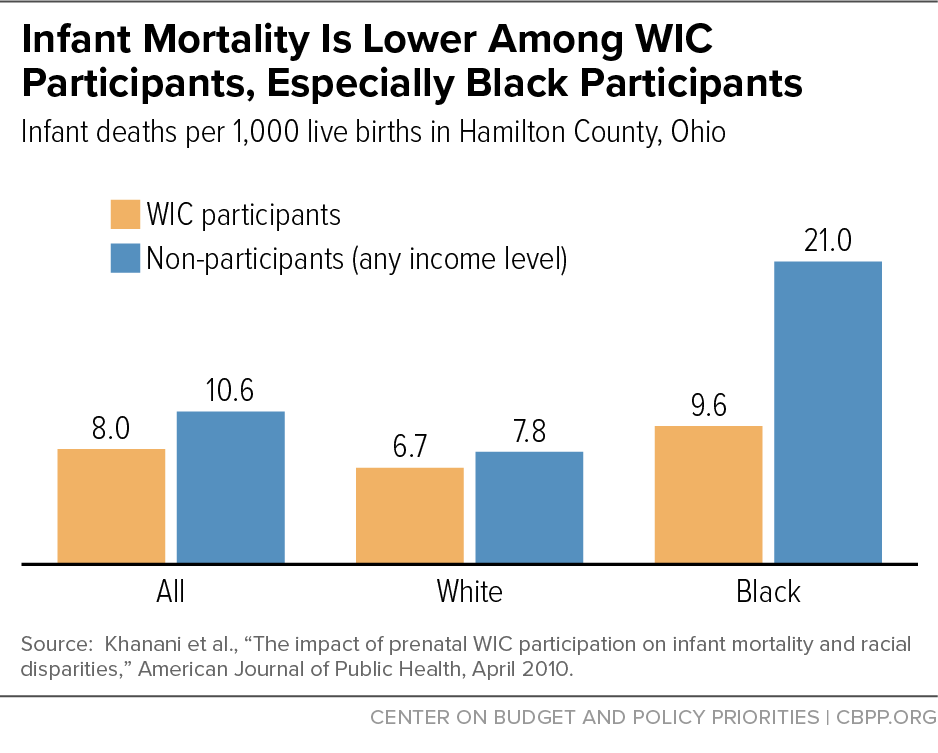
Several early studies suggested that prenatal WIC participation was associated with reductions in infant mortality.[38] Although researchers have paid less attention to this issue since then, recent evidence suggests a similar conclusion. One national study published in 2017 found that prenatal participation in WIC reduced the likelihood of infant mortality by about 15 percent.[39] In addition, researchers in Ohio found a lower infant mortality rate among WIC participants (8.0 infant deaths per 1,000 live births) than non-WIC participants (10.6). The difference was especially striking for Black individuals, with a rate of 9.6 among WIC participants compared to 21.0 among non-WIC participants.[40]
This suggests that WIC can significantly reduce racial disparities in infant mortality. A similar examination of infant mortality rates in Kansas found a comparable difference among Black individuals (9.8 among WIC participants compared to 17.7 among non-participants). WIC participation, however, was associated with a slightly higher infant mortality rate among white parents.[41] However, the most recent comprehensive research review concluded that parental WIC participation is likely to be associated with lower risk of infant mortality.[42]
WIC’s Impacts on Nutrition
WIC supports healthier diets, promotes breastfeeding and better infant feeding practices, and may improve food security among children. Since the 2009 introduction of improved food packages better aligned with current dietary guidance, WIC participants are purchasing and consuming more fruits, vegetables, whole grains, and low-fat dairy.
Adequate nutrition during infancy and early childhood is essential to the growth, health, and development of children to their full potential. Moreover, it is important to establish healthful eating behaviors early in life. CDC research teams have linked detailed data on infants’ feeding practices to their diet, health, and development six years later to show the importance of early nutrition for long-term health outcomes. For example, infants who are breastfed longer and introduced to foods or beverages other than breast milk later tend to have lower rates of ear, throat, and sinus infections by age 6.[43] By contrast, infants who consume sugar-sweetened beverages are twice as likely to consume them and to be obese at age 6.[44] And infants who consume fruits and vegetables infrequently are more likely to be infrequent consumers at age 6.[45]
WIC Supports More Nutritious Diets Among Infants and Young Children
WIC improves the quality of participants’ diets by providing healthy foods tailored to meet the nutrient needs of parents and their children during pregnancy, breastfeeding, infancy, and childhood. Participants can use WIC vouchers only for specific healthy foods, such as whole grains, dairy, fish, peanut butter, beans, fruits, and vegetables.
In addition, WIC makes nutrition education available to parents and caretakers. Participants — individually or in groups — meet with a nutritionist, registered dietitian, or trained paraprofessional to learn about the important relationships among nutrition, physical activity, and health. They also discuss issues such as healthy eating during and after pregnancy, developing healthy eating habits in children, reading food labels when shopping, and cooking healthy meals.
Children participating in WIC are more likely to obtain essential vitamins and minerals. There is strong evidence that the introduction of WIC in the 1970s increased infants’ and children’s intake of some essential vitamins and minerals, especially iron. While vitamin and mineral intake has improved for most children since that time, research suggests that WIC participation continues to increase the iron density of preschoolers’ diets.[46] The most recent comprehensive review of the evidence concludes that young children participating in WIC may take in more vitamin D and iron and less saturated fat than eligible non-participants and that recent changes to the WIC food package may have improved nutrient intakes still further.[47]
Children participating in WIC are more likely to consume healthier foods. A child’s participation in WIC is associated with greater consumption of 100 percent fruit juice, whole grain cereals, and an age-appropriate transition from whole milk for younger children to low-fat milk for older children.[48] A national study found, for example, that infants participating in WIC were more likely to consume infant cereal and baby food vegetables, toddlers were more likely to consume whole milk, and young children were more likely to consume low-fat milk than eligible non-participants.[49]
Children participating in WIC are more likely to have healthier overall diets. The focus of some research has shifted to the overall diet of infants, toddlers and young children, moving beyond single foods, food groups, or nutrients. The most recent systematic review of this evidence found meaningfully higher scores on the Healthy Eating Index (HEI) among children participating in WIC, and concluded that participation and exposure to the current food package is associated with improved diet quality.[50] A study published after the systematic review found that the HEI scores of children participating in WIC were about 5 percent (3 points) higher than eligible non-participants after controlling for potential selection bias.[51] More recently, a study based on 20 years of national data found a 20 percent reduction (roughly 10 points on the HEI) in overall diet quality among children who aged out of WIC (i.e., reached their 5th birthday) but had not yet enrolled in school and so were not yet eligible for free or reduced-price school meals.[52]
The length of time children participate in WIC may affect the quality of their diets. Children who participated in WIC during most of their first two, three, or four years of life had better-quality diets than children who, despite remaining eligible for benefits, stopped receiving WIC benefits before their first birthday. Importantly, those who participated consistently during their first five years had better overall diets at age 6, suggesting that WIC’s nutrition assistance and education may influence dietary choices even as they lose eligibility for program benefits.[53] There is also some evidence that duration of WIC participation is associated with reduced consumption of sugar-sweetened beverages and the likelihood of meeting dietary recommendations to limit added sugar.[54]
WIC Supports More Nutritious Diets Among Adults
While the evidence for WIC’s impact on the healthfulness of foods consumed by adult WIC participants is sparse, the most recent comprehensive review describes two studies that indicate higher HEI scores for WIC participants during pregnancy and suggest greater fruit consumption.[55]
Researchers have also looked at the type and nutritional quality of foods purchased by WIC participants. One study concludes that participation in WIC is associated with about a 5 percent improvement in nutritional quality of food purchases as reflected in the HEI.[56] Another finds evidence that changes in the food purchases of WIC participants persist even after they leave the program.[57]
Revised Food Packages Have Enhanced WIC’s Impact
In December 2007 (effective in 2009) and again in April 2024 (to be fully implemented by April 2026), USDA updated the rules governing WIC foods based on recommendations from the Institute of Medicine (now called the National Academies of Sciences, Engineering, and Medicine) to align them more closely with current nutrition science and guidance, including the Dietary Guidelines for Americans and the American Academy of Pediatrics’ infant feeding practice guidelines. The 2009 changes were designed to promote sound nutrition and healthy weight by providing vouchers for fruits and vegetables; adding whole grain and soy products; reducing milk, cheese, and juice allowances; restricting the fat content of milk; reducing saturated fat, cholesterol, and sugar; and giving state agencies more flexibility to accommodate the food preferences of specific cultural groups.
The 2024 update codified the increased cash value benefit for purchases of fruits and vegetables, reduced the amount of juice and milk, eliminated flavored milk, expanded the variety of whole grain and protein options, adjusted the amounts of infant foods, and provided additional flexibility for cultural or dietary preferences. These changes further improved the nutritional value of the WIC food packages.
While the 2024 update to the WIC food package is currently being implemented and thus has not been evaluated, many researchers examined the impact of the 2009 changes on the food purchases and consumption choices of different groups of participants, in a variety of locales, using a range of research methods. The results are generally consistent: WIC participants receiving the revised food packages purchased and consumed more fruits, vegetables, whole grains, and low-fat dairy.[58]
Among all WIC participants, for example, multiple national and state studies have suggested a positive relationship between the food package revisions and fruit and vegetable purchases or consumption, although the results of smaller local studies are less consistent.[59] Among children receiving WIC, the revised food packages have been associated with healthier household food purchases, better dietary quality, improved nutrient intakes, and reduced risk of obesity.[60] A recent analysis suggested that the revised food package might have prevented nearly 60,000 cases of childhood obesity in 2019 and lessened income and racial disparities in the prevalence of obesity.[61]
Fewer studies have looked specifically at the impact of the changes to WIC packages on adults. Researchers found some moderate improvements in several measures of dietary quality and nutrient intake during pregnancy among participants in Memphis and surrounding Shelby County, Tennessee, although these did not persist more than a month after delivery. Another study using national survey data found no evidence of significant improvements in dietary quality among adults receiving WIC, but the sample of WIC participants after implementation of the revised food packages may have been too small (just 81 participants) to detect a meaningful difference. Other studies found a reduction in the likelihood of gaining more than recommended weight during pregnancy and an increase in the likelihood of breastfeeding following introduction of the revised food package.[62]
A distinct component of the current WIC food package that has been shown to have a positive impact is the monthly cash value benefit that can be used to purchase fruits and vegetables. In its 2017 report on how to update the WIC food packages, the National Academies of Sciences, Engineering, and Medicine recommended increasing the cash value benefit to allow participants to purchase fruits and vegetables representing half the recommended daily intake. In response to the economic disruptions caused by the COVID-19 pandemic, Congress authorized an increase to the cash value benefit to begin during the summer of 2021. The increase was adjusted to more closely match the National Academies’ recommendation and extended for the next three fiscal years through appropriations laws before being made permanent through rulemaking.[63]
Research across multiple states following implementation of the 2021 increase shows that it increased the amount, variety, and quality of fruit and vegetables purchased and consumed, especially among children whose intakes were initially the lowest;[64] increased food security for some families with limited resources;[65] and increased participant satisfaction, potentially improving participation and retention in the WIC program.[66]
WIC Promotes and Supports Breastfeeding
Breastfeeding is associated with significant health benefits for both the child and parent. Breastfeeding is a beneficial source of nutrition that provides the healthiest start for an infant and lowers a parent’s risk of developing certain cancers and chronic diseases. The American Academy of Pediatrics recommends that new parents breastfeed exclusively for about the first six months of a baby’s life and continue for as long as mutually desired by parent and baby.[67] In addition to its nutritional benefits, breastfeeding protects against a number of childhood illnesses and allergies and is associated with reductions in Sudden Infant Death Syndrome and obesity. It also strengthens the emotional connection between parent and baby.[68]
The decision to begin and continue breastfeeding is influenced by a complex array of factors, of which participation in WIC is only one. These include individual characteristics such as age, education, socioeconomic status, health, and parental confidence; the newborn’s health; the method of delivery and duration of labor; the extent of family support and involvement of a second parent; and societal factors such as workplace and parental leave policies, access to lactation support, and cultural practices.[69]
Because of the associated health benefits, the WIC program promotes breastfeeding as the optimal infant feeding choice and supports new parents along the way. WIC offers new parents breastfeeding counseling, peer support, and enhanced benefits, while also providing safe and appropriate food for formula-fed infants. Parents who choose to breastfeed receive ongoing counseling, educational materials, and follow-up support from others with personal experience. Breastfeeding parents also retain their eligibility for WIC benefits longer. Those who exclusively breastfeed receive a food package that is both larger and more varied than the packages provided to those who use infant formula.
USDA strengthened the incentives and support for breastfeeding when new food packages were implemented in 2009, in response to recommendations from the Institute of Medicine, which is now called the National Academies of Sciences, Engineering, and Medicine. Following a second review of the food packages, in 2017 the National Academies recommended additional revisions to better support breastfeeding parents and infants. These recommendations were incorporated into program rules in April 2024.[70]

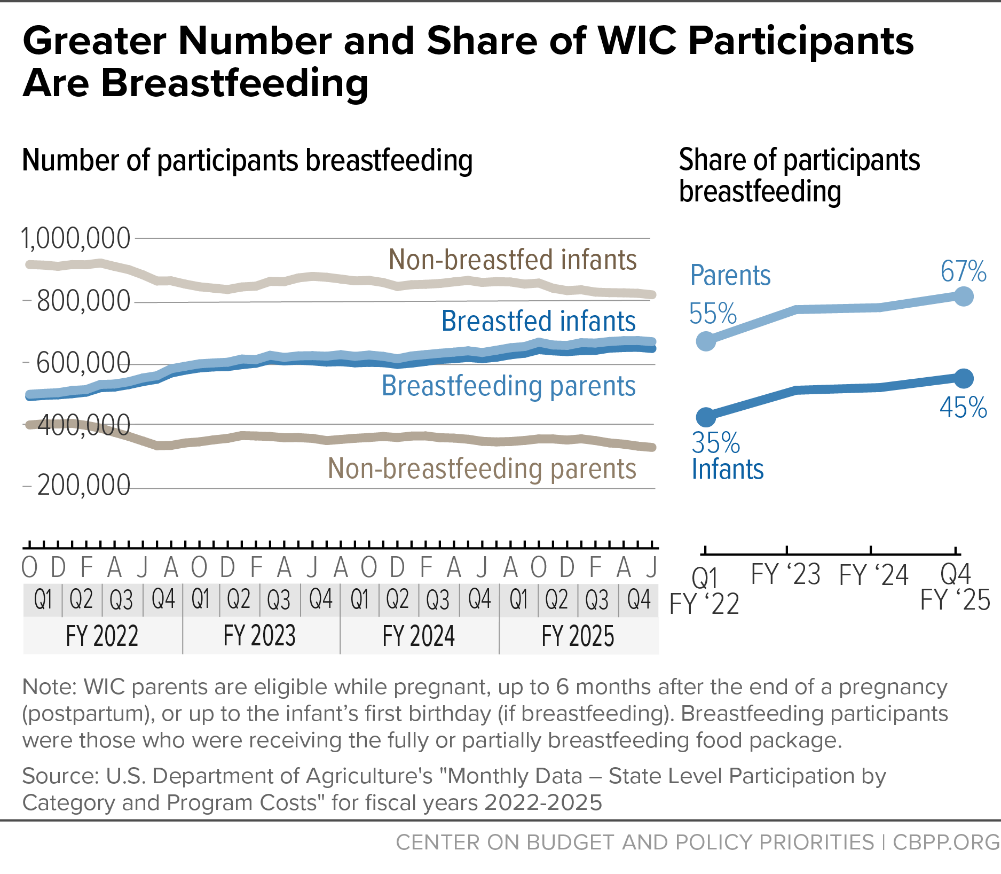
Breastfeeding rates among program participants generally trended upwards in recent decades before leveling off around 2016. (See Figure 3.) More recent monthly participation data shows an uptick in breastfeeding since 2022. [71] Between the first quarter of fiscal year 2022 and the last quarter of fiscal year 2024, the number of fully or partially breastfeeding adult participants grew by 26 percent, the share of postpartum participants who were breastfeeding grew from 55 percent to 64 percent, and the number of non-breastfeeding adult participants declined by 14 percent.[72] (See Figure 4.) Likewise, over the same period the number of fully or partially breastfeeding infant participants grew by 29 percent, the share of infant participants who were breastfeeding grew from 35 percent to 43 percent, and the number of non-breastfeeding infants declined by 6 percent.
These breastfeeding increases were likely triggered by the widespread and acute infant formula shortage during much of fiscal year 2022. As parents struggled to find formula, the number of breastfeeding infants and parents escalated. But as the shortage abated in fiscal year 2023, breastfeeding among WIC participants remained at its elevated level and continued to climb, though more slowly, through fiscal year 2024, indicating that the shift might be sustained.

In general, however, WIC participants are still less likely than non-participants to breastfeed their infants despite these improvements and WIC’s strong policy and operational emphasis on promoting breastfeeding.[73] This raises the question of whether providing free infant formula creates an incentive for formula feeding, thereby discouraging breastfeeding, or whether instead new parents who are already less likely to breastfeed are more likely to participate in WIC in order to get help obtaining infant formula. Individuals who are Black, less educated, lower income, or younger are less likely to breastfeed than others and are also more likely to participate in WIC.
A recent study based on a large sample of children suggested that the negative association between WIC participation and breastfeeding is largely due to selection bias — meaning that people who are less likely to breastfeed could be more likely to enroll in WIC.[74] The most recent systematic review of this question and more current research found little evidence that WIC participants are less likely to begin breastfeeding than eligible non-participants, after controlling for other differences between these two groups, and some evidence that the breastfeeding support services provided by WIC may improve the initiation and duration of breastfeeding.[75] Thus, current evidence does not support concerns that WIC participation deters breastfeeding initiation.[76]
Recent evidence also suggests that breastfeeding may encourage continued participation in WIC as children grow older. Many families drop out of WIC around the time that children reach their first birthday — at which time eligibility must be recertified and the food package changes from one appropriate for an infant to one for a young child — even though they remain eligible.[77] USDA’s Economic Research Service reported that 23 percent of families participating in WIC during the first year of an infant’s life leave the program around their first birthday.[78] However, a study of predominately Hispanic infants in Southern California found that those who were fully breastfed during the last half of infancy were three times as likely to be recertified, and partially breastfed infants were twice as likely to be recertified compared to children who were fully formula-fed as infants.[79] And an analysis of national survey data show that infants who were fully breastfed for at least six months were nearly three times as likely to continue on WIC through age 2 as infants who were not breastfed.[80]
In addition, early participation in WIC may improve breastfeeding rates. Those who enter WIC in the first trimester of their pregnancy are more likely to begin breastfeeding and continue breastfeeding longer than those who enter in their third trimester.[81] Among participants with more than one child, early participation in WIC increased the chances of breastfeeding at three months by 15 percent, at six months by 25 percent, and at 12 months by 33 percent.[82]
Evidence also substantiates the beneficial effects of WIC’s breastfeeding support. One study, based on a national sample of participants, suggested that the likelihood of breastfeeding increases with each additional support provided in the WIC clinic — for example, access to peer and lactation counselors, postnatal home visits, flexible administration of breast pump education, or policies that limit formula in the first 30 days postpartum.[83] Another study of parents of infants in seven WIC clinics suggested that those who receive a WIC breastfeeding consultation are a third more likely to exclusively breastfeed than those who do not.[84] A third study in greater Minnesota (outside the Minneapolis-St. Paul metropolitan area) compared counties with and without WIC peer counselors and found that the availability of breastfeeding peer counseling resulted in increases of 3 to 4 percentage points in breastfeeding rates at three and six months, and increases of 4 to 5 percentage points in rural counties.[85]
WIC Supports Better Infant Feeding Practices
The American Academy of Pediatrics recommends introduction of solid foods into a baby’s diet around six months and delaying the introduction of cow’s milk until a child’s first birthday. Babies who start eating solid food too early are more likely to be overweight or obese later in life. Cow’s milk is not only difficult for infants to digest but fails to provide all the fat, calories, and nutrients (especially iron) babies need to grow well and be healthy.
WIC supports healthy infant feeding by excluding all cow’s milk from infant food packages; introducing infant cereal, fruits, and vegetables at six months; and, for fully breastfed babies, introducing infant meats at six months. In addition, WIC includes infant formula in food packages for those who are unable or choose not to breastfeed, to ensure that all infants have a safe and appropriate source of good nutrition.
Data from a national survey of infant feeding practices show that the early introduction of solid foods is no longer a major issue among WIC participants. Only 20 percent of parents participating in WIC introduce solid foods —cereals, fruits, vegetables, or meat — before four months, compared to at least 60 percent 20 years ago.[86] The median age of introduction is solid foods (i.e., the point at which 50 percent of parents have introduced a food) is 4.5 months for baby cereal, six months for fruits and vegetables, and eight months for meats.[87] In addition, cow’s milk is introduced to most infants participating in WIC near their first birthday, consistent with current guidance. At eight months of age, only 10 percent of participating infants have consumed cow’s milk, and by 11 months, 37 percent have. Results from a more recent national survey affirm the conclusion that the overwhelming majority of WIC and other infants do not consume solid foods before four months.
There is suggestive evidence of a cyclic pattern of formula feeding among some low-income families — meaning infant formula feeding shows a pattern of increasing and then decreasing throughout the month. The share of energy intake (calories) derived from formula at the beginning of a month (68 percent) was significantly higher than at the end of a month (58 percent). Because there was no change in total energy consumed, it appears that adults compensated for the reduced formula by substituting non-recommended foods. And, in fact, adult participants were significantly more likely to feed cow’s milk or fruit juice to their infants at the end of a month than at the beginning. Most of the participants in this study purchased their entire allotment of WIC formula at once, within two or three days of issuance. Although a single shopping trip reduces the burden of multiple shopping trips, having a month’s supply of formula on hand may increase overuse at the beginning of the month and lead to shortages at the end. Although the study was based on a small sample of participants in a single WIC clinic, these findings are of concern because cyclic feeding patterns during infancy may be associated with an increased risk of obesity.[88]
WIC May Improve Food Security
Food security — access to a safe and secure source of enough food to sustain an active, healthy life — is important for children to develop normally and grow up healthy. Food insecurity among children is associated with many adverse consequences for cognitive development as well as for school readiness, academic performance, and educational attainment; physical, mental, and social health; and behavior. Recent research has shown that even marginal food security is associated with poor health and developmental outcomes.[89]
WIC could improve food insecurity and reduce hunger as part of the national nutrition safety net, though these goals are not a central part of its mission. WIC’s monthly food package effectively supplements household food budgets, increasing participants’ resources to buy food and potentially improving food security.[90]
Relatively few studies have looked directly at the relationship between WIC and food security. There is some indication, however, that participation in WIC is associated with reductions in food insecurity, especially among children. One study estimated that participation in WIC reduces the prevalence of food insecurity among children by at least 20 percent.[91] Another found that households experienced reduced food insecurity after WIC’s cash value benefit for fruit and vegetable purchases was increased in 2021.[92] In addition, indirect evidence of WIC’s impact is found in increases in food insecurity in households when children age out of WIC after their fifth birthday and have not yet enrolled in kindergarten, so do not receive free or reduced-price meals at school.[93] And while participation in WIC alone during childhood did not result in reduced food insecurity later as an adult in one study, participation in both SNAP and WIC had a larger positive effect on food security during adulthood than participation in either program alone.[94]
WIC’s Impacts on Immunization, Health, and Cognitive Development
Low-income children participating in WIC have immunization rates comparable to more affluent children and significantly higher than low-income children who never participated. Children participating in WIC are also more likely to receive preventive medical care than other low-income children. And participation in WIC may help reduce childhood obesity and the prevalence of anemia and possibly asthma. In addition, new evidence suggests that early exposure to WIC may improve children’s educational prospects.
WIC Helps Ensure That Children Are Properly Immunized
Immunizing children against disease helps them stay healthy and protects others from diseases that once harmed or killed thousands of children. Because of advances in medical science, immunized children are protected against more diseases than ever before. Widespread immunization also helps protect those who are too young or unable to be vaccinated. And by reducing, and in some cases eliminating, harmful diseases, today’s vaccinations can protect future generations.
WIC staff screen the immunization records of all infants and children under age 2 and refer parents to immunization services to help ensure that coverage is up to date. Several studies have shown that such screening and referrals are effective ways to increase vaccination rates.[95]
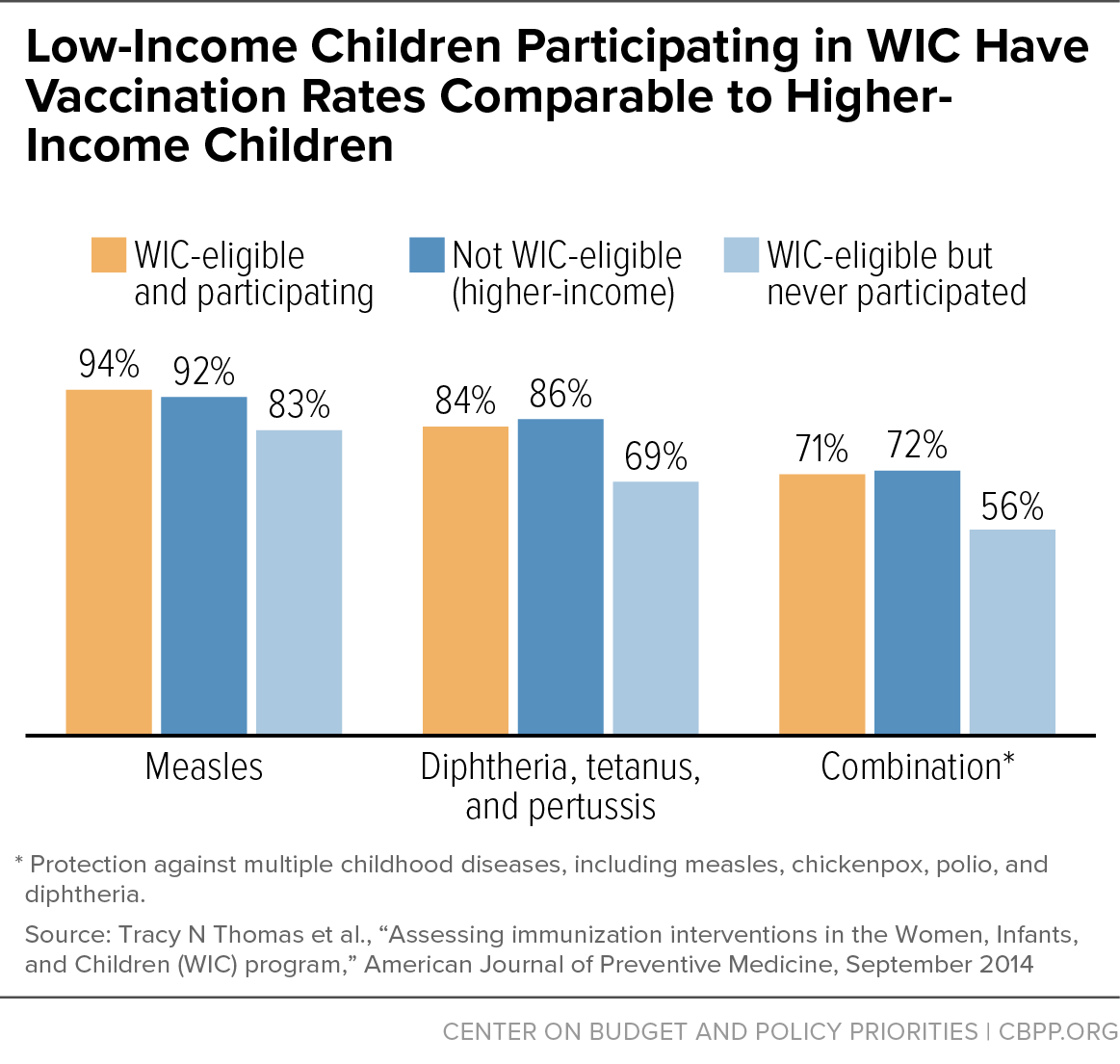
While new research on the relationship between WIC participation and immunization is limited, a recent comprehensive review determined participation in WIC may be associated with increased immunizations.[96] Among families enrolled in Medicaid in South Carolina, WIC participation was associated with a modest increase in the probability that an infant is vaccinated.[97] The findings are more striking for older children. Low-income children who have never participated in WIC have immunization rates ranging from 5 to 19 percent lower than current participants, while children who remain in WIC tend to have immunization coverage comparable to higher-income children.[98] (See Figure 5.)

WIC Improves Access to Health Care
Parental and children’s health depends partially on their access to health care services. Parents and children with access to health care are diagnosed and treated promptly and can obtain quality preventive care, which can enable them to avoid illness or complications. WIC serves as a gateway to health care, connecting families to resources such as prenatal, obstetric, parental, and pediatric care; dental care; and counseling for smoking cessation and substance use. USDA-sponsored research found that 95 percent of children enrolled in WIC as infants have a doctor’s office, health clinic, or other medical facility that they visit for routine physical examinations and wellness checks by the time they near their fourth birthday.[99]
In general, research has shown that children who participate in WIC — or whose parent does — make more use of health care services and are less likely to have unmet health care needs than non-participants. Researchers in North Carolina, for example, concluded that WIC participation among children was associated with increased use of preventive care and increased diagnosis and treatment of common childhood illnesses. Similar results regarding the frequency of well-child visits were found in a survey of unmarried, low-income parents in 20 large cities and in an analysis of Medicaid records in South Carolina. Children were less likely to have no place for routine care or to have never seen a dentist by age 5 if their family participated in WIC.[100]
A recent study shows that people who were enrolled in Medicaid at the time of their delivery (a proxy for low-income individuals) and who also participated in WIC were 30 percent more likely to receive adequate prenatal care than Medicaid enrollees who did not participate in WIC.[101] WIC participation was associated with reduced risk of late entry into prenatal care (at six months or more pregnant) among low-income people who rely on public health insurance (primarily Medicaid) in a California study.[102] Similarly, participation in WIC was associated with an increase in the number of prenatal care visits and reductions in costly admissions to neonatal intensive care units in a large sample of Pennsylvania adults enrolled in Medicaid.[103]
WIC May Reduce Childhood Obesity
The prevalence of childhood obesity in the United States more than tripled between the late 1970s and the 2020s with 1 in 5 children now overweight or obese.[104] Childhood obesity is particularly troubling because it is a strong predictor of adult obesity and can start children on the path to health problems previously confined to adults, such as diabetes, high blood pressure, and high cholesterol. Early intervention is important, because the prevalence of obesity increases throughout early childhood and levels off by around age 10.[105]
WIC can reduce the risk of obesity among young children in several ways. The current food packages are calibrated to the number of calories need to maintain a healthy diet. The fruits, vegetables, and whole grains in the food package are consistent with recommended food patterns associated with healthy weight. In addition, WIC encourages breastfeeding, which may protect against excessive weight gain.
While some early research indicated that there may be an association between WIC participation and overweight or obesity, the most recent systematic review of research undertaken after the 2009 food package revisions suggested that the current package actually lowers the risk of an unhealthy weight by 10 percent among children 2 to 4 years old.[106]
WIC Reduces the Prevalence of Anemia and Possibly Asthma
Iron is an essential mineral that, among other functions, carries oxygen throughout the body and helps muscles store and use that oxygen. Iron deficiency anemia, resulting from too little iron in the body, can increase the risk of premature birth, delay normal motor skills and cognitive processing in infants, and cause fatigue or memory loss in adolescents and adults. In addition, the American Academy of Pediatrics notes that iron deficiency without anemia during infancy and childhood can have lasting implications for development and behavior.[107] While the nutrient intakes of infants, toddlers, and young children generally meet or exceed dietary recommendations, there is evidence of a subset of older infants whose iron intake falls short of those recommendations.[108]
WIC was created, in part, to reduce the prevalence of iron deficiency and anemia by providing only iron-fortified infant formulas, infant foods, and breakfast cereals in prescribed food packages for infants and young children. It may also have had an indirect effect on non-participating children, as manufacturers brought iron-fortified products reformulated for WIC to market, making them available to all children whether they participate in WIC or not.
The evidence suggests that WIC played a role in reducing the prevalence of childhood anemia. CDC researchers found a steady decline in the prevalence of anemia between 1976 and 1985 (from 7.8 percent to 2.9 percent) and a reduction of more than 5 percent for most age and racial and ethnic groups between 1980 and 1991, periods of substantial growth in WIC participation.[109] Most recently, one study found a reduced probability of anemia among young children after introduction of the revised WIC food package in 2009, which indicates improvements in dietary iron intake among children in families participating in WIC.[110]
In addition, several studies have found that participation in WIC is associated with increased iron intake.[111] Data from a national survey of infant and toddler feeding practices show that the risk of inadequate iron intake among older infants (those between 6 and 12 months) is substantially lower among WIC participants (13 percent) than either lower-income (26 percent) or higher-income (34 percent) non-participants.[112]
Early-life access to WIC may also alleviate the burden of asthma and promote lifelong health. The results of one study suggest that every year of access to WIC gradually prevents the onset of asthma.[113]
Children Who Participate in WIC May Be Better Prepared for School
There is substantial evidence that economic disadvantages during critical periods of brain development can affect children’s cognitive and socioemotional development and readiness to learn, producing disparities in behaviors, skills, and academic achievement. These disparities may grow as children age. WIC supports sound nutrition during critical periods of cognitive development to mitigate the detrimental effects of poverty.
Some research suggests that prenatal and early childhood participation in WIC is associated with improved cognitive development, communication skills, and, possibly, academic achievement. Children whose parent participated in WIC while pregnant scored higher on assessments of cognitive development at age 2 than similar children whose parent did not participate. The benefit associated with WIC participation persisted into the school years, as children whose parent participated in WIC when they were in utero performed better on reading assessments.[114] Other studies have found that WIC participation contributes to improved communication skills among children up to 2 years old.[115]
Even brief gaps in program participation may have short-term consequences for achievement. Children who enter kindergarten after aging out of WIC and experience a gap in nutrition assistance coverage score lower on math and reading tests in the fall of their kindergarten year, but not in the spring.[116]
Participation in WIC may also be associated with improved mental health and reduced behavioral problems in early childhood. A recent study in South Carolina associated prenatal WIC participation with a 5 percent reduction in the incidence of Attention-Deficit/Hyperactivity Disorder and other common childhood mental health conditions. Children whose parent participated in WIC during pregnancy were also 8 percent less likely to repeat a grade. The effects were concentrated among Black children and the lowest-income Medicaid recipients — groups at high risk of negative birth outcomes.[117] Research based on a larger, national sample suggested that children who participate in WIC experience fewer behavior problems as they enter school, though the effect may fade as children age into middle school.[118]
WIC’s Impact on Racial and Ethnic Health Disparities
Racial and ethnic health disparities in the United States — i.e., differences in health and health care between groups that stem from broader social and economic inequities — are extensive, persistent, and consequential for disease prevalence, mortality, and access to care.[119] In general, infants of color have higher rates of low birthweight, preterm birth, and infant mortality compared to white infants. People of color are more likely to develop chronic conditions such as diabetes, heart disease, and obesity. Communities of color often experience higher rates of food insecurity, which can lead to nutritional deficiencies and poorer health outcomes. Barriers to health care, including transportation, language, and cultural differences, can disproportionately affect people of color. And despite large gains in coverage since implementation of the Affordable Care Act, people of color are less likely to have health insurance and more likely to go without care due to its cost.[120]
Addressing disparities in health and health care would improve the nation’s overall health and economic prosperity. Racial and ethnic disparities contribute to higher rates of illness and death, limiting the overall health of the nation. Health disparities are also costly, resulting in excess medical bills, lost productivity, and economic loss due to premature deaths.
WIC is positioned to address these disparities in several ways. To begin with, program participation rates are highest among eligible people who are Hispanic or Black.[121] The WIC food package provides nutritious foods that may help establish healthy eating habits early in life and help prevent nutrition-related obesity, diabetes, and heart disease. Current food packages include a wider range of foods more appealing to people from different racial and cultural backgrounds. WIC provides free health screenings and specialized support tailored to individual participants, prioritizing conditions that disproportionately affect people of color, such as preterm birth, low birthweight, and anemia. And, when possible, participants are paired with breastfeeding counselors who share their language, race, or ethnicity to improve the effectiveness of peer counseling.[122]
Most research to date has focused on documenting existing racial and ethnic differences in WIC participation, birth outcomes, dietary quality, breastfeeding, and client satisfaction among program participants. More recently, limited evidence has emerged suggesting that WIC has the potential to reduce some of these disparities.[123]
Prenatal Participation in WIC May Reduce Disparities in Birth Outcomes
Black infants, and to a lesser extent Hispanic infants, tend to have worse overall health than white infants. Prenatal participation in WIC is associated with reduced differences in the risk of infant mortality, preterm birth, low birthweight, neonatal intensive care admissions, and extended hospitalization between babies of color and white infants.[124] Similarly, while the risk of stillbirth among Black people is twice as great as for white people, a study of births in five sites across the country suggested that WIC participation may reduce that risk by nearly 65 percent.[125] A similar narrowing of the gap was observed in Hamilton County, Ohio, where the rate of infant mortality among Black babies born to parents who did not participate in WIC (21 of every 1,000) was substantially higher than the rate among white babies (just under 8 of 1,000). The Ohio study found that the racial gap was substantially smaller among babies born to WIC participants: just under 10 of 1,000 Black infants compared to just under 7 of 1,000 white infants.[126] (See Figure 6.)


Participation in WIC May Reduce Breastfeeding Disparities
WIC participants who identify as Asian, Hispanic, or white are more likely to initiate breastfeeding and continue longer than those who identify as Native American, Black, or Pacific Islander.[127] A recent review of the available research focused on Black parents found mixed results regarding the association between WIC participation and breastfeeding initiation and a general negative association with breastfeeding duration.[128] However, a subsequent study of births in Florida found that Black and Hispanic parents were 10 to 20 percent more likely to begin breastfeeding if they participated in WIC.[129]
Racial and ethnic disparities in breastfeeding have been declining more generally in recent years. From 2009 to 2017, breastfeeding initiation rates increased among low-income individuals regardless of WIC participation status, race, or ethnicity. Non-Hispanic Black people experienced the largest gains over that period, with increases of more than 20 percent, which reduced the breastfeeding disparity between them and other racial and ethnic groups. The gap in breastfeeding initiation between WIC participants and eligible non-participants also narrowed over this period, particularly for Asian Americans and Pacific Islanders, among whom breastfeeding initiation rates rose by 2017 to higher levels for WIC participants (21 percent) than for eligible non-participants (9 percent). The breastfeeding gap between WIC participants and eligible non-participants also narrowed for American Indians and Alaska Natives and non-Hispanic white people.[130]
Participant Experiences in WIC
In recent years, WIC has modernized how services and benefits are obtained by replacing paper vouchers with electronic benefits, developing smartphone apps, exploring online grocery shopping options, and offering remote services. In combination with the increase in the value of the fruit and vegetable component of WIC’s food benefits, these changes could affect how WIC participants experience the program. Several themes emerge from a growing body of research on how participants experience WIC.
Satisfaction With WIC Is Generally Quite High
WIC participants generally report positive perceptions and experiences with the program.[131] About 3 in 4 respondents in a multi-state survey reported no challenges with WIC services. Some especially valued the nutrition, health, and breastfeeding education provided in WIC clinics.[132]WIC participants are highly supportive of the program’s efforts to support diversity, equity, and inclusion. Large majorities of participants agreed that WIC staff make them feel respected, valued, and welcomed, that they can communicate in their own language, relate to their culture, and look like them.[133] Participants’ race, ethnicity, and place of residence, however, may affect their experience and satisfaction with the program. In one study, for example, Black households were more likely to face challenges accessing WIC services than white households, and rural households were generally less satisfied when using WIC than urban households.[134]
Providing Both In-Person and Remote Services Improves Program Access
In response to the COVID-19 pandemic, many WIC services that would typically have been delivered in person were instead delivered via a wide variety of remote methods. While in-person office visits have resumed, many participants continue to use email, online websites, text messages, and video appointments to communicate with staff and provide needed documentation.[135] Participants are highly satisfied with this hybrid approach and find it easier to enroll remotely than in person. There are also indications that WIC staff believe the flexibility of remote options enables them to better serve participants and should be continued.[136] Recent research suggests that waiving requirements for in-person appointments increased WIC participation by 11 percent, even though some areas did not take full advantage of all waivers intended to ease enrollment and retention.[137]
“I actually found it (WIC appointments) much…easier (than in the past) because I didn’t have to go into the office…especially if you can’t find a babysitter. So I found it more convenient for me, because I have such a busy schedule because of school. It works perfectly for me.”[138] — WIC participant in California
Participants Believe WIC Helps Them Purchase More and Better Fruits and Vegetables
As noted earlier in this report, the monthly cash value benefit for purchasing fruits and vegetables was increased starting in 2021. WIC participants in multiple states reported that the higher benefit enabled them to buy a greater amount and wider variety of fruits and vegetables as well as higher-quality produce. Many reported that the overall quality of their child’s diet improved because they could afford to rely less on inexpensive processed foods.
“I thought (the CVB increase) was amazing, because we eat more FV since there’s been an increase. (Before the increase) we were eating more processed food and I don’t think that my daughter was getting adequate nutrition from eating those types of foods [. . . ].”[139]— WIC participant in California
“I started looking up different recipes for different vegetables because I would just buy the basics like carrots, celery, the same old stuff and make the same old soups (before the increase) … and now I buy more cauliflower, squash. We eat a lot of roasted vegetables now and I just want to expose them to a bigger variety.”[140]— WIC participant in California
“[W]e’ve discovered that he loves asparagus and broccoli. So, we could like do that for lunch or like a little midday snack. I give him some grapes, and like broccoli, or strawberries, and asparagus, just for a healthier snack or lunch, instead of going to like freezer meals and potato chips and stuff like that.”[141]— WIC participant in North Carolina
Some Challenges Remain to Enrolling and Retaining Families Despite Modernization Efforts
In recent years state WIC programs have used federal flexibilities to streamline the certification process.[142] Nonetheless, some participants still find it difficult to fit appointments into their work and child care schedules; get to WIC locations during office hours, especially in rural areas; understand the documentation and other requirements for maintaining eligibility; and access technology that works for them.[143] WIC participants who serve the country as members of the armed forces face particular challenges, with frequent relocations and deployments adding to the difficulty of accessing and continuing benefits.[144]
“[Applying was] a very tedious process. Pretty much they were asking for every information possible. I thought I signed up online but I just didn’t understand some of the questions they were asking me. But I must have got it wrong and [had to] resubmit it.”[145]— WIC participant in Virginia
“Every time it seems like we need to renew, my husband’s out of town, he’s deployed, he’s in the field . . . There has to be another system where we don’t have to check every 3 to 6 months.”[146]— Spouse of enlisted military member
Using Benefits in Grocery Stores Can Be a Confusing Process
Grocery shopping isn’t always a smooth experience for WIC participants, despite the completed transition to electronic benefit cards and the development of apps designed to simplify shopping for WIC-approved foods. Once enrolled in WIC, participants must learn which specific foods the program will provide them and how to navigate retailers that vary in the availability of WIC-approved foods, quality of customer service, and compliance with program rules. Dissatisfaction with the retail experience may cause some participants to make less than full use of their benefits or leave the program entirely. For some participants, WIC-authorized foods are sometimes hard to find, grocery store labeling can be non-existent or inaccurate, preferred brands are not always available, and checking out at the register can be stigmatizing.[147]
“[It is hard to shop with WIC benefits] because the grocery stores have things that say they’re WIC, but they don’t go through as WIC items [at the register]. When they slide it, they’re not WIC items. So, it’s confusing.[148]— WIC participant in Virginia
“Some of the people have trouble if you pick a different grocery store, you can’t find the brand, you get the wrong brand, you get the wrong size, you’ve got to be doing math….I mean, it’s confusing enough picking your cereal … now I can get this type of Cheerios — not just this type, but now I’ve got to add up boxes to add to this exact amount of Cheerios, but your kid wants this Cheerios. Well, you can’t get that one. So I think people get frustrated.”[149]— WIC participant in North Carolina
“I would just say the lines are hard to take. I’ve [met] people on line that you can tell are irritated with me or you can tell they are like, ‘Oh, God, here you go’ and I have to do five WIC vouchers [laughs].”[150]— WIC participant in Oregon
“People, cashiers, they give you a look when they see that you’re walking up with your WIC folder.”[151]— WIC participant in New York
WIC’s Impacts on Neighborhood Food Environments
Neighborhoods can affect diet quality and health.[152] Eating a healthy diet may be difficult because nutritious options are not readily available, easily accessible, or affordable in a local community. Many low-income communities have few stores that sell healthy food, especially high-quality fruits and vegetables.[153]
Requirements that stores participating in WIC stock an array of nutritious foods have helped improve access to fruits, vegetables, and whole grains in many low-income communities.[154] The 2009 revisions to the WIC food packages in particular helped reshape the food retailing landscape. To obtain authorization to accept WIC food vouchers, stores must meet minimum food inventory requirements established by states, consistent with federal standards.[155] As a result of the food package revisions, all WIC-authorized grocery stores must now stock at least two varieties of fruits, two varieties of vegetables, and at least one whole-grain cereal.
Although participants obtain most of their WIC foods in large superstores, supermarkets, or grocery stores, small grocery, convenience, and corner stores are important to the overall food environment in many neighborhoods.[156] The latest generation of research strongly suggests that the 2009 requirements increased access to healthy foods in these smaller stores, especially in low-income communities. Multiple studies, conducted in various locations using different study designs, have consistently found that availability of healthy foods — including fruits, vegetables, and whole grains — increased after implementation.[157] Within months of implementation, for example, WIC-approved convenience and grocery stores in Connecticut, especially those in low-income areas, offered more and a wider variety of healthy foods, especially whole-grain products.[158]
Authorization to accept WIC benefits also has advantages for retailers, particularly smaller stores that may be the only easily accessible food store in some low-income communities. Recent research took advantage of a natural experiment in which one national discount variety store chain often located in low-income neighborhoods became an authorized WIC vendor in eight stores in North Carolina. Researchers found that becoming a WIC-authorized vendor led to an increase in sales of healthy, WIC-eligible foods compared to similar stores not authorized as WIC vendors. In addition to an increase in sales volume of WIC-eligible foods, average weekly dollar sales per store increased by 15 percent.[159]
Conclusion
Poverty and adversity during early childhood can have lifelong consequences for physical, mental, and economic well-being. WIC is designed to support sound nutrition and health at critical points in development — in utero, during infancy, as a toddler, and during the early childhood years. An extensive body of research over nearly half a century shows that WIC participation is associated with healthier births, reduced infant mortality, better infant-feeding practices, more nutritious diets, better access to primary and preventive health care, and improved cognitive development and academic achievement. Recent research also suggests that WIC may reduce racial and ethnic health disparities, has high participant satisfaction, and can improve neighborhood food environments. These striking results highlight the importance of ensuring that all eligible parents and young children can get WIC benefits during pregnancy and critical periods of child development.
Appendix: Assessing the Strength of Evidence
WIC is one of the most thoroughly studied federal programs. The extensive research literature on WIC provides strong evidence of its effectiveness but has certain limitations, which can overstate or understate its impact.[160] Four commonly cited limitations are that these studies: (1) are almost entirely non-experimental, based on statistical comparisons between those who received benefits and those who did not; (2) are subject to potential selection bias as a consequence; (3) do not fully address the problem of gestational age bias; and (4) do not sufficiently consider prenatal survival bias.
Experimental versus non-experimental evidence. Some research methods provide better evidence than others. The “gold standard” for evaluating the effectiveness of a program or intervention is the randomized control trial, which is designed to minimize the risk that factors unrelated to the intervention or program benefit will influence the results. These trials randomly assign people to either a treatment or a control group. Researchers can accurately estimate the impact of program participation as the difference in outcomes between the treatment and control groups because they were randomly selected from the same population, lived through the same shifting programmatic, economic, and social conditions, and differ only in their program experience.
However, randomized control trials are generally not feasible to evaluate WIC’s effectiveness for a number of reasons, including the ethical issues raised by withholding beneficial nutrition and health benefits from a random sample of low-income parents and children. As a result, researchers rely on a variety of quasi- and non-experimental approaches.
Selection bias. In the absence of a randomized control trial, research results may be biased by the self-selection of low-income parents and their children into WIC. If parents who enroll in WIC are more able, more motivated, healthier, or have access to better health care than other parents, then selection bias may lead researchers to mistakenly conclude that WIC is more effective than it really is. But if parents who enroll in WIC are more disadvantaged, exhibit more risky behaviors, or are more likely to experience adverse birth outcomes than others, then selection bias may lead to conclusions that WIC is less effective than it really is.
However, the potential of selection bias does not justify overly discounting findings from non-experimental research. A vast number of studies reflecting different time periods, samples, and ways of addressing selection bias support the conclusion that WIC works.[161] Moreover, most evidence suggests that selection bias is more likely to lead to underestimates of WIC’s beneficial impacts because WIC participants are more disadvantaged and prone to adverse birth outcomes than low-income non-participants. One influential study, for example, reported that adult WIC participants are more disadvantaged than other low-income adults in terms of education, age, marital status, involvement of a second parent, smoking behavior, obesity, use of public assistance, employment, and incidence of a previous low birthweight or premature infant. Despite these disadvantages, WIC participation was still associated with positive outcomes.[162]
Gestational age bias. Individuals whose pregnancies last longer have better birth outcomes. They also have more time to enroll in WIC. Thus, those whose pregnancies last longer may have better birth outcomes because of their longer pregnancies, not because of WIC. Some researchers argue that the strong association observed among prenatal WIC participation, birth weight, and the frequency of preterm births is largely meaningless, because it is the result of not controlling for gestational age bias. As a result, they focus on measures of fetal growth (such as birth weight adjusted for gestational age) and find positive but more modest associations with WIC participation.[163]
It is likely, however, that correcting for gestational age at birth may understate WIC’s positive impact on birth outcomes because it does not capture any positive effect WIC has on extending the duration of healthy pregnancies. Participation in WIC could help extend healthy pregnancies, for example, by better connecting expectant parents to prenatal health care. A recent study shows that people who were enrolled in Medicaid at the time of their delivery (a proxy for low-income individuals) and who also participated in WIC were 30 percent more likely to receive adequate prenatal care than Medicaid enrollees who did not participate in WIC.[164]
To assess the effect of WIC on extending the duration of healthy pregnancies, one study used linked birth and death certificates and WIC records in California to compare WIC participants and individuals eligible for WIC but not enrolled in each week of gestation. This approach addresses gestational age bias by comparing birth outcomes among those whose pregnancies reach the same length and who have the same opportunity to use WIC. This study suggested that WIC participation is associated with large reductions in the risk of adverse birth outcomes beginning about the 29th week of pregnancy. Specifically, the risk of premature birth was reduced by up to 48 percent, the risk of low birthweight by 23 to 36 percent, and the risk of perinatal death (defined as fetal or infant death 20 to 46 weeks after the last menstrual period) by 22 to 31 percent.[165]
Using a different method to assess the association between WIC participation and gestational age, other researchers found a more modest reduction in the risk of a premature birth. The risk of a preterm birth was reduced by as much as 9 percent in Oklahoma and as much as 7 percent in Missouri for individuals who began participating in WIC at the beginning of their pregnancy.[166] Within a large sample of Pennsylvania adults participating in Medicaid, participation in WIC reduced the incidence of low birthweight for gestational age by about 5 percent.[167]
- Prenatal survival bias. Some researchers have recently argued that more attention needs to be paid to the processes that affect which implanted pregnancies become live births, because the same mechanisms believed responsible for many of the lasting effects of early adversity are documented predictors of whether a healthy pregnancy is established and maintained. These researchers suggest that assuming prenatal selection is random, when in fact it is not, can produce a non-trivial bias that may mask the true effect of a program like WIC. The true effect of WIC, they speculate, may be substantially underestimated or not detected at all in the presence of this survival bias if program participation improves survival in the early stages of pregnancy.[168]
Our assessment acknowledges the valid evidential contribution of different research methods while giving greater weight to evidence generated from groups of studies across multiple populations, settings, and circumstances. While the research about WIC’s effectiveness may rely on methods that fall short of the “gold standard,” few public programs have so consistent a body of positive research findings.
End Notes
[1] Steven Carlson is a research analyst who previously directed the Office of Policy Support at the U.S. Department of Agriculture’s Food and Nutrition Service. The opinions and conclusions expressed in this report are solely those of the authors and should not be construed as representing the views of the U.S. Department of Agriculture.
[2] Clancy Blair and C. Cybele Raver, “Poverty, Stress, and Brain Development: New Directions for Prevention and Intervention,” Academic Pediatrics, Vol. 16, No. 3, December 1, 2016, https://www.academicpedsjnl.net/article/S1876-2859(16)00026-7/fulltext.
[3] Mary Kay Fox, William Hamilton, and Biing-Hwan Lin, “Effects of Food Assistance and Nutrition Programs on Nutrition and Health: Volume 3, Literature Review,” United States Department of Agriculture Economic Research Service, December 9, 2004, https://www.ers.usda.gov/publications/pub-details?pubid=46574; Silvie Colman et al., “Effects of the Special Supplemental Nutrition Program for Women, Infants, and Children (WIC): A Review of Recent Research,” United States Department of Agriculture Food and Nutrition Service, January 2012, https://www.fns.usda.gov/effects-special-supplemental-nutrition-program-women-infants-and-children-wic-review-recent-research; Steven Carlson and Zoë Neuberger, “WIC Works: Addressing the Nutrition and Health Needs of Low-Income Families for More Than Four Decades,” Center on Budget and Policy Priorities, January 27, 2021, https://www.cbpp.org/research/food-assistance/wic-works-addressing-the-nutrition-and-health-needs-of-low-income-families; Laura Caulfield et al., “Maternal and Child Outcomes Associated with the Special Supplemental Nutrition Program for Women, Infants, and Children (WIC),” Agency for Healthcare Research and Quality, April 2022, https://www.ncbi.nlm.nih.gov/books/NBK579797/.
[4] See, for example, J Brooks-Gunn, G J Duncan, “The effects of poverty on children,” Future of Children, Vol. 7, No. 2, 1997, https://pubmed.ncbi.nlm.nih.gov/9299837/. For a comprehensive review of more recent evidence that children growing up in families with low incomes fare worse than children in more affluent families, see National Academies of Sciences, Engineering, and Medicine, “A Roadmap to Reducing Child Poverty,” The National Academies Press, 2019, https://www.nationalacademies.org/projects/DBASSE-BCYF-16-05/publication/25246.
[5] See, for example, John Cook and Deborah Frank, “Food Security, Poverty, and Human Development in the United States,” Annals of the New York Academy of Sciences, Vol. 1136, No. 1, July 25, 2008, https://nyaspubs.onlinelibrary.wiley.com/doi/10.1196/annals.1425.001; Rafael Perez-Escamilla and Rodrigo Pinheiro de Toledo Vianna, “Food Insecurity and the Behavioral and Intellectual Development of Children: A Review of the Evidence,” Journal of Applied Research on Children, Vol. 3, No. 1, 2012, http://digitalcommons.library.tmc.edu/childrenatrisk/vol3/iss1/9; Klébya Hellen Dantas de Oliveira et al., “Household food insecurity and early childhood development: Systemic review and meta-analysis,” Maternal and Child Nutrition, Vol. 16, No. 3, February 12, 2020, https://onlinelibrary.wiley.com/doi/10.1111/mcn.12967; Danielle Gallegos et al., “Food Insecurity and Child Development: A State-of-the-Art Review,” International Journal of Environmental Research and Public Health, Vol. 18, No. 17, August 26, 2021, https://www.mdpi.com/1660-4601/18/17/8990; Food insecurity is defined as lack of access to a safe and secure source of enough food to sustain an active, healthy life.
[6] Neal Halfon et al., “Measuring Equity From The Start: Disparities In The Health Development of US Kindergartners,” Health Affairs, Vol. 39, No. 10, October 2020, https://www.healthaffairs.org/doi/10.1377/hlthaff.2020.00920.
[7] Bergen Nelson et al., “Predictors of Poor School Readiness in Children Without Developmental Delay at Age 2,” Pediatrics, Vol. 138, No. 2, August 1, 2016, https://publications.aap.org/pediatrics/article-abstract/138/2/e20154477/52460/Predictors-of-Poor-School-Readiness-in-Children?redirectedFrom=fulltext.
[8] Luke Hyde et al., “An ecological approach to understanding the developing brain: Examples linking poverty, parenting, neighborhoods, and the brain,” American Psychologist, Vol. 75, No. 9, 2020, https://psycnet.apa.org/doiLanding?doi=10.1037%2Famp0000741.
[9] Aditi Shrivastava and Urvi Patel, “Research Reinforces: Providing Cash to Families in Poverty Reduces Risk of Family Involvement in Child Welfare,” Center on Budget and Policy Priorities, May 1, 2023, https://www.cbpp.org/research/income-security/research-reinforces-providing-cash-to-families-in-poverty-reduces-risk-of; Greg Duncan et al., “The Importance of Early Childhood Poverty,” Social Indicators Research, Vol. 108, May 25, 2012, https://link.springer.com/article/10.1007/s11205-011-9867-9.
[10] Clancy Blair et al., “Allostasis and allostatic load in the context of poverty in early childhood,” Development and Psychopathology, July 15, 2011, https://www.cambridge.org/core/journals/development-and-psychopathology/article/abs/allostasis-and-allostatic-load-in-the-context-of-poverty-in-early-childhood/DFB2E31408F0741B071BE94CA228EAF6.
[11] Daniel Brisson et al,, “A Systematic Review of the Association between Poverty and Biomarkers of Toxic Stress,” Journal of Evidence-Based Social Work, Vol. 17, No. 6, July 12, 2020, https://www.tandfonline.com/doi/full/10.1080/26408066.2020.1769786.
[12] Jack Shonkoff et al., “ The Lifelong Effects of Early Childhood Adversity and Toxic Stress,” Pediatrics, Vol. 129, No. 1, January 2012, https://publications.aap.org/pediatrics/article/129/1/e232/31628/The-Lifelong-Effects-of-Early-Childhood-Adversity; Janet Currie and Maya Rossin-Slater, “Early-Life Origins of Life-Cycle Well-Being: Research and Policy Implications,” Journal of Policy Analysis and Management, Vol. 34, No. 1, November 4, 2014, https://onlinelibrary.wiley.com/doi/10.1002/pam.21805; Center on the Developing Child,
“From Best Practices to Breakthrough Impacts,” May 4, 2016, https://developingchild.harvard.edu/resources/report/best-practices-breakthrough-impacts/; Charles Nelson et al., “Adversity in childhood is linked to mental and physical health throughout life,” British Medical Journal, Vol. 371, October 28, 2020, https://www.bmj.com/content/371/bmj.m3048.
[13] Center on the Developing Child, “The Foundations of Lifelong Health Are Built in Early Childhood,” May 28, 2010, https://developingchild.harvard.edu/resources/report/the-foundations-of-lifelong-health-are-built-in-early-childhood/.
[14] Caroline Ratcliffe and Signe-Mary McKernan, “Child Poverty and Its Lasting Consequence. Low-Income Working Families,” Urban Institute, September 20, 2012, http://www.urban.org/research/publication/child-poverty-and-its-lasting-consequence.
[15] Greg Duncan, Katherine Magnuson, and Elizabeth Votruba-Drzal, “Moving Beyond Correlations in Assessing the Consequences of Poverty,” Annual Review of Psychology, Vol. 68, January 2017, https://www.annualreviews.org/content/journals/10.1146/annurev-psych-010416-044224.
[16] Greg Duncan, Kathleen Ziol-Guest, and Ariel Kalil, “Early-Childhood Poverty and Adult Attainment, Behavior, and Health,” Child Development, Vol. 81, No. 1, February 4, 2010, https://academic.oup.com/chidev/article/81/1/306/8267483. The authors estimate that a $10,000 annual increase in low-income families’ income before a child’s fifth birthday is associated with a 68 percent increase in adult earnings and more than 500 additional work hours per year after age 25.
[17] Blair and Raver.
[18] Shonkoff et al.
[19] Early life experiences may also affect nutrition behavior later in life. A recent systematic review identified a 46 percent increase in the odds of adult obesity following exposure to multiple adverse events in childhood. See David Wiss and Timothy Brewerton, “Adverse Childhood Experiences and Adult Obesity: A Systematic Review of Plausible Mechanisms and Meta-Analysis of Cross-Sectional Studies,” Physiology & Behavior, September 1, 2020, https://www.sciencedirect.com/science/article/abs/pii/S003193842030278X. A study of adults in Nevada suggests that fruit and vegetable consumption in adulthood may also be associated with the cumulative effects of multiple adverse childhood experiences. See Masako Horino and Wei Yang, “Impact of adverse childhood experiences and fruit and vegetable intake in adulthood,” Public Health Nutrition, Vol. 24, No. 5, April 22, 2020, https://pubmed.ncbi.nlm.nih.gov/32319883/.
[20] Cristiana Berti et al., “Early-life nutritional exposures and lifelong health: immediate and long-lasting impacts of probiotics, vitamin D, and breastfeeding,” Nutrition Reviews, Vol. 75, No. 2, February 2017, https://academic.oup.com/nutritionreviews/article-abstract/75/2/83/2961786.
[21] Adrian J Cameron, et al., “A Review of the Relationship Between Socioeconomic Position and the Early-Life Predictors of Obesity,” Current Obesity Reports, Vol. 4, June 26, 2015, https://link.springer.com/article/10.1007/s13679-015-0168-5.
[22] Xiaozhong Wen et al., “Sociodemographic Differences and Infant Dietary Patterns,” Pediatrics, Vol. 134, No. 5, November 1, 2014, https://publications.aap.org/pediatrics/article-abstract/134/5/e1387/75993/Sociodemographic-Differences-and-Infant-Dietary?redirectedFrom=fulltext.
[23] Barbara Devaney, “Very Low Birthweight Among Medicaid Newborns in Five States: The Effects of Prenatal WIC Participation,” United States Department of Agriculture Food and Nutrition Service, March 1992, https://www.fns.usda.gov/research/wic/very-low-birthweight-among-medicaid-newborns-five-states-effects-prenatal-wic-participation; Barbara Devaney, Linda Bilheimer, Jennifer Schore, “The Savings in Medicaid Costs for Newborns and Their Mothers Resulting From Prenatal Participation in the WIC Program: Volume 1,” United States Department of Agriculture Food and Nutrition Service, October 1, 1990, https://www.fns.usda.gov/research/wic/savings-medicaid-costs-newborns-and-their-mothers-resulting-prenatal-participation-wic-program; Barbara Devaney, Linda Bilheimer, Jennifer Schore, “The Savings in Medicaid Costs For Newborns and Their Mothers Resulting From Prenatal Participation in the WIC Program: Volume 2,” United States Department of Agriculture Food and Nutrition Service, April 1991, https://www.fns.usda.gov/research/wic/savings-medicaid-costs-newborns-and-their-mothers-resulting-prenatal-participation-wic-program; Barbara Devaney and Allen Schirm, “Infant Mortality Among Medicaid Newborns in Five States: The Effects of Prenatal WIC Participation,” United States Department of Agriculture Food and Nutrition Service, May 1993, https://www.fns.usda.gov/research/wic/infant-mortality-among-medicaid-newborns-five-states-effects-prenatal-wic-participation; In light of the significant changes in the WIC and Medicaid participation and policy environments, USDA launched a second WIC-Medicaid Study in 2010. The study’s goal was to use linked administrative data from WIC, Medicaid, and vital records in two states (Missouri and Oklahoma) to assess the feasibility of examining the association between WIC participation during pregnancy and early childhood and birth outcomes and health care utilization and costs. While the project demonstrated the feasibility of this approach to analyze WIC’s impact on an expanded set of pregnancy and birth outcomes, the absence of cost data for the growing number of Medicaid recipients in managed care programs presented an unsurmountable challenge to measuring the association between WIC and Medicaid costs. See Keith Kranker, Mary Kay Fox, and Pia Caronongan, “WIC-Medicaid II Feasibility Study: Final Report,” United States Department of Agriculture Food and Nutrition Service, September 2018, https://www.fns.usda.gov/research/wic-medicaid-ii-feasibility-study.
[24] This review, sponsored by USDA’s Economic Research Service, points out that “the consistency of the results across studies is noteworthy. This is especially true when . . . the bulk of the literature is comprised of relatively large, well-conducted studies, [and] includes both national samples and state-level data . . . from a number of different time periods.” Fox, Hamilton, and Lin.
[25] Colman et al.
[26] Caulfield et al.
[27] Rita Hamad, Daniel Collin, and Rebecca Baer, “Association of Revised WIC Food Package With Perinatal and Birth Outcomes,” Journal of the American Medical Association Pediatrics, Vol. 173, No. 9, July 1, 2019, https://jamanetwork.com/journals/jamapediatrics/fullarticle/2737097.
[28] Brenda Bustos et al., “The Supplemental Nutrition Program for Women, Infants, and Children and Birth Outcomes Among Hispanic Mothers in California: A Sibling Control Design,” Journal of Racial and Ethnic Health Disparities, Vol. 12, October 8, 2024, https://link.springer.com/article/10.1007/s40615-024-02187-7. A pair of studies found that WIC participation contributed to lower odds of preterm deliveries, neonatal intensive care admissions, and gestational hypertensive disorders across weight categories (underweight, normal weight, overweight, and obese) though the controls for potential self-selection into the program were limited. See Sarah Dzubay et al., “Impact of WIC benefits on neonatal outcomes, stratified by BMI category, among Medicaid participants,” American Journal of Obstetrics & Gynecology, Vol. 230, No. 1, January 2024 https://www.ajog.org/article/S0002-9378(23)00979-1/fulltext; Sarah Dzubay et al., “Impact of WIC on hypertensive disorders in pregnancy, stratified by BMI category, among Medicaid participants,” American Journal of Obstetrics & Gynecology, Vol. 228, No. 1, January 2024, https://www.ajog.org/article/S0002-9378(23)00978-X/fulltext.
[29] Megha Arora et al, “Impact of WIC benefits on perinatal outcomes among pregnant patients with low prenatal care utilization,” American Journal of Obstetrics & Gynecology, Vol. 228, No. 1, February 9, 2023, https://www.ajog.org/article/S0002-9378(22)01248-0/fulltext. The APGAR score is a standardized test that evaluates a newborn’s health and response to resuscitation efforts immediately after birth. A score below 7 may indicate that the baby needs immediate medical care.
[30] Evan Peet et al., “Variation in the infant health effects of the women, infants, and children program by predicted risk using novel machine learning methods,” Health Economics, Vol. 32, No. 1, October 17, 2022, https://onlinelibrary.wiley.com/doi/10.1002/hec.4617.
[31] See, for example, Victoria Lazariu-Bauer et al., “A Comparative Analysis of Effects of Early Versus Late Prenatal WIC Participation on Birth Weights: NYS, 1995,” Maternal and Child Health Journal, Vol. 8, June 2004, https://link.springer.com/article/10.1023/B:MACI.0000025730.02966.62; Marianne Bitler and Janet Currie, “Does WIC work? The effects of WIC on pregnancy and birth outcomes,” Journal of Policy Analysis and Management, Vol. 24, No. 1, November 17, 2004, https://onlinelibrary.wiley.com/doi/10.1002/pam.20070; Ted Joyce, Diane Gibson, and Silvie Colman, “The changing association between prenatal participation in WIC and birth outcomes in New York City,” Journal of Policy Analysis and Management, Vol. 24, No. 4, September 1, 2005, https://onlinelibrary.wiley.com/doi/10.1002/pam.20131; Ted Joyce, Andrew Racine, and Cristina Yunzal-Butler, “Reassessing the WIC effect: evidence from the Pregnancy Nutrition Surveillance System,” Journal of Policy Analysis and Management, Vol. 27, No. 2, March 13, 2008, https://onlinelibrary.wiley.com/doi/10.1002/pam.20325; Hilary Hoynes, Marianne Page, and Ann Huff Stevens, “Can targeted transfers improve birth outcomes?: Evidence from the introduction of the WIC program,” Journal of Public Economics, Vol. 95, No. 7-8, August 2011, https://www.sciencedirect.com/science/article/abs/pii/S0047272710002082; Maya Rossin-Slater, “WIC in your neighborhood: New evidence on the impacts of geographic access to clinics,” Journal of Public Economics, Vol. 102, June 2013, https://www.sciencedirect.com/science/article/abs/pii/S0047272713000741; Stephanie Ettinger de Cuba et al., “Prenatal WIC Is Associated with Increased Birth Weight of Infants Born in the United States with Immigrant Mothers,” Journal of the Academy of Nutrition and Dietetics, Vol. 122, No. 8, August 2022, https://www.jandonline.org/article/S2212-2672(22)00072-7/abstract; Hyunkyu Ko, “Increased WIC Eligibility and Birth Outcomes,” American Journal of Health Economics, Vol. 10, No. 4, September 26, 2024, https://www.journals.uchicago.edu/doi/10.1086/726122.
[32] Jens Ludwig and Matthew Miller, “Interpreting the WIC debate,” Journal of Policy Analysis and Management, Vol. 24, No. 4, September 1, 2005, https://onlinelibrary.wiley.com/doi/10.1002/pam.20133.
[33] Bitler and Currie.
[34] Joyce, Racine, and Yunzal-Butler; Janet Currie and Ishita Rajani, “Within-Mother Estimates of the Effects of WIC on Birth Outcomes in New York City,” Economic Inquiry, Vol. 53, No. 4, April 23, 2015, https://onlinelibrary.wiley.com/doi/10.1111/ecin.12219.
[35] Lyudmyla Sonchak, “The Impact of WIC on Birth Outcomes: New Evidence from South Carolina,” Maternal and Child Health Journal, Vol. 20, March 14, 2016, https://link.springer.com/article/10.1007/s10995-016-1951-y.
[36] Anna Chorniy, Janet Currie, and Lyudmyla Sonchak, “Does Prenatal WIC Participation Improve Child Outcomes?,” American Journal of Health Economics, Vol. 6, No. 2, March 12, 2020, https://www.journals.uchicago.edu/doi/10.1086/707832. This study suggests that WIC may have larger effects on more disadvantaged parents who are at higher risk of adverse birth outcomes. The WIC-Medicaid II Feasibility Study found no evidence of WIC’s impact on birthweight in Missouri or Oklahoma (Kranker, Fox, and Caronongan).
[37] United States Center for Disease Control and Prevention, “Maternal Infant Health: Infant Mortality,” September 16, 2024, https://www.cdc.gov/maternal-infant-health/infant-mortality/index.html.
[38] See, for example, the summary in Table 18 of USDA, Economic Research Service (2004). More recently, however, the WIC-Medicaid II feasibility study found no impact of WIC on infant mortality in Missouri and Oklahoma. See Kranker, Fox, and Caronongan.
[39] Samir Soneji and Hiram Beltrán-Sánchez, “Association of Special Supplemental Nutrition Program for Women, Infants, and Children with Preterm Birth and Infant Mortality,” Journal of the American Medical Association Network Open, Vol. 2, No. 12, December 4, 2019, https://jamanetwork.com/journals/jamanetworkopen/fullarticle/2756257.
[40] Intisar Khanani et al., “The Impact of Prenatal WIC Participation on Infant Mortality and Racial Disparities,” American Journal of Public Health, Vol. 100, No. S1, April 1, 2010, https://ajph.aphapublications.org/doi/full/10.2105/AJPH.2009.168922.
[41] Nikki Keene Woods, Jared Reyes, and Amy Chesser, “Infant Mortality and Race in Kansas: Associations With Women, Infants, and Children Services,” Journal of Primary Care and Community Health, Vol. 7, No. 3, March 2, 2016, https://journals.sagepub.com/doi/10.1177/2150131916635572.
[42] Caulfield et al.
[43] Ruowei Li et al., “Breastfeeding and Risk of Infections at 6 Years,” Pediatrics, Vol. 134, No. 1, September 1, 2014, https://publications.aap.org/pediatrics/article-abstract/134/Supplement_1/S13/33071/Breastfeeding-and-Risk-of-Infections-at-6-Years?redirectedFrom=fulltext.
[44] Liping Pan et al., “A Longitudinal Analysis of Sugar-Sweetened Beverage Intake in Infancy and Obesity at 6 years,” Pediatrics, Vol. 134, No. 1, September 1, 2014, https://publications.aap.org/pediatrics/article-abstract/134/Supplement_1/S29/33049/A-Longitudinal-Analysis-of-Sugar-Sweetened?redirectedFrom=fulltext.
[45] Kirsten Grimm et al., “Fruit and vegetable intake during infancy and early childhood,” Pediatrics, Vol. 134, No. 1, September 1, 2014, https://publications.aap.org/pediatrics/article-abstract/134/Supplement_1/S63/33053/Fruit-and-Vegetable-Intake-During-Infancy-and?redirectedFrom=fulltext.
[46] Colman et al.
[47] Caulfield et al.
[48] Caulfield et al.
[49] Guthrie Joanne et al., “WIC and non-WIC Infants and Children Differ in Usage of Some WIC-Provided Foods,” Journal of Nutrition, Vol. 148, No. 3, June 2018, https://www.sciencedirect.com/science/article/pii/S0022316622164229. A more recent study found few differences in the trends in food consumption between infants and children participating and WIC and income-eligible non-participants, but it included only limited controls for age, race, and sex. See Cheryl Fryar et al., “Trends in Food Consumption Among Children Aged 1-4 Years by Participation in the Special Supplemental Nutrition Program for Women, Infants, and Children, United States, 2005-2018,” Journal of Nutrition, Vol. 153, No. 3, March 2023, https://www.sciencedirect.com/science/article/pii/S0022316623025191.
[50] Caulfield et al. The HEI is a measure of diet quality used to assess how well a set of foods aligns with key recommendations of the Dietary Guidelines for Americans.An HEI score of 100 indicates that an individual has met dietary recommendations for 13 dietary components.
[51] Kelin Li et al., “WIC Participation and Dietary Quality among US Children: Impact of the 2009 Food Package Revision,” Journal of Hunger & Environmental Nutrition, Vol. 17, No. 4, April 29, 2022, https://www.tandfonline.com/doi/full/10.1080/19320248.2022.2070444.
[52] Travis Smith and Pourya Valizadeh, “Aging out of WIC and child nutrition: Evidence from a regression discontinuity design,” American Journal of Agricultural Economics, Vol. 106, No. 2, May 31, 2023, https://onlinelibrary.wiley.com/doi/10.1111/ajae.12410.
[53] Nancy Weinfield et al., “Longer Participation in WIC Is Associated with Better Diet Quality in 24-Month-Old Children,” Journal of the Academy of Nutrition and Dietetics, Vol. 120, No. 6, June 2020, https://www.jandonline.org/article/S2212-2672(19)31765-4/abstract; Christine Borger, Courtney Paolicelli, and Brenda Sun, “Duration of Special Supplemental Nutrition Program for Women, Infants, and Children (WIC) Participation is Associated With Children’s Diet Quality at Age 3 Years,” American Journal of Preventative Medicine, Vol. 62, No. 6, June 2022, https://www.ajpmonline.org/article/S0749-3797(22)00062-9/abstract; Christine Borger et al., “WIC Infant and Toddler Feeding Practices Study 2 (ITFPS-2): Fourth Year Report,” United States Department of Agriculture Food and Nutrition Service, November 2020, https://fns-prod.azureedge.us/research/wic/itfps-2-fourth-year-report.
[54] Christopher Anderson et al., “Longer Family Participation in WIC is Associated With Lower Childhood Sugar-Sweetened Beverage Intake,” Journal of Nutrition Education and Behavior, Vol. 54, No. 3, March 2022, https://www.jneb.org/article/S1499-4046(21)00861-7/abstract; Christine Borger et al., “Duration of WIC Participation and Early Feeding Practices Are Associated With Meeting the Added Sugars Recommendation at Age 3 Years,” Journal of Nutrition Education and Behavior, Vol. 54, No. 7, July 2022, https://www.jneb.org/article/S1499-4046(22)00051-3/abstract.
[55] Caulfield et al. The study cited in this review also reported that WIC participants consumed more whole grains and less fat than eligible nonparticipants but the differences were not statistically significant. One study published after this systematic review found no significant improvement in overall diet quality among adult WIC participants. See Yarisbel Melo Herrera et al., “Associations between Participation in the Special Supplemental Nutrition Program for Women, Infants, and Children (WIC) and Maternal Diet Quality,” The Journal of Nutrition, Vol. 153, No. 11, November 2023, https://www.sciencedirect.com/science/article/pii/S0022316623725492.
[56] Di Fang et al., “WIC Participation and Relative Quality of Household Food Purchases: Evidence from FoodAPS,” Southern Economic Journal, Vol. 86, No. 1, July 2019, https://onlinelibrary.wiley.com/doi/10.1002/soej.12363. This analysis also suggests that the improvements in nutritional quality are not simply a reflection of unobserved differences between participants and non-participants. WIC households had healthier purchases only when benefits were redeemed. During weeks when benefits were not redeemed, the nutritional quality of purchases among WIC households was no different from that of eligible non-participating households. In addition, among those redeeming WIC benefits, the improvements in purchase quality disappeared once shopping baskets filled mainly with WIC-eligible foods were excluded from the analysis. Taken together, the evidence suggests that foods provided by WIC can explain most if not all of the improvement in the quality of food purchases.
[57] Romana Khan, Ting Zhu, and Sanjay Dhar, “The effect of the WIC program on consumption patterns in the cereal category,” Quantitative Marketing and Economics, Vol. 16, September 15, 2017, https://link.springer.com/article/10.1007/s11129-017-9191-z.
[58] David Joseph Schultz, Carmen Byker Shanks, and Bailey Houghtaling, “The Impact of the 2009 Special Supplemental Nutrition Program for Women, Infants, and Children Food Package Revisions on Participants: A Systematic Review,” Journal of the Academy of Nutrition & Dietetics, Vol. 115, No. 11, November 2015, https://www.jandonline.org/article/S2212-2672(15)01115-6/abstract; Qi Zhang et al., “Fruit and Vegetable Purchases and Consumption among WIC Participants after the 2009 WIC Food Package Revision: A Systematic Review,” Advances in Nutrition, Vol. 11, No. 6, November 2020, https://www.sciencedirect.com/science/article/pii/S2161831322003544; Food Research and Action Center, “Impact of the Revised WIC Food Packages on Nutrition Outcomes and the Retail Food Environment,” May 2019, https://frac.org/research/resource-library/impact-of-the-revised-wic-food-packages-on-nutrition-outcomes-and-the-retail-food-environment.
[59] Zhang et al., 2020.
[60] Caulfield et al.
[61] Erica Kenney et al., “Cost-effectiveness of Improved WIC Food Package for Preventing Childhood Obesity,” Pediatrics, Vol. 153, N.o 2, January 23, 2024, https://publications.aap.org/pediatrics/article/153/2/e2023063182/196443/Cost-effectiveness-of-Improved-WIC-Food-Package.
[62] Rita Hamad et al., “The Impact of the Revised WIC Food Package on Maternal Nutrition During Pregnancy and Postpartum,” American Journal of Epidemiology, Vol. 188, No. 8, August 2019, https://academic.oup.com/aje/article/188/8/1493/5490056; Megan Oberle et al., “Impact of the 2009 WIC Food Package Changes on Maternal Dietary Quality,” Journal of Hunger & Environmental Nutrition, Vol. 15, No. 6, Feb 10, 2020, https://www.tandfonline.com/doi/full/10.1080/19320248.2020.1724227; Richard Pulvera, Daniel Collin, and Rita Hamad, “The effect of the 2009 WIC revision on maternal and child health: A quasi-experimental study,” Pediatric and Perinatal Epidemiology, Vol. 36, No. 6, https://onlinelibrary.wiley.com/doi/10.1111/ppe.12898; Hongyang Di, “Essays on Assessing the Impact of WIC Food Package Revisions on Participants’ Food Selection and Consumption and Infant Feeding Practices,” Texas A&M University, December 2020, https://oaktrust.library.tamu.edu/server/api/core/bitstreams/ac78409d-daba-441c-8a06-76c6f6aa497b/content.
[63] The cash value benefit for fruit and vegetable purchases was increased from $9 for children and $11 for adults to $35 for both children and adults in 2021. At the start of fiscal year 2022, under authority granted through appropriations legislation, USDA followed the National Academies’ recommendation by establishing different benefit amounts for each participant category. This approach was made permanent through 2024 rulemaking, which comprehensively updated WIC’s food packages. In fiscal year 2026 the cash value benefit is $26 monthly for children, $48 for pregnant and postpartum participants, and $52 for fully or partially breastfeeding participants.
[64] Christopher Anderson et al.¸ “Increased WIC Cash Value Benefit is Associated with Greater Amount and Diversity of Redeemed Fruits and Vegetables among Participating Households,” Current Developments in Nutrition, Vol. 7, No. 9, September 2023, https://cdn.nutrition.org/article/S2475-2991(23)26570-1/fulltext; Alana Chaney et al., “Evaluating the Association of the Increase in the WIC Cash Value Benefit on the Diversity of MyPlate Fruits and Vegetables redeemed and Consumed By Children in Low-Income Households,” Current Developments in Nutrition, Vol. 8, No. 6, June 2024, https://cdn.nutrition.org/article/S2475-2991(24)01712-8/fulltext; Emily Duffy et al., “Examining the Association Between an Increase in the WIC Fruit and Vegetable Benefit and WIC Participant Food Purchases,” Journal of Nutrition Education and Behavior, Vol. 56, No. 8, August 2024, https://www.jneb.org/article/S1499-4046(24)00169-6/abstract; Allison Nitto et al., “Mixed method evaluation of the COVID-19 changes to the WIC cash-value benefit for fruits and vegetables,” Frontiers in Public Health, Vol. 12, April 28, 2024, https://www.frontiersin.org/journals/public-health/articles/10.3389/fpubh.2024.1371697/full; Public Health Foundation Enterprises, “Increasing the WIC vegetable and fruit benefits results in large increases to both the amount and variety purchased,” Nutrition Policy Institute, December 2022, https://lawicdata.org/wp-content/uploads/2023/01/cvb_plu_final0103.pdf.
[65] Marisa Tsai et al., “Larger WIC Cash Value Benefit for Vegetables and Fruit Is Associated With Lower Food Insecurity and Improved Participant Satisfaction in WIC Families and Children,” Current Developments in Nutrition, Vol. 6, No. 1, June 2022, https://www.sciencedirect.com/science/article/pii/S2475299123131180; Marisa Tsai et al., “ Associations of Increased WIC Benefits for Fruits and Vegetables With Food Security and Satisfaction by Race and Ethnicity, ” Preventing Chronic Disease, Vol. 21, March 28, 2024, https://www.cdc.gov/pcd/issues/2024/23_0288.htm; Shannon Whaley et al., “Increased WIC Benefits for Fruits and Vegetables Increases Food Security and Satisfaction Among California Households with Young Children,” Journal of the Academy of Nutrition and Dietetics, Vol. 123, No. 10, October 2023, https://www.jandonline.org/article/S2212-2672(23)00278-2/fulltext.
[66] Lorrene Ritchie et al., “Multi-State WIC Participant Satisfaction Survey: Cash Value Benefit Increase During COVID,” National WIC Association, March 1, 2022, https://thewichub.org/multi-state-wic-participant-satisfaction-survey-cash-value-benefit-increasing-during-covid/; Catherine Martinez et al.¸“California WIC Participants Report Favorable Impacts of the COVID-Related Increase to the WIC Cash Value Benefit,” International Journal of Environmental Research and Public Health, Vol. 19, No. 17, August 25, 2022, https://www.mdpi.com/1660-4601/19/17/10604; Emily Duffy et al., “’I Think That’s the Most Beneficial Change That WIC Has Made in a Really Long Time’: Perceptions and Awareness of an Increase in the WIC Cash Value Benefit,” International Journal of Environmental Research and Public Health, Vol. 19, No. 14, July 14, 2022, https://www.mdpi.com/1660-4601/19/14/8671; McKenna Halverson and Allison Karpyn, “WIC Participants’ Perceptions of the Cash-Value Benefit Increase during the COVID-19 Pandemic,” Nutrients, Vol. 14, No. 17, August 26, 2022, https://www.mdpi.com/2072-6643/14/17/3509.
[67] Joan Younger Meek and Lawrence Noble, “Policy Statement: Breastfeeding and the Use of Human Milk,” Pediatrics, Vol. 150, No. 1, June 27, 2022, https://publications.aap.org/pediatrics/article/150/1/e2022057988/188347/Policy-Statement-Breastfeeding-and-the-Use-of.
[68] Stanley Ip et al., “Breastfeeding and maternal and infant health outcomes in developed countries,” Evidence Report/Technology Assessment, Vol. 153, April 2007, https://pubmed.ncbi.nlm.nih.gov/17764214/.
[69] Committee on Health Care for Underserved Women, Breastfeeding Expert Work Group, “Barriers to Breastfeeding: Supporting Initiation and Continuation of Breastfeeding,” American College of Obstetricians & Gynecologists, Vol. 137, No. 2, February 2021, https://journals.lww.com/greenjournal/fulltext/2021/02000/barriers_to_breastfeeding__supporting_initiation.47.aspx.
[70] There are three infant food packages, including one with no formula for infants who are exclusively breastfed, one for fully formula fed infants, and one for partially breastfed infants, with formula in amounts up to approximately half of the maximum permitted. To support breastfeeding of any duration and intensity, the new rules promote individualized tailoring of infant food packages to provide an amount of formula that will assist parents in achieving their breastfeeding goals and “meet but not exceed the infant’s nutritional needs.”
Food packages for parents align with the infant packages, with varying amounts of food based on the amount of breastfeeding and formula feeding. The packages for fully breastfeeding parents have the greatest quantity of food, with reduced amounts for breastfeeding parents whose infants receive formula in a partially breastfed package. Food packages for parents whose infants receive the full-formula package contain less food than the partially breastfeeding and fully breastfeeding packages, and the parent’s benefits end when the infant turns six months old instead of extending throughout the infant’s first year like the partially or fully breastfeeding packages.
[71] U.S. Department of Agriculture Food and Nutrition Service, “Monthly Data- State Level Participation by Category and Program Costs, Fiscal Years 2022-2024,” https://www.fns.usda.gov/pd/wic-program.
[72] The shares of breastfeeding infants in the monthly data are lower than in the shares in Figure 4 in part because Figure 4 includes infants who were previously breastfed but have discontinued breastfeeding.
[73] See, for example, Qi Zhang et al., “Trends in Breastfeeding Disparities in US Infants by WIC Eligibility and Participation,” Journal of Nutrition Education and Behavior, Vol. 51, No. 2, February 2019, https://www.jneb.org/article/S1499-4046(18)30849-2/abstract.
[74] Qi Zhang et al., “Revisiting the relationship between WIC participation and breastfeeding among low-income children in the U.S. after the 2009 WIC food package revision,” Food Policy, Vol 101, May 2021, https://www.sciencedirect.com/science/article/abs/pii/S0306919221000683.
[75] Susan Gross et al., “Breastfeeding Outcomes Associated With the Special Supplemental Nutrition Program for Women, Infants, and Children: A Systematic Review,” Academic Pediatrics, Vol. 23, No. 2, March 2023, https://www.academicpedsjnl.net/article/S1876-2859(22)00534-4/fulltext.
[76] One study published after completion of the systematic review concluded that while the prevalence of breastfeeding initiation increased between 2009 and 2017, it remained lower for WIC participants (78.5 percent) than for eligible non-participants (81.4 percent). It is not clear how meaningful this 3-point difference is, especially since this research did not fully account for selection bias. See Marie Thoma et al., “Breastfeeding Initiation Trends by Special Supplemental Nutrition Program for Women, Infants, and Children Participation and Race/Ethnicity Among Medicaid Births,” Journal of Nutrition Education and Behavior, Vol 55, No 3, March 2023, https://www.jneb.org/article/S1499-4046(22)00532-2/fulltext.
[77] Few studies examine the role of participants’ preference for and perceived value of WIC foods and packages in program participation and retention. Based on a survey and in-depth interviews of participants at eight WIC clinics in Illinois, researchers found that participants prioritized the infant packages over other WIC foods and packages, influenced by the high cost of infant formula. See Summer Weber et al., “Preferences and Perceived Value of WIC Food Among WIC Caregivers,” Journal of Nutrition Education and Behavior, Vol. 50, No. 7, , July-August 2018, https://www.jneb.org/article/S1499-4046(18)30527-X/fulltext.
[78] Laura Tiehen and Alison Jacknowitz, “WIC Participation Patterns: An Investigation of Delayed Entry and Early Exit,” United States Department of Agriculture Economic Research Service, December 28, 2010, https://www.ers.usda.gov/publications/pub-details?pubid=44783.
[79] Shannon Whaley et al., “Breastfeeding Is Associated With Higher Retention in WIC After Age 1,” Journal of Nutrition Education and Behavior, Vol. 49. No. 10, November-December 2017, https://www.jneb.org/article/S1499-4046(17)30772-8/abstract. Based on detailed discussions with a small number of WIC participants in Los Angeles, researchers speculate that parents who formula-feed and predominantly receive material supports from WIC are less motivated to stay in the program after the formula benefits end, while breastfeeding parents who receive both material and social supports feel more connected to WIC and are motivated to continue using WIC services even when material supports are reduced. See Rebeca Almeida et al., “A Qualitative Study of Breastfeeding and Formula-Feeding Mothers’ Perceptions of and Experiences in WIC,” Journal of Nutrition Education and Behavior, Vol. 52, No. 6, June 2020, https://www.jneb.org/article/S1499-4046(19)31142-X/abstract.
[80] Shannon Whaley et al., “Predictors of WIC Participation Through 2 Years of Age,” Journal of Nutrition Education and Behavior, Vol. 52, No. 7, July 2020, https://www.jneb.org/article/S1499-4046(19)31182-0/abstract.
[81] Bailey Houghtaling, Carmen Byker Shanks, and Mica Jenkins, “Likelihood of Breastfeeding Within the USDA’s Food and Nutrition Service Special Supplemental Nutrition Program for Women, Infants, and Children Population: A Systematic Review of the Literature,” Journal of Human Lactation, Vol. 33, No. 1, December 15, 2016, https://journals.sagepub.com/doi/10.1177/0890334416679619.
[82] E. Metallinos-Katsaras, L. Brown, and R. Colchamiro, “Maternal WIC Participation Improves Breastfeeding Rates: A Statewide Analysis of WIC Participants,” Maternal and Child Health Journal, Vol. 19, April 29, 2014, https://link.springer.com/article/10.1007/s10995-014-1504-1.
[83] Stacy Gleason et al., “Breastfeeding Duration Is Associated With WIC Site-Level Breastfeeding Support Practices,” Journal of Nutrition Education and Behavior, Vol. 52, No. 7, July 2020, https://www.jneb.org/article/S1499-4046(20)30025-7/abstract.
[84] Paschal Apanga et al., “The role of state breastfeeding alws and programs on exclusive breastfeeding practice among mothers in the special supplemental nutrition program for Women, Infants, and Children (WIC),” International Breastfeeding Journal, Vol. 17, No. 46, June 25, 2022, https://link.springer.com/article/10.1186/s13006-022-00490-9.
[85] Julia Interrante et al., “Effects of Breastfeeding Peer Counseling on Country-Level Breastfeeding Rates Among WIC Participants in Greater Minnesota,” Women’s Health Issues, Vol. 34, No. 3, May-June 2024, https://www.whijournal.com/article/S1049-3867(23)00212-8/abstract.
[86] Christine Borger et al., “WIC Infant and Toddler Feeding Practices Study 2 (ITFPS-2): Second Year Report,” United States Department of Agriculture Food and Nutrition Service, April 2018, https://www.fns.usda.gov/research/wic/itfps-2/second-year-report.
[87] Laurie May et al., “WIC Infant and Toddler Feeding Practices Study – 2: Infant Year Report,” United States Department of Agriculture Food and Nutrition Service, January 2017, https://www.fns.usda.gov/research/wic/itfps-2/infant-year-report.
[88] Jigna Dharod et al., “Cyclic Formula Feeding Among Infants Participating in the Special Supplemental Nutrition Program for Women, Infants, and Children,” Journal of Nutrition, Vol. 154, No. 7, July 2024, https://www.sciencedirect.com/science/article/pii/S0022316624002785.
[89] John Cook et al., “Are Food Insecurity's Health Impacts Underestimated in the U.S. Population? Marginal Food Security Also Predicts Adverse Health Outcomes in Young U.S. Children and Mothers,” Advances in Nutrition, Vol. 4, No. 1, Jan 2013, https://www.sciencedirect.com/science/article/pii/S2161831322010882.
[90] We would expect WIC’s impact on food security to be relatively modest given the value of the monthly WIC food benefit — about $84 per person in fiscal year 2025. (Note that the average monthly cost to the federal government was much lower — about $65 — due to discounts on infant formula.) By way of comparison, the Supplemental Nutrition Assistance Program (food stamps) provided a monthly benefit of $188 per person in fiscal year 2025.
[91] Brent Kreider, John Pepper, and Manan Roy, “Identifying the Effects of WIC on Food Insecurity Among Infants and Children,” Southern Economic Journal, Vol. 82, No. 4, January 12, 2016, https://onlinelibrary.wiley.com/doi/10.1002/soej.12078. More recent technical work suggests that participating in both SNAP and WIC may improve the food security rate by 24 percentage points compared with participating in SNAP alone. Because of the small sample used in this analysis, however, the positive impact could be as little as 1.9 percentage points. See Helen Jensen, Brent Kreider, and Oleksandr Zhylyevskyy, “Investigating Treatment Effects of Participating Jointly in SNAP and WIC when the Treatment is Validated Only for SNAP,” Southern Economic Journal, Vol. 86, No. 1, May 3, 2019, https://onlinelibrary.wiley.com/doi/10.1002/soej.12365. Similarly, participation in both SNAP and WIC as a young child may increase the odds of being more food secure in young adulthood than in childhood compared to low-income children who do not participate in either SNAP or WIC. See Julia Wolfson, Noura Insolera, and Alicia Cohen, “The Influence of Nutrition Assistance Program Particidpation, Parental Nutritional Knowledge, and Family Foodways on Food Security and Child Well-Being,” University of Kentucky Center for Poverty Research, May 2019, https://eric.ed.gov/?id=ED602222.
[92] Whaley et al., 2023.
[93] Irma Arteaga, Colleen Heflin, and Sara Gable, “The impact of aging out of WIC on food security in households with children,” Children and Youth Services Review, Vol. 69, October 2016, https://www.sciencedirect.com/science/article/abs/pii/S0190740916302316; Seung Jin Cho, “The effect of aging out of Women, Infants, and Children on food insecurity,” Health Economics, Vol. 31, No. 4, January 22, 2022, https://onlinelibrary.wiley.com/doi/10.1002/hec.4470; Xia Si and Tammy Leonard, “Aging Out of Women Infants and Children: An Investigation of the Compensation Effect of Private Nutrition Assistance Programs,” Economic Inquiry, Vol. 58, No. 1, September 11, 2019, https://onlinelibrary.wiley.com/doi/10.1111/ecin.12842; Namgyoon Oh, “Nutrition to Nurturance: The Impact of Children’s WIC Eligibility Loss on Parental Well-being,” April 25, 2024, https://papers.ssrn.com/sol3/papers.cfm?abstract_id=4789562. Another study found minimal effects of aging out on child food security but found significant reductions in calorie intake and higher reports of food insecurity among adults in the household, an indication that parents reduce their own consumption in order to buffer their children from the consequences of losing access to WIC benefits. See Marianne Bitler et al., “Mothers as insurance: Family spillovers in WIC,” Journal of Health Economics, Vol. 91, September 2023, https://www.sciencedirect.com/science/article/pii/S0167629623000619.
[94] Noura Insolera, Alicia Cohen, and Julia Wolfson, “SNAP and WIC Participation During Childhood and Food Security in Adulthood, 1984–2019 ,” American Journal of Public Health, Vol. 112, No. 10, September 14, 2022, https://ajph.aphapublications.org/doi/full/10.2105/AJPH.2022.306967.
[95] Jessica Cataldi, Mattie Kerns, and Sean O’Leary, “Evidence-based strategies to increase vaccination uptake: a review,” Current Opinion in Pediatrics, Vol. 32, No. 1, February 2020, https://journals.lww.com/co-pediatrics/abstract/2020/02000/evidence_based_strategies_to_increase_vaccination.21.aspx.
[96] Caulfield et. al.
[97] Tim Bersak and Lyudmyla Sonchak, “The Impact of WIC on Infant Immunizations and Health Care Utilization,” Health Services Research, Vol. 53, No. S1, December 1, 2017, https://onlinelibrary.wiley.com/doi/10.1111/1475-6773.12810.
[98] Tracy Thomas et al., “Assessing Immunizations Interventions in the Woman, Infants, and Children (WIC) Program,” American Journal of Preventive Medicine, Vol. 47, No. 5, November 2014, https://www.ajpmonline.org/article/S0749-3797(14)00315-8/abstract.
[99] Borger et al., 2020.
[100] Paul Buescher et al., “Child Participation in WIC: Medicaid Costs and Use of Health Care Services,” American Journal of Public Health, Vol. 93, No. 1, January 1, 2003, https://ajph.aphapublications.org/doi/full/10.2105/AJPH.93.1.145; Pinka Chatterji and Jeanne Brooks-Gunn, “WIC Participation, Breastfeeding Practices, and Well-Child Care Among Unmarried, Low-Income Mothers,” American Journal of Public Health, Vol. 94, No. 8, August 1, 2004, https://ajph.aphapublications.org/doi/full/10.2105/AJPH.94.8.1324; Bersak and Sonchak; Christian King and Henry Mancao, “Special supplemental nutrition programme for women, infants and children participation and unmet health care needs among young children,” Child Care, Health and Development, Vol. 48, No. 4, January 7, 2022, https://onlinelibrary.wiley.com/doi/10.1111/cch.12959?msockid=0aa2d86f20796d852c29ce0e211a6c8e. One study (Chorniy, Currie, Sonchak) found no difference in access to health care between WIC children and non-WIC siblings within families. If, however, all children in a family benefit when one child gains access to health care, these estimates could underestimate WIC’s true impact on health care utilization.
[101] Kandice Lacci-Reilly and Larissa Brunner Huber, “Women, Infants, and Children enrollment and pregnancy-related behaviors and outcomes among Medicaid recipients in the United States,” Birth, Vol. 50, No. 1, December 20, 2022, https://onlinelibrary.wiley.com/doi/10.1111/birt.12700.
[102] Rebecca Baer et al., “Maternal factors influencing late entry into prenatal care: a stratified analysis by race or ethnicity and insurance status,” Journal of Maternal-Fetal & Neonatal Medicine, Vol. 32, No. 20, April 22, 2018, https://www.tandfonline.com/doi/full/10.1080/14767058.2018.1463366.
[103] Ji Yan, “Is WIC effective in improving pregnancy-related outcomes? An empirical reassessment,” Economics & Human Biology, Vol. 47, December 2022, https://www.sciencedirect.com/science/article/abs/pii/S1570677X22000934.
[104] Kathy Hu and Amanda Staiano, “Trends in Obesity Prevalence Among Children and Adolescents Aged 2 to 19 Years in the US From 2011 to 2020,” Journal of the American Dietetic Association, Vol. 176, No. 10, July 25, 2022, https://jamanetwork.com/journals/jamapediatrics/fullarticle/2794534.
[105] Patricia Anderson, Kristin Butcher, and Diane Whitmore Schanzenbach, “Understanding recent trends in childhood obesity in the United States,” Economics & Human Biology, Vol. 34, February 28, 2019, https://www.sciencedirect.com/science/article/abs/pii/S1570677X18302429.
[106] Liping Pan, David Freedman, and Sohyun Park, “Changes in Obesity Among U.S. Children Aged 2 Through 4 Years Enrolled in WIC During 2010-2016,” Journal of the American Medical Association, Vol. 321, No. 23, June 18, 2019, https://jamanetwork.com/journals/jama/fullarticle/2735808.
[107] Robert Baker et al., “Diagnosis and Prevention of Iron Deficiency and Iron-Deficiency Anemia in Infants and Young Children (0–3 Years of Age),” Pediatrics, Vol. 126, No. 5, November 1, 2010, https://publications.aap.org/pediatrics/article/126/5/1040/65343/Diagnosis-and-Prevention-of-Iron-Deficiency-and.
[108] Nancy Butte et al., “Nutrient Intakes of US Infants, Toddlers, and Preschoolers Meet or Exceed Dietary Reference Intakes,” Journal of the American Dietetic Association, Vol. 110, No. 12, December 2010, https://www.jandonline.org/article/S0002-8223(10)01480-X/fulltext.
[109] Ray Yip et al., “Declining Prevalence of Anemia Among Low-Income Children in the United States,” Journal of the American Medical Association, Vol. 258, No. 12, September 25, 1987, https://jamanetwork.com/journals/jama/article-abstract/368324; Ray Yip et al., “Pediatric nutrition surveillance system--United States, 1980-1991,” Morbidity and Mortality Weekly Report Surveillance Summaries, Vol. 41, No. 7, November 27, 1992, https://pubmed.ncbi.nlm.nih.gov/1484523/.
[110] Namrata Sanjeevi and Jeanne Freeland-Graves, “The Special Supplemental Nutrition Program for Women, Infants, and Children food package revisions and anemia in children aged 2-5 years,” American Journal of Clinical Nutrition, Vol. 116, No. 4, October 6, 2022, https://pubmed.ncbi.nlm.nih.gov/36055958/.
[111] Steven Yen, “The effects of SNAP and WIC programs on nutrient intakes of children,” Food Policy, Vol.. 35, No. 6, December 2010, https://www.sciencedirect.com/science/article/abs/pii/S0306919210000710; Anna Maria Siega-Riz et al., “The effect of participation in the WIC program on preschoolers' diets,” The Journal of Pediatrics, Vol. 144, No. 2, February 2004, https://www.jpeds.com/article/S0022-3476(03)00772-8/fulltext; Sanjeevi and Freeland-Graves.
[112] Jun Schinyoung et al., “Usual Nutrient Intakes from the Diets of US Children by WIC Participation and Income: Findings from the Feeding Infants and Toddlers Study (FITS) 2016,” The Journal of Nutrition, Vol. 148, No. 3, June 2018, https://www.sciencedirect.com/science/article/pii/S0022316622164217.
[113] Results for diabetes, high blood pressure, obesity, and heart disease were all statistically insignificant, however. See Grace Hwang and Kichan Kim, “Long-Run Impacts of an Early-life Nutrition Program: Evidence from the Introduction of the Special Supplemental Nutrition Program for Women, Infants, and Children (WIC),” Maternal and Child Health Journal, Vol. 28, October 8, 2024, https://link.springer.com/article/10.1007/s10995-024-04005-2.
[114] Margot Jackson, “Early childhood WIC participation, cognitive development and academic achievement,” Social Science & Medicine, Vol. 126, February 2015, https://www.sciencedirect.com/science/article/abs/pii/S0277953614008168. A more recent study, however, using different data sets and measures of cognitive development did not find a significant relationship between participation in WIC and increased cognitive performance as children entered school nor later in middle childhood. See Caitlin Hines and Rebecca Ryan, “Early Childhood WIC Receipt and Cognitive and Socioemotional Outcomes at School Entry and Middle Childhood,” in Food Insecurity in Families with Children: Integrating Research, Practice, and Policy, SpringerBriefs in Psychology, 2021.
[115] See, for example, Corneliu Bolbocean and Frances Tylavskly, “The impact of safety net programs on early-life developmental outcomes,” Food Policy, Vol. 100, No. 2, January 2021, https://www.researchgate.net/publication/348396366_The_impact_of_safety_net_programs_on_early-life_developmental_outcomes; Ashwini Lakshmanan et al., “Association of WIC Participation and Growth and Developmental Outcomes in High-Risk Infants,” Clinical Pediatrics, Vol. 59, No.1, October 31, 2019, https://journals.sagepub.com/doi/10.1177/0009922819884583.
[116] Irma Arteaga, Colleen, Heflin, and Sarah Parsons, “Design Flaws: Consequences of the Coverage Gap in Food Programs for Children at Kindergarten Entry,” Applied Economic Perspectives and Policy, Vol. 41, No. 2, May 21, 2018, https://onlinelibrary.wiley.com/doi/10.1093/aepp/ppy009.
[117] Chorniy, Currie, and Sonchak. Note that some of those whose parents participated during pregnancy may also have received WIC benefits as children. Among children in South Carolina who were covered prenatally, 89.3 percent continued to receive WIC services in their first year of life, dropping to 60.6 percent, 42.8 percent, 31.0 percent, and 22.0 percent in the four years that follow.
[118] Hines and Ryan. Another study that focused on socioemotional rather than cognitive development in a small sample of Medicaid recipients in Memphis, TN found no association between WIC participation at 12 and 24 months and an assessment of infants’ and toddlers’ socioemotional competence and behavioral problems. See Abigail Arons et al., “Participation in the special supplemental nutrition program for women, infants, and children is not associated with early childhood socioemotional development: Results from a longitudinal cohort study,” Preventive Medicine Reports, Vol. 4, December 2016, https://www.sciencedirect.com/science/article/pii/S2211335516301103.
[119] See, for example, Thomas LaVeist et al., “The Economic Burden of Racial, Ethnic, and Educational Health Inequities in the US,” Journal of the American Medical Association, Vol. 329, No. 19, May 16, 2023, https://jamanetwork.com/journals/jama/article-abstract/2804818; Nambi Ndugga et al., “Race, Inequality, and Health,” KFF, July 29, 2024, https://www.kff.org/racial-equity-and-health-policy/health-policy-101-race-inequality-and-health/.
[120] Breanna Sharer and Gideon Lukens, “Health Coverage Rates Vary Widely Across — and Within — Racial and Ethnic Groups,” Center on Budget and Policy Priorities, May 9, 2024, https://www.cbpp.org/research/health/health-coverage-rates-vary-widely-across-and-within-racial-and-ethnic-groups.
[121] Courtenay Kessler et al., “National- and State-Level Estimates of WIC Eligibility and Program Reach in 2022,” United States Department of Agriculture Food and Nutrition Service, August 2024, https://www.fns.usda.gov/research/wic/eer/2022.
[122] WIC participants are highly supportive of the program’s efforts to support diversity, equity, and inclusion. Large majorities of participants agreed that WIC staff make them feel respected, valued, and welcomed, that they can communicate in their own language, relate to their culture, and look like them. See Danielle Lee et al., “Multi-State WIC Participant Satisfaction Survey,” National WIC Association, February 2024, https://media.nwica.org/2023%20multistate%20wic%20survey%201.pdf.
[123] It is worth noting that using the standard but rather broad racial and ethnic groupings may mask important within group differences. In Minnesota, for example, infant mortality rates are more than two times higher among African Americans than among East African immigrants, and Hmong and East African women who enroll in WIC during pregnancy are more than twice as likely to continue participating postpartum than other Asian/Pacific Islanders and multi-generational Blacks, respectively. See Nichole Castillo and Marcia McCoy, “Associations Between Infant Formula Exposure, Housing Instability and Postneonatal Mortality Among Participants in the Special Supplemental Nutrition Program for Women, Infants, and Children (WIC),” Maternal and Child Health Journal, Vol. 28, August 20, 2024, https://link.springer.com/article/10.1007/s10995-024-03981-9; Betsy Lundmark, Ellen Demerath, and Jamie Stang, “Race, Ethnicity, and Cultural Identity Modify Postpartum Participation in the Minnesota WIC Program,” Maternal and Child Health Journal, Vol. 28, November 4, 2023, https://link.springer.com/article/10.1007/s10995-023-03818-x. A study of WIC participants in the District of Columbia found that Black immigrants were nearly 3 times as likely to begin breastfeeding as African Americans. See Amira Roess et al., “Disparities in Breastfeeding Initiation Among African American and Black Immigrant WIC Recipients in the District of Columbia, 2007–2019,” American Journal of Public Health, Vol. 112, No. 4, March 23, 2022, https://ajph.aphapublications.org/doi/abs/10.2105/AJPH.2021.306652. A study of recent births in 48 states and the District of Columbia, while not limited to WIC participants, affirms this concern. Among parents identifying as Asian, for example, 90 percent initiated breastfeeding. Initiation rates among Asian subgroups, however, showed substantial variation, ranging from 84 percent among parents who identified as other Asian to 94 percent among Japanese parents. See Kristin Marks et al., “Disaggregation of Breastfeeding Initiation Rates by Race and Ethnicity — United States, 2020–2021,” Vol. 20, Preventing Chronic Disease, December 14, 2023, https://www.cdc.gov/pcd/issues/2023/23_0199.htm.
[124] Alexander Testa and Dylan Jackson, “Race, ethnicity, WIC participation, and infant health disparities in the United States,” Annals of Epidemiology, Vol. 58, June 2021, https://www.sciencedirect.com/science/article/abs/pii/S104727972100020X. In general, participation in WIC reduces the likelihood of adverse birth outcomes by roughly 10 to 20 percent among Black infants and 10 to 15 percent among Hispanic infants. The estimates are consistent across several specifications though not always statistically significant.
[125] Meghan Angley et al., “Association of participation in a supplemental nutrition program with stillbirth by race, ethnicity, and maternal characteristics,” BMC Pregnancy and Childbirth, Vol. 18, No. 306, July 24, 2018, https://link.springer.com/article/10.1186/s12884-018-1920-0.
[126] Khanani et al.
[127] Sofia Segura-Pérez et al., “Impact of breastfeeding interventions among United States minority women on breastfeeding outcomes: a systematic review,” International Journal for Equity in Health, Vol. 20, No. 72, March 6, 2021, https://link.springer.com/article/10.1186/s12939-021-01388-4.
[128] Shannon Trinh et al., “Examining the Role of Women, Infant, and Children in Black Women Breastfeeding Duration and Exclusivity: A Systematic Review,” Breastfeeding Medicine, Vol. 18, No. 10, October 17, 2023, https://www.liebertpub.com/doi/10.1089/bfm.2023.0091. An earlier review suggested that policy and community interventions at WIC clinics, health facilities, and community agencies are likely to improve breastfeeding outcomes. See Segura-Pérez et al.
[129] Sarah Buxbau et al., “Disparities in Infant Nutrition: WIC Participation and Rates of Breastfeeding in Florida,” International Journal of Environmental Research and Public Health, Vol. 20, No. 11, May 29, 2023, https://www.mdpi.com/1660-4601/20/11/5988.
[130] Thoma et al., 2023.
[131] For a summary of much of this research, see Molly Sheridan and Coline Ferrant, “Participation in the Women, Infants and Children (WIC) Program: A Synthesis of the Literature,” HAL, January 2022, https://sciencespo.hal.science/OSC-PAPERS/hal-03521082v1.
[132] Lee et al.
[133] Lee et al.
[134] Amanda Gilbert et al., “Access to and Satisfaction with the Women, Infants, and Children (WIC) Program: Differences Across Race, Ethnicity, Income, and Urbanicity among Missouri Residents,” Food and Nutrition Bulletin, Vol. 46, No. 2-3, March 19, 2025, https://journals.sagepub.com/doi/10.1177/03795721251323312.
[135] Lee et al.
[136] Lauren Au et al., “A Qualitative Examination of California WIC Participants’ and Local Agency Directors’ Experiences during the Coronavirus Disease 2019 Pandemic,” Journal of the Academy of Nutrition and Dietetics, Vol. 122, No. 12, December 2022, https://www.jandonline.org/article/S2212-2672(22)00627-X/fulltext; Alison Ventura, Catherine Martinez, and Shannon Whaley, “Participants’ Perceptions of COVID-19-Related Changes to WIC Recertification and Service Delivery,” Journal of Community Health, Vol. 47, September 23, 2021, https://link.springer.com/article/10.1007/s10900-021-01026-8; Evelyn Morris et al., “Insights from Washington State’s COVID-19 Response: A Mixed-Methods Evaluation of WIC Remote Services and Expanded Food Options Using the RE-AIM Framework,” Journal of the Academy of Nutrition and Dietetics, Vol. 122, No. 12, December 2022, https://www.jandonline.org/article/S2212-2672(22)00169-1/fulltext.
[137] W. Clay Fannin, Colleen Heflin, and Leonard Lopoo, “The Effects of Waiving WIC Physical Presence Requirements on Program Caseloads,” Social Service Review, Vol. 98, No. 3, July 15, 2024, https://www.journals.uchicago.edu/doi/10.1086/730818.
[138] Au et al.
[139] Martinez et al.
[140] Martinez et al.
[141] Duffy et al., 2022.
[142] Zoë Neuberger, “WIC State Agencies Continue to Use Federal Flexibility to Streamline Enrollment,” Center on Budget and Policy Priorities, December 19, 2024, https://www.cbpp.org/research/food-assistance/wic-state-agencies-continue-to-use-federal-flexibility-to-streamline.
[143] Sheridan and Ferrant. A statewide survey in Missouri suggests that these barriers to participation and redemption of benefits in retail stores may be associated with increased levels of food insecurity among children and adults. See Tyler Frank et al., “Connecting the Dots between Barriers to W.I.C. Access and Adult and Child Food Insecurity: A Survey of Missouri Residents,” Nutrients, Vol. 15, No. 11, May 27, 2023, https://www.mdpi.com/2072-6643/15/11/2496.
[144] Lee et al.; Binny Chokshi et al., “Military Family Perspectives on Enrollment and Engagement in the WIC Program,” Military Medicine, Vol. 189, No. 11-12, May 14, 2024, https://academic.oup.com/milmed/article/189/11-12/e2506/7671459; Michelle Estradé, “A Systems Approach to Identify Factors Influencing Participation in Two Tribally-Administered WIC Programs,” Nutrients, Vol. 15, No. 5, February 28, 2023, https://www.mdpi.com/2072-6643/15/5/1210.
[145] Simone Sequeira, Rachel Edelman, and Deidre Hirschtritt, “In Their Own Words: Parents Help Us Understand Barriers to Accessing WIC,” Code for America, April 27, 2022, https://codeforamerica.org/news/understand-barriers-to-accessing-wic/.
[146] Chokshi et al.
[147] Christina Chauvenet et al., “WIC Recipients in the Retail Environment: A Qualitative Study Assessing Customer Experience and Satisfaction,” Journal of the Academy of Nutrition and Dietetics, Vol. 119, No. 3, March 2019, https://www.jandonline.org/article/S2212-2672(18)31891-4/abstract; Lucia Leona et al., “The WIC Shopping Experience: A Qualitative Study Examining Retail-based Strategies to Increase WIC Retention and Redemption Rates,” Journal of Hunger & Environmental Nutrition, Vol. 17, No. 4, April 28, 2021, https://www.tandfonline.com/doi/full/10.1080/19320248.2021.1915906; Thriving PA, “WIC Participants Encourage Improvements to Remove Barriers to Access: Thriving PA Community Sessions Feedback,” December 2022, https://online.flippingbook.com/view/928849259/; Harmony Reppond, “Poverty Stigma: Assessing the Surveillance of and Psychological Reframing by WIC Recipients,” Journal of Poverty, Vol. 29, No. 3, April 9, 2024, https://www.tandfonline.com/doi/full/10.1080/10875549.2024.2335468; Duffy et al., 2022; Lee et al. Note that, in recent years, USDA’s Food and Nutrition Service has taken steps to enable simple and convenient shopping for WIC families by, for example, exploring options for online ordering and improving the in-store experience. See United States Department of Agriculture Food and Nutrition Service, “WIC Modernization,” November 24, 2025, https://www.fns.usda.gov/wic/modernization/improving-shopping-experience.
[148] Chauvenet et al.
[149] Carolyn Barnes, “‘It Takes a While to Get Used to’: The Costs of Redeeming Public Benefits,” Journal of Public Administration Research and Theory, Vol. 31, No. 2, April 2021, https://academic.oup.com/jpart/article/31/2/295/5917011.
[150] Chauvenet et al.
[151] Leone et al.
[152] Michael Ver Ploeg et al., “Access to Affordable and Nutritious Food-Measuring and Understanding Food Deserts and Their Consequences: Report to Congress,” United States Department of Agriculture Economic Research Service, https://www.ers.usda.gov/publications/pub-details?pubid=42729.
[153] USDA reports that about 1 in 5 WIC households live more than a mile from a supermarket in urban areas and more than 10 miles from a supermarket in rural areas. Nearly 90 percent of parents agree, however, that fresh fruits and vegetables are easy to purchase and plentiful in their communities. See Borger et al., 2020.
[154] Although the evidence is at best anecdotal, food manufacturers may also respond to WIC’s food package requirements by reformulating their products. In the mid-1980s, for example, General Mills increased the amount of iron in Cheerios— one of the most popular WIC-eligible cereals — so that it would meet program requirements.
[155] An examination of rules in place in 2017 found a wide range of minimum stocking requirements for WIC-authorized retailers across states, which may result in disparities in food and beverage products available to WIC recipients depending on their state of residence and the size or type of stores available in their neighborhoods. See Jennifer Pelletier, Liana Schreiber, and Melissa Laska, “Minimum Stocking Requirements for Retailers in the Special Supplemental Nutrition Program for Women, Infants, and Children: Disparities Across US States,” American Journal of Public Health, Vol. 107, No. 7, July 2017, https://ajph.aphapublications.org/doi/abs/10.2105/AJPH.2017.303809. A subsequent study examined and found wide variation in the criteria used to authorize vendor participation in WIC. See Matthew Landry et al., “USDA Special Supplemental Nutrition Program for Women, Infants and Children (WIC) Vendor Criteria: An Examination of US Administrative Agency Variations,” International Journal of Environmental Research and Public Health, Vol. 18, No. 7, March 29, 2021, https://www.mdpi.com/1660-4601/18/7/3545.
[156] Laura Tiehen and Elizabeth Frazão, “Where Do WIC Participants Redeem Their Food Benefits? An Analysis of WIC Food Dollar Redemption Patterns by Store Type,” United States Department of Agriculture Economic Research Service, https://www.ers.usda.gov/publications/pub-details?pubid=44076. More recent data, though limited to participants in Massachusetts, are consistent with this result: 63 percent of WIC participants redeemed benefits only in superstores, supermarkets and large grocery stores.
[157] For a summary of this research, see Food Research and Action Center.
[158] Tatiana Andreyeva et al., “Positive Influence of the Revised Special Supplemental Nutrition Program for Women, Infants, and Children Food Packages on Access to Healthy Foods,” Journal of the Academy of Nutrition and Dietetics, Vol. 112, No. 6, June 2012, https://pubmed.ncbi.nlm.nih.gov/22709812/; Erin Havens et al., “Federal Nutrition Program Changes and Healthy Food Availability. American Journal of Preventive Medicine, Vol. 43, No. 4, https://pubmed.ncbi.nlm.nih.gov/22992360/.
[159] Katelin Hudak et al., “Special Supplemental Nutrition Program for Women, Infants, and Children (WIC) authorization of discount variety stores: leveraging the private sector to modestly increase availability of healthy foods,” American Journal of Clinical Nutrition, Vol. 111, No. 6, June 2020, https://www.sciencedirect.com/science/article/pii/S0002916522011352.
[160] See, for example, Douglas Besharov and Peter Germanis, “Rethinking WIC: An Evaluation of the Women, Infants, and Children Program,” American Enterprise Institute, 2000, https://www.aei.org/research-products/book/rethinking-wic/.
[161] Researchers have confronted the potential of non-random selection by, for example, accounting for as many observable characteristics as possible within rich data sets, exploiting limited variation across states in program rules or food prices and larger variations associated with the initial program rollout or openings and closing of WIC clinics, and limiting the analysis to pairs of children born to the same parent to control factors that cannot be observed but do not change from one birth to another.
[162] Bitler and Janet Currie.
[163] Joyce, Racine, and Yunzal-Butler.
[164] Lacci-Reilly and Huber.
[165] Kathryn Fingar et al., “Reassessing the Association Between WIC and Birth Outcomes Using a FetusesatRisk Approach,” Maternal and Child Health Journal, Vol. 21, August 16, 2016, https://link.springer.com/article/10.1007/s10995-016-2176-9.
[166] Kranker, Fox, and Caronongan. These researchers note that the estimated reductions in the probability of preterm birth obtained from their approach (using discrete time hazard models) are smaller than those estimated in previous research that did not adjust for gestational-age bias. They suggest that the difference in average gestational lengths between WIC participants and non-participants is, to a large extent, driven by gestational-age bias (not impacts of WIC on gestational age).
[167] Yan.
[168] Jenna Nobles and Amar Hamoudi, “Detecting the Effects of Early-Life Exposures: Why Fecundity Matters,” Population Research and Policy Review, Vol. 38, November 26, 2019, https://link.springer.com/article/10.1007/s11113-019-09562-x.