

Using Administrative Advocacy to Improve Access to Medicaid, SNAP, TANF, and WIC
This Toolkit was developed by
- CBPP Health Team: Jennifer Wagner, Farah Erzouki, Maani Stewart
- CBPP Food Assistance Team: Ed Bolen, Joseph Llobrera, Emmie DiCicco, Zoë Neuberger
- CBPP Income Security Team: Aditi Shrivastava
- Tamika Moore, Lived Expertise Consultant
- The Rachel Cahill Consulting Team
Section 1: Basics of Administrative Advocacy
- Chapter 1.1: Understanding the Basics of Administrative Advocacy
- Chapter 1.2: Building a Relationship With Your Agency
- Chapter 1.3: Creating a Workgroup
- Chapter 1.4: Incorporating Lived Experience in Administrative Advocacy
- Chapter 1.5: Identifying the Levers of Change
- Chapter 1.6: Setting Priorities
- This Equity Analysis Checklist is a resource you can download and use to assess the equity of programs and policies
- Program Accessibility and Effectiveness
- Understanding Disparities and Impact
- Community Engagement and Lived Experience
- Policy and Structural Considerations
- Adjusting Your Priorities When Opportunity Strikes
- Chapter 1.7: Making the Case
- Chapter 1.8: Dealing With Unresponsive Agencies.
- Chapter 1.9: Improving Programs in Key Action Areas.
Section 2: Examining Your State
- Chapter 2.1: Using the Landscape Assessment
- Chapter 2.2: Going Beyond the Landscape: Examining Your State
- Chapter 2.3: Understanding Program Requirements vs. Options
- Chapter 2.4: Digging Into How States Exercise Flexibility
- Chapter 2.5: Implementing Policy: Checking a Box Does Not Necessarily Make a Good Program
Section 3: Program Area Deep Dives
Section 1: Basics of Administrative Advocacy
Chapter 1.1: Understanding the Basics of Administrative Advocacy
Administrative advocacy seeks to improve government processes and policies in programs including Medicaid, the Supplemental Nutrition Assistance Program (SNAP), Temporary Assistance for Needy Families (TANF), and Special Supplemental Nutrition Program for Women, Infants, and Children (WIC). Administrative advocacy focuses on how a program operates and how well it delivers its benefits or services. Though administrative advocacy may result in program changes, these changes must comply with existing state and federal laws.
While legislative advocacy focuses on influencing lawmakers to pass, amend, or oppose laws, administrative advocacy involves working with executive branch agencies and officials who implement those laws. This can include commenting on proposed rules, analyzing data to understand program performance, meeting with agency staff, and making recommendations to ensure programs are administered effectively and equitably.
Administrative advocacy requires a specific set of tools. To be effective, you must first understand how the program operates in your state or county. For example, how does your state or local agency process applications? Is the program accessible to all eligible populations? Is your state agency maximizing opportunities to get benefits to eligible people as quickly as possible? This toolkit will help you figure out how to answer those questions and equip you with the resources you need to be successful in administrative advocacy.
Why Administrative Advocacy Is Important
Administrative advocacy is vital to ensuring the policies and procedures an agency implements are effective and consider the needs of the people the program serves. Administrative advocacy can make lasting changes and improve the experience of economic and health security program participants. Without advocate engagement, state and local government agencies may make operational decisions that result in inequitable access to these programs.
For example, an agency may be inclined to close in-person offices to save on leasing costs and free up time for staff to process more phone and online applications. But from a client perspective, this could limit access for individuals who lack reliable internet or phone service, are deaf or hard of hearing, or face other barriers. Effective administrative advocacy could prevent the agency from making a decision that would result in people losing access to needed benefits.
How Administrative Advocacy Is Accomplished
Administrative advocacy requires policy and program knowledge, relationships with key agency staff, strategic thinking, and persistence. Administrative advocacy is a long game, requiring patience to identify solutions and persuade agency staff to adopt them. A large part of administrative advocacy is understanding the agency’s perspective, developing expertise in program rules, and identifying processes that may be causing unnecessary access barriers.
Chapter 1.2: Building a Relationship With Your Agency
Getting Your Agency to Engage
A critical step in effective administrative advocacy is getting your state or county agency to talk to you. You can have a lot of information about barriers to access and how to address them, but that will have little impact if you don’t have a relationship with the agency. Agency staff may not always see the value of talking to advocates, so build a relationship with a reciprocal connection that shows how you can help them, not just how they can help you.
You can build a strong agency relationship by:
- Do your research. Use the landscape assessment resource to learn as much as you can about how your state operates first, so you can use your meeting time to ask more probing questions. Identify other states that are doing a better job and what your state can learn from them.
- Be a resource. Agencies juggle multiple priorities and have limited resources. You can share relevant research and highlight best practices that will make their job easier and improve program performance.
- Praise when you can. Medicaid, SNAP, TANF, and WIC are all complex programs to operate. Publicly praising your agency when they do a good job can build goodwill.
- Spread the word. Offer to use your connections to clients and grassroots groups, social media, and other communication channels to share information that the agency wants to promote.
- Offer to translate outreach material. If your state has limited capacity to translate materials into multiple languages, and you or a trusted allies have the capacity, offer to translate outreach flyers and other documents into the languages your state is missing.
- Share client experiences. Let the agency know if you have specific examples of a policy or practice gone awry, such as notices arriving late, calls being dropped, or an incorrect policy being applied to certain populations. Ask to meet and bring as many examples as you can to show a pattern with specific cases the agency can investigate and correct.
- Lean on friends. If your state or county agency is hesitant to work with you, ask your allies, direct service groups, or even state legislators to bring an issue to their attention. Establishing a larger workgroup can bring the agency to the table. (See Chapter 1.3: Creating a Workgroup.)
A strong, trusting relationship with your agency partners isn’t built overnight — it’s cultivated over time. Successful advocacy work involves engaging agencies early and often, not just when you face an urgent problem. By proactively establishing yourself as a helpful, reliable partner, you create a foundation of trust that makes future collaboration smoother and more effective.
At the same time, building a relationship with an agency doesn’t mean you always have to support their actions. Respectfully point out when they aren’t following the law or are otherwise harming clients. The key is to have a strong underlying relationship so that when these moments arise, the agency works collaboratively with you to solve the problem rather than getting defensive and shutting you out.
Chapter 1.3: Creating a Workgroup
One of the best ways to ensure that your state agency continues to engage with you is to create an administrative workgroup. This is a group of advocates and agency officials who meet regularly to share updates and feedback, with the goal of improving programs and operations.
This is different from coalition meetings, which are spaces to discuss legislative advocacy strategy or design outreach campaigns. Administrative workgroup meetings should be dedicated spaces to ask detailed questions about program policy and operations and provide feedback about how things are playing out on the ground.
A workgroup can focus on a single program (e.g., SNAP), a single issue that may cross multiple programs (e.g., hunger and include SNAP and WIC) or across multiple programs administered together (e.g., Medicaid and SNAP in a state with integrated administration).
Who Should Be at the Table
Workgroups can vary in size, scope, and frequency of meetings. To be effective, they should include members with a mix of insights into program operations and the issues clients are experiencing. Think beyond policy advocates to include providers, legal aid lawyers, community groups, application assisters, and program participants. It’s critical to include people with lived experience to ensure policies reflect the realities of those most impacted. Their insights can reveal unintended consequences, surface barriers that data alone can’t capture, and strengthen solutions that truly meet community needs. (See Chapter 1.4: Incorporating Lived Experience in Administrative Advocacy.)
Creating an Inclusive Workgroup: Community Agreements
Community agreements provide a foundation for respectful, productive collaboration in a workgroup with diverse participants. While agreements should be co-created and agreed to among members of the working group to ensure they reflect every participant’s needs and priorities, here are some common norms:
Recognize and value all perspectives.
|
Foster inclusive and accessible conversations.
|
Respect confidentiality.
|
Listen with openness and intent.
|
Communicate with respect and care.
|
Invite the Agency
An administrative workgroup is most effective when your state agency is at the table and is an active participant. Establishing this level of participation requires building trust with your agency. Although this takes time, doing so increases the likelihood of the agency staying engaged through leadership changes.
To Improve the Odds of the Agency Engaging:
Be mindful of the agency’s time and assess the environment. Are there existing meetings the agency is already attending that can be repurposed or expanded? Did a workgroup exist in the past, and if so, why did it end? |
Create a value proposition. Show the agency why attending workgroup meetings can simplify their communications with advocates and providers and help them meet their program goals. |
Socialize the idea over time. The agency may hesitate to commit to a large standing meeting, so you may need to start small and build over time. The agency may be more comfortable speaking to a smaller group of organizations they already work with before they agree to invite others. If you have a larger existing meeting already in place, try asking the agency to be a guest to speak or present on specific topics until they feel comfortable joining the workgroup. |
Give the agency time to prepare. The agency will be more likely to attend if they know what topics they will be asked about. Send a detailed agenda or prepared questions well ahead of the meeting and give the agency time to respond. They may need to invite someone else from the agency or not be able to answer certain questions, so build in time for them to give feedback on the agenda. |
Set a collaborative tone. While workgroup meetings are spaces to highlight concerns and ask questions, it is critical that they not be used to attack the agency. Establishing an atmosphere of professionalism and respect is key to building and maintaining the agency’s trust. |
Chapter 1.4: Incorporating Lived Experience in Administrative Advocacy
Throughout this toolkit, we emphasize incorporating not only professional expertise but also lived experience in administrative advocacy. Lived experience refers to the firsthand knowledge gained by individuals who have navigated food insecurity, poverty, or programs such as Medicaid, SNAP, TANF, and WIC. These individuals — whether currently or formerly impacted — bring valuable perspectives that cannot be fully captured through data or policy analysis alone.
While this toolkit generally captures these perspectives through the term “lived experience” and “lived expertise,” we also refer to community members, directly impacted individuals or communities, and program participants or clients.
How Lived Experience Improves Policy and Programs
Lived experience is essential in administrative advocacy because it provides an authentic firsthand perspective. People with lived experience can humanize issues in a way that numbers, charts, and surveys will never be able to. They understand what works — and what doesn’t — based on their real-world interactions with government programs. Without their input, there is a risk that programs overlook key challenges and needs.
Research and experience show that integrating lived expertise into decision-making improves program design, implementation, and outcomes.
Involving people with lived experience leads to:
| Increased trust, engagement, and participation | People are more likely to participate in programs when they see that those designing them truly understand their realities. |
|---|---|
| More responsive policies | People with lived experience help shape policies based on real needs rather than assumptions. |
| Greater community ownership | When impacted communities are involved in decision-making, they feel a stronger sense of agency in public assistance programs. |
Including people with lived experience in policy discussions can also reduce stigma and reshape narratives. By sharing their stories and insights, people with lived experience can:
- challenge negative stereotypes and reframe conversations around dignity, equity, and rights;
- encourage dialogue between policymakers, program administrators, and the people impacted by their decisions; and
- shift public perception, helping the broader community better understand the complexities of poverty and public assistance programs.
By intentionally incorporating lived experience into administrative advocacy, we move beyond policy in theory and toward policy that truly works for the people it is meant to serve.
While this toolkit offers strategies for building relationships with directly impacted community members, we also recognize that many advocates and service providers have firsthand experience navigating public assistance programs or personal connections to impacted communities. Additionally, we acknowledge the critical role of application assisters and other frontline service providers who work closely with program participants and have valuable insights into the challenges, barriers, and successes within public programs. Their perspectives, informed by direct engagement with clients, represent another important form of expertise that strengthens administrative advocacy.
Bringing Lived Experience to Your State Agency
One powerful way to build trust and ensure accountability is to bring real-world experiences to decision-makers.
Preparing for Agency Engagement: Setting People With Lived Experience Up for Success
People with lived experience should have the tools, preparation, and support they need to effectively engage with agency staff and leadership. To set them up for success:
- Provide context. Explain agency processes, key decision-makers, and policy structures.
- Offer training. Support skill-building, if needed, in advocacy, public speaking, and policy analysis.
- Define roles clearly. People with lived experience should not be in meetings just to share stories. They should be engaged in problem-solving and decision-making.
- Ask what support is needed. Do not make assumptions about what participants need to contribute fully.
By ensuring preparedness and support, we empower community members to engage as equal partners in advocacy.
Looking for Alignment With the Agency’s Mission and Values
If an agency prioritizes public participation and empowerment, bringing in people with lived experience helps make those commitments meaningful. Many agencies already follow professional standards, ethical guidelines, or funding requirements that emphasize community involvement. Offering connections to people with lived experience is a way to help them involve the community.
Engaging people with lived experience early in the design phase of policies or systems also helps agencies identify and avoid inefficiencies before they become systemic problems. This can lead to more efficient use of resources and stronger, more adaptable programs.
Making the Case to the Agency to Incorporate Lived Expertise
For agencies unfamiliar with integrating lived expertise into their decision-making processes, the idea may feel unfamiliar or daunting. Proactively offer structured options and address common concerns to help agencies feel more confident in embracing this approach.
Many agencies may not know where to start. Offer clear, actionable options for structuring participation, such as:
- advisory boards, which are formal groups of lived experts who provide input on policies and program implementation;
- consultative roles, which are opportunities for individuals with lived experience to provide feedback on an as-needed basis; and co-leadership models, which are shared decision-making structures where lived experts and agency representatives work as equal partners.
Here are three common concerns that agencies express about engaging with people with lived experience, along with suggested responses.
- Lack of formal or “professional” experience.
→ Response: Lived experience is a form of expertise in its own right. Their real-world insights complement, rather than compete with, traditional expertise. - Risk of biased or one-sided perspectives.
→ Response: Lived expertise enhances — not replaces — other forms of knowledge. Including diverse perspectives fosters more balanced, well-rounded decision-making. Agencies already rely on various experts, such as economists, program administrators, and researchers. Lived experts add another critical dimension to the conversation. - Logistical and structural challenges.
→ Response: Agencies can start with small, manageable steps to build confidence in the process. This can include piloting a single advisory meeting, incorporating lived experts in one specific policy review, or partnering with advocacy groups that have experience facilitating engagement. A phased approach allows agencies to incorporate lived expertise at a comfortable pace while experiencing the benefits firsthand.
Change doesn’t happen overnight. But by framing lived expertise as an asset rather than a challenge, and providing agencies with clear pathways for integration, we can build stronger, more inclusive public programs that better serve the communities they are designed to support.
Chapter 1.5: Identifying the Levers of Change
Not every problem can be fixed through agency action alone. Assessing if your state or county agency has the power to fix an issue helps ensure your advocacy efforts are strategic and impactful. This is sometimes called identifying the levers of change.
To determine whether an issue can be addressed through administrative advocacy, start by breaking it down:
- What is the issue? What problem are people experiencing, and how does it impact access to benefits?
- What is the root cause? Is it bureaucratic inefficiency, outdated technology, restrictive policy, or something else?
- Who has the power to fix it?
- Can this issue be resolved by working with local offices or frontline staff?
- Does the state agency oversee this issue? Can it change policies on its own, or would state legislative approval be required?
- Does the issue require the involvement of a federal agency, or would it take an act of Congress?
If the state or county agency can’t resolve the issue on their own, it should not be a priority for administrative advocacy. Focus your efforts on realistic solutions rather than wasting advocacy resources at the wrong level of government.
Keep in mind that your state agency may not be aware of alternative policies and operations, and you may need to educate them. Or there may be additional constraints you are not aware of. Understanding the issue and who has the power to address it can provide you with much-needed context when it comes to setting priorities.
Chapter 1.6: Setting Priorities
Prioritization is necessary in all advocacy work. Every advocate has a laundry list of issues to address and policies to improve. By identifying the levers of change you can narrow that list down to issues your state or county agency can actually address through administrative advocacy. From there, the next step is to decide what you and your allies will prioritize.

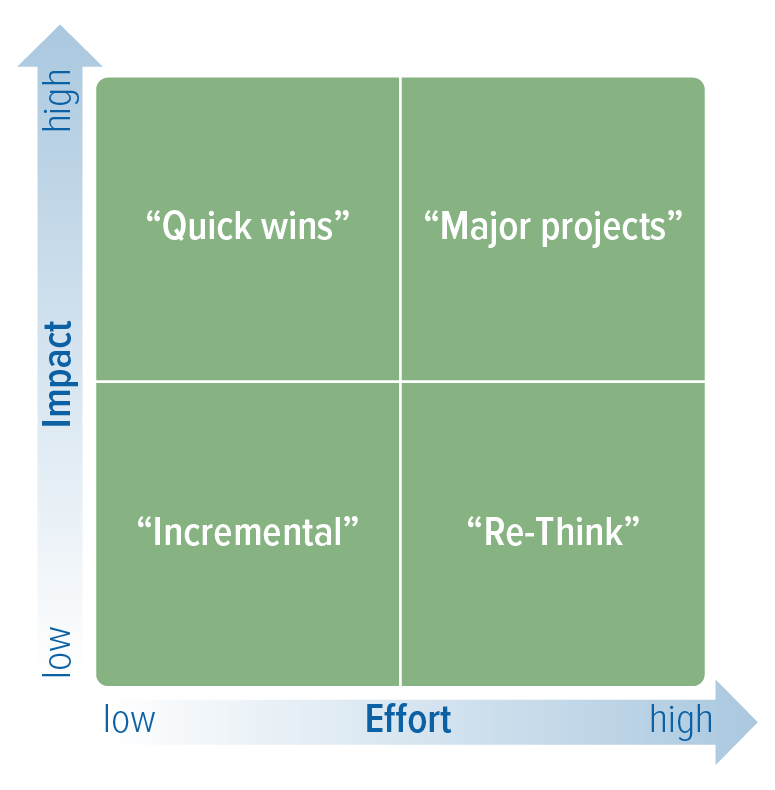
A useful tool for prioritization in advocacy work is the Action-Priority Matrix, which helps assess potential initiatives based on their impact and effort. Impact can be measured in a number of ways, such as by the number of people who benefit, the size of a benefit increase, or the reduction in time to complete an application. Effort is the amount of time and resources you and/or the state/local agency need to expend to accomplish this impact. This matrix categorizes tasks into four quadrants: Quick Wins (high impact, low effort), Major Projects (high impact, high effort), Incremental (low impact, low effort), and Re-Think (low impact, high effort). By plotting advocacy issues within this matrix, organizations can identify which efforts will yield the most meaningful results with available resources.
There may be tension between the advocacy goals that are most important to your community and those that are achievable at the level of government you can influence and in the current political context. That’s okay. In coordination with your allies, it can be helpful to set both audacious long-term goals and more achievable short-term goals.
Applying an Equity Analysis to Policy Options
All families — no matter their race, the language they speak, or where they live — deserve enough food, affordable health care, and enough money to meet their basic needs and thrive. But for generations, legal and political decisions have created systems that systematically exclude and disadvantage American Indian, Alaska Native, Black, Latino, Asian, and multiracial households. These discriminatory systems have denied equitable access to housing, employment, education, and health care. As a result, families of color experience significantly higher rates of poverty and food insecurity compared to white households.
Programs like Medicaid, SNAP, TANF, and WIC are critical tools for closing these gaps and making sure all families, regardless of race or ethnicity, have what they need to be healthy and whole. Through administrative advocacy, advocates have an important role to make sure these programs operate equitably. That includes ensuring they reach the communities that need them and that program improvements are shaped by the lived expertise of program participants.
One of the most important tools in this work is an equity analysis checklist, a practical tool that helps to assess whether a policy supports inclusive outcomes or continues to disadvantage certain communities. Using an equity analysis checklist, you can assess how a potential administrative priority impacts different populations — asking not just how many people are affected, but who is affected, why, and in what ways.
You may not always have the answers to these questions yourself. That’s why it's essential to build ongoing relationships with a diverse range of stakeholders — especially those most impacted by structural racism and exclusionary policies. Application assisters, community-based organizations, and people with lived expertise can provide critical insights into what’s working, where barriers exist, and which solutions would have the greatest impact.
Equity analysis is not a one-time step — it’s an ongoing process. Even well-intentioned policy changes may have unintended consequences, so continuous evaluation and feedback loops with impacted communities are necessary to ensure policies truly advance equity rather than reinforce existing disparities.
Program Accessibility and Effectiveness
✔ Who is currently benefiting from the program, and who is being left out?
Grandparents raising grandchildren often face challenges navigating benefit programs, especially if they are low-income, non-English speakers, or lack digital access.
✔ Are eligibility requirements or administrative burdens disproportionately excluding certain groups?
Many grandparents do not realize they are eligible for benefits for their grandchildren due to complex rules and application processes.
✔ How does the program ensure cultural responsiveness and inclusivity?
The agency’s outreach materials are only available in English and Spanish, leaving out other language communities such as Vietnamese, Somali, and Mandarin speakers. Materials also lack options for people with visual disabilities — there are no large-print, Braille, or screen reader–compatible versions available. Additionally, the visual design does not reflect the cultural diversity of the communities served. Without proactive steps to ensure language and visual accessibility, the program risks excluding those who already face systemic barriers to accessing benefits.
Understanding Disparities and Impact
✔ Who is most affected by this issue, and are there disparities across race, ethnicity, income, geography, or other factors?
Black, Latino, and immigrant grandparents are disproportionately represented among kinship caregivers but often lack access to linguistically and culturally appropriate resources.
✔ How do current policies contribute to or mitigate these disparities?
Existing policies fail to prioritize language access, making it difficult for non-English speakers to access benefits.
✔ What historical or systemic factors have shaped the inequities we see today?
Past exclusionary policies and lack of investment in language access have created persistent barriers for non-English-speaking households.
Community Engagement and Lived Experience
✔ Have we sought input from people with lived experience using the program?
Your allies confirm that language barriers prevent grandparents from accessing benefits for their grandchildren.
✔ Are we centering the voices of those with lived experience in decision-making?
Your allies can bring in impacted grandparents to share their experiences and advocate for improved accessibility.
✔ What do participants say about barriers to accessing or using benefits effectively?
Participants emphasized that lack of translated materials, confusing applications, and difficulty reaching bilingual staff make enrollment nearly impossible.
Policy and Structural Considerations:
✔ Does this program address root causes of inequity or just symptoms?
Improving outreach alone does not address the larger issue of limited language accessibility in benefit programs.
✔ Are we reinforcing or dismantling systemic barriers through our approach?
By embedding language accessibility into this opportunity, you can help dismantle exclusionary practices that have long made programs inaccessible.
✔ What policy changes could improve equitable access and outcomes?
You propose that all outreach materials for grandparents be available in multiple languages (including Braille), feature a large-font option, and be culturally responsive.
By applying an equity lens to policymaking, you may be able to find ways of working toward a more equitable administration of the program even if the initial opportunity did not seem to do so. Instead, you integrate community priorities into existing opportunities, strengthen relationships with the agency, and build momentum for future language access improvements. This also sets a precedent for embedding equity considerations into all future policy discussions, rather than treating them as secondary concerns.
Adjusting Your Priorities When Opportunity Strikes
Sometimes, opportunities for administrative change emerge unexpectedly. Advocates must be ready to adapt their priorities or strategies to take advantage of these opportunities. In politically challenging environments, recognizing and acting in these moments may provide the best chance to advance meaningful reforms.
Opportunities for change can emerge in different ways:
Imagen

| New Leadership: A newly appointed agency director may be more open to feedback or eager to make a mark early in their tenure. |
Imagen

| Agency Initiatives: Agencies sometimes introduce new policies they want to promote — advocates can help identify implementation issues and educate community members. |
Imagen

| Crisis Response: The COVID-19 pandemic created sudden openings for long-overdue changes, such as allowing online WIC applications and telephonic signatures. |

| Policy Distractions: When agencies are focused on high-profile initiatives, smaller but important changes may fly under the radar and be approved with minimal resistance. |
The deeper your existing relationship is with agency staff, the more likely they are to turn to you in these moments for support and feedback.
Chapter 1.7: Making the Case
While convincing an agency to change is always challenging, you can increase your chances of success if you analyze three key considerations: the political environment, the agency’s limitations, and the potential value of small changes.
Understanding the Political Environment
While Medicaid, SNAP, TANF, and WIC have specific program goals and requirements defined by federal statute, each state or county has its own political environment that directly impacts how individual agencies operate. Agency leaders are accountable to federal, state, and sometimes county authorities, whose views of the programs can drive many agency policies.
For example, if your governor is hostile to adequately funding Medicaid, they may direct the agency to focus on efforts to “limit fraud and abuse” as a way to restrict access to the program. Agency leaders may then institute policies to require clients to submit additional paperwork to renew their coverage.
Understanding the Agency’s Limitations
Even without political direction, agencies may face real barriers that limit their ability to improve program operations. Advocates should be mindful of these limitations when making their case. They may include:
- outdated technology systems that delay modernization efforts;
- budget constraints that limit staffing and outreach; or
- competing priorities that push operational changes to the back burner.
For example, an agency may agree that they should update their application to require less paperwork at renewal, but their computer system is so outdated that it will take years to implement.
Understanding That Small Changes Can Matter
Agencies juggle various demands and limitations that make administering the programs challenging. Officials must weigh how a suggested change may impact multiple other areas of the agency including computer systems, staffing levels, vendor contracts, or other programs they administer. Big complex changes can take years of sustained advocacy to achieve, but tweaks like adjusting workflows or changing schedules may be easier for agencies to implement.
While keeping your bigger, long-term goals in mind, you can make a case for the agency to explore smaller changes now that can have a meaningful impact on the client experience. To successfully make the case for change, advocates must balance urgency with pragmatism. If you understand the agency’s environment and leverage lived experience, you can find immediate wins while laying the groundwork for broader reforms.
For example, the online portal clients use to apply and manage their case may be very challenging to use and not have key features like document submission. It may need a complete overhaul which will take years.
Chapter 1.8: Dealing With Unresponsive Agencies
If, despite numerous attempts at engaging the state agency to address an issue, the agency remains unresponsive, consider the following strategies:
- Be persistent. Follow up regularly while maintaining professionalism. Attitudes may change under new agency leadership or if a new governor is elected.
- Find an issue of mutual concern. If your top priority fails to gain traction with the agency, there may be a challenge the agency is grappling with that you could help them address.
- Find a legislative champion. Engage a state legislator who could serve as an effective bridge between advocates and the agency. Educate your champion on the issue and give them strategic questions to ask the agency. They are particularly likely to get your agency to engage if they are a member of the Budget or Appropriations Committee.
- Consider unlikely coalition allies. Sometimes the most effective messengers aren’t the usual advocacy groups. Think about engaging business leaders, faith-based organizations, health care providers, or others who may share your concerns or values. They may bring different perspectives and credibility with agency leaders that can advance your goals. Are there other state or local agencies that serve the people who would benefit from the change you are advocating for, such as city health departments or school districts? Would they approach the agency about the benefits of your agenda? Your agency leaders may be more willing to listen to these perspectives.
- Play "good parent, bad parent.” If your organization is seen as adversarial, working with an organization that has closer ties to the agency can help gain behind-the-scenes access. If your organization has a contract with the agency that limits your ability to raise concerns, partner with a group that is free to publicly criticize the agency when needed.
- Go above their heads. In some cases, appealing to federal officials at either the regional or national office that oversees the programs you work on may be necessary to escalate the issue. Advocates should think carefully about the political climate, both at the federal and state level, before approaching these federal agencies. Be mindful of any recent statements federal officials have made about your agenda and how willing they are to engage with advocates.
- Use media strategically. Despite your best efforts, your agency may refuse to take action on your issues of concern. Carefully consider if it is time to craft a media campaign to put pressure on the agency.
- Consider litigation. You and your allies may consider suing your agency, if the agency has violated the law. This step requires careful consideration, because it can take years to get a final decision, and engaging in litigation will have a long-term impact on relationships between advocates and the agency.
Chapter 1.9: Improving Programs in Key Action Areas
Now that you’re familiar with how administrative advocacy works, it’s time to consider the key action areas in each program ripe for improvement through administrative advocacy. (Note that state administrations have varying levels of authority and some of these actions may require legislative changes in some states.)
| Program | Action Area | Notes |
|---|---|---|
| Medicaid | Raise Income Limits | Raise income limits to increase the number of people who qualify for Medicaid, particularly for childless adults, parents, and pregnant people. |
| Medicaid | Streamline Verification Procedures | Expand the number of data sources used and improve the policy applicable to verifying income and resources to reduce how often applicants and enrollees must submit additional information and expedite processing. |
| Medicaid | Increase Ex Parte Renewal Rates | Increase the rate of Medicaid renewals done using data sources without requiring action from enrollees (ex parte renewals) to increase retention of eligible people and reduce administrative burden on agencies and enrollees. |
| Medicaid | Expand Coverage for Seniors and People with Disabilities | Offer medical coverage to seniors and people with disabilities (the non-MAGI population) with higher income and high medical needs, raise income and asset limits, and streamline enrollment processes to improve access for seniors and people with disabilities. |
| SNAP | Lengthen Certification Periods | Lengthen certification periods so recertifications are required less frequently to reduce the chance that an eligible participant loses benefits due to administrative burden. |
| SNAP | Adopt Broad-Based Categorical Eligibility (BBCE) | Use BBCE to increase or eliminate the asset test and raise the gross income limit up to 200 percent of the federal poverty level to streamline eligibility determinations and increase access. |
| SNAP | Minimize Work Requirements | Use waivers and exemptions for able-bodied adults without dependents (ABAWDs) and operate a voluntary (vs. mandatory) SNAP Employment and Training program to minimize the harm from work requirements. |
| SNAP | Reduce Procedural Closures | Implement simplified reporting and adopt the reinstatement waiver to minimize the number of people who lose benefits for procedural reasons (due to paperwork issues, not because they were found ineligible). |
| TANF | Provide Non-Recurrent Short-Term Benefits (NRSTs) | Issue cash or in-kind services through NRSTs to address a crisis or one-time need like the birth of a child, utility shutoff, or eviction to help families without triggering work requirements or time limits. |
| TANF | Raise Cash Benefit Levels | Tie benefit levels to cost-of-living adjustments or issue monthly supplements for housing and other needs to increase the amount of assistance a family receives. |
| TANF | Innovate to Better Serve Families | Measure outcomes instead of process-focused work requirements, implement people-centered activities, and optimize the caseload reduction credit to better serve families. |
| TANF | Reduce or Eliminate Punitive Policies | Eliminate problematic and racist policies like family caps, diversion payments, drug testing, and drug felony bans that impede access. |
| WIC | Improve Access for Pregnant People and Children | Target outreach to children and pregnant people to maximize enrollment during these critical life stages. |
| WIC | Use Data to Increase Take-up | Share enrollment data in Medicaid and SNAP with WIC agencies so they can conduct outreach to eligible families who aren’t participating. |
| WIC | Adopt Presumptive Eligibility for Pregnant People | Expedite access for pregnant people by allowing them to enroll as soon as they are determined income-eligible and complete the nutrition assessment within 60 days (known as presumptive eligibility). |
| WIC | Adopt Automatic Newborn Enrollment | Automatically enroll newborns without additional income documentation based on parent enrollment in other programs to ensure infants have critical food and nutrition benefits right away. |
| WIC | Adopt Digital Tools | Deploy digital tools like online contact request forms, interactive portals and apps, and document submission channels to make applying and participating easier. |
| Operations & Delivery | Develop Mobile-Responsive Websites | Develop mobile-responsive websites so families can apply for and manage their benefits from cell phones and tablets to improve access. |
| Operations & Delivery | Improve Online Renewals | Improve user experience, languages offered, and accessibility of online renewals to make it easier for families to renew benefits. |
| Operations & Delivery | Improve Language Access for Online Portals | Make online portals accessible in multiple languages so all residents can apply and manage benefits online. |
| Operations & Delivery | Minimize Use of Identity Proofing | Minimize barriers caused by unnecessary deployment of identity proofing (including knowledge-based verification and biometrics) to reduce barriers to online services. |
In the next section, you’ll learn more about how to use the landscape to explore the action areas above and other key data points, and how to dig into your state-specific policy, operations, and data to identify opportunities for advocacy.
Previous: Chapter 1: Basics of Administrative Advocacy
Section 2: Examining Your State
Chapter 2.1: Using the Landscape Assessment
The landscape assessment is a compilation of state-by-state eligibility, operations, and outcome data across all 50 states and D.C. on Medicaid, SNAP, TANF, and WIC. The landscape pulls together data from a variety of reports and information gathered by CBPP into a centralized user-friendly format to show where each state stands on program eligibility, policy, operations, and performance. Advocates can leverage these data to see how their state compares to others and identify opportunities to improve policy and program administration in their state. Advocates can also use these data to better formulate a clear “ask” for program administrators, and more effectively engage with administrators to produce intended results.
Navigating the Landscape
The landscape is intended to be a comprehensive dataset. However, the aggregate view may be overwhelming, particularly if you are interested in data related to a specific population or program. Therefore, the landscape offers several ways to filter and focus on the data you need.
The landscape has data for Medicaid, SNAP, TANF, and WIC and can be filtered by program. Medicaid can be further filtered by MAGI Medicaid/CHIP (children, parents, pregnant people, expansion adults) or Non-MAGI Medicaid (seniors and people with disabilities). You can also filter for data related to specific populations, including:
- children;
- immigrants;
- pregnant/postpartum people; and
- seniors/people with disabilities.
You can also filter by data categories, including:
- eligibility rules, which affect who qualifies for the program, such as income and asset limits;
- operations, which are policy and technology choices that affect processes, such as online applications, language availability, and certification periods; and
- outcome metrics, which are performance data such as participation rates, timeliness, and food insecurity rates.
Users can also combine these features. For example, if you are interested in your state’s data related to Medicaid eligibility for the pregnant/postpartum population, you would take the following steps:
- Filter to MAGI Medicaid/CHIP for the assistance program.
- Filter to Pregnant/Postpartum for the population.
- Filter to Eligibility Rules.
- Filter to your state.
You could then look at your state’s upper income limit for full Medicaid coverage for pregnant people and from-conception-to-end-of-pregnancy (FCEP) coverage, learn about the difference between these two types of coverage, compare eligibility limits to other states, and go to the data source for more details.
Here’s another example. If you were looking for opportunities to improve access for seniors and people with disabilities in your state, you could:
- Filter to seniors/people with disabilities.
- Filter to your state and neighboring states.
This would allow you to see your state’s policies specific to seniors and people with disabilities across Medicaid, SNAP, TANF, and WIC, such as whether the state has the Elderly Simplified Application Project waiver for SNAP and the income limits for the Medicaid programs that serve seniors. By including neighboring states, you could see how your state’s policy compares to others in the region.
Data in the landscape is limited to metrics available across all 50 states and D.C. There are many other policies and operational choices that affect access to benefits that are not included. Advocates should use the landscape to identify areas of focus and/or possible solutions to identified issues. Then, as described in Chapter 2.2, you can dig into state-specific rules, policy, data reports, and individual experiences to formulate your agenda.
Chapter 2.2: Going Beyond the Landscape: Examining Your State
To be an effective advocate, you need to understand how programs are actually being delivered in your state. Agency leadership may not fully understand how different policies and technologies are playing out on the ground and may present their systems as functioning well. Advocates need a solid understanding of program policies and operations to identify issues and push for specific, necessary improvements.
The landscape is a great starting point to help compare your state to others and identify key data points, but it doesn’t tell the whole story of how these programs operate on the ground.
Useful expertise comes from digging deeper to understand what’s happening in your state. Analyze policies in practice, identify gaps, and ask the right questions. The deeper your understanding, the more effectively you can problem-solve, build trust with agencies, and advocate for necessary improvements. Agencies want to work with advocates who can bring value.
In this section, we outline resources that, when used alongside the landscape data, will deepen your understanding of state programs and improve your advocacy efforts.
Websites
State websites provide information about programs administered by state agencies, including general program information, rules and policy, and data. Depending on the setup in your state, departments to explore may include the health agency, the human services or social services agency, and the department of public health.
These websites can answer foundational questions, such as:
- Which department administers Medicaid, SNAP, TANF, and WIC?
- How do people apply for Medicaid, SNAP, TANF, and WIC -- through a single application for multiple programs or a separate application for each?
- What languages is the application available in?
- Can people apply online and/or over the phone? Where can people go for in-person assistance?
Program Manuals
On the state website, there may be a link to program manuals, which provide details on operations and policy. State program manuals are guides for agency staff that offer detailed descriptions of how programs like Medicaid, SNAP, TANF, and WIC are administered. Each program may have its own manual, or programs administered together may all be in a single manual. The manual will typically have detailed guidance outlining how key components of the program are operationalized, such as the application process, eligibility requirements, and verification processes.
Manuals can answer such questions as:
- What are the eligibility requirements for each program?
- How long can people receive benefits before they have to complete some sort of renewal?
- What is the process for an eligibility worker to verify information provided from an applicant or enrollee? What data sources can they use to verify information?
Program and Policy Updates
State agencies issue official notices that communicate important updates, policy changes, and guidance for program implementation. These updates can be a valuable resource for understanding how state policies are changing and for identifying any gaps or opportunities for improvement. They are particularly informative when there is a natural disaster, state operational changes, or major federal changes.
Many agencies publish memos on their websites under sections like "Policy Updates," "Program Guidance," or "News & Communications." Some agencies offer dedicated portals for partners and community organizations. Check these portals for memos that might not be publicly available.
Data
Many agencies publish data on the programs they administer, either on a dashboard or through reports. It can be useful to monitor these data to evaluate the state’s performance and observe trends over time on metrics such as application processing timeliness and call center wait times. Agencies may publish monthly data reports, or they may include valuable information in other documents such as budget requests or reports to the legislature.
Questions to consider include:
- Does the state regularly publish data on application metrics like volume, processing timeliness, and average time to process?
- Are there data on reasons for application denials, such as incomplete information, missed interviews, or ineligibility?
- Does the state have data on the percentage of enrollees who successfully complete their renewals?
- Are there data on the percentage of applications that are from people who lost benefits at renewal and reapplied (a measure of churn)?
- Is there information on call centers, such as volume, wait time, and abandonment rates?
- Is the state collecting and using disaggregated data (on race, ethnicity, geography, disability, etc.) to track metrics across different populations?
- What data does the state not regularly publish that would help identify barriers faced by clients and guide potential improvements?
Participants and Application Assisters
As highlighted in Chapter 1.4, the lived experiences of people who participate in the programs are crucial for understanding how these programs truly operate.
To start trying to better understand the client experience, you can try calling the call center yourself or applying online. In addition, one of the most effective ways to deepen your knowledge is by engaging directly with people enrolled in the program(s) and application assisters. Their firsthand experiences provide valuable insight into the real challenges people face when navigating the application and renewal processes. By listening to those who are directly impacted, you can uncover barriers and inefficiencies that may not be captured in official reports or data, helping you advocate for meaningful changes.
Ask participants and application assisters questions like:
- What is it like to call the call center?
- How long are the wait times?
- What is it like navigating the menu to reach an eligibility worker?
- What can you do through the call center (apply, renew, report changes, etc.)?
- What challenges exist in this process?
- What is it like to use the online portal?
- What are the most common reasons you hear for application denials?
- Which communities or groups experience the greatest barriers to accessing benefits?
- How are underserved or vulnerable populations supported, and where are the gaps?
- What communication channels does the agency use to engage participants? Social media? Text messages? Other methods?
- How do participants feel about the timeliness, language, or structure of communication?
Leverage Your Agency Relationship
Not every operational detail or set of data may be publicly available. But if there is critical information that isn't readily available to the public, you may be able to leverage your relationship with the agency to get access to it. By cultivating strong, trust-based partnerships with agency staff, you can gain a deeper understanding of how programs are functioning. This access will allow you to uncover key insights that might not be reflected in public data or documents.
Use your time with the agency strategically to lift the curtain on areas that could be impacting program effectiveness, such as internal processes, staffing challenges, or technological limitations. The more you understand these operational details, the better equipped you'll be to advocate for meaningful changes. Ask questions about:
- Staffing capacity. Is the agency adequately staffed to meet demand? If people are experiencing challenges with the timely processing of applications and renewals or overall customer service, the agency may not have the capacity to process its workload.
- IT systems. How capable are the agency’s IT systems for processing Medicaid, SNAP, TANF, and WIC applications? IT systems can be a source of errors and inefficiencies, particularly if there a long list of changes waiting to be made.
- Inefficient processes or procedures. Is the agency making the application or renewal process more complex than it needs to be, such as by requiring eligibility workers to collect unnecessary verification documents? This can add time to every application or recertification, resulting in backlogs and timeliness challenges.
Chapter 2.3: Understanding Program Requirements vs. Options
Medicaid, SNAP, TANF, and WIC have a mix of federal, state, and sometimes local rules and funding. The federal rules lay out what an administering entity must do or not do, and what it may choose to do. It’s important for advocates to understand these differences. Advocating for an agency to do something that is required — where there is a possibility of federal enforcement or litigation — is a different conversation than making the case that an agency should do something to streamline access that is not required.
- Federal requirements. All the programs have federal laws and regulations that specify policies and procedures the state or local government administering the program must follow to receive federal funding. These often include “must” or “shall” language. Requirements include verifying income in SNAP; allowing applications online, over the phone, and in person in Medicaid; and attempting to determine whether an applicant is adjunctively income-eligible for WIC via Medicaid, SNAP, or TANF enrollment before requiring income documentation.
- State options. States also have many choices when designing and implementing their programs. While some choices are specifically called out as state plan options in federal law, others are choices states make when determining how they will deliver benefits. For example, in SNAP, states have the option of accepting telephonic signatures for applications and options around the length of disqualification periods. They can also choose how many eligibility offices they make available to serve participants and whether participants are instructed to call a central call center or given the number of a specific caseworker. In Medicaid, states have the option to adopt Express Lane Eligibility to use information from other programs to enroll or renew people in Medicaid, and they have significant freedom in how they count income and expenses in determining eligibility for the non-MAGI (seniors and people with disabilities) population.
Not all state options are “best practices.” Some inhibit access. For example, states have the option to verify certain eligibility factors for SNAP and Medicaid but aren’t required to. If the state opts to verify many non-required eligibility factors, households will face the additional burden of tracking down and submitting this additional verification, agency eligibility workers will have more information to process on every case, and errors will become more likely. Advocates, particularly those working in challenging environments, may more often push against adoption of certain options than for them.
Sometimes practices and policies shift between federal requirements and state options. For example, 12-month continuous eligibility for children in Medicaid was previously a state option, but a change in federal law made it mandatory in 2024. Further, some programs offer waivers of certain requirements that allow states to test out different practices, such as demonstration projects in SNAP and 1115 waivers in Medicaid. (See Chapter 2.4).
In addition to federal statutes and regulations, there are also state laws and regulations that may influence what is mandatory and what is optional for a state. While state laws should not contradict federal standards, they may add requirements or prohibit agencies from exercising certain federal flexibilities. For example, the state legislature could pass a law prohibiting the SNAP agency from using ABAWD time limit waivers.
When advocating for states to adopt options that aren’t required, it can be helpful to point out other states that have done so, especially those that may be similar to your state in geography or political environment. States are often more comfortable adopting new policies that have been tested in other states. If the majority of states have adopted a certain implementation choice, it may be helpful to point out that your state is behind and one of few that hasn’t yet made a change.
Chapter 2.4: Digging Into How States Exercise Flexibility
As detailed in the previous section, states have a number of options in how they administer Medicaid, SNAP, TANF, and WIC. Each program has procedures for how a state must document its choices and when federal approval is required.
In addition, most programs offer states the opportunity to waive mandatory provisions of laws or regulations, within certain parameters. These waivers can be used for policies that increase or inhibit access. Advocates should understand which mandatory provisions can be waived; potential requirements around the waivers, such as cost neutrality; and how the waiver process works.
SNAP Flexibilities
SNAP options. Federal law and regulations explicitly give states the option to adopt certain SNAP eligibility and administrative policies. Options typically do not require specific approval from Food and Nutrition Service (FNS, that agency within the U.S. Department of Agriculture, or USDA, that oversees SNAP), though the state may have to inform FNS which option is being used. States can use this flexibility to improve the program’s reach — for example, by raising the gross income level and asset limit using the Broad-Based Categorical Eligibility option.
SNAP administrative waivers. FNS can grant waivers to state agencies of SNAP regulations for certain policies that are not mandated by the statute and where FNS deems the change could result in a more effective and efficient administration of the program. Some waivers may be temporary in response to extraordinary conditions such as natural disasters or health emergencies and expire as conditions improve. States may also request longer-term waivers that can meaningfully impact clients. For example, states may apply for a waiver to forgo the interview at recertification for households with elderly or disabled members with no earnings. FNS often requires states to report data for administrative waivers and states periodically need to resubmit their waivers for FNS approval.
SNAP demonstration project waivers. FNS has the authority to conduct demonstration projects to test changes to SNAP that involve waiving provisions of the SNAP statute to see if the change improves the way SNAP operates. FNS considers this authority one of the agency’s best tools to encourage state innovation, as it allows states to pilot and evaluate new ideas that may lead to new approaches in SNAP administration like the Elderly Simplified Application Project (ESAP) and the Standard Medical Deduction (SMD). Demonstration projects must include a rigorous evaluation, must be time-limited, and cannot increase the cost of the program unless such costs are offset by a reduction in benefits or deductions. Under the statute, some SNAP requirements, like timely service, cannot be waived or altered.
Medicaid Flexibilities
State Plan Amendments (SPAs). States set out in their state plan the details of their Medicaid program, including populations covered, services offered, and operational choices. The state agency periodically amends the plan to reflect changes in state policy, such as when a state adopts express lane eligibility. This is known as a state plan amendment (SPA). States must send SPAs to Centers for Medicare & Medicaid Services (CMS, the agency within the U.S. Department of Health and Human Services, or HHS, that oversees Medicaid) for review and approval. CMS has 90 days to make a decision but can pause the process by writing to request additional information. While approval of a SPA is not contingent on meeting any budgetary target, states are required to indicate the expected federal financial impact.
Medicaid Section 1115 Demonstration Waivers. Section 1115 of the Social Security Act gives the HHS Secretary the authority to approve experimental, pilot, or demonstration projects that are found to be “likely to assist in promoting the objectives of the Medicaid program.” Section 1115 demonstration waivers offer states an avenue to test new approaches that differ from what is required by federal statute. Past approved waivers have included targeted eligibility expansions, provisions related to social determinants of health, and multi-year continuous eligibility for young children. Section 1115 waivers must be cost-neutral, include a plan for monitoring and evaluation of the demonstration, and offer a hypothesis about the outcomes of proposed waiver policies. The state must publish the proposed waiver and provide a 30-day notice and comment period at the state level. The state then submits the final application to CMS, along with responses to all public comments. There is then another 30-day federal notice and comment period. CMS reviews those comments, may negotiate with the state on terms and conditions, and then may finalize the waiver agreement. Generally, 1115 demonstration waivers are approved for an initial five-year period and can be extended for up to an additional three to five years, depending on the populations served.
WIC Flexibilities
WIC streamlining flexibilities. The federal statute and rules give states flexibility to streamline WIC certification processes to make it easier for eligible families to access the program and to reduce the administrative burden on local staff. States have options that can make it easier for parents to enroll, like using presumptive eligibility to provide food benefits more promptly to pregnant applicants; automatically enrolling newborns born to WIC participants who are also Medicaid, SNAP, or TANF enrollees; or exempting working parents from the requirement to bring their children to certification appointments.
WIC modernization. States received American Rescue Plan Act funding to update WIC technology. State and local WIC agencies use these funds to better serve families by expanding the use of participant-facing tools, such as online appointment schedulers, two-way texting, and interactive participant portals or mobile apps.
TANF Flexibilities
TANF state plan. TANF’s block grant structure gives states broad authority to set their own policies and procedures to meet the four purposes of TANF defined in federal law. States have extensive flexibility to determine eligibility, benefit levels, and what their program funds. As a result of this broad flexibility, there is a lot of variation among states. While many changes that affect delivery of benefits can be made at the administrative level, other options and waivers that substantially affect funding levels may require state legislation before they can take effect. Some states can make improvements administratively, like increasing income limits, benefit levels, or altering sanctions in their TANF state plan. Some states can also administratively provide one-time cash to low-income families in the form of a non-recurrent short-term benefit without seeking state legislation.
Chapter 2.5: Implementing Policy: Checking a Box Does Not Necessarily Make a Good Program
Convincing a state to take action to adopt a good policy is only half the battle. Strong implementation is just as crucial and must be carefully monitored to make sure the goals of the policy change are achieved.
A state might have all the right policies on the books, but if implementation is flawed, it can be just as harmful as not having the right policies in place. A state may pass a law or adopt a waiver but not change the eligibility system to actually implement it. Or the eligibility workers may not be following the new policy because it is not reflected in the program manual, the manual is written in a confusing way, or eligibility workers were not properly trained on the change. Further, there could be something preventing implementation of the new policy.
For example, a state may change its verification policy to accept self-attestation for certain eligibility factors, but quality control or an audit identifies self-attestation as an error, causing workers to stick to the old policy of aggressive verification to avoid getting marked as error-prone. In addition, allowing self-attestation, rather than requiring it, may not be enough to change eligibility workers’ habits. Sound implementation ensures that programs are more than just good policy on paper but also effective and accessible in practice.
Previous: Chapter 2: Examining Your State
Section 3: Program Area Deep Dives
Chapter 3.1: Diving Into Program Areas
This chapter provides examples from Medicaid, SNAP, TANF, and WIC of how advocates can pull together information from the landscape and this toolkit to advocate for change. Each example proceeds through five steps:
- Prioritize a policy issue. You can identify an area of advocacy with potential for impact by determining where there are opportunities to improve policy or operations, performing an equity analysis, and considering where you can align with your agency’s priorities. (See Chapter 1.6.)
- Research the issue. Use the landscape as well as a deep dive into your state’s circumstances to see what options and waivers your state has elected, what data are available, and what the client experience is. (See Chapter 2.1 and Chapter 2.2.) This analysis may overlap with the first step as you prioritize a policy issue to focus on. Also consider where your state may have the right laws, options, or waivers in place but where implementation is the obstacle. (See Chapter 2.5.)
- Identify possible areas of improvement. Consider waivers and options as well as best practices from other states or programs that your state could implement to address the identified issue. (See Chapter 2.3.)
- Engage on the issue. Meet with the state agency to lift up the problem you have identified and offer solutions to address the issue. (See Chapter 1.2.)
- Learn from a state example. Gain insights from real-world examples of advocates who have tackled these issues and made progress.
Chapter 3.2: Medicaid Deep Dive (Ex Parte Renewals)
Prioritize a Policy Issue
In Medicaid, one of the most useful tools to streamline access is maximizing ex parte renewals. Under federal Medicaid regulations, before a state can send out renewal documents and require enrollees to respond, it must first attempt to renew coverage ex parte, where an enrollee’s coverage is renewed based on information in the enrollee’s case file or in electronic data sources. The enrollee isn’t required to return a form or take any action to maintain Medicaid coverage.
Ex parte renewals have many benefits for both enrollees and state agencies. They:
- ensure eligible individuals retain coverage, minimizing gaps in coverage that can increase costs;
- significantly reduce state administrative burden by automating renewals and minimizing re-applications from eligible individuals who lost coverage; and
- free enrollees from having to respond to notices, try to reach the agency to ask questions or get clarification, or risk loss of coverage due to red tape.
Research the Issue
First, determine how your state performs on ex parte renewals compared to other states using the landscape. The latest national data (from January 2025) indicate that over 50 percent of renewals across the country are renewed ex parte. What is your state’s rate? Are you above or below the average?
Next, check what data are available from your state around ex parte renewals and renewals outcomes more generally. Many states had detailed data dashboards during “unwinding” and may be maintaining them. Or you may need to ask your agency for more recent and more detailed data. Some states are doing better with MAGI (children, parents, pregnant people, and expansion adults) renewals than non-MAGI (seniors and people with disabilities) renewals, so try to get a rate broken down into these two categories.
To really dig in, request and review your state’s eligibility system design documents, which direct how the IT system is programmed. These documents contain useful information such as what the system rules are, why it doesn’t renew some cases ex parte, and what data sources the system accesses during the renewal process.
Identify Possible Areas of Improvement
Based on your research and answers to key questions, begin brainstorming areas of improvement and solutions to bring to your state agency. These can be based on obvious gaps identified in your own state’s process, best practices implemented by other states, or other insights learned through the research stage. To improve your state’s ex parte rate, some possible areas of improvement include:
- including all populations in the ex parte process;
- using all reliable and relevant federal, state, and commercial data sources;
- optimizing how assets are evaluated during the ex parte process for the non-MAGI population;
- implementing strategies including using SNAP data to verify income and completing ex parte renewals when no information is found in income or asset data sources.
Engage on the Issue
Most state agencies are interested in improving the ex parte renewal process since it can significantly reduce burden on eligibility workers and minimize churn. In some cases, the state Medicaid agency sets the policy while the human services agency conducts the renewals. Since the human service agency feels the brunt of the inefficiencies, consider asking them to work with the Medicaid agency to change the policy.
Ex parte renewals are complex with evolving policy and complicated programming. It is critical to come to the table with a deep understanding of the policy flexibility that is available as well as examples from other states. Offering to help analyze the issue and identify opportunities for improvement can lead to a productive partnership with the agency, which may not have the resources to do a deep dive into the ex parte renewal data, rules, and options. Make the case that investing in system changes in this area will produce substantial dividends in the future for both enrollees and the agency.
Learn From a State Example
West Virginia previously had one of the lowest ex parte renewal rates in the country, with rates consistently below 25 percent prior to the pandemic and as recently as 2022. Through conversations with the state Medicaid agency and reviewing the Medicaid application and other documents, advocates in West Virginia discovered that the state’s Medicaid application required applicants to actively opt into ex parte renewals, a practice contrary to federal Medicaid renewal rules. After advocates brought this to the attention of their state agency, the agency successfully removed the opt-in requirement from their Medicaid application. Along with other improvements, this policy change caused the state’s ex parte renewal rate to increase significantly. West Virginia reported a 64 percent ex parte renewal rate for December 2024.
Chapter 3.3: SNAP Deep Dive (Interview Process)
Prioritize a Policy Issue
Households applying for SNAP typically fill out an application form, are interviewed by state agency staff, and submit documents and other forms of verification. This process requires significant state resources and can create barriers to participation for eligible people, especially if they are unable to make an interview time or need to reschedule. Improving the interview process can help households seeking food assistance and also reduce a state agency’s workload.
Many people have their SNAP application or renewal denied because of a missed interview, even though they qualify for benefits. In addition, the interview consumes a significant amount of time for eligibility workers. Streamlining the interview — particularly the scheduling process and length of the interview — can reduce burden on both participants and eligibility workers, increasing efficiency and accuracy.
The interview has historically had two intended purposes. The first is to ensure access by providing applicants an opportunity to clarify their circumstances, tell their stories, and help ensure people who need help navigating the system can apply and receive the benefits they are eligible for. The second purpose relates toprogram integrity. The interview helps states get the information they need to ensure accurate benefits are issued to eligible households, which also protects households from overpayments they would have to repay later.
There is no statutory requirement for applicants to complete an interview. While federal SNAP regulations require every applicant to be interviewed, there are only a few guidelines on what constitutes an interview, what is covered in an interview, and how an interview occurs. Specifically, SNAP regulations state that:
- The interview must resolve any unclear or incomplete information with the household.
- Households must be informed of their rights and responsibilities, including the responsibility to report changes.
- The state agency must schedule interviews as promptly as possible.
- The agency must notify a household that misses its scheduled appointment.
- The agency must schedule a second interview if a household that missed a scheduled interview contacts the agency before SNAP’s 30-day processing period ends.
This leaves many details unclear. Understanding the situation requires digging into both the process the state agency uses to conduct interviews and any available data on interview completion rates.
Research the Issue
There are many pieces of data that can help you understand how big a barrier the interview process is in your state and whether your agency is using available options to streamline the process. One useful strategy is to check your agency’s website for a program manual, operational guidance, or instructions to eligibility workers. (See Chapter 2.2.) Questions to consider include:
- How does your state manage interviews?
- How does the state schedule interviews?
- Is the household supposed to call in at their scheduled time, or does the agency call them? How often does the agency fail to call at the scheduled time?
- What happens when a household is unable to complete the interview? Does the state offer another opportunity before denying the application, as required by federal SNAP regulations?
- What happens when a household needs to reschedule?
- Does your state have different processes based on household type? Seniors and disabled households may have different requirements than others, for example.
- How long is the interview?
- Does the eligibility worker go over the entire application again, or focus in on areas like income and expenses?
- Does the eligibility worker read over the entire rights and responsibilities section during the interview?
- How successful is your state’s interview process? Community partners, like application assisters and legal aid offices, can be a great source of information about barriers and pain points.
- How many applications and recertifications are denied due to failure or inability to complete the interview?
- What percentage of households are unable to complete the interview and thus are found ineligible for SNAP? The state agency is required to identify the reason an application is denied or an active case is terminated. The level of specificity of the cause may vary, but the agency is likely to track applications and cases terminated due to lack of interview and may be able to provide more detail about the reasons for denials.
Identify Possible Areas of Improvement
If you discover that the interview serves as a barrier to access or consumes so much staff time that other parts of the SNAP eligibility process are under-resourced, you can explore ways to improve the interview process. Some key questions include:
- What is required by federal or state law or rules and what options are available to the state?
- What best practices exist in other states around scheduling the interview and streamlining the interview itself?
States can request to waive some rules related to the interview. Two common waivers available related to SNAP interviews are:
- Unscheduled (on-demand) interview waiver. FNS allows states to waive the interview scheduling requirements. Instead of scheduling a specific date and time for an interview, a state can provide a household the option to complete a telephone interview at their convenience within a specified time. Before proposing this approach, consider whether the state has the staffing capacity and flexibility to conduct call-in interviews. If call center wait times are long and people can’t get through, this waiver could inhibit access instead of streamlining it. An alternative approach that is an emerging best practice and doesn’t require a waiver is to still schedule an interview but inform the household that they can call in any time before their scheduled appointment to complete the interview at their convenience.
- Elderly/disabled recertification interview waiver. This waiver allows states to forgo the requirement to conduct an interview at recertification for households that have no earned income and in which all adult members are elderly or disabled, provided the household meets all other recertification requirements.
States also have some flexibility in establishing interview procedures. States are required to provide rights and responsibilities, including explaining work requirements, to all certified households, and many use the interview as the place to share this information. This can add a significant amount of time to each individual interview, so streamlining this critical client protection may help improve the interview process.
One possibility is for agencies to complete the interview when an applicant first contacts the agency, either by appearing in-person to apply or when applying by phone. During a phone application, the agency can accept a verbal signature, known as a telephonic signature, which can make the process more efficient since a signature form doesn’t have to be sent to a client and returned. FNS has also clarified that community-based organizations, like SNAP application assisters, can record the telephonic signature while taking a telephonic application, though community-based organizations usually can’t conduct the interview.
Engage on the Issue
The interview complements the application form, and your state agency may be balancing several factors in striving for an efficient application process. States must decide how much information to ask on the application and how much to collect in the interview. Only the applicant’s name, address, and signature is federally required for a SNAP application to be filed, though states may ask for much more information upfront or rely on the interview to collect the additional necessary information. You can help identify ways to improve the interview process for households by understanding the state’s overall application process and the interview’s role in it.
Consider the many factors the agency is balancing that interact with their policies around interviews. For example, if the agency is understaffed, helping them find ways to streamline scheduling, shorten interviews, and reduce “churn” caused by missed interviews can be useful in coping with insufficient staffing. And interviews significantly impact timeliness. If interviews are scheduled for 20 or more days after the application is received, the agency is unlikely to process that application within the required 30-day window.
If the agency is feeling pressure around these areas, offering solutions to improve the interview process may make them more eager to engage with you. You can support this engagement by:
- Cultivating the relationship with your state agency. Your agency may be interested in ways to streamline the process. You can ensure this is done in a way that also helps households, rather than the agency just shifting responsibility to the household.
- Bringing in lived experience. Centering the experiences of SNAP participants and those who were unable to complete the process can be powerful.
- Coming to the table with solutions and ideas. Best — or even just better — practices from other states may help convince the state agency to streamline their process, improve their training, or find other ways to improve interviews.
Learn From a State Example
Advocates in Franklin County, Ohio, were concerned about SNAP application denials from missed interviews, amid persistently high call center wait times. They submitted a public records request and learned that 65 percent of SNAP applications were denied for a missed interview over the course of a year. With this data in hand, the advocates began meeting regularly with county leadership, who agreed to bring in a call center operations consultant to help improve the county’s call center processes and make it easier for applicants to complete telephonic interviews.
Chapter 3.4: TANF Deep Dive (Expanding Cash Benefits, Innovating, and Reducing Punitive Policies)
Prioritize a Policy Issue
The broad flexibility written into the federal statute that authorizes TANF means that each state has a unique TANF program and structure, and decisions on how to spend TANF funds can vary. Once you become familiar with the nuances of your own state’s program, review the opportunities below to consider which best fits your state’s context and needs, including which changes can be made administratively and which would require the legislature to act.
Research the Issue
Families may experience challenges with a variety of aspects of the TANF program, including not qualifying for assistance, insufficient benefit amounts, or facing penalties. Since program design varies so much across states, identify where clients in your state face barriers and look to other states for best practices that can reduce barriers.
Identify Possible Areas of Improvement
Here are four ways that states can innovate to improve outcomes for TANF families.
1. Provide cash directly to families to address short-term crises.
Non-Recurrent Short-Term Benefits (NRSTs) are a mechanism that enables states to use TANF funds to provide cash or in-kind services to families with children without triggering work requirements, behavioral requirements, or time limits. NRSTs must be designed to address a crisis or one-time “episode of need,” such as the birth of a child, utility shutoff, fleeing domestic violence, eviction, or other short-term challenges. They are not intended for ongoing use and cannot be provided for more than four months.
2. Draw inspiration from the TANF pilot model.
In 2023, under the federal Fiscal Responsibility Act, five states (California, Kentucky, Maine, Minnesota, and Ohio) were selected for six-year pilot programs to measure success not by the process-focused work participation rate but by outcomes tied to family stability and earnings. However, HHS recently rescinded this initiative. Despite this rescission, current law still stipulates that states maintain broad programmatic flexibility to strengthen TANF to be more efficient and promote well-being-related outcomes by modifying work requirements and other engagement activities. Using the TANF pilot model as a guiding “north star” can open a door for states to be creative and tailor their program to meet the needs of their state by prioritizing family well-being. Options include:
- Establishing innovative policies that prioritize measuring outcomes related to family well-being and stability.
- Implementing people-centered programmatic learnings and activities that have been informed by people with lived expertise to meet the individualized needs of families, such as measuring health, education, and social-related outcomes.
- Optimizing the caseload reduction credit to allow for more flexible work participation requirements without facing financial penalties.
3. Raise cash benefit levels and expand access.
TANF cash benefit levels largely remain low, despite states having the flexibility to increase monthly cash benefit levels to help recipients and to institute polices that can implement a sustained benefit level increase. This has a disproportionate impact on low-income Black and immigrant families and affects families’ ability to meet their needs and maintain financial stability. Options for raising benefits include:
- Codifying structural administrative changes, such as cost-of-living adjustments that ensure the cash benefit levels adjust with inflation over time to help families meet and maintain their needs. When tying benefits to a Standard of Need or to a share of the federal poverty guidelines, it is critical to make sure that the level is not set too low.
- Facilitating additional assistance mechanisms such as monthly supplements for housing and other needs like diapers and period products.
- Providing cash benefits to pregnant individuals without children.
4. Reduce or Eliminate Punitive Policies
Lifetime benefit limits, family cap regulations, and full-family sanctions are examples of restrictive policies that limit families’ ability to access TANF cash benefits and meet their needs. Programmatically, TANF can be reimagined to be less punitive through more affirming frameworks that empower recipients and to step away from racist, paternalistic, sexist tenets.
- Advocate for recipient autonomy and dignity by repealing family caps and adopting policies rooted in the Reproductive Justice and Black Women Best frameworks.
- Eradicate problematic policies, such as one-time diversion payments and drug-testing, which restrict families’ ability to access TANF cash benefits and have negative economic outcomes.
- Eliminate punitive and racist drug felony bans in states that still opt to have them.
Engage on the Issue
Because the TANF block grant is limited, it can be difficult to get state agencies to agree to increase caseloads and benefit levels. However, many states spend little of their TANF funds on cash assistance to low-income families, so there is an opportunity to advocate for redirecting those funds toward cash assistance. Advocates can also connect needed TANF changes to priorities of state governors, such as racial equity, child development, or housing stability.
Learn From State Examples
States have employed NRSTs in various ways, including:
- Cash for expectant parents. Rx Kids prescribes cash allowances to every parent expecting an infant across several Michigan communities, including Flint, Kalamazoo, and the eastern Upper Peninsula. For low-income families, some payments are funded by TANF as NRST benefits.
- Emergency housing assistance. Massachusetts administers HomeBASE, a program that offers NRST funds to unhoused families or those at risk of becoming unhoused. This covers costs such as rent, security deposits, furniture, and other expenses that could otherwise hinder their ability to secure stable housing.
- Utility assistance. Maryland provides NRSTs in the form of electricity assistance to low-income families experiencing utility shutoffs.
Between July 1, 2022, and July 1, 2023, Kentucky took administrative measures that doubled its maximum monthly benefit level. For a single-parent household of three, the benefit increased from $262 to $524. Since TANF was created in 1996, this was the first time that Kentucky's TANF agency increased its benefit level. Because of this, when adjusting for the value lost due to inflation over those 27 years, this increase represents a modest 8 percent increase.
An example of a state eliminating a punitive policy is Georgia’s repeal of its family cap policy in 2023.
Chapter 3.5: WIC Deep Dive (Increasing Take-Up)
Prioritize a Policy Issue
Nationwide, only about half of eligible individuals participate in WIC. Take-up varies among states, with some serving only one-third of those eligible and others serving two-thirds or more. Take-up is lower for pregnant people and children than for infants and their postpartum parents. Take-up is also lower in rural areas than in metropolitan areas. There are many ways to modernize the program and increase take-up through innovative and inclusive outreach, streamlined enrollment and renewal processes, participant-oriented service delivery practices, and a smoother shopping experience for WIC-authorized foods. State WIC agencies are in varying stages of implementing strategies to address these areas, and USDA has supported them through policy flexibility, technical assistance, and targeted funding. This deep dive will focus on policies and practices to streamline enrollment and renewals, referred to as WIC certification/recertification.
Research the Issue
While WIC programs operate under a set of federal eligibility rules, state and local WIC agencies have considerable flexibility to determine policies and processes for certifying new applicants and recertifying participants. Many states have adopted practices to streamline WIC certification/recertification with favorable responses from participants and WIC staff. Some of the practices involve implementing participant-facing digital tools, but many are modifications to policies and staff procedures. To improve participants’ experiences, such changes require educating both staff and participants on new approaches and options and how to revise them as needed.
The metrics in the landscape, along with CBPP’s report on state certification policies and certification streamlining toolkit, can help you identify flexibilities your state has not implemented that would make certification easier for applicants, as well as states that have implemented them and could serve as models. Additional details about these and other certification policies may be found in your state’s WIC policy manual, which some states post on their websites and others may provide upon request. Local WIC staff can also be a good resource for explaining certification processes.
Identify Possible Areas of Improvement
Here are four ways states can take administrative action to streamline access to WIC and improve take-up.
1. Make full use of adjunctive eligibility.
Applicants who are enrolled in Medicaid, SNAP, or TANF are considered income-eligible for WIC under the “adjunctive eligibility” policy. All states have an automated online or phone system to check adjunctive eligibility and applicants do not need to provide additional documentation of their income.
There are several ways this authority can be fully used:
- Documentation of participation in Medicaid, SNAP, or TANF can be used to document both income and residence, and some states use it to document identity.
- Checking adjunctive eligibility in advance of certification appointments minimizes the need for participants to gather documents and can shorten the certification appointment.
- To facilitate timely enrollment of newborns, infants of participants who received WIC while pregnant and are enrolled in Medicaid or are members of households receiving SNAP or TANF may be considered adjunctively income-eligible without collecting any additional income documentation.
2. Collect information in advance of certification appointments.
Establishing mechanisms to collect other information needed for eligibility determinations in advance can facilitate enrollment and shorten appointments.
- States must establish policies for accepting electronic documents and may accept them before, during, or after a certification appointment using methods including email, text, participant portals, and document uploading tools.
- Increasingly, states offer digital tools, such as forms that collect contact information so a WIC clerk can call to schedule a certification appointment, or partial online applications where families enter demographic and basic health information.
3. Offer remote appointments.
Remote appointments make it easier for families to enroll and participate in WIC by overcoming transportation, work schedule, and childcare challenges. While federal regulations require in-person certification appointments for WIC applicants, states can offer remote appointments by making wide use of federal flexibility.
- Waivers that are available through September 2026 permit WIC to conduct certification appointments by telephone or videoconference.
- Federal regulations permit exemptions from the physical presence requirement for infants and children under certain conditions, such as infants under 8 weeks of age, infants or children who were present at the initial certification and receive ongoing health care, or infants and children under the care of working parents or caretakers.
4. Employ presumptive eligibility for prenatal applicants.
Federal regulations allow for pregnant people to be enrolled as soon as they are determined to be income-eligible, with a nutrition assessment completed within 60 days. This two-step process may make it easier for pregnant applicants to start receiving food benefits as soon as they contact WIC to apply, especially if presumptive eligibility is determined via a telephone appointment. If the nutrition assessment is scheduled after a prenatal health care visit, information from the provider may be available to make the nutrition assessment easier.
Engage on the Issue
Once you have identified which of the streamlining opportunities makes sense for your state, meet with your state WIC agency to understand their concerns or implementation barriers, offer support they may need to overcome obstacles, and suggest other ideas for simplifying certification processes.
Learn From a State Example
The Maricopa County, Arizona WIC program worked with the state WIC agency to update procedures related to viewing electronic versions of certification documents on phones, tablets, computers, or other devices. Staff were trained to offer these options during in-person certification appointments when hard copies were not available, and to accept documentation submitted electronically during the 30-day temporary certification period so participants would not need to bring documents to the WIC site. By accepting electronic documents, the program reduced the share of certifications that were temporary from 26 percent to 12 percent eight months after implementation and to 2 percent 12 months after implementation.