

Republican Megabill Implementation and Trump Administration Actions Will Deepen Harms for Black Households and Small Businesses
The Trump Administration and Republicans in Congress have adopted policies that adversely impact people of all races, including Black individuals and families, who are the focus of this report. The standard of living for Black households and small businesses faltered in 2025 due to a variety of Trump Administration policies, like cuts to the federal workforce, intentional attacks on inclusionary hiring initiatives, and the imposition of tariffs.[2] The harm from these policies has been evident in the labor market for Black households, where the unemployment rate for Black workers rose from 6 percent in 2024 to 6.9 percent in 2025. Through the first quarter of 2026, the Black unemployment rate continued to rise, reaching 7.3 percent in April 2026, the highest since October 2021. Now, further harm is expected from the implementation of the harmful Republican megabill (the July 2025 reconciliation law known as H.R. 1).
The law, enacted last year, redistributes trillions of dollars upward over the next decade through its combination of tax cuts — skewed to wealthy, disproportionately white people — and cuts in food assistance and health coverage.[3] These cuts are particularly harmful to Black households since these programs have helped narrow racial inequities in health coverage and food security and improved many outcomes. For example, Medicaid expansion has not only led to better health access and better health outcomes, but it has also improved financial well-being. By preventing medical debt and bankruptcies, Medicaid expansion provides indirect financial benefits to adults with low incomes by way of improved credit scores and, in turn, better terms for credit cards, mortgages, and other loans.[4] The Supplemental Nutrition Assistance Program (SNAP) supports individuals and families in affording food and boosts economic activity, especially during an economic downturn. Every $1 in additional federal spending on SNAP benefits during a recession generates $1.54 in economic activity as households use their benefits to shop at over 250,000 local grocery stores and supermarkets, spurring new spending throughout local economies across the country.[5] Overall, the megabill will cost $3.4 trillion over ten years and add $4.1 trillion to our debt, including interest payments on the additional borrowing. Independent analyses project that, in the long run, the law will provide only a meager boost to the economy and might, in fact, slow economic growth.[6]
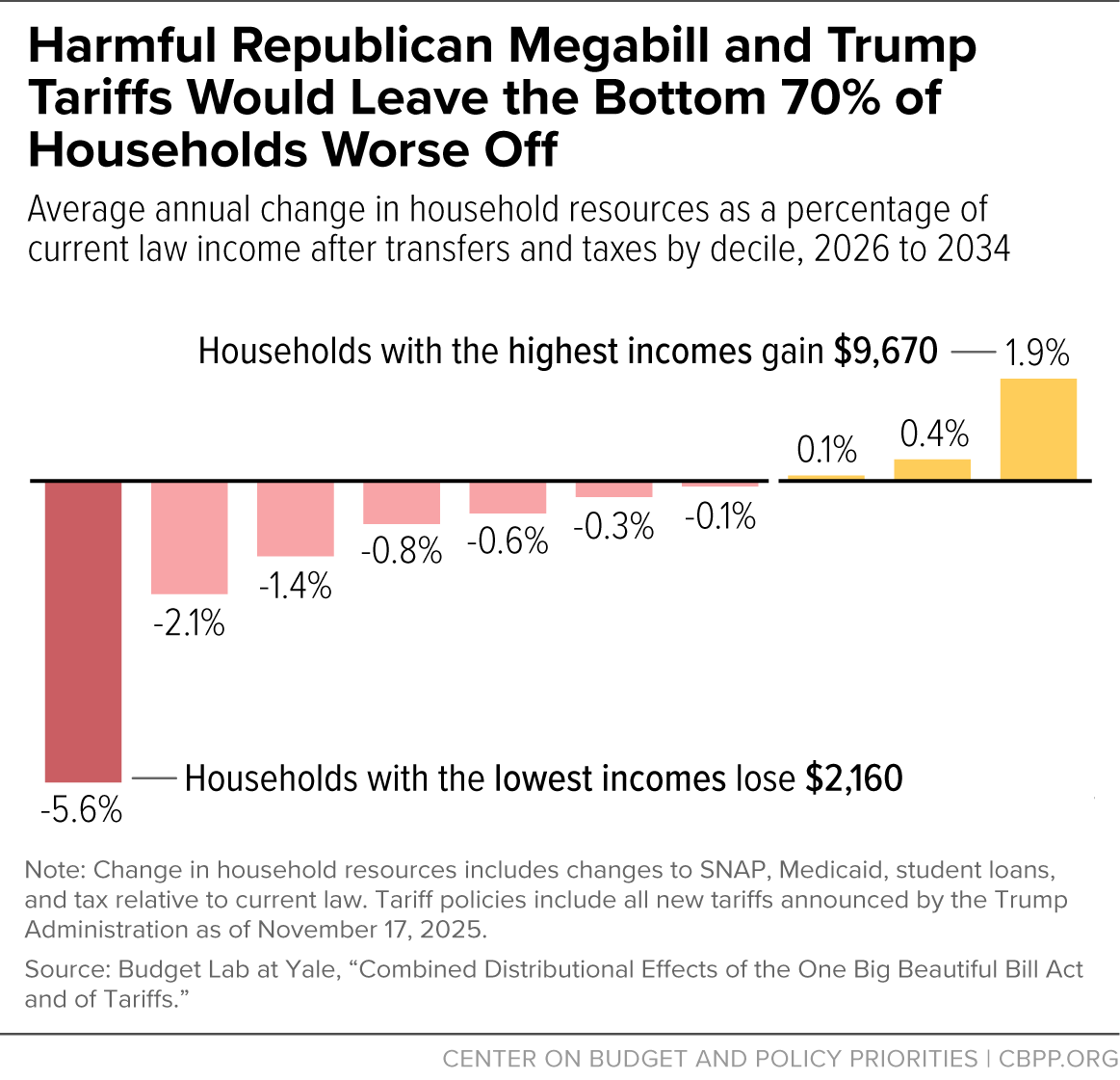
This upward redistribution is worsened by tariffs that impose a larger burden on low- and moderate-income people than on people with high incomes and raise costs for small business owners. A study by the Budget Lab at Yale found that households with incomes in the bottom 70 percent are worse off when the effects of the megabill and tariffs are taken into account.[7] (See Figure 1.)

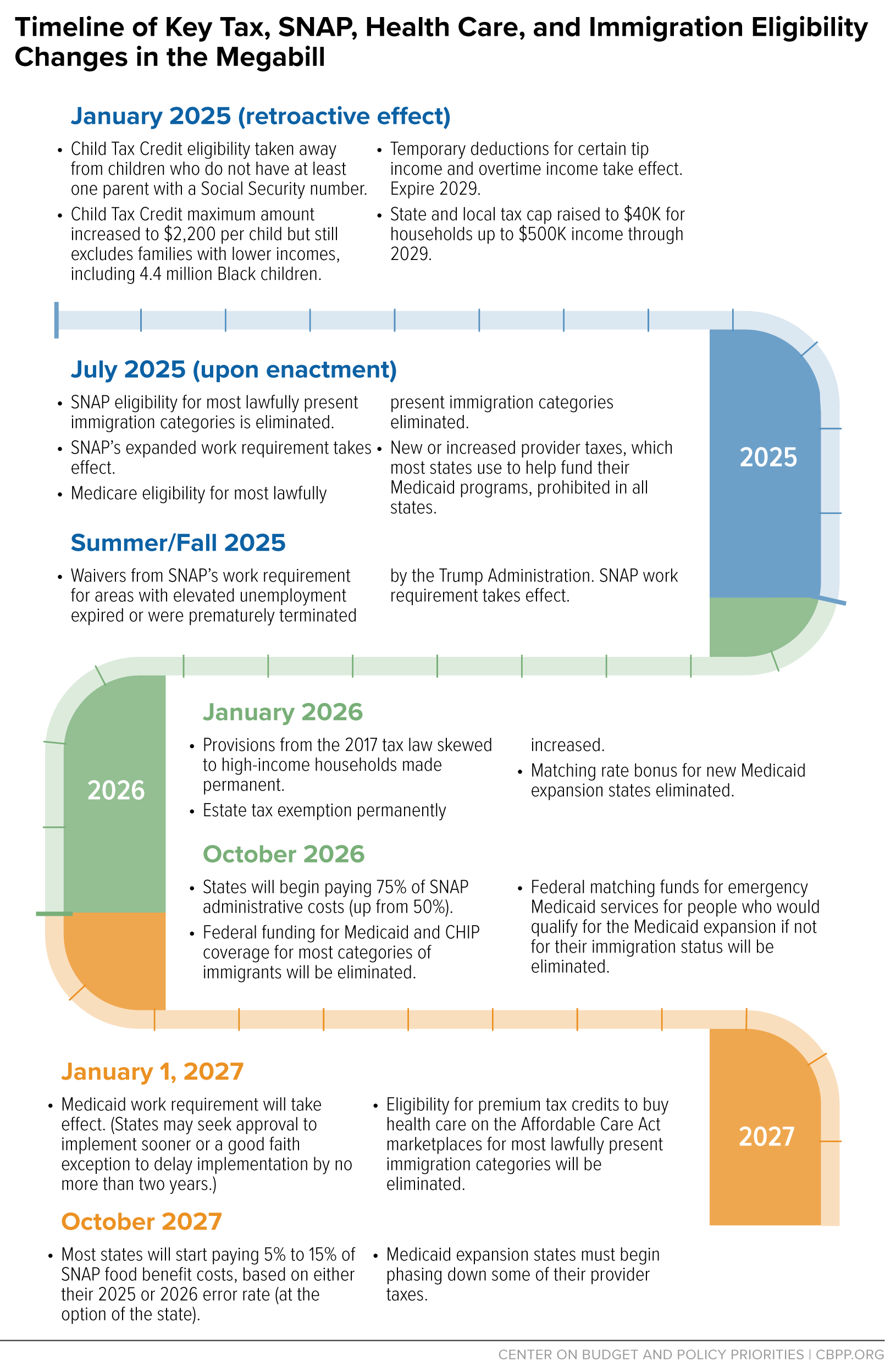
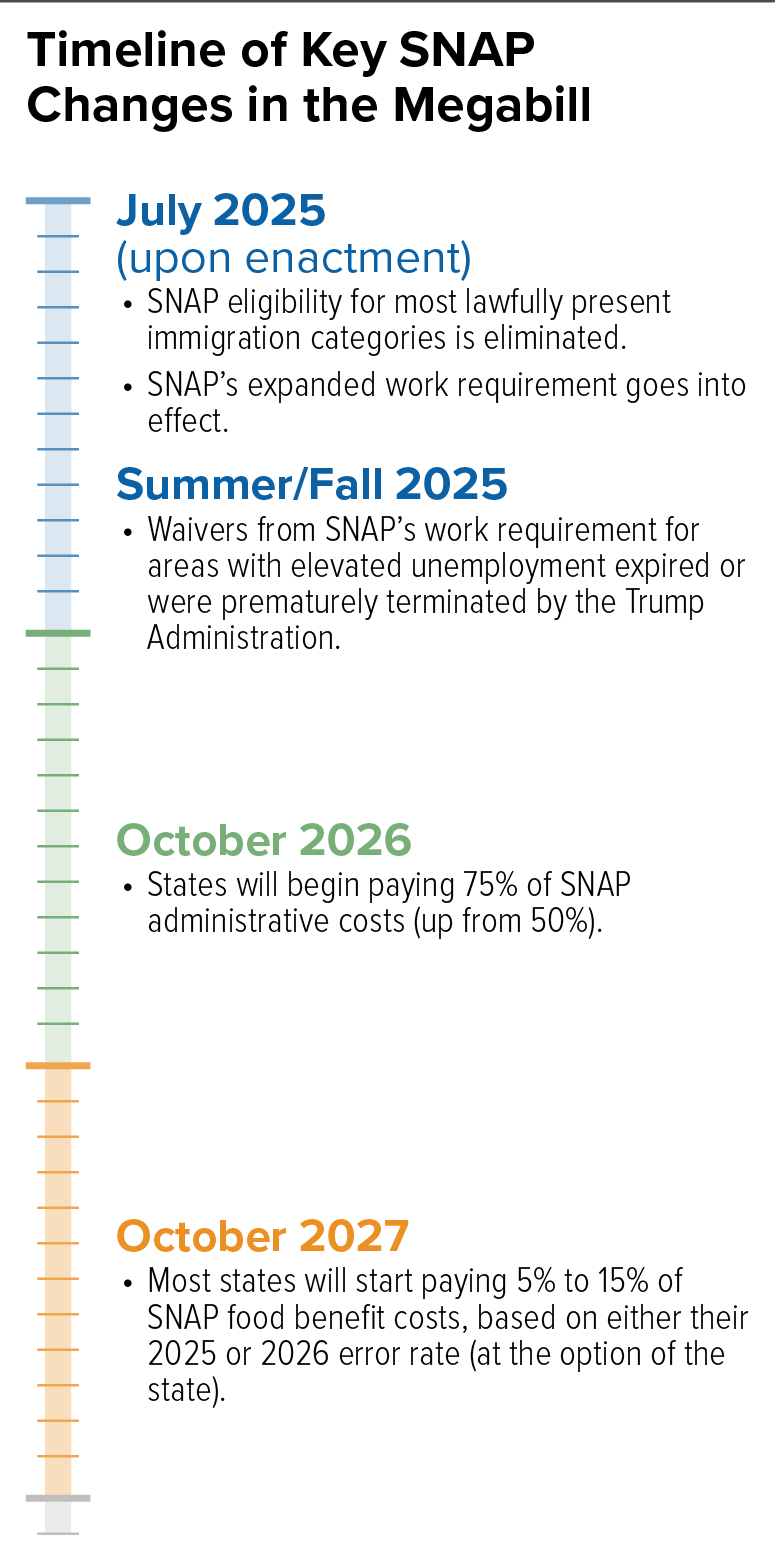
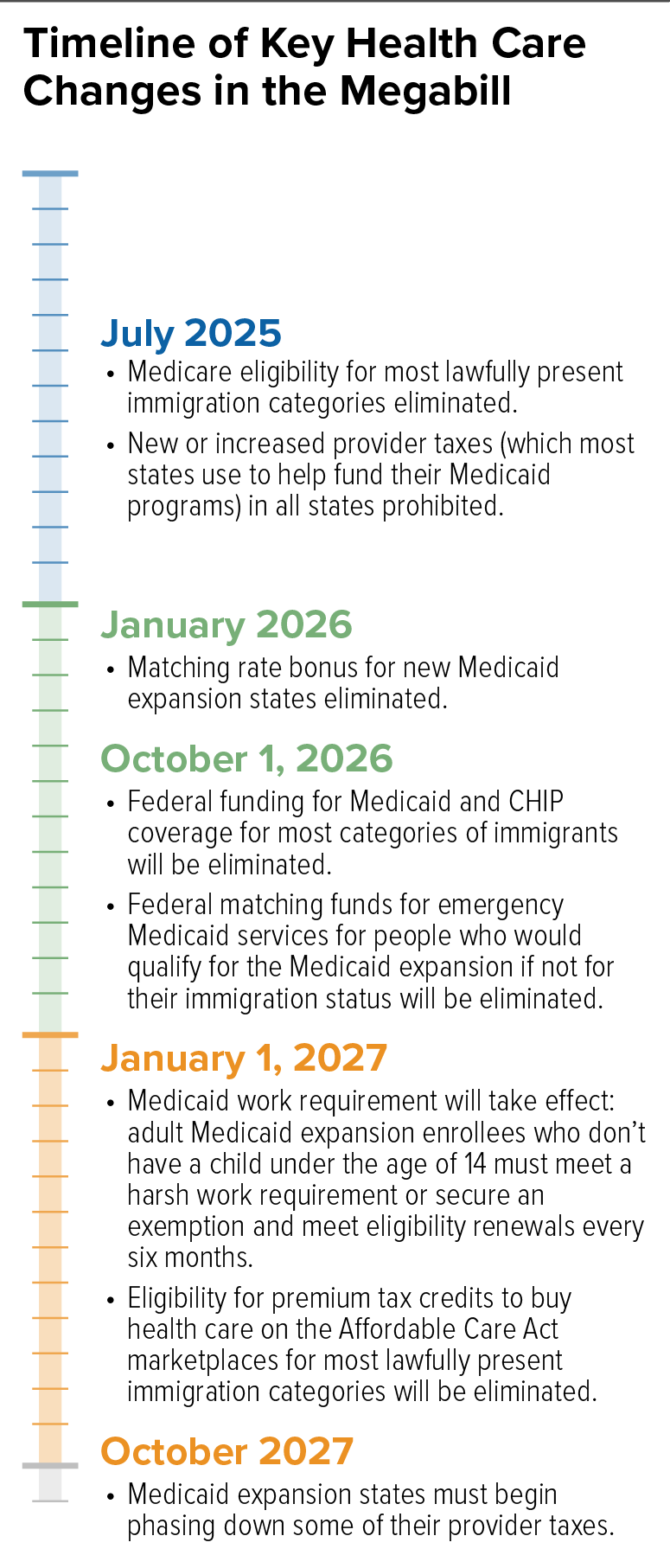
Not all the provisions of the megabill have gone into effect yet, and their impacts on people and communities will unfold over time. This paper outlines the major tax, SNAP, health care, and immigration eligibility provisions of the megabill; explains why these provisions exacerbate harms for Black communities; and provides implementation timelines for major megabill provisions. (See Figure 2.)
States will have to implement many of the megabill’s cuts to health care and food assistance, and they have some choices about how to do this. They can make “high road” choices that mitigate harm and reduce the number of people who lose help, or they can make “low road” decisions that exacerbate harm. High road choices require resources and sound implementation.

States are making these policy and programmatic decisions now, and some of those decisions could jumpstart the negative impacts on households’ access to health and food assistance. For example, CBPP’s analysis shows SNAP participation declined by 3.5 million people (or 9 percent) between the megabill’s July 2025 enactment and February 2026 (the last month with data on all states). These participation declines began before some of the major changes from H.R. 1 were fully in effect. We expect these harms to grow as states fully implement eligibility restrictions and take actions to lower their error rates.[8]
The Republican megabill’s tax cuts are tilted in favor of wealthy households and households with high incomes, deepening racial wealth and income inequities.
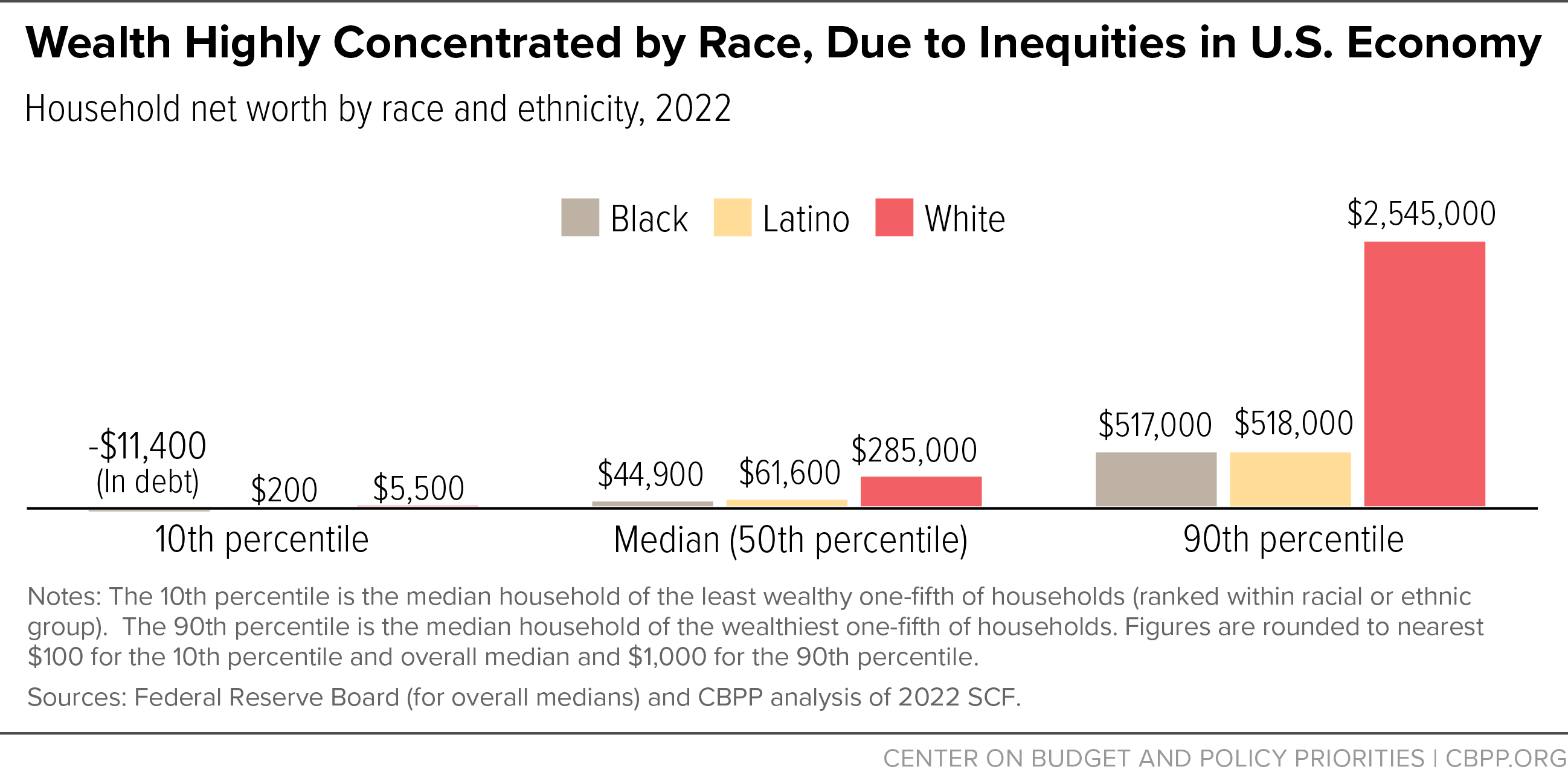
Historical racism and continuing racial prejudice and discrimination, through both public policies and private actions, have locked a large share of Black households out of opportunities for economic prosperity, while providing a far larger share of white individuals and households with access to opportunities to create and pass on wealth from generation to generation. (See Figure 3.) As a result, households of color are overrepresented at the lower end of the income and wealth distributions, and white households are overrepresented at the higher end.[9] The megabill’s provisions skewed towards wealthy and high-income households, therefore, go disproportionately to white households. For example, the megabill increases the amount a wealthy couple can pass on tax-free to their heirs to $30 million, $1.7 million more than under prior law. Because of the large exemption, fewer than 1 in 1,000 estates are wealthy enough to owe any estate tax.

Meanwhile, the megabill fails to deliver for individuals and families with lower incomes, harming millions of Black families:
- While the megabill expands the maximum Child Tax Credit from $2,000 to $2,200, more than half of Black children under age 17 — an estimated 4.4 million Black children — are left out of the full $2,200-per-child credit this year because their families’ incomes are too low.[10]
- Temporary tax deductions for certain tip and overtime income do little to benefit households with lower incomes. Black workers comprise a slightly smaller share of the tipped workforce than of the overall workforce (11.3 percent and 12.3 percent, respectively). Among tipped workers of all races, more than 1 in 3 will receive no benefit from the deduction because their annual income is so low they don’t pay federal income tax.[11] There are far more effective policies to help workers in low-paying jobs than singling out the subset who have tipped or overtime earnings.[12]
- Finally, households with incomes in the top 1 percent will receive tax cuts over three times the size of those for households with incomes in the bottom 60 percent, measured as a share of after-tax income.

Overall, the Tax Policy Center (TPC) finds the megabill’s tax provisions favor white households over Black households. TPC estimates show that while white households represent about 60 percent of total households, they will receive 70 percent of the megabill’s tax benefits; in contrast, Black households represent nearly 14 percent of households but will receive just over 8 percent of the tax cuts.[13]
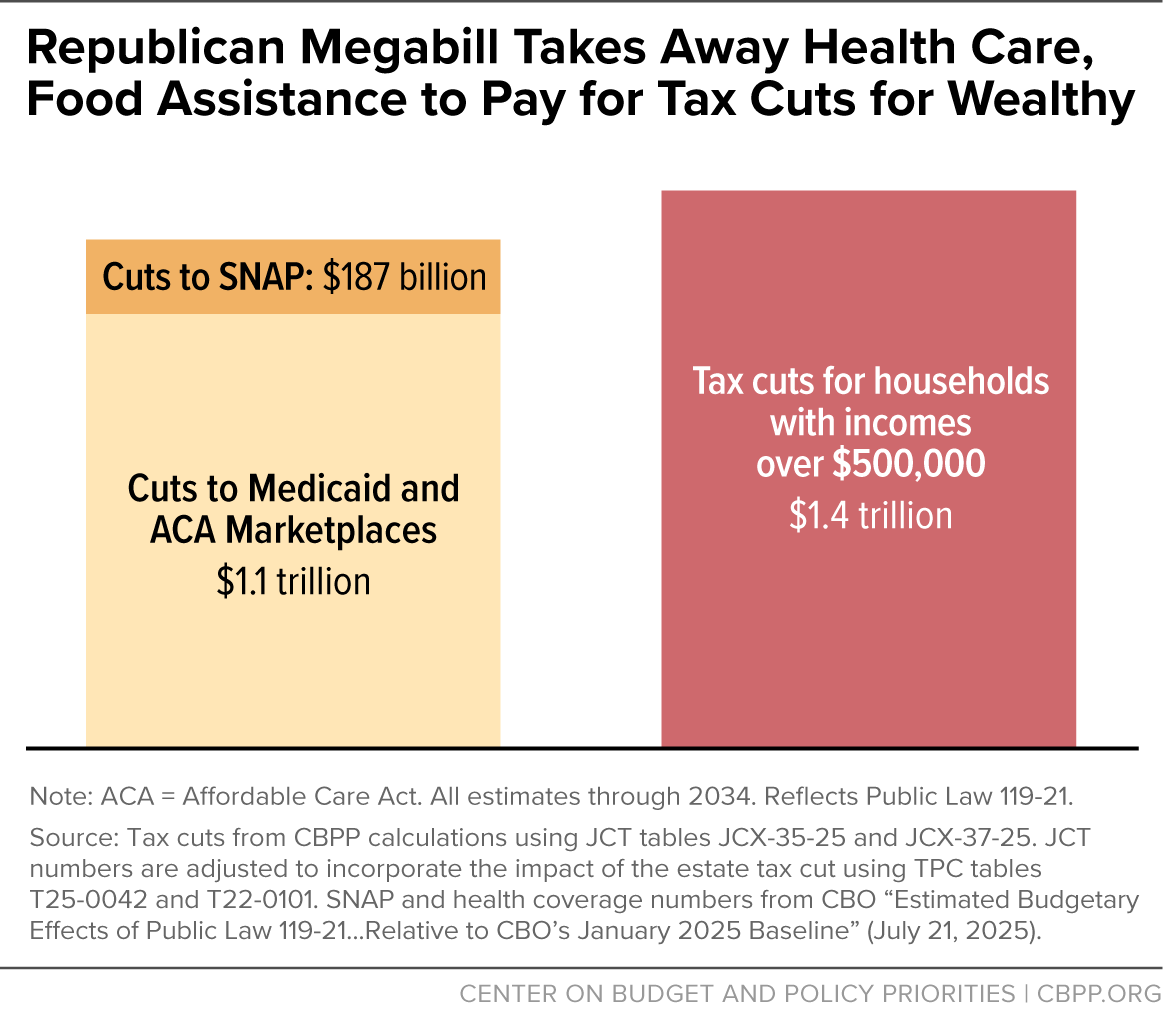
The cost of these skewed tax cuts is partially offset by taking away food assistance and health coverage from millions of people with low and moderate incomes and singling out people who are immigrants for particularly harsh eligibility restrictions. (See Figure 4.)
The Republican megabill cuts SNAP by nearly $187 billion through 2034, the largest funding cut in the program’s history.
The megabill will increase poverty, food insecurity, and hunger, including among children. The law takes away food assistance, in part, by expanding the harsh SNAP work requirement that previously applied to most non-elderly, non-disabled adults without children in their homes. The megabill extends the SNAP work requirement to include adults with children age 14 and older and adults ages 55 to 64. People subject to the requirement cannot receive food benefits for more than three months in a 36-month period unless they document they are working at least 20 hours per week or prove (through a red tape-laden process) that they qualify for an exemption, such as being unable to work due to a physical limitation.[14]

The megabill also ends work requirement exemptions for veterans, people experiencing homelessness, and young people who recently aged out of foster care, which were put in place in the Fiscal Responsibility Act of 2023. As a result, some of the individuals previously exempt from the work requirement have already begun losing SNAP, though many more will lose food benefits throughout the first half of 2026. This comes amid job market concerns that artificial intelligence-related (AI) displacement will make it harder for people to find work, and therefore, more difficult to meet the work requirement for SNAP.

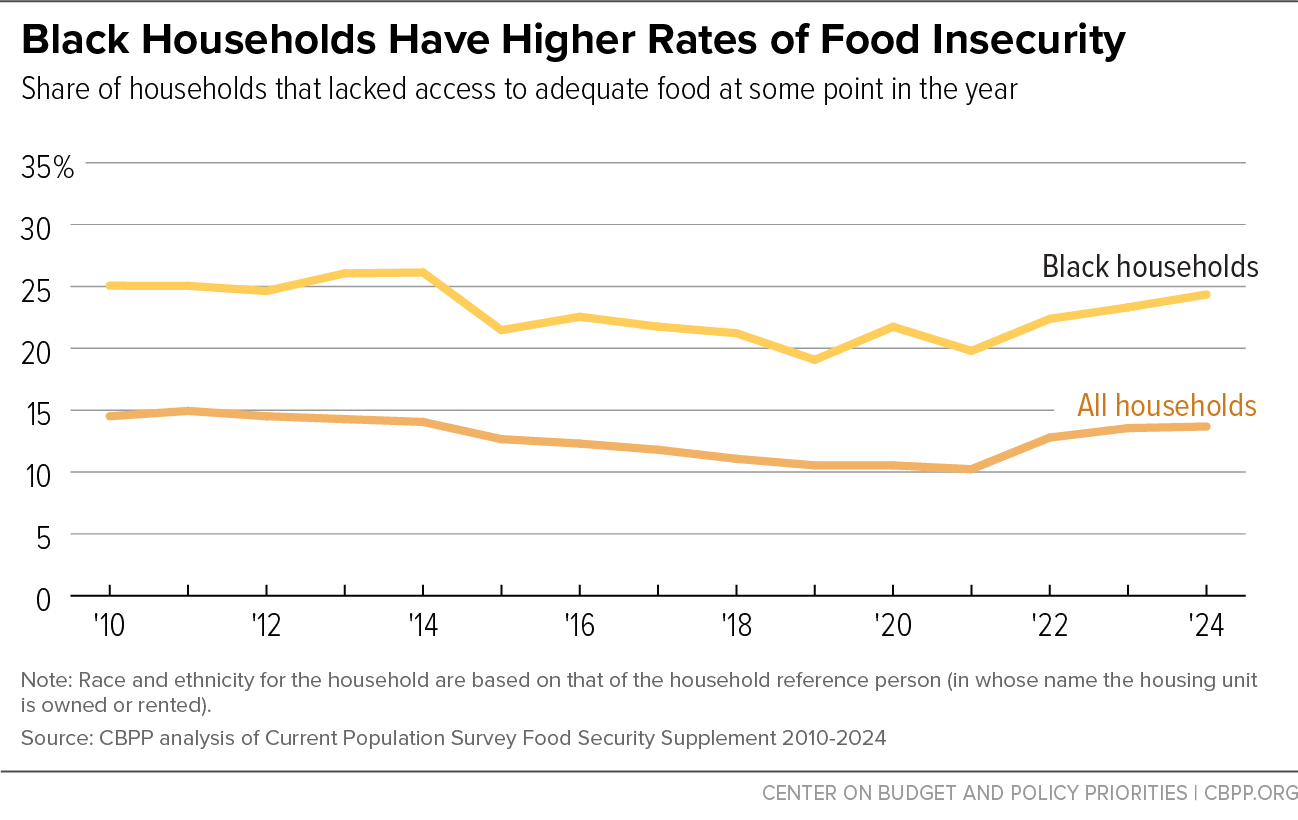
Black households have seen rising food insecurity in the aftermath of the COVID-19 pandemic. (See Figure 5.) The expansion of the SNAP work requirement could be particularly consequential for Black people, who often face higher unemployment rates, structural barriers to employment, and longer periods between jobs.
In addition, the law requires most states to pay between 5 and 15 percent of the cost of SNAP benefits starting in 2027 — the first time in the program’s modern history. The amount they will be required to pay will depend on either their 2025 or 2026 “error rate,” which measures the accuracy of each state’s eligibility and benefit determinations.
States that are unable or unwilling to pay these costs could end their SNAP programs entirely, which would leave children, seniors, workers, people with disabilities, parents, and veterans without access to food assistance. Conservative-leaning states and those with fewer resources — including many states in the South with large Black communities — may be more likely to end or sharply scale back their SNAP programs than other states as a result of these new cost burdens.
With so little time to reduce error rates, some states are already adopting policies and procedures that seek to reduce errors by making it more difficult for eligible low-income households to access the food assistance they need to afford groceries. SNAP participation nationwide fell by 3.5 million people (9 percent) between the law’s July 2025 enactment and February 2026, the latest month of data.[15]
The Republican megabill is projected to take health coverage away from 15 million people.

The law cuts health care by more than $1 trillion and failed to renew premium tax credit (PTC) enhancements, which made coverage on the Affordable Care Act (ACA) marketplaces far more affordable for working families while they were in place.
Medicaid plays an important role in providing coverage for Black individuals and families, reducing health inequities and uninsurance rates. [16] The ACA cut the uninsured rate for Black individuals under age 65 by almost half between 2013 and 2023.[17] In addition, PTC enhancements spurred ACA marketplace enrollment among Black households, which grew 186 percent between 2021 (when enhancements took effect) and 2024.[18] The ACA marketplace is also a key source of coverage for Black small business owners and self-employed workers, with 781,000 having been enrolled in individual market coverage in 2024.[19] This means that deep cuts in Medicaid and the loss of the PTC enhancements will have an outsized impact on Black individuals and families.
The megabill takes Medicaid away from people who can’t meet a harsh work requirement, including people who are between jobs, and creates incentives for states to restrict access to health coverage and care.
The work requirement applies to adult Medicaid expansion enrollees who don’t have a child under the age of 14. This group will see their health coverage taken away unless they can meet the burdensome work requirement or secure an exemption and pass eligibility renewals every six months. (States may seek approval to implement sooner or a good faith exception to delay implementation by no more than two years.) Just like with the SNAP work requirement, higher unemployment rates for Black workers and higher labor market volatility will make it even more difficult for low-paid Black workers to maintain their coverage due to these requirements.[20]
Note that work requirements for health coverage and food assistance would mean that people who lose their jobs, or face greater difficulty finding a job due to dislocation caused by AI, wouldn’t have access to food assistance or health coverage during a period of unemployment.
The megabill also eliminates the matching rate bonus that Congress enacted several years ago to encourage states to adopt the ACA Medicaid expansion. In the ten remaining non-expansion states, 22 percent of the uninsured people who would become newly eligible through expansion are Black.[21] Disincentivizing Medicaid expansion adoption will make it less likely that Black residents in these states gain coverage. (See box, “Temporary Rural Health Fund Will Not Offset Harms of Nearly $1 Trillion in Cuts to Medicaid.”)
Finally, the law’s limits on provider taxes, which are how almost all states fund their Medicaid programs, impact both how states finance Medicaid and how they pay providers. States should adopt a revenue-first approach to make up for the lost revenue.[22] If they don’t, they face some difficult choices. Some states may scale back health care by cutting the amount they pay health care providers and hospitals, putting access to care in jeopardy; cutting back on health services that are covered in their Medicaid program; erecting new access barriers to Medicaid; and/or restraining who is eligible. Black families would be deeply affected by these actions, particularly those that undermine public hospitals and clinics where Black households are more likely than other groups to get care. If states choose to protect health care without raising revenues from other sources, then they would have to cut programs elsewhere in the budget, like education, child care, or transportation, which are all critically important to Black households.
The megabill takes health coverage and food assistance away from people who are immigrants in the country lawfully.
Almost 1 in 10 Black people in the U.S. are immigrants, and the vast majority of Black immigrants are from the Caribbean and Africa.[23] (See box, “Trump Administration’s Targeting of Black Immigrants.”) More than half (57 percent) of Black immigrants are naturalized citizens.
The Trump Administration and congressional Republicans have used increasingly bombastic language to falsely claim that the anti-immigrant benefits-related cuts in the megabill are aimed at people without a documented immigration status. The reality is that our nation already blocked people without a documented immigration status from basic needs programs and had previously restricted many people with lawful immigration statuses from programs like Medicaid and SNAP.
The megabill further narrows eligibility based on immigration status, taking away food assistance and health coverage from people with many lawful statuses, and creating a new, far narrower group who will remain eligible for SNAP, Medicare, ACA marketplace plans, Medicaid, and the Children’s Health Insurance Program. This new, narrow group includes only:
- Citizens and nationals of the United States;
- Lawful permanent residents (LPRs, also known as green card holders);
- Cuban-Haitian entrants, who meet specific criteria as defined in the Refugee Education Assistance Act of 1980;[24] and
- People from the Federated States of Micronesia, Republic of the Marshall Islands, or Republic of Palau who live and work in the United States under Compacts of Free Association (COFA), often referred to as COFA migrants.
The law excludes most categories of lawful immigration statuses, including people granted humanitarian protections such as refugees, people granted asylum, and certain victims of domestic violence or labor or sex trafficking, among others living lawfully in the U.S. Limiting eligibility in this way reflects a stark departure from our country’s long-standing, bipartisan commitment to people fleeing violence and persecution.


Finally, while not part of the megabill, the Administration’s ongoing executive actions will hurt Black households and Black small businesses throughout 2026.
Historically, the Black unemployment rate is higher than the overall unemployment rate, even when the economy is strong, due to structural racism and ongoing discrimination in education and employment. When the economy weakens, Black households are usually the first to feel the effects, with Black workers tending to be the first fired and last hired during the business cycle.[25]
A significant portion of this job loss for Black workers was due to the Administration’s massive federal jobs cut. Black workers hold 18.6 percent of federal jobs, which have been a pathway to economic security for Black families for decades. While the Administration cut the federal workforce by 277,000 jobs in 2025 through a combination of pressure campaigns, broadly offered departure incentives, and firings,[26] a nearly additional 60,000 federal jobs have been lost to date in 2026, further impacting the labor market for Black workers. In addition, this Administration has directly targeted the Black community through its attacks on Diversity, Equity, and Inclusion initiatives in the private sector.[27] Since January 2025, the administrative and support services sector has lost 59,000 jobs. Black women tend to hold jobs in this sector, and the broader corporate retreat from inclusive hiring practices has exacerbated job losses for Black workers, and Black women in particular.[28]
Tariffs drive up the cost of consumer goods and input costs for small businesses.[29] Large companies and companies with access to the White House often have been able to avoid tariffs through exemptions or blunt their impacts through reductions.[30] But small businesses, particularly Black-owned small businesses, that source from foreign countries have been struggling with higher costs.[31] While the tariffs now in place are lower than those initially announced, the current average tariff rate of 10.5 percent is still significant and affects operations for small and large businesses.[32]
Tariffs have been an ongoing reality since the start of the Trump Administration. On April 2, 2025, the President announced a wide-ranging tariff scheme imposing a minimum tariff rate of 10 percent on over 70 countries. When the market reacted negatively, President Trump postponed many of these tariffs and backtracked on several others. This would become indicative of how tariffs proceeded throughout the rest of 2025. Adding to the volatility, President Trump seems to call for tariffs in response to a wide variety of events.[33]
On February 20, 2026, the Supreme Court struck down President Trump’s use of the International Economic Emergency Powers Act to impose tariffs in April 2025. However, President Trump has continued imposing broadly similar tariffs using different authorities (which could face further legal challenges).[34]
End Notes
[1] We would like to thank the Black Economic Alliance Foundation for their insights and support of this work.
[2] Gbenga Ajilore, “The Economy Posed Challenges for Black Households and Black-Owned Businesses in 2025,” CBPP, February 3, 2026, https://www.cbpp.org/blog/the-economy-posed-challenges-for-black-households-and-black-owned-businesses-in-2025.
[3] Brendan Duke, “Republican Megabill Trades Essential Support to Low-Income People for Skewed Tax Cuts,” CBPP, updated February 11, 2026, https://www.cbpp.org/research/federal-tax/republican-megabill-trades-essential-support-to-low-income-people-for-skewed.
[4] Kenneth Brevoort, Daniel Grodzicki, and Martin Hackmann, “Medicaid and Financial Health,” National Bureau of Economic Research Working Paper 24002, November 2017, https://www.nber.org/system/files/working_papers/w24002/w24002.pdf.
[5] Patrick Canning and Brian Stacy, “The Supplemental Nutrition Assistance Program (SNAP) and the Economy: New Estimates of the SNAP Multiplier,” Economic Research Service, July 2019, https://www.ers.usda.gov/publications/pub-details?pubid=93528.
[6] Duke, op. cit.
[7] Yale Budget Lab, “Combined Distributional Effects of the One Big Beautiful Bill Act and of Tariffs,” updated December 2025, https://budgetlab.yale.edu/research/combined-distributional-effects-one-big-beautiful-bill-act-and-tariffs-0.
[8] Dottie Rosenbaum et al., “SNAP Tracker: People Are Losing Food Assistance as the Republican Megabill Is Implemented,” updated May 18, 2026, https://www.cbpp.org/research/food-assistance/snap-tracker-people-are-losing-food-assistance-as-the-republican-megabill.
[9] Chye-Ching Huang and Roderick Taylor, “How the Federal Tax Code Can Better Advance Racial Equity,” CBPP, July 25, 2019, https://www.cbpp.org/research/federal-tax/how-the-federal-tax-code-can-better-advance-racial-equity.
[10] Tax Policy Center (TPC) national estimate for 2026 allocated by race based on CBPP analysis of American Community Survey data for 2022-2024, using 2026 tax parameters and incomes adjusted to 2026 projected levels using February 2026 Congressional Budget Office projections. Black children are those identified as Black only, not Latino. The share of Black children under age 17 left out of the full $2,200 Child Tax Credit is the share of the average 2022-2024 ACS population under 17. TPC, “T25-0258 – Distribution of Tax Units, Children, and Dependents by Size of Child Tax Credit (CTC), 2026,” August 5, 2025, https://taxpolicycenter.org/model-estimates/T25-0258.
[11] Nina Mast, “Tipping is a racist relic and a modern tool of economic oppression in the South,” Economic Policy Institute, June 18, 2024, https://www.epi.org/publication/rooted-racism-tipping/; Ernie Tedeschi, “The ‘No Tax on Tips Act’: Background on Tipped Workers,” Yale Budget Lab, June 24, 2024, https://budgetlab.yale.edu/news/240624/no-tax-tips-act-background-tipped-workers.
[12] Brendan Duke, “Overhyped Deductions for Tipped Income and Overtime Do Little for Workers,” April 9, 2026, https://www.cbpp.org/research/federal-tax/overhyped-deductions-for-tipped-income-and-overtime-do-little-for-workers.
[13] Urban-Brookings Tax Policy Center, “T26-0009 – 2025 Budget Reconciliation Act, One Big Beautiful Bill Act (OBBBA), Distribution by ECI Percentile and Racial or Ethnic Group, 2026,” March 19, 2026, https://taxpolicycenter.org/model-estimates/t26-0009.
[14] Food and Nutrition Service, U.S. Department of Agriculture, “SNAP Work Requirements,” updated August 29, 2025, https://www.fns.usda.gov/snap/work-requirements.
[15] Rosenbaum et al.
[16] CBPP, “Introduction to Medicaid,” November 4, 2025, https://www.cbpp.org/research/health/introduction-to-medicaid.
[17] CBPP, “2025 Budget Stakes: Cuts Would Widen Economic Disparities for Many People of Color,” February 28, 2025, https://www.cbpp.org/research/poverty-and-inequality/2025-budget-stakes-cuts-would-widen-economic-disparities-for-many.
[18] CBPP, “2025 Budget Stakes: Cuts Would Widen Economic Disparities for Many People of Color.”
[19] CBPP analysis of Current Population Survey Annual Social and Economic Supplement data. ACA marketplace coverage comprises the large majority of individual market coverage. Small business is defined as having fewer than 50 employees.
[20] Elizabeth Ananat, Anna Gassman-Pines, and Olivia Howard, “Work requirements penalize workers in volatile occupations,” The Hamilton Project, May 22, 2025, https://www.hamiltonproject.org/publication/post/work-requirements-penalize-workers-in-volatile-occupations/.
[21] Elizabeth Zhang, “Nearly 3 Million Uninsured Adults Would Gain a Path to Medicaid Coverage if Their States Adopted ACA Medicaid Expansion,” CBPP, updated March 19, 2026, https://www.cbpp.org/research/health/nearly-3-million-uninsured-adults-would-gain-a-path-to-medicaid-coverage-if-their.
[22] Wesley Tharpe, Clara Wilson, and Joanna LeFebvre, “Sound State Revenue Choices Essential to Counteract Harmful Policies and Build Forward,” CBPP, February 26, 2026, https://www.cbpp.org/research/state-budget-and-tax/sound-state-revenue-choices-essential-to-counteract-harmful-policies.
[23] Christine Tamir and Monica Anderson, “One-in-Ten Black People Living in the U.S. Are Immigrants,” Pew Research Center, January 20, 2022, https://www.pewresearch.org/race-and-ethnicity/2022/01/20/one-in-ten-black-people-living-in-the-u-s-are-immigrants/.
[24] Section 501(e) of the Refugee Education Assistance Act of 1980, P.L. 96–422.
[25] Gbenga Ajilore, “With Economic Risks High, Here Are Three Facts to Remember About Recessions,” CBPP, April 17, 2025, https://www.cbpp.org/blog/with-economic-risks-high-here-are-three-facts-to-remember-about-recessions.
[26] Kiran Rachamallu and Devin O’ Connor, “Administration’s Radical Personnel Cuts Bypassed Congress and Lacked Transparency, Obscuring Impact on Public Services,” CBPP, January 15, 2026, https://www.cbpp.org/research/federal-budget/administrations-radical-personnel-cuts-bypassed-congress-and-lacked.
[27] Gbenga Ajilore, “The Republican Agenda’s Triple Threat to Black Households’ Economic Well-Being,” CBPP, August 7, 2025, https://www.cbpp.org/research/economy/the-republican-agendas-triple-threat-to-black-households-economic-well-being.
[28] Pavithra Mohan, “Trump’s anti-DEI policies are hurting college-educated Black women,” Fast Company, February 12, 2026, https://www.fastcompany.com/91490412/trumps-anti-dei-policies-are-hurting-college-educated-black-women.
[29] Gbenga Ajilore, “The Economy Posed Challenges for Black Households and Black-Owned Businesses in 2025,” CBPP, February 3, 2026, https://www.cbpp.org/blog/the-economy-posed-challenges-for-black-households-and-black-owned-businesses-in-2025.
[30] Maria Aspan, “Trump grants tariff breaks to 'politically connected' companies, Senate Dems say,” NPR, February 4, 2026, https://www.npr.org/2026/02/04/nx-s1-5698264/trump-wyden-van-hollen-tariffs-politically-connected-companies.
[31] Adam Mahoney and Aallyah Wright, “Black-Owned Businesses Confront Rising Costs Amid Trump’s Tariffs,” Capital B, August 7, 2025, https://capitalbnews.org/black-owned-businesses-trump-tariffs-costs/.
[32] Ana Swanson, “Why Haven’t Trump’s Tariffs Had a Bigger Impact?,” New York Times, January 3, 2026, https://www.nytimes.com/2026/01/03/business/economy/trump-tariffs-prices-impact.html.
[33] Chad P. Brown, “Trump's trade war timeline 2.0: An up-to-date guide,” Peterson Institute for International Economics, February 20, 2026, https://www.piie.com/blogs/realtime-economics/2025/trumps-trade-war-timeline-20-date-guide; Ana Swanson, “Trump Returns to a Familiar Role: Sowing Trade Chaos,” New York Times, January 22, 2026, https://www.nytimes.com/2026/01/22/us/politics/trump-trade-chaos.html.
[34] Herb Scribner and Courtenay Brown, “Trump signals new tariffs plan. Here's how Section 122 works,” Axios, February 20, 2026, https://www.axios.com/2026/02/20/trump-tariff-plan-section-122-trade-act; Kimberly Clausing and Maurice Obstfeld, “What the Supreme Court’s Tariff Ruling Changes, and What it Doesn’t,” Peterson Institute for International Economics, February 23, 2026, https://www.piie.com/blogs/realtime-economics/2026/what-supreme-courts-tariff-ruling-changes-and-what-it-doesnt.