

The Republican Agenda’s Triple Threat to Black Households’ Economic Well-Being
The Trump Administration and Republican majorities in both houses of Congress are advancing a three-pronged policy agenda that will deliver particular harm to the Black community. The recently enacted Republican megabill doubles down on costly tax cuts skewed to wealthy, disproportionately white people, while doing little for people with low and moderate incomes. Worse still, it will take away food assistance and health coverage from millions doing low-paid work through onerous work reporting requirements.[2] Executive actions, meanwhile, are undermining basic governance while hollowing out the federal workforce, a key source of opportunity for Black households since it desegregated in 1948, and vital for building the Black middle class. [3],[4] And lastly, the Trump Administration’s extreme tariff scheme will cost jobs, raise the price of many goods, and create an uncertain environment that is harmful to businesses and particularly Black-owned businesses, which are often relatively small and less well connected to government officials, and thus less likely to obtain exemptions from tariffs.[5] [6]
Opportunity should be available to everyone no matter their race, color, or creed. The Administration’s agenda limits the opportunities for Black households to live in healthy and thriving communities, to have the chance to move forward in life, and to be free from worry about “just getting by.”
This three-part agenda — legislation, executive action, and tariffs — will disproportionately benefit households with incomes in the top 1 percent of the income distribution while doing much less for, and often harming, households with incomes in the bottom 80 percent, particularly those in the bottom 20 percent.[7] And structural inequities in the economy, like labor market discrimination and the instability of low-paid work, will amplify the impact on the Black community. The tax system, meanwhile, advantages those whose income comes from wealth (like stock market gains) rather than labor and therefore disadvantages Black households who have less wealth.
Taken together, this agenda hurts low- and moderate-income people, families, and communities of all races and Black people, families, and communities especially. And paired with the President’s executive orders targeting government efforts to expand equity and inclusion within and outside government — from ending government funding for equity-related medical research to pressuring state public schools not to engage in equity-related activities it defines vaguely at best — it shows this Administration’s hostility to the Black community.
Black Households Disproportionately Targeted by Reconciliation Bill’s Massive Benefit Cuts, Left Out by Its Giveaways to Wealthy
The tax and spending package enacted July 4, 2025, will take away health coverage through Medicaid and the ACA marketplaces and food assistance through Supplemental Nutrition Assistance Program (SNAP) from millions of people — to pay, in part, for huge tax giveaways for wealthy households and businesses that will drive up deficits and fiscal risk.
Black people face systemic inequities that depress their earnings and wealth, limit employment opportunities, and make it harder to access necessities like health care and stable housing. Federal programs like SNAP, Medicaid, and housing assistance are therefore critical to helping tens of millions of Black households afford these basic needs. In 2023, 11 million Black people lived in a household that reported receiving SNAP in the past 12 months, and 13 million Black people were insured through Medicaid or the Children’s Health Insurance Program (CHIP). [8] These programs should be supported, not cut.[9]

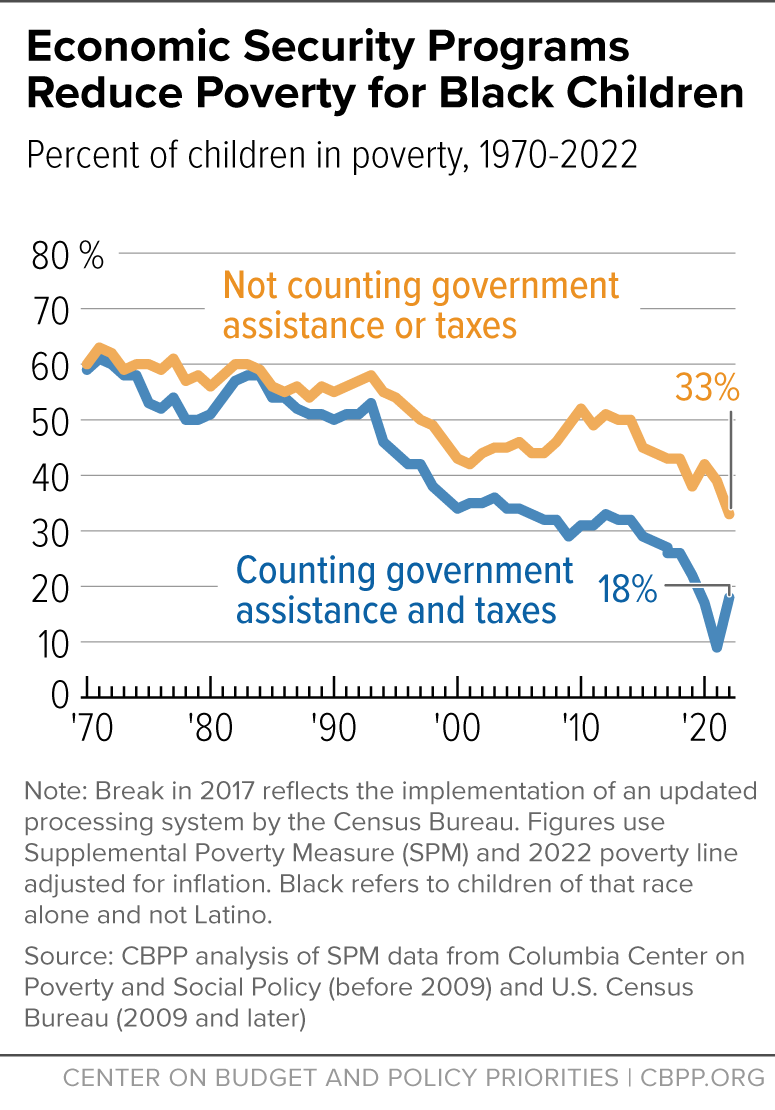
Improving these programs and reducing access barriers would drive further gains in equity. The economic foundation they help provide can help families get better jobs, provide their children with high-quality education, and contribute to the broader economy. These programs have made a significant difference in the lives of Black children. (See Figure 1.)
Republicans enacted the megabill’s massive cuts to this critical assistance to help pay for the plan’s centerpiece — $4.5 trillion of tax cuts through 2034, the bulk of them to extend the expiring tax cuts enacted in 2017 during President Trump’s first term.
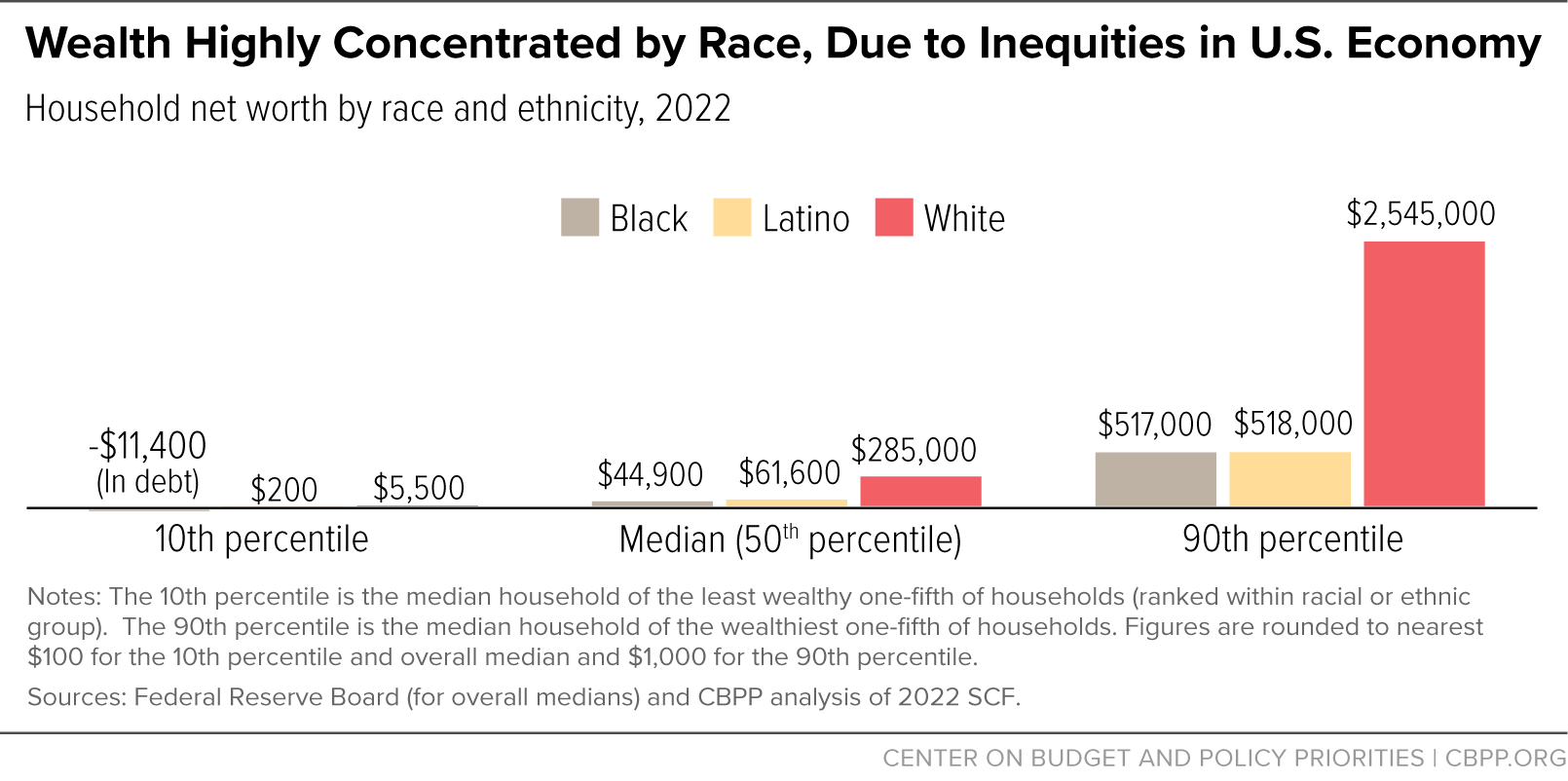
As Dorothy Brown has written about extensively, the tax system’s structure already worsens the racial wealth gap because it taxes wage income more than wealth, and Black households have less wealth than white households.[10] Across the wealth distribution, white households have a higher net worth than Black households and the racial wealth gap is significantly higher at the 90th percentile. (See Figure 2.)
The 2017 tax law worsened these inequities, where white households received 80 percent of the benefits but comprised only 67 percent of tax filers.[11] Extending and expanding on the 2017 tax law, as the reconciliation bill did, will only perpetuate this disparity. An analysis of a possible extension found that 72 percent of the benefits of the individual tax rate changes from extending the 2017 tax law would go to white tax filers while 8 percent of the benefits would go to Black tax filers, and nothing in the final bill changed that underlying dynamic.[12]

Executive Actions Hollow Out Key Employment Sources, Services, Protections, and More
The Trump Administration has unleashed a flurry of measures to radically reshape the federal government. These moves, many of them unlawful, will weaken key public services for people across the country. Examples include severe reductions in workforce (RIFs) across federal agencies like the Social Security Administration (SSA), Department of Health and Human Services (HHS), Department of Veterans Affairs (VA), and the Department of Agriculture (USDA). The Administration is also closing regional offices and consolidating divisions in ways that will undermine important agency duties and activities.[13]
These workforce reductions will harm Black households because federal employment has been a pathway to enter the middle class and generate intergenerational wealth, something that Black households have otherwise been systemically denied as a group.[14] Federal public service provides meaningful careers that deliver enormous benefits to the public, while providing opportunity for Black workers to experience steady pay and excellent benefits, including strong pension benefits — an important feature given racial inequities in retirement savings.
Black people have found the federal labor market to be robust for opportunities relative to the broader labor force overall: they comprise 18.6 percent of the federal workforce and 13 percent of the civilian labor force.[15] Beyond the harms suffered by people losing these jobs, majority-Black communities could suffer economically, not only in the Washington, D.C. suburbs of Prince George’s and Charles counties in Maryland, but in areas across the country with a large federal presence and large Black communities, such as in the South.[16]
Administration’s Undermining of Social Security Threatens Black Beneficiaries Especially
Hollowing out the federal workforce will also degrade services the public relies on. For example, staff reductions and other harmful steps the Trump Administration is taking with SSA will make it harder for people to apply for the Social Security benefits they’ve earned or get questions answered and problems addressed. Given the racial wealth gap, Social Security is an even more important support for Black retirees than white retirees. Due to many structural issues like inequities in the labor market and in access to retirement plans and health coverage, wealth inequities rise as people age, and white people have greater retirement savings and greater levels of home equity, exacerbating the wealth gap.[17] (See Figure 3.)

The wealth gap would be even wider if it weren’t for Social Security.[18] Social Security is a large portion of retirement income for Black people, with over 70 percent of beneficiaries receiving 50 percent or more of their retirement income from Social Security and over 30 percent of beneficiaries relying on it for 100 percent of their retirement income.[19] In addition, Black individuals are 1.5 to 2 times more likely to receive benefits from Social Security Disability Insurance than white individuals.
At the outset of the second Trump Administration, funding for SSA was inadequate for more than a decade, and the agency was facing a customer service crisis, with long hold times on the phone and record-long waits for disability determinations.[20] But even against this backdrop, this Administration is dramatically undermining the agency’s operations by cutting staff, closing regional SSA offices, stopping beneficiaries from conducting routine tasks by phone, and increasing reporting burdens.[21] The Administration walked back some of these policies in the face of public pressure, but many of the obstacles it imposed remain. This will make it harder for retirees to get necessary service from SSA, especially when forced to travel to field offices.[22] There are 35 states where more than 10 percent of seniors do not live within 45 minutes of an SSA field office.[23] Cutting staff and closing offices will only make that worse.
Civil Rights, Protections for Black-Owned Businesses Also Among Those Under Assault
Other executive actions that will harm the Black community include those that undo environmental protections for communities of color, who face higher exposure to pollutants, and the steps the Environmental Protection Agency has taken to undo vital environmental justice regulations.[24]
The Administration’s attacks on civil rights protections are especially troubling and threaten harm across ages and disciplines. It fired nearly half the staff at the Department of Education, with an emphasis on staff in the Office of Civil Rights, which will make it difficult to investigate discrimination on the basis of race, gender, and disability.[25] It has similarly targeted civil rights offices across the federal government, including at SSA, the Department of Labor, and the Federal Trade Commission.[26]
In a threat to Black workers and others facing discrimination, the Administration has directly targeted previous executive orders that prohibited employment discrimination on the basis of race, religion, and national origin as it relates to federal contracting.[27] President Trump rescinded various executive orders that tackled discrimination, promoted diversity and inclusion in the federal workforce, and advanced equity through other regulations. It has gone so far as rescinding Executive Order 11264 — from 1965 — that prohibited discrimination in federal contracting and subcontracting.[28] That this Administration went back to the Civil Rights era to rescind executive orders shows the lengths it will go to try and reverse gains for Black people and other marginalized groups.
Lastly, one executive action that did not get as much attention as others undoes key supports for Black-owned businesses. The order called for eliminating seven smaller government entities, and the loss of one of them — the Minority Business Development Agency (MBDA) — represents a direct attack on the Black community. The MBDA, recently codified into law through the bipartisan Infrastructure Investment and Jobs Act, worked to ensure that minority business owners can get access to capital and technical assistance needed to compete effectively in the market.[29] All the career staff have been reassigned and many of the regional business centers have closed due to uncertainty about funding.[30]
In fiscal year 2023, MBDA facilitated access to $1.5 billion in capital and helped businesses get $3.8 billion in contract awards. Such work continues to be vital given the existing inequities in small-business lending between Black and white business owners. A Federal Reserve survey found that Black-owned firms are more likely to face financial challenges than white-owned firms.[31] Another study found that Black people, and not just business owners, face racial discrimination in financial loan services.[32] MBDA is necessary to address these issues, and its elimination is another assault.
Tariffs’ Economic Risks Loom Especially Large for Black Households
The Administration has proposed and implemented sweeping taxes on imported goods, known as tariffs, through executive actions. It has justified them in part on the need to raise revenues to offset the extension of the 2017 tax cuts, raising a regressive tax (tariffs) while enacting tax cuts that favor the wealthy. The tariff scheme has been implemented in a chaotic and haphazard way, and the courts ruled that some of the tariffs were illegally imposed, so the outcome is still uncertain. Still, it is clear that the tariffs increase the prices of imported goods, causing supply to fall since input costs for businesses will rise. But the sheer uncertainty about the ultimate tariff regime also leads to lower demand as businesses put off investment and consumers spend less, as many lose jobs and even more worry about losing their jobs. Therefore, this tariff scheme causes an elevated risk of recession.
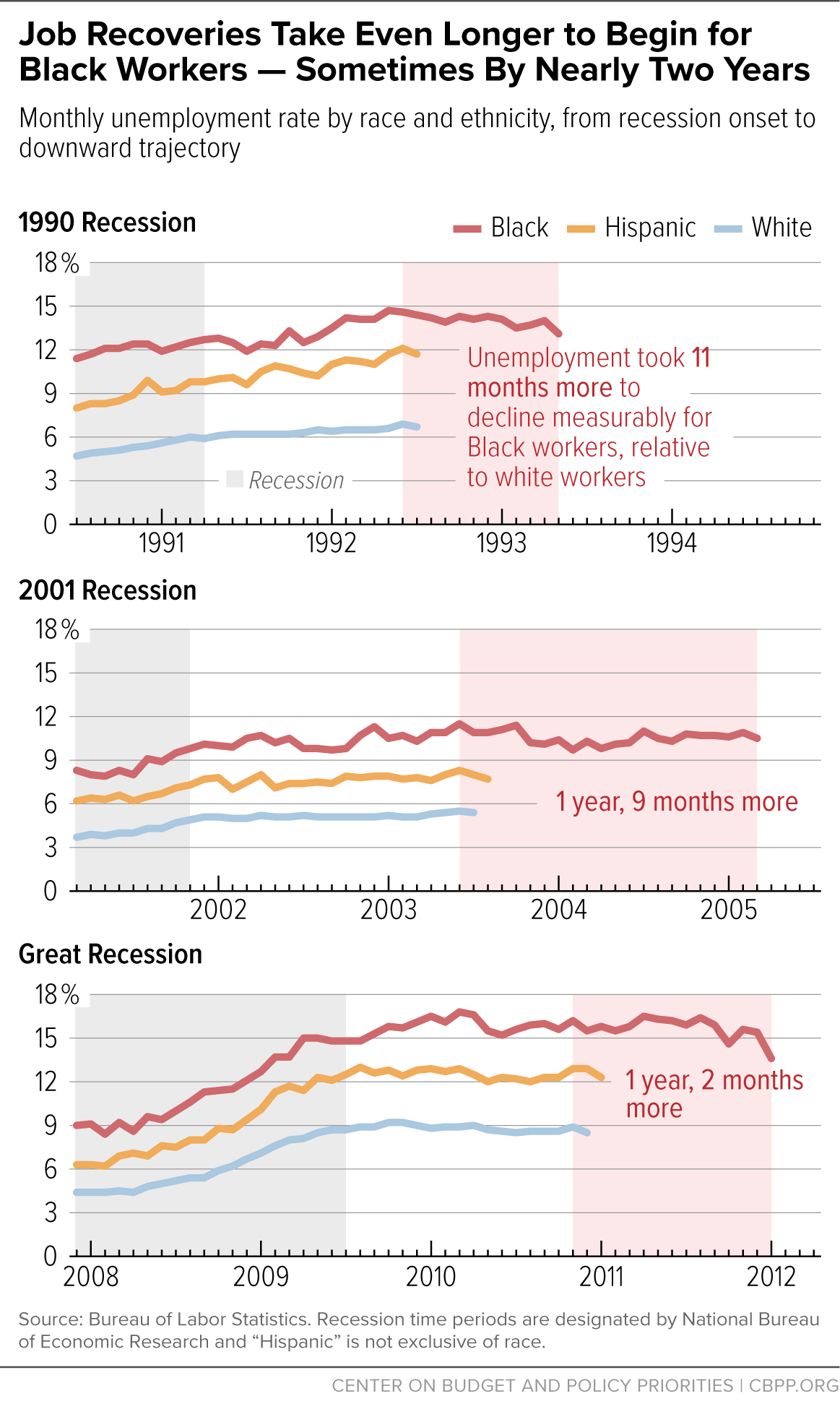
And as has been well documented, Black workers tend to lose their jobs at the onset of economic downturns and are the last group to regain employment during a recovery.[33] Figure 4 shows that employment recovery takes the longest to begin for Black workers after the recession technically ended.
Businesses with Black owners and clienteles will also face more harm from the tariffs. This speaks to the regressivity of tariffs for both businesses and consumers as the burden of tariffs falls more heavily on lower-income households and smaller businesses. Large corporations and politically connected companies can get exemptions from tariffs because they can afford armies of lawyers, consultants, and lobbyists.[34] This happened in April 2025 when Apple got phones and certain other items exempted from the tariffs on China, leading other executives to lobby the Administration and get exemptions for their products.[35] Only 1.6 percent of Fortune 500 companies have Black CEOs.[36]


Black-owned businesses will likely not be able to benefit from tariff exemptions and will be at a disadvantage relative to white firms since their costs will go up disproportionately. Tariffs can also pose particular harms for Black women due to the types of products that end up subject to them. Tariffs hit products for those working in the care industry, like diapers or cleaning supplies, or raw materials for Black-owned hair care products.[37]
Interest rates have also risen due to this Administration’s tariff policy, which raises the cost for businesses needing capital, adding to the existing uncertainty in the economy.[38] This uncertain business environment will make it less likely that Black-owned firms will experience success. Black-owned businesses are less likely to have access to capital, particularly with respect to accessing capital through equity relative to debt. Even with debt financing, a study from MBDA finds that minority-owned firms are more likely to pay higher interest rates, receive lower loan amounts, and to be denied loans.[39] And as noted, these owners have less recourse now that there’s effectively no MBDA for them to turn to. Thus, rising interest rates will harm Black businesses and impact their sustainability.
End Notes
[1] We would like to thank the Black Economic Alliance (BEA) Foundation for their insights into this report.
[2] Gideon Lukens and Elizabeth Zhang, “Senate Bill Expands Medicaid Work Requirements to Include Some Parents, Would Take Away Coverage From Millions: State and Congressional District Estimates“, CBPP, June 18, 2025, https://www.cbpp.org/research/health/senate-bill-expands-medicaid-work-requirements-to-include-some-parents-would-take.
[3] White House, Executive Order on the Desegregation of the Armed Forces, 1948, https://www.archives.gov/milestone-documents/executive-order-9981.
[4] John-John Williams IV and Greg Morton, “Federal jobs helped build Baltimore’s Black middle class. What happens now?” Baltimore Banner, April 3, 2025, https://www.thebaltimorebanner.com/economy/trump-federal-jobs-black-baltimore-R4KEHQPAXJEHVCIG6KURIBBNCE/.
[5] Brendan Duke and Gbenga Ajilore, “Republican Agenda’s ‘Triple Threat’ to Low- and Moderate-Income Family Well-Being,” CBPP, April 17, 2025, https://www.cbpp.org/research/federal-tax/republican-agendas-triple-threat-to-low-and-moderate-income-family-well-being.
[6] Gbenga Ajilore, “The 2017 Tax Law Did Not Boost the Economy,” CBPP, April 8, 2025, https://www.cbpp.org/blog/the-2017-tax-law-did-not-boost-the-economy.
[7] The analysis is of the House-passed bill but given that the final law retains most of the House’s provisions, the dynamic is likely similar. The Budget Lab, “Combined Distributional Effects of the One Big Beautiful Bill Act and of Tariffs,” June 16, 2025, https://budgetlab.yale.edu/research/combined-distributional-effects-one-big-beautiful-bill-act-and-tariffs
[8]CBPP analysis of 2023 American Community Survey (ACS) Public Use Microdata Sample (PUMS) data. Program participation estimates based on ACS data may differ from estimates from administrative data due to differences in data collection, definition of coverage, time period, and universe. The estimates are also linked from this piece: https://www.cbpp.org/research/poverty-and-inequality/2025-budget-stakes-cuts-would-widen-economic-disparities-for-many
[9]CBPP, “2025 Budget Stakes: Cuts Would Widen Economic Disparities for Many People of Color,” February 28, 2025, https://www.cbpp.org/research/poverty-and-inequality/2025-budget-stakes-cuts-would-widen-economic-disparities-for-many.
[10] Dorothy Brown, “The Whiteness of Wealth,” 2025, https://dorothyabrown.com/whiteness-of-wealth/.
[11] Meg Wiehe, “Race, Wealth and Taxes: How the Tax Cuts and Jobs Act Supercharges the Racial Wealth Divide,” Institute on Taxation and Economic Policy, October 11, 2018, https://itep.org/race-wealth-and-taxes-how-the-tax-cuts-and-jobs-act-supercharges-the-racial-wealth-divide/.
[12] Joe Hughes, “Two Ways a 2025 Federal Tax Bill Could Worsen Income and Racial Inequality,” ITEP, March 26, 2025, https://itep.org/two-ways-a-2025-federal-tax-bill-could-worsen-income-and-racial-inequality/,
[13] Nicole Rapfogel, “HHS Moves Forward with Plan to Fire 10,000 Additional Employees and Restructure,” CBPP, May 22, 2025, https://www.cbpp.org/research/federal-budget/executive-action-watch?item=29753.
[14] Williams IV and Morton.
[15] Brandon Tensley, “How the Cutting of Federal Jobs Puts Black Workers at Risk,” Capital B, February 14, 2025, https://capitalbnews.org/black-federal-workers-jobs-trump/; Drew DeSilver, “What the data says about federal workers,” Pew Research Center, January 7, 2025, https://www.pewresearch.org/short-reads/2025/01/07/what-the-data-says-about-federal-workers/.
[16] U.S. Census QuickFacts, Prince George’s County, Maryland, Charles County, Maryland, Population estimates July 1, 2024, https://www.census.gov/quickfacts/fact/table/princegeorgescountymaryland,charlescountymaryland/PST045224;
[17] Kimberly Blanton, “White-Black 401k Gap Widens for the Old and the Rich,” Center for Retirement Research, May 16, 2024, https://crr.bc.edu/white-black-401k-gap-widens-for-the-old-and-the-rich/; Andy Markowitz, “The Racial Retirement Gap in 7 Facts,” AARP, February 5, 2024, https://www.aarp.org/money/retirement/racial-savings-wealth-gap/; Kilolo Kijakazi, Karen Smith, and Charmaine Runes, “African American Economic Security and the Role of the Social Security, Urban Institute, July 2019, https://www.urban.org/sites/default/files/publication/100697/african_american_economic_security_and_the_role_of_social_security.pdf.
[18] Catherine Sylvain and Natasha Sarin, “Social Security and the Racial Wealth Gap,” Wharton Pension Research Council Working Paper No. 2023-19, The Wharton School Research Paper, September 1, 2023, http://dx.doi.org/10.2139/ssrn.4617406.
[19] Alexa Hendley and Natasha Bilimoria, “Minorities and Social Security: An Analysis of Racial and Ethnic Differences in the Current Program,” Office Of Retirement Policy, Office of Policy, Social Security Administration, 1999, https://www.ssa.gov/policy/docs/ssb/v62n2/v62n2p59.pdf.
[20] Colleen Carey, Nolan H. Miller, and David Molitor, “Racial and Ethnic Disparities in SSDI Entry and Health,” National Bureau of Economic Research, July 3, 2024, https://www.nber.org/brd/20241/racial-and-ethnic-disparities-ssdi-entry-and-health; Paul Van De Water, “SSA Budget Will Worsen Customer Service Crisis, But Investment in 2025 Could Fund Turnaround,” CBPP, April 12, 2024, https://www.cbpp.org/blog/ssa-budget-will-worsen-customer-service-crisis-but-investment-in-2025-could-fund-turnaround.
[21] Kathleen Romig and Devin O’Connor, “Trump Administration Plans to Force Millions More Seniors and People With Disabilities to Travel to Social Security’s Overburdened Field Offices,” CBPP, July 29, 2025, https://www.cbpp.org/blog/trump-administration-plans-to-force-millions-more-seniors-and-people-with-disabilities-to.
[22] Claire Zippel and Devin O’Connor, “Social Security Service Restrictions Burden Seniors With Long, Unnecessary Travel,” CBPP, updated June 13, 2025, https://www.cbpp.org/research/social-security/social-security-service-restrictions-burden-seniors-with-long-unnecessary; Kathleen Romig, “Nearly 2 Million More People Will Need to Visit Social Security Offices Under Revised Policy,” CBPP, May 2, 2025, https://www.cbpp.org/blog/nearly-2-million-more-people-will-need-to-visit-social-security-offices-under-revised-policy; Romig and O’Connor, “Reassignment Won’t Fix the Largest-Ever Social Security Staffing Cut,” CBPP, June 23, 2025, https://www.cbpp.org/research/social-security/reassignment-wont-fix-the-largest-ever-social-security-staffing-cut.
[23]Claire Zippel and Devin O’ Connor, “Restricting Phone Service for Social Security Will Harm Seniors,” CBPP, April 8, 2025, https://www.cbpp.org/research/social-security/restricting-phone-services-for-social-security-will-harm-seniors
[24] Mikaela Tajo, “EPA's Gutting of Pollution and Climate Regulations Will Hurt Communities That Need Them Most,” CBPP, May 22, 2025, https://www.cbpp.org/research/federal-budget/executive-action-watch?item=29751; Tajo, “4 More Executive Orders Harm Climate, Low-Income Communities,” CBPP, April 8, 2025, https://www.cbpp.org/research/federal-budget/executive-action-watch?item=29843.
[25] Joanna LeFebvre, “Trump Administration Fires Nearly Half of Education Department Staff,” CBPP, March 12, 2025, https://www.cbpp.org/research/federal-budget/executive-action-watch?item=29702.
[26] Julian Mark, Hannah Natanson, and Danielle Abril, “Trump officials start dismantling civil rights offices, as part of DOGE’s secret plan,” Washington Post, February 28, 2025, https://www.washingtonpost.com/nation/2025/02/28/doge-trump-civil-rights-office-closing-eeoc/.
[27] The White House, Ending Illegal Discrimination and Restoring Merit-Based Opportunity, January 21, 2025, https://www.whitehouse.gov/presidential-actions/2025/01/ending-illegal-discrimination-and-restoring-merit-based-opportunity/.
[28] The White House, Executive Order on Establishing a Committee and a Council Relating to the Status of Women, December 14, 1941, https://www.presidency.ucsb.edu/documents/executive-order-11126-establishing-committee-and-council-relating-the-status-women.
[29] MBDA defines minority-owned businesses as those owned by individuals who are African American, Hispanic, Asian American and Pacific Islander, or American Indian and Alaska Native.
[30] Natalie Madeira Cofield, “Minority Business Development Agency Layoffs Signal Major Shift,” Forbes, April 10, 2025, https://www.forbes.com/sites/nataliemadeiracofield/2025/04/10/minority-business-development-agency-layoffs-signal-major-shift/; Tacoma Weekly, “Minority Business Center Forced to Close,” June 21, 2025, https://tacomaweekly.com/minority-business-center-forced-to-close-p10011-117.htm.
[31] FED Small Business, “2022 Report on Firms Owned by People of Color: Based on the 2021 Small Business Credit Survey,” June 29, 2022, https://www.fedsmallbusiness.org/survey/2022/2022-report-on-firms-owned-by-people-of-color.
[32] Maura Scott, Sterline Bone, and Marina Cozac, “Revealing and Mitigating Racial Bias and Discrimination in Financial Services,” Journal of Marketing Research, Vol. 61, Issue 4, May 4, 2023, https://journals.sagepub.com/doi/abs/10.1177/00222437231176470.
[33] Gbenga Ajilore, “With Economic Risks High, Here Are Three Facts to Remember About Recessions,” CBPP, April 17, 2025, https://www.cbpp.org/blog/with-economic-risks-high-here-are-three-facts-to-remember-about-recessions.
[34] Dan Armstrong, “Politically Connected Corporations Received More Exemptions from U.S. Tariffs on Chinese Imports, Study Finds,” Lehigh University, October 8, 2024, https://news.lehigh.edu/politically-connected-corporations-received-more-exemptions-from-us-tariffs-on-chinese-imports; Scott Lincicome, “Last Word: Happy Days Are Here Again (for Trade Lawyers and Lobbyists),” CATO Institute, 2025, https://www.cato.org/free-society/spring-2025/last-word-happy-days-are-here-again-trade-lawyers-lobbyists.
[35] Tony Romm, “Businesses Plead for Tariff Breaks After Trump Spares iPhones,” New York Times, Aprill 22, 2025, https://www.nytimes.com/2025/04/22/us/politics/trump-tariffs-relief-apple.html.
[36] Eva Roytburg, “The Number of Black Fortune 500 CEOs is Still Abysmally Low. A ‘Shocking’ Corporate DEI Practice Might Be to Blame, Stanford Professor Says,” Fortune, June 19, 2024, https://fortune.com/2024/06/19/the-number-of-black-fortune-500-ceos-is-still-abysmally-low-a-shocking-corporate-dei-practice-might-be-to-blame-stanford-professor-says/; Rebecca Leppert, “A Look at Black-Owned Businesses in the U.S.,” Pew Research Center, February 12, 2025, https://www.pewresearch.org/short-reads/2025/02/12/a-look-at-black-owned-businesses-in-the-us/
[37] Stacy M. Brown, “Tariffs are Crushing Black Women, Advocate Warns,” Washington Informer, April 9, 2025, https://www.washingtoninformer.com/trump-tariffs-affect-black-women/; Bracey Harris, “Coming to a Beauty Supply Store Near You: Trump’s Trade War,” NBC News, April 17, 2025, https://www.nbcnews.com/news/us-news/trump-tariffs-beauty-products-trade-war-black-owned-business-rcna201395
[38]“Dollar Rides Treasury Yields Higher as Trump’s Tariffs Begin to Bite,” CNBC, July 16, 2025, https://www.cnbc.com/2025/07/16/dollar-rides-treasury-yields-higher-as-trumps-tariffs-begin-to-bite.html.
[39] Robert Fairlie and Alicia Robb, “Disparities in Capital Access between Minority and Non-Minority-Owned Businesses: The Troubling Reality of Capital Limitations Faced by MBEs,” U.S. Department of Commerce, Minority Business Development Agency, January 2010, https://www.mbda.gov/sites/default/files/migrated/files-attachments/DisparitiesinCapitalAccessReport.pdf.