

House Republican Reconciliation Bill Would Force States to Cut Food Assistance, Health Care, and Other Vital Services
The House Republican reconciliation bill features major cuts to food assistance and health care for millions of people, as reports have long indicated it would.[1] The plans would achieve those cuts in large part by imposing substantial new costs on state and local governments, both directly through added program costs and indirectly through longer-term spillover effects. This would be hard for state and local policymakers to shoulder even when times are good, let alone now with their finances under growing strain and many economic forecasters citing increased risks of recession. Ultimately those costs — and harms — will be borne by parents, children, veterans, seniors, people with disabilities, and others across every community in every state.[2]
In response to such sizable new costs, states would likely be forced to cut some combination of both the long-standing federal programs that help people afford rising grocery costs and health care, as well as investments in a range of public goods like schools and infrastructure supported through state and local budgets. What’s more, House Republicans paired these proposed spending cuts with a series of tax changes that shower enormous benefits on the nation’s richest people, in a combined package known formally as “reconciliation.”[3] That upside-down package cleared the full House on May 22 and now awaits action in the Senate over the next few weeks, where unlike most legislation it is not subject to the filibuster and could be approved by a simple majority vote.
The House-passed budget plan includes at least $800 billion over ten years in health care cuts, likely more once official estimates are complete, primarily through deep cuts to Medicaid and affordable coverage in the Affordable Care Act (ACA) marketplaces. Based on Congressional Budget Office (CBO) estimates of coverage losses for individual provisions, the package will result in roughly 15 million people losing health coverage and becoming uninsured.[4] The House Republican plan also cuts nearly $300 billion from the Supplemental Nutrition Assistance Program (SNAP), which for 50 years has ensured a national commitment to providing low-income families with enough support to afford an adequate diet, no matter what state they live in. The package abandons this commitment.
Most of the cuts to SNAP come from a sizable cut in federal funding for food benefits. States would then have to backfill for those cuts or take steps to cut back the number of people participating in SNAP or cut benefits to reduce state costs. And because SNAP is technically an optional program for states — though all states have it, as up until now they have had no reason not to — these deep federal funding cuts could even result in some states opting to end SNAP entirely if they are unable to come up with the state funds required to fill this hole.[5] CBO projects that states’ reactions to this new funding requirement would reduce or eliminate benefits for about 1.3 million people in an average month over the 2028–2034 period, totaling about $30 billion in cuts to food benefits. But the loss in SNAP benefits could be much higher than CBO has projected if more states take aggressive steps to cut enrollment to lower costs or opt out of the program entirely.[6]
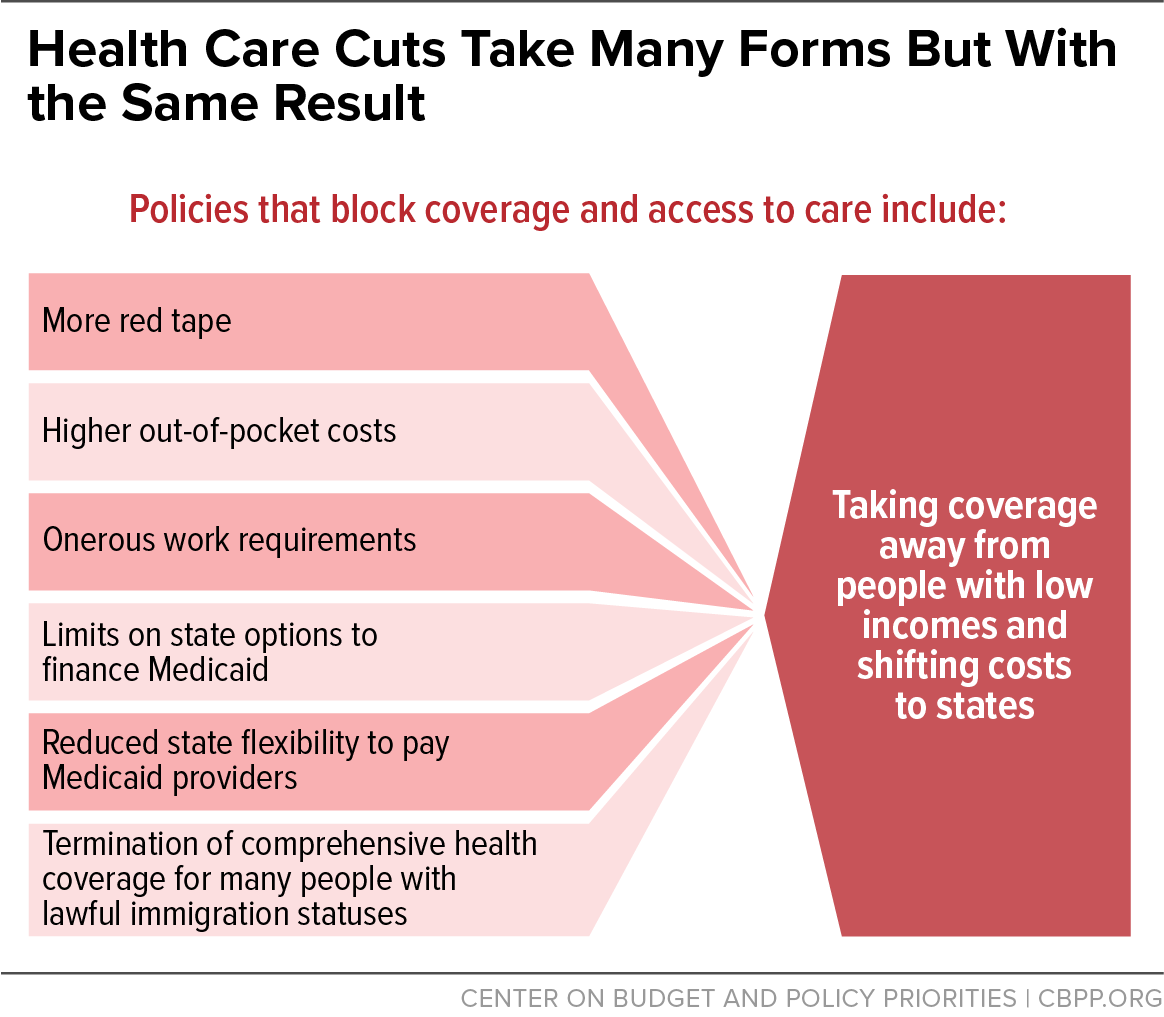
For health care, meanwhile, a series of harmful changes would layer additional costs onto states. In some cases, the cost shifts are direct, including by restricting which tools states can use to finance their share of Medicaid and harshly penalizing states that provide comprehensive health coverage to people with certain immigration statuses, even if they serve people using states’ own funds and no federal funds. In other cases, they’re indirect, such as when people become likelier to show up in local emergency rooms requiring uncompensated care because they have lost health coverage due to onerous new work requirements in Medicaid and expansive new red tape designed to drive down enrollment in the ACA marketplace.[7]
Many of the House-approved changes to programs that help people afford health care and groceries would, in effect, force states to decide which benefits to cut, which people to disenroll, which taxes or fees to raise, and which other vital state and local programs to defund. States are required to balance their budgets each year, so taking on additional costs would require them to raise an equal amount of revenue or cut funding for other programs and services that people count on. And because most states are unlikely to fully bridge the gap through additional taxes and fees, they would need to cut health care and food assistance that the federal government has long covered, as well as other public investments that state and local budgets support, such as schools, infrastructure, and many others. As a result, more families would struggle to make ends meet, more children and parents would lose access to a doctor, and less money would flow to local grocers, rural hospitals, and small businesses.
Shift of Food Benefit Costs Onto States Is Unprecedented
A centerpiece of the reconciliation bill approved by House Republicans is a measure that radically alters the structure of SNAP benefits by requiring states to pay a portion of food benefit costs for the first time. For the almost 50-year history of SNAP in its modern form, the program’s food benefits have been 100 percent federally funded. This was a policy choice to reflect a nationwide commitment to addressing food insecurity, ensuring that all eligible low-income households receive a food benefit that reflects what they need to afford an adequate diet no matter which state they live in.
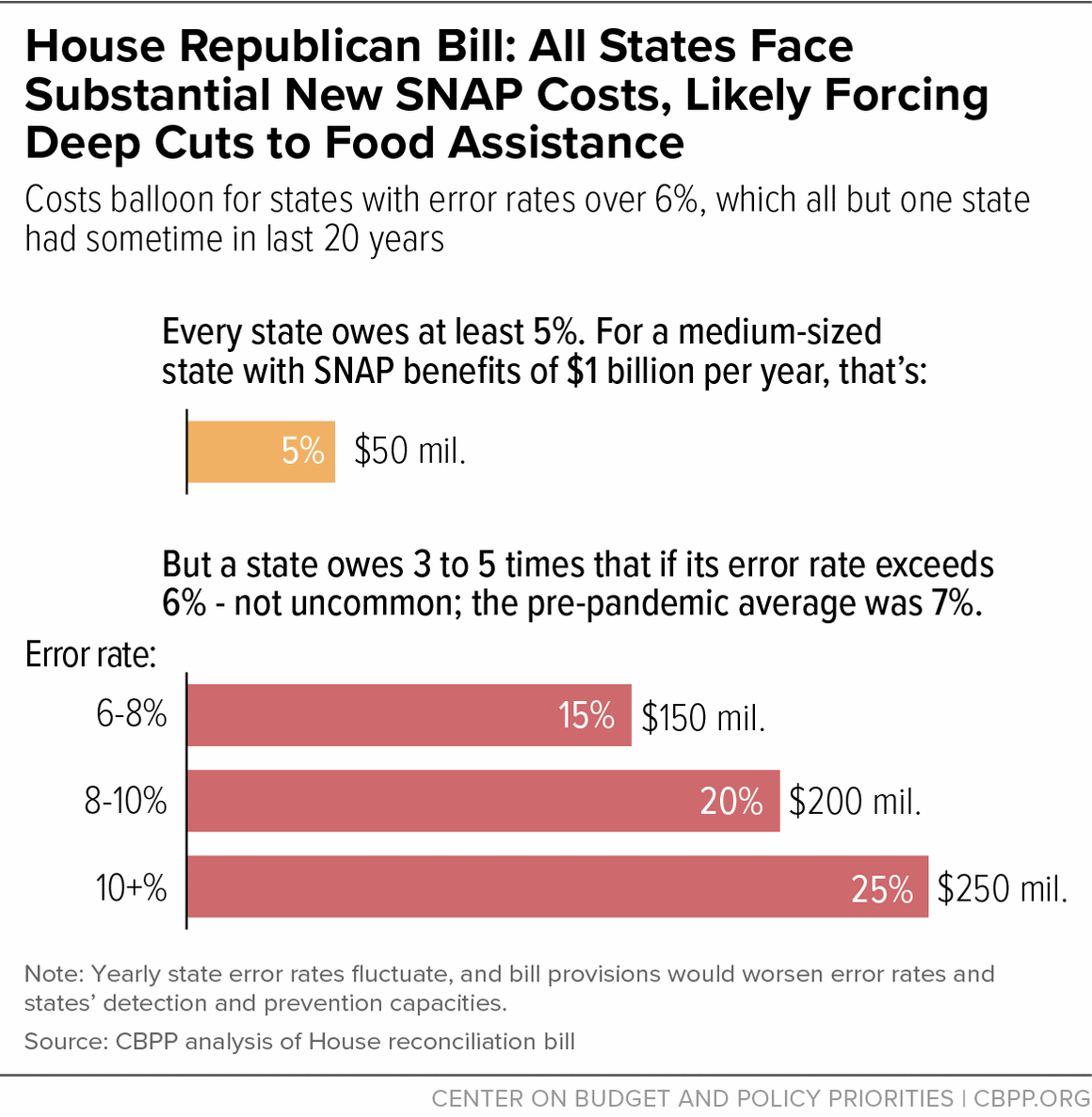
The House bill, however, requires all states to pay a minimum of 5 percent of food benefit costs starting in 2028. If enacted into law, this requirement alone would substantially strain state budgets and likely lead to deep cuts to food assistance. If every state had needed to pay 5 percent of food benefit costs last year, states would have needed to collectively pay about $4.7 billion.[8]
But every state would be at risk of owing far more — potentially up to five times that amount — based on their combined payment error rate (a measure of the under- and over-payments states made in their SNAP programs, which almost entirely reflect unintentional mistakes by state workers and households, as opposed to fraud).[9] States with an error rate of 6 to 8 percent would owe 15 percent of food benefit costs; states with an error rate of 8 to 10 percent would owe 20 percent; and states with an error rate exceeding 10 percent would owe 25 percent. (See Figure 1.)
Over the last two decades, every state except one — South Dakota — has had an error rate exceeding 6 percent for at least one year. Error rates vary year to year, and under this structure, a modest change in the state’s error rate could increase costs substantially. For example, a state whose error rate rises from 5.8 percent to 6.1 percent rate would see their food benefit costs suddenly triple — potentially sending state lawmakers scrambling in search of either new revenues or budget cuts to cover the unexpected costs.
These are substantial sums for state budgets, even at the 5 percent minimum rate — let alone when the requirement soars up to five times higher. For example[10]:
- In Michigan, 5 percent of food benefit costs would total about $152 million in 2028 — more than the state’s annual spending on its Department of Agriculture and Rural Development, which promotes food safety and provides assistance to farmers.
- In California, a 15 percent match would cost about $1.8 billion annually, roughly equal to state spending for its Department of Public Health.
- In Alabama, a 25 percent cost-share would require $431 million annually, or nearly twice state spending on the Alabama Law Enforcement Agency, which runs the highway patrol, issues driver’s licenses, and runs statewide criminal investigations.
Cuts to federal funding of this magnitude will result in significant harm to low-income people as states try to cut back the program to lower their costs. States can take steps including cutting benefits, restricting eligibility, or making it more difficult for eligible people to access assistance — as state officials nationwide have recently noted.[11] And as described, these federal funding cuts may result in some states opting to end SNAP entirely if they are unable to come up with the state funds required to fill this hole.

Additional provisions in the House-passed budget plan, including dramatically expanding SNAP’s harsh existing work requirement to an estimated 6 million additional low-income adults and eliminating an administrative simplification in calculating utility costs for many households, would also substantially increase administrative burden on states and increase the risk of errors.[12] But at the same time the plan worsens administrative burdens on states, it also cuts federal funding for the administrative costs of operating the SNAP program in half — itself a $27 billion cut to state budgets over the 2026 to 2034 period. (Currently, administrative costs are split 50-50 between the federal government and states, but the bill would require states to pay 75 percent of the cost of administering the program.) States that have been making progress to improve payment accuracy by investing in staff, training, and technology upgrades may be forced to pull back on those investments as a result. The bill also expands what counts as an error, increasing the payment error rate for each state and potentially tipping a state over the threshold to a substantially higher cost-share requirement.
This combination — policy changes that make errors more likely, slashing federal resources for states to reduce errors, and adding unprecedented and disproportionate error rate penalties — would, if approved in the Senate, align states’ incentives in one direction: erecting barriers that make it much harder for low-income people who are eligible for food assistance to access it. It’s likely such barriers would fall disproportionately on working families, who often have volatile income due to the unstable nature of low-paying work. And whether a state severely restricts access or ends the program entirely, all SNAP participants are at risk of losing all of their benefits, including children, seniors, and people with disabilities. If that happens, hunger will rise and children’s health and development will be seriously harmed.
Harmful Health Cuts Would Layer Additional Costs, Directly and Indirectly
The House-passed budget plan also includes harmful changes to Medicaid and the Affordable Care Act’s marketplace coverage that would layer on additional costs for states and localities and undermine health coverage for millions of people as a result. In some cases, the Republican plan would impose added costs on states directly, while in other cases the costs would be more indirect but could over time still be substantial. (See Figure 2.)
The most significant direct costs come in two ways: new restrictions on how states can finance their share of the Medicaid program and harsh penalties for states that provide comprehensive health coverage to a person who is not a U.S. citizen or an immigrant with a status that falls within a narrowly-defined group known in federal law as “qualified aliens,” even if the person is lawfully living in the U.S. or if the coverage is funded entirely with state funds.

Limits on Provider Taxes
Today, every state but Alaska uses health-care-related taxes, assessments, or fees — often known as provider taxes — such as taxes on the number of hospital facility beds or nursing home revenue, to raise state funds to help pay for Medicaid.[13] These taxes must comply with federal rules that have evolved over time to ensure that taxes are broad-based, uniformly imposed, and do not hold providers harmless.[14] The revenue from these taxes plays a significant role in states’ ability to support the program overall: about a third of the money states spent on Medicaid in the 2024 fiscal year came from outside their general funds, including from provider taxes and fees, payments from local governments, and other money held outside their main spending account.[15]
But the reconciliation plan substantially restricts this long-standing state revenue tool in two ways. One provision immediately bars states from instituting any new provider taxes or raising existing taxes by increasing either the tax rate or the base of the tax. Another provision essentially codifies a new proposed rule from the Centers for Medicare & Medicaid Services (CMS) making technical changes that will prohibit certain existing provider taxes currently found in at least California, Illinois, Massachusetts, Michigan, New York, Ohio, and West Virginia.[16]
As a result, the House-passed plan prohibits all states from raising revenue through new provider taxes or by increasing current taxes. Depending on how state taxes are structured, over time they could become inadequate to support the level of provider payments or services that they support today. And even states with existing provider taxes could be forced to eliminate them or, at best, adjust them in ways that depress future revenue in order to comply with the new standards. Without new or increased provider taxes as a financing option, states would face three choices — raise other taxes and fees to fill the gap, cut other state-funded public services, or shrink their Medicaid programs over time by cutting eligibility, benefits, and provider payment rates (or some combination of those approaches). And, as noted, the need for new sources of state funding for Medicaid would come at the same time as states would be facing steep cost shifts in SNAP as well.
Cuts to Medicaid are particularly likely when budget shortfalls emerge, including when the economy is weak and demand for services high, like during a recession and its aftermath, but also if other revenue sources used to finance Medicaid fail to keep up with rising health care costs. The Congressional Budget Office estimates that these two provisions would cut nearly $124 billion from Medicaid over ten years.[17] In its prior analysis of other potential cuts to provider taxes, CBO concluded that barring or sharply restricting provider taxes would cut federal Medicaid spending because limitations would result in states having to cut their Medicaid programs, since states likely wouldn’t replace all of the lost revenue from these taxes.[18]
Moreover, other provisions in the bill that restrict policies states use to help administer Medicaid, such as new limitations on state directed payments, would, if enacted, effectively cut provider rates for some providers and could limit enrollees’ access to care, which could carry some additional fiscal implications for states and localities long term.[19] State directed payments in expansion states would be limited to Medicare rates, while non-expansion states would be allowed to set rates at 110 percent of Medicare rates.
Penalties for States That Provide Comprehensive Health Coverage to Certain Immigrants
Another provision in the House bill that would impose significant direct costs is a harsh new penalty for states that provide comprehensive health coverage to certain categories of immigrants (including many who have lawful immigration status), regardless of the source of funding for that coverage. Namely, the reconciliation bill would penalize states that offer coverage to any immigrant who is not considered to be a “qualified alien” — a restrictive immigration-related eligibility standard created by a 1996 law that is used by Medicaid and other programs and excludes many people living and working lawfully in the U.S.[20]
This penalty would cut the 90 percent federal matching rate for the ACA Medicaid expansion to 80 percent if a state provides comprehensive health coverage to a person who is not a U.S. citizen or a “qualified alien,” even if the state solely uses its own funds or private funds to provide this coverage. Moreover, for the purpose of this penalty, the bill treats people with humanitarian parole (such as Afghans who assisted the U.S. during wartime and would be harmed if they remained in Afghanistan) as if they are not a “qualified alien,” even though they are a group listed under that standard for Medicaid eligibility. This means states would have to either end Medicaid (and any other comprehensive coverage) to this group to avoid being penalized.
If enacted, this provision will require most of the 40 states and District of Columbia that have expanded Medicaid to low-income adults under the ACA to modify their immigration-related eligibility requirements for Medicaid and potentially other programs, including state-only funded programs that serve people who do not meet the “qualified alien” standard as specified in this policy, or face severe penalties. (States that have not expanded Medicaid would not face any penalty if they continue to provide coverage to people who are not considered a “qualified alien.”) Many states would have to enact new state laws to modify existing coverage to avoid the penalty, and in the case of New York, the state is required by its constitution to provide coverage to certain people who do not fit into the narrow “qualified alien” standard. In total, states with expanded Medicaid programs run this risk of losing an estimated $145 billion over a nine-year span from fiscal years 2028 to 2034 if they provide comprehensive health coverage to any person who does not meet the “qualified alien” standard.[21]
Indirect State and Local Costs From Widespread Coverage Losses
If approved in the Senate, the reconciliation plan’s cuts to Medicaid, the projected drop in coverage from the failure of the bill to extend the ACA’s enhanced premium tax credits, other cuts to marketplace coverage made by provisions in the bill, and harsh coverage restrictions for millions of immigrants living and working lawfully in the U.S.[22] would likely increase costs on the state and local level in indirect ways as well.
For one, the enormous number of people who could lose Medicaid or ACA marketplace coverage and become newly uninsured — about 15 million according to CBO — would translate over time into more people likely to show up at local emergency rooms and clinics without the ability to pay, as state officials have recently been warning.[23] The costs for such uncompensated care can be sizable and put significant strain on hospitals and other health care providers, especially those that serve disproportionately high levels of low-income and vulnerable populations, including rural hospitals.
People do not cease to need health care when they lose health insurance; the cost of providing that care merely shifts. Just as reductions in the uninsured when the ACA was implemented caused states’ uncompensated care costs to fall[24], the policies included in the House reconciliation bill – including onerous new work requirements for some Medicaid enrollees, other burdensome red tape across the health care system, and increased costs that will make coverage unaffordable for many marketplace enrollees — would cause the number of uninsured to grow, which would drive states’ uncompensated care costs up. States and localities, in turn, would have to expend additional funds to keep these vital community health providers afloat.
Over the long term, provisions in the House bill that result in higher numbers of people without coverage at all and more people who face higher cost sharing in either Medicaid or marketplace coverage will also make people less healthy and generate additional indirect costs to states and localities over time.[25] When people have been forced to sacrifice their health care because they are cut off by red tape or because they can no longer afford routine care, they lose access to preventive and primary care, intervention for life-threatening conditions, and treatments for chronic conditions. For example, a person with diabetes who loses health coverage would lose the ability to properly manage their condition so they can maintain their health and continue in their job. Over time, those dynamics would significantly harm the health and financial well-being[26] of people directly affected and would have negative implications for state and local finances and the well-being of the economy when people seek uncompensated care for now-more-serious and costly conditions.
Cost-Shift Measures Would Force States to Raise Revenues or Make Cuts
Whether in the short- or longer-term, state and local policymakers would struggle to shoulder such substantial new costs in health care and food assistance — both in good times or bad.
A primary reason for this is that states each year must balance their budgets, meaning that they can only adopt the level of spending that available revenues allow them to cover.[27] Any dollar needed to backfill federal cuts to SNAP or Medicaid means a dollar that must be either raised through additional taxes and fees or shifted from another state or local priority, such as education or transportation. While at least some states may choose to (at least partially) take the revenue-raising path, past experience and the tax policy debates in states over recent decades strongly suggest that many would not — at least not enough to fully bridge the gap. For example, in the decade following the onset of the Great Recession, more states chose to cut their personal or corporate income taxes than to raise them.[28]
That would leave most states in a position of having to impose significant spending cuts — either to health care and food assistance or by shifting funds from other vital services, such as schools or infrastructure, and likely both.
One possibility, for example, is that the added fiscal strain could push states to consider cuts for various populations and benefits that are optional for them to cover under Medicaid. That’s what happened after state and local revenues fell during the Great Recession, when from 2010 to 2012, every state and the District of Columbia cut spending for home and community-based services. These services are optional for states to provide and help older adults and people with disabilities remain in their homes and communities.[29] And as previously noted, states would likely respond to major new funding responsibilities for food assistance by cutting food benefits, restricting eligibility in ways that cut people off entirely, or both — or even opting out of the SNAP program entirely.
Another likelihood is that added health and food benefit costs would push states and localities to shift funds around from other responsibilities, ranging from infrastructure and housing to, most notably, public education. Funding for public K-12 schools, colleges, and universities accounts for about 45 percent of state general fund budgets nationwide, which makes it highly vulnerable to cuts when finances become strained.[30] When revenue collections plummeted after the Great Recession, for example, states enacted enormous cuts to K-12 education, which in many states were never fully reversed.[31] Just the additional costs to states from new SNAP responsibilities could create significant pressures and force hard trade-offs; for context, the potential costs of just the proposed 5 percent minimum match requirement is the equivalent of average salary costs for about 65,000 public school teachers nationwide (see appendix for state-by-state comparisons).
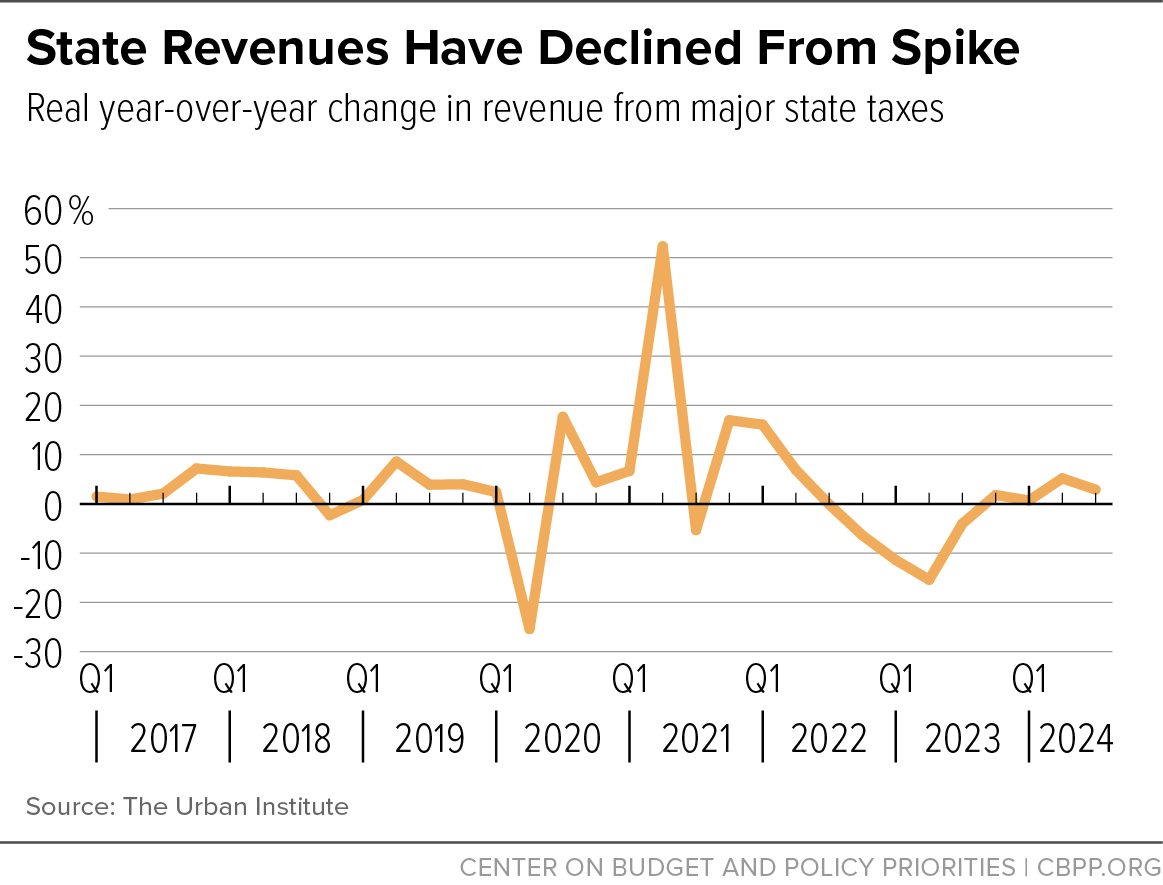
The likelihood of cuts would be high even when states’ fiscal and economic conditions are good, due to their underlying balanced budget requirements. But they would also be especially problematic now, when state finances are already strained and the economy is signaling increased risks of recession. Tax revenue fell in 40 states in fiscal year 2024, after adjusting for inflation.[32] Growth rates over the past few years have moderated significantly from the historically high revenue growth that fueled surpluses in many states during the recovery from COVID-19.[33] (See Figure 3.) And recently, a number of states have been revising their revenue estimates downward to account for ongoing fiscal and economic headwinds.

As a result, a number of states are already wrestling with short- to long-term shortfalls, even before any new costs associated with these proposals are realized, and some have recently enacted or explored harmful state-level cuts.[34] For example:
- Colorado lawmakers had to close a $1.2 billion shortfall this year, the equivalent of a 7 percent cut to the state’s $17 billion general fund for the 2025-26 fiscal year. To do so, they cut government operations across the board, reduced funding for transportation projects and local agencies, and scaled back support for various social and community programs, such as workforce development and food pantries.[35]
- Indiana recently encountered an unexpected $2 billion shortfall, which sent lawmakers scrambling with only a few weeks left in the state’s legislative session. In the end, Republican leaders chose to make up the difference by raising the cigarette tax, cutting public health and higher education funding, and spending down budget reserves.[36]
- Nebraska policymakers recently wrapped up the state’s legislative session, which was defined in large part by a projected two-year shortfall of $432 million, equivalent to about 8 percent of the state’s general fund. Negotiators eventually settled on a broad mix of agency cash transfers, rolling back some tax breaks, tweaks to teachers’ retirement, and cuts to programs such as public health to fill the gap.[37]
States’ strained fiscal position is due to a number of interlocking pressures, including a wave of large tax cuts that many states enacted in recent years, a surge of costly new private school voucher programs, and the expiration of pandemic-era federal aid.[38] State tax revenues are also potentially vulnerable to additional fluctuations from upcoming federal tax changes, due to a series of complex linkages between state and federal income tax codes.[39] And growing fallout from the ongoing federal layoffs could further depress collections in some communities, as workers and their families lose disposable income and local economic activity softens.[40]
Finally, state and local revenues are also closely linked to fluctuations in the national economy. If the economy were to tip into recession, as some experts view as possible, the impacts on state budgets and the services they fund would be substantial: state tax revenues declined by 4.5 percent during the 2001 recession and by 11 percent because of the 2007-2009 recession.[41] Under such scenarios, deep and harmful budget cuts to health care, food assistance, and other state and local services would be virtually guaranteed.
| APPENDIX TABLE 1 | |||||||
|---|---|---|---|---|---|---|---|
House Republican Reconciliation Bill SNAP Cost-Shift Would Force States to Make Painful Trade-offs | |||||||
| Projected costs under proposed state payment of share of SNAP food benefit costs, compared to average public school teacher salaries by state | |||||||
| State/Territory | Average Teacher Salaries 2023-2024 | State Share of 5% Cost-Shift in FY2028 (millions) (under 6% error rate) | # of Teacher Salaries Equivalent at 5% Share | State Share of 15% Cost-Shift in FY2028 (millions) (6% to 7.99% error rate) | # of Teacher Salaries Equivalent at 15% Share | State Share of 25% Cost-Shift in FY2028 (millions) (10% or higher error rate) | # of Teacher Salaries Equivalent at 25% Share |
| Alabama | $61,912 | $86 | 1,390 | $258 | 4,170 | $431 | 6,960 |
| Alaska | $78,256 | $12 | 150 | $37 | 470 | $62 | 790 |
| Arizona | $62,714 | $100 | 1,590 | $300 | 4,780 | $501 | 7,990 |
| Arkansas | $58,337 | $27 | 460 | $82 | 1,410 | $137 | 2,350 |
| California | $101,084 | $615 | 6,080 | $1,844 | 18,240 | $3,076 | 30,430 |
| Colorado | $68,647 | $65 | 950 | $194 | 2,830 | $324 | 4,720 |
| Connecticut | $86,511 | $44 | 510 | $133 | 1,540 | $222 | 2,570 |
| Delaware | $71,186 | $13 | 180 | $38 | 530 | $63 | 890 |
| District of Columbia | $86,663 | $16 | 180 | $48 | 550 | $79 | 910 |
| Florida | $54,875 | $328 | 5,980 | $984 | 17,930 | $1,641 | 29,900 |
| Georgia | $67,641 | $162 | 2,390 | $487 | 7,200 | $812 | 12,000 |
| Guam | N/A | $6 | N/A | $18 | N/A | $30 | N/A |
| Hawai'i | $74,222 | $36 | 490 | $109 | 1,470 | $182 | 2,450 |
| Idaho | $61,516 | $14 | 230 | $42 | 680 | $70 | 1,140 |
| Illinois | $75,978 | $222 | 2,920 | $666 | 8,770 | $1,111 | 14,620 |
| Indiana | $58,620 | $71 | 1,210 | $214 | 3,650 | $356 | 6,070 |
| Iowa | $62,399 | $26 | 420 | $79 | 1,270 | $131 | 2,100 |
| Kansas | $58,146 | $20 | 340 | $61 | 1,050 | $101 | 1,740 |
| Kentucky | $58,325 | $57 | 980 | $172 | 2,950 | $286 | 4,900 |
| Louisiana | $55,911 | $95 | 1,700 | $283 | 5,060 | $473 | 8,460 |
| Maine | $62,570 | $18 | 290 | $54 | 860 | $90 | 1,440 |
| Maryland | $84,338 | $75 | 890 | $223 | 2,640 | $373 | 4,420 |
| Massachusetts | $92,076 | $130 | 1,410 | $390 | 4,240 | $651 | 7,070 |
| Michigan | $69,067 | $152 | 2,200 | $456 | 6,600 | $761 | 11,020 |
| Minnesota | $72,430 | $43 | 590 | $128 | 1,770 | $213 | 2,940 |
| Mississippi | $53,704 | $42 | 780 | $125 | 2,330 | $209 | 3,890 |
| Missouri | $55,132 | $75 | 1,360 | $225 | 4,080 | $376 | 6,820 |
| Montana | $57,556 | $8 | 140 | $25 | 430 | $42 | 730 |
| Nebraska | $60,239 | $16 | 270 | $49 | 810 | $82 | 1,360 |
| Nevada | $66,930 | $50 | 750 | $150 | 2,240 | $250 | 3,740 |
| New Hampshire | $67,170 | $8 | 120 | $23 | 340 | $38 | 570 |
| New Jersey | $82,887 | $96 | 1,160 | $287 | 3,460 | $479 | 5,780 |
| New Mexico | $68,440 | $51 | 750 | $153 | 2,240 | $255 | 3,730 |
| New York | $95,615 | $366 | 3,830 | $1,095 | 11,450 | $1,828 | 19,120 |
| North Carolina | $58,292 | $146 | 2,500 | $438 | 7,510 | $731 | 12,540 |
| North Dakota | $58,581 | $6 | 100 | $17 | 290 | $28 | 480 |
| Ohio | $68,236 | $158 | 2,320 | $473 | 6,930 | $790 | 11,580 |
| Oklahoma | $61,330 | $75 | 1,220 | $224 | 3,650 | $374 | 6,100 |
| Oregon | $77,130 | $79 | 1,020 | $238 | 3,090 | $397 | 5,150 |
| Pennsylvania | $76,961 | $212 | 2,750 | $636 | 8,260 | $1,061 | 13,790 |
| Rhode Island | $82,189 | $17 | 210 | $51 | 620 | $85 | 1,030 |
| South Carolina | $60,763 | $64 | 1,050 | $193 | 3,180 | $321 | 5,280 |
| South Dakota | $56,328 | $9 | 160 | $27 | 480 | $45 | 800 |
| Tennessee | $58,630 | $81 | 1,380 | $242 | 4,130 | $403 | 6,870 |
| Texas | $62,463 | $358 | 5,730 | $1,074 | 17,190 | $1,792 | 28,690 |
| Utah | $69,161 | $19 | 270 | $57 | 820 | $95 | 1,370 |
| Vermont | $69,562 | $7 | 100 | $22 | 320 | $37 | 530 |
| Virgin Islands | N/A | $4 | N/A | $10 | N/A | $18 | N/A |
| Virginia | $66,327 | $88 | 1,330 | $263 | 3,970 | $439 | 6,620 |
| Washington | $91,720 | $95 | 1,040 | $286 | 3,120 | $477 | 5,200 |
| West Virginia | $55,561 | $28 | 500 | $84 | 1,510 | $141 | 2,540 |
| Wisconsin | $65,762 | $68 | 1,030 | $203 | 3,090 | $339 | 5,150 |
| Wyoming | $63,669 | $3 | 50 | $8 | 130 | $14 | 220 |
| United States | $72,030 | $4,664 | 64,750 | $13,979 | 194,070 | $23,321 | 323,770 |
Source: Center on Budget and Policy Priorities and National Education Association data. | |||||||
End Notes
[1] Sharon Parrott, “House Republican Bill Fails the Country; Senate Should Reject Any Bill That Takes Away Health Coverage, Food Assistance,” CBPP, May 22, 2025, https://www.cbpp.org/press/statements/house-republican-bill-fails-the-country-senate-should-reject-any-bill-that-takes.
[2] “House Republicans’ Extreme Budget Plan Fails Families, Children, and Communities,” CBPP, May 29, 2025, https://www.cbpp.org/research/state-budget-and-tax/house-republicans-extreme-budget-plan-fails-families-children-and-0.
[3] Chuck Marr et al., “House Republican Tax Bill Is Skewed to Wealthy, Costs More Than Extending 2017 Tax Law, and Fails to Deliver for Families,” CBPP, May 22, 2025, https://www.cbpp.org/research/federal-tax/house-republican-tax-bill-is-skewed-to-wealthy-costs-more-than-extending-2017.
[4] CBPP, “By the Numbers: House Bill Takes Health Coverage Away from Millions of People and Raises Families’ Health Care Costs,” updated May 23, 2025, https://www.cbpp.org/research/health/by-the-numbers-house-bill-takes-health-coverage-away-from-millions-of-people-and.
[5] Katie Bergh, Dottie Rosenbaum, and Wesley Tharpe, “House Reconciliation Bill Proposes Deepest SNAP Cut in History, Would Take Food Assistance Away From Millions of Low-Income Families,” CBPP, May 28, 2025, https://www.cbpp.org/research/food-assistance/house-reconciliation-bill-proposes-deepest-snap-cut-in-history-would-take.
[6] Phillip L. Swagel, Letter to Reps. Amy Klobuchar and Angie Craig Re: Potential Effects on the Supplemental Nutrition Assistance Program of Reconciliation Recommendations Pursuant to H. Con. Res. 14, as Ordered Reported by the House Committee on Agriculture on May 12, 2025, Congressional Budget Office, May 22, 2025, https://www.cbo.gov/system/files/2025-05/Klobuchar-Craig-Letter-SNAP_5-22-25.pdf.
[7] Elizabeth Zhang and Gideon Lukens, “Harsh Work Requirements in House Republican Bill Would Take Away Medicaid Coverage From Millions: State and Congressional District Estimates,” CBPP, May 13, 2025, https://www.cbpp.org/research/health/harsh-work-requirements-in-house-republican-bill-would-take-away-medicaid-coverage.
[8] Katie Bergh and Dottie Rosenbaum, “House Agriculture Committee Proposal Would Worsen Hunger, Hit State Budgets Hard,” CBPP, May 13, 2025, https://www.cbpp.org/research/food-assistance/house-agriculture-committee-proposal-would-worsen-hunger-hit-state-budgets.
[9] Dottie Rosenbaum and Katie Bergh, “SNAP Includes Extensive Payment Accuracy System,” CBPP, updated June 21, 2024, https://www.cbpp.org/research/food-assistance/snap-includes-extensive-payment-accuracy-system.
[10] For additional state-by-state comparisons of potential SNAP match costs, see Appendix 3 in Bergh, Rosenbaum, Tharpe.
[11] Tim Storey, Letter to Reps. GT Thompson and Angie Craig, National Conference of State Legislatures, May 15, 2025, https://www.ncsl.org/resources/details/ncsl-raises-concerns-about-snap-cost-shifts-to-states.
[12] Katie Bergh, Catlin Nchako, and Luis Nuñez, “Worsening SNAP’s Harsh Work Requirement Would Take Food Assistance Away From Millions of Low-Income People,” CBPP, April 30, 2025, https://www.cbpp.org/research/food-assistance/worsening-snaps-harsh-work-requirement-would-take-food-assistance-away.
[13] Alice Burns et al., “5 Key Facts About Medicaid and Provider Taxes,” KFF, March 26, 2025, https://www.kff.org/medicaid/issue-brief/5-key-facts-about-medicaid-and-provider-taxes/
[14] Ibid.
[15] National Association of State Budget Officers (NASBO), “2024 State Expenditure Report,” p.53, https://www.nasbo.org/reports-data/state-expenditure-report.
[16] The legislation gives the Secretary of HHS discretion to phase these taxes out over no more than three years but, unlike the CMS rule, it does not offer any guarantee of a transition period for states. Edwin Park, “Medicaid and CHIP Cuts in the House-Passed Reconciliation Bill Explained,” Georgetown Center for Children and Families, May 27, 2025, https://ccf.georgetown.edu/2025/05/27/medicaid-and-chip-cuts-in-the-house-passed-reconciliation-bill-explained/#heading-1.
[17] CBO, “Estimated Budgetary Effects of a Bill to Provide for Reconciliation Pursuant to Title II of H. Con. Res. 14, the One Big Beautiful Bill Act As Ordered Reported by the House Committee on the Budget May 18, 2025,” May 20, 2025, https://www.cbo.gov/publication/61420.
[18] Because of the match rate structure in Medicaid, if states spend less by, for example, cutting eligibility or provider payments, the amount they receive from the federal government falls as well. Allison Orris and Elizabeth Zhang, “Congressional Republicans Can’t Cut Medicaid by Hundreds of Billions Without Hurting People,” CBPP, March 17, 2025, https://www.cbpp.org/research/health/congressional-republicans-cant-cut-medicaid-by-hundreds-of-billions-without-hurting#restrict-provider-taxes-a-core-cbpp-anchor.
[19] Allie Gardner, “Medicaid Cuts Would Reduce Access to Health Care for Entire Communities,” CBPP, May 6, 2025, https://www.cbpp.org/blog/medicaid-cuts-would-reduce-access-to-health-care-for-entire-communities.
[20] Margot Dankner et al., “House Republican Reconciliation Bill Takes Away Health Coverage, Food Assistance, Tax Credits from Millions of Immigrants and Their Families,” CBPP, May 29, 2025, https://www.cbpp.org/research/immigration/house-republican-reconciliation-bill-takes-away-health-coverage-food.
[21] For state-by state estimates, see Table 1 in Dankner et al.
[22] In addition to the new penalty for Medicaid expansion states described above, the House reconciliation bill would strip coverage from millions of immigrants through new barriers and coverage restrictions in Medicare and the ACA marketplaces. For more details, see Dankner et al.
[23] Tony Romm, “Chasing Tax Cuts, Trump and Republicans Want to Make States Pay,” New York Times, May 13, 2025, https://www.nytimes.com/2025/05/13/us/politics/trump-republicans-tax-cuts-spending-states.html.
[24] Jessica Schubel and Matt Broaddus, “Uncompensated Care Costs Fell in Nearly Every State as ACA’s Major Coverage Provisions Took Effect,” CBPP, May 23, 2018, https://www.cbpp.org/research/uncompensated-care-costs-fell-in-nearly-every-state-as-acas-major-coverage-provisions-took.
[25] Jennifer Wagner, “More Frequent Medicaid Renewals Would Increase Errors and Lead Eligible People to Lose Health Coverage,” CBPP, May 12, 2025, https://www.cbpp.org/blog/more-frequent-medicaid-renewals-would-increase-errors-and-lead-eligible-people-to-lose-health.
[26] Shameek Rakshit et al., “The burden of medical debt in the United States,” Peterson-KFF Health System Tracker, February 12, 2024, https://www.healthsystemtracker.org/brief/the-burden-of-medical-debt-in-the-united-states/.
[27] Tax Policy Center, “What are state balanced budget requirements and how do they work?” updated January 2024, https://taxpolicycenter.org/briefing-book/state-and-local-tax/fiscal-federalism-and/what-are-state-balanced.
[28] Michael Leachman and Erica Williams, “Policy Brief: States Can Learn From Great Recession, Adopt Forward-Looking, Antiracist Policies,” CBPP, February 17, 2021, https://www.cbpp.org/research/state-budget-and-tax/states-can-learn-from-great-recession-adopt-forward-looking-0.
[29] Jessica Schubel et al., “History Repeats? Faced With Medicaid Cuts, States Reduced Support For Older Adults And Disabled People,” Health Affairs Forefront, April 16, 2025, https://www.healthaffairs.org/content/forefront/history-repeats-faced-medicaid-cuts-states-reduced-support-older-adults-and-disabled.
[30] CBPP, “State Budgets Basics,” revised May 24, 2022, https://www.cbpp.org/research/policy-basics-the-abcs-of-state-budgets.
[31] Nicholas Johnson, “The Great Recession Badly Hurt Kids’ Schooling; Today’s Recession Could Do Much Worse,” CBPP, May 27, 2020, https://www.cbpp.org/blog/the-great-recession-badly-hurt-kids-schooling-todays-recession-could-do-much-worse.
[32] Justin Theal and Alexandre Fall, “State Tax Revenue Declines Again in Fiscal 2024 but Shows Signs of Stabilizing,” Pew, January 9, 2025, https://www.pewtrusts.org/en/research-and-analysis/articles/2025/01/09/state-tax-revenue-declines-again-in-fiscal-2024-but-shows-signs-of-stabilizing.
[33] Lucy Dadayan, “Real State Tax Revenues Decline Amid Growing Fiscal Uncertainty,” Tax Policy Center, May 16, 2025, https://taxpolicycenter.org/research-reports/real-state-tax-revenues-decline-amid-growing-fiscal-uncertainty.
[34] Kevin Hardy, “Cutting services or raising taxes: State lawmakers weigh how to fill big budget gaps,” Stateline, January 22, 2025, https://stateline.org/2025/01/22/cutting-services-or-raising-taxes-state-lawmakers-weigh-how-to-fill-big-budget-gaps/?emci.
[35] Brian Eason, “Colorado legislature passes $43.9 billion budget that cuts transportation, social programs to fund rising health care costs,” Colorado Sun, April 21, 2025, https://coloradosun.com/2025/04/21/colorado-legislature-passes-43-billion-2025-26-budget/.
[36] Brandon Smith, “ Indiana GOP closes $2B budget gap with cigarette tax hike, health cuts,” WFYI, April 23, 2025, https://www.wfyi.org/news/articles/gop-leaders-unveil-final-budget-with-cigarette-tax-hike-and-cuts-to-public-health-higher-education.
[37] Zach Wendling, “Nebraska passes $11 billion two-year budget, closes major projected deficit for now,” Nebraska Examiner, May 15, 2025, https://nebraskaexaminer.com/2025/05/15/nebraska-passes-11-billion-two-year-budget-closes-major-projected-deficit-for-now/.
[38] Wesley Tharpe, “States Should Prioritize Long-Term Stability Over More Tax Cuts,” Bloomberg Tax, January 17, 2025, https://news.bloombergtax.com/tax-insights-and-commentary/states-should-prioritize-long-term-stability-over-more-tax-cuts.
[39] Carl Davis, “Sharp Turn in Federal Policy Brings Significant Risks for State Tax Revenues,” ITEP, April 9. 2025, https://itep.org/sharp-turn-in-federal-policy-brings-significant-risks-for-state-tax-revenues/.
[40] Wesley Tharpe, “Sweeping Federal Worker Layoffs Leave States Reeling,” CBPP, April 1, 2025, https://www.cbpp.org/blog/sweeping-federal-worker-layoffs-leave-states-reeling.
[41] Elizabeth McNichol, Michael Leachman, and Joshuah Marshall, “States Need Significantly More Fiscal Relief to Slow the Emerging Deep Recession,” CBPP, April 14, 2020, https://www.cbpp.org/research/state-budget-and-tax/states-need-significantly-more-fiscal-relief-to-slow-the-emerging.