

Block-Granting Not a Solution to Benefit Cliffs
Testimony of Nick Gwyn, Senior Fellow, Center on Budget and Policy Priorities, Before the Senate Committee on Small Business & Entrepreneurship
Thank you, Chair Ernst, Ranking Member Markey, and members of the committee. My name is Nick Gwyn, and I am a Senior Fellow for Government Affairs at the Center on Budget and Policy Priorities (CBPP). CBPP is a nonpartisan research and policy institute that advances federal and state policies to help build a nation where everyone has the resources they need to thrive and share in the nation’s prosperity.
Ensuring that individuals and families receiving means-tested public benefits can increase their earnings without abruptly losing large amounts of critical assistance is an important goal and deserves broad support. Many basic needs programs already promote this objective by phasing out benefits slowly as earnings increase, rather than terminating substantial assistance based on small changes in earnings.
For example, the Supplemental Nutrition Assistance Program (SNAP) benefit formula disregards 20 percent of participants’ earned income when calculating their benefits. And, benefits phase out gradually as countable income rises, declining by 24 to 36 cents per additional dollar of earnings. As a result, the vast majority of SNAP workers see an increase in their total income when their earnings increase.
However, families can encounter benefit cliffs in some programs, given inadequate program resources. Child care assistance is one example. In large part because its funding is capped, only about 17 percent of children age 5 and under who are federally eligible receive child care assistance.[1]
In general, addressing program benefit cliffs requires additional resources to provide a longer, slower down-ramp in benefits, rather than an abrupt drop, as earnings rise. To create a slower phase-out without additional resources means cutting benefits for working families whose earnings are lower than the families hitting a cliff. Among other things, this could mean that workers gaining a toehold in a job wouldn’t get the help they need to make ends meet.
In short, to ease benefit cliffs without increasing poverty requires investing in additional help for working families. This is a good investment — it would help families afford the basics and avoid instability in housing and child care, which can not only harm children and families but also make it harder to maintain a job. But we should not pretend that we can ease benefit cliffs without either providing more resources or accepting more hardship and poverty.
First, Do No Harm
Any effort to improve how program benefits phase down as earnings increase should start with a commitment to avoid policy changes that worsen benefit cliffs.
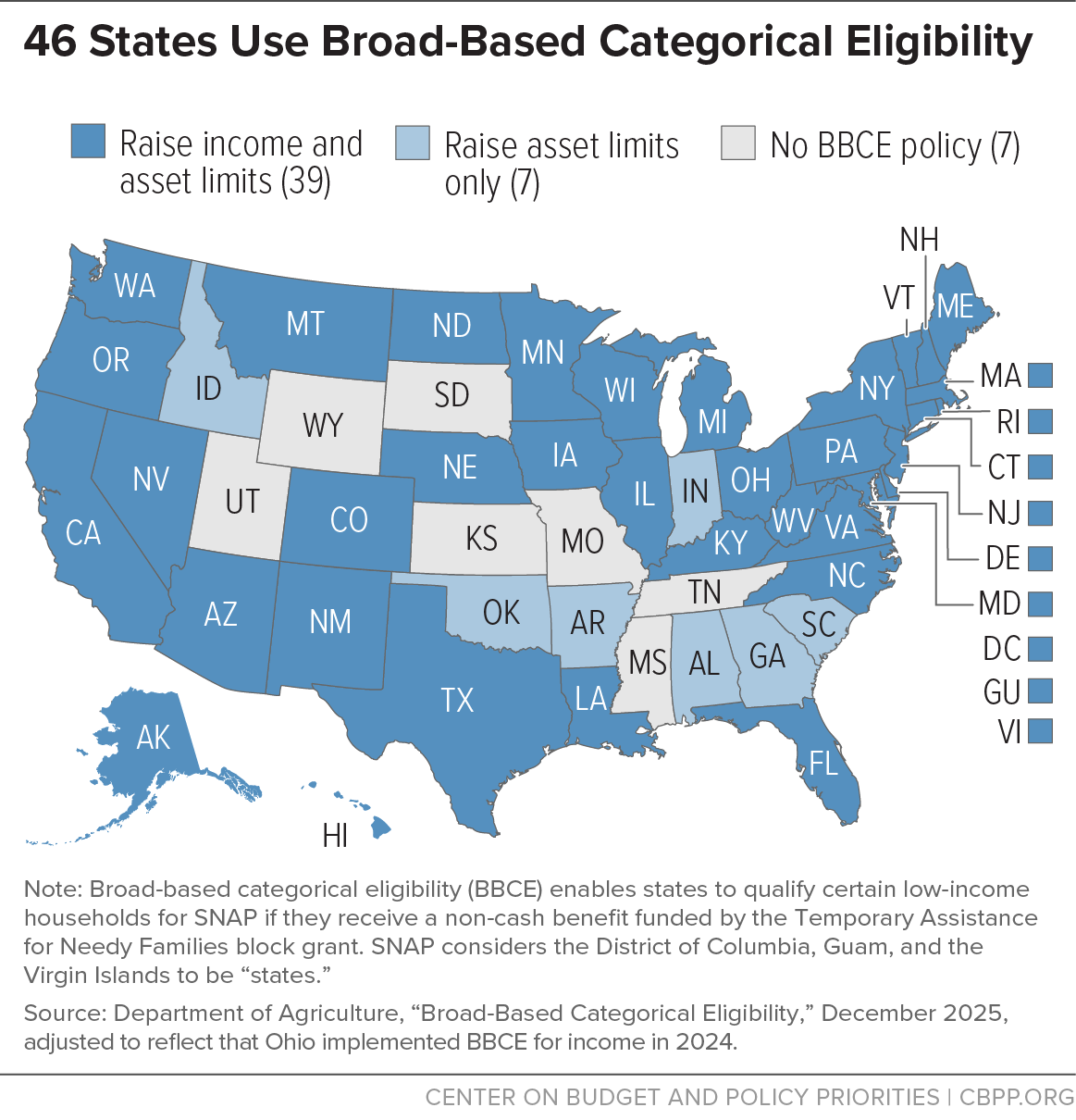
For example, some have suggested eliminating states’ long-standing flexibility to raise SNAP income and asset limits somewhat so that households with a small earnings gain (or a modest rise in savings) don’t lose substantial SNAP benefits. Forty-six states have adopted this policy, known as broad-based categorical eligibility (BBCE). (See Figure 1.) It is particularly valuable for working families who face housing or child care expenses that consume a sizeable share of their income.

Eliminating BBCE would create steep benefit cliffs for a large number of working families, many of whom would lose SNAP entirely. Indeed, CBPP estimates that eliminating BBCE would take away food benefits from 6 million people, most of them in working families (as well as many people who are elderly or have a disability).[2]
Also, Congress has made benefit cliffs worse for many working people by letting the premium tax credit (PTC) enhancements for marketplace health coverage expire at the end of 2025. While those enhancements were in place, someone who got a raise and no longer qualified for Medicaid could instead qualify for an Affordable Care Act (ACA) marketplace plan with a $0 premium and very low cost-sharing as their income rose. Now, if a single individual’s earnings rise from $21,600 (138 percent of the federal poverty level, Medicaid’s income limit in states that have adopted the ACA Medicaid expansion) to $21,800 (139 percent of poverty), they go from receiving Medicaid with premium costs of $0 per year to needing to pay $770 for an ACA silver-level plan.
Block Grants Are Less Accountable, Responsive, and Sustainable
Some proposals presented as efforts to address benefit cliffs would shift funding for multiple programs to a single, flexible block grant. The Upward Mobility Act, for example, would provide up to five states with block-grant funding for ten programs for five years.
The fundamental problem with block grants is they are less accountable, less responsive, and less sustainable over time than entitlement programs like Medicaid and SNAP, or even discretionary programs with specific purposes like rental assistance.
Block-granting often leads to less transparency and responsibility for achieving core program goals. Converting programs like SNAP and housing assistance into a block grant would eliminate key protections that ensure people get the benefits for which they are eligible. These protections include specific requirements like establishing fair eligibility processes and providing benefits on a timely basis, as well as broader safeguards related to the allocation and use of program funding.
While giving states flexibility to innovate can be valuable, block grants permit, and sometimes even encourage, states to use that flexibility to redirect funding away from the core purposes for which it was approved. For example, states spend less than one-fourth of their Temporary Assistance for Needy Families (TANF) block-grant funds on basic cash assistance for families with children, a decline of 68 percent from the program’s first year.[3] Provisions in TANF, like work requirements, time limits and other features, have discouraged states from providing basic assistance to families, while the TANF block grant’s extreme flexibility has prompted many states to use it to fill budget holes across a wide spectrum of social service areas.
Block grants also do not grow when the need for assistance increases during recessions or under other circumstances. This contrasts starkly with entitlement programs such as SNAP, which expand immediately and automatically to address rising need and then shrink as the economy recovers. This feature is critically important during recessions. It not only directly helps families who lose jobs or income but also moderates the severity and duration of the recession by lessening the drop in consumer purchasing power, thereby helping the economy as a whole.
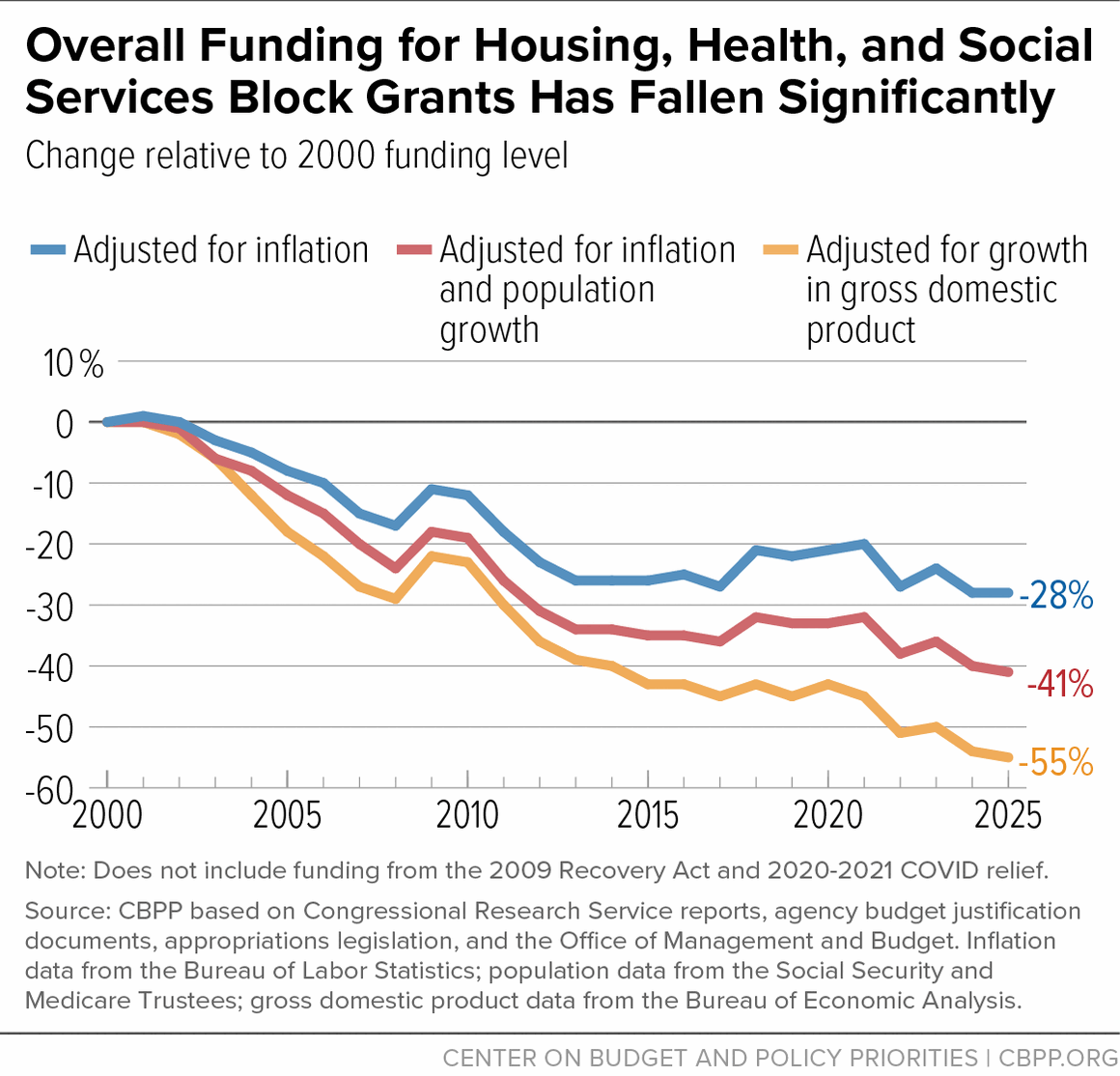
Further, because block grants are often used in diffuse ways, it is difficult to assess their impact, making them more vulnerable to shrinking over time. [4] Block grants have often experienced steep funding cuts in real terms, as Figure 2 shows. For example, TANF has lost about half of its real value, while job services grants have lost two-thirds and the Social Services Block Grant has lost 80 percent. This dramatic erosion in funding means less assistance is going to people in need.

More fundamentally, collapsing funding streams into a block grant but not providing any new resources buys into the false notion that there is a cost-free way to expand assistance for working families with somewhat higher incomes without increasing poverty and hardship among families with even lower incomes. If Congress wants to address benefit cliffs, the answer is not to create block grants that lack sufficient funding to accomplish their stated purpose and then blame states when they either don’t reduce benefit cliffs or do so at the expense of lower-income families.
Reconciliation Law, Expiration of PTC Enhancements Already Causing Widespread Harm
As this committee considers the impact of people losing benefits due to earnings gains, it is important to recognize that millions of people are now losing essential food and health assistance because of the massive cuts in last year’s budget reconciliation legislation (H.R. 1) and Congress’s failure to extend the PTC enhancements. As noted above, those enhancements were key to reducing the benefit cliff that occurs when an individual’s income rises and they lose Medicaid coverage.
As a result of H.R. 1’s SNAP cuts, some 3.5 million people lost help buying groceries from July 2025 through February.[5] It appears that close to half of those losing benefits are children, based on data from states that publicly report SNAP caseload data for children.[6]
This dramatic drop cannot be explained by a rapid improvement in people’s economic well-being or reduced need for help affording food. Nationally, unemployment has remained steady, real wages declined year-over-year in April, and food insecurity remained high in 2025. Also, grocery costs are rising and could be headed even higher due to the war with Iran, given the impacts of oil and gas prices on fertilizer and transportation costs.[7] The sharp decline in the number of SNAP participants is almost surely driven by initial implementation of the new SNAP cuts and other fallout from H.R. 1.[8]
On health care, up to 15 million people will become uninsured by 2034 because of H.R. 1’s enormous cuts to Medicaid, its changes to the ACA marketplace, its failure to extend the PTC enhancements, and other harmful ACA marketplace rule changes, according to the Congressional Budget Office.[9] The premiums people pay for ACA marketplace coverage more than doubled in 2026, on average, leading more than 1 million people to drop this coverage.[10] Damage to the ACA marketplaces should be of particular concern to this committee, given that about half of the adults under age 65 enrolled in the marketplace are employed by a small business with fewer than 25 workers or are self-employed entrepreneurs or small business owners, according to KFF.[11]
Conclusion
Most federal benefit programs attempt to reduce potential steep benefit declines when earnings increase. Further efforts to minimize benefit cliffs for working families could be beneficial but must not come at the cost of undermining the very programs these families depend on to help them meet their basic needs, especially as the costs of food, fuel, housing, and health care continue to rise.
End Notes
[1] First Five Years Fund, “2026 Child Care & Development Block Grant (CCDBG) in the United States,” https://www.ffyf.org/wp-content/uploads/2026/04/FFYF_2026_CCDBG-National.pdf.
[2] Dottie Rosenbaum et al., “SNAP’s ‘Broad-Based Categorical Eligibility’ Supports Working Families, Older Adults, and Those Saving for the Future,” CBPP, updated March 17, 2026, https://www.cbpp.org/research/food-assistance/snaps-broad-based-categorical-eligibility-supports-working-families-and-0.
[3] Diana Azevedo-McCaffrey, Aditi Shrivastava, and Maria Manansala, “Investing TANF Dollars in Basic Assistance Is Vital for Families to Meet Needs,” CBPP, updated January 15, 2026, https://www.cbpp.org/research/income-security/investing-tanf-dollars-in-basic-assistance-is-vital-for-families-to-meet.
[4] Richard Kogan et al., “History Shows That Block-Granting Low-Income Programs Leads to Large Funding Declines Over Time,” CBPP, July 29, 2025, https://www.cbpp.org/research/federal-budget/history-shows-that-block-granting-low-income-programs-leads-to-large.
[5] Dottie Rosenbaum et al., “SNAP Tracker: People Are Losing Food Assistance as the Republican Megabill Is Implemented,” CBPP, updated May 29, 2026, https://www.cbpp.org/research/food-assistance/snap-tracker-people-are-losing-food-assistance-as-the-republican-megabill.
[6] Luis Nuñez, “Sharp Drop in Number of Children Receiving SNAP Food Assistance Under New Federal Law,” CBPP, May 27, 2026, https://www.cbpp.org/blog/sharp-drop-in-number-of-children-receiving-snap-food-assistance-under-new-federal-law.
[7] Ibid.
[8] CBPP, “By the Numbers: Harmful Republican Megabill Takes Food Assistance Away From Millions of People,” updated August 14, 2025, https://www.cbpp.org/research/food-assistance/by-the-numbers-harmful-republican-megabill-takes-food-assistance-away-from.
[9] CBPP, “By the Numbers: Harmful Republican Megabill Will Take Health Coverage Away From Millions of People and Raise Families’ Costs,” updated August 27, 2025, https://www.cbpp.org/research/health/by-the-numbers-harmful-republican-megabill-will-take-health-coverage-away-from https://www.cbpp.org/research/health/by-the-numbers-harmful-republican-megabill-will-take-health-coverage-away-from.
[10] Jennifer Sullivan and Elizabeth Zhang, “Higher Marketplace Premiums Take a Toll on Enrollment and on Marketplace Enrollees,” CBPP, May 18, 2026, https://www.cbpp.org/research/health/higher-marketplace-premiums-take-a-toll-on-enrollment-and-on-marketplace-enrollees.
[11] Matt McGough et al., “About Half of Adults with ACA Marketplace Coverage are Small Business Owners, Employees, or Self-Employed,” KFF, September 10, 2025, https://www.kff.org/affordable-care-act/about-half-of-adults-with-aca-marketplace-coverage-are-small-business-owners-employees-or-self-employed/.