

States Should Pursue New Revenue Options to Expand Access and Prevent Cuts to Affordable Housing and Homelessness Solutions
Increased and ongoing public investments by state and local governments play a critical role in ensuring that people and communities thrive, including by expanding access to stable, affordable housing and strengthening homelessness prevention and response services.
The United States has the resources and ingenuity to ensure that everyone, no matter their income or race, can afford and keep a home without compromising or forgoing other needs, like food, medical care, transportation, or child care. Yet despite the wide recognition across states and communities that too many people face unaffordable housing costs, states and localities are underinvesting in housing affordability solutions. And, with rising state budget pressures, including those stemming from the cuts in 2025’s harmful Republican reconciliation law and the possibility of additional federal budget cuts through the appropriations process, there is a risk that states and localities will continue to underinvest in or scale back their efforts to address housing affordability. But states can take a different path and secure additional revenue — a powerful, yet underutilized, tool for expanding housing security, bolstering economies, and advancing racial equity.
State and Local Revenue for Proven Solutions to Housing and Other Needs Are More Important Now Than Ever
An unprecedented number of people are struggling to keep a roof over their heads or are without a home at all.[1] More than 21 million households pay half or more of their income for housing, sometimes even when working multiple jobs. About 70 percent of those households have incomes less than $30,000, and most of them are renters.[2] Homelessness has also reached a record high, with over 771,000 people across the country residing in shelters or forced to sleep outside on a single night in 2024.
This is set to worsen as millions of families are likely to lose health care, food assistance, and housing assistance because of harmful federal funding cuts and policy changes, leaving them at a greater risk of housing insecurity and homelessness as they try to keep up with rising costs and meet all of their basic needs.
Explore revenue options for housing and homelessness solutions
Proven Solutions Are Inadequately and Unreliably Funded
For decades, policymakers have underfunded housing and homelessness programs and, partly as a result, housing has become less affordable.[3]
No state has enough housing that is affordable to residents with extremely low incomes.[4] Yet state governments spend very little on housing relative to other kinds of public investment. On average, states allocate less than 1 percent of their direct spending to housing and community development initiatives, like building more affordable housing and helping people with low incomes pay for rent.[5]
When states do fund affordable housing programs, they frequently rely on one-time funding from federal emergency funds or temporary state budget surpluses. For example, the American Recue Plan Act injected billions of dollars into state and local economies that many states leveraged for critical but temporary housing and income support during the COVID-19 pandemic, as well as capital investments in new affordable housing, but those federal emergency resources have expired. [6]
One-time funding can be well-suited to cover upfront costs for new construction and rehabilitation and resources including one-time emergency rent relief like the Emergency Rental Assistance Program. Many of these investments have meaningfully increased the supply of affordable housing and likely prevented eviction during the pandemic. However, using one-time or temporary funds to support ongoing programs like rental assistance, supportive housing, and homelessness prevention creates funding cliffs. Programs like rental assistance and operating assistance require ongoing or long-term investment to make housing accessible to people with the lowest incomes.
For example, California’s Homekey Program was created during the pandemic to provide grants to local public entities to buy and convert properties like hotels, motels, and vacant apartment buildings, and created 15,000 units of interim and permanent, supportive housing for people experiencing or at-risk of homelessness. The program also included up to five years of funding to pay for ongoing operating costs for the new projects.[7] However, many housing providers report that developments lack sustainable funding for long-term operating costs to ensure the properties’ maintenance and affordability are adequately maintained over time. If funding is not sustained, households are at increased risk of poor living conditions, evictions, or even homelessness when temporary dollars run out.[8]
At the federal level, lawmakers have severely underfunded the programs that are most critical for families, including rental assistance and public housing. As a result, only 1 in 4 eligible households receive help.[9] On top of that, the Trump Administration has proposed deep cuts to federal housing and homelessness programs that more than 10 million people now use to help pay the rent each month, while backing punitive, anti-homeless laws that are ineffective, costly, racially discriminatory, and take resources away from effective solutions.[10]
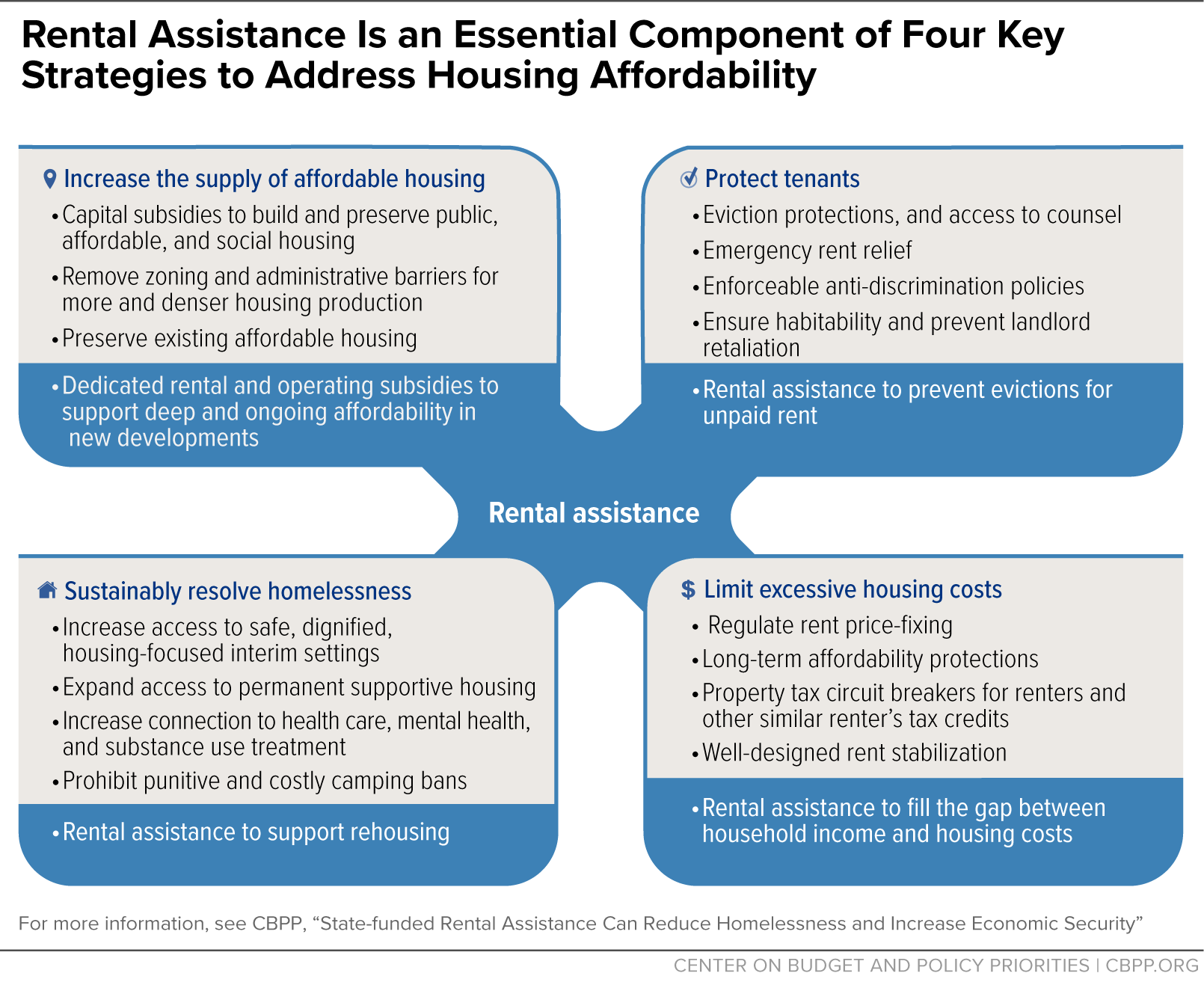
For policymakers who want to tackle housing affordability, there are proven solutions to invest in, including rental assistance, eviction prevention, emergency funds and legal supports, robust supportive services, affordable housing development and preservation, and tenant legal protections. (See Figure 1.) These solutions work together to stabilize families; reduce the risk of overburdening emergency services, like emergency rooms and shelters; strengthen local economies; and create more equitable communities.[11] Increased and sustained funding can help states bring these solutions and outcomes to scale, and ensure people who need help affording housing — including those most at risk of homelessness or eviction — get the help they need.

Revenue Options to Fund Affordable Housing and Homelessness Solutions
States have a range of options to secure new, ongoing revenue. Some options are tied directly to the housing market while other revenue streams may not be, such as income taxes, corporate and business taxes, sales taxes on goods and services, and more.
In some cases, revenue-raisers can be earmarked in whole or in part for housing programs; for example, several state and local jurisdictions have recently established sales tax increases where revenue is dedicated at least in part to affordable housing and homelessness programs. (See “Sales Tax.“)
Some states direct housing-related revenue-raising policies, like real estate transfer taxes, to housing investments. Importantly, in addition to assessing housing-related revenue options based on the amount and stability of revenue generated, states and localities should consider the impact of different housing-related revenue options — and the investments they would fund — on housing supply and affordability. For example, some revenue options (impact fees, demolition taxes, and document recording fees) may deter development depending on their design. Others (taxes on vacant properties, short-term rentals, and land values) could help encourage owners to make more housing available.
Some revenue options to fund housing and homelessness solutions include:
Recent Ballot Wins Signal Support for Housing Funding Measures
Recent elections included many notable wins for measures that raised new revenue for affordable housing and homelessness programs, signaling strong public support for prioritizing solutions to the affordable housing crisis even if it means raising taxes. For example, Minnesota lawmakers proposed a constitutional amendment to raise the state sales tax to create three dedicated funds focused on supporting housing stability, homeownership, and renter protections, and Rhode Island voters recently passed a statewide bond measure dedicating millions in funding to housing. [59] Voters in Los Angeles have repeatedly approved new revenue measures to fund affordable housing solutions, including Measure ULA (a mansion tax approved by voters in 2022) and Measure A (a half-cent sales tax approved by votes in 2024 to fund affordable housing, homelessness prevention and intervention, and tenant legal support).[60]
New Revenue Can Help States Build Toward a Future Where Everyone Can Afford Housing
Raising revenue is a powerful tool states can use to fund housing solutions and create thriving, equitable communities. Investing in proven housing solutions can prevent and reduce homelessness, strengthen family well-being, improve broader health and education outcomes, and promote long-term economic prosperity.
As more people struggle to stay housed, states cannot afford to wait. With the federal government cutting and weakening already underfunded programs, states have an opportunity and face a real need to lead, demonstrating their commitment to being part of the solution to the housing crisis and building the momentum needed to press the federal government to do more.
End Notes
[1] Joint Center for Housing Studies of Harvard University (JCHS), “The State of the Nation’s Housing 2025,” 2025, https://www.jchs.harvard.edu/sites/default/files/reports/files/Harvard_JCHS_The_State_of_the_Nations_Housing_2025.pdf.
[2] JCHS, “Table A.1: Housing Cost-Burden Households by Tenure and Income: 2019, 2022, and 2023,” 2025 Harvard_JCHS_State_Nations_Housing_2025_Appendix_Tables_061725.xlsx.
[3] Erik Gartland, “Funding Limitations Create Widespread Unmet Need for Rental Assistance,” CBPP, February 15, 2022, https://www.cbpp.org/research/housing/funding-limitations-create-widespread-unmet-need-for-rental-assistance.
[4] National Alliance to End Homelessness, “State of Homelessness: 2025 Edition,” September 4, 2025, https://endhomelessness.org/state-of-homelessness/; National Low Income Housing Coalition (NLIHC), “The Gap,” March 2025, https://nlihc.org/gap.
[5] Urban Institute, “State and Local Backgrounders: Housing and Community Development Expenditures,“ April 26, 2024, https://www.urban.org/policy-centers/cross-center-initiatives/state-and-local-finance-initiative/state-and-local-backgrounders/housing-and-community-development-expenditures. Note: State and local governments combined spend about 2 percent of their direct spending on housing and community development agency initiatives. This may not capture spending on housing initiatives through other state agencies. Most housing and community development expenditures are funded by the federal government.
[6] Douglas Rice and Ann Oliva, “Housing Assistance in American Rescue Plan Act Will Prevent Millions of Evictions, Help People Experiencing Homelessness,” CBPP, March 11, 2021, https://www.cbpp.org/research/housing/housing-assistance-in-american-rescue-plan-act-will-prevent-millions-of-evictions; Sonya Acosta and Mohammed Akel, “Unless Congress Acts, 59,000 Additional Households at Risk of Homelessness,” CBPP, June 23, 2025, https://www.cbpp.org/blog/unless-congress-acts-59000-additional-households-at-risk-of-homelessness.
[7] Enterprise, “California’s Homekey Program: Innovation to Address Homelessness and Community Health at the Beginning of a Pandemic,” October 2024, https://www.enterprisecommunity.org/sites/default/files/2024-10/2024-Homekey-Case-Studies-Report.pdf.
[8] Carolina Reid, Ryan Finnigan, and Shazia Manji, “California’s Homekey Program: Unlocking Housing Opportunities for People Experiencing Homelessness,” Terner Center for Housing Innovation, March 17, 2022, https://ternercenter.berkeley.edu/research-and-policy/homekey-1-0-lessons-learned/.
[9] CBPP, “77% of Low-Income Renters Needing Federal Rental Assistance Don't Receive It,” https://www.cbpp.org/77-of-low-income-renters-needing-federal-rental-assistance-dont-receive-it.
[10] Anna Bailey, “Executive Order Calls on Federal Agencies to Abandon Effective Homelessness Solutions and Promote Fear and Punishment,” CBPP, July 24, 2025, https://www.cbpp.org/research/federal-budget/executive-action-watch?item=30206; Corporation for Supportive Housing, “CSH Response to HUD’s CoC NOFO: What’s at Stake,” November 14, 2025, https://www.csh.org/2025/11/csh-response-to-huds-coc-nofo-whats-at-stake/; Nicole DuBois, Claire Herbert, and E. Mae Sowards, “Criminalizing Homelessness Worsens the Crisis, Research Shows,” National Alliance to End Homelessness, February 2025, https://endhomelessness.org/wp-content/uploads/2025/02/CriminalizingWorsensTheCrisis_NAEH_2-4-25.pdf.
[11] Anna Bailey, Peggy Bailey, and Erik Gartland, “Policymakers Can Solve Homelessness by Scaling Up Proven Solutions: Rental Assistance and Supportive Services,” CBPP, February 27, 2025, https://www.cbpp.org/research/housing/policymakers-can-solve-homelessness-by-scaling-up-proven-solutions-rental.
[12] Design choices for progressive real estate transfer taxes include determining the tax rates and thresholds, as well as the tax base, including whether there are exemptions for certain types of transactions (for example, transactions related to affordable housing or first-time home purchases) and whether different rates apply to different properties (for example, valuing multi-family housing differently than single-family housing to avoid penalizing properties that provide housing to multiple households).
[13] Samantha Waxman, Carl Davis, and Erika Frankel, “States Should Enact, Expand Mansion Taxes to Advance Fairness and Shared Prosperity,” CBPP and Institute on Taxation and Economic Policy (ITEP), June 26, 2024, https://www.cbpp.org/research/state-budget-and-tax/states-should-enact-expand-mansion-taxes-to-advance-fairness-and.
[14] Anna Phillips, “States Should Turn to Mansion Taxes to Raise Needed Revenue in 2026,” CBPP, October 24, 2025, https://www.cbpp.org/blog/states-should-turn-to-mansion-taxes-to-raise-needed-revenue-in-2026; Mari Castaldi, “Taxing Very High-Value Home Sales Is an Equitable and Effective Strategy to Raise Revenue and Fund Affordable Housing,” July 19, 2024, https://www.cbpp.org/research/housing/taxing-very-high-value-home-sales-is-an-equitable-and-effective-strategy-to-raise; NLIHC, “State and Local Housing Trust Fund,” 2025, https://nlihc.org/resource/now-available-2025-state-local-housing-trust-fund-report.
[15] CBPP, “16 States Earmark Revenue From Real Estate Transfer Taxes to Fund Affordable Housing,” June 19, 2024, https://www.cbpp.org/media/14-states-earmark-revenue-from-real-estate-transfer-taxes-to-fund-affordable-housing.
[16] Phillips, 2025.
[17] ITEP, “Who Pays? 7th Edition,” January 2024, https://sfo2.digitaloceanspaces.com/itep/ITEP-Who-Pays-7th-edition.pdf
[18] CBPP, “Toward Fairer, More Equitable Property Taxes,” July 2025, https://www.cbpp.org/research/state-budget-and-tax/toward-fairer-more-equitable-property-taxes#series; ITEP, 2024.
[19] Urvi Patel, Mari Castaldi, and Anna Phillips, “Broad Property Tax Cuts Won’t Provide Relief to Those Most Impacted by High Housing Costs: Renters With Low Incomes,” CBPP, May 8, 2025, https://www.cbpp.org/blog/broad-property-tax-cuts-wont-provide-relief-to-those-most-impacted-by-high-housing-costs.
[20] Wesley Tharpe, “Easing State Restraints on Local Taxing Power Can Strengthen Democracy, Promote Prosperity and Equity,” CBPP, March 28, 2023, https://www.cbpp.org/research/state-budget-and-tax/easing-state-restraints-on-local-taxing-power-can-strengthen.
[21] Rose Bender, “Tax Policy Highs and Lows from the 2025 Montana Legislature,” Montana Budget & Policy Center, June 2025, https://montanabudget.org/report/tax_2025_leg.
[22] D.C. Office of Tax and Revenue, “Real Property Tax Rates,” https://otr.cfo.dc.gov/page/real-property-tax-rates.
[23] Utah State Tax Commission Property Tax Division, “Property Tax Exemptions Standards of Practice,” Rev. May 15, 2025, https://propertytax.utah.gov/standards/standard02.pdf.
[24] Rita Jefferson, “Local Vacancy Taxes: A Tool but Not a Panacea,” November 17, 2025, https://itep.org/vacancy-tax-blight-tax-property-tax-tools/.
[25] D.C. Office of Tax and Revenue, “Vacant Real Property,” https://otr.cfo.dc.gov/page/vacant-real-property-0.
[26] Rhode Island Department of Revenue Division of Taxation, “Summary of Legislative Changes,” Rev. August 26, 2025, https://tax.ri.gov/sites/g/files/xkgbur541/files/2025-07/2025_summary_of_legislative_changes.pdf.
[27] Atlanta City Council, “Atlanta City Council Approves ‘Blight Tax’ on Owners of Neglected Properties,” August 5, 2024, https://citycouncil.atlantaga.gov/Home/Components/News/News/3900/175.
[28] Berkeley Municipal Code, 7.54.080 Use of Funds for General Municipal Purposes, https://berkeley.municipal.codes/BMC/7.54.070.
[29] Brian Maass and Colin McIntyre, “Affordable housing advocates float idea of new "Ghost Tax" on Denver landlords,” CBS News, September 4, 2025, https://www.cbsnews.com/colorado/news/affordable-housing-advocates-new-ghost-tax-denver-landlords/; Eddie Dowd, “To address housing shortage, Oahu lawmakers consider ‘empty homes tax’ for vacant properties,” Hawaii News Now, October 16, 2024, https://www.hawaiinewsnow.com/2024/10/16/address-housing-shortage-oahu-lawmakers-consider-empty-homes-tax-vacant-properties/; The New York State Senate, 2025-2026 Legislative Session, Assembly Bill A3284, https://www.nysenate.gov/legislation/bills/2025/A3284.
[30] Nebraska Revised Statute 76-903. Design; collection of tax; refund; procedure; disbursement, https://nebraskalegislature.gov/laws/statutes.php?statute=76-903.
[31] California Government Code § 27388.1 (2024) https://leginfo.legislature.ca.gov/faces/codes_displaySection.xhtml?sectionNum=27388.1.&lawCode=GOV
[32] NLIHC, 2025; Washington State Legislature, RCW 36.22.250 Document recoding surcharge, https://app.leg.wa.gov/RCW/default.aspx?cite=36.22.250.
[33] Metropolitan Planning Council, “Affordable Housing Demolition Tax: Highland Park, Lake County ,” https://metroplanning.org/case-studies/demolition-highland-park/; The City of Highland Park Illinois, “2026 Proposed Budget for City Revenue and Capital Improvement,” https://highlandparkil.iqm2.com/Citizens/Detail_LegiFile.aspx?Frame=&MeetingID=3527&MediaPosition=128.340&ID=8264; Metropolitan Planning Council, “Demolition Tax: Lake Forest, Lake County,” https://metroplanning.org/case-studies/demolition-lake-forest/; Metropolitan Planning Council, “Affordable Housing Demolition Tax: Evanston, Cook County,” https://metroplanning.org/case-studies/affordable-demolition-evanston/.
[34] Jacob Nelson, “City Council Reviews Demolition Tax,” Patch, March 14, 2013, https://patch.com/illinois/highlandpark/city-council-reviews-demolition-tax.
[35] Montgomery County, Maryland, Bill5-25 Demolition Tax for Affordable Housing Production, March 18, 2025, https://www.montgomerycountymd.gov/OLO/Resources/Files/eis/2025/EIS-Bill5-25.pdf.
[36] Pennsylvania Housing Finance Agency, “Pennsylvania Housing Affordability and Rehabilitation Enhancement Fund (PHARE),” https://www.phfa.org/legislation/act105.aspx.
[37] Shelby Bradford, “Pa. gas drillers pay record amount in impact fees,” StateImpact Pennsylvania, June 26, 2023, https://stateimpact.npr.org/pennsylvania/2023/06/26/pa-gas-drillers-pay-record-amount-in-impact-fees/; Marcellus Shale Coalition, “Pennsylvania’s Impact Fee,” 2024, https://marcelluscoalition.org/wp-content/uploads/2024/06/Impact-Fee-2024-1.pdf.
[38] New Jersey Department of Community Affairs, “Non-Residential Development Fees,” https://www.nj.gov/dca/dlps/hss/nrdf.shtml; New Jersey Division of Taxation, “Standards for Valuing Property,” https://www.nj.gov/treasury/taxation/pdf/lpt/APPROVEDNRDFBrochure.pdf.
[39] City and County of Denver, “Expanding Housing Affordability Ordinance and Affordable Housing Fee,” https://denvergov.org/Government/Agencies-Departments-Offices/Agencies-Departments-Offices-Directory/Community-Planning-and-Development/Plan-Review-Permits-and-Inspections/Development-Fees/EHA-Ordinance-and-Affordable-Housing-Fee.
[40] Colorado 75th General Assembly, 2025 Regular Session, HB25-1247 County Lodging Tax Expansion, https://leg.colorado.gov/bills/hb25-1247.
[41] Whitney Tucker, “Black Women Best Framework Points the Way to Equitable and Just State Tax Reform,” CBPP, April 17, 2024, https://www.cbpp.org/research/state-budget-and-tax/black-women-best-framework-points-the-way-to-equitable-and-just-state.
[42] Carl Davis, “State Itemized Deductions: Surveying the Landscape, Exploring Reforms,” ITEP, February 5, 2020, https://itep.org/state-itemized-deductions-surveying-the-landscape-exploring-reforms/.
[43] California Legislature 2023-2024 Regular Session, Assembly Bill 2616, https://leginfo.legislature.ca.gov/faces/billNavClient.xhtml?bill_id=202320240AB2616; 80th Oregon Legislative Assembly, 2019 Regular Session, A-Engrossed House Bill 3349, https://olis.oregonlegislature.gov/liz/2019R1/Measures/Overview/HB3349; 82nd Oregon Legislative Assembly, 2023 Regular Session, Senate Bill 976, https://olis.oregonlegislature.gov/liz/2023R1/Measures/Overview/SB976.
[44] North Carolina Department of Revenue, “North Carolina Standard Deduction or North Carolina Itemized Deductions,” https://www.ncdor.gov/taxes-forms/individual-income-tax/filing-topics/north-carolina-standard-deduction-or-north-carolina-itemized-deductions.
[45] Arizona Center for Economic Progress, “Housing in Arizona: Policy Priorities in the Misinformation Age,” May 27, 2025, https://azeconcenter.org/housing-arizona-policy-priorities-in-the-misinformation-age/; Arizona Joint Legislative Budget Committee, “Historical Tax Law Changes Unclaimed Property Collections,” 2024, https://www.azjlbc.gov/21taxbook/unclaimedproperty.pdf.
[46] CBPP, “Advancing Racial, Economic, and Health Justice Through Climate Action,” December 12, 2024, https://www.cbpp.org/research/climate-change/advancing-racial-economic-and-health-justice-through-climate-action.
[47] Camila H. Alvarez, “Structural Racism as an Environmental Justice Issues: A Multilevel Analysis of the State Racism Index and Environmental Health Risks from Air Toxins,” Journal of Racial and Ethnic Health Disparities, Vol. 10, January 2022, https://doi.org/10.1007/s40615-021-01215-0; Sheree Henderson and Rebecca Wells, “Environmental Racism and the Contamination of Black Lives: A Literature Review,” Journal of African American Studies, Vol. 25, January 2021, https://doi.org/10.1007/s12111-020-09511-5.
[48] CBPP, “Advancing Racial, Economic, and Health Justice Through Climate Action.”
[49] Rachel Jacobson, “States Should Address Climate Change and Revenue Needs Together for Maximum Impact,” CBPP, March 3, 2024, https://www.cbpp.org/blog/states-should-address-climate-change-and-revenue-needs-together-for-maximum-impact; California Department of Housing and Community Development, “Affordable Housing and Sustainable Communities (AHSC),” https://www.hcd.ca.gov/grants-and-funding/programs-active/affordable-housing-and-sustainable-communities; Virginia Energy Efficiency Council, “RGGI Facts and FAQs,” https://vaeec.org/rggi/faqs/.
[50] Cole Shultz, “Land Values Taxes,” Sustainable Development Code, https://sustainablecitycode.org/brief/land-value-taxes/; CalMatters, “AB 362: Real property taxation: land value taxation study, 2023-2024,” https://calmatters.digitaldemocracy.org/bills/ca_202320240ab362; Johan Sheridan, “Land value tax pilot program proposed to make New York housing affordable,” NEWS10 ABC, April 15, 2025, https://www.news10.com/news/ny-news/land-value-tax-pilot-program-proposed-to-make-new-york-housing-affordable/; Christian Cardenas, “Minnesota can adopt a commonsense tax solution for the vacant lot predicament in its cities,” MINNPOST, March 14, 2025, https://www.minnpost.com/community-voices/2025/03/minnesota-can-adopt-a-commonsense-tax-solution-for-the-vacant-lot-predicament-in-its-cities/.
[51] Virginia Government Code § 58.1-3221.1. Classification of land and improvements for tax purposes, law.lis.virginia.gov/pdf/vacode/58.1-3221.1/.
[52] Bipartisan Policy Center, “Detroit, MI: A Case Study on Taxing Land Instead of Property,” December 6, 2023, https://bipartisanpolicy.org/article/detroit-mi-a-case-study-on-taxing-land-instead-of-property/.
[53] Dylan Grundman O'Neill, “Putting California Proposition 15 in Context,” ITEP, October 8, 2020, https://itep.org/putting-california-proposition-15-in-context/.
[54] CBPP, “State and Local Borrowing,” January 16, 2018, https://www.cbpp.org/research/state-budget-and-tax/state-and-local-borrowing.
[55] Brendan Duke, ”Trump Administration, Congressional Republicans Are Worsening Affordability Challenges in Many Ways,” CBPP, December 18, 2025, https://www.cbpp.org/research/poverty-and-inequality/trump-administration-congressional-republicans-are-worsening. Note that these amounts are based on the Consumer Expenditure Survey, which has a different income cutoff than the Survey of Income Program Participation analysis of the difficulty of paying bills and/or food insecurity. Expenditures exceed incomes for the bottom half of households in the Consumer Expenditure Survey. The average post-tax income of households in the bottom half of the income distribution is $34,000 while total spending amounts to $45,000. Utilities, groceries, health care, transportation, and shelter amount to $31,000 — 89 percent of income and 68 percent of total spending. There are persistent concerns about the survey’s extreme expenditure-to-income ratio for households at the very bottom of the income distribution (expenditures are about four times as large as income); this analysis focuses on the bottom 50 percent for this reason. A U.S. Treasury analysis of consumption-to-income ratios that attempts to correct for issues with these ratios also shows that the bottom five deciles as a whole consume more than they earn. See Julie-Ann Cronin, "U.S. Treasury Distributional Analysis Methodology," U.S. Treasury Department, May 2022, https://home.treasury.gov/system/files/131/TP-8.pdf.
[56] ITEP, 2024.
[57] Duke, 2025.
[58] Eric Figueroa and Julian Legendre, “States That Still Impose Sales Taxes on Groceries Should Consider Reducing or Eliminating Them,” CBPP, April 1, 2020, https://www.cbpp.org/research/state-budget-and-tax/states-that-still-impose-sales-taxes-on-groceries-should-consider; ITEP, 2024.
[59] Minnesota 94th Legislature, HF 3279, 2025, https://www.revisor.mn.gov/bills/94/2025/0/HF/3279/versions/0/; NLIHC, “Voters Approve Housing and Homelessness Ballot Measures across the Country on Election Day,” November 12, 2024, https://nlihc.org/resource/voters-approve-housing-and-homelessness-ballot-measures-across-country-election-day.
[60] Los Angeles Housing Department, United to Housing Los Angeles (ULA), https://housing.lacity.gov/ula; County of Los Angeles Homeless Initiative, “The Facts About Measure A,” November 2024, https://homeless.lacounty.gov/news/the-facts-about-measure-a/.