MÁS ALLÁ DE LOS NÚMEROS
Broad Property Tax Cuts Won’t Provide Relief to Those Most Impacted by High Housing Costs: Renters With Low Incomes
Everyone should be able to afford a home, but most communities across the United States are far from that reality. Nationally, more people than ever before are paying more than they can afford to keep a roof over their heads. State and local policymakers have an important role to play in increasing housing affordability by advancing policies that address the root cause of the housing crisis: bringing down the costs of housing and increasing people’s incomes to help them afford it. Investment in rental assistance is a key solution.
However, under the guise of addressing housing affordability, some state lawmakers are pushing broad property tax cuts, a policy approach that primarily benefits wealthy homeowners, threatens local revenue for schools and other important public services, and creates barriers for first-time homebuyers. Blanket property tax cuts fail to deliver housing relief where it’s needed most: among renters with low incomes.
Among all households with severe cost burdens — paying over half of their income on housing — 59 percent are renters, or a total of 9.8 million people. Among severely cost burdened renter households, 92 percent have very low incomes (meaning less than 50 percent of the Area Median Income, or AMI). For example, in a region where the AMI is $80,000, a household with an income of $40,000 or below would be considered very low income.
Untargeted property tax policies mainly benefit wealthier property owners without delivering sufficient relief to renters with low incomes, whose rent reflects the property taxes that their landlords pay. For example, renters are often left out of exemptions that waive payments of some or all of a homeowner’s property tax, like the homestead exemption, and through homeowner tax credits, even though low-income renters have paid the property tax through their rent payments.
Other measures targeted to homeowners, including limits to how quickly the value of their home can increase each year, can sometimes make renting more expensive by shifting local property taxes onto non-owner-occupied housing, such as apartment buildings. Finally, broad property tax rate cuts greatly reduce property tax revenue that local governments rely on for well-resourced schools, roads, responsive emergency services, and other critical public infrastructure. As such, renters may see their costs rise and the quality of local services and infrastructure deteriorate due to cuts in funding, all while continuing to face unsustainable housing cost burdens.
Further, Black and Latine households are more likely to be renters compared to white households and are disproportionately cost-burdened. These disparities stem from generations of discriminatory policies and practices that often persist today and whose impacts are long-lasting. For example, Black families have too often endured, and sometimes continue to endure, policies that create barriers to homeownership with their roots in the system of slavery — including restrictions on property ownership, land and property dispossession through “legal” means (such as unfairly high property tax assessments), neighborhood segregation, employment discrimination, and racially discriminatory access to home loans (or redlining). Tax policies, like broad property tax cuts, that don’t benefit renter households contribute to exacerbating racial wealth inequities.
A targeted, more equitable form of property tax relief known as “circuit breaker” tax credits are a better option. They are designed to reach households with lower incomes who face housing cost burdens by capping how much a household must pay in property taxes above a certain threshold of their income. Twenty-nine states (plus the District of Columbia) have such a tax credit — many of which include renters to offset the property taxes they pay through their rent.
Rather than pursue broad property tax cuts that threaten local revenue without delivering relief from high housing costs to low-income renters, state leaders should look to policies that address a root issue in the housing affordability crisis: the gap between people’s incomes and housing costs. To provide direct assistance to households struggling to afford their rent, states can invest in rental assistance that helps bridge that gap. Rental assistance has been shown to greatly reduce homelessness and housing insecurity but is chronically underfunded at the federal level.
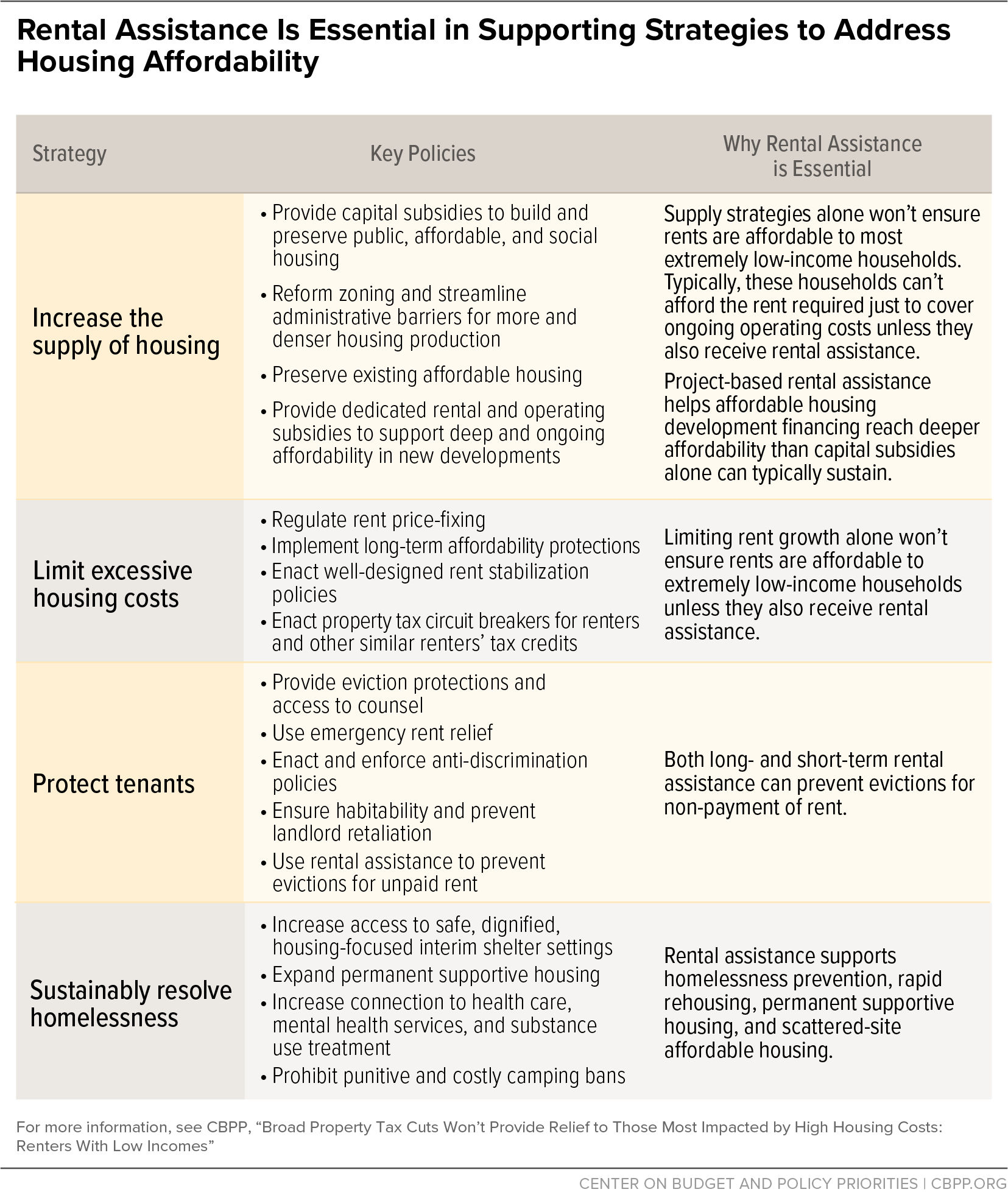
In addition, to bring down overall housing costs and expand the availability of affordable housing, states can incentivize affordable housing production and preservation by funding capital subsidy programs, removing administrative barriers to affordable housing permitting and construction, and reforming exclusionary zoning policies that have stymied affordable and multifamily housing. They can also pass sensible tenant protections, including limiting excessive rent increases and preventing evictions.
Policymakers should reject blanket property tax cuts put forward under the guise of advancing housing affordability. Instead, they should prioritize policies that make housing affordable for those with the lowest incomes while preserving the critical local revenue that keeps our communities thriving.