

House Republican Health Agenda Cuts Coverage, Raises People’s Costs
Clear Harm to Eligible People From Unprecedented Cuts
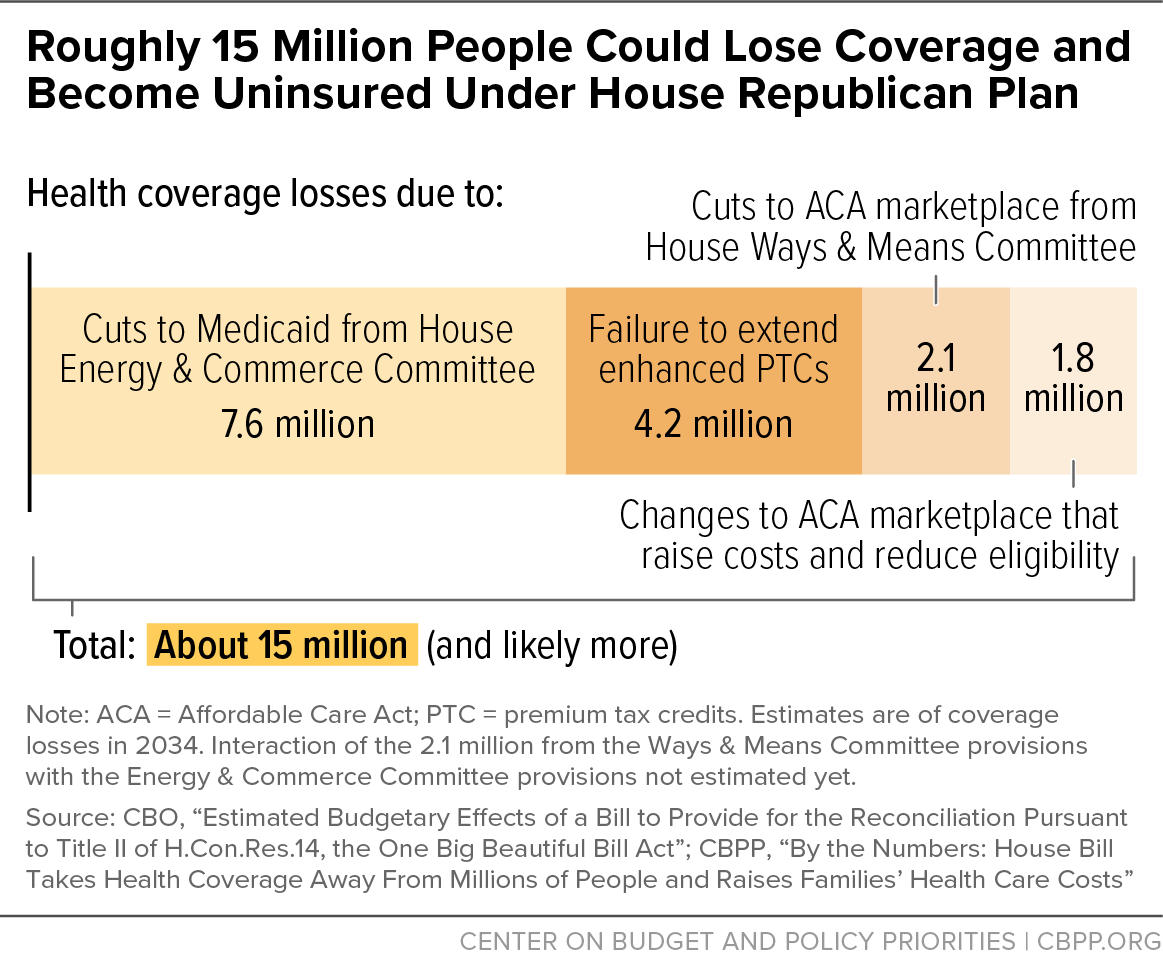
Roughly 15 million low- and moderate-income people would lose health coverage and become uninsured under the House Republicans’ sweeping and draconian health care agenda — part of their plan to help pay for tax cuts for the wealthy and corporations by taking away health coverage and slashing support for families who are already struggling with rising costs and an uncertain economy.
The legislation passed by the House of Representatives last week[1] includes at least $800 billion in cuts to Medicaid and the Affordable Care Act (ACA) marketplaces over ten years, and likely more once official estimates of changes that were made before final House passage are complete.[2] The bill also fails to extend enhanced premium tax credits that are helping more than 22 million people buy insurance on the marketplace and are set to expire at the end of 2025 (just like the tax cuts the House Republicans have chosen to extend). In their quest to cut hundreds of billions of dollars from health care, the House Republicans’ bill will take away federally supported coverage programs from millions of people.
Along with the cuts that will result in coverage losses, the bill would raise costs for millions of others who manage to keep their health coverage, and it cruelly targets specific people with harsh restrictions and reduced access to care, including people who are immigrants with a lawful status and their families.

Despite misleading claims otherwise, nearly all of those losing Medicaid and marketplace coverage and those facing higher costs are eligible for these programs and are U.S. citizens or have a lawful immigration status.[3] And those harmed by this plan do include children, older adults, and people with disabilities.
People need health care to live. If the House bill is adopted by the Senate, , it will have a devastating impact on the health and well-being of millions of people, including people with pre-existing health conditions, low-paid workers, veterans, small business owners, and children. It will mean people lose access to life-saving treatments, routine doctor visits, and medications they need. It will increase costs across the health care system as more people delay care. This could worsen life-threatening health conditions, drive families into medical debt and bankruptcy, and put people’s lives at risk.
House Bill Would Render Some 15 Million People Uninsured
A major way the bill cuts coverage is by imposing new barriers and red tape in both Medicaid and the marketplaces. Many people who are eligible for coverage will be caught in the legislation’s interlocking, punitive policies.
Taking Away Coverage From People Not Meeting a Work Requirement
The single biggest Medicaid cut in dollar terms is an extreme provision that would take away coverage from low-income adults enrolled in the Medicaid expansion group who can’t document meeting rigid work requirements or show they qualify for an exemption. The provision as passed by the House would take effect no later than December 31, 2026, but states would have the option to implement work requirements even earlier. Accelerating the start date of this provision (which as originally adopted by the House Energy & Commerce Committee would have taken effect in January 2029 and would have cut Medicaid by an estimated $280 billion over six years) would cut Medicaid even more deeply.[4]
People subject to the requirements would have to be employed to enroll in Medicaid, posing real barriers to people who get laid off and lose their employer health coverage or people who are ill and need care to get better and find work. Even worse, it gives states the option to adopt an unlimited “lookback” period, meaning they could require people to report work hours far back into the past — could be months or years — as a condition of qualifying for Medicaid. Given the unstable nature of the low-paid labor market; workers’ lack of sick leave, let alone family and medical leave; and growing economic uncertainty due to the chaotic tariff policies the President has pursued, these provisions would block many people from getting coverage in the first place. Making matters worse, state decisions about how they define compliance and how often they check compliance could add to coverage losses.


Millions of parents, pregnant adults, chronically ill individuals, and people with disabilities will lose coverage, even though the legislation includes a list of exemptions. Evidence from brief experiences with work requirements in Medicaid and in other programs shows much of the coverage loss would occur among people who work or should qualify for an exemption but, nevertheless, lose coverage due to red tape.[5]
CBPP estimates the proposal would put 9.7 million to 14.4 million people at risk of losing Medicaid coverage in 2034.[6] (See Table 1 for state-by-state estimates.) If states experience coverage loss at rates similar to those observed when Arkansas implemented work requirements in 2018-2019, an estimated 7 million people among those at risk would lose coverage. But coverage losses could well be higher because of the draconian nature of the proposal and uncertainty about how states will implement it. If a state chooses to implement the policy as harshly as possible, nearly all of those at risk in the state could lose coverage.
Adding Sludge to Eligibility and Enrollment Processes
Administrative burdens prevent eligible people from enrolling and staying enrolled in Medicaid and marketplace coverage. The House Republicans’ bill includes several provisions that will add burdens for enrollees and for states, cutting federal support for Medicaid and the marketplaces and contributing to the coverage losses in the Republican plan.
One provision would block implementation of two Medicaid rules issued during the Biden Administration. One rule was designed to make it easier for low-income seniors and people with disabilities who receive Medicare to access Medicare Savings Programs (MSPs), a part of state Medicaid programs that help pay people’s Medicare premiums and often cost-sharing charges.[7] The other simplified the eligibility and enrollment process for Medicaid, the Children’s Health Insurance Program (CHIP), and the Basic Health Program (BHP).[8] Blocking these rule improvements, which together cut Medicaid by about $167 billion, would mean fewer adults and children will have access to affordable care through Medicaid that they are eligible for.[9] That’s because people trying to enroll or stay enrolled will have to contend with procedural barriers to coverage, such as required in-person interviews of seniors and people with disabilities; ineffective or absent outreach by state agencies using old address information; and for children, being blocked from CHIP if they lose other coverage or a parent doesn’t pay premiums, and because of annual or lifetime benefit limitations.[10]
The House Republicans’ bill would also require states to redetermine eligibility for enrollees in the Medicaid expansion group twice a year, instead of annually, starting with renewals due on or after December 31, 2026. This would add excessive red tape for enrollees as well as state agencies, which are likely to make more mistakes with the sharp increase in workload. Experience shows that people who still meet eligibility criteria will lose coverage and “churn” on and off Medicaid, leading to interruptions in people’s medications and treatments that leave them sicker and raise health care costs, and increasing burdens on both families and states as people have to reapply to connect back to coverage.[11] Indeed, CBO estimated this provision would cut $53 billion in federal spending between fiscal years 2028 and 2034 as more frequent renewals would cause eligible enrollees to lose coverage.[12]
A number of other provisions will create unprecedented barriers for eligible people to get and maintain coverage in the marketplaces. The legislation shortens the annual open enrollment period by more than four weeks, which has no good policy justification except to reduce access; ends automatic re-enrollment — which more than half of all people renewing covering for 2025 relied on[13] — by requiring all enrollees to take action to continue their coverage each year; imposes more burdensome income verification requirements; makes it easier for insurers to disenroll people with unpaid premiums; and eliminates repayment caps that protect people with low incomes from owing back large amounts when they reconcile advance premium tax credits at tax time. People can owe money back if they, for example, get a higher-paying job or get married partway through the year. Even if they report the change immediately and their premiums are adjusted based on their new circumstances, they can face a sizeable repayment amount because of the way the tax credit is calculated using annual information.[14] Making this all worse, the Trump Administration slashed federal funding for enrollment assistance by 90 percent earlier this year; if these provisions are enacted, it will be very difficult for people to find help understanding and complying with them.[15]
The decision to cut federal health spending largely by burdening individuals and families with complex, antiquated, and unnecessary processes will overload state agencies and the marketplaces, likely blocking and delaying enrollment for many people, not only those the House bill intends to target. For instance, the myriad changes to Medicaid eligibility and enrollment processes, on top of the work requirement, will burden state agencies, and all Medicaid enrollees — including children who aren’t part of the Medicaid expansion at all — will suffer from delayed processing of applications, longer call center wait times, and more errors.[16]
Millions of People Who Remain Covered Would Face Higher Costs
The bill would make several changes that increase costs for people enrolled in Medicaid and the marketplaces. These changes come at a time when families are already struggling to make ends meet in the face of rising costs for food, rent, and other household expenses, and are worried about their future economic outlook.[17] Changes that increase the cost of getting care disproportionately harm people with chronic conditions, severe injuries, and other costly illnesses, who would have to pay more to continue to receive the services they rely on to treat their condition(s) and maintain or restore health.
Adding New Out-of-Pocket Charges for Many Medicaid Enrollees
The bill would require all states to impose cost-sharing on people with income greater than the federal poverty level ($15,650 per year for an individual in 2025) who are enrolled in Medicaid through the ACA expansion — up to $35 per charge, starting in October 2028. Consistent with current statute, total charges would be capped at 5 percent of a person’s income and certain services would be exempt from cost-sharing.[18] (For someone earning $15,650, 5 percent of income is $780 — a hefty fee that people with incomes at the poverty line cannot afford.) States would have the option to allow providers to deny services if people aren’t able to pay. CBO estimates this would cut $13 billion in federal Medicaid spending by 2034 — a direct hit to people who meet all Medicaid eligibility criteria.[19]
Even small amounts of cost-sharing — between $1 and $5 — are a barrier for people with low incomes, as a large body of evidence has repeatedly confirmed.[20] This policy will cause many people to delay or skip needed care, which can lead to worse health outcomes and result in enrollees needing more costly health care later.
Increasing Premiums and Cost-Sharing for ACA Marketplace Enrollees
Another element of House Republicans’ health agenda targets the ACA marketplaces, which provide coverage and financial assistance to more than 22 million people.[21] The marketplaces, which started in 2014, are a critical source of coverage for those who lack health benefits at their jobs, such as self-employed people, low-paid workers, and older people not yet eligible for Medicare.[22]
CBO estimated 4.2 million people will be uninsured in 2034[23] because Republicans so far have not extended enhanced premium tax credits (PTC) that are set to expire at the end of 2025. In addition, this decision will mean nearly everyone who remains in the marketplaces will have to pay higher premiums, and some will be quite large.
For example, the typical family of four with income of $65,000 will pay $2,400 more per year to keep their marketplace coverage without the PTC enhancements.[24] Some Republicans argue they shouldn’t be blamed for the 4.2 million people projected to lose coverage due to the PTCs’ expiration. But they chose to extend all of the expiring 2017 tax cuts — and even expand provisions that benefit the wealthiest people in the country — yet chose not to extend the enhanced PTCs for people who need help affording coverage. For many moderate- and middle-income families, the expiration of the PTCs will cost them far more than they gain under the extension of the 2017 tax cuts.
A number of other marketplace changes in the House legislation would add to people’s costs, including:
- Altering how certain ACA technical elements (“applicable percentages” and “maximum out-of-pocket” limits) are adjusted each year. This would increase premiums for most of the people who receive premium credits and increase exposure to catastrophically high costs.
- Eroding the value of coverage by allowing individual market insurers to offer plans with higher deductibles and cost-sharing. This would also increase enrollees’ net premiums, because it would reduce PTC amounts, and it would leave enrollees exposed to higher out-of-pocket costs through deductibles and cost-sharing.
Taken together, these additional changes would mean massive cost increases for enrollees. A typical family of four making $85,000 enrolled in a silver benchmark marketplace plan could face an annual premium increase of $1,027 and a $900 increase in their annual out-of-pocket limit as a result of these changes[25] — on top of a $3,042 annual increase in premium costs if the enhanced premium credits expire.
An additional change made just before the House passed the bill will make marketplace coverage even more expensive for many enrollees. The bill would alter the way cost-sharing reductions (CSRs), which reduce deductibles and other out-of-pocket costs for enrollees with income up to 250 percent of the federal poverty level, are funded. Currently, insurers build these costs into silver level plan premiums, which are also used to calculate a person’s PTC amount. But the bill would appropriate CSR costs directly, so that insurers would no longer build CSR costs into silver level plan premiums. If silver level plan premiums are lower, people will receive smaller PTCs and be responsible for larger premium payments themselves.[26] A CBO analysis of a similar proposal in 2018 found that appropriating CSR payments would result in lower PTCs and an increase in the number of people who are uninsured, primarily among people with income between two- and four-times the poverty level (between $31,300 and $62,600 for an individual in 2025).[27]
Collectively, these marketplace policy changes will result in huge premium increases that will lead some enrollees to drop coverage altogether and others to switch to skinnier plans with lower premiums to maintain coverage. But these plans come with higher deductibles and other cost-sharing charges, heightening the risk that enrollees will delay or avoid needed care.
Bill Targets Specific People, Entities for New Restrictions and Exclusions
The House bill would also block health care access for people who are immigrants, transgender people, women, and people in need of reproductive health services.
Under current law, only U.S. citizens and people who are lawfully present[28] in the U.S. can qualify for PTCs, cost-sharing reductions for ACA marketplace plans, and state Basic Health Programs. The Republican budget legislation radically restricts which categories of immigrants would qualify for these insurance programs, stripping eligibility from all lawfully present immigrants except for people with lawful permanent resident status (LPR or green card holders), Cubans paroled into the U.S. under a specific family reunification program, and people living in the U.S. from the nations in the Compacts of Free Association (COFA).[29] People without a documented immigration status are already barred from purchasing coverage in the ACA marketplaces, despite House Republicans claiming otherwise. Those who would be affected include people with immigration statuses designed to help people in humanitarian need, like those granted refugee and asylee status and victims of trafficking and domestic violence.
The budget legislation would also take away an affordability provision that the ACA created for people who have lawful immigration statuses but do not meet the restrictive immigration-related Medicaid requirements for enrollment. Today, people who are lawfully present with incomes below the poverty line, but who do not qualify for Medicaid because of their immigration status, can get financial assistance to help them buy ACA health plans. The Republican legislation would end this provision.
The Republican budget legislation would also take Medicare away from some people with lawful immigration status. Medicare is an earned benefit, meaning that only those who themselves (or whose spouses) have worked in the U.S. for at least 40 quarters — ten years — qualify.[30] Currently, lawfully present immigrants who meet this work history test and other program requirements are eligible for Medicare. This bill would restrict access so that only U.S. citizens, LPRs, certain Cuban parolees, and people residing in the U.S. from COFA nations would be eligible.
The House bill would make large cuts to federal funding for Medicaid expansion in states that provide comprehensive health coverage to people who are not U.S. citizens or a “qualified alien,”[31] even if the state solely uses its own funds or private funds to provide this coverage, or the state provides coverage permitted under the federal Medicaid or CHIP programs. This would include state-funded programs in 16 states and the District of Columbia that provide comprehensive health coverage to people who are not citizens and do not have a “qualified alien” status, as well as any comprehensive coverage (including Medicaid) to people granted humanitarian parole.[32] This penalty could also potentially apply to states with optional coverage programs for lawfully residing children or pregnant adults that were authorized by the Children’s Health Insurance Program.[33] CBO estimated an earlier version of this[34] would cause 1.4 million people to become uninsured.[35]
Many of the people who would be barred from health coverage as a result of these changes are retired (in the case of Medicare enrollees) or work low-paying jobs that do not provide health insurance. Because they have no other source of health coverage, they would become uninsured, limiting their ability to get health care and increasing their use of safety-net providers.
The budget legislation targets transgender and nonbinary people as well, with chilling restrictions on insurance coverage of gender-affirming care for children and adults. It removes an extensive list of specific medical services (e.g., hysterectomies, mastectomies, vasectomies, and puberty-blocking drugs) from the ACA’s Essential Health Benefits if they are used for gender transition by people of any age, which would reduce coverage for marketplace enrollees and many Medicaid enrollees, as well.[36] The bill also prohibits Medicaid or CHIP from using federal funds to pay for gender-affirming care for children and adults. Finally, the bill would codify in statute that the only two sexes are male and female, attempting to legislate intersex people out of existence. Gender-affirming care is supported by clinicians and can be life-saving and life-affirming.[37] Transgender and nonbinary people will undoubtedly suffer if this bill becomes law.
The budget legislation would also restrict access to preventive care, primary care, and reproductive and sexual health care by prohibiting Medicaid funds from being used to pay for care provided by Planned Parenthood for ten years. This represents an escalation from Trump’s first term, when the Republican-controlled House voted to withhold Medicaid funds from Planned Parenthood for one year. In 2022, Planned Parenthood served 2.05 million patients, half of whom were covered by Medicaid or the Title X family planning program. Seventy-six percent of Planned Parenthood clinics are located in rural or medically underserved areas, and many people rely on Planned Parenthood as their main source of primary and reproductive care.[38] Defunding Planned Parenthood would exacerbate barriers to care for people with low incomes and those in medically underserved areas and reduce their choices about whom they trust to provide care.
| TABLE 1 | |||||
|---|---|---|---|---|---|
People at Risk of Having Medicaid Coverage Taken Away by Proposed Work Requirement, 2034 (thousands of people) | |||||
| At risk of losing coverage | Coverage loss | Share of expansion* enrollees who… | |||
| Under greater data matching | Under limited data matching | Under AR-like rates | Lose coverage under AR-like rates | Didn’t work in the last year and don’t qualify for an exemption | |
| Total | 9,669 | 14,424 | 6,962 | 39% | 13% |
| Alaska | 40 | 45 | 28 | 53% | 13% |
| Arizona | 268 | 376 | 193 | 43% | 14% |
| Arkansas | 132 | 177 | 95 | 35% | 13% |
| California | 2,291 | 3,450 | 1,650 | 42% | 14% |
| Colorado | 185 | 289 | 133 | 33% | 10% |
| Connecticut | 184 | 279 | 132 | 48% | 17% |
| Delaware | 33 | 57 | 24 | 37% | 11% |
| District of Columbia | 83 | 114 | 59 | 52% | 24% |
| Hawai‘i | 77 | 108 | 55 | 47% | 14% |
| Idaho | 34 | 54 | 24 | 26% | 7% |
| Illinois | 473 | 714 | 341 | 48% | 14% |
| Indiana | 138 | 204 | 99 | 31% | 8% |
| Iowa | 78 | 117 | 56 | 31% | 8% |
| Kentucky | 197 | 282 | 142 | 30% | 8% |
| Louisiana | 222 | 331 | 160 | 31% | 9% |
| Maine | 47 | 67 | 34 | 40% | 13% |
| Maryland | 199 | 298 | 143 | 44% | 13% |
| Massachusetts | 225 | 350 | 162 | 46% | 14% |
| Michigan | 332 | 510 | 239 | 33% | 9% |
| Minnesota | 123 | 202 | 88 | 44% | 14% |
| Missouri | 126 | 189 | 91 | 28% | 8% |
| Montana | 40 | 66 | 29 | 28% | 11% |
| Nebraska | 27 | 39 | 20 | 32% | 9% |
| Nevada | 98 | 143 | 70 | 32% | 11% |
| New Hampshire | 27 | 39 | 20 | 35% | 14% |
| New Jersey | 228 | 362 | 164 | 29% | 11% |
| New Mexico | 116 | 175 | 83 | 31% | 9% |
| New York | 1,353 | 1,994 | 974 | 49% | 19% |
| North Carolina | 339 | 496 | 244 | 35% | 11% |
| North Dakota | 9 | 15 | 6 | 30% | 9% |
| Ohio | 311 | 473 | 224 | 37% | 10% |
| Oklahoma | 117 | 159 | 84 | 31% | 9% |
| Oregon | 224 | 341 | 161 | 33% | 12% |
| Pennsylvania | 358 | 538 | 258 | 32% | 9% |
| Rhode Island | 39 | 67 | 28 | 40% | 14% |
| South Dakota | 16 | 25 | 11 | 33% | 9% |
| Utah | 42 | 62 | 30 | 30% | 8% |
| Vermont | 35 | 47 | 25 | 43% | 14% |
| Virginia | 252 | 380 | 182 | 33% | 9% |
| Washington | 287 | 420 | 206 | 35% | 10% |
| West Virginia | 77 | 110 | 55 | 33% | 11% |
| Wisconsin* | 187 | 261 | 135 | 52% | 18% |
* Since the work requirement only applies to adults without children enrolled through non-disability pathways, the work requirement will only affect Wisconsin, the District of Columbia, and the 40 states that have adopted Medicaid expansion. Estimates for Wisconsin include adults without children outside of the disability and expansion pathways. People who gain coverage under Georgia’s Pathways to Coverage waiver program would also be subject to the proposed work requirement, but they already meet the Georgia program’s work requirements, so we do not provide estimates for this population. Note: Estimates of those at risk of losing coverage represent the number of enrollees who would be subject to work requirements and who would not be automatically exempted from reporting requirements. The limited data matching scenario assumes that states automatically exempt enrollees based on parenthood. The greater data matching scenario assumes that states also automatically exempt enrollees based on wage data and compliance with SNAP work requirements. Among enrollees subject to work requirements and not automatically exempted under the greater data matching scenario, we assume that 72 percent would lose coverage based on work requirement experiences in Arkansas. Source: CBPP estimates based on MBES enrollment data collected by the Center for Medicaid & Medicare Services, 2023 American Community Survey data, and June 2024 Medicaid Baseline Projections from the Congressional Budget Office | |||||
End Notes
[1] A manager’s amendment considered during the House Rules Committee made changes to the House reconciliation legislation as reported by the House Budget Committee. See Amendment to Rules Committee Print 119-3 Offered by Mr. Arrington of Texas, May 21, 2025, https://amendments-rules.house.gov/amendments/RCP_119-3_Managers_xml%20(002)250521201648156.pdf.
[2] Based on a Congressional Budget Office (CBO) score of an earlier version of the House bill that does not include the more draconian changes made before final passage, this includes at least $716 billion in cuts to Medicaid. CBO, “Estimated Budgetary Effects of a Bill to Provide for Reconciliation Pursuant to Title II of H. Con. Res. 14, the One Big Beautiful Bill Act As Ordered Reported by the House Committee on the Budget May 18, 2025,” May 20, 2025, https://www.cbo.gov/publication/61420.
[3] People without a documented immigration status are already ineligible for coverage through these programs.
[4] CBO May 20, 2025.
[5] Laura Harker, “Pain but No Gain: Arkansas’ Failed Work-Reporting Requirements Should Not Be a Model,” CBPP, August 8, 2023, https://www.cbpp.org/research/health/pain-but-no-gain-arkansas-failed-medicaid-work-reporting-requirements-should-not-be; Matt Fiedler, “How would implementing an Arkansas-style work requirement affect Medicaid enrollment?” Center on Health Policy at Brookings, April 30, 2025, https://www.brookings.edu/articles/how-would-implementing-an-arkansas-style-work-requirement-affect-medicaid-enrollment/.
[6] Gideon Lukens and Elizabeth Zhang, “Harsh Work Requirements in House Republican Bill Would Take Away Medicaid Coverage From Millions: State and Congressional District Estimates,” CBPP, May 13, 2025, https://www.cbpp.org/research/health/harsh-work-requirements-in-house-republican-bill-would-take-away-medicaid-coverage.
[7] Streamlining Medicaid; Medicare Savings Program Eligibility Determination and Enrollment, 88 Fed. Reg. 65230, September 21, 2023, https://www.govinfo.gov/content/pkg/FR-2023-09-21/pdf/2023-20382.pdf.
[8] Streamlining the Medicaid, Children’s Health Insurance, and Basic Health Program Application, Eligibility Determination, Enrollment, and Renewal Processes, 89 Fed. Reg. 22780, April 2, 2024, https://www.govinfo.gov/content/pkg/FR-2024-04-02/pdf/2024-06566.pdf.
[9] CBO May 20, 2025.
[10] Jennifer Wagner, “Setting the Record Straight on the Medicaid Eligibility and Enrollment Rules,” CBPP, January 21, 2025, https://www.cbpp.org/blog/setting-the-record-straight-on-the-medicaid-eligibility-and-enrollment-rules.
[11] See “Reducing Churn Keeps Eligible Families Connected,” in Jennifer Wagner, “Medicaid Ex Parte Renewals Are an Efficient Strategy to Ensure Eligible Enrollees Have Health Care, Increase Accuracy, and Reduce Administrative Costs,” CBPP, February 25, 2025, https://www.cbpp.org/blog/medicaid-ex-parte-renewals-are-an-efficient-strategy-to-ensure-eligible-enrollees-have-health; Jennifer Wagner and Judith Solomon, “Continuous Eligibility Keeps People Insured and Reduces Costs,” CBPP, May 4, 2021, https://www.cbpp.org/research/health/continuous-eligibility-keeps-people-insured-and-reduces-costs.
[12] CBO May 20, 2025. This cut also is likely to increase once CBO updates its estimate to reflect that more frequent redeterminations will start earlier than proposed (December 31, 2026, rather than October 1, 2027) in the version of the legislation that CBO scored.
[13] In state-based marketplaces, 73 percent of re-enrollments were completed through automatic re-enrollment in 2025, compared to 46 percent of re-enrollments in states with the federally facilitated marketplace. Centers for Medicare & Medicaid Services (CMS), “2025 Marketplace Open Enrollment Period Public Use Files,” updated May 12, 2025, https://www.cms.gov/data-research/statistics-trends-reports/marketplace-products/2025-marketplace-open-enrollment-period-public-use-files.
[14] Claire Heyison, “Republican Proposals Would Raise Taxes for Enrollees in Affordable Care Act Marketplaces,” CBPP, February 7, 2025, https://www.cbpp.org/blog/republican-proposals-would-raise-taxes-for-enrollees-in-affordable-care-act-marketplaces
[15] CMS, “CMS Announcement on Federal Navigator Program Funding,” February 14, 2025, https://www.cms.gov/newsroom/press-releases/cms-announcement-federal-navigator-program-funding.
[16] Jennifer Wagner, “More Frequent Medicaid Renewals Would Increase Errors and Lead Eligible People to Lose Health Coverage,” CBPP, May 12, 2025, https://www.cbpp.org/blog/more-frequent-medicaid-renewals-would-increase-errors-and-lead-eligible-people-to-lose-health.
[17] “US consumer confidence plunges in April,” Reuters, April 29, 2025, https://www.reuters.com/business/us-consumer-confidence-plunges-april-2025-04-29/.
[18] Medicaid enrollees cannot be charged cost-sharing for certain emergency services, family planning services and supplies, and pregnancy-related services. States can apply the 5 percent cap on cost-sharing on either a monthly or quarterly basis. A change in the text that the House Rules Committee adopted before House passage broadens exemptions to prevent cost-sharing for any primary care services, mental health care services, or substance use disorder services. One Big Beautiful Bill Act, Rules Committee Print 119-3, May 18, 2025, https://rules.house.gov/sites/evo-subsites/rules.house.gov/files/documents/rcp_119-3_final.pdf.
[19] CBO May 20, 2025.
[20] Madeline Guth, Meghana Ammula, and Elizabeth Hinton, “Understanding the Impact of Medicaid Premiums & Cost-Sharing: Updated Evidence from the Literature and Section 1115 Waivers,” KFF, September 9, 2021, https://www.kff.org/medicaid/issue-brief/understanding-the-impact-of-medicaid-premiums-cost-sharing-updated-evidence-from-the-literature-and-section-1115-waivers/; Samantha Artiga, Petry Ubri, and Julia Zur, “The Effects of Premiums and Cost Sharing on Low-Income Populations: Updated Review of Research Findings,” KFF, June 1, 2017, https://www.kff.org/medicaid/issue-brief/the-effects-of-premiums-and-cost-sharing-on-low-income-populations-updated-review-of-research-findings/.
[21] CMS, “2025 Marketplace Open Enrollment Period Public Use Files,” updated May 12, 2025, https://www.cms.gov/data-research/statistics-trends-reports/marketplace-products/2025-marketplace-open-enrollment-period-public-use-files.
[22] U.S. Department of the Treasury, “Affordable Care Act Marketplace Coverage for the Self-Employed and Small Business Owners,” September 20, 2024, https://home.treasury.gov/news/press-releases/jy2608.
[23] CBO, Response to Letter from Ranking Member Pallone, Neal, and Wyden, May 11, 2025, https://democrats-energycommerce.house.gov/sites/evo-subsites/democrats-energycommerce.house.gov/files/evo-media-document/cbo-emails-re-e%26c-reconcilation-scores-may-11%2C-2025.pdf.
[24] Gideon Lukens and Elizabeth Zhang, “Premium Tax Credit Improvements Must Be Extended to Prevent Steep Rise in Health Care Costs,” CBPP, November 14, 2024, https://www.cbpp.org/research/health/premium-tax-credit-improvements-must-be-extended-to-prevent-steep-rise-in-health.
[25] Gideon Lukens and Elizabeth Zhang, “Proposed ACA Marketplace Rule Would Raise Health Care Costs for Millions of Families,” CBPP, April 1, 2025, https://www.cbpp.org/research/health/proposed-aca-marketplace-rule-would-raise-health-care-costs-for-millions-of.
[26] The House-passed legislation also stipulates that CSR payments may not be used for plans that include abortion coverage (other than “if necessary to save the life of the mother or if the pregnancy is a result of rape or incest”). This would have implications in the 12 states where plans are currently required by state law to include abortion coverage as well as in the 13 states that allow plans to include abortion coverage.
[27] CBO, “Re: Appropriation of Cost-Sharing Reduction Subsidies,” March 19, 2019, https://www.cbo.gov/system/files/115th-congress-2017-2018/reports/53664-costsharingreduction.pdf.
[28] National Immigration Law Center, “‘Lawfully Present’ Individuals Eligible Under the Affordable Care Act,” updated May 2024, https://www.nilc.org/wp-content/uploads/2015/11/Lawfully-Present-Individuals-Eligible-Under-ACA-2024.pdf.
[29] The Compacts of Free Association (COFA) allow citizens of Micronesia, the Marshall Islands, and Palau to live, work, and study in the U.S. as lawfully present noncitizens.
[30] People who are eligible for Medicare because of a disability, end-stage renal disease diagnosis, or amyotrophic lateral sclerosis (ALS) diagnosis may be able to get coverage despite having worked in the U.S. for fewer than 40 quarters.
[31] A 1996 law created the “qualified alien” immigration standard to be used in determining eligibility for Medicaid; a narrow list of immigration statuses are defined as “qualified,” and many people with “qualified alien” status are only eligible for Medicaid after they have had that status for five years.
[32]This group would otherwise meet the federal immigration-related eligibility requirement for federally funded Medicaid after a five-year waiting period, but for the purposes of this penalty, the House bill excludes them from the “qualified alien” standard, meaning that states would trigger the penalty if they continued to cover this group in Medicaid.
[33] The House-passed bill exempts states that have taken up this “lawfully residing” option (created by 2009 legislation) to provide coverage through Medicaid, but the bill language is unclear as to whether the penalty could still be levied on states that have taken up this option under CHIP.
[34] The earlier House Energy & Commerce Committee version of the bill would have severely penalized 14 states plus the District of Columbia that have created comprehensive health coverage programs, solely using their own state funds, for adults and children without a documented immigration status. The provision would have cut federal Medicaid funding in these states, forcing them to choose between cutting or dropping their state-funded programs for people who are undocumented and cutting enrollment, benefits, or provider payments in Medicaid. Gideon Lukens, Elizabeth Zhang, and Shelby Gonzales, “House Republican Bill Would Cut Medicaid Funding to States Providing Own Health Coverage to People Who Are Undocumented,” CBPP, updated May 19, 2025, https://www.cbpp.org/research/health/house-republican-bill-would-cut-medicaid-funding-to-states-providing-own-health.
[35] CBO May 20, 2025.
[36] The ACA outlines ten categories of Essential Health Benefits (EHB) (such as emergency care and mental health care) that insurance plans in the individual and small-group markets must cover, and states decide many of the details about specific health services within federal rules. Under the House provision, states would be able to require coverage of gender-affirming care in their insurance markets, but they would have to defray the costs that marketplace plans would incur by covering gender-affirming care. The provision affects most Medicaid expansion enrollees because the EHB forms the basis of what’s covered under alternative benefit plans that states frequently adopt for that group.
[37] David A. Klein, Scott L. Paradise, and Emily T. Goodwin, “Caring for Transgender and Gender-Diverse Persons: What Clinicians Should Know,” American Family Physician, Vol. 98, No. 11, December 2018, https://www.aafp.org/pubs/afp/issues/2018/1201/p645.html.
[38] Planned Parenthood Federation of America, “The Irreplaceable Role of Planned Parenthood Health Centers,” April 2024, https://www.plannedparenthood.org/uploads/filer_public/44/fd/44fdb4f0-33c2-4993-8087-3e862183c1de/2024-irreplaceable-role-factsheet.pdf.