

House Committee Farm Bill’s $30 Billion SNAP Cut, Other Harmful Proposals Outweigh Improvements
In May, the House Agriculture Committee approved a farm bill proposal authored by Chair Glenn “GT” Thompson that would reauthorize and modify the Supplemental Nutrition Assistance Program (SNAP) and several other nutrition-related programs.[1] While the bill includes some modest improvements, including an important provision restoring SNAP eligibility to people returning to the community from prison after a drug-related felony conviction, these would come at an unnecessary and unacceptable cost: a roughly $30 billion cut in benefits for all SNAP participants in future years, based on Congressional Budget Office (CBO) estimates.
The roughly $30 billion SNAP cut comes from the bill’s limitation on the Agriculture Department’s (USDA) authority to adjust the cost of the Thrifty Food Plan (TFP) to accurately reflect the cost of a realistic, healthy diet. The TFP, a set of foods representing a frugal but nutritionally adequate diet, is used to set SNAP benefit levels. Starting in 2027, the proposed limitation would cut SNAP benefits for 40 million people, including 17 million children, 6 million older adults, and 4 million people with disabilities in a typical month, based on CBO’s estimates. This would be the largest SNAP cut in nearly 30 years and would grow over time as SNAP benefits became more and more inadequate.
The bill also includes harmful changes that would fundamentally alter how states administer SNAP, including misguided program integrity and privatization measures that would increase red tape and erect new access barriers for eligible households while offering no clear benefits. Most notably, the bill would allow states to outsource core SNAP eligibility functions related to application processing and eligibility determinations to private companies. When Texas and Indiana experimented with a privatization policy two decades ago, it led to widespread problems such as incorrect benefit allotments, long application backlogs, and the inappropriate release of SNAP participants’ private information.
SNAP is the country’s most important anti-hunger program, helping more than 40 million people in low-income households put food on the table in a typical month. Despite its modest benefits — only $6.20 per person per day, on average — SNAP is highly effective at reducing food insecurity, alleviating poverty, and supporting better health, educational attainment, and economic security for participants.
The farm bill offers an opportunity to build on SNAP’s effectiveness and make real progress in reducing food insecurity. Many of Chair Thompson’s stated priorities for the nutrition title — modernizing benefit delivery, supporting employment opportunities, strengthening program integrity, and promoting healthy eating — are shared by committee members on both sides of the aisle. There is also bipartisan interest in strengthening SNAP by expanding access to certain populations historically excluded from the program, such as people released from prison after a drug-related felony conviction and residents of U.S. Territories excluded from SNAP. Strong bipartisan consensus is necessary to enact a farm bill, and this consensus is achievable.
Unfortunately, the House Agriculture Committee bill takes a far different course, siphoning approximately $20 billion from future food assistance for low-income people to fund unrelated programs that do not help low-income households meet their food needs. (See Table 1.) Reflecting a bipartisan interest in reducing, not increasing, hunger and the bipartisanship needed to pass a farm bill, no farm bill in recent memory has been enacted that cut SNAP in order to pay for unrelated initiatives in other titles of the bill.
Congress should reject this misguided approach and instead pursue a farm bill that advances food security and family well-being by protecting and strengthening SNAP. The farm bill framework released by Senate Agriculture Committee Chair Debbie Stabenow, which includes key improvements to SNAP without harmful benefit cuts, should be the basis for farm bill negotiations moving forward.
| TABLE 1 | |
|---|---|
House Agriculture Committee Farm Bill Cuts Nutrition Programs to Fund Other Priorities Based on CBO estimates | |
| CBO 10-Year Cost Estimate (2024 to 2033) | |
| SNAP cut from limiting future TFP reevaluations* | -$29.4 billion |
| SNAP benefit improvements** | $8.7 billion |
| Other SNAP provisions | $0.35 billion |
| Block Grants for Puerto Rico and American Samoa | -$0.95 billion |
| Non-SNAP nutrition programs | $0.75 billion |
| Total nutrition | -$20.6 billion |
* Included in Title XII of the bill. ** Including interactions of those changes with TFP cut. Note: Figures are rounded. Source: Congressional Budget Office (CBO), “H.R. 8467, Farm, Food, and National Security Act of 2024, as ordered reported May 23, 2024, and with subsequent amendments as provided by the House Committee on Agriculture on July 30, 2024,” https://www.cbo.gov/system/files/2024-08/hr8467.pdf. | |
Bill Would Cut Future Benefits by Freezing Cost of Thrifty Food Plan
Section 12401 of the bill would cut SNAP benefits by roughly $30 billion over the next decade, based on CBO estimates, by prohibiting increases in the cost of the TFP outside of inflation adjustments — regardless of what the evidence indicates about the cost of a healthy diet.
The scientific and economic factors that determine the cost of a healthy, realistic diet evolve over time. If the evidence shows that the cost of such a diet has risen by more than simple food inflation, SNAP benefits should adjust to reflect this. Under the permanent limitation in the bill, SNAP benefits would become increasingly out of step with changes in dietary guidance, food consumption, and other factors. As a result, the ability of SNAP benefits to help families purchase a healthy diet would erode, as occurred for decades between the TFP’s creation in 1975 and its revision in 2021.[2]
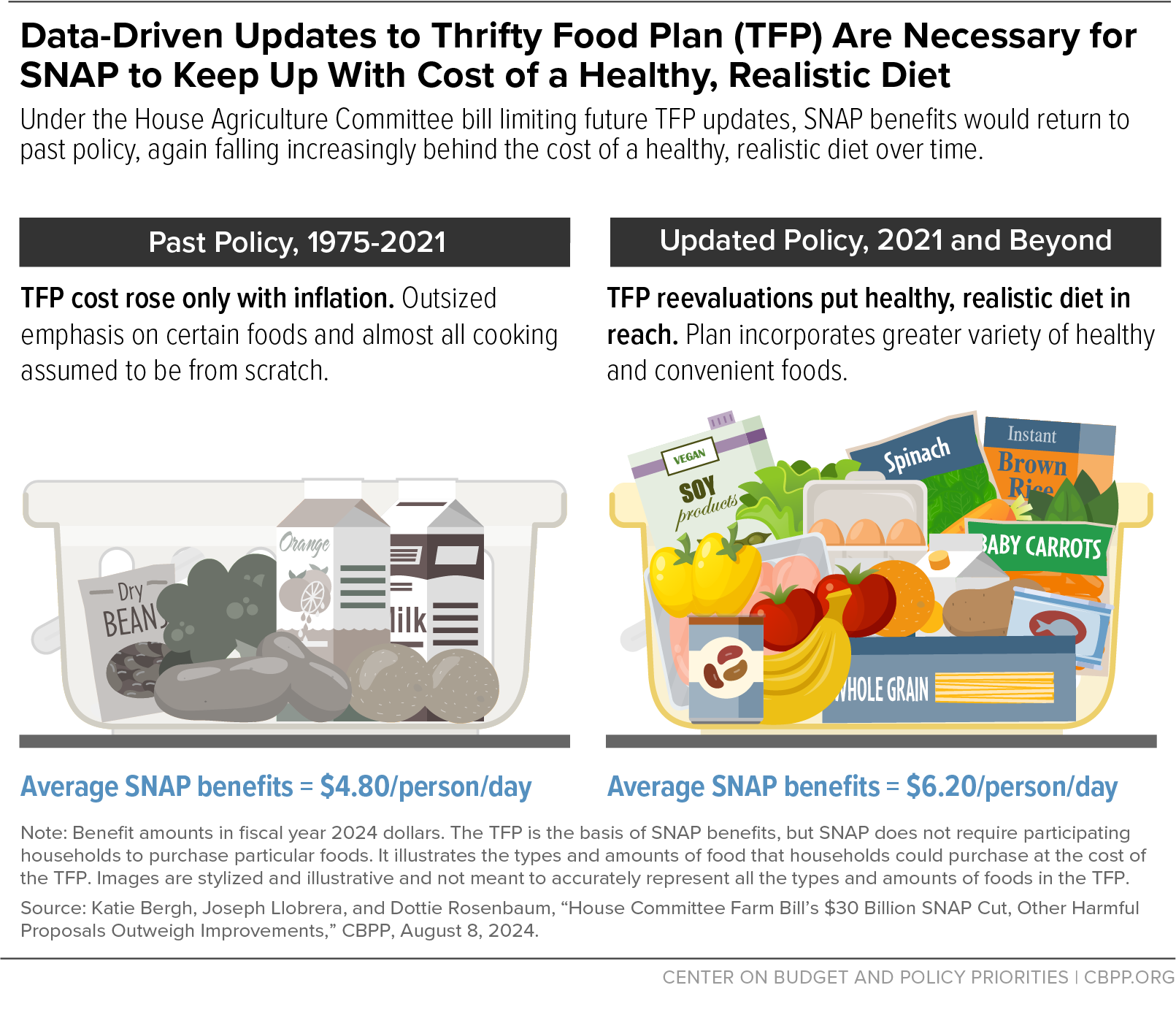
Keeping the TFP’s cost at a predetermined level over that period resulted in unrealistic assumptions about how families would stretch their inadequate food budgets. The TFP assumed, for example, that to meet the Dietary Guidelines for Americans at a very low cost, families would buy 25 pounds of milk and 20 pounds of orange juice each week, but very little of other commonly purchased, but somewhat more expensive, staple foods, like lettuce and cheese. It also assumed that despite the increase in women’s labor force participation since the 1970s, households would spend hours each day preparing meals mostly from scratch, such as cleaning and soaking dried beans overnight rather than buying canned beans. (See Figure 1.)
Recognizing that food price inflation is only one factor influencing the cost of a healthy diet, Congress revised the TFP process in the 2018 farm bill. A directive supported on a bipartisan basis in that legislation requires USDA to periodically reevaluate the TFP to account for factors in addition to food price inflation, including changes in dietary guidance and food consumption patterns. USDA, through a science-driven process, made a substantial TFP adjustment in 2021, increasing the purchasing power of SNAP benefits for the first time in nearly five decades.[3] (Future updates under the current process will likely be much smaller than the 2021 update, which had to make up for decades’ worth of changes in what constitutes a healthy, realistic diet.)

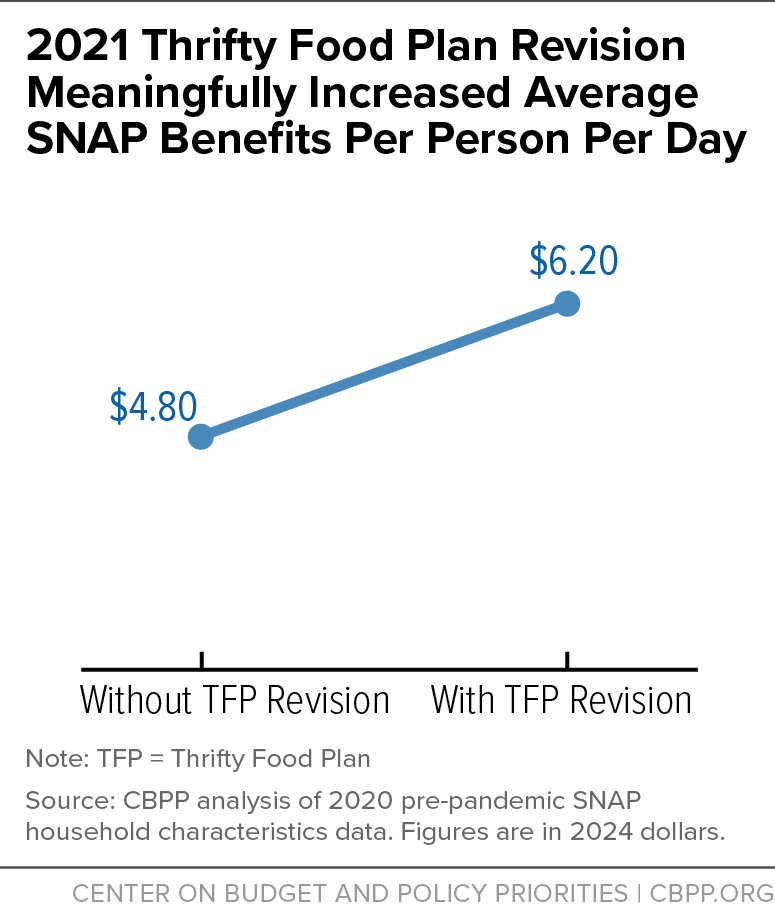
Even with the 2021 update, current SNAP benefits are modest, averaging just $6.20 per person per day in 2024. But this average benefit would be even lower — only $4.80 per day — without the 2021 update. (See Figure 2.) This update lifts over 2 million SNAP participants above the poverty line, including more than 1 million children.[4] The poverty-reducing impact of the update is strongest for Black and Hispanic individuals, researchers found, suggesting that this revision may reduce long-standing inequities in poverty and food insecurity. [5]

The House Agriculture Committee’s farm bill would return SNAP to the de facto policy prior to 2021, in which the cost of the TFP was adjusted only for inflation.[6] SNAP households would receive roughly $30 billion less in benefits over the 2027-2033 period than under current law, based on CBO estimates.[7] Every SNAP participant would experience a benefit cut: roughly $7 less per person per month over the 2027-2031 period and $15 less per month in 2032 and 2033. Since SNAP benefits under CBO’s baseline will average only about $7 per person per day in 2027, rising to about $8 in 2032 and 2033, the cut would equal a day’s worth of benefits each month initially, rising to almost two days’ worth by the end of the decade.
Moreover, the cuts during the 2027-2033 period would be just the beginning. This change in permanent law would restrict future TFP adjustments for inflation only. After 2033, SNAP benefits would likely fall further behind the cost of a healthy diet, as occurred before the 2021 update, resulting in an even deeper benefit cut in subsequent years.
Using CBO’s assumptions, we estimate how the cut would affect various groups of SNAP participants over the 2027–2033 period (see Figure 3).[8]
- Children: $18 billion of the cut would affect households with children, which in a typical month would include about 17 million children.
- Preschool-age children: $9 billion of the cut would affect households with young children (under age 5), which in a typical month would include about 5 million young children.
- Older adults: $5 billion of the cut would affect households with older adults, which in a typical month would include more than 6 million individuals aged 60 or older.
- People with disabilities: $6 billion of the cut would affect households with people with disabilities, which in a typical month would include more than 4 million disabled individuals.
- Working families: $11 billion of the cut would affect households with earnings.[9]


SNAP recipients in Hawai’i and Alaska would face additional changes under the bill. Under current law, USDA calculates separate TFP cost adjustments for these states to reflect the higher cost of food there.[10] The bill would create a separate TFP cost adjustment for “rural” areas of Hawai’i, as is currently the rule for Alaska. This would likely result in a small benefit increase for participants in some areas of the state, reflecting potentially higher food costs outside of urban areas in Hawai’i. However, it’s not clear how USDA would implement this provision, as only a very small share of Hawai’i residents live in rural areas under Census definitions.
Critically, the bill also would likely cut future benefits for SNAP participants in Hawai’i and Alaska by capping inflation adjustments of the TFP for Alaska and Hawai’i to be no greater than the inflation adjustment for the mainland TFP. This would mean that annual inflation adjustments for Hawai’i and Alaska could no longer reflect the higher food price inflation these states often experience compared to the rest of the country. As a result, SNAP participants in Hawai’i and Alaska would receive less to buy groceries in the future than under current law. Hawai’i’s food inflation has been higher than the U.S. rate in 18 of the last 30 years, and Alaska’s food inflation has been higher than the U.S. rate in nine of those years.
Bill Includes Other Harmful Provisions
In addition to the harmful changes to future TFP updates, the bill includes several other problematic provisions that could increase hardship for low-income families.
Outsourcing Core Operations to Private Companies
SNAP rules require that state civil service employees perform core SNAP eligibility functions related to application processing and eligibility determinations. This longstanding requirement ensures that caseworkers’ goal is to implement program rules effectively, not to maximize profits.
SNAP appropriately allows private companies to perform some SNAP operational functions, such as developing computer systems, performing building maintenance, providing custodial services, or managing EBT card issuance, to leverage their competitive advantage in these areas. But the government retains key functions to avoid jeopardizing eligible households’ access to the program.
SNAP has complex eligibility rules, and some applicants’ circumstances are difficult to assess quickly, particularly people with volatile income from informal jobs or gig work and older adults and people with disabilities who qualify for SNAP’s medical deduction. Low-income households require trained, professional civil service workers to appropriately screen and verify their information and ensure they receive the correct benefit levels — especially since the household must repay any benefits they receive in error due to an eligibility worker’s mistake. When these functions are turned over to for-profit companies, they may focus on the bottom line — such as minimizing staffing and customer service to keep costs as low as possible — rather than providing comprehensive support for low-income households and prioritizing access.
Section 4111 of the bill would effectively do away with the requirement that state employees perform these core functions related to application processing and eligibility determinations. It would allow states to hire private contractors to “undertake supplemental nutrition assistance program certification or carry out any other function of the State agency” in virtually unlimited circumstances. Also, Section 4105 would authorize private contractors to screen SNAP participants for referrals to employment and training programs, though this would likely be allowed under the broader authority in Section 4111 as well.
While Section 4111 specifies certain circumstances where using contractors would be allowed, including public health emergencies and natural disasters, the flexibility to use contractors would not be limited to these temporary circumstances. In fact, a state could outsource SNAP administration to private contractors whenever it experienced an increase in SNAP applications or wasn’t able to process applications on a timely basis, regardless of the reason. For example, a state that chronically underfunded its human services workforce could use the resulting processing delays to justify contracting out SNAP administration to a private company.
The bill would allow this contracting flexibility to persist indefinitely and with minimal federal oversight. If a state justified its use of private contractors using any reason other than a temporary staffing shortage, the bill would set no limit on how long the state could use these contractors, opening the door to a permanent shift to privatized administration. States would be required to notify USDA of their intent to use this flexibility, but the bill exempts the use of private contractors from the typical oversight requirements states face when making major changes to their program operations.
Past attempts to privatize SNAP eligibility determinations have had disastrous results. During the early 2000s, Texas and Indiana contracted for-profit companies to perform key parts of the eligibility process, including accepting applications, advising clients on program requirements and eligibility, and verifying eligibility. Serious problems resulted in both states.
In Texas, for example, thousands of people were unable to apply or were given misinformation. Many received incorrect benefit allotments or were wrongly denied benefits. Long application backlogs materialized. Individuals’ private information was inappropriately released, compromising their security. And taxpayer dollars were wasted, as none of the promised performance improvements or cost savings (which were slated to come from closing eligibility offices) were realized. [11]
Consistent with this experience, CBO estimates that the bill’s two privatization provisions would each increase federal costs by $1 million over ten years.
Weakening Privacy Protections for Sensitive Personal Information
Instances of SNAP participants receiving benefits in multiple states simultaneously are rare, representing only 0.2 percent of participants, according to one study.[12] Often, this is the result of a state’s failure to promptly close the case when a household moves out of state and does not indicate that the household is attempting to defraud the program.
The 2018 farm bill established the National Accuracy Clearinghouse (NAC), an interstate data matching system, to prevent these rare cases of duplicate participation. Implementation of the NAC was delayed during the pandemic, but USDA is now rolling it out across states and anticipates that all states will be participating by October 2027.[13]
Section 4110 of the House Agriculture Committee bill would require USDA to withdraw its current regulations for the NAC and promulgate new rules within six months, essentially starting the implementation process all over again. USDA would be required to engage a single private contractor to administer the NAC nationwide. States would be required to turn over to this contractor a list of highly sensitive personal information — well beyond the information needed to check for duplicate participation — for the more than 40 million current SNAP participants and all future participants.
Section 4110 would also eliminate the important NAC privacy protections included in the 2018 farm bill, which prevent households’ sensitive information from being used for other purposes and from being retained longer than needed. Without these protections, this bill could result in an enormous nationwide database where personally identifiable information about all current and future SNAP participants is stored in perpetuity, contradicting best practices recommended by data security experts. This would put private information, including the Social Security numbers and income and asset information of tens of millions of people, at risk of data breaches or other misuse.
The rationale for proposing such sweeping changes is unclear. If policymakers are concerned about the delay in implementing the 2018 farm bill provision, requiring USDA to start over from scratch is highly unlikely to speed the process. Regardless, there is no justification for putting participants’ personal information at such grave risk. CBO estimates that this provision would increase federal costs by $15 million over ten years.
Imposing Misguided Program Integrity Changes With No Clear Benefits
Eliminating the tolerance threshold for small errors (Sec. 4114): SNAP has one of the most extensive payment accuracy systems of any federal program, with intensive up-front eligibility checks and a rigorous quality control process that rechecks the accuracy of state decisions. The payment error rate that results from this quality control process serves as the main performance metric for states, and state agencies with persistently high error rates are subject to steep fiscal penalties. As a result, states currently have a strong incentive to prioritize payment accuracy over all else, often at the expense of other considerations like accessibility, timeliness, and customer service.[14]
SNAP has long excluded small overpayments and underpayments from a state’s payment error rate calculation; this “tolerance threshold” is $56 per month in fiscal year 2024.[15] Excluding these small errors is appropriate; as noted, SNAP has very complex eligibility and benefit calculation rules, and many low-income families participating in SNAP face changeable circumstances such as unpredictable work hours and unstable housing. The tolerance threshold allows states to focus their payment accuracy efforts on preventing and addressing larger errors that have a more substantial cost to the federal government.
The House Agriculture Committee bill would eliminate this threshold entirely, so all errors — even cases where a household was receiving only $1 more or less in SNAP benefits each month than they should have under program rules — would be considered in the state’s error rate calculation. Eliminating the tolerance threshold likely wouldn’t have a meaningful direct impact in improving payment accuracy, since current rules already require states to identify, correct, and report to USDA on errors below the threshold. However, it would likely influence how states prioritize their error reduction efforts and could cause them to pay less attention to larger, costlier errors.
The primary impact of this change would be to increase SNAP’s reported payment error rate and associated sanctions for states with persistently high error rates. States would likely respond by imposing policies that aim to reduce errors but create new administrative burdens for households and eligibility workers. For example, states might require more paperwork from households seeking benefits, or might direct eligibility workers to collect and verify information from households that goes beyond what program rules require. These additional burdens would likely fall disproportionately on families with earnings, whom states and USDA consider to be more “error prone” because of the volatile incomes of many low-paid workers.[16]
This additional red tape would likely reduce access to the program and worsen the timeliness challenges that many states are currently grappling with, resulting in higher levels of food insecurity.
CBO estimates that eliminating the tolerance threshold would decrease federal costs by $70 million over ten years.
Suspending benefits for households with exclusively out-of-state transactions (Sec. 4126): The bill would require states to track out-of-state SNAP transactions and suspend the benefits of any household that exclusively makes purchases in another state for more than 90 days. Benefits would not be reinstated until the household affirmatively provided evidence that they still reside in the state where they receive benefits, or the state agency investigated and determined that they still reside there.
It isn’t clear what problem this provision is intended to address. Consistently purchasing food in another state doesn’t necessarily indicate that a household is receiving benefits in more than one state, and duplicate participation is very rare (as noted above). Rather than amending the Food and Nutrition Act, this provision would amend a separate law regarding EBT card skimming and other forms of electronic benefit theft, but it would be extremely unlikely to capture fraudulent activity based on theft of EBT card information. While individuals who have stolen EBT card information sometimes redeem benefits in another state, the unsuspecting SNAP participant, a victim of EBT theft, would presumably continue making purchases in their home state and would report the theft as soon as they realized their benefits were missing. It is highly unlikely that a SNAP household would make zero legitimate in-state purchases while their benefits were fraudulently drained out of state, unnoticed, for more than 90 days.
A much more likely outcome is that this provision would jeopardize benefits for households who shop across state lines for legitimate reasons, in line with program rules. For example, in rural communities near state borders, the only accessible grocery store may be in a neighboring state. In metropolitan areas that span multiple states, such as the Washington, D.C. and Kansas City metro areas, a household may live in one state and routinely pick up groceries while commuting home from their job in another state. It is also unclear how online purchases, which are increasingly popular among SNAP households and may appear to be out-of-state transactions, would be accounted for.
Once a household’s benefits were suspended under this provision, the burden would almost certainly fall on the household to prove their residency, further jeopardizing access to benefits for households who may have done nothing wrong. Providing sufficient evidence to restore benefits may be a particular challenge for people without stable housing, who may lack formal documentation of their living arrangements to prove their residency.
Some states currently monitor out-of-state transactions as an indicator that a household may have moved, but making this a federal requirement would place substantial new administrative burdens on states. In addition to monitoring purchases to comply with the requirement, state agencies would need to request and review documentation of residency for affected households and handle a greater volume of client inquiries as households’ benefits are suspended. These tasks would divert limited staff time away from core program functions such as processing applications and recertifications.
CBO estimates that the provision would increase federal costs by $1 million over ten years, indicating that the cost of administering this new requirement would exceed any savings from suspending benefits for affected households.
Increasing state retention of recovered overpayments (Sec. 4113): Under current law, states retain a percentage of the funds they recover from overpayments that were caused by the household, either through an intentional program violation or, more commonly, an inadvertent household error. (For example, a household might not understand when they need to report a change in their circumstances.) This creates a modest financial incentive for states to pursue claims, since the overpaid benefits that states collect and retain are 100 percent federally funded.
The bill would raise the percentage of recovered overpayments that states can keep from 35 to 50 percent for overpayments caused by intentional program violations. For overpayments caused by inadvertent household errors, the retention rate would remain at 20 percent except in situations where the state recouped those overpaid benefits by reducing the household’s unemployment benefits, in which case the rate would rise from 35 to 50 percent.
By increasing the retention rates, the bill could further incentivize states to pursue claims against households, though states could also just retain a larger share of the overpayments they would have otherwise collected. Currently, states must file a claim against households who receive an overpayment and attempt to recover those overpaid funds, with limited exceptions.
But because this provision would substantially increase the difference between the retention rates for overpayments due to most inadvertent household errors (which would stay at 20 percent) versus intentional fraud (which would rise to 50 percent), it could also encourage states to treat unintentional errors as purposeful violations. A state suspecting that a SNAP participant has intentionally violated program rules must prove that the violation was not accidental, but many states use the threat of criminal prosecution, or other dire consequences, to pressure participants into signing documents admitting to the allegations and waiving their right to a hearing, regardless of whether they actually meant to break the rules. Households then lose SNAP benefits for a year or more in addition to having to repay any benefits they received in error.
The bill stipulates that retained funds can only be used in SNAP, such as investments in technology, administration and distribution, or anti-fraud activities. Because these funds would be kept by states rather than returned to the Treasury, CBO estimates this provision would increase federal spending by $225 million over ten years.
Opening the Door to Costly and Stigmatizing Purchasing Restrictions
The bill includes several other provisions that appear to lay the groundwork for future attempts to restrict the types of foods that SNAP participants can buy. Such restrictions would be stigmatizing for participants and create substantial red tape for program administrators, SNAP retailers, and participating households.
All people, regardless of how they pay for their groceries, should be able to buy the foods that best meet their cultural preferences, dietary requirements, and other needs. Misguided attempts to blame SNAP for diet-related disease and poor health ignore the strong evidence that SNAP participation is linked to improved health and lower health care costs.[17] In fact, SNAP participants report that their most common barrier to achieving a healthy diet is the affordability of healthy food, a challenge that restricting food purchases would not address and the bill’s $30 billion benefit cut would only worsen.[18]
Changing SNAP’s statutory purposes to include prevention of diet-related disease (Sec. 4101): The bill would add a new purpose of SNAP: preventing diet-related chronic disease, disability, premature death, unsustainable health care costs, and undermining of military readiness. It also would establish as a policy of Congress that the Secretary of Agriculture should administer SNAP in a manner that will provide participants with “access to a variety of foods essential to optimal health and well-being.” While this provision would have no direct policy implications, it would further shift the statutory purpose of SNAP away from its core goal of reducing hunger and malnutrition. This would come on top of a provision in last year’s Fiscal Responsibility Act that amended SNAP’s statutory purpose to include assisting low-income adults in obtaining employment and increasing their earnings.
Requiring USDA to collect data about SNAP purchases from retailers (Sec. 4108): This provision would require USDA to collect and make publicly available a statistically significant sample of transaction data for all customers, including SNAP customers, including total costs and descriptions of the items purchased. The bill would limit disclosure of identifying data and require this data to be made public in a way that prevents identification of individual stores, store chains, or households. While the intent of this provision is not clear, proponents of restricting SNAP purchases have sought more data on what SNAP participants use their benefits to buy. A previous study of purchasing patterns found no major difference between the expenditure patterns of SNAP and non-SNAP customers.[19] CBO estimates that the provision would increase federal spending by $10 million over ten years.
Undermining Dietary Guidelines and Cutting Nutrition Education Funding
Even as the bill would add prevention of diet-related disease to SNAP’s statutory purposes, it includes several provisions that would undermine efforts to ensure federal nutrition programs are based on sound nutrition science and would weaken support for nutrition education.
Politicizing the Dietary Guidelines for Americans (Sec. 12402): The Dietary Guidelines for Americans (DGAs) are currently updated every five years through an independent, scientific process overseen by USDA and the Department of Health and Human Services. These guidelines underpin federal nutrition programs, including nutrition standards for school meals and food packages in the Special Supplemental Nutrition Program for Women, Infants, and Children (WIC). The bill would politicize the DGAs by empowering an advisory board largely appointed by members of Congress to shape their development. It would also cut the frequency of DGA updates in half, to every ten years, and skip the 2025 DGA update, which is now in process and will be the first to consider equity and climate implications. And it would prohibit consideration of social determinants of health or other policy factors in the development of future DGAs. CBO estimates that the provision would increase federal spending by $25 million over ten years.
Cutting funding for SNAP nutrition education (Sec. 4120): SNAP has a federally funded nutrition education component, the Nutrition Education and Obesity Prevention Grant Program (known as “SNAP-Ed”). SNAP-Ed programs are implemented by state agencies and partnering organizations in every state. The bill would reduce annual funding for SNAP-Ed to $521 million in fiscal year 2025, adjusted annually for inflation moving forward. CBO estimates that this would cut $230 million from nutrition education over ten years.
Bill Fails to Address Several Key Issues
Two important issues that the House Agriculture Committee fails to address are EBT card skimming and providing more equitable food assistance for Puerto Rico and other U.S. Territories that are excluded from SNAP.
No Provisions to Protect Victims of EBT Card Skimming
In recent years, electronic theft of SNAP benefits through card skimming, card cloning, and similar means has become an increasing problem. SNAP benefit theft through these methods has been reported in almost every state. Individuals engaging in EBT theft place skimming devices on point-of-sale devices to surreptitiously capture EBT card information and PINs, then use that stolen information to drain a household’s account without their knowledge. For affected low-income households, who often have few resources to fall back on, discovering in the checkout line that they have no SNAP benefits left to pay for their groceries can be devastating.
Consumer protection rules ensure credit and debit card users are not held liable for fraudulent transactions if their accounts are compromised, but those rules exclude EBT card users. In late 2022, Congress, recognizing that low-income households should not bear the brunt of this criminal activity, required states to use federal funds, with certain limitations, to replace SNAP benefits stolen through skimming. Since then, states have reported replacing more than $61.5 million in SNAP benefits stolen from nearly 125,000 households nationwide based on USDA data through December 2023.[20] This amount represents a tiny fraction (0.138 percent) of all SNAP benefits issued during this period, but for the affected households, these replacement SNAP dollars can be the difference between putting food on the table that month and going hungry. The 2022 law also instructed USDA to work with states to detect and prevent skimming and promulgate regulations to require states to take enhanced security measures. Those regulations are scheduled to be issued this fall.
Many states are undertaking efforts to prevent EBT card skimming, such as allowing households to freeze their EBT account when they are not actively using their card. In the coming months, at least two states (California and Oklahoma) are planning to implement chip-enabled EBT cards, which are less vulnerable to skimming. But while additional anti-skimming measures are gradually being put in place, households affected by electronic benefit theft will continue to need their stolen benefits restored.
Unfortunately, Congress only authorized replacement for SNAP benefits stolen between October 1, 2022 and September 30, 2024. Congress must act before then to extend the authority to replace these benefits, but the House Agriculture Committee’s farm bill does not include such an extension — or any other measures to protect EBT card users from electronic benefit theft. In contrast, the farm bill framework proposed by Senate Agriculture Committee Chair Debbie Stabenow would extend this authority permanently and add other EBT card security measures.
No Measures to Reduce Inequities Between U.S. Territories and States
For decades, Puerto Rico, American Samoa, and the Commonwealth of the Northern Mariana Islands have received capped block grants for nutrition assistance in lieu of participating in SNAP. Guam and the U.S. Virgin Islands participate in SNAP on the same basis as states and the District of Columbia.
The block grant structure and limited funding for these nutrition assistance programs (NAPs) have several disadvantages compared to SNAP. For example, Puerto Rico’s NAP generally has more restrictive eligibility limits and lower benefits than SNAP, even though Puerto Rico has high levels of poverty. And because NAP is a block grant, it cannot automatically expand to accommodate increased need following natural disasters or economic downturns, as SNAP can.
The House bill would make no progress in shifting the excluded U.S. Territories to full participation in SNAP or parity with SNAP. The bill’s effects on the block grants for Puerto Rico and American Samoa are complicated:
Under current law, those block grants are based on a stated dollar amount for fiscal year 2003 with annual adjustments for changes in the cost of the TFP since then. (For example, the combined amount for fiscal year 2023 was $2.8 billion, based on the fiscal year 2022 level adjusted for the annual change in the cost of the TFP.) Section 4124 of the bill would establish a new base funding level for nutrition assistance in Puerto Rico and American Samoa — $3.046 billion in 2025 — and continue the annual adjustments in subsequent years based on changes in the cost of the TFP.[21] CBO estimates this change would cut NAP funding by $100 million in 2025 and $950 million over ten years.
CBO does not describe the rationale for this estimate, but it appears that CBO estimates this cut because it is scoring the bill using the assumptions of its May 2023 baseline, which projected higher food inflation in 2023 and 2024 than has actually occurred.[22] In its May 2023 baseline, CBO assumed that the 2025 block grant amount for the two territories would be $3.14 billion, but due to lower-than-expected inflation, the 2025 funding level under current law will be only $2.9 billion. Thus, the bill’s 2025 funding level is more than $100 million higher than the actual block grant will be under current law, rather than $100 million lower. Over ten years, that difference would result in a more than $1 billion increase in the block grant.
- Separately, however, because future annual adjustments to these territories’ NAP funding are pegged to changes in the Thrifty Food Plan, we estimate the bill’s provision to limit increases from future TFP updates only to inflation adjustments would cut future funding by more than $700 million over ten years, based on CBO’s projections. CBO does not separately identify this amount but notes that its estimate of the roughly $30 billion SNAP cut from the TFP provision “includes reductions in spending for programs such as the nutrition assistance programs for Puerto Rico and American Samoa.” Thus, we estimate the bill would result in a net increase in NAP funding of about $300 million over the next decade.
| TABLE 2 | |
|---|---|
Funding for the Block Grant for Nutrition Assistance in Puerto Rico and American Samoa | |
| 2025 Funding Level | |
| Under the House Agriculture Committee bill* | $3.046 billion |
| Under the CBO May 2023 baseline with inflation projections for fiscal year 2024 and 2025 | $3.144 billion |
| Level based on actual inflation | $2.935 billion |
* Based on the manager’s amendment adopted during the markup on May 23, 2024, https://docs.house.gov/meetings/AG/AG00/20240523/117371/HMKP-118-AG00-20240523-SD004.pdf. Note: Under all three scenarios the fiscal year 2025 amount will be adjusted for future changes in the TFP, so the difference in the 2025 amount will also be reflected in future years’ block grant amounts. | |
As noted, the bill takes no concrete steps to transition Puerto Rico into SNAP, though Chair Thompson expressed support for this eventual transition during committee consideration of the bill. In contrast, Chair Stabenow’s farm bill framework would establish a ten-year pathway for Puerto Rico to begin implementing SNAP. Enabling Puerto Rico to participate in SNAP is critical to reducing the longstanding disparities in nutrition assistance between the states and Puerto Rico.[23]
Bill Includes Some Modest SNAP Improvements
The House Agriculture Committee bill repurposes a small fraction of the roughly $30 billion in savings over ten years resulting from its cut to future benefits and other provisions to pay for a few benefit improvements for certain categories of participants in SNAP and other nutrition programs. But Congress could make these improvements without the bill’s large benefit cut and other harmful changes.
People Reentering the Community Following a Drug-Related Felony Conviction
Perhaps the most important of these improvements would end the lifetime SNAP disqualification for people convicted of a drug-related felony and restore their SNAP eligibility when they return to the community after prison (Section 4122).
In the decades since the lifetime disqualification policy was enacted, almost every state has enacted laws to restore eligibility to at least some individuals affected by it. However, half of the states still apply the ban to some individuals. In these states, many people who have completed their sentences remain ineligible for SNAP or struggle to provide the documentation required to receive benefits. Due to inequities in the criminal legal system, disqualification disproportionately harms people of color.[24]
People reentering the community after incarceration often face significant barriers to employment and housing, and many struggle with food insecurity. Preventing them from accessing SNAP simply creates another barrier to successful reintegration and does nothing to advance public safety. CBO estimates that restoring benefits for these excluded individuals would increase federal spending by $730 million over ten years. According to CBO, 35,000 people would become newly eligible and receive $265 a month on average in 2033.
Restoring eligibility nationwide for people convicted of a drug-related felony has bipartisan support in Congress, and it would strengthen SNAP and reduce longstanding inequities in rates of food insecurity. But there is no need to couple this policy with future benefit cuts for all SNAP participants. Senator Stabenow’s farm bill framework includes this benefit restoration without harmful cuts or policy changes that would put benefits for low-income people at risk.
The House Agriculture Committee bill would also make incarcerated individuals who are scheduled to be released within 30 days eligible for SNAP (Section 4123). Several states currently use waivers to allow incarcerated individuals to apply for SNAP ahead of their release, which can facilitate more timely access to benefits upon their release and ensure they have resources for food when they return to the community. The bill would establish a slightly different policy: rather than facilitating an early application for benefits to be received after they are released, it would enable these individuals to qualify for SNAP and begin receiving benefits for the month prior to their scheduled release. CBO estimates that this provision would increase spending by $46 million over ten years.
People With Earnings
Excluding income from subsidized employment and job training programs (Sec. 4103): The 2018 farm bill added subsidized employment — jobs where the employer receives a government subsidy to cover some or all of the wages — as an option that states could offer through their SNAP employment and training (E&T) programs. However, income from subsidized jobs through E&T or other workforce programs is counted when determining SNAP eligibility and benefit amounts, and some SNAP participants earn enough through these programs that they are no longer eligible for SNAP. The House Agriculture Committee bill would exclude income from SNAP E&T programs, vocational rehabilitation programs, refugee employment programs, and certain other job training programs from counting as income or resources for SNAP purposes. CBO estimates that the change would increase SNAP spending by $62 million over ten years.
Excluding income from high school students through age 21 (Sec. 4103): Currently, high school students can work without their income being counted for SNAP purposes until their 18th birthday. This creates a “birthday cliff”: As soon as a high school student turns 18, their income is included in their family’s SNAP benefit calculation, which can reduce the household’s SNAP benefits or even make the household ineligible. Section 4103 would delay when the income of a high school student starts counting for SNAP purposes until the student’s 22nd birthday. CBO estimates that excluding earnings for high school students aged 18 through 21 would increase SNAP spending by $1.6 billion over ten years.
Increasing the earned income deduction (Sec. 4104): In the SNAP benefit calculation, households with earnings currently receive a 20 percent earned income deduction. This preferential treatment for earnings over unearned income, like Social Security or cash assistance, reflects the fact that income a household spends on work-related expenses, like transportation, is not available to be spent on food. Section 4104 would increase the earned income deduction to 22 percent of earnings. This would result in a modest benefit increase for a large share of SNAP households who have earnings and would expand eligibility to a small number of households who are just above the income threshold to qualify for SNAP. CBO estimates that this provision would increase SNAP spending by $7.4 billion over ten years, with about 2 percent of that cost attributed to households newly eligible under this change.
Older Adults and College Students
Making ESAP a state option (Sec. 4125): The Elderly Simplified Application Project (ESAP) is a demonstration project that allows states to use simplified SNAP applications, extend certification periods, waive the recertification interview, and offer verification flexibilities to facilitate access to SNAP when all household members are aged 60 or older and have no earned income. These households typically have low but relatively stable incomes from Social Security or other benefits and are very likely to remain eligible for SNAP from year to year. Some states also include adults with disabilities who have no earned income in their projects or allow children to be present in the household. Currently, 23 states operate ESAPs.[25]
The bill would establish ESAP as a state option. Currently, implementing ESAP as a demonstration project requires states to gain approval from USDA, conduct evaluations, and meet other requirements, which may discourage more widespread adoption. State options do not have these requirements and are more straightforward for states to adopt, so establishing ESAP as a state option could encourage additional states to implement it.
Under the state option, states could offer a streamlined application and certification process for households where all adult members have no earned income and are age 60 or older or have a disability. These households would have a 36-month certification period and would not have to complete a recertification interview unless they requested one. Additionally, states would be required to maximize the use of data matching to verify income and household size and to accept self-declaration of certain eligibility information unless the information provided by the household was questionable. States would also be required to establish accountability and fraud prevention measures in implementing ESAP.
The streamlining provided under ESAP can make it easier for eligible older adults, who participate in SNAP at relatively low rates, to access benefits and stay connected to the program longer. CBO estimates that this provision would increase federal spending by $118 million over ten years, likely reflecting a small participation increase among older adults.
Facilitating outreach to eligible college students (Sec. 4304): Current SNAP eligibility rules for college students are restrictive and complex. Even if they meet other eligibility requirements, college students enrolled at least half-time are not eligible for SNAP unless they meet one or more exemptions, such as caring for a child under age 6, participating in a work study program, or working at least 20 hours per week. Due to the complexity of SNAP’s student rules, low-income college students who meet these exemptions may not be aware that they could be eligible for SNAP. The bill would require USDA to issue guidance to states on how to identify and notify students participating in work study programs that they likely qualify for SNAP. (The bill does not expand access to SNAP for college students who don’t have enough resources to afford a healthy diet but who are currently ineligible for SNAP.) CBO estimates that the provision would not affect federal spending.
Tribes
Authorizing self-determination contracts for FDPIR (Sec. 4102): The bill would require USDA to enter into self-determination contracts with Indian Tribal Organizations (ITOs) requesting to administer any “function, service, or activity” of the Food Distribution Program on Indian Reservations (FDPIR). In lieu of SNAP, FDPIR provides food commodities to households with low incomes who reside on Indian reservations and to Native American households living in other designated areas in Oklahoma.
While more than 100 ITOs currently administer FDPIR, the commodities distributed through the program are procured by USDA. The 2018 farm bill authorized self-determination demonstration projects for ITOs to manage commodity procurement themselves, which have been successful at allowing tribes to select and purchase foods preferred by their citizens from the vendors of their choice. However, these demonstration projects are limited in scope and require dedicated funding through the annual appropriations process.
The bill would expand this self-determination authority and make it a permanent feature of the program available to all ITOs, thereby supporting sovereignty and ensuring the foods provided through FDPIR better reflect participants’ preferences. CBO estimates that this provision would increase federal spending by $380 million over ten years, noting that based on information from USDA, CBO anticipates that the cost of food procured by tribes would be 70 percent higher than foods USDA procures.
Authorizing self-determination demonstration projects in CSFP (Sec. 4204): The Commodity Supplemental Food Program (CSFP) provides USDA commodities to supplement the diets of low-income older adults. Mirroring the successful self-determination projects for FDPIR authorized in the 2018 farm bill, the current House Agriculture Committee bill would authorize self-determination demonstration projects for ITOs to procure commodities for CSFP, though these demonstration projects would be subject to the availability of appropriations.
Bill Includes Improvements in Other Nutrition Programs
The bill also uses another small fraction of the roughly $30 billion cut from SNAP to increase funding for some other nutrition programs. They include:
- The Emergency Food Assistance Program (TEFAP): Section 4119 provides an additional $106 million over ten years in mandatory funding for TEFAP commodities. Section 4119 also provides an additional $30 million in mandatory funding for Farm to Food Bank initiatives. However, because the funding for TEFAP commodities in future years is indexed to changes in the Thrifty Food Plan, we estimate that this investment would essentially be offset by a roughly $100 million cut to TEFAP resulting from the bill’s changes to future TFP reevaluations. Emergency feeding organizations would also be negatively impacted by a separate provision restricting the Secretary of Agriculture’s discretionary uses of the Commodity Credit Corporation (Section 1608). This has been an important funding stream for commodity purchases in recent years.
- The Gus Schumacher Nutrition Incentive Program (GusNIP): Section 4306 provides an additional $171 million for GusNIP.
- The Healthy Fluid Milk Incentives Program: Section 4310 provides an additional $25 million for milk incentives.
- The Senior Farmers Market Nutrition Program (SFMNP): Section 4201 provides an additional $18 million for SFMNP.
- Food Box Pilot Program: Section 4302 provides $200 million for a new pilot program to deliver boxes of food to supplement the nutrition of food insecure households.
These programs all supplement SNAP, either by providing additional emergency food for households who do not participate in SNAP or receive too little in benefits to meet their dietary needs, or by providing additional resources to allow households to purchase more of certain types of food. TEFAP provides commodities for food banks and other emergency feeding organizations to distribute to low-income households; GusNIP funds incentives to encourage SNAP participants to buy fruits and vegetables; the Healthy Fluid Milk Incentives Program similarly incentivizes milk purchases; and SFMNP provides coupons that allow low-income older adults to buy produce from local farmers.
But shoring up these programs by limiting future TFP updates and cutting future SNAP benefits is counterproductive. Allowing SNAP benefits to fall behind the cost of a healthy, realistic diet by undermining TFP updates will only raise demand for these other programs over time, as SNAP benefits become increasingly inadequate and low-income households increasingly struggle to make their benefits last the entire month. Also, the programs receiving added funding reach only a small fraction of SNAP households. Moreover, the total amount of funding added to these programs is substantially smaller than what the bill would cut from future SNAP benefits for all participants, so low-income households would be left worse off on balance.
Appendix: Other SNAP-Related Provisions in House Agriculture Committee Bill
The bill’s nutrition title contains a number of SNAP-related provisions beyond those discussed in this report. These would:
- Make permanent the 2018 farm bill’s prohibition on certain EBT fees, which CBO estimates would increase federal spending by $59 million over ten years (Section 4106)
- Prohibit the owners of SNAP-authorized retailers from redeeming benefits at their stores, which CBO estimates would increase federal spending by $4 million over ten years (Section 4107)
- Make states’ approved plans of operation for SNAP publicly available, which CBO estimates would increase federal spending by $4 million over ten years (Section 4109)
- Amend the process for administrative actions against SNAP retailers and require a report on retailer fraud metrics, which CBO estimates would increase federal spending by $3 million over ten years (Section 4112)
- Require a 60-day public comment for new or updated guidance proposing substantive changes for conducting SNAP quality control reviews (Section 4115)
- Establish an Office of Program Integrity within the USDA Food and Nutrition Service, which CBO estimates would increase federal spending by $7 million over ten years (Section 4116)
- Extend the authorization of appropriations for SNAP through fiscal year 2029 (Section 4117)
- Increase mandatory funding for Community Food Project grants from $5 million to $10 million per year, which CBO estimates would increase federal spending by $45 million over ten years (Section 4118)
- Extend the authorization of appropriations for recipient and retail food store program integrity activities (Section 4121)
- Eliminate the requirement for states to use wage data from the National Directory of New Hires when certifying and recertifying SNAP households, which CBO estimates would increase federal spending by $83 million over ten years (Section 4127)
- Require USDA to report annually on the food security and diet quality of SNAP participants and non-participants, which CBO estimates would increase federal spending by $1 million over ten years (Section 4128)
- Require a National Academies of Sciences, Engineering, and Medicine study to assess the efficacy of allowing hot foods to be purchased with SNAP benefits, which CBO estimates would increase federal spending by $3 million over ten years (Section 4129)
End Notes
[1] The legislative text of the bill and other supporting documents can be found on the House Agriculture Committee website at https://agriculture.house.gov/farmbill/. A manager’s amendment with some changes to the nutrition title was adopted at the start of the markup; see https://docs.house.gov/meetings/AG/AG00/20240523/117371/HMKP-118-AG00-20240523-SD004.pdf. The CBO’s estimate states that the Agriculture Committee provided CBO with additional amendments on July 30, 2024. We are not able to incorporate those changes that affected nutrition spending (if any) into our descriptions of the bill.
[2] Steven Carlson, Joseph Llobrera, and Brynne Keith-Jennings, “More Adequate SNAP Benefits Would Help Millions of Participants Better Afford Food,” CBPP, July 15, 2021, https://www.cbpp.org/research/food-assistance/more-adequate-snap-benefits-would-help-millions-of-participants-better.
[3] U.S. Department of Agriculture, “Thrifty Food Plan, 2021,” August 2021, https://FNS.usda.gov/TFP; Joseph Llobrera, Matt Saenz, and Lauren Hall, “USDA Announces Important SNAP Benefit Modernization,” CBPP, August 26, 2021, https://www.cbpp.org/research/food-assistance/usda-announces-important-snap-benefit-modernization.
[4] Joseph Llobrera, “Recent Increase in SNAP Purchasing Power Invests in Children’s Health and Well-Being,” CBPP, August 29, 2022, https://www.cbpp.org/research/food-assistance/recent-increase-in-snap-purchasing-power-invests-in-childrens-health-and.
[5] Laura Wheaton and Danielle Kwon, “Effect of the Reevaluated Thrifty Food Plan and Emergency Allotments on Supplemental Nutrition Assistance Program Benefits and Poverty,” Urban Institute, August 1, 2022, https://www.urban.org/research/publication/effect-reevaluated-thrifty-food-plan-and-emergency-allotments-supplemental.
[6] Prior to the 2018 farm bill, USDA could have reevaluated the TFP at any time. The 2018 legislation required a reevaluation every five years, “based on current food prices, food composition data, consumption patterns, and dietary guidance.” In addition to stipulating that future reevaluations cannot increase the cost of the Thrifty Food Plan (outside of inflation adjustments), the House Agriculture Committee bill would replace this directive with a requirement that reevaluations occur no more frequently than at five-year intervals, making future TFP reevaluations optional and potentially lengthening the intervals between reevaluations. It would also delay the next reevaluation by a year to 2028.
[7] CBO projects that the cut in future SNAP benefits would begin in 2027 because that is when the next reevaluation of the Thrifty Food Plan is scheduled to take effect under current law, which requires reevaluations every five years. CBO’s estimate that this provision would cut future benefits by almost $30 billion uses a ten-year budget window, 2024-2033, but the cut to future benefits would continue to grow after 2033.
[8] CBPP analysis of the bill’s proposed cut, CBO’s May 2023 baseline (with CBPP adjustments to account for actual inflation figures for the June 2023 TFP), USDA fiscal year 2020 pre-pandemic SNAP household characteristics data, and USDA fiscal year 2023 SNAP administrative data. Demographic groups are not mutually exclusive.
[9] Based on CBO’s estimate and May 2023 baseline and CBPP’s analysis using USDA’s “Characteristics of Supplemental Nutrition Assistance Program Households, Fiscal Year 2020” data.
[10] In fiscal year 2024, the maximum SNAP benefit for a household of four in the 48 contiguous states and the District of Columbia is $973 per month. For a household of four in Hawai’i, the maximum benefit for a four-person household is $1,759. In Alaska, it’s $1,248 in urban areas, $1,591 in “rural 1” areas, and $1,937 in “rural 2” areas.
[11] Center for Public Policy Priorities, “Updating and Outsourcing Enrollment in Public Benefits: The Texas Experience,” November 2006, http://library.cppp.org/files/3/CPPP_PrivReport_(FS).pdf; Center for Public Policy Priorities, “News Release: New Report on Texas’ Troubled Outsourcing Experiment Tells Cautionary Tale for Sister States,” November 13, 2006, http://library.cppp.org/files/3/privatizationrelease_CH.pdf.
[12] PCG, “National Accuracy Clearinghouse (NAC) Evaluation, Final Report,” October 2015, p. 9, https://www.fns.usda.gov/snap/nac-evaluation-final-report.
[13] U.S. Department of Agriculture, Food and Nutrition Service, “SNAP National Accuracy Clearinghouse,” https://www.fns.usda.gov/snap/nac.
[14] Dottie Rosenbaum and Katie Bergh, “SNAP Includes Extensive Payment Accuracy System,” CBPP, updated June 21, 2024, https://www.cbpp.org/research/food-assistance/snap-includes-an-extensive-payment-accuracy-system.
[15] U.S. Department of Agriculture, Food and Nutrition Service, “SNAP Quality Control – Error Tolerance Threshold,” https://www.fns.usda.gov/snap/qc/ett.
[16] Joseph Llobrera and Lauren Hall, “SNAP Provides Critical Benefits to Workers and Their Families,” CBPP, August 10, 2023, https://www.cbpp.org/research/food-assistance/snap-provides-critical-benefits-to-workers-and-their-families.
[17] Steven Carlson and Joseph Llobrera, “SNAP Is Linked With Improved Health Outcomes and Lower Health Care Costs,” CBPP, December 14, 2022, https://www.cbpp.org/research/food-assistance/snap-is-linked-with-improved-health-outcomes-and-lower-health-care-costs.
[18] Maeve Gearing, Sujata Dixit-Joshi, and Laurie May, “Barriers That Constrain the Adequacy of Supplemental Nutrition Assistance Program (SNAP) Allotments: Survey Findings,” U.S. Department of Agriculture, Food and Nutrition Service, June 2021, https://fns-prod.azureedge.us/sites/default/files/resource-files/SNAP-Barriers-SurveyFindings.pdf.
[19] Steven Garasky et al., “Foods Typically Purchased by Supplemental Nutrition Assistance Program (SNAP) Households,” U.S. Department of Agriculture, Food and Nutrition Service, November 2016, https://fns-prod.azureedge.us/sites/default/files/ops/SNAPFoodsTypicallyPurchased.pdf.
[20] U.S. Department of Agriculture, Food and Nutrition Service, “SNAP Replacement of Stolen Benefits Dashboard,” https://www.fns.usda.gov/data-research/data-visualization/snap-replacement-stolen-benefits-dashboard.
[21] Section 19 of the Food and Nutrition Act authorizes the NAP block grants for Puerto Rico and American Samoa. The NAP block grant for the Commonwealth of the Northern Mariana Islands is authorized in separate legislation (Public Law 96-597) and is not amended by this bill.
[22] In its May 2023 baseline, CBO projected 8.7 percent and 2.3 percent food inflation underlying the fiscal year 2024 and 2025 block grant amounts, respectively. The actual amounts were lower: 3.6 percent for the 2024 block grant and 0.25 percent for the 2025 block grant.
[23] For more on reducing inequities in the U.S. Territories’ food assistance programs, see Javier Balmaceda, “Puerto Rico and Other Territories Should Get Food Assistance Equity in Upcoming Farm Bill,” CBPP, September 27, 2023, https://www.cbpp.org/blog/puerto-rico-and-other-territories-should-get-food-assistance-equity-in-upcoming-farm-bill.
[24] Ed Bolen, “Restore SNAP for People With Drug-Related Convictions,” CBPP, May 17, 2021, https://www.cbpp.org/blog/restore-snap-for-people-with-drug-related-convictions.
[25] Casey McConnell et al., “State Options Report,” U.S. Department of Agriculture, Food and Nutrition Service, June 2024, https://fns-prod.azureedge.us/sites/default/files/resource-files/snap-16th-state-options-report-june24.pdf.