

Overhyped Deductions for Tipped Income and Overtime Do Little for Workers
The Trump Administration has attempted to sell the megabill enacted in July 2025 as helping workers by aggressively promoting two of the law’s new tax deductions, which it has dubbed “no tax on tips” and “no tax on overtime,” including at several White House events focused exclusively on these provisions. But in reality, the deductions are some of the smallest provisions in the law, in both the number of people they affect and fiscal cost. They also are poorly designed tax policies and policymakers have far better alternatives to help workers in low-paying jobs.
As a whole, the megabill (H.R. 1) represents the greatest legislative transfer of resources from lower- to higher-income families in modern times. It will deliver $4.5 trillion of tax cuts heavily tilted to the wealthiest Americans, partially financed by $1.3 trillion in cuts to programs that help Americans with low and middle incomes afford health care and groceries.[1] At the same time, the Administration’s sweeping tariffs — which it has cited as offsetting the cost of the megabill — have helped push up consumer prices, reducing the purchasing power of these workers’ wages.
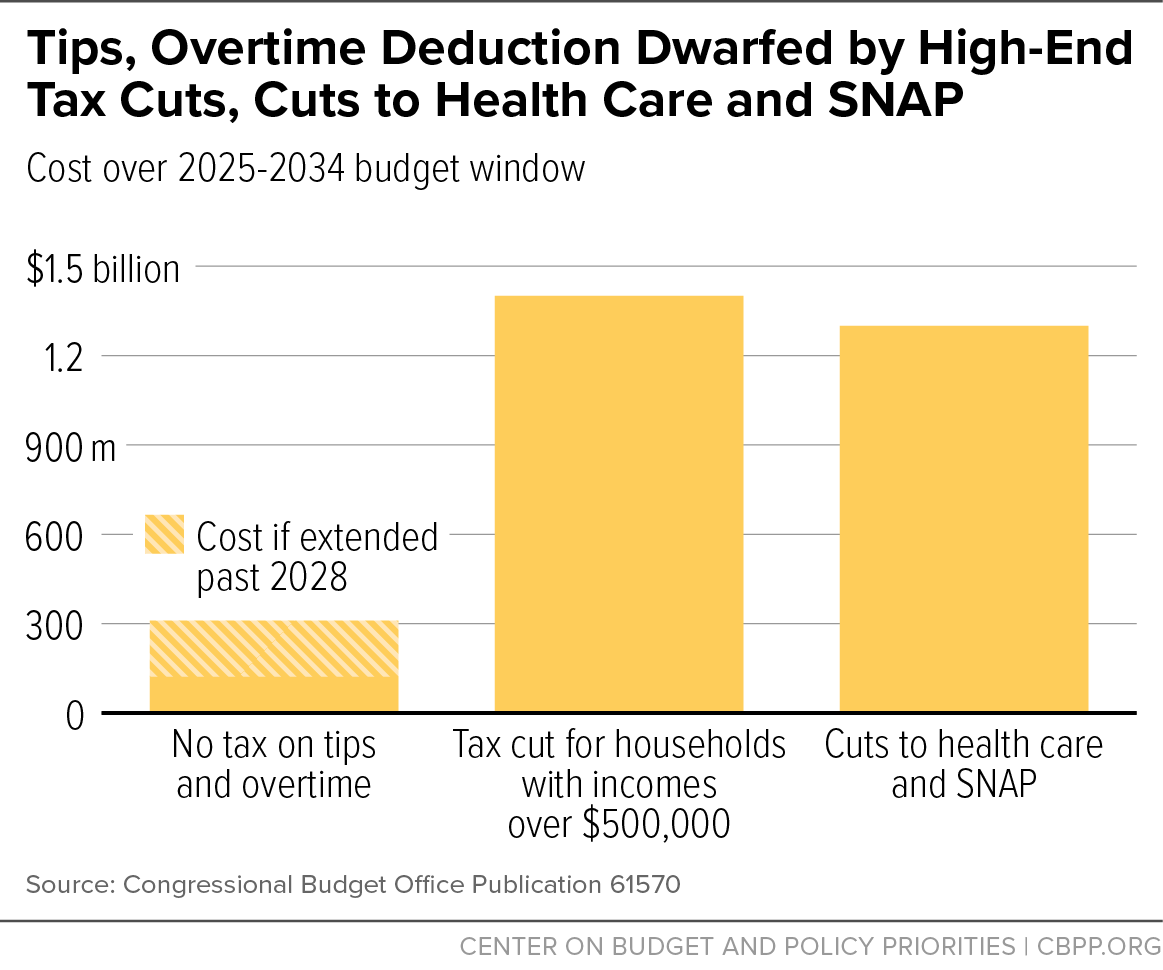
- Megabill’s tax cuts for the wealthy are far larger. Only about 3 percent of households receive the deduction for tipped income and only 9 percent will receive the deduction for overtime pay, the Tax Policy Center estimates.[2] The combined cost of the provisions, which are in effect only through 2028, is $122 billion[3] – or about 3 percent of the total cost of the new law’s tax cuts through 2034. Even if Congress extended these deductions through 2034, they would still cost just a fraction ($300 billion) of the law’s $1.4 trillion in tax cuts for households making over $500,000 or its $1.3 trillion in cuts to health care and nutrition assistance.
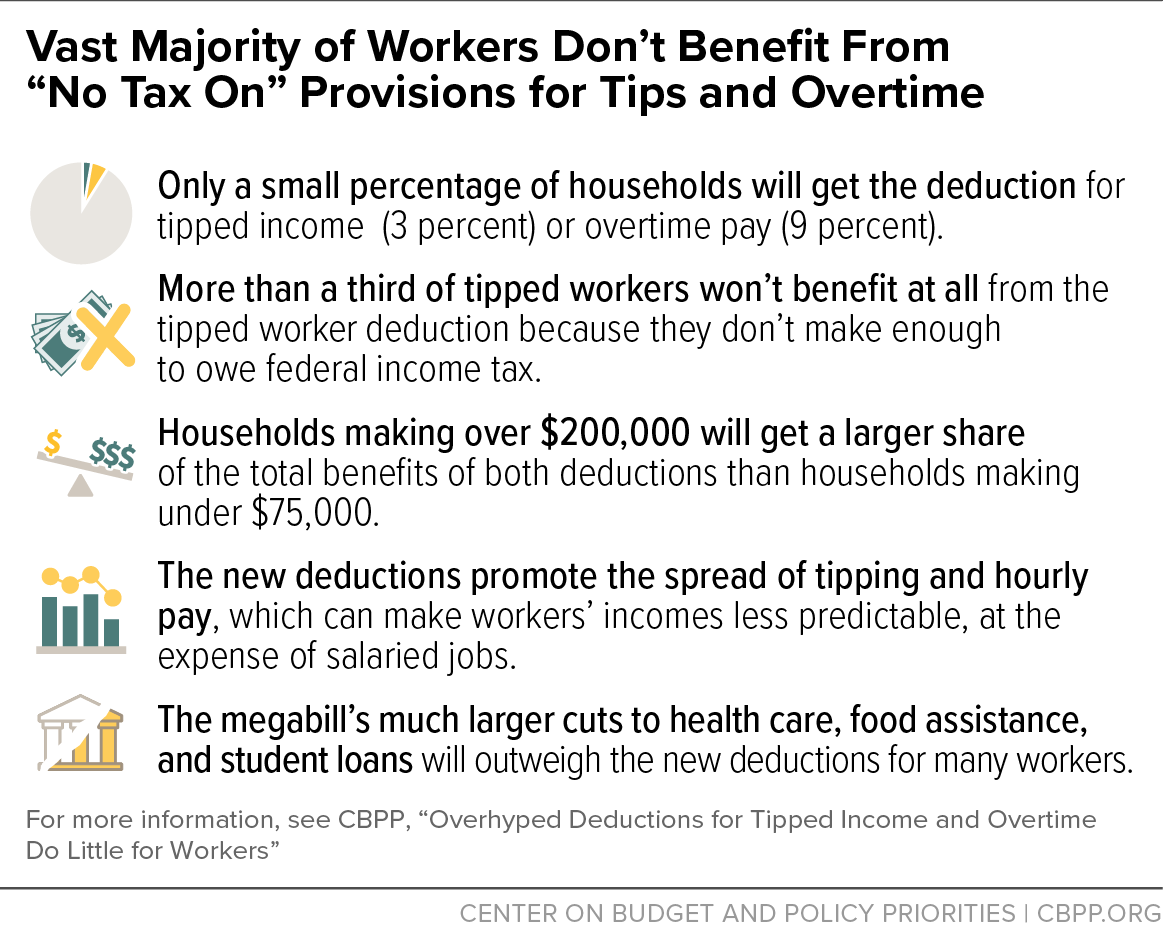
Tip and overtime deductions are poorly targeted. The Administration describes these provisions as working-class tax cuts, but because they are structured as income tax deductions, they are largely ineffective at helping low- and moderate-income households. For instance, over one-third of tipped workers make less than the standard deduction, which is the amount ($15,750 for singles and $31,500 for married couples in 2025) that households need to earn to receive any benefit from income tax deductions. None of these workers will get even a dollar of benefit from the tipped worker deduction because they owe no federal income tax without the deduction.
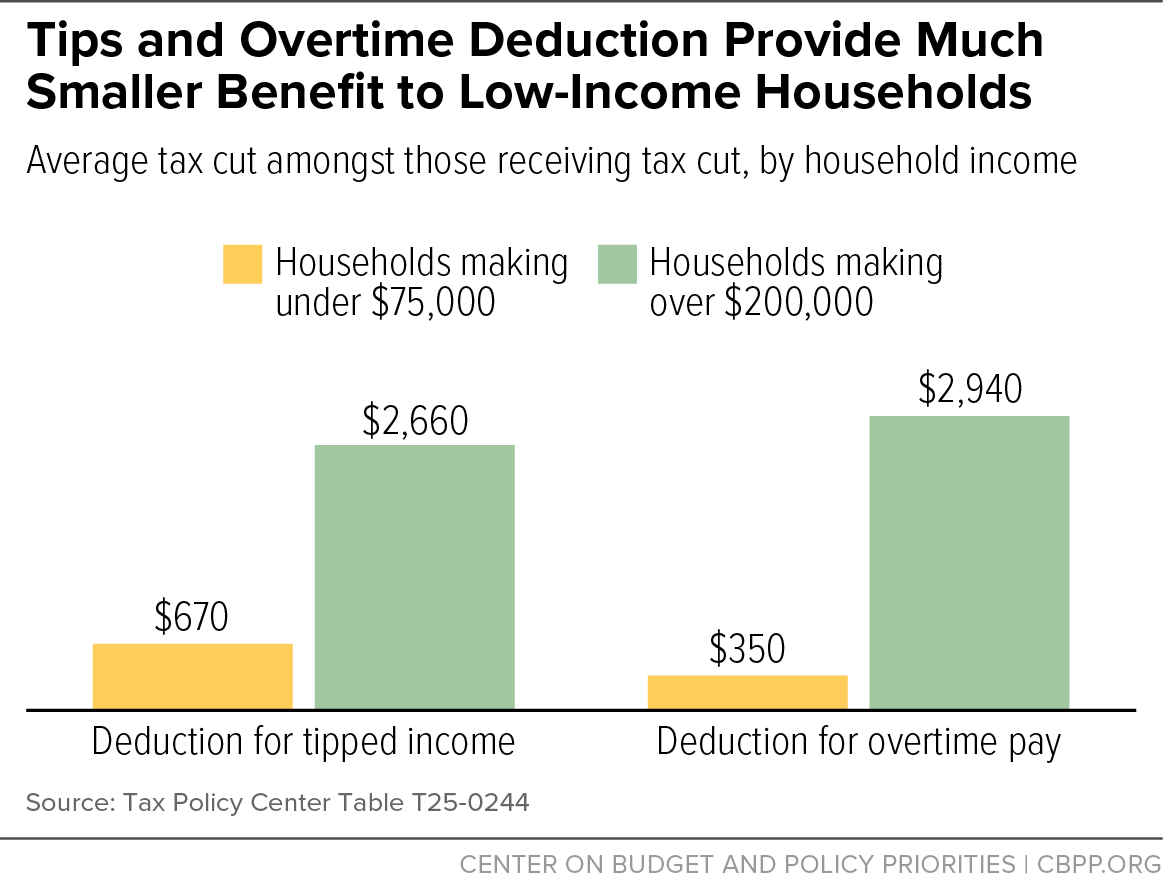
Even for the workers who will receive these deductions, the benefits are skewed to those with higher incomes, who receive a larger tax benefit for each dollar they deduct because they are in higher income tax brackets. Among households receiving the tipped income deduction, those making over $200,000 will receive an average benefit of $2,660 a year, or about four times the $670 average benefit for those making under $75,000. The overtime deduction is even more skewed: households receiving the deduction with income over $200,000 will get six times as much on average as households making under $75,000.[4]
- Other megabill provisions will hurt workers. Even for workers who receive a modest tax cut from the deductions, the megabill’s cuts to health care, nutrition assistance, and student loans may be larger. The megabill cuts over $1 trillion from Medicaid and Affordable Care Act marketplace coverage, for example, and it cuts SNAP by $187 billion or about 20 percent.[5] Workers also face a tax increase due to the Administration’s unilateral tariffs.
- Design of deductions is flawed. The deductions benefit some workers but not others who are similarly situated. There is no policy rationale for taxing janitors more heavily than tipped waiters earning the same amount. Similarly, there is no rationale for providing a tax break for someone who works 45 hours one week (including overtime) and 35 hours the next week but not for someone who works 40 hours both weeks.
This unequal treatment is not only unfair but makes the tax code and the economy less efficient, since workers will prefer jobs where they can take advantage of these deductions over jobs where they cannot. These deductions also could promote the spread of tipping and hourly pay at the expense of salaried jobs.
Policymakers should repeal these provisions or, at a minimum, allow them to expire on schedule after 2028. They also should resist any effort to expand special tax breaks for certain types of income or certain types of workers. Far better tax policy alternatives are available to bolster the incomes of households with low and moderate incomes.
“No Tax On” Provisions Are Minor Part of Republican Megabill
The Administration has repeatedly highlighted the megabill’s deductions for tipped income and overtime pay. For example, an August White House factsheet on the Administration’s first 200 days put these provisions as the top item in its list of fulfilled campaign promises; they were one of only two parts of the megabill mentioned (the other was missile defense).[6] Similarly, the Administration’s Labor Day factsheet’s discussion of the megabill put them as the first two provisions mentioned after statistics on the size of the tax cuts.[7]
Nevertheless, these provisions — which are only in effect through 2028 — are dwarfed by the new law’s permanent tax cuts for the wealthy. (See Figure 1.) The deduction for tipped income costs $32 billion and the deduction for overtime pay costs $90 billion through 2028.[8] Their combined cost of $122 billion makes up less than 3 percent of the $4.5 trillion in tax cuts in the megabill over ten years. In contrast, the 20 percent deduction for pass-through businesses, which primarily benefits millionaires, costs $737 billion over ten years, or 16 percent of the tax cuts’ cost.[9]

The tax cuts for households making over $500,000, as well as the cuts to health care and nutrition assistance, come in at $1.4 and $1.3 trillion respectively, or more than ten times larger than these two deductions. Even if these provisions were extended after 2028, their ten-year cost would amount to about $300 billion — a sizable amount, but still far smaller than the tax cuts for the wealthy.[10]
These provisions also do not benefit the vast majority of workers. The tipped income deduction will benefit fewer than 3 percent of households and the overtime pay deduction fewer than 9 percent, the Tax Policy Center estimates.[11] (See Figure 2; the share claiming the overtime deduction this filing season has been higher than expected, as discussed below.) By contrast, 12 percent of people receive food assistance through SNAP — all of whom will see their benefits cut due to the megabill, now or in the future.[12]

Income Tax Deductions Are Flawed Way to Help Workers
The Administration has used the new deductions to argue that the megabill helps working-class Americans, but income tax deductions are a particularly ineffective way of reaching these workers. The benefit of an income tax deduction is directly tied to someone’s marginal tax rate. For example, someone in the 22 percent tax bracket (with adjusted gross income of $128,000 to $238,000 for a married couple in 2025) gets a 22 cent tax cut for each dollar deducted, while someone in the 10 percent tax bracket (adjusted gross income of $31,000 to $55,000 for a married couple in 2025) gets just 10 cents. And most importantly, given the difficulty of meeting basic needs on a very low income — someone in the 0 percent bracket (adjusted gross income up to $15,750 for singles and $31,500 for married couples in 2025) doesn’t benefit from the deduction at all.
Thus, the ability of income tax deductions to help low-wage workers is limited. Over one-third of tipped workers make less than the standard deduction, so they get no benefit from the tipped income deduction.[13] Moreover, a single parent with two children making up to about $35,000 (and a married couple with two children making up to around $40,000) similarly receive no benefit because each dollar of tax cut from the deduction reduces their Child Tax Credit by a dollar.[14]
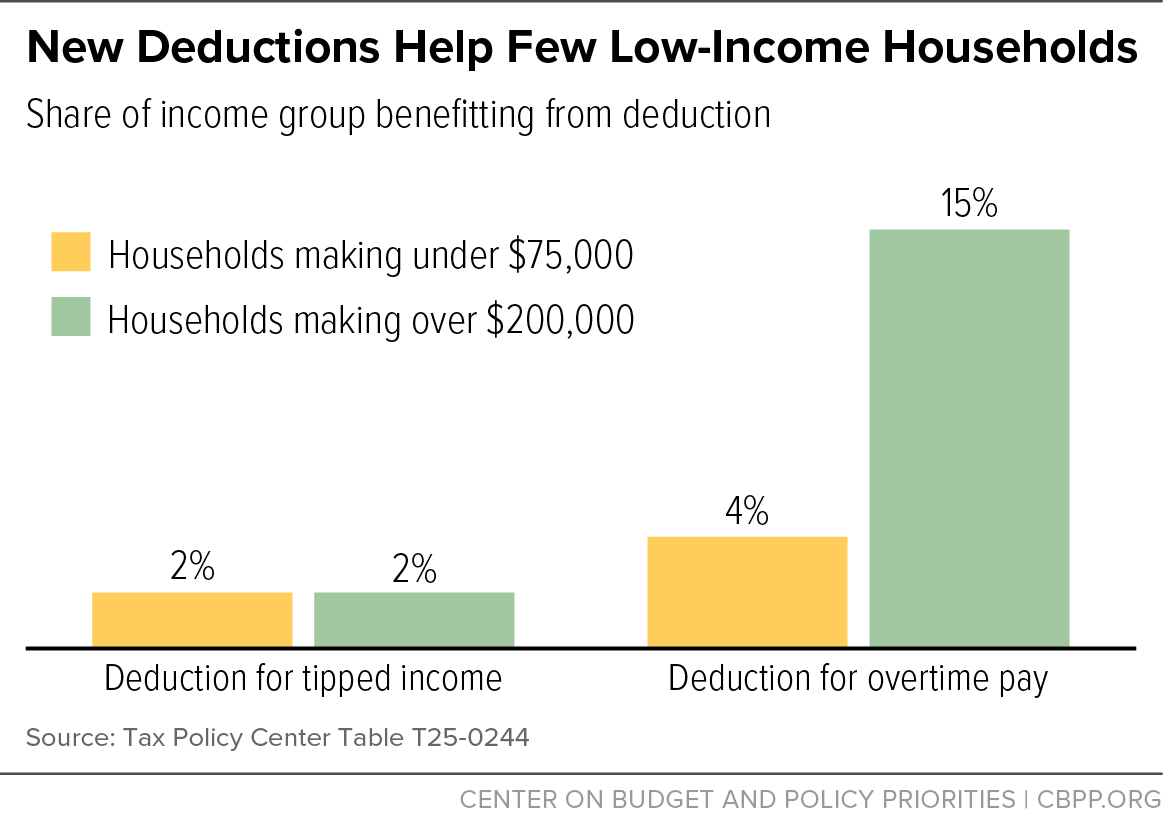
These ostensibly working-class deductions, therefore, do less for low-wage workers and more for high-wage workers than advertised. Roughly the same small share of households making under $75,000 (2.2 percent) and those making over $200,000 (2.1 percent) will benefit from the deduction for tipped workers, according to the Tax Policy Center. But among households claiming the deduction, the lower-income group will benefit much less: those making under $75,000 will receive about $670 per year, compared to $2,660 — or about four times as much — for those making over $200,000. (See Figure 3.) This is partly because those with higher incomes receive a larger benefit for each dollar they deduct, as noted above.[15]

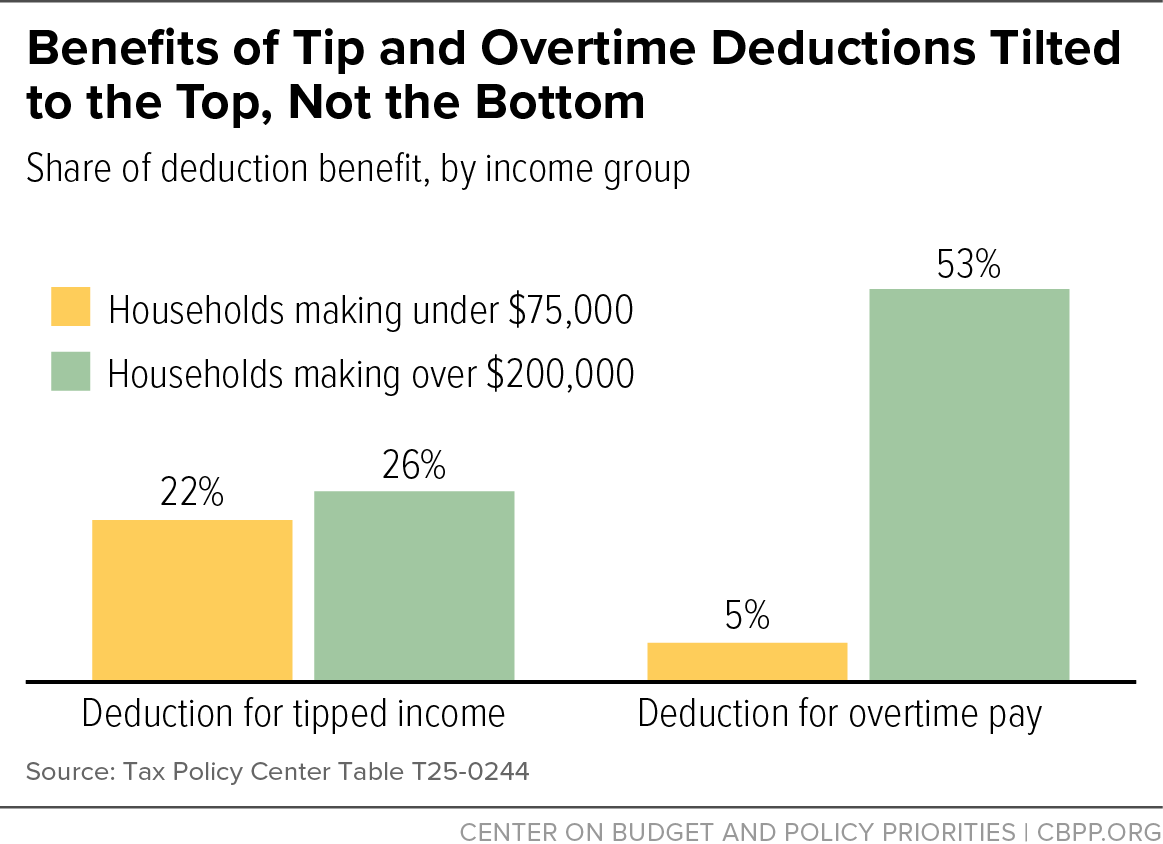
In fact, households making under $75,000 will receive a smaller share of the overall benefits of the deduction (22 percent) than households making over $200,000 (26 percent), even though the deduction phases out for single and married filers with incomes over $150,000 and $300,000, respectively, because income tax deductions are by their nature so top-tilted. (See Figure 4.)

The benefits of the overtime deduction are even more lopsided. Roughly 4 percent of households making under $75,000 will claim the deduction, compared to 15 percent of households making over $200,000. Also, among households claiming the deduction, the average benefit is just $350 a year for those making under $75,000, compared to $2,940 – more than eight times as much — for households making over $200,000.[16] Households making under $75,000 will receive only 5 percent of the overall benefits from the deduction, while more than half of the benefits will go to households making over $200,000, despite the same income limits described above for tipped income. (See Figure 5.)

Filing statistics this April show a higher number of filers claiming the overtime deduction than some analysts projected when it was enacted. The Treasury Department waived employer reporting requirements for employers for tax year 2025 (but not for future years). Filers who lack accurate reporting of their overtime pay that qualifies for the deduction may inaccurately claim the tax benefit, either inadvertently or intentionally. This is one of multiple potential explanations for the higher number of claims, reported The Wall Street Journal.[17]
Megabill Will Hurt Many of the Workers It Claims to Help
Unlike the 2017 tax law, which established most of the tax cuts made permanent by the megabill, the megabill also includes enormous cuts and other changes to health care, nutrition assistance, and student loans, in addition to tax provisions. The Trump Administration has trumpeted megabill provisions that will help a tiny sliver of workers but doesn’t talk about the many ways the non-tax provisions will harm those very workers. In addition, a larger number of low-income people will experience those cuts, without even the paltry benefits of the new deductions, than will benefit from the new deductions. And the Administration’s sweeping tariffs — which the President has claimed will help offset the cost of the megabill — will cost even the lowest-income households thousands of dollars.[18]
Policymakers have tried-and-true ways to benefit broad swaths of low-paid workers, such as expanding the Earned Income Tax Credit and making more of the Child Tax Credit available to these workers. This approach can provide greater benefits to low-paid workers with income from tips or overtime, to say nothing of other low-paid workers.
Consider the following examples:
A North Carolina parent of two teens over age 13 works full-time as a waiter, earning $30,000: $20,000 in tips and $10,000 in wages. She receives no benefit from the tipped income deduction. While the deduction lowers her taxable income and thus her tax liability before taking tax credits into account, each dollar of reduction in her pre-tax-credit tax liability is offset by a dollar reduction in her Child Tax Credit. The result is she is no better off financially.
Moreover, while her family receives health coverage through Medicaid (North Carolina is an expansion state), because her children are over 13 she is subject to the megabill’s new Medicaid work requirement. If she loses her job, is given too few hours in a particular month than is required by the work requirement because business is slow, or encounters paperwork issues, she could lose Medicaid coverage; she would not be eligible to re-enroll in Medicaid until she could prove she met the work requirement again. And even if she satisfies the work requirement, she might still lose coverage due to increased red tape from the twice-yearly eligibility redeterminations required by the megabill. Those same situations could also cut her off from SNAP after only three months, reducing the food assistance her family receives. (Her children would still qualify for SNAP.)
There are far better ways to support families like this one. In 2024, 169 House Republicans voted for legislation championed by House Ways and Means Chair Jason Smith and Senate Finance Committee Chair Ron Wyden that would have increased the Child Tax Credit for most of the children whose families currently receive less than the full credit (like this family) because their families’ earnings are too low. Enacting those improvements to refundability with the current $2,200 per-child credit would increase her income by $360.[19] The annual cost of all of the Wyden-Smith CTC improvements (about $30 billion over three years) is roughly similar to the tipped income deduction.[20]
A young adult in Nevada who cares for his ailing parent works as a bartender but gets irregular hours due to the tourism slump in Las Vegas.[21] He makes $14,000 annually, $12,000 of it from tips. He receives no benefit from the tipped income deduction because his income is too low.
He receives health coverage through Medicaid (Nevada is an expansion state and covers single adults with low incomes), but he could lose Medicaid due to the new work requirement if he gets too few hours of work in a month to meet the work requirement. Like the North Carolina parent discussed above, he would not be eligible to re-enroll until he could prove he met the work requirement, and even if he satisfies the work requirement, he could lose coverage due to red tape from twice-yearly redeterminations.
The unemployment rate in Clark County, where he lives, is above 5 percent but does not qualify for a waiver of SNAP's harsh work requirement under the new rules established by the megabill. Thus, he will be cut off SNAP after three months if he can't consistently document enough work hours. The county’s unemployment rate also fails to satisfy the work requirement exemptions for Medicaid.
By contrast, restoring the expansion of the Earned Income Tax Credit that was part of the 2021 American Rescue Plan (adjusted for inflation) would boost his income by roughly $1,400.
A home health aide makes about $32,000; she receives a $13 hourly wage and works 45 hours a week, so she also receives five hours of overtime pay per week. She can deduct $1,700 in overtime wages, which gives her a $200 annual tax cut.
Her employer does not provide health care benefits, so she buys insurance through the Affordable Care Act marketplace. Her premiums will rise by almost $1,500 in 2026 because of the expiration of the premium tax credit improvements at the end of 2025.[22]
A single hairdresser makes $32,000 annually, with $6,000 of it coming from tips. She receives about a $700 tax cut from the tipped income deduction. Like the home health aide example above, her employer does not provide health care benefits so she buys insurance through the Affordable Care Act marketplace, and her premiums rose by almost $1,500 in 2026 because of the expiration of the premium tax credit improvements.
Moreover, under the megabill’s new student loan repayment program, she will pay $960 more in student loans from beauty school when she finishes at the end of this year than she would have owed under the Saving on a Valuable Education (SAVE) Plan, which the law eliminates.[23]
New Deductions Introduce Distortions to Tax Code and Economy
The tip and overtime provisions also make the tax code less fair and less efficient. A well-recognized attribute of good tax policy is “horizontal equity,” meaning that two households (with a similar number of adults and children) making the same amount of income should pay a similar tax rate.[24] The new exemptions violate this principle since they only benefit narrow categories of workers.
This is not only unfair but also creates incentives that distort our economy. An effective tax code raises sufficient revenue while minimizing incentives for people or businesses to change their behavior solely for tax reasons except when this is necessary to address an issue that private markets do not account for, such as pollution.[25] But the new deductions do encourage workers to prefer certain jobs over others, without any policy rationale.
Even if the tipped income deduction was implemented in a narrow manner with few loopholes, it would create an incentive for workers to prefer employment in tipped occupations over non-tipped ones, since the after-tax pay of a tipped work with the same pre-tax compensation would now be higher. It is difficult to think of a reason why public policy should encourage workers to move from non-tipped to tipped occupations.
Similarly, the deduction for overtime pay is limited to workers who qualify for overtime under federal overtime statutes and regulations, which exclude specific occupations such as teachers and executive assistants. They also exclude salaried employees making over $684 a week (about $35,000 annually) while including hourly employees making up to $107,432 annually. The deduction, therefore, discourages workers from entering certain occupations and encourages them to seek out hourly instead of salaried work. Moreover, the deduction actually encourages unstable schedules since someone who works 45 hours one week and 35 hours the next will receive a tax cut while someone who works 40 hours for two weeks will not.
These tax incentives can also distort how employees get paid. The deduction for tipped income, for example, only applies to occupations that were customarily and normally tipped at the end of 2024; the megabill instructs Treasury to draw up a list. Treasury’s preliminary list of professions, issued in September, is extraordinarily broad, covering not just occupations like waiters and bartenders but digital content creators, hotel clerks, home repair workers, and delivery truck drivers, where some tipping may exist but is rare.[26] An analysis by the Budget Lab at Yale found that occupations eligible for the deduction include home cleaners (who currently derive 0.7 percent of their compensation from tips), home landscapers (0.4 percent), home electricians (0.01 percent), home maintenance and repair workers (0.005 percent), and home plumbers (0.002 percent).[27] This generates a new incentive for these occupations to shift toward a tipping model, in which employers provide only a minimal wage and expect employees to supplement it with substantial tips.
Similarly, employers could shift more jobs from salaried to hourly, making more workers eligible for overtime pay, but also reduce base hourly wages while providing consistent overtime — enabling workers to increase their earnings (thanks to the new deduction) without increasing employer costs. Thus, the deduction provides a tax incentive for employers and employees to restructure their compensation structures only to reap benefits from the tax code, not for a business- or worker-centered reason.
There is no gain in economic efficiency for people to pay home repair workers in tips (indeed, it creates far more uncertainty for both consumers about what a service costs and for workers about what they will earn) or for many salaried occupations to be paid on an hourly basis. Yet the tax code will now encourage businesses and workers to change their behavior and occupational choices to maximize the tax savings. And in both cases, the tax code will encourage employment arrangements in which workers’ earnings are more volatile (since customers can choose how much to tip and hourly wage compensation is less stable than salaried).
Policymakers could try to address these horizontal equity issues by expanding the new deductions to cover more types of pay or occupations, but this would dramatically increase their fiscal cost. Some may even try to get around them by exempting vast swaths of middle-income taxpayers from income taxes entirely, as recent proposals by Senators Van Hollen and Booker have done. The megabill already makes the U.S. fiscal trajectory even more unsustainable, adding $3.4 trillion to deficits over ten years. Increasing the cost of those deductions or exempting large shares of middle-income households from income taxes would simply add to the damage from the costly megabill tax cuts and could crowd out potential positive policy changes, such as repealing President Trump’s regressive tariffs and cuts to Medicaid and SNAP or reinstating the premium tax credit improvements.
End Notes
[1] Brendan Duke, “Republican Megabill Trades Essential Support to Low-Income People for Skewed Tax Cuts,” CBPP, February 3, 2026, https://www.cbpp.org/research/federal-tax/republican-megabill-trades-essential-support-to-low-income-people-for-skewed.
[2] Tax Policy Center (TPC), “Preliminary Estimates of Tax Benefits of Deductions for Tips and Overtime,” July 31, 2025, https://taxpolicycenter.org/tax-model-analysis/preliminary-estimates-tax-benefits-deductions-tips-and-overtime. For data, see the accompanying tables T25-0244 and T25-0246.
[3] Joint Committee on Taxation (JCT), “Estimated Revenue Effects Of A Manager’s Amendment To The Tax Provisions To Provide Reconciliation Of The Fiscal Year 2025 Budget In The Senate Relative To Present Law,” JCX-31-25, June 28, 2025, https://www.jct.gov/publications/2025/jcx-31-25/.
[4] TPC, op. cit.
[5] See the following CBPP policy briefs: “By the Numbers: Harmful Republican Megabill Will Take Health Coverage Away From Millions of People and Raise Families’ Costs,” updated August 27, 2025, https://www.cbpp.org/research/health/by-the-numbers-harmful-republican-megabill-will-take-health-coverage-away-from; “By the Numbers: Harmful Republican Megabill Takes Food Assistance Away From Millions of People,” August 14, 2025, https://www.cbpp.org/research/food-assistance/by-the-numbers-harmful-republican-megabill-takes-food-assistance-away-from.
[6] White House, “200 Days of Winning: President Trump Is Keeping His Promises,” August 7, 2025, https://www.whitehouse.gov/articles/2025/08/200-days-of-winning-president-trump-is-keeping-his-promises/.
[7] White House, “President Trump Is Delivering for American Workers,” September 1, 2025, https://www.whitehouse.gov/articles/2025/09/president-trump-is-delivering-for-american-workers/.
[8] JCT, op. cit.
[9] Congressional Budget Office (CBO), “Effects on Deficits and the Debt of Public Law 119-21 and of Making Certain Tax Policies in the Act Permanent,” August 4, 2025, https://www.cbo.gov/system/files/2025-08/61466-DebtService.pdf.
[10] CBPP calculations using JCT tables JCX-35-25 and JCX-37-25. JCT numbers are adjusted to incorporate the impact of the estate tax cut using TPC tables T25-0042 and T22-01-01. SNAP and health coverage numbers from CBO, “Estimated Budgetary Effects of Public Law 119-21, to Provide for Reconciliation Pursuant to Title II of H. Con. Res. 14, Relative to CBO’s January 2025 Baseline,” July 21, 2025, https://www.cbo.gov/publication/61570.
[11] TPC, op. cit.
[12] Over time, the new law will shrink food assistance for all 40 million SNAP participants by restricting future updates to the Thrifty Food Plan, the basis for SNAP benefits. CBO estimates that SNAP households’ average benefit will be about $14 per month lower by 2034 as a result. CBPP, “Harmful Republican Megabill,” op. cit.
[13] Ernie Tedeschi, “The ‘No Tax on Tips Act’: Background on Tipped Workers,” Budget Lab at Yale, June 24, 2024, https://budgetlab.yale.edu/news/240624/no-tax-tips-act-background-tipped-workers.
[14] The full Child Tax Credit for 2025 is $2,200 per child, but families can only receive up to $1,700 per child as a refund; the remaining $500 per child can only be used to reduce their federal income tax liability. To get the full $2,200 credit, therefore, a family must have at least $500 of income tax liability per child. For families whose income exceeds the standard deduction but whose federal income tax liability is less than $500 per child, any reduction in their income tax liability due to the new deductions for tipped and overtime income results in a same-sized reduction in the non-refundable portion of their Child Tax Credit, effectively leaving the family no better off.
[15] The average benefit for all households with incomes under $75,000 is only $13 because so few households benefit. For all households with income over $200,000, the average benefit is $25, almost twice as much.
[16] The average benefit for all households making under $75,000 is just $10, while the average benefit for all households making over $200,000 is $180.
[17] Richard Rubin and Ashlea Ebeling, “Workers Are Claiming ‘No Tax on Overtime’—Maybe a Bit Too Much,” Wall Street Journal, April 4, 2026, https://www.wsj.com/personal-finance/taxes/overtime-tax-policy-deduction-claims-ba23d21a.
[18] Budget Lab at Yale, “State of U.S. Tariffs: January 19, 2026,” January 19, 2026, https://budgetlab.yale.edu/research/state-us-tariffs-january-19-2026.
[19] The legislation's improvements to the refundable portion of the credit include phasing in the credit on a per-child basis and eliminating the refundability cap by 2025. This figure applies those improvements to the current Child Tax Credit maximum amount of $2,200.
[20] JCT, “Estimated Revenue Effects Of H.R. 7024, The ‘Tax Relief For American Families and Workers Act of 2024,’ Scheduled For Markup By The Committee on Ways And Means On January 19, 2024,” January 17, 2024, https://www.jct.gov/publications/2024/jcx-3-24/.
[21] Steve Wolford, “Las Vegas hospitality workers face challenges amid visitor slump,” news3lv.com, January 12, 2026, https://news3lv.com/news/local/las-vegas-hospitality-workers-face-challenges-amid-visitor-slump.
[22] This is the national average for a 45-year-old buying individual coverage. Gideon Lukens and Elizabeth Zhang, “Health Insurance Premium Spikes Imminent as Tax Credit Enhancements Set to Expire,” CBPP, November 3, 2025, https://www.cbpp.org/research/health/health-insurance-premium-spikes-imminent-as-tax-credit-enhancements-set-to-expire.
[23] Michele Zampini, “How the Reconciliation Law Changes the Federal Student Loan Repayment System,” Institute for College Access and Success, July 24, 2025, https://ticas.org/affordability-2/reconciliation-2025-student-loans/.
[24] See Richard A. Musgrave, "Horizontal Equity, Once More," National Tax Journal, Vol. 43, No. 2, 1990.
[25] See, for example U.S. Treasury, “Tax Reform for Fairness, Simplicity, and Economic Growth,” November 1984, p. 13, https://home.treasury.gov/system/files/131/Report-Tax-Reform-v1-1984.pdf.
[26] Jordan Weissmann, “No, Mr. President, I will not tip my plumber,” The Argument, September 15, 2025, https://www.theargumentmag.com/p/no-mr-president-i-will-not-tip-my.
[27] Internal Revenue Service, “Occupations That Customarily and Regularly Received Tips; Definition of Qualified Tips,” September 22, 2025, https://www.federalregister.gov/documents/2025/09/22/2025-18278/occupations-that-customarily-and-regularly-received-tips-definition-of-qualified-tips.