

Three Strikes Against Filers This Tax Season: IRS Cuts, No Direct File, Skewed Tax Code Changes
A strong federal tax system can be a foundation for policies that expand opportunity, promote fairness, and foster broadly shared success. But it requires a modern, well-resourced infrastructure that helps filers navigate the system and collects the taxes that are legally owed. Recent policy choices by the Trump Administration and congressional Republicans have made the tax system less effective at fulfilling those core functions, which means filers already have three strikes against them when they prepare their taxes this year. Those policy choices include:
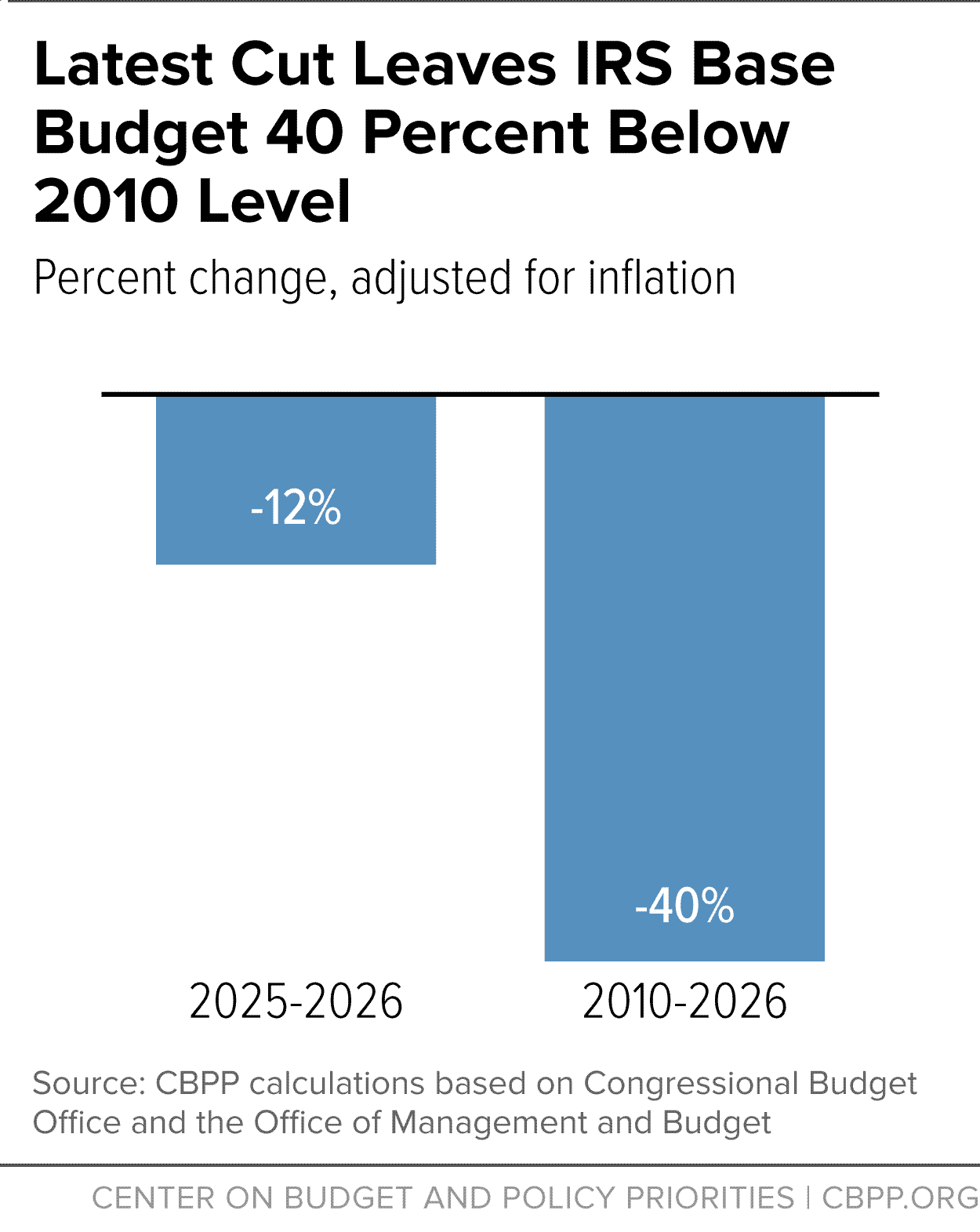
- Cutting IRS funding and staff. Congress recently passed a fiscal year 2026 appropriations package that cut $1.1 billion from the IRS’s annual budget and rescinded most of the remaining multiyear funding Congress provided in the 2022 Inflation Reduction Act (IRA) to rebuild the agency after a decade of Republican-led cuts. The base IRS budget is now 40 percent below its 2010 level, after adjusting for inflation, and the Trump Administration’s new budget proposes to cut the agency’s funding in 2027 even further. Budget cuts, plus a large decline in staffing (27 percent in just the past year), weaken the agency’s ability to do essential work like answering filers’ questions and auditing complex high-income returns.
- Eliminating the IRS’s free tax filing program, Direct File. The Trump Administration’s decision to end Direct File, the IRS’s free electronic filing tool, will make tax filing harder and more costly for many households with low or moderate incomes. These filers will now have to rely on commercial tax preparation companies or hire a paid tax preparer.
- Enacting huge tax cuts skewed to the wealthy, alongside damaging cuts for other households. High-income and high-wealth households will enjoy new tax windfalls this filing season from last year’s harmful Republican megabill (H.R. 1), which gave them disproportionately large tax breaks. Households with low or moderate incomes will receive far less. The new law, for example, leaves out 19 million children from the full $2,200 Child Tax Credit because their families’ incomes are too low. On top of potential IRS delays and other filing challenges, these families also face acute affordability challenges from rising prices and the massive cuts in health care and food assistance the megabill imposed to partly offset the large cost of its tax cuts.
Taken together, these policy choices threaten to undermine the integrity of the tax system. Many households — especially those with low or moderate incomes — will likely find it more difficult to quickly and easily file their tax returns and get their questions answered. Meanwhile, the underfunded and understaffed IRS is less able to enforce the nation’s tax laws and collect tax revenue, especially from high-income households and owners of profitable, complex businesses.
Cuts in Funding and Staff Imperil IRS’s Ability to Perform Basic Functions
The IRS needs adequate resources, particularly funding and staff, to do its job — collecting the revenue needed to fund public services while serving taxpayers. But funding cuts and other actions by the Trump Administration and congressional Republicans have left the IRS grappling with severe funding and staffing cuts, leadership turmoil, and outdated technology. As a result, the IRS is ill-equipped to provide the customer service taxpayers deserve or to enforce the nation’s tax laws.

After a decade of Republican-driven budget cuts from 2011 to 2020 that led to deep staffing cuts, plummeting audit rates, and dysfunction across the IRS, the IRA included nearly $80 billion in funding over ten years to supplement the IRS’s base budget and finance a multiyear rebuilding effort.[1] That funding was designed to improve tax compliance and increase tax collections, primarily from high-income households, while also improving customer service for all filers and supporting long-overdue technology upgrades.
The IRS used this new funding to make tangible improvements in tax filers’ experience — improving phone service, serving more filers in person by opening or reopening Taxpayer Assistance Centers, and improving communication with filers via website upgrades. (The IRS also piloted the Direct File program, described below.)[2] Nevertheless, congressional Republicans have once again targeted the IRS for cuts. Through a series of rescissions, lawmakers repealed $53.8 billion of the original $80 billion that was supposed to last through 2031, leaving less than $10 billion remaining after accounting for the funds obligated through fiscal year 2025.[3]
Compounding this problem, the IRS’s base budget was frozen in nominal (non-inflation-adjusted) terms from 2022 through 2025. And the recently passed 2026 appropriations bill included the largest-ever cut to IRS base funding — 12 percent or $1.1 billion — primarily affecting enforcement and operations support. The IRS base budget is now 40 percent below its 2010 level, after adjusting for inflation. (See Figure 1.)
The funding cuts, combined with the Trump Administration’s attacks on the federal workforce, have drastically reduced staff levels: the number of IRS staff has fallen by 27 percent in the past year.[4]
Weakening Customer Service
These funding and staff cuts have important consequences for taxpayer service this filing season. The Treasury Inspector General for Tax Administration (TIGTA) has warned that staff shortages may lead to slower refund processing and fewer resources for taxpayer help, such as in-person assistance.[5]
The number of unprocessed tax returns and other correspondence continues to grow and is now more than twice pre-pandemic levels.[6] Efforts to use technology upgrades to digitize paper returns and speed processing are behind schedule, in part due to staff shortages, according to TIGTA.[7]
The IRS typically brings on temporary customer service staff during filing season, but in January the agency was far behind its targets, hiring only 20 percent of the 2,200 customer service workers it sought.[8] To try to compensate for staff shortages during filing season, the IRS took the unusual step of reassigning staff with little or no relevant experience — including those in the human resources and IT departments — to answer phones and process tax returns.[9]
These reassignments, however, are unlikely to fix the problem. Reassigned workers must complete a 12-week training that won’t be complete until after April 15 — too late to help with the main filing season rush.[10] The IRS has lowered its goal for phone service this filing season, aiming to answer just 70 percent of incoming calls (down from 85 percent in 2025).[11] This means many more taxpayers will fail to get their questions answered, and taxpayer errors will likely increase. “We’re just not able to provide timely service to people,” one IRS employee explained.[12]
Undermining Tax Enforcement
The gutting of the IRS is most apparent, however, in tax compliance and enforcement. For 2026, Congress cut the IRS enforcement budget by 8 percent, to the lowest level since 1988 after adjusting for inflation. These cuts will hinder the agency’s ability to administer the tax code and collect legally owed taxes — particularly from high-income and high-wealth taxpayers, who have more complex returns and can use sophisticated tax avoidance schemes to lower their taxes. The Trump Administration’s 2027 budget proposes to further cut the agency’s budget by $1.4 billion, with an 18 percent cut, or about $900 million, to enforcement.
Cutting the IRS enforcement budget is especially shortsighted; research shows that every dollar spent on IRS tax enforcement raises multiple dollars in revenue, which means that every dollar cut from IRS enforcement loses more than a dollar of revenue. (See Figure 2.)

The income of partnerships (like most investment funds and real estate businesses), for example, is heavily concentrated among high-income individuals but is especially hard to trace to specific individuals because of complicated, multi-layered ownership structures.[13] Yet fewer than 0.3 percent of large partnerships were audited in 2019, down from a still low 1.4 percent in 2007.[14] Even when audits do occur, IRS agents often lack the resources to conduct them adequately; audits frequently result in no change to the return because, for example, the statute of limitations runs out.[15]
While the Biden Administration initiated a plan to ramp up audits of large, complex partnerships like private equity funds, the Trump Administration has largely abandoned the effort.[16] This makes it even less likely that complex partnerships and their owners will pay what they legally owe.
Ending Direct File Raises Households’ Costs
On top of customer service issues at the IRS, the Trump Administration’s decision to end Direct File will make tax filing harder and more costly for many households with low or moderate incomes.
The IRA directed the IRS to commission an independent study of the feasibility of the government creating a free tax filing program. Based on the study’s results, the IRS developed and rolled out a pilot version in 2024, followed by an expanded version for 2025, with plans to continue expanding in later years. Direct File was the first electronic filing tool that gave filers a no-cost option to file their taxes directly through the IRS, instead of using outside tax preparation software or paying a private tax preparer.
Direct File showed that the government can effectively use technology to save tax filers time and money. Customer satisfaction with the new program was high, with 94 percent of Direct File users in 2025 describing their experience as “excellent” or “above average.”[17] The Government Accountability Office deemed the Direct File pilot a success and recommended that the IRS expand the tool to taxpayers in all states,[18] and TIGTA recommended continued expansions and improvements.[19]
Given these results, the Administration’s decision to end Direct File was a bewildering choice, particularly at a time when many low- and middle-income taxpayers are expressing serious concerns around affordability due to the rising cost of living. If Direct File were available this filing season, millions of households would now be eligible to file their taxes for free, without having to navigate a maze of complicated and potentially costly offerings by commercial tax preparation firms.
Instead of Direct File, Treasury has promoted the “Free File” program, through which tax prep companies offer limited services to certain tax filers for free. This program was widely criticized in the past for misleading filers so that they ended up paying to file their returns, despite being eligible to file for free. As ProPublica reported, for example, Intuit (the parent company of TurboTax) used special coding language to hide free products from search engine results,[20] and the Federal Trade Commission subsequently took action against Intuit for engaging in deceptive advertising practices.[21]
Without Direct File, taxpayers may also rely more heavily on paid tax preparers, most of whom are “unenrolled preparers” with no credential to indicate they have demonstrated competency in tax preparation. Unenrolled preparers frequently make mistakes,[22] leaving tax filers – many of whom work for low wages – to deal with the fallout: having to return money they don’t have, paying interest and penalties, or losing future access to tax credits they have otherwise earned.[23]
Tax-filing problems may be more common this year as filers and preparers struggle to understand the extensive changes in the tax code from the 2025 Republican megabill, such as the complicated new deductions for some tip and overtime income. Unlike households with high incomes, who can hire sophisticated tax advisors to help them claim and maximize their tax breaks, households with lower incomes may struggle to understand their eligibility or miss out on tax benefits they are entitled to.
Skewed Tax Cuts Make Tax System Less Fair
Even as many tax filers with low or moderate incomes will struggle with tax filing, high-income households will benefit from large new tax breaks from the megabill, one of the most regressive pieces of fiscal legislation in U.S. history.[24]
Large Tax Windfalls at the Top, Damaging Cuts for Other Households
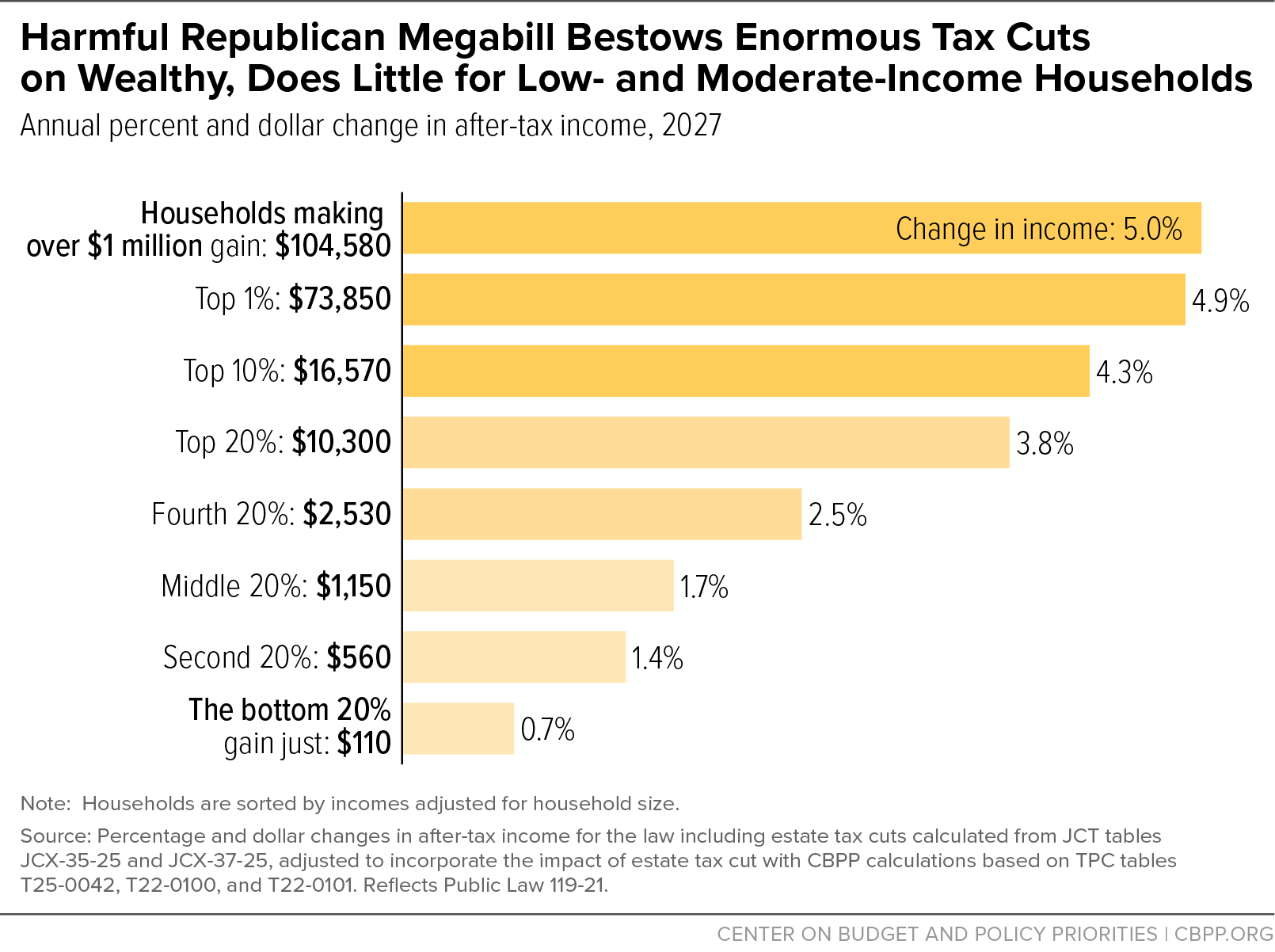
Under the megabill, the average household with $1 million or more in income will receive over $100,000 in tax breaks in 2027 (when the tax cuts are fully phased in), while the average household earning less than $50,000 will get about $250, or less than $1 a day. Measured as a share of after-tax income, the tax cuts will be more than three times as large for households with incomes in the top 1 percent than for households in the bottom 60 percent.[25] (See Figure 3.)


The core of the megabill’s $4.5 trillion in tax cuts is its extension of the individual income and estate tax provisions of the 2017 tax law that were scheduled to expire at the end of 2025. For example, the megabill extended the cut in the top individual income tax rate from 39.6 percent to 37 percent, which in 2025 applied only to incomes over $751,601 for married couples, and the 20 percent deduction for certain income that owners of pass-through businesses (partnerships, S corporations, and sole proprietorships) report on their individual tax returns.
These large extended tax cuts for high-income and high-wealth households come on top of the large benefits those households continue to receive from the 2017 law’s permanent corporate tax cuts.
The megabill also added $1.2 trillion in new tax cuts, which likewise are skewed in favor of wealthy households and corporations. They include a further cut in the estate tax that allows married couples to pass on $30 million to their heirs tax free. And the megabill reversed several business tax increases Republicans included in the 2017 tax law to partially offset the cost of the law’s large cut in the corporate tax rate – giving yet another windfall to corporate shareholders and adding around $700 billion to the law’s cost.[26]
While cutting taxes at the top, the megabill left out 19 million children from the full $2,200 Child Tax Credit because their families’ incomes are too low.[27] To partly offset the cost of its tax cuts, it imposed massive funding cuts that will take health coverage and food assistance away from millions of people, while singling out immigrants with lawful status and their families for particularly harsh restrictions.[28] And it failed to extend premium tax credit enhancements that provided vital help to households buying private health coverage through the marketplace, who now face mounting affordability challenges as a result.[29]
New Deductions Poorly Targeted, Overshadowed by Other Changes
Finally, the law’s tax deductions for certain tip and overtime income are some of the smallest provisions, in both cost and the number of people they affect. The deduction for tipped income costs $32 billion and the deduction for overtime pay costs $90 billion through 2028.[30] Their combined cost of $122 billion makes up less than 3 percent of the $4.5 trillion in tax cuts in the megabill over ten years. In contrast, the 20 percent deduction for pass-through businesses, which primarily benefits millionaires, costs $737 billion over ten years, or 16 percent of the tax cuts’ cost.[31]
These provisions also do not benefit the vast majority of workers. The tipped income deduction will benefit fewer than 3 percent of households and the overtime pay deduction fewer than 9 percent, the Tax Policy Center estimates.[32] Over one-third of tipped workers make less than the standard deduction, so they get no benefit from the tipped income deduction.[33]
As a whole, the megabill represents the greatest legislative transfer of resources from lower- to higher-income families in modern times. The end result of its tax cuts and spending cuts will be increased income inequality and economic hardship for millions of households that already face challenges today.[34]
End Notes
[1] Chuck Marr, Samantha Jacoby, and Jabari Cook, “Success of the IRS Rebuilding and Tax Gap Reduction Effort Depends on Sufficient Funding Through Annual Appropriations,” CBPP, December 7, 2022, https://www.cbpp.org/research/federal-tax/success-of-the-irs-rebuilding-and-tax-gap-reduction-effort-depends-on.
[2] Josephine Cureton, “On Tax Day, Reject DOGE-Led Cuts to the IRS Workforce and Budget,” CBPP, April 10, 2025, https://www.cbpp.org/blog/on-tax-day-reject-doge-led-cuts-to-the-irs-workforce-and-budget.
[3] IRS, “Fiscal Year 2026 Congressional Budget Justification & Annual Performance Report and Plan,” Table 1.2, https://www.irs.gov/pub/irs-pdf/p4450.pdf#page=7.
[4] Taxpayer Advocate Service, “National Taxpayer Advocate Annual Report to Congress: 2025,” January 26, 2026, https://www.taxpayeradvocate.irs.gov/reports/2025-annual-report-to-congress/full-report/.
[5] TIGTA, “The Internal Revenue Service’s Readiness for the 2026 Filing Season,” January 26, 2026, https://www.oversight.gov/sites/default/files/documents/reports/2026-01/2026400002_Readiness%20Memo_Final.pdf.
[6] Erin Shilling and Erin Slowey, “Backlogs, Job Holes Plague IRS in Tax Season After DOGE Cuts,” Bloomberg Tax, March 30, 2026, https://news.bloombergtax.com/daily-tax-report/backlogs-job-holes-plague-irs-in-tax-season-after-doge-cuts; TIGTA, “The Internal Revenue Service’s Readiness for the 2026 Filing Season,” January 26, 2026, https://www.oversight.gov/sites/default/files/documents/reports/2026-01/2026400002_Readiness%20Memo_Final.pdf.
[7] TIGTA, “The IRS Has Made Limited Progress Achieving Paperless Processing,” February 6, 2026, https://www.tigta.gov/sites/default/files/reports/2026-02/2026408003fr.pdf.
[8] Danny Nguyen, “IRS Suffering Filing-Season Shortfall After Layoffs, Watchdog Report Says,” Politico Pro, April 6, 2026, https://subscriber.politicopro.com/article/2026/04/irs-falls-short-of-filing-season-staffing-goals-report-says-00860634.
[9] Eric Katz, “‘Setting this agency up for failure’: Amid staffing crunch, IRS taps employees with no relevant experience to assist during filing season,” Government Executive, February 4, 2026, https://www.govexec.com/management/2026/02/setting-agency-failure-amid-staffing-crunch-irs-taps-employees-no-relevant-experience-assist-during-filing-season/411192/.
[10] Shilling and Slowey, op. cit.
[11] TIGTA, “The Internal Revenue Service’s Readiness for the 2026 Filing Season,” January 26, 2026, https://www.oversight.gov/sites/default/files/documents/reports/2026-01/2026400002_Readiness%20Memo_Final.pdf.
[12] Shilling and Slowey, op. cit.
[13] Michael Cooper et al., “Business in the United States: Who Owns It, and How Much Tax Do They Pay?” Tax Policy and the Economy, Vol. 30, June 2016, https://www.nber.org/books-and-chapters/tax-policy-and-economy-volume-30/business-united-states-who-owns-it-and-how-much-tax-do-they-pay.
[14] Government Accountability Office (GAO), “IRS Audit Processes Can Be Strengthened to Address a Growing Number of Large, Complex Partnerships,” July 2023, https://www.gao.gov/assets/gao-23-106020.pdf.
[15] Ibid.; Edward G. Fox, Zachary Liscow, and Michael Love, “The Case for Corporate Tax: Two Trends Make Pass-Through Taxation Harder to Defend,” Tax Policy Center, February 10, 2026, https://taxpolicycenter.org/taxvox/case-corporate-tax-two-trends-make-pass-through-taxation-harder-defend.
[16] Jesse Drucker, “Push to Audit Private Equity and Venture Capital Falters Under Trump,” New York Times, January 8, 2026, https://www.nytimes.com/2026/01/08/business/irs-private-equity-venture-capital-audits.html.
[17] IRS, “IRS Direct File: Filing Season 2025 Report,” May 13, 2025, https://taxpayer-rights.org/wp-content/uploads/2025/06/2025-14762.pdf.
[18] GAO, “IRS Successfully Piloted Online Tax Filing but Opportunities Exist to Expand Access,” December 2024, https://www.gao.gov/assets/gao-25-106933.pdf.
[19] TIGTA, “Inflation Reduction Act: Results of the Direct File Pilot,” March 20, 2025, https://www.tigta.gov/sites/default/files/reports/2025-08/2025408015fr.pdf.
[20] Justin Elliott and Paul Kiel, “Inside TurboTax’s 20-Year Fight to Stop Americans from Filing Their Taxes for Free,” ProPublica, October 17, 2019, https://www.propublica.org/article/inside-turbotax-20-year-fight-to-stop-americans-from-filing-their-taxes-for-free.
[21] Joe Hernandez, “The FTC Bars TurboTax Maker Intuit from Advertising ‘Deceptive’ Free Services,” NPR, January 23, 2024, https://www.npr.org/2024/01/23/1226291903/turbotax-intuit-ftc-free-services.
[22] Taxpayer Advocate Service, “National Taxpayer Advocate 2025 Purple Book,” Legislative Recommendation #4, December 31, 2024, https://www.taxpayeradvocate.irs.gov/wp-content/uploads/2024/12/ARC24_PurpleBook_02_ImproveFiling_4.pdf.
[23] John Wancheck, “IRS Needs Authority to Regulate Tax Return Preparers,” CBPP, May 5, 2021, https://www.cbpp.org/blog/irs-needs-authority-to-regulate-tax-return-preparers.
[24] Emily Badger, Alicia Parlapiano, and Margot Sanger-Katz, “Trump’s Big Bill Would Be More Regressive Than Any Major Law in Decades,” New York Times, June 12, 2025, https://www.nytimes.com/interactive/2025/06/12/upshot/gop-megabill-distribution-poor-rich.html.
[25] The bottom 60 percent of households will see an increase in after-tax income of 1.5 percent ($610), on average, in 2027 as a result of the tax cuts, compared to a 4.9 percent ($73,850) increase for those in the top 1 percent.
[26] Joint Committee on Taxation (JCT), JCX-35-25, July 1, 2025, https://www.jct.gov/publications/2025/jcx-35-25/.
[27] Samantha Jacoby , Chuck Marr, and Kris Cox, “Republican Megabill Tax Provisions Are Skewed to the Rich, Fail to Deliver for Families, and Are Fiscally Irresponsible,” CBPP, December 17, 2025, https://www.cbpp.org/research/federal-tax/republican-megabill-tax-provisions-are-skewed-to-the-rich-fail-to-deliver-for.
[28] Brendan Duke, “Republican Megabill Trades Essential Support to Low-Income People for Skewed Tax Cuts,” CBPP, updated February 11, 2026, https://www.cbpp.org/research/federal-tax/republican-megabill-trades-essential-support-to-low-income-people-for-skewed.
[29] Jennifer Sullivan, “People Who Rely on the ACA Marketplaces Face Mounting Affordability Challenges,” CBPP, February 5, 2026, https://www.cbpp.org/blog/people-who-rely-on-the-aca-marketplaces-face-mounting-affordability-challenges.
[30] JCT, JCX-31-25, June 28, 2025, https://www.jct.gov/publications/2025/jcx-31-25/.
[31] Congressional Budget Office, “Effects on Deficits and the Debt of Public Law 119-21 and of Making Certain Tax Policies in the Act Permanent,” August 4, 2025, https://www.cbo.gov/system/files/2025-08/61466-DebtService.pdf.
[32] Tax Policy Center, “Preliminary Estimates of Tax Benefits of Deductions for Tips and Overtime,” July 31, 2025, https://taxpolicycenter.org/tax-model-analysis/preliminary-estimates-tax-benefits-deductions-tips-and-overtime. For data, see the accompanying tables T25-0244 and T25-0246.
[33] Ernie Tedeschi, “The ‘No Tax on Tips Act’: Background on Tipped Workers,” Budget Lab at Yale, June 24, 2024, https://budgetlab.yale.edu/news/240624/no-tax-tips-act-background-tipped-workers.
[34] Danilo Trisi, “After-Tax Income Gaps Are Large Already; Megabill Will Redistribute Upwards, CBO Projects,” CBPP, September 11, 2025, https://www.cbpp.org/blog/analyzing-the-census-bureaus-2024-poverty-income-and-health-insurance-data?entry_uuid=c60d635e-4a7c-4c3b-88bf-4e1afde4c14a#entry.