

We Can Support Work by Helping People, Not Hurting Them
The House-passed budget reconciliation bill would take away health coverage and food assistance from people not meeting harsh and red tape-laden work requirements despite significant evidence this will substantially increase hardship, while doing little to nothing to increase employment.[1]But policymakers do have a number of options they can use to support work. These policies, many of which would be particularly beneficial at a time when our economy shows signs of weakness, focus on helping people find and keep employment and adequately support their families.
Among the pro-work policies Congress should consider:
- Make work pay by expanding the Earned Income Tax Credit and Child Tax Credit and raising the minimum wage;
- Support low- and moderate-income workers by protecting food, health, and housing assistance.
- Assist working parents by increasing access to affordable child care and ensuring paid family and medical leave;
- Help people prepare for and enter the workforce by promoting proven training programs and by funding subsidized employment and registered apprenticeships;
- Aid workers with disabilities by lifting earnings and asset limits in the Supplemental Security Income program;
- Support workers while they look for a new job by reforming the Unemployment Insurance system;
- Tailor services for job seekers by focusing the Temporary Assistance for Needy Families program on results; and
- Support collective bargaining rights so workers have the opportunity and power needed to press for better wages and benefits.
Make Work Pay
Expand the Earned Income Tax Credit and Child Tax Credit. Numerous studies have found that tax credits for workers paid low and moderate wages, including the Earned Income Tax Credit
(EITC) and Child Tax Credit, boost work and reduce poverty. Additionally, they can provide significant benefits to children in working families, including improved future academic and employment outcomes. For example, one study found that infants in families who receive more support from child-related tax benefits go on to have higher test scores, high school graduation rates, and earnings into young adulthood.[2] Yet for all their success these credits could be more effective.

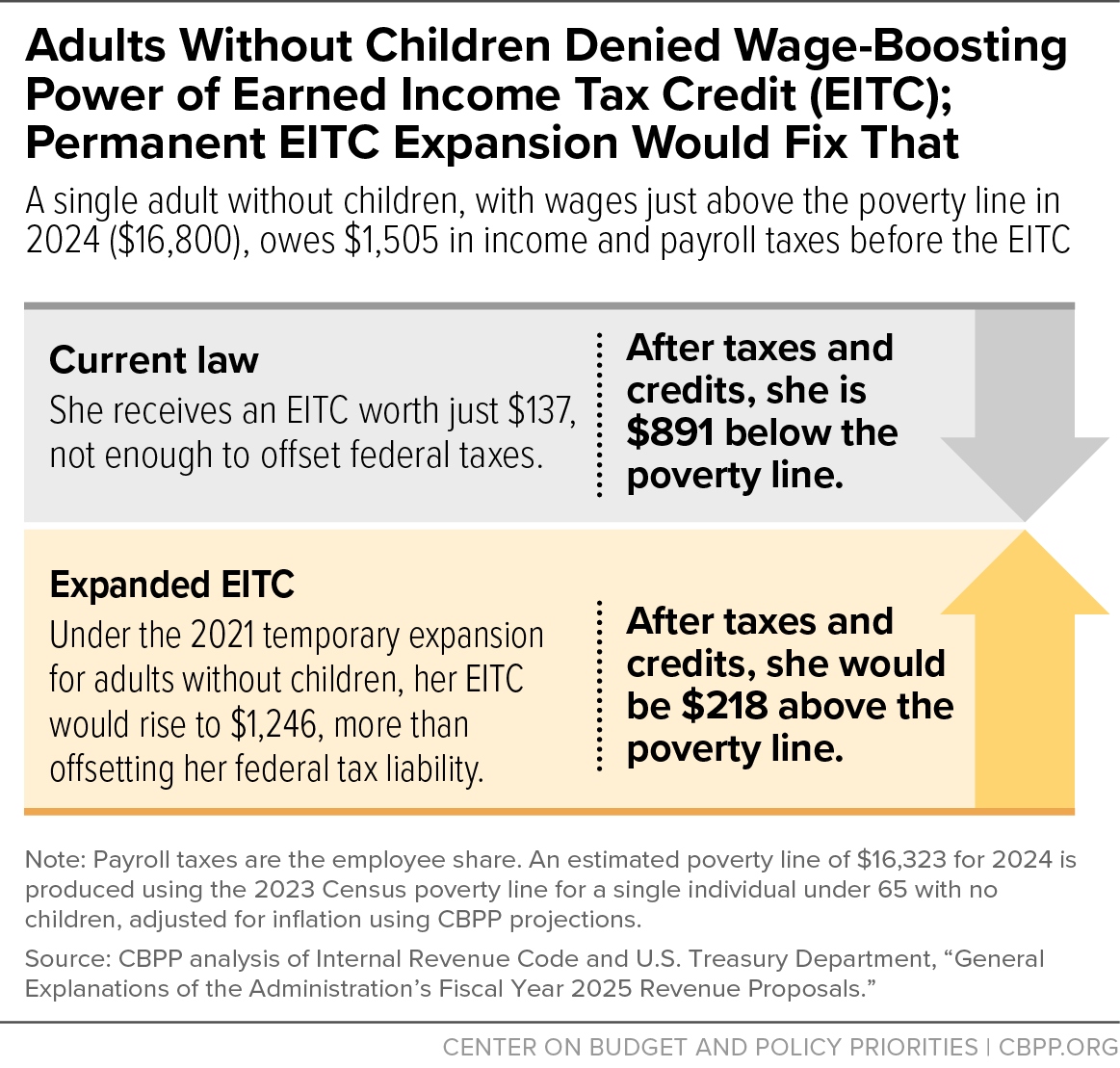
The EITC for workers not raising children is meager, or non-existent for younger and older workers. An estimated 6 million working adults who are not raising children and whose income is either below or just above the poverty line are pushed into — or deeper into — poverty because their EITC is not enough to offset payroll taxes as well as any federal income tax liability.[3] Policymakers should expand the EITC, such as by restoring the 2021 temporary expansion. (See Figure 1.) Unfortunately, the massive tax and budget bill recently passed by the House not only fails to address this issue, but instead erects additional barriers to the EITC by imposing new paperwork burdens on claimants.[4]
Additionally, the Child Tax Credit shortchanges families paid low wages. Congress should address the flaws in the credit that stop an estimated 17 million children, including 4 in 10 Black children and more than 1 in 3 Native American and Latino children, from receiving the full value of the credit because their parents don’t earn enough.[5] Instead, the disparity for low-income earners would only grow under the House budget reconciliation legislation, which denies 17 million children any of the proposed increase in the Child Tax Credit.[6] Under that bill, a single parent with two children earning $16,000 a year as a home health aide would get no additional credit, while a married couple with two children earning $400,000 a year would receive an extra $1,000.
Raise the minimum wage. The federal minimum wage is $7.25 per hour, which translates to only $15,080 in pre-tax annual earnings for a full-time, year-round worker. It has not been increased since 2009, the longest stretch the national minimum wage has gone without an increase since it was instituted in 1938. Since that last increase, the minimum wage has lost about 30 percent of its real value to inflation.[7]While a number of states have their own minimum pay standards, 20 states still operate under the federal minimum wage. Raising it would help millions of workers, especially women, Black, and Latino workers, who disproportionately work in low-paid jobs.
A higher minimum wage would draw more people into the labor market and provide an obvious benefit to workers and their families now earning near the current minimum wage, but some research has questioned its impact on the availability of jobs. However, most studies suggest that the chief effects of a higher minimum wage would be to raise wages, lower poverty, and increase family income for low- and moderate-income families. And while weekly average employment could decline, any resulting earnings losses would typically be temporary for any given worker and, for workers overall, would be greatly outweighed by higher wages earned.[8][9]
Support Low- and Moderate-Income Workers
Protect food, health, and housing assistance. Some of the most common occupations in the country, including cooks, cashiers, home health aides, and child care providers have low pay and few benefits. It’s vitally important to protect these and similar workers’ access to affordable health coverage through Medicaid and the Affordable Care Act (ACA) marketplaces, to housing assistance, and to help buying groceries through SNAP. It’s also noteworthy that 1 in 4 small business owners (self-employed owners of an incorporated business) live in a household that gets food assistance from SNAP or health coverage from Medicaid or the Children’s Health Insurance Program (CHIP) at some point in the year, according to Census data for 2023.
Roughly 18.2 million people who worked during 2023 lived in households that received SNAP benefits. Approximately 21.3 million Medicaid enrollees worked during 2023. Some workers particularly rely on this assistance. For example, half or more of all taxi drivers, home health aides, and roofers live in a household that used Medicaid or CHIP for health coverage or SNAP for food assistance in the past year. Helping low-income workers secure stable housing, provide food for their families, and address their health care needs can help prevent work disruptions caused by frequent moves or evictions, absences due to illness or lack of access to care, or other obstacles that result from difficult tradeoffs as families seek to meet their basic needs, like whether to pay their rent, buy groceries, or fix their car.
One immediate step policymakers should take to maintain health care support for workers is to extend the enhanced tax credits for ACA marketplace health coverage that are scheduled to expire at the end of 2025. Of the 24 million enrollees in the marketplace, the vast majority have earnings from employment and more than 90 percent receive tax credits that reduce their premiums.[10] A typical couple making $42,000, for example, will face a $1,550 annual increase if Congress lets the credit enhancements expire. Among those who would be hurt most by the expiration: self-employed workers and small business owners (who together made up 28 percent of all marketplace enrollees in 2022), and Black and Latino workers.[11] In addition to keeping premiums low, reducing deductibles and other out-of-pocket costs would help the many low-paid people in the marketplaces better afford care.[12]
Yet the House reconciliation bill fails to extend the enhanced tax credits that help working families afford health coverage — which will result in over 4 million people losing their health coverage and many millions more paying higher costs — even as that same legislation extends and even expands tax breaks for those with very high incomes. And the bill would impose new cost-sharing charges on working people with income just above the poverty line who are enrolled in a state’s Medicaid expansion.
Make It Easier for Parents to Work and Stay Connected to their Jobs
Increase access to child care. Child care can be prohibitively expensive for working families, with annual costs from $6,552 to $15,600 in 2022.[13]And yet the Child Care Development Fund program, which supports low-income families with help paying for child care, serves only 1 of every 7 children eligible for assistance under federal rules.[14]
Expanding access to affordable, high-quality child care to everyone who needs it would increase the number of women with young children working full time, for the full year by about 17 percent, and by about 31 percent for women without any college degree, research finds. Additionally, access to affordable child care could increase the lifetime earnings for mothers.[15]
Ensure paid family and medical leave. Nearly 3 in 4 private sector employees do not have access to paid family leave, and nearly 1 in 4 do not have a single paid sick day, according to Bureau of Labor Statistics data collected by the Center for American Progress.[16] Ensuring these workers can care for family members or themselves will help them keep working during pregnancy, short-term illness, crises for their children or other family members, or other unpredictable
circumstances.[17]Research has found that paid parental leave is very cost effective in providing large net social benefits to families, including improving the health of mothers and increasing the health, education, and future earnings of their newborn children.[18]
Help People Prepare for and Enter the Workforce
Promote proven training programs. Federal workforce development spending has fallen by two-thirds over the last four decades after adjusting for inflation, even as the labor force has grown substantially, helping lead to a skills gap in the workforce.[19] The U.S. invests less in workforce development policies than nearly every other industrialized country in the world, according to the National Skills Coalition.[20]Successful training programs need to be significantly scaled up, while continuing efforts to test and evaluate additional approaches to increase employment entry, retention, and advancement.[21] The House-passed reconciliation bill not only fails to make such investments in vocational training, but it also would raise borrowing costs and restrict access to Pell Grants for many post-secondary students.[22]
Fund subsidized employment and registered apprenticeships. Subsidized jobs, for which the government or a philanthropic organization temporarily pays all or some of a worker’s wages, can help people with little work history, criminal records, or other barriers to work.[23]Registered apprenticeships provide another pathway for workers without much previous experience to gain valuable skills and employment opportunities.[24]
Aid Workers With Disabilities
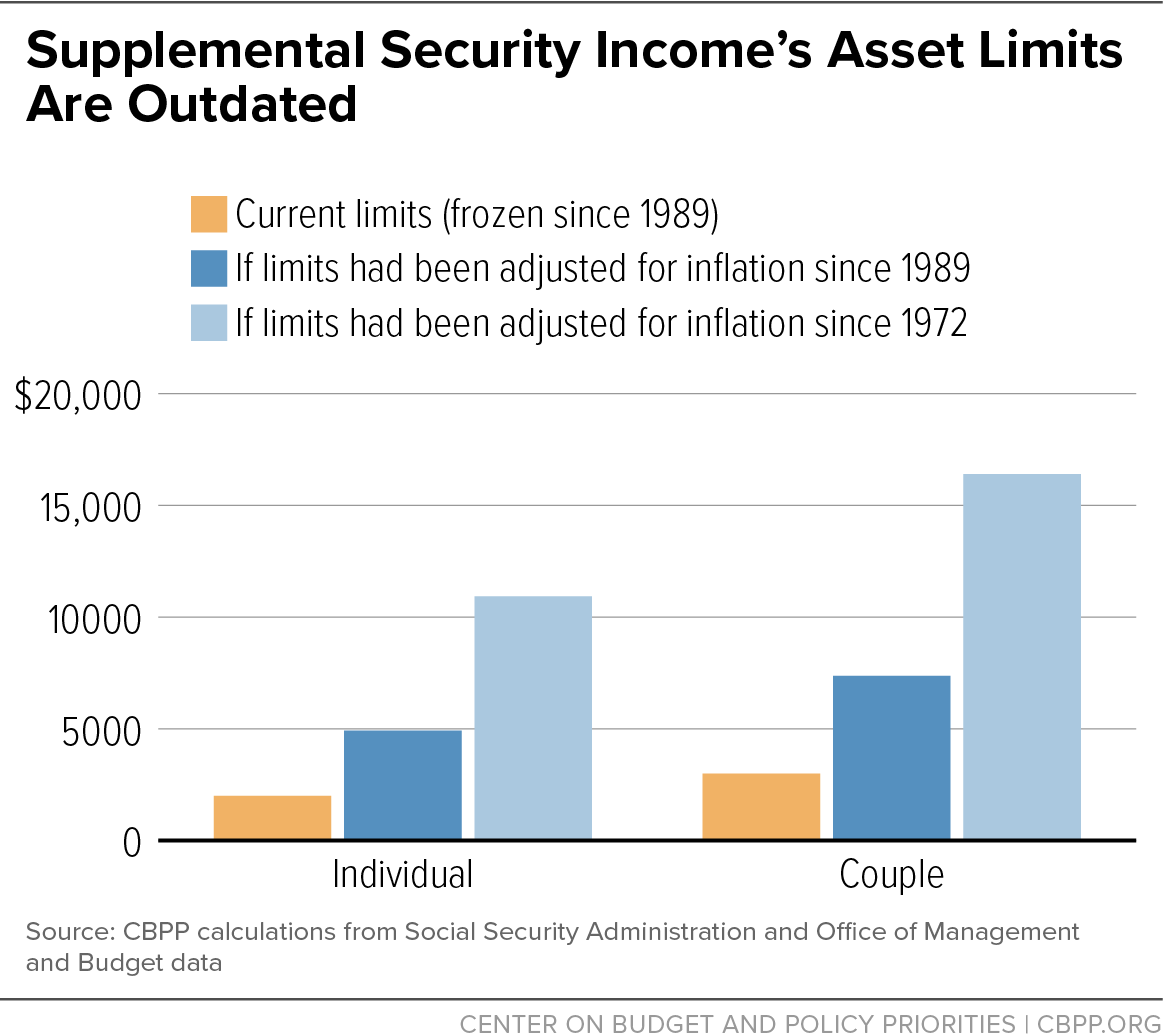
Lift SSI earnings and asset limits. The Supplemental Security Income (SSI) program, which provides monthly cash assistance to disabled and older people with very low or no income, has an asset limit ($2,000) that has been frozen since 1989, and an earnings disregard (allowing $65 a month in earnings to not count against eligibility and benefit levels) that has remained unchanged since the program was started in the early 1970s.[25]
These provisions were designed to help and encourage SSI recipients to work and save, and they desperately need updating. Had the SSI resource limit and earnings disregard been indexed to inflation since 1972, when the program was enacted, they would be about five times as high as they are today. (See Figure 2.)

Support Workers While They Look for a New Job
Reform UI. Assisting people who have lost work through no fault of their own and are looking for a new job helps families at a critical moment while also keeping people attached to the labor force. (Individuals must generally be seeking work to be eligible for unemployment benefits.) But major gaps in our Unemployment Insurance (UI) system, which now provides assistance to only about one-quarter of the unemployed, undercuts this mission.
The failure of the UI system to adapt to a changing economy over many decades — leaving out independent contractors, self-employed workers, and many part-time workers — as well as state legislators’ deliberate policy choices to restrict access to unemployment benefits in some states, highlights the need for change.[26] Comprehensive, permanent reform is needed to ensure the UI system works for all workers at all times, but if a near-term economic downturn occurs, Congress must be prepared to quickly enact emergency measures to address the most significant deficiencies in the current system.
Tailor Job-Seeking Services
Focus TANF on results. The Temporary Assistance for Needy Families (TANF) program funds states to provide cash assistance and services to low-income families, which can help them meet their basic needs and pay for things they need to secure work, including transportation, child care, and clothing. TANF serves a small share of eligible families, partly because it includes rigid requirements focused on documenting recipients’ time spent on a limited set of federally defined work activities.
Following a bipartisan law, the Biden Administration awarded five states pilot projects to test approaches to tailoring services to TANF recipients’ needs and to hold the states accountable to increasing participant employment and family well-being. Unfortunately, the Trump Administration rescinded those performance-based projects awarded to five states and recently issued a new request for proposals (RFP). While this new RFP takes a much too limited view of family well-being by not considering total resources available to families, the pilots remain an opportunity for testing new outcome-focused approaches.
Build Worker Power
Support collective bargaining rights. Ensuring that working people can collectively negotiate through a union with employers regarding their pay, benefits, and other issues can lead to higher wages and better working conditions. Among full-time workers, union members had median weekly earnings of $1,337 in 2024, while non-union workers had median weekly earnings of $1,138, according to the Bureau of Labor Statistics.[27]
The decline in union membership is likely one of the factors leading to a decades-long growing gap between productivity and typical workers’ pay.[28]Efforts to roll back collective bargaining rights will further reduce workers’ ability to receive fair treatment and earn wages high enough to afford basic needs without government assistance.[29] Policymakers should instead reduce barriers to workers joining unions and collectively bargaining for better pay and working conditions, especially given evidence that many tens of millions more workers would join a union if they could.[30]
Conclusion
Congress can take many productive paths to effectively support and promote work that don’t entail taking help away that people need to afford their basic needs. Increasing the value of work, reducing barriers to employment, helping people look and prepare for a job, and making it easier to maintain employment will both support work and improve the lives of workers and their families.
End Notes
[1]. Nick Gwyn, “Administration’s “If You Want Welfare” Arguments Conceal Proposals’ True Impact,” CBPP, May 16, 2025, https://www.cbpp.org/blog/administrations-if-you-want-welfare-arguments-conceal-proposals-true-impact.
[2] Andrew Barr, Jonathan Eggleston, and Alexander A. Smith, “Investing in Infants: the Lasting Effects of Cash Transfers to New Families,” Quarterly Journal of Economics, Vol. 137, No. 4, April 20, 2022, https://doi.org/10.1093/qje/qjac023.
[3] Kiran Rachamallu, “About 14 Million Low-Income Adults Not Raising Children at Home Would Benefit From Permanently Expanded EITC,” CBPP, September 19, 2024, https://www.cbpp.org/blog/about-14-million-low-income-adults-not-raising-children-at-home-would-benefit-from-permanently.
[4] Greg Leiserson, “Ways and Means Bill Would Cut Earned Income Tax Credit by Increasing Bureaucratic Burdens for Families,” The Tax Law Center, May 14, 2025, https://taxlawcenter.org/blog/ways-and-means-bill-would-cut-earned-income-tax-credit-by-increasing-bureaucratic-burdens-for-families.
[5] See Table 1 in Kris Cox and Stephanie Hingtgen, “Policymakers Should Expand the Child Tax Credit for the 17 Million Children Currently Left Out of the Full Credit,” CBPP, February 5, 2025, https://www.cbpp.org/blog/policymakers-should-expand-the-child-tax-credit-for-the-17-million-children-currently-left-out.
[6] CBPP, “By the Numbers: House Republican Tax Agenda Favors the Wealthy and Leaves Millions of Working Families Behind,” May 19, 2025, https://www.cbpp.org/research/federal-tax/by-the-numbers-house-republican-tax-agenda-favors-the-wealthy-and-leaves.
[7] Joe Hernandez, “It has now been 15 years since the federal minimum wage rose to $7.25,“ NPR, July 24, 2024, https://www.npr.org/2024/07/24/nx-s1-5050573/federal-minimum-wage-increase-15-year-anniversary.
[8] Arindrajit Dube and Ben Zipperer, “Own-Wage Elasticity: Quantifying the Impact of Minimum Wages on Employment,” NBER, September 2024, http://www.nber.org/papers/w32925.
[9] Nabeel Alsalam et al., “The Budgetary and Economic Effects of S. 2488, the Raise the Wage Act of 2023,” CBO, December 2023, https://www.cbo.gov/system/files/2023-12/The_Budgetary_and_Economic_Effects_of_S.%202488_the_Raise_the_Wage_Act_of_2023_1.pdf.
[10] Jennifer Sullivan, “Policies Designed to Strengthen ACA Marketplaces Succeed, But Are Under Threat,” CBPP, March 3, 2025, https://www.cbpp.org/blog/policies-designed-to-strengthen-aca-marketplaces-succeed-but-are-under-threat.
[11] Gideon Lukens and Elizabeth Zhang, “Premium Tax Credit Improvements Must Be Extended to Prevent Steep Rise in Health Care Costs,” CBPP, November 14, 2024, https://www.cbpp.org/research/health/premium-tax-credit-improvements-must-be-extended-to-prevent-steep-rise-in-health.
[12] Claire Heyison, “Next Round of ACA Improvements Should Focus on Marketplace Cost Sharing,” CBPP, April 10, 2024. https://www.cbpp.org/blog/next-round-of-aca-improvements-should-focus-on-marketplace-cost-sharing.
[13] U.S. Department of Labor (DOL), “NEW DATA: Childcare costs remain an almost prohibitive expense,“ November 19, 2024, https://blog.dol.gov/2024/11/19/new-data-childcare-costs-remain-an-almost-prohibitive-expense.
[14] Child Care Development Fund Program, “Child Care and Development Fund (CCDF) Report on States’ and Territories ‘Priorities for Child Care Services: Fiscal Year,” Department of Health and Human Services, Updated December 2024, https://acf.gov/sites/default/files/documents/occ/FY_2022_CCDF_Priorities_Report.pdf.
[15] See Figure 9 in Robert Paul Hartley et al., “The Effects of Affordable, High-quality Child Care on Family Income, the Gender Earnings Gap, and Women’s Retirement Security,” National Women’s Law Center, March 2021, https://nwlc.org/wp-content/uploads/2021/04/A-Lifetimes-Worth-of-Benefits-Compliant.pdf.
[16] Molly Weston Williamson, “The State of Paid Family and Medical Leave in the U.S. in 2024,” CAP, January 17, 2024, https://www.americanprogress.org/article/the-state-of-paid-family-and-medical-leave-in-the-u-s-in 2024/; Molly Weston Williamson, “Getting To Know the Healthy Families Act,” CAP, September 5, 2023, https://www.americanprogress.org/article/getting-to-know-the-healthy-families-act/.
[17] Kathleen Romig and Kathleen Bryant, “A National Paid Leave Program Would Help Workers, Families,” CBPP, April 27, 2021, https://www.cbpp.org/research/economy/a-national-paid-leave-program-would-help-workers-families.
[18] Buyi Wang et al., “The Benefits and Costs of Paid Family Leave,” National Bureau of Economic Research, December 2024, https://www.nber.org/papers/w33279.
[19] Eleanor Mueller, “‘This is a crisis point’: Job training deficit leaves critical jobs unfilled,” Politico, May 26, 2022, https://www.politico.com/news/2022/05/26/fix-workforce-development-inflation-surges-00033745.
[20] Amanda Bergson-Shilcock, “Federal Policy Priorities for a Skilled America,” National Skills Coalition, https://nationalskillscoalition.org/wp-content/uploads/2025/03/NSC_Federal-Policy_Agenda_2025.pdf.
[21] MDRC, “Workforce Futures Issues “What’s Working?” Report,” November 2024, https://www.mdrc.org/news/workforce-futures-issues-whats-working-report.
[22] Alison Durkee, “How Trump’s Spending Bill Could Impact Student Loans—Including Higher Payments And More Restrictions,” Forbes, May 23, 2025, https://www.forbes.com/sites/alisondurkee/2025/05/23/how-trumps-spending-bill-could-impact-student-loans-including-higher-payments-and-more-restrictions/.
[23] Danielle Cummings and Dan Bloom, “Can Subsidized Employment Programs Help Disadvantaged Job Seekers?,” MDRC, February 2020, https://www.mdrc.org/work/publications/can-subsidized-employment-programs-help-disadvantaged-job-seekers.
[24] DOL, Employment and Training Administration, “Biden-Harris administration awards over $244M to modernize, diversify, expand Registered Apprenticeships in growing industries,” July 11, 2024, https://www.dol.gov/newsroom/releases/eta/eta20240711-0.
[25] Kathleen Romig and Sam Washington, “Policymakers Should Expand and Simplify Supplemental Security Income,” CBPP, Updated May 4, 2022, https://www.cbpp.org/research/social-security/policymakers-should expand-and-simplify-supplemental-security-income.
[26] See p. 3 in Nick Gwyn and Jenna Gerry, “Unemployment Insurance System Unprepared for Another Recession,” CBPP, April 18, 2023, https://www.cbpp.org/sites/default/files/4-18-23ui.pdf.
[27] U.S. Bureau of Labor Statistics, “Union Members Summary,” January 28, 2025, https://www.bls.gov/news.release/union2.nr0.htm; https://www.epi.org/productivity-pay-gap/.
[28] Economic Policy Institute, “The Productivity–Pay Gap,” Updated May 15, 2025, https://www.epi.org/productivity-pay-gap/.
[29] Economic Policy Institute, “Executive Order on “Exclusions from Federal Labor-Management Relations Programs,” April 25, 2025, https://www.epi.org/policywatch/executive-order-on-exclusions-from-federal-labor-management-relations-programs/.
[30] Margaret Poydock et al., “16 million workers were unionized in 2024,” Economic Policy Institute, January 28, 2025, https://www.epi.org/publication/millions-of-workers-millions-of-workers-want-to-join-unions-but-couldnt/.