

Interference With and Weakening of Statistical Agencies Threaten Nation's Data, Mask Harms of Administration Policies, and Undermine Evidence-Based Policymaking
Rigorous data collection and evaluation of public programs support sound investment of federal dollars. When policymakers or the public seek to understand the effects — good, bad, or neutral — of a policy or program, they can turn to federally collected and analyzed data. High-quality federal data allow us to understand social problems and adjust our policy approaches to address them effectively.
Unfortunately, the Trump Administration is undermining the federal government’s capacity to assess the impact of policy changes, including the harmful 2025 Republican reconciliation law’s deep cuts to people’s food assistance through SNAP and their health coverage through Medicaid.
In addition to canceling and cutting funds for data collection activities, the Administration is weakening federal agencies and the infrastructure that supports data collection, statistics, evaluation, and research.[2] (See Figure 1.) Recent actions suggest an effort to politicize federal statistical and research activities, which threatens public trust. Eroding the quality and credibility of the nation's data has important consequences for everyone who uses data to guide decisions, whether it’s businesses and investors thinking about how to expand, or counties planning a new school.
Federal agencies should uphold evidence-building principles, which are established in law under the Foundations for Evidence-Based Policymaking Act, signed by President Trump in 2019. Congress, for its part, should ensure agencies are staffed appropriately to fulfill their missions, reject further proposed cuts, and perform its constitutional role of executive oversight.
Protecting the independence and capacity of federal evaluation work serves everyone’s interests, regardless of views on any particular policy or program, because sound evidence helps the public and policymakers understand what works, what does not, and who is affected.
Trump Administration Has Substantially Reduced Social Science and Statistics Staff, Potentially Obscuring Effects of Recent Program Cuts
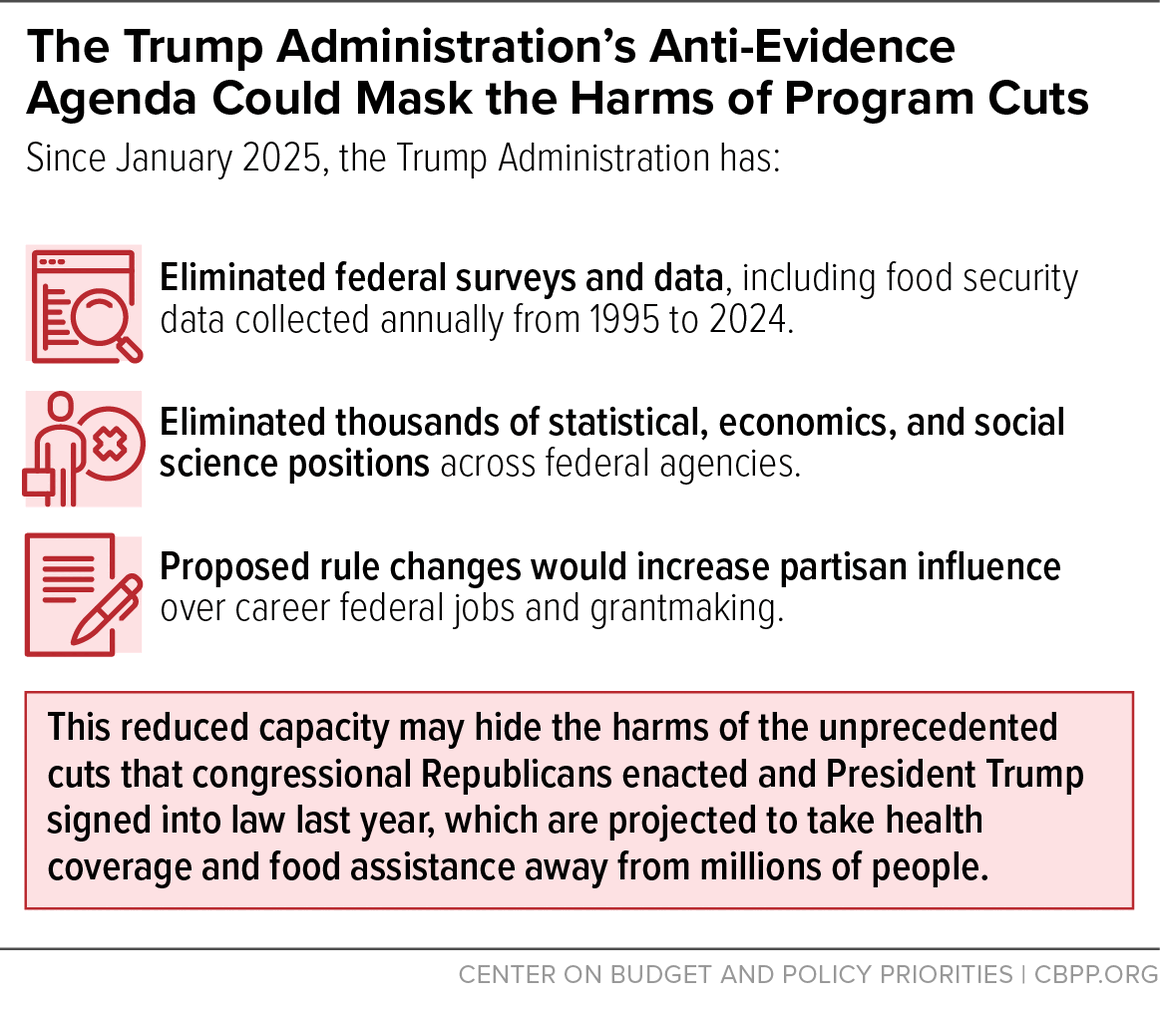
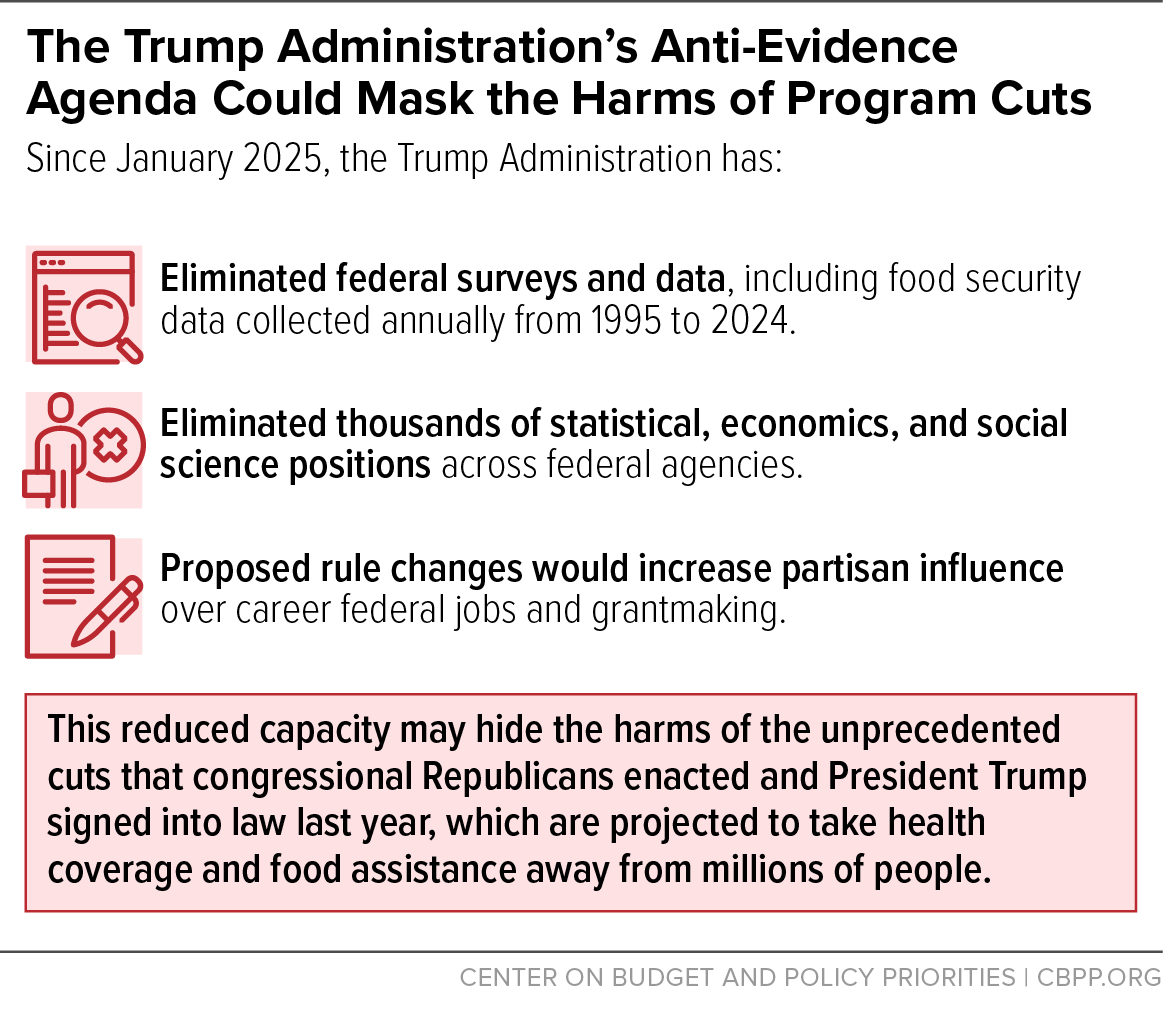
The Trump Administration has made sweeping cuts to the federal workforce, of more than 264,000 positions in the first 18 months of its term.[3] These reductions include large cuts to agencies focused on statistics, program evaluation, and social science research. This reduced capacity may hide the harms of the unprecedented cuts that congressional Republicans enacted last year, which are projected to take health coverage and food assistance away from millions of people. Many of the people the Administration has pushed out are those who would ordinarily produce or support research into the programs’ effectiveness and the needs of families who use them.
Using recently released data from the Office of Personnel Management (OPM), we examined net changes in full-time staffing at the 13 principal federal statistical agencies from January 2025 to August 2026. (See Figure 2.) Because OPM workforce data do not identify all 13 agencies directly, for 8 of the 13 statistical agencies, we report employment figures for the smallest observable government entity of which the agency is a part. To better identify workers supporting statistical, research, or evaluation functions across all 13 agencies of interest, we additionally report changes in full-time personnel in two OPM occupational groups: 1) Mathematics and Statistics and 2) Social Science, Psychology, and Welfare. (See Methodology Note for additional details.)
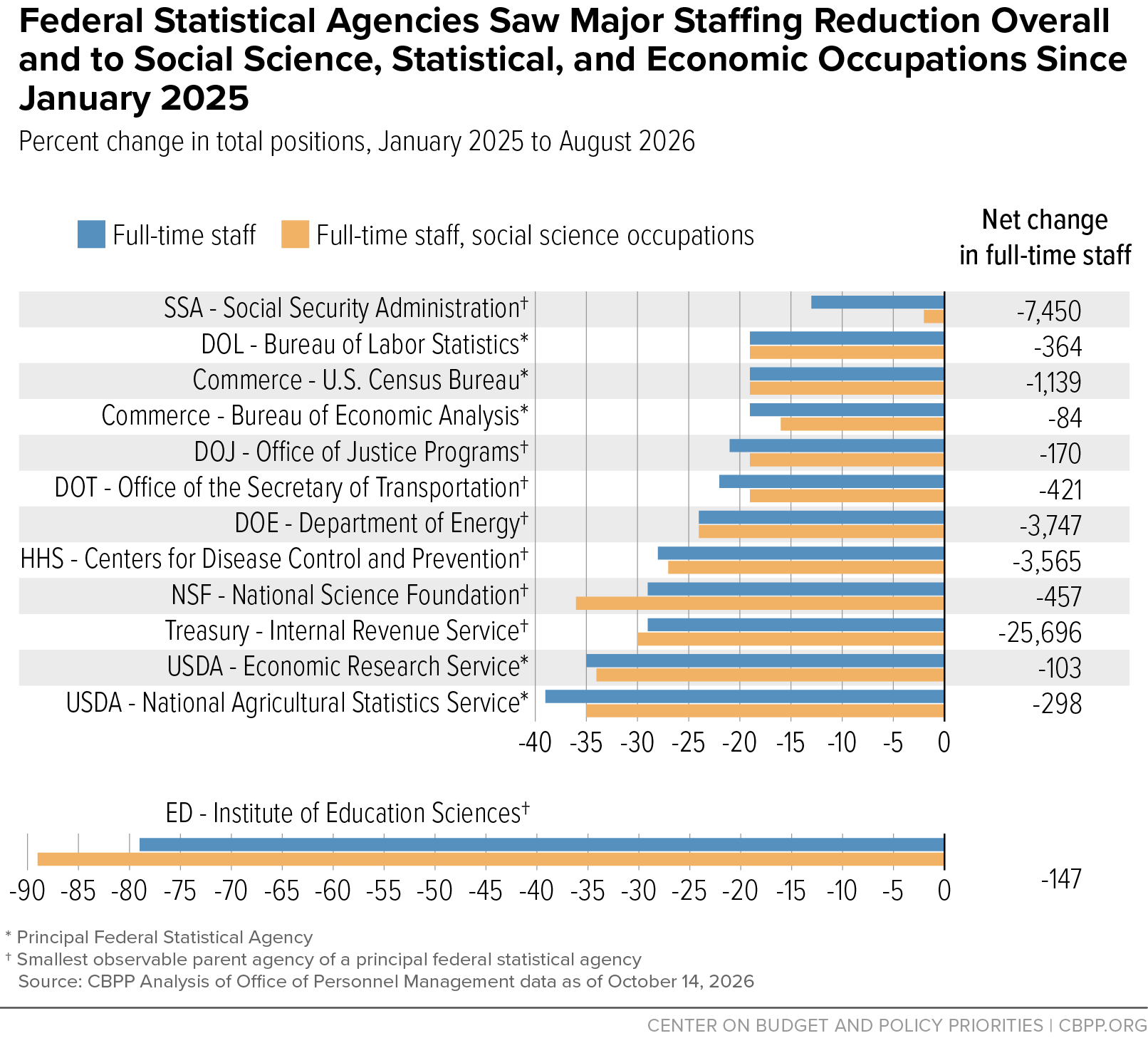
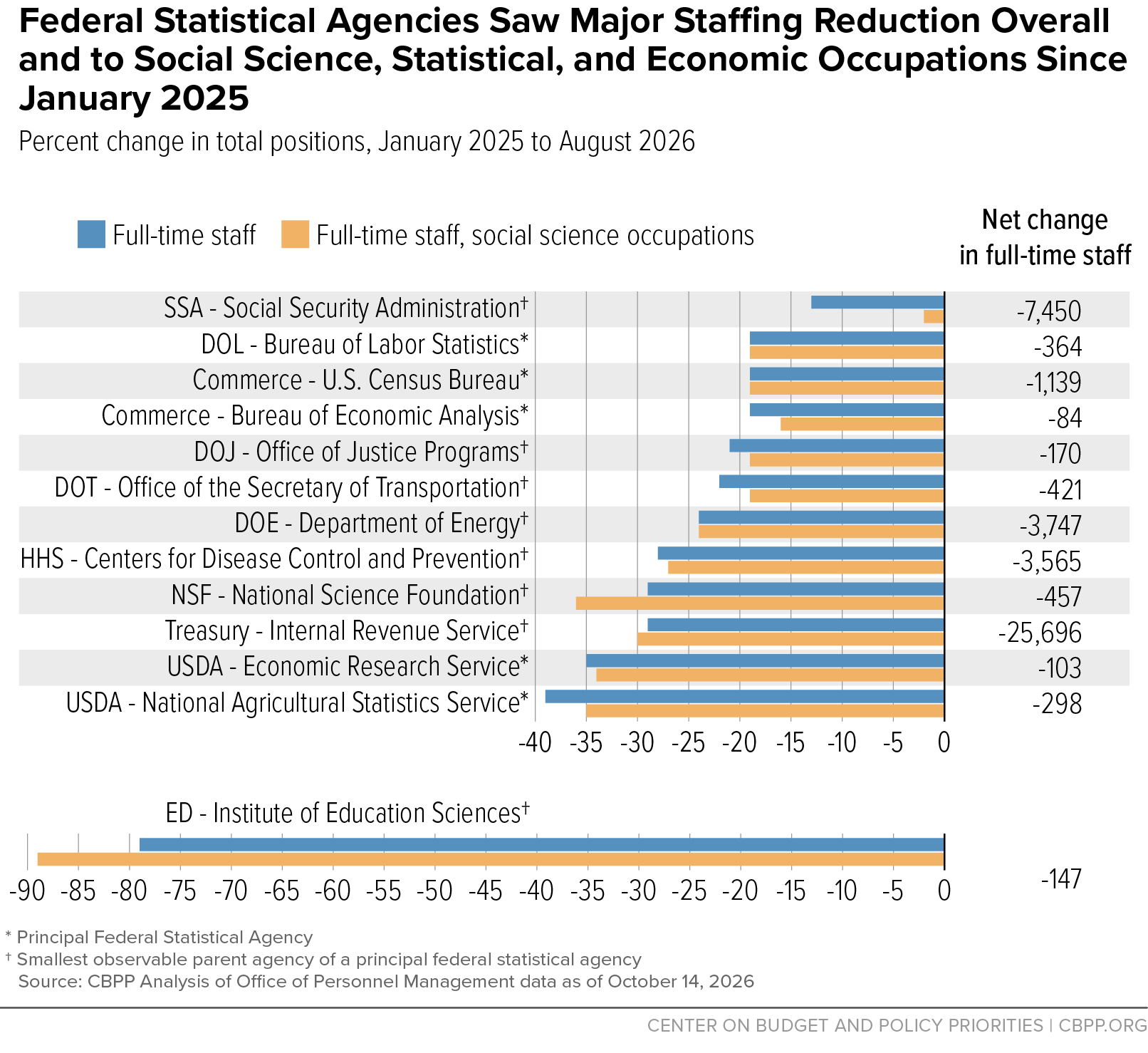
Overall, we found that all 13 principal federal statistical agencies (or the smallest observable parent agency) lost full-time staff between January 2025 and August 2026. Cuts range from about 13 percent at the Social Security Administration to nearly 80 percent in the Department of Education’s Institute of Education Sciences. Most agencies fall in a middle band of still-dramatic losses, of roughly one-fifth to one-third of their full-time staff, with comparable declines in social science, statistics, and economics occupations specifically. At several agencies, reductions in social science and statistics occupations outpaced cuts to the agency's workforce overall in percentage terms, highlighting that this is not a simple downsizing, but one that is falling hardest on the staff responsible for producing and analyzing data.
Staffing cuts to these agencies reduce the federal government’s capacity to collect, analyze, and share data that inform policymakers and the public. Below, we consider examples from several of these agencies and identify some of the policy effects federal agencies are now less equipped to track and evaluate due to cuts and chaos.
U.S. Census Bureau and Bureau of Labor Statistics (BLS)
Since January 2025, the Census Bureau's full-time staff fell 19 percent. Full-time staff in its social science occupations fell by the same share. The agency lost 1,139 full-time positions overall. Similarly, the Bureau of Labor Statistics lost 19 percent of its full-time staff overall (364 positions) and 19 percent of those in social science occupations.
Both of these agencies track demographics, employment, working conditions, inflation, and labor market trends. Data collected by the Census Bureau are used to apportion representation in Congress and distribute more than $1.5 trillion in public spending annually. And data the Census Bureau typically releases each September provide some of our most detailed pictures of how people in the U.S. fared economically in the prior year, including measures of poverty, median income, health coverage, and income inequality. BLS, for its part, provides our best picture of the U.S. labor market in near-real time (with needed adjustments for prior months).
To maintain the quality of federal survey data, agencies are pursuing necessary modernization efforts to address rising costs and falling response rates. The Census Bureau is also scheduled to ramp up planning and testing activities ahead of the 2030 Census. The two bureaus losing one-fifth of their staff in social science occupations undermines these efforts at a critical juncture by shrinking teams and discarding hard-earned expertise.
U.S. Department of Agriculture (USDA)
USDA houses 2 of the 13 principal federal statistical agencies: the Economic Research Service (ERS) and the National Agricultural Statistics Service (NASS). From January 2025 to August 2026, ERS lost 35 percent of its full-time staff and NASS saw a 39 percent reduction.
NASS conducts surveys and generates reports on a range of issues relevant to U.S. agriculture, including production, prices, farm finances and labor, and chemical use. Over the same period that this agency has lost one-third of full-time staff, the Administration’s actions have worsened the challenges faced by U.S. farmers and ranchers. For instance, the Administration has imposed sweeping tariffs and undermined trade agreements, causing trade uncertainty, and its war in Iran has driven up costs for fuel and fertilizer. With reduced capacity, NASS will be less able to track the effects of these issues and produce timely and accurate data that U.S. producers rely on to plan and prepare, especially in an environment of rapid change.
ERS produces economic research on issues in agriculture, food and nutrition, global markets, the environment, and rural areas.[4] For nearly 30 years, ERS reported on the extent and severity of food insecurity among U.S. households in the annual report, “Household Food Security in the United States.” The report relied on data collected in the national food security survey, a supplement to the Current Population Survey fielded at a yearly cost of only about $1 million to USDA, per documents filed with the Office of Management and Budget.[5] In September 2025, the Administration abruptly discontinued the food security survey and announced they would no longer produce the annual report. (This cancellation is part of a larger pattern of canceled or reduced federal data collection since January 2025.[6])
In addition to steep staffing reductions, in April 2026, USDA revived an effort from the first Trump administration to relocate USDA research positions from Washington, D.C., to other cities. Polls by various unions representing USDA employees found that more than three-quarters of affected staff would resign rather than relocate.[7] Losses from this mandate would likely mirror personnel losses that followed a similar 2019 relocation. Using a mandate to relocate or resign is one way to reduce staff without formally cutting jobs that support evaluation of policies.
Meanwhile, the 2025 Republican reconciliation law made unprecedented cuts to SNAP, the nation's primary anti-hunger program. The law reduces the program’s funding by roughly 20 percent and forces massive costs onto states. As pressure on states rises, the number of people receiving SNAP has fallen by more than 5.5 million people — including an estimated 2 million children — since the July 2025 cuts were enacted, even as unemployment nationally has been flat.[8]
Against the backdrop of this sharp decline in the number of people receiving food assistance, staffing at ERS, which conducts research on food security and SNAP participation, has fallen by more than one-third, and the Administration cancelled the premier source of information about household food security. The cancellation of the data collection and accompanying report leaves us unable to accurately assess the full effect of dramatic declines in SNAP participation since July 2025 on important measures of food hardship, including whether people are skipping meals because they don’t have enough money for food.
Centers for Disease Control & Prevention (CDC) and Other Health-Monitoring Agencies
CDC, the agency responsible for tracking health trends, conducting disease surveillance, and preventing outbreaks, is losing capacity. Since January 2025, the agency's full-time staff in social science and statistics positions fell by 27 percent, a loss of over 200 positions.
Cuts to CDC funding and staffing bode poorly as millions of people are losing their access to affordable health coverage. Fifteen million more people are projected to become uninsured by 2034 because of the 2025 reconciliation law’s cuts to Medicaid and the expiration of the enhanced premium tax credits that lowered the cost of buying coverage on the Affordable Care Act marketplace.[9] A larger uninsured and underinsured population may lead to more uncompensated care, reduced use of primary care services, and an increase in adverse health outcomes. Yet, staff cuts at the National Center for Health Statistics, which CDC houses, limit the agency's ability to collect data and publish the full range of analyses that would document the health consequences of these coverage losses.
Staffing losses to public health agencies extend beyond the 13 principal statistical agencies. The National Institutes of Health lost 165 full-time social science staff, a 22 percent decline since January 2025. The Agency for Healthcare Research and Quality lost 24 such positions, a 45 percent decline. Both agencies conduct health services research and evaluate treatment effectiveness — work that allows policymakers to understand if coverage losses are translating into worse health outcomes, delayed care, or preventable deaths. Without it, the human cost of recent programmatic cuts is at risk of going undocumented and unaddressed.
Department of Education
The Administration attempted to fire nearly half of the staff at the Department of Education in March 2025 and is advancing proposals to dismantle the department altogether. The Institute of Education Sciences, which produces research and data that track how well schools are performing, has been decimated. Since January 2025, its full-time social science and statistics staff fell by 89 percent, a loss of 55 positions, leaving only seven such staff remaining. This collapse in research capacity directly undermines the federal government's ability to measure educational trends and spot problem areas and areas of improvement that can help policymakers and educators improve education. It is unlikely that so few staff can sustain the research infrastructure needed to track student achievement, evaluate which interventions work, or flag which schools and districts are falling behind.
Social Security Administration (SSA)
Since January 2025, the Social Security Administration has lost more than 7,400 staff overall, a 13 percent reduction. Recent cuts come on top of SSA’s yearslong understaffing problem, contributing to the degradation of service largely for older, bereaved, and disabled people who most rely on the SSA.
For the period between April 2025 and June 2026, the full-time social science and statistics workforce was reduced by one-quarter compared to January 2025. Staffing in these positions within SSA appears to have nearly returned to January 2025 levels as of August 2026, however this is explained by a likely seasonal increase in Social Science Student Trainees (interns);[10] the agency’s permanent social science and statistical capacity remains diminished relative to the beginning of the second Trump administration.
Social Security's retirement trust fund is now projected to be depleted by 2032, and the reconciliation law accelerated that timeline while worsening the program's long-term finances.[11] Given that the program’s fiscal outlook has deteriorated, it is especially important that the agency’s capacity to accurately track and project programmatic needs and changes is maintained.
Executive Leadership Across Agencies
The Trump Administration sharply reduced Senior Executive Service (SES) positions — which are the highest level of career civil service leadership in the federal government and include managerial, supervisory, and policy positions — at many of these agencies. All but one of the 13 agencies experienced double-digit percentage losses in full-time SES positions between January 2025 and August 2026 (the Bureau of Economic Analysis also saw a reduction but of only 6 percent). Long vacancies or permanent terminations of senior leadership roles risk losing institutional memory and expertise, delaying or disrupting long-term planning, and reducing productivity.
Signs of Political Influence Over Federal Statistical and Research Activities Threaten Public Trust
Federal agencies and OPM are making changes that risk politicizing the federal workforce and increasing the influence that political appointees hold over research and evaluation activities. Undue influence can undermine scientific integrity, evidence-based policymaking, and public trust.
In February 2026, OPM finalized a rule that creates a new job classification for career civil service workers in positions the Administration determines are “policy related,” called Schedule Policy/Career (known as Schedule F when these new classifications were originally proposed during the first Trump Administration).[12] Administration officials initially indicated that up to 50,000 federal employees could be impacted by the policy change.[13] As of June 2026, approximately 8,000 career federal positions have been reclassified.[14] Per an appendix published by the White House, examples of affected job titles include “Research Epidemiologist,” “Supervisory Social Science Specialist,” “Deputy Director Extramural Research,” and “Senior Research Economist.”[15]
This change effectively strips these positions of civil service protections, allowing employees in these positions to be fired at will and weakening whistleblower protections. Removing job protections potentially provides legal cover for politically motivated firings and creates a pathway to erode long-standing nonpartisanship within the civil service.
Additionally, on May 29, the Office of Management and Budget (OMB) released a proposed rule that seeks to modify government-wide grants guidance.[16] The proposed rule would radically transform how grant award decisions are made, allowing them to be based on purely political calculations, including who receives funds, what is required of grantees, and when grants can be canceled.[17] This rule would introduce an enormous risk of capriciousness, abuse, and corruption. The proposed rule received tens of thousands of public comments, including objections from university associations, scientific organizations, and researchers. The resolution passed by Congress to fund the government through December 11, 2026, includes a provision that temporarily blocks OMB from implementing the rule through that date.[18]
Recent actions within the Commerce Department, meanwhile, complicate the Census Bureau’s work and remove guardrails against political influence. An unusual directive from the department’s political appointees prohibits the use of a standard statistical method for protecting the privacy of survey respondents, limiting the Census Bureau to blunter instruments.[19] The directive forced the Census Bureau to delay the release of detailed income, poverty, and health coverage data from the American Community Survey; 1-year ACS estimates were expected to be published in mid-September but were delayed until October 29. The 1-year ACS data saw no decrease in the availability, granularity, and geographic coverage compared to past years’ data because these estimates rely primarily on a different privacy method that is not restricted by the order.[20] The Census Bureau is still assessing how to produce 5-year ACS data and ACS microdata in a manner compliant with the order. A key question is what data will be withheld, if any, when 5-year ACS data are released.
On September 10, the Administration proposed a regulatory change to exclude some immigrants from the next decennial census (used for apportioning representation in Congress and allocating federal funding, among other purposes).[21] This change would be at odds with long-standing legal understandings of the 14th Amendment’s requirement that the decennial census count the “whole number of persons.”[22] The proposed rule would also prohibit the Census Bureau from including questions on race, ethnicity, and sexual orientation in the decennial census questionnaire.[23] Both proposals hold serious negative implications for the accuracy and utility of the once-per-decade count. The decennial census has captured data on race since the first census in 1790, and statisticians in the public and private sectors rely on demographic data like these to construct nationally representative survey samples, so the change would undermine the accuracy of other surveys.[24]
Another recent example suggests that there are political appointees willing to exploit the Census Bureau’s sterling reputation for partisan purposes. In August 2026, a report was published to the Census Bureau website that the White House then amplified as evidence of debunked claims of noncitizen voting in 2020. Former Census Bureau staff flagged the report as a marked departure from Census Bureau standards for transparency and rigor in several ways: there were no named authors or indication of the responsible Bureau division, no measures of uncertainty, little discussion of key limitations, and conclusions that mischaracterize failed data linkages as proof of fraud.[25] Per independent reporting, career Census Bureau staff were not involved in producing this report but staff at a think tank aligned with the Trump Administration were.[26]
Perhaps even more alarmingly, around the time of this report’s publication, the Commerce Department appears to have quietly altered its Scientific Integrity directive to remove language prohibiting political influence over federal data.[27]
Policymakers Should Protect the Capacity and Independence of Federal Evaluation Work
Federal agency leaders and Congress have a role to play in ensuring that the federal government collects data and conducts research and evaluations that are high quality, timely, and free from political interference. Federal agencies should uphold the principles established by the bipartisan Foundations for Evidence-Based Policymaking Act, which President Trump signed into law in 2019.[28] That law requires agencies to develop systematic plans for identifying policy questions and collecting data to support evidence-based policymaking, designate senior officials to coordinate evaluation and statistical activities, and regularly assess the independence and quality of their research and analysis efforts. It also mandates that government data be made publicly accessible, and that statistical agencies protect the confidentiality of information providers. By dismantling the staff and independence of federal statistical and research agencies, the current Administration directly undermines these statutory commitments.
Members of Congress should hold agency leadership accountable to these principles and use their oversight authority to understand whether evaluation, research, and statistical activities are being undermined. Congress should permanently block the proposed rule from OMB that would upend, and risk the politicization of, federal grantmaking, including for research. Implementing statutory guardrails against politically motivated or otherwise capricious firings of career civil servants, including guarantees of due process, would reduce concerns related to the new Schedule Policy/Career status OPM has created. Congress should also use its power of the purse to ensure agencies are staffed appropriately to fulfill their missions and reject cuts that would further diminish the government’s capacity to evaluate the effectiveness and efficiency of public programs.
Methodology Note: This analysis uses federal personnel data released by the Office of Personnel Management (OPM) as of July 16, 2026. We consider the 13 principal federal statistical agencies — those formally designated as primarily responsible for collecting, processing, analyzing, and disseminating statistical data.[29] OPM data include the agency and sub-agency in which each federal worker is employed but does not include sufficient details to identify workers in specific offices within sub-agencies. Therefore, not all 13 principal federal statistical agencies are directly observable: five (Bureau of Economic Analysis, Bureau of Labor Statistics, Economic Research Service, Census Bureau, and National Agricultural Statistics Survey) appear as distinct sub-agencies and are observed directly; the remaining eight are nested within larger sub-agencies, and for these we report figures for the smallest observable parent organization. To better identify workers supporting statistical, research, or evaluation functions across all 13 agencies, we additionally report personnel headcount restricted to employees in the Mathematics and Statistics (OPM occupational group 15) and Social Science, Psychology, and Welfare (OPM occupational group 1) occupational groups. From the latter group, we exclude an occupational series specific to the Social Security Administration named Social Insurance Administration because workers in this occupational series are primarily concerned with program administration and operations rather than social science.[30]
End Notes
[1] Yumna Hussain was an intern with CBPP from September 2025 through July 2026.
[2] dataindex.us, “Federal Data Terminations Tracker,” updated October 5, 2026, https://dataindex.us/terminations-tracker; dataindex.us, “Data Checkup,” https://dataindex.us/collections/; Steve Pierson et al., “2026 Midyear Update: Resources and Leadership Supporting Federal Statistics,” American Statistical Association, September 10, 2026, https://www.amstat.org/docs/default-source/amstat-documents/FedStatHealth_MidYearUpdate.pdf.
[3] Kiran Rachamallu and Devin O’Connor, “Administration’s Radical Personnel Cuts Bypassed Congress and Lacked Transparency, Obscuring Impact on Public Services,” CBPP, January 15, 2026, https://www.cbpp.org/research/federal-budget/administrations-radical-personnel-cuts-bypassed-congress-and-lacked; Federal Workforce Data, U.S. Office of Personnel Management, “Workforce Changes,” September 2026, https://data.opm.gov/explore-data/analytics/workforce-changes.
[4] Economic Research Service, U.S. Department of Agriculture, “About ERS,” September 3, 2026, https://www.ers.usda.gov/about-ers.
[5] Peyton McConnell and Luis Nuñez, “Food Insecurity Remained High in 2024, Administration Ends Data Collection Before SNAP Cuts Push It Higher,” CBPP, updated February 3, 2026, https://www.cbpp.org/blog/food-insecurity-remained-high-in-2024-administration-ends-data-collection-before-snap-cuts; Regulatory Information, U.S. Office of Information and Regulatory Affairs, “ICR Documents”, March 3, 2025, https://www.reginfo.gov/public/do/PRAViewDocument?ref_nbr=202412-0536-001.
[6] dataindex.us, “Federal Data Terminations Tracker,” and “Data Checkup,” op. cit.
[7] Tyler Spece, Eric Katz, and Natalie Alms, “USDA Workers Don’t Plan to Stay on the Job as Offices Relocate,” July 22, 2026, The Washington Sun, https://www.washingtonsun.com/agencies/usda-mandatory-office-relocation.
[8] Dottie Rosenbaum et al., “SNAP Tracker: People are Losing Food Assistance as the Harmful 2025 Republican Reconciliation Law is Implemented,” CBPP, updated October 23, 2026, https://www.cbpp.org/research/food-assistance/snap-tracker-people-are-losing-food-assistance-as-the-harmful-2025.
[9] CBPP, “By the Numbers: Harmful Republican Megabill Will Take Health Coverage Away From Millions of People and Raise Families’ Costs,” August 27, 2025, https://www.cbpp.org/research/health/by-the-numbers-harmful-republican-megabill-will-take-health-coverage-away-from.
[10] U.S. Office of Personnel Management, "General Schedule Qualifications Standards," https://www.opm.gov/policy-data-oversight/classification-qualifications/general-schedule-qualification-standards/#url=GS-CSST-OCCUPATIONS.
[11] Kathleen Romig, “Social Security’s Financial Outlook Deteriorated, in Part Due to Trump Policies,” CBPP, June 9, 2026, https://www.cbpp.org/press/statements/social-securitys-financial-outlook-deteriorated-in-part-due-to-trump-policies.
[12] Improving Performance, Accountability and Responsiveness in the Civil Service, 91 Fed. Reg. 5580 (February 6, 2026). Proposed rule available at https://www.federalregister.gov/documents/2026/02/06/2026-02375/improving-performance-accountability-and-responsiveness-in-the-civil-service.
[13] Erich Wagner, "Trump admin moves to finalize return of Schedule F," Government Executive, February 5, 2026, https://www.govexec.com/workforce/2026/02/trump-admin-moves-finalize-return-schedule-f/411239/.
[14] Drew Friedman, "Trump moves about 8,000 federal positions to Schedule Policy/Career," Federal News Network, June 3, 2026, https://federalnewsnetwork.com/workforce/2026/06/trump-moves-about-8000-federal-positions-to-schedule-policy-career/.
[15] The White House, “Appendix to Executive Order Implementing Schedule Policy/Career in the Excepted Service,” June 3, 2026, https://www.whitehouse.gov/wp-content/uploads/2026/06/2026SchedulePolicyCareer.eo_.APPENDIX.pdf.
[16] Regulation for Federal Financial Assistance, 91 Fed. Reg. 32198 (May 29, 2026). Proposed rule available at https://www.federalregister.gov/documents/2026/05/29/2026-10817/regulation-for-federal-financial-assistance.
[17] Jacob Leibenluft, Devin O’Connor, and Sam Berger, “The Trump Administration Seeks to End Nonpartisan Grantmaking,” CBPP, June 17, 2026, https://www.cbpp.org/research/federal-budget/the-trump-administration-seeks-to-end-nonpartisan-grantmaking.
[18] Helen Huiskes, “Congress funds government until December, averting preelection shutdown,” The Hill, September 1, 2026, https://thehill.com/homenews/house/6063667-house-government-funding-cr-shutdown-midterms/.
[19] Beth Jarosz, Jae June Lee, and Chris Dick, "STANDARD DEVIATIONS: How Will Methodology Restrictions Affect Demographic and Economic Data?" The Census Project, August 13, 2026, https://thecensusproject.org/2026/08/13/standard-deviations-how-will-methodology-restrictions-affect-demographic-and-economic-data/.
[20]Census Bureau, U.S. Department of Commerce, "2025 American Community Survey 1-year Estimates," October 29, 2026, https://www.census.gov/newsroom/press-kits/2026/acs-1-year-estimates.html.
[21] Hansi Lo Wang, “Trump Officials Propose Sweeping Changes to the Census that Would Reshape Voting Maps,” NPR, updated October 2, 2026, https://www.npr.org/2026/09/09/nx-s1-5845147/trump-us-census-citizenship-question-race-categories.
[22] Legal experts note that Congress originally debated and rejected a version of the 14th Amendment that would have apportioned representation in the House of Representatives by the number of “citizens,” and voted instead to count “persons.” Brief for The Brennan Center for Justice as Amicus Curiae Supporting Appellees and Affirmance, Sue Evenwel et al., v. Greg Abbott, Governor of Texas, 578 U.S. 54 (2016) (No. 14-940), available at https://www.brennancenter.org/sites/default/files/legal-work/Brennan%20Center%20Amicus%20Curiae%20Brief.pdf.
[23] Decennial Census of the Population of Americans; Proposed Criteria and Proposed Regulations for Demographic Questions, 91 Fed. Reg. 57524 (September 10, 2026). Proposed rule available at https://www.federalregister.gov/documents/2026/09/10/2026-18481/decennial-census-of-the-population-of-americans-proposed-residence-criteria-and-proposed-regulations.
[24] National Conference on Citizenship, "Most Public and Private Statistics Rely on Accurate Census Data," accessed November 9, 2026, https://ncoc.org/a-primer-on-census-data/.
[25] Amy O'Hara, "Dissecting the ‘Beginning Analysis’ of Noncitizen Voting," Massive Data Institute, August 2026, https://mdi.georgetown.edu/response-to-voter-record-analysis/.
[26] Hansi Lo Wang, Jude Joffe-Block, and Miles Parks, “Experts Raise Alarms Over Census Bureau Report Trump is Touting on Noncitizen Voting,” NPR, updated August 20, 2026, https://www.npr.org/2026/08/19/nx-s1-5938799/trump-census-bureau-noncitizen-voting.
[27] Hansi Lo Wang, “Trump Officials Cut Political Interference Ban After Unusual Census Bureau Report,” NPR, August 31, 2026, https://www.npr.org/2026/08/31/nx-s1-5948057/department-commerce-census-bureau-scientific-integrity.
[28] Foundations for Evidence-Based Policymaking Act of 2018, Pub. L. No. 115-435, 132 Stat. 5529 (2019).
[29] Statspolicy.gov, U.S. Office of Management and Budget, "The Federal Statistical System," https://statspolicy.gov/about/#fss.
[30] U.S. Office of Personnel Management, "Position Classification Standard for Social Insurance Administration Series, GS-0105," December 1993, https://www.opm.gov/policy-data-oversight/classification-qualifications/classifying-general-schedule-positions/standards/0100/gs0105.pdf.