MÁS ALLÁ DE LOS NÚMEROS
WIC Can Be Strengthened to Improve Pregnancy-Related Health
Everyone who gives birth should have a healthy start to parenthood, no matter who they are, where they live, or how much money they have. However, in the United States, we fall far short of this goal. The U.S. has one of the highest maternal mortality rates of any developed nation. People of color and people with low incomes in the U.S. face especially high maternal mortality rates, driven by structural racism, disparities in health care access, and systemic socioeconomic inequities.
It is imperative that we shift the paradigm in this country from simply surviving childbirth to achieving holistic and equitable wellness, so that every person has the foundation to thrive and embark on parenthood without fear that pregnancy and birth might cost them their health.
The Special Supplemental Nutrition Program for Women, Infants, and Children, better known as WIC, supports millions of low-income families throughout the U.S. during the prenatal and postpartum periods. For 50 years, WIC has been improving pregnancy-related health among low-income people, and the program is well-positioned to do more. Some WIC agencies have implemented strategies to help address the maternal health crisis, and agencies could build on these efforts to increase the program’s impact.
Pregnancy-Related Health Complications Are Widespread, Particularly Affecting People of Color
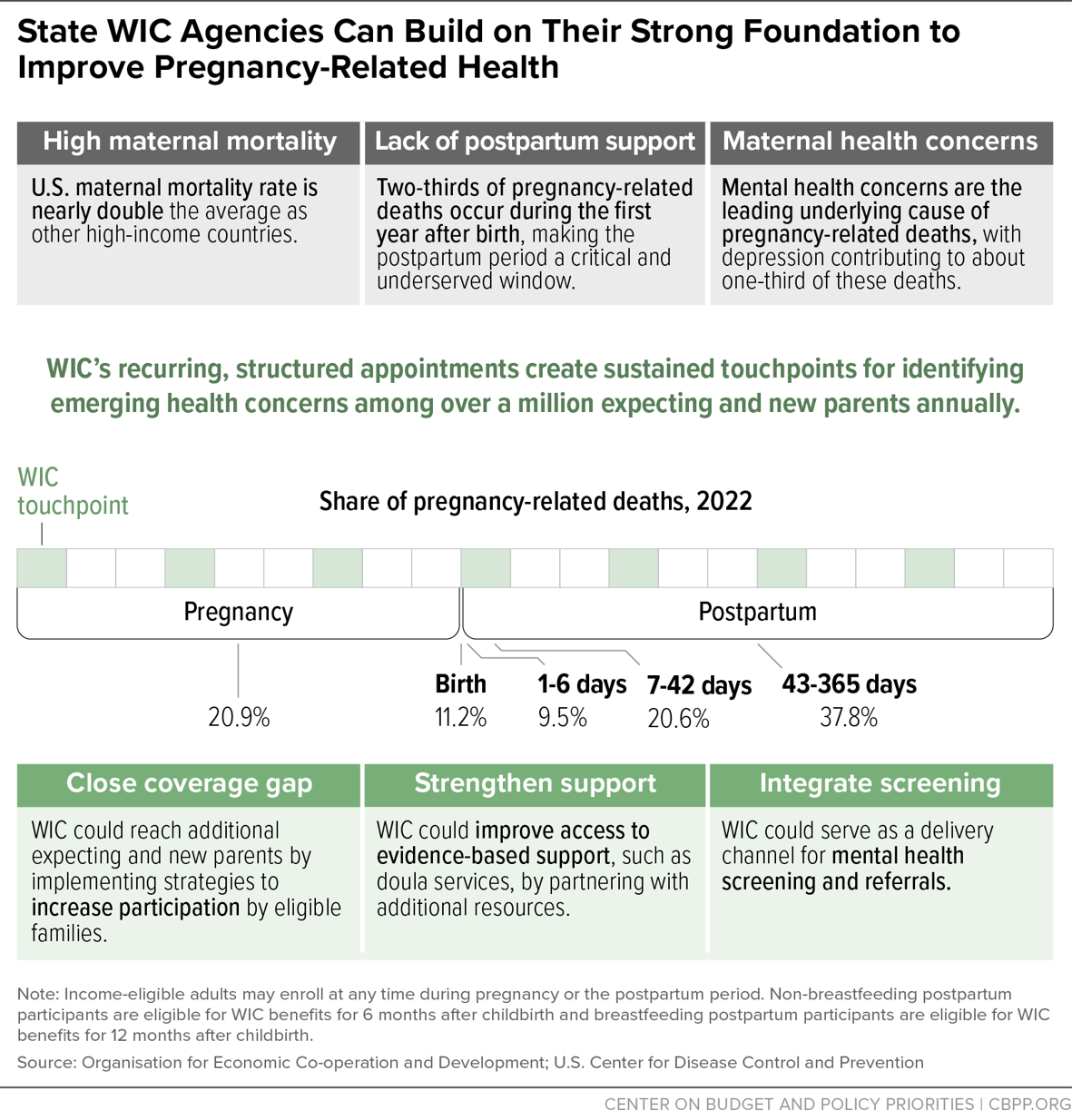
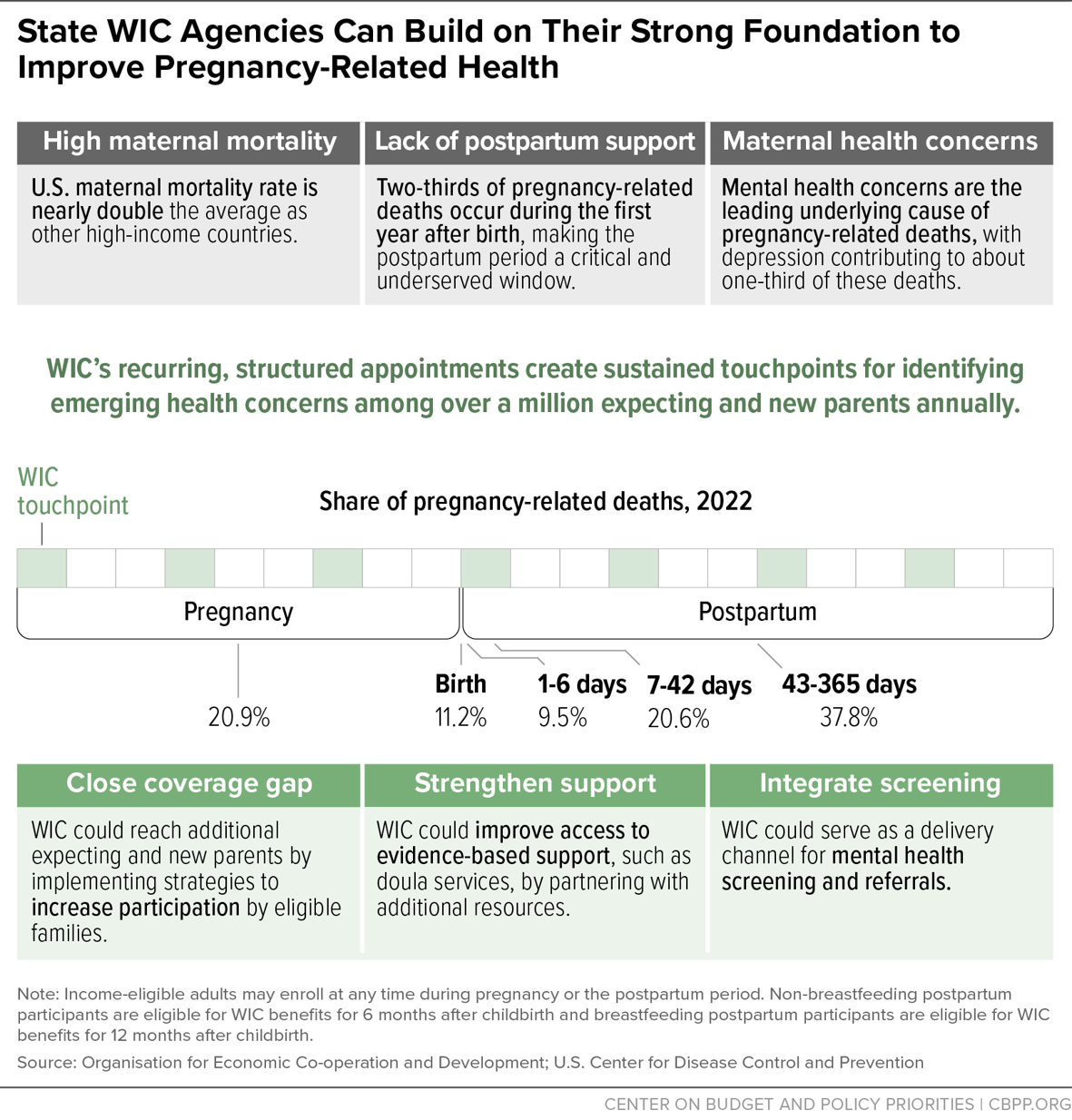
Nearly 33,000 people in the U.S. faced pregnancy complications that resulted in short- or long-term health consequences in 2022, known as severe maternal morbidity. Communities of color experience the greatest rates of pregnancy-related health complications due to systemic racism and economic inequality. Not everyone survives these complications, and two-thirds of pregnancy-related deaths occur during the first year after birth, making the postpartum period a critical and underserved window.
The U.S. maternal mortality rate, which captures the subset of pregnancy-related deaths that occur during pregnancy or within 42 days of the end of the pregnancy, is nearly double the average as those in other higher-income countries. National mortality data shows it has not improved over the past decade and reveals stark inequities — Black and American Indian and Alaskan Native (AIAN) women die from pregnancy and childbirth-related causes at about three times the rate of white women due to social drivers of health, including provider bias and discrimination, and gaps in obstetric care in rural and medically underserved regions.
Mental health conditions are the leading underlying cause of pregnancy-related deaths, and one-third of these mental health-related deaths are attributable to depression. Yet, postpartum depression frequently goes undiagnosed and untreated among people who have low incomes or live in rural areas, where access to routine mental health screening is limited.
In 2023 the American College of Obstetricians and Gynecologists (ACOG) issued its first-ever clinical practice guidelines for the screening, diagnosis, and treatment of perinatal mental health conditions. ACOG recommends screening at the initial prenatal visit, later in pregnancy, and again at postpartum visits. Turning that recommendation into practice, especially for low-income families, requires a care delivery system built around recurring, trusted contact — a gap WIC could fill by incorporating mental health screening and referrals for diagnosis and treatment.
WIC Could Play a Stronger Role in Improving Pregnancy-Related Health
WIC already has the reach, recurring contact, and the trust of millions of low-income families. The services WIC provides can directly impact pregnancy-related health. WIC serves over 1 in 5 pregnant and postpartum people nationwide and provides nutritious foods, nutrition education, breastfeeding support, and referrals to health care and social services. Studies show that participating in WIC improves diets and access to prenatal care. And researchers have found that women who report healthy diets rich in fruits, vegetables, whole grains, nuts, and legumes and who limit red and processed meats before and/or during pregnancy tend to have fewer pregnancy complications. Additionally, having consistent and timely prenatal care reduces the risk of pregnancy-related complications.
WIC's recurring, structured appointments create sustained touchpoints for identifying emerging health concerns throughout pregnancy and beyond. Because eligibility lasts for six months postpartum for non-breastfeeding participants and 12 months postpartum for breastfeeding participants, WIC maintains contact with people who have given birth throughout a high-risk window. State WIC agencies can build on WIC’s strong foundation to:
- Close the WIC coverage gap. Only 49.3 percent of all eligible pregnant people and 72.8 percent of all eligible postpartum people participated in WIC in 2023. Despite automatically being income-eligible through Medicaid or SNAP, only 19.3 percent of pregnant Medicaid participants and 20.3 percent of pregnant SNAP participants received WIC benefits in 2023. Closing the WIC coverage gap, by enrolling more of the people who are already eligible, could yield improvements in pregnancy-related health. There are many strategies states can adopt to increase participation by eligible individuals.
- Strengthen WIC’s prenatal and postpartum support for participants. The WIC Maternal Health Center has developed evidence-informed resource guides to help WIC agencies address important pregnancy-related health issues, including urgent maternal warning signs, blood pressure monitoring, and psychosocial screening and referrals. States can draw on these guides to strengthen services for pregnant and postpartum participants. The Foundation for Delaware County in Pennsylvania’s “Family Village” initiative demonstrates how WIC can function as a hub by connecting participants with home visiting nurses, community health workers, and doulas. In addition to connecting participants to community-based providers, this integrated model includes referrals to housing support, immigration assistance, and programming that includes dads, partners, and children with complex medical needs. Expanding this approach to more areas could improve access to evidence-based supports such as doula services, particularly as 26 states and Washington, D.C. now reimburse doulas through Medicaid.
- Integrate postpartum mental health screening. Research finds that screening for postpartum depression in well-baby and other community care settings is effective, making WIC’s existing structure a natural setting for identifying participants in need of care. The Health Resources and Services Administration has already invested in this approach. It is funding 13 state and regional programs to expand providers’ capacity to screen, assess, treat, and refer pregnant and postpartum women for mental health and substance use disorders. WIC could serve as a care delivery channel for expanding screening and referrals to more states. Emerging evidence suggests that WIC clinics can successfully screen participants and connect families to care, indicating that scaling up these services could strengthen postpartum support nationwide.