MÁS ALLÁ DE LOS NÚMEROS
To Public Schools’ Detriment, Some States Continue to Increase Spending on Private School Vouchers
Every child should have access to a quality public education that prepares them for long-term opportunity and success. Yet lawmakers in many states continue jeopardizing that promise by increasing funding for private school voucher programs, often undermining investments in public schools. Instead, states should sustain and increase spending in public schools, which serve 90 percent of all students.
The stakes of state budget choices have been especially high this year as states begin to feel the effects of cuts to federal health care and food assistance programs passed in last year’s Republican reconciliation law as well as their own sweeping tax cuts. Unlike the federal government, states must balance their budgets each year, so when Congress pushes new costs onto states and provides less funding, states must either raise new revenue or cut services.
These pressures led some states to reduce funding for or halt expansion of school voucher programs and evaluate the programs’ value to students’ academic achievement. For example, lawmakers in Louisiana and Mississippi rejected proposed funding increases for their states’ school voucher programs and Georgia lawmakers passed a budget that cut funding for the state’s school voucher program by $41 million.
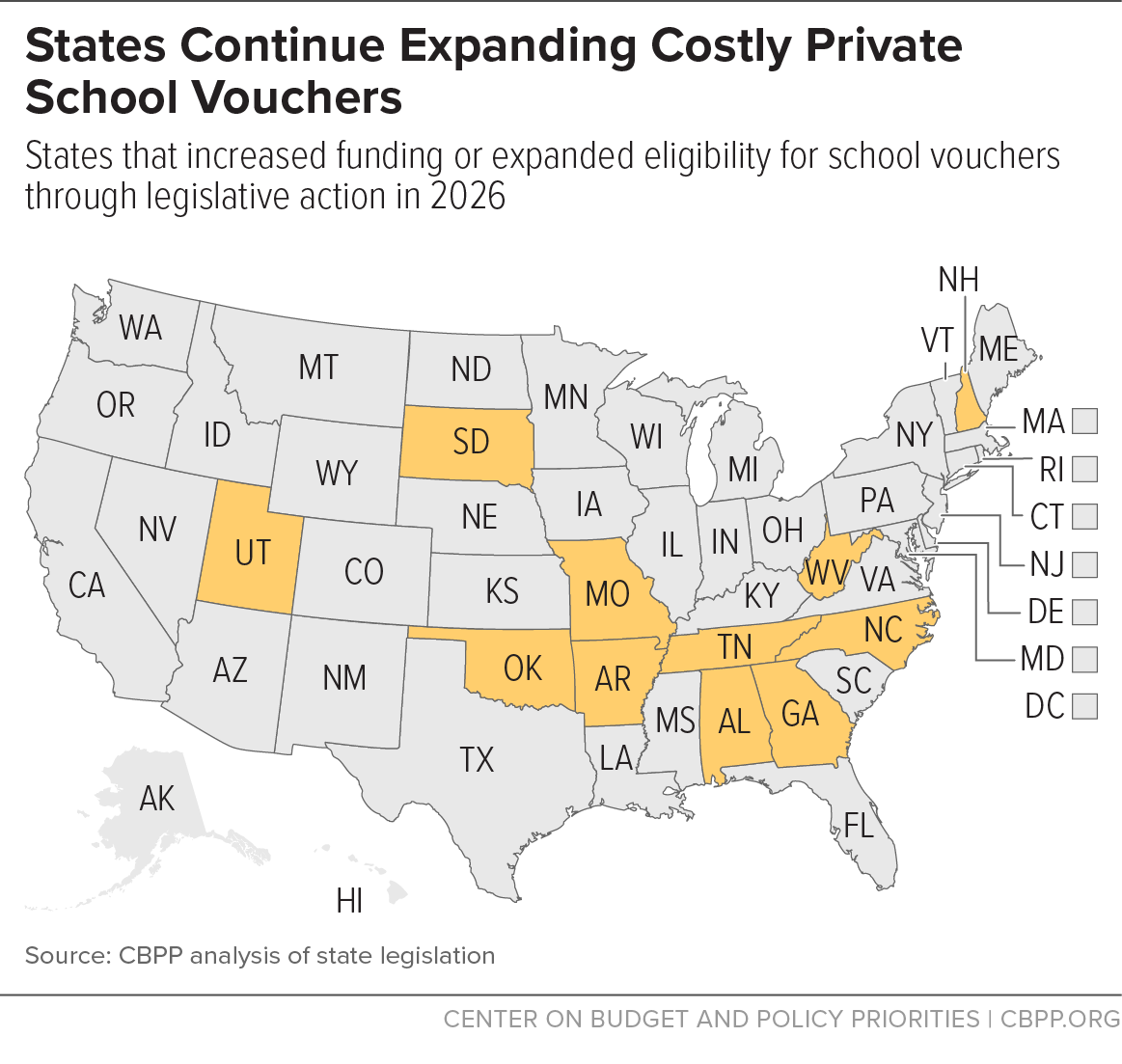
Unfortunately, 11 states passed legislation increasing funding or expanding eligibility for school vouchers in 2026, including:
- Arkansas lawmakers approved the governor’s proposal to increase funding for school vouchers from about $300 million to almost $400 million. More than $1 in $10 of the state’s K-12 spending now goes to school vouchers. That rivals Ohio’s share of education spending on school vouchers, which is the third-highest in the country. The state didn’t make a commensurate effort this year to boost support for public schools, despite the fact that teacher pay has dropped by 8 percent over the last decade when accounting for inflation.
- Tennessee more than doubled its spending on school vouchers — from $144 million to over $300 million — while exposing public schools to more risk by reimbursing them for fewer disenrolling students than lawmakers had previously promised. Legislators increased funding for public schools slightly, but with 2025 per-student spending ranking 51st in the country, the state’s funding levels remain very low despite the small increase.
- West Virginia increased funding for school vouchers from about $100 million to $276 million to cover the costs of a planned expansion in eligibility to all students regardless of prior public school attendance. One-third of these funds will come from a one-time surplus, suggesting the state may not have sufficient ongoing funding for school vouchers alongside its other commitments like public schools and health care. Instead of spending on school vouchers, legislators could have used the recurring funds to fill part of a $225 million deficit in special education services.
Voucher funding is set to rise automatically in other states, including Florida, where it increases with program enrollment, and North Carolina, where lawmakers wrote annual increases into a 2024 law.

In addition to increasing spending on private school vouchers, many states are also opting into the school voucher program funded by federal tax credits that congressional Republicans and President Trump enacted as part of last year’s harmful reconciliation law. Opting into the program won’t directly affect state education funding, but funding for local school districts could decline if the federal program incentivizes more students to leave public schools for private schools and state funding formulas don’t otherwise adjust. When public school enrollment declines, schools often must stretch fewer dollars over a similar amount of fixed expenses.
States should redirect private school voucher program funding to evidence-based services in public schools that serve all students, regardless of ability or identity. The dollars could be particularly effective if applied to services that have been shown to address disparities in academic outcomes along lines of race and socioeconomic status, including recruiting and retaining effective teachers and high-impact tutoring programs.
States should also consider limiting eligibility for school vouchers, requiring private schools that receive public funds to meet the same data-reporting standards as public schools, or ending school vouchers altogether, as Illinois did in 2023. When state budgets are being squeezed, lawmakers should prioritize public funds for public schools because they are required to serve all students.