MÁS ALLÁ DE LOS NÚMEROS
As Budgets Tighten, Some State Lawmakers Reconsider Costly Private School Vouchers
Every child should have access to a quality K-12 education that prepares them for long-term opportunities and success. But lawmakers in some states have jeopardized equitable access to education by enacting costly school voucher programs that siphon public funds away from public schools to subsidize tuition at private schools that are not held to the same standards. However, in the face of historic cuts to federal support for states, some state lawmakers are considering shifting spending priorities away from school voucher programs.
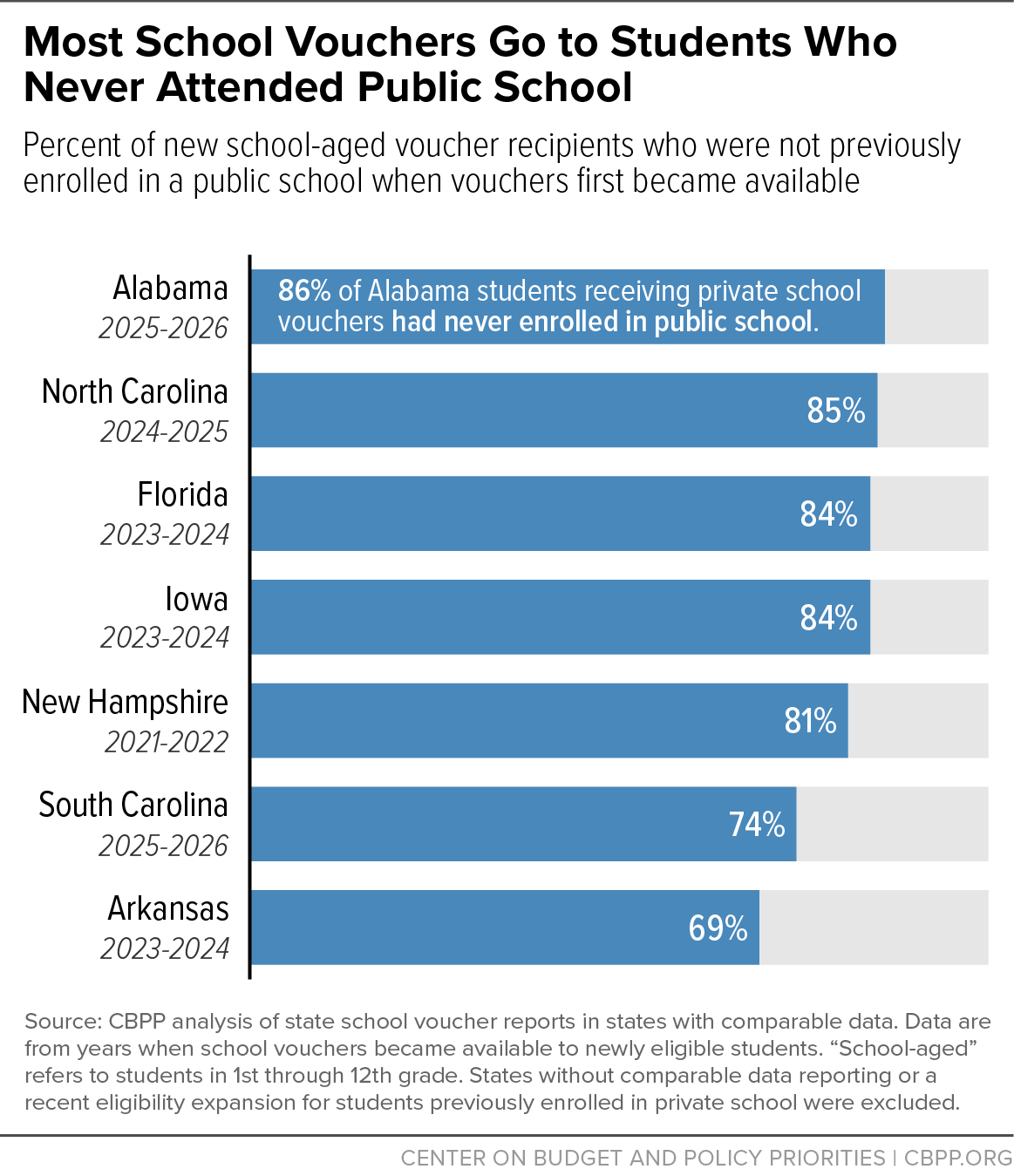
Private school vouchers do little to expand opportunity. An analysis of data from state school voucher programs in seven states that created new or recently expanded existing programs found most newly eligible school-aged students had already been enrolled in a private school or were being homeschooled in the previous year. For example, participation in Florida’s school voucher program doubled in 2023, when the state eliminated income limits, with 84 percent of new 1st through 12th grade voucher recipients having already been enrolled in private school. Given both the cost and who benefits most from school voucher programs, lawmakers should reconsider these programs and instead reprioritize responsible investments in public schools that serve all children, regardless of ability, socio-economic status, gender, or religious beliefs.

Skepticism about school voucher programs is growing in states that have such programs. For example:
- For the second year in a row, Louisiana Senate leaders indicated they may reject Governor Landry’s proposal, currently under consideration, to double spending on school vouchers. They want more information about the vouchers’ impact on student outcomes, especially because prior research found that school vouchers caused declines in Louisiana students’ test scores, particularly in math. Lawmakers chose to fund public school tutoring instead of a private school voucher expansion last year, citing concerns about possible public school funding reductions, lack of voucher-related benefits in rural areas, and ongoing costs, which could reach $500 million annually when fully expanded.
- Senate leaders rejected the Mississippi House of Representatives’ signature school voucher expansion proposal without debate in early February. They cited concerns about new recurring costs of up to about $400 million annually and little accountability for private schools. For example, private schools would not be required to provide essential supportive services for students with disabilities or report student assessment data to the state, as public schools do.
- Georgia’s legislature passed a budget that cuts the state’s school voucher program by $41 million this year due to lack of demand from eligible students in 2025. Current eligibility includes only students from families with low and moderate incomes attending the 25 percent of public schools with the lowest test scores. Low test scores are associated with poverty, but Georgia provides no supplemental funding for economically disadvantaged students. Of 20,000 applicants, only about 8,000 qualified for the vouchers, suggesting demand for private school tuition subsidies is greater among families with higher incomes than among the eligible population. This matches reports from other states, where between 69 and 86 percent of new school-aged voucher users had previously attended private school or were homeschooled prior to vouchers becoming available. (See figure above.)
- Florida’s Senate Bill 318 (SB 318), which would have added guardrails to the state’s $4 billion school voucher programs, ultimately failed this year, though it did have bipartisan support from Senate lawmakers and could be reconsidered next year. This legislation was introduced to address a dearth of financial accountability uncovered in program audits. Florida lost track of as many as 30,000 students, resulting in late payments of $47 million to school districts and between $60 million and $110 million in excess voucher payments. SB 318 would have required voucher overpayments to be returned to the Department of Education within 30 days and guaranteed minimum payments to school districts, among other accountability measures. A 2020 Urban Institute report found that close to 60 percent of Florida voucher students returned to public school within two years, so guardrails, like those in SB 318, to ensure that public schools receive adequate funding for the students they educate are critical.
- The South Carolina senator who sponsored the state’s 2025 school voucher law is now supporting a proposal, being considered as part of the state budget, to prevent giving $7,500 vouchers to children who are being homeschooled and have not previously received them. While the original law excluded children who were being homeschooled, the state agency implementing the program has allowed certain homeschooling set ups to qualify for the voucher. Additionally, some lawmakers have expressed concerns over a lack of data on the overall voucher program, including the homeschool component. South Carolina’s school voucher program was modeled after Arizona’s program, which, according to one report, has enabled parents to misspend over $10 million on items including gift cards, luxury hotel stays, and wedding gifts.
As the concerns in these states around cost, effectiveness, and accountability demonstrate, careful monitoring of school voucher programs and honest assessment of their performance and cost are critical. Given the fiscal challenges states are now facing, including the billions of dollars of cuts in areas such as SNAP and Medicaid enacted last year, costly state-enacted tax cuts, and other pressures, now is the time for state policymakers to take stock of funding priorities, including the needs of public schools, which serve 90 percent of our nation’s children. Policymakers have opportunities to improve education in the states listed above, where at least half of students attend schools in chronically underfunded districts. Research suggests additional school funding can improve student outcomes, especially for economically disadvantaged students and students of color. One way to help ensure that schools have the funding they need is to reject any further school voucher program expansions and scale back school voucher spending by limiting eligibility and improving oversight and accountability, in addition to raising and protecting revenue.