MÁS ALLÁ DE LOS NÚMEROS
Cuts to Health Care, Food Assistance, and Income Support to Fund Tax Cuts for the Wealthy Would Worsen Housing Instability and Homelessness
In the wealthiest nation in the world, we have the resources to ensure everyone can afford necessities, including a safe, affordable place to live, enough food, and access to quality health care. But Republican budget proposals to deeply cut health coverage, food assistance, and income support to pay for tax cuts for the wealthy would do the opposite.
Everyone’s housing, food security, health care access, and other basic needs depend on having enough income to cover each of these costs. But millions of families’ incomes are too low, through no fault of their own, making it difficult to meet basic needs without help. While wages for lower-paid workers have recently trended upward, that doesn’t make up for the 40 years of stagnant or declining wages prior to the pandemic. And many people take care of children or relatives or have barriers to work, such as chronic health conditions or disabilities, that result in lower incomes.
Cuts to programs providing basic support — including Medicaid, the Supplemental Nutrition Assistance Program (SNAP), Supplemental Security Income (SSI), and Temporary Assistance for Needy Families (TANF) — increase family expenses. This puts households already facing unaffordable rents at greater risk of losing their housing and undermines efforts to rehouse people experiencing homelessness. Policymakers should reject these cuts and similar proposals that put the wealth of a few ahead of the basic needs of many. In addition, policymakers should expand rental assistance, ultimately building toward a rental assistance guarantee.
The Republicans’ proposed cuts come at a time when more people than ever are being forced into homelessness or are spending more than half their income on rent. Rent is generally deemed affordable when a family pays 30 percent or less of their income for housing. However, three out of four households who need and qualify for rental assistance can’t access it because of chronic underfunding. As a result, many people pay more than 30 percent of their income for rent. More than 24 million people living in over 12 million low-income households who spend more than half their income on rent. These households have little left over after paying rent each month to cover groceries, health insurance copays or premiums, or other basic needs, like gas, diapers, or school supplies.
Families that would lose assistance through Medicaid, SNAP, SSI, and TANF due to Republican cuts may have to make agonizing trade-offs, like using money needed for rent to feed their children and buy their medications. This could put families at risk of eviction or homelessness and make it harder for those already experiencing homelessness to secure housing. Access to health and income supports are critical components of highly effective strategies that pair rental assistance with personalized health and social services to help unhoused people gain permanent housing.
Republican House and Senate budget plans are poised to make it harder for families who are already struggling to afford housing and other basic needs. Specifically, Republican proposals to reduce supports for basic needs would:
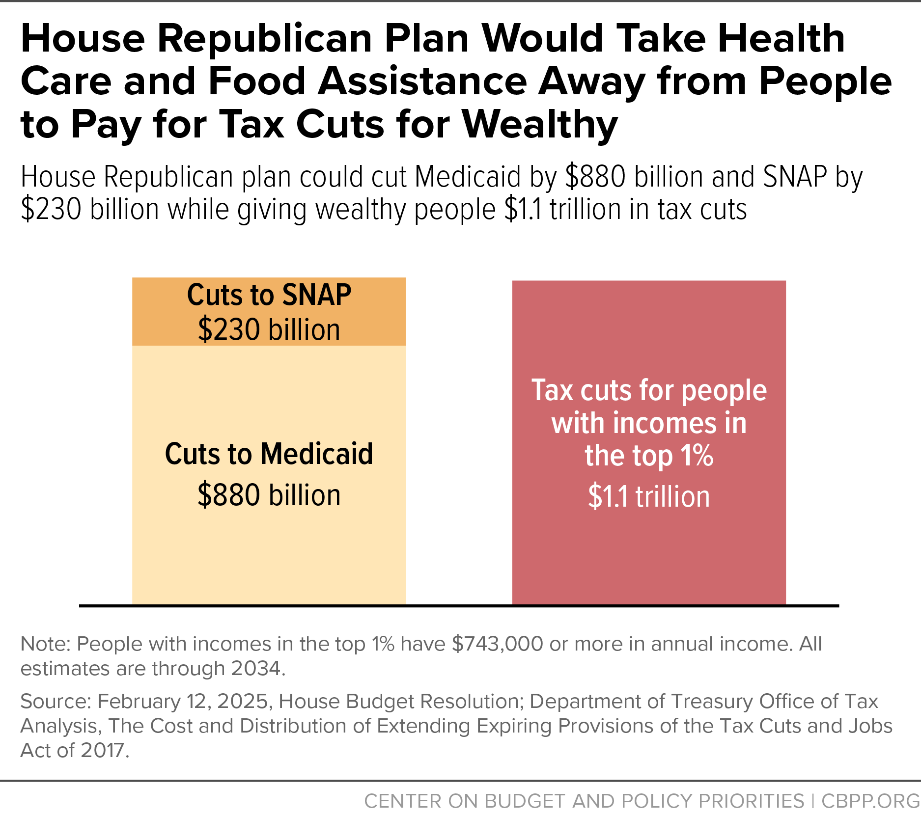
Cut Medicaid funding, leaving more people uninsured or unable to access critical health care services. The House budget proposal could cut Medicaid by $880 billion or more. (See Figure 1). The specifics for reaching these cuts haven’t been finalized, but Project 2025 and other recent Republican proposals provide a roadmap. For example, Republicans in Congress have floated one proposal that would make it prohibitively costly for states to maintain the Medicaid expansion, which currently covers 20 million adults with low incomes. Other proposals would put health coverage at risk for millions by taking it away from people who can’t prove they meet ineffective and burdensome work requirements; arbitrarily capping Medicaid funding to states below what is needed to keep pace with rising health care costs; and otherwise shifting costs onto states.
Any of these cuts would make it likely that many or all states would reduce costs by taking away coverage, lowering provider payment rates, reducing benefits, or a combination of all three. These include services that help people stay housed, such as limiting mental health and substance use services; housing-related and other health-related social needs services; or the number of seniors and people with disabilities who get services to help them live in their communities instead of institutions.
- Cut SNAP benefits and create more red tape for people who need help affording food. SNAP is our nation’s most effective and important tool to fight hunger, reaching about 1 in 8 people in the U.S., including 1 in 5 children. Yet the House budget plan lays out the possibility of cutting $230 billion or more from the SNAP program. Again, the specifics have not been finalized, but we know from past Republican proposals and recent reports what they are considering. Some proposals include cutting benefits for all 40 million people who use SNAP to put food on the table, punishing people who increase their incomes or build savings by taking away food assistance, or expanding harsh penalties that take food away from people who can’t prove they meet harsh work requirements. Another proposal would undermine SNAP’s ability to respond to growing need, such as during recessions.
- Cut TANF income assistance to families with the lowest incomes or make TANF’s already harsh work requirements more inflexible. Such proposals would take away income assistance for necessities such as rent, utilities, and school supplies from some of the nation’s lowest-income families. Families could also lose access to important services and supports, such as child care. TANF funding has already lost half of its value due to inflation because Congress has not increased funding since the program was established in 1996.
- Slash SSI benefits to families with disabled children. SSI already has very strict eligibility criteria and provides a modest benefit, averaging $650 a month, for a child with disabilities. Some proposals would cut children’s SSI benefits if another member of the family receives SSI, which would make it harder for hundreds of thousands of families to meet their basic needs.
Congress should reject cuts to economic and health security programs that will make it harder for people to meet their basic needs and increase their risk of eviction and homelessness. Instead, policymakers should strengthen assistance for people struggling to make ends meet by expanding rental assistance toward the goal of providing it to everyone who needs it, increasing access to food assistance and affordable health coverage, encouraging states to invest more TANF funds in income support, increasing how much families receiving SSI can have in earnings and savings, and expanding the Child Tax Credit. These investments will complement each other and help ensure everyone has the resources they need, and nobody has to live on the streets, in shelters, in parks, or in their car.