

2025 Budget Stakes: Millions Could Lose Needed Food Assistance
Republican proposals Congress could consider this year would take away or reduce food assistance from tens of millions of people who need it to afford groceries. A range of proposals, including a menu of spending cuts that House Republicans are reportedly considering, would fundamentally reshape the Supplemental Nutrition Assistance Program (SNAP), our nation’s most effective and important tool to fight hunger, and weaken food assistance programs focused on helping children in families with low incomes.
Republican Proposals Would Cut, Radically Restructure SNAP
Roughly 40 million people — children, parents, older adults, disabled people, workers, and other low-income people — receive food assistance from SNAP each month, including 1 in 5 children. Studies show that people who participate in SNAP are less likely to be food insecure; they also have better health and lower medical costs, and children do better in school.

Due in part to long-standing discrimination and racism, Black, Hispanic, and multiracial households have higher poverty rates and higher rates of food insecurity than white households. They are therefore more likely to be eligible for, and participate in, SNAP.
Proposals under consideration that would reduce households’ access to needed SNAP benefits include:
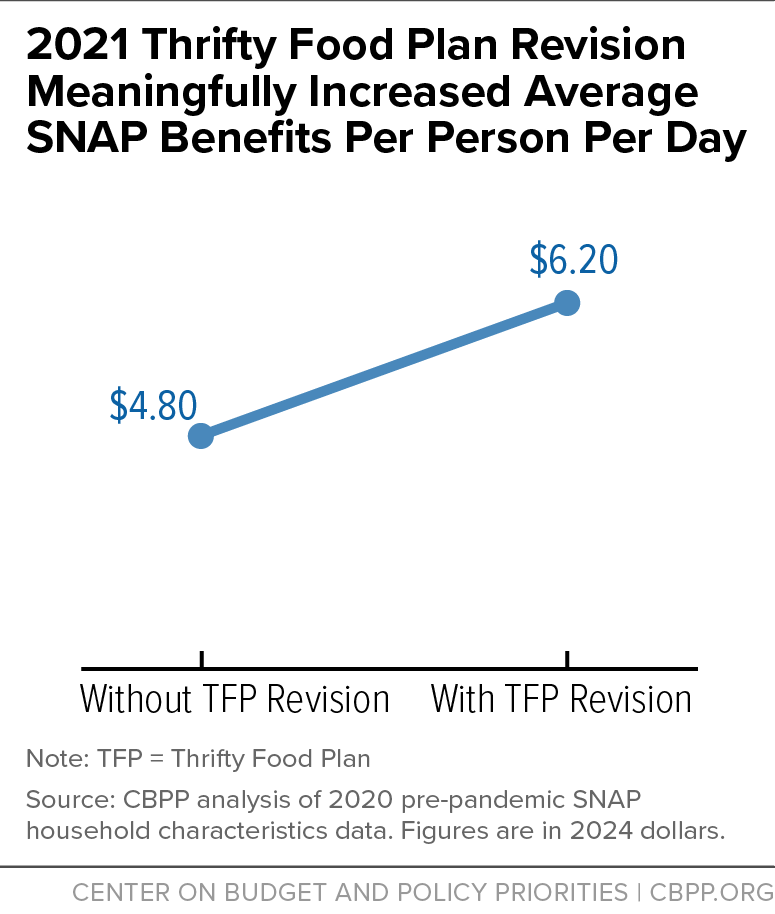
Cutting SNAP benefits by preventing the Agriculture Department from adjusting benefit levels to keep up with the cost of a healthy, realistic diet. SNAP benefits are based on the cost of the Agriculture Department’s Thrifty Food Plan, which represents a nutritionally adequate diet at minimal cost. The latest update to the plan, in 2021, resulted in a modest but meaningful increase in SNAP benefits, which average $6.20 per person per day in 2025. The adjustment lifted more than 2 million SNAP participants above the poverty line.
Restricting future updates so they couldn’t reflect current dietary guidance and the types of foods people eat would cut benefits for all participants by more than $30 billion over the next decade, the Congressional Budget Office estimates. Reversing the 2021 update would immediately cut benefits for all participants to $4.80 per person per day, on average, and cut SNAP by more than $250 billion over the next decade.
Taking food assistance away from people by expanding SNAP’s harsh, ineffective work requirement. Under current rules, most non-elderly, non-disabled adults without children in their homes can’t receive benefits for more than three months out of every three years if they don’t document they are working at least 20 hours per week. Studies show this three-month limit doesn’t increase employment or earnings; it just cuts people off from needed help to buy groceries, deepening poverty and increasing hardship. Most SNAP participants who can work do work, often in key service or sales roles like cashiers, cooks, or home health aides. Applying the limit to more groups of people, such as those in areas with insufficient jobs, adults aged 55-64, parents of school-age children, veterans, people experiencing homelessness, and youth who have aged out of foster care, would only make it harder for more people to afford enough food.
Forcing deep SNAP benefit cuts by radically altering SNAP’s funding structure. Under current SNAP rules, food assistance that’s sufficient to afford a very low cost but realistic, healthy diet is available to every household that qualifies and applies for help. SNAP expands automatically to meet increased need when the economy weakens and then shrinks when the economy recovers. But this structure would be weakened by requiring states to pay a portion of SNAP benefit costs, which are currently 100 percent federally funded, for the first time. Shifting even a small share of SNAP benefit costs to states would strain state budgets and force states to cut benefits or restrict eligibility. This harm would be particularly acute during recessions, when state revenues plummet but more people need food assistance, worsening food insecurity and undermining SNAP’s role as an important economic stimulus.
Eliminating SNAP eligibility for certain working families and those with modest savings. A long-time option lets states phase out SNAP benefits more gradually as incomes rise so households can take slightly higher-paying jobs and still benefit from SNAP. It also lets states adopt less-restrictive asset tests so families, older adults, and people with a disability can have modest savings without losing SNAP. Eliminating this option would terminate SNAP for more than 3 million people. Children whose households lose eligibility for SNAP because of this change would also lose automatic eligibility for free school meals.
Proposals Would Weaken Child Nutrition Programs
Congress may also consider proposals that would weaken child nutrition programs, including:
Making it harder and more stigmatizing for children in low-income communities to get free school meals. Schools in every state serving large numbers of children in low-income families can provide free school meals to all students, reducing administrative costs and eliminating the stigma children can feel about getting free meals. Under one proposal to restrict this option, 24,000 schools serving 12 million children, across every state, would no longer be able to provide free meals to all students.
Gutting food assistance programs that help children in summer, when children don’t get school meals. The Summer EBT program provides grocery benefits to roughly 21 million children in low-income families. The Summer Food Service Program provides meals to more than 2 million children on average each day when school is out. Gutting these programs would leave more children without enough to eat in the summer, when children’s food hardship spikes, and would increase families’ grocery bills.
Alternative Path Could Improve Access to Food Assistance
The extreme agenda represented by proposals like these, which would make millions of people worse off while extending and expanding tax breaks for wealthy households and businesses, is the wrong direction for our nation. A far better path would be to ensure people have the resources they need to thrive, such as by increasing access to food assistance, not reducing it.
For example, Congress should eliminate SNAP rules that prevent many people from participating in the program. These include formerly incarcerated individuals with drug felony convictions, who now face a lifetime ban on SNAP in some states, and residents of Puerto Rico, American Samoa, and the Commonwealth of the Northern Mariana Islands, where eligibility for food assistance and/or benefit levels are more limited because these territories are excluded from SNAP.