

Congressional Republicans Can’t Cut Medicaid by Hundreds of Billions Without Hurting People
Medicaid is a popular program that covers 72 million people.[1] The majority of U.S. adults across party affiliations oppose cuts to Medicaid.[2] Nevertheless, Republicans in Congress want to pass deep and damaging cuts to Medicaid to pay for tax cuts for wealthy people as part of their budget legislation. This has led to enormous pushback, and some Republicans are now claiming their changes would not hurt eligible people who are enrolled in Medicaid to receive the health care they need. This is false. Republicans’ push to cut Medicaid by hundreds of billions of dollars has led them to consider a set of policies that would, indeed, harm Medicaid enrollees. (See Figure 1.)
Some of these proposals will directly and immediately reduce the number of people who receive Medicaid, which is how the policies save money. Some policies take aim at the Affordable Care Act (ACA) Medicaid expansion and would achieve many of the same goals as ACA repeal.[3] Other policies will upend Medicaid financing and payment arrangements and pass the cost onto states, which likely will be unable to absorb these new costs. These cuts could push states to cut funding for other state programs and services or cut Medicaid eligibility, benefits, provider payments, or some combination of the these.
These changes will hurt people’s access to health care and their health. Deep Medicaid cuts would mean a person could lose health coverage through Medicaid and be unable to get cancer treatment, that an older adult loses the home-based care they need to stay out of an institution, or that a young adult can’t get insulin to control their diabetes.
Health care is a basic need, and Medicaid provides that for a broad range of low- and moderate-income people in our country, including children, adults with low incomes, seniors, and people with disabilities. Cutting Medicaid by taking away coverage and shifting costs to states will have long-term and expensive repercussions, including worse health outcomes, greater costs to hospital systems, and straining state and local economies. Cutting Medicaid is ill-advised and should be rejected.

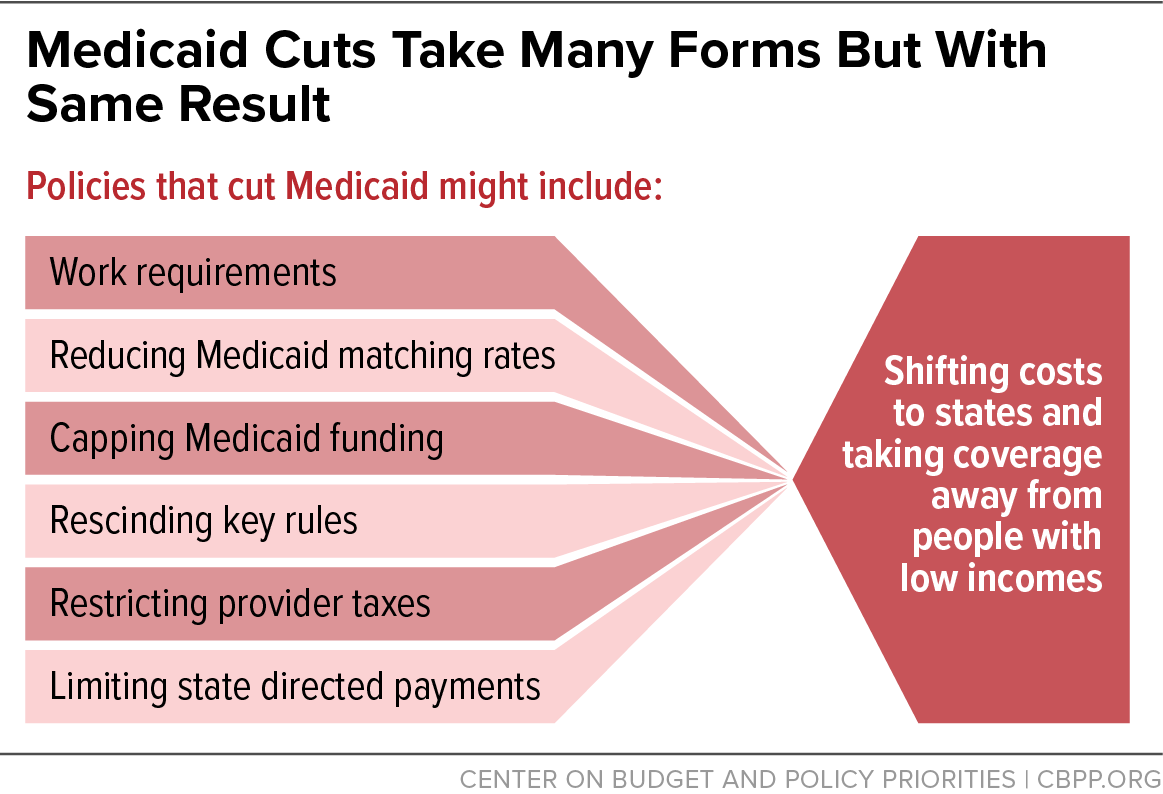
Some Policies Will Cut Medicaid by Reducing the Number of Enrollees, Others Will Cut Medicaid Funding and Push States to Make Cuts
Some policies Republicans are considering will directly and immediately reduce the number of people who receive Medicaid, which is how the policies save money. Other policies will upend Medicaid financing and payment arrangements and may leave states with little choice but to cut eligibility, benefits, provider payments, or all three.
Medicaid is the largest shared state-federal program, with nearly two-thirds of overall state expenditures coming from federal dollars. Some Medicaid proposals would reduce federal funding by seeking to shift greater costs onto states, such as by requiring them to pay for a larger share of the cost of Medicaid. Given the sheer scope of federal support that Medicaid provides to states, along with the fact that states’ own revenue collections are showing signs of strain, policymakers at the state and local level are highly unlikely to backfill all the federal funding lost.[4]
The following sections describe among the most frequently discussed proposals to cut Medicaid funding.
Take Coverage Away From People Who Do Not Meet Unnecessary and Burdensome Work Requirements
CBPP estimates that 36 million Medicaid enrollees could be at risk of having their coverage taken away under various work requirement proposals — a loss that would affect people in every state.[5] Work requirements are burdensome and unnecessary because 92 percent of people who receive Medicaid are already working full or part time, or they are not working because they are a caregiver, have an illness or disability, or are attending school.[6]
Nevertheless, they would still be at risk of losing coverage. Work requirements lead to coverage losses among people who cannot navigate complex work-reporting and verification systems, people who can’t navigate the exemption process, and people who have been laid off or are otherwise unemployed, often temporarily. Work requirements cut coverage, and they do not increase employment,[7] leading the Congressional Budget Office to conclude when analyzing a recent proposal that “the employment status of and hours worked by Medicaid recipients would be unchanged.”[8]
Finally, proposals to apply work requirements only to the people covered by the ACA’s Medicaid expansion are just as problematic.[9] Focusing on this smaller group does not eliminate concerns that parents, older adults, veterans, and people with disabilities will lose coverage; they are among the more than 20 million adults who have gained coverage thanks to the Medicaid expansion. Any work requirement risks kicking people off Medicaid.
Reduce Federal Matching Rates
A variety of Republican plans have proposed cutting the matching rate for medical services, either for states that currently have a 50 percent match, for the District of Columbia, or for the entire Medicaid expansion population.[10] They have also proposed cutting some matching rates that apply to administrative services in Medicaid; the targeted administrative matching rates help keep nursing home residents safe through inspections; promote high-quality care; help support states’ Medicaid Fraud Control Units; and help states maintain efficient, accurate systems that are vital for modernization projects, which help protect Medicaid’s program integrity. Any of these reductions in the matching rate would shift costs to states and some would result in people losing coverage.
Indeed, some Republicans have, at times, publicly backed away from the proposal to reduce the federal 90 percent matching rate that applies to Medicaid expansion enrollees, likely because the harm to people is crystal clear. The Urban Institute estimates that up to 10.8 million people would become uninsured[11] if states respond to massive funding reduction by dropping their expansions (a possibility due in part to state laws that require some states to drop their expansions if the federal government’s commitment drops).[12] And some of the rest of the more than 20 million people — including veterans, people experiencing homelessness, parents, and people with disabilities — who now have health coverage thanks to the Medicaid expansion would experience higher costs.[13] While some states might maintain coverage for some or all of their expansion population, cutting federal funding for the Medicaid expansion will shift major costs to states and lead many to drop the expansion.
Cap Federal Medicaid Funding
Per capita caps impose a hard cap on per-person spending and would disrupt the federal-state financing partnership that has been in place since Medicaid’s start. Per capita caps are explicitly designed to cut federal Medicaid funding over time.[14] If federal funding drops sharply, states — nearly all of which must balance their budgets each year — would likely need to close the budget gap by scaling back Medicaid by cutting people from the program, slashing benefits for remaining enrollees, reducing payments to hospitals and physicians — or a combination of all three.[15] The Urban Institute projects a per capita cap could cut federal Medicaid spending between $676 billion and $1.1 trillion.[16] Optional services, like those that help people with disabilities live in their homes, could be on the chopping block.
Recently, some Republican members have suggested capping the federal government’s spending on the costs of the Medicaid expansion, rather than caps across all of Medicaid.[17] This, too, would jeopardize coverage for millions of people, just like reducing the matching rate for the expansion rate would. It could cut between $72 and $190 billion of federal funding from 2026 to 2034. The cost increases of Medicaid expansion for states that maintain their expansion even in the face of these cuts would average between 41 to 108 percent over this period, increasing each year and reaching 96 to 201 percent in 2034. (See Table 1.)
Change Medicaid Eligibility Rules to Make It Harder for People to Get and Keep Coverage
The Biden Administration finalized two important rules to make it easier for eligible people — primarily children, seniors, and people with disabilities — to access and retain Medicaid. Some Republicans are advocating to reverse these rules and reinstate — or even add — barriers that make it harder for eligible people to access Medicaid coverage.[18] Repealing the rules would increase paperwork and red tape, creating inefficiency and, most importantly, discouraging people from enrolling. The savings would come from eligible people not enrolling or, put another way, the cost savings would come at the expense of low-income people’s access to health care.[19]
Republicans have also touted policies like requiring states to conduct renewals for Medicaid enrollees every six months, rather than every year, as is the case for most enrollees (and people with private coverage). Such a policy would increase waste by increasing state administrative costs to check coverage more frequently and to re-enroll people who lose coverage due to more administrative barriers. But it would also harm enrollees. More frequent eligibility checks would cause more eligible people to inappropriately lose coverage for procedural reasons — not because the state determined they were no longer eligible for Medicaid, but because they didn’t receive a notice, didn’t understand what they needed to do to keep their coverage, didn’t return documents on time, or the Medicaid agency didn’t process the paperwork in a timely way.[20]
Rescind a Rule Intended to Keep Nursing Home Residents Safe
The Biden Administration also finalized rules intended to keep nursing home residents safe by requiring minimum staffing standards as well as more reporting and transparency of pay for direct care and support staff.[21] Medicaid is the primary payer for more than 6 in 10 residents in nursing facilities. Lowering nursing home standards would hurt both Medicaid and Medicare and set back efforts to ensure safe, quality care for seniors and other people who need nursing facility services. Rescinding the standards in the rule, which are due to be phased in over multiple years beginning May 2026, would save the states and the federal government money at the expense of nursing home residents’ health and safety.
Restrict Provider Taxes, a Core Tool States Use to Raise Revenue
Medicaid financing rules are complex, but they are bounded by long-standing statutes, regulations, and guidance that establish a state-federal funding partnership. The goal of these standards is to help ensure that states contribute their share of financing, and that they have flexibility to raise funds to support Medicaid and pay providers.[22] States must follow Medicaid law and regulations designed to ensure that they contribute a minimum amount of support to the program; do not use federal Medicaid dollars as the source of their share; and use the federal funds they receive to serve Medicaid enrollees.
Today, every state but Alaska uses health-care related taxes, assessments, or fees — often known as provider taxes — such as taxes on the number of hospital facility beds or nursing home revenue, to raise state funds to help pay for Medicaid.[23] States have used the revenue from provider taxes to help pay for adjustments in provider reimbursements to keep pace with increased health costs; to avert cuts in Medicaid benefits; and to expand Medicaid benefits and eligibility, including to support the ACA Medicaid expansion. These are a long-standing and integral part of state Medicaid budgets, as Nevada’s governor, a Republican, recently reiterated.[24]
If provider taxes were restricted, states would have to make hard choices about how to pay their share of Medicaid costs to sustain their current programs.[25] If states could simply provide other financing to replace the revenues from provider taxes, federal Medicaid spending (which covers a specified share of state Medicaid costs) would remain unchanged. But the Congressional Budget Office (CBO) predicts that barring or sharply restricting states from using provider taxes would produce federal savings because CBO expects that states would not be able to replace all the lost revenue and would cut their Medicaid programs to offset the loss of funds.[26] If states lose provider tax revenue and cut spending on Medicaid as a result — through eligibility or benefit cuts or provider cuts that harm enrollees by reducing their access to care — overall federal support for state Medicaid programs will decline, which is the goal of such policies.
Limit or Eliminate State Directed Payments
In recent years, a growing number of states have used state directed payments (SDPs) to require Medicaid managed care plans to increase provider rates or set minimum rates for a specified type of provider to improve access or quality. Subject to certain rules, SDPs allow states to direct managed care programs to make payments to providers deemed necessary to carry out state-defined objectives, including participation in value-based purchasing models and ensuring adequate provider payments, among other policies. [27] SDPs are an exception to the general rule prohibiting states from directing expenditures by managed care plans to providers.
The Biden Administration recently finalized rules to both set limits on SDPs and to require enhanced reporting and transparency around SDPs. However, congressional action that would indiscriminately limit or eliminate SDPs would result in cutting provider rates and likely result in terminating state-designed initiatives to promote better quality and access for enrollees.
Cutting Medicaid Funding Will Widen Health Inequities
The proposals described above will cut billions of dollars from Medicaid by taking coverage away from millions of people or shifting the cost of maintaining coverage and access to states, which likely will scale back their Medicaid programs to deal with the funding shortfall. To close the gap, states will cut Medicaid eligibility, benefits, or provider rates, or make other hard choices to balance their budgets.
These cuts will affect people in every state and of all races and ethnicities. Medicaid has helped to narrow health inequities for people with low incomes across the country, including rural residents of all races and especially Black, Latino, and Indigenous people who experience unique barriers to health care. Cutting Medicaid funding would particularly harm these people and make people less healthy.
| TABLE 1 | |||
|---|---|---|---|
Impact of a Medicaid Expansion Per Capita Cap, FY 2026-2034 | |||
| Current state-funded expansion spending ($ millions) | Increase in state-funded expansion spending ($ millions) | ||
| Under CPI-U | Under CPI-U + 1.6 | ||
| Expansion states | 175,410 | 189,828 | 71,847 |
| Alaska | 456 | 493 | 187 |
| Arizona | 5,370 | 5,811 | 2,199 |
| Arkansas | 2,947 | 3,189 | 1,207 |
| California | 33,260 | 35,993 | 13,623 |
| Colorado | 2,776 | 3,004 | 1,137 |
| Connecticut | 2,884 | 3,121 | 1,181 |
| Delaware | 770 | 834 | 316 |
| District of Columbia | 731 | 791 | 299 |
| Hawai‘i | 946 | 1,024 | 388 |
| Idaho | 874 | 946 | 358 |
| Illinois | 6,189 | 6,698 | 2,535 |
| Indiana | 4,133 | 4,473 | 1,693 |
| Iowa | 1,626 | 1,760 | 666 |
| Kentucky | 4,971 | 5,380 | 2,036 |
| Louisiana | 5,219 | 5,648 | 2,138 |
| Maine | 764 | 827 | 313 |
| Maryland | 4,521 | 4,893 | 1,852 |
| Massachusetts | 3,676 | 3,979 | 1,506 |
| Michigan | 7,434 | 8,045 | 3,045 |
| Minnesota | 3,067 | 3,319 | 1,256 |
| Missouri | 3,268 | 3,537 | 1,339 |
| Montana | 1,195 | 1,293 | 489 |
| Nebraska | 862 | 933 | 353 |
| Nevada | 2,132 | 2,307 | 873 |
| New Hampshire | 424 | 459 | 174 |
| New Jersey | 5,476 | 5,926 | 2,243 |
| New Mexico | 2,444 | 2,645 | 1,001 |
| New York | 18,811 | 20,357 | 7,705 |
| North Carolina | 7,431 | 8,042 | 3,044 |
| North Dakota | 419 | 453 | 172 |
| Ohio | 6,668 | 7,216 | 2,731 |
| Oklahoma | 2,375 | 2,571 | 973 |
| Oregon | 4,956 | 5,363 | 2,030 |
| Pennsylvania | 7,816 | 8,459 | 3,201 |
| Rhode Island | 735 | 796 | 301 |
| South Dakota | 360 | 390 | 148 |
| Utah | 1,120 | 1,212 | 459 |
| Vermont | 379 | 410 | 155 |
| Virginia | 7,024 | 7,602 | 2,877 |
| Washington | 7,349 | 7,953 | 3,010 |
| West Virginia | 1,550 | 1,677 | 635 |
Note: Per capita cap impacts were estimated using fiscal year (FY) 2025 as a base year and two growth rates: the consumer price index (CPI-U) and the CPI-U + 1.6 percentage points (CPI-U + 1.6), which was used to approximate the medical consumer price index (CPI-M) based on historical data. To maintain current Medicaid expansion funding levels, states would have to increase expansion spending by 108 percent under the CPI-U and by 41 percent under the CPI-U + 1.6, on average, from FY 2026 to 2034. Cost shifts would increase each year and, by FY2034, would reach 201 percent under the CPI-U and 96 percent under the CPI-U + 1.6. The percent increase is the same across all states because we assume that each state follows national growth rates in spending and enrollment. The ultimate impact of a per capita cap will depend on specific policy parameters, such as the base year and the cap growth rate, as well as state-specific trends in spending and enrollment. Source: CBPP estimates based on Centers for Medicare & Medicaid Services’ MBES data and Congressional Budget Office projections. Total expansion enrollment and spending from MBES were projected from FY2023 to FY2025. States that adopted Medicaid expansion before 2019 were assumed to return to FY2019 trends in FY2025 to account for differences in pandemic-era spending and enrollment trends. FY2025 estimates for North Carolina and South Dakota, which expanded Medicaid in 2023, were calculated using MACPAC analysis of T-MSIS data and state dashboard enrollment data. | |||
End Notes
[1] KFF, “7 Charts About Public Opinion on Medicaid,” March 7, 2025, https://www.kff.org/medicaid/poll-finding/7-charts-about-public-opinion-on-medicaid/.
[2] Shannon Schumacher et al., “KFF Health Tracking Poll February 2025: The Public’s Views on Potential Changes to Medicaid,” KFF, March 7, 2025, https://www.kff.org/medicaid/poll-finding/kff-health-tracking-poll-public-views-on-potential-changes-to-medicaid/; KFF, “7 Charts About Public Opinion on Medicaid.”
[3] Edwin Park, “Same Playbook: Major Medicaid Cuts under Consideration for Budget Reconciliation Similar to Medicaid Cuts in Failed ACA Repeal Bills from 2017,” Georgetown University Center for Children and Families (CCF), February 24, 2025, https://ccf.georgetown.edu/2025/02/24/same-playbook-major-medicaid-cuts-under-consideration-for-budget-reconciliation-similar-to-medicaid-cuts-in-failed-aca-repeal-bills-from-2017.
[4] Wesley Tharpe and Meg Wiehe, “President Trump, Congressional Republican Proposals Would Shift Large Costs to States, Inflict Widespread Harm,” CBPP, January 30, 2025, https://www.cbpp.org/research/state-budget-and-tax/president-trump-congressional-republican-proposals-would-shift-large.
[5] Gideon Lukens and Elizabeth Zhang, “Medicaid Work Requirements Could Put 36 Million People at Risk of Losing Health Coverage,” CBPP, updated February 5, 2025, https://www.cbpp.org/research/health/medicaid-work-requirements-could-put-36-million-people-at-risk-of-losing-health.
[6] Jennifer Tolbert et al., “Understanding the Intersection of Medicaid and Work: An Update,” KFF, February 4, 2025, https://www.kff.org/medicaid/issue-brief/understanding-the-intersection-of-medicaid-and-work-an-update/.
[7] Benjamin Sommers et al., “Medicaid Work Requirements In Arkansas: Two-Year Impacts On Coverage, Employment, And Affordability Of Care,” Health Affairs, Vol. 39, No. 9, September 2020, https://www.healthaffairs.org/doi/10.1377/hlthaff.2020.00538; Benjamin Sommers et al., “Medicaid Work Requirements — Results from the First Year in Arkansas,” New England Journal of Medicine, Vol. 381, No. 11, June 19, 2019, https://www.nejm.org/doi/full/10.1056/NEJMsr1901772.
[8] Phillip Swagel, Letter to Rep. Pallone re: CBO’s Estimate of the Budgetary Effects of Medicaid Work Requirements Under H.R. 2811, the Limit, Save, Grow Act of 2023,” Congressional Budget Office, April 26, 2023, https://www.cbo.gov/system/files/2023-04/59109-Pallone.pdf.
[9] Morgan Rimmer, “Johnson insists Republicans won’t cut entitlements to pay for Trump’s agenda,” CNN, February 26, 2025, https://www.cnn.com/2025/02/26/politics/mike-johnson-speaker-medicaid-trump-agenda/index.html.
[10] For a discussion of these matching rate policies and estimates of how some would shift costs to states, see Allison Orris and Gideon Lukens, “Medicaid Threats in the Upcoming Congress,” CBPP, updated December 13, 2024, https://www.cbpp.org/research/health/medicaid-threats-in-the-upcoming-congress.
[11] Matthew Buettgens, “Reducing Federal Support for Medicaid Expansion Would Shift Costs to States and Likely Result in Coverage Losses,” Urban Institute, February 24, 2025, https://www.urban.org/research/publication/reducing-federal-support-medicaid-expansion-would-shift-costs-states-and.
[12] Arizona, Arkansas, Illinois, Indiana, Montana, New Hampshire, North Carolina, Utah, and Virginia would quickly end Medicaid expansion if the federal matching rate falls below 90 percent; Idaho, Iowa, and New Mexico are likely to reduce their funding if the matching rate falls. Phil Galewitz, “9 States Poised To End Coverage for Millions if Trump Cuts Medicaid Funding,” KFF Health News, December 4, 2024, https://kffhealthnews.org/news/article/medicaid-expansion-funding-trigger-laws-9-states-trump-administration/; Adam Searing, “Federal Funding Cuts to Medicaid May Trigger Automatic Loss of Health Coverage for Millions of Residents of Certain States,” Georgetown CCF, November 27, 2024, https://ccf.georgetown.edu/2024/11/27/federal-funding-cuts-to-medicaid-may-trigger-automatic-loss-of-health-coverage-for-millions-of-residents-of-certain-states/https://ccf.georgetown.edu/2024/11/27/federal-funding-cuts-to-medicaid-may-trigger-automatic-loss-of-health-coverage-for-millions-of-residents-of-certain-states/.
[13] Gideon Lukens and Elizabeth Zhang, “Premium Tax Credit Improvements Must Be Extended to Prevent Steep Rise in Health Care Costs,” CBPP, November 14, 2024, https://www.cbpp.org/research/health/premium-tax-credit-improvements-must-be-extended-to-prevent-steep-rise-in-health.
[14] Elizabeth Zhang, “4 Reasons Why Lawmakers Should Reject Medicaid Per Capita Caps,” CBPP, February 10, 2025, https://www.cbpp.org/blog/4-reasons-why-lawmakers-should-reject-medicaid-per-capita-caps.
[15] Gideon Lukens and Elizabeth Zhang, “Medicaid Per Capita Cap Would Harm Millions of People by Forcing Deep Cuts and Shifting Costs to States,” CBPP, January 7, 2025, https://www.cbpp.org/research/health/medicaid-per-capita-cap-would-harm-millions-of-people-by-forcing-deep-cuts-and.
[16] John Holahan, Claire O’Brien, and Lisa Dubay, “Imposing Per Capita Medicaid Caps and Reducing the Affordable Care Act’s Enhanced Match,” Urban Institute, February 27, 2025, https://www.urban.org/research/publication/imposing-capita-medicaid-caps-and-reducing-affordable-care-acts-enhanced-match.
[17] Peter Sullivan, “Scoop: House GOP eyes Medicaid expansion moves,” Axios, March 5, 2025, https://www.axios.com/pro/health-care-policy/2025/03/05/house-gop-eyes-medicaid-expansion-moves; Edwin Park, “Imposing a Per Capita Cap on the Medicaid Expansion Would Lead to an Effective Cut in the Expansion Matching Rate for States,” Georgetown CCF, March 7, 2025, https://ccf.georgetown.edu/2025/03/07/imposing-a-per-capita-cap-on-the-medicaid-expansion-would-lead-to-an-effective-cut-in-the-expansion-matching-rate-for-states/.
[18] Jacob Bogage, Jeff Stein, and Dan Diamond, “Trump allies eye overhauling Medicaid, food stamps in tax legislation,” Washington Post, November 18, 2024, https://www.washingtonpost.com/business/2024/11/18/gop-targets-medicaid-food-stamps/.
[19] Jennifer Wagner, “Setting the Record Straight on the Medicaid Eligibility and Enrollment Rules,” CBPP, January 21, 2025, https://www.cbpp.org/blog/setting-the-record-straight-on-the-medicaid-eligibility-and-enrollment-rules.
[20] Jennifer Wagner, “Lessons Learned From Unwinding Can Improve Medicaid,” CBPP, January 29, 2024, https://www.cbpp.org/blog/lessons-learned-from-unwinding-can-improve-medicaid.
[21] Priya Chidambaram et al., “A Closer Look at the Final Nursing Facility Rule and Which Facilities Might Meet New Staffing Requirements,” KFF, May 21, 2024, https://www.kff.org/medicaid/issue-brief/a-closer-look-at-the-final-nursing-facility-rule-and-which-facilities-might-meet-new-staffing-requirements/.
[22] For a discussion of this history, see Sara Rosenbaum and Alison Barkoff, “What Lies Ahead For Medicaid In Budget Reconciliation?” Health Affairs, February 11, 2025, https://www.healthaffairs.org/content/forefront/lies-ahead-medicaid-budget-reconciliation.
[23] KFF, “States With At Least One Provider Tax in Place: SFY 2004 - SFY 2024,” https://www.kff.org/medicaid/state-indicator/states-with-at-least-one-provider-tax-in-place/; see also Alison Mitchell, “Medicaid Provider Taxes,” Congressional Research Service, updated December 30, 2024, https://crsreports.congress.gov/product/pdf/RS/RS22843.
[24] Tabitha Mueller, “Nevada Republican Gov. Lombardo speaks out against GOP’s possible Medicaid cuts,” The Nevada Independent, February 26, 2025, https://thenevadaindependent.com/article/nevada-republican-gov-lombardo-speaks-out-against-gops-proposed-medicaid-cuts.
[25] Edwin Park, “Limiting State Provider Taxes Would Shift Costs to States and Weaken Medicaid,” CBPP, updated March 16, 2016, https://www.cbpp.org/research/health/limiting-state-provider-taxes-would-shift-costs-to-states-and-weaken-medicaid.
[26] Robert Greenstein, “The Misinformed Attack on Medicaid Provider Taxes,” CBPP, December 10, 2012, https://www.cbpp.org/blog/the-misinformed-attack-on-medicaid-provider-taxes; CBO, “Options for Reducing the Deficit, 2023-2032 – Volume I: Larger Reductions,” December 7, 2022, https://www.cbo.gov/system/files/2022-12/58164-budget-options-large-effects.pdf.
[27] 42 C.F.R. § 438.6. Directed payments must be tied to utilization and delivery of services under the managed care contract, be distributed equally to specified providers under the managed care contract, advance at least one goal in the state’s managed care quality strategy, and not be conditioned on provider participation in intergovernmental transfer (IGT) agreements. For more information, see MACPAC, “Directed Payments in Medicaid Managed Care,” October 2024, https://www.macpac.gov/wp-content/uploads/2024/10/Directed-Payments-in-Medicaid-Managed-Care.pdf.