

2025 Budget Stakes: Vulnerable People Could Be Targeted for Painful Cuts
Republican proposals that Congress might consider this year could take away income assistance and services from families with the lowest incomes, children with disabilities, and other vulnerable people, making their lives even harder. A range of proposals, including a menu of spending cuts that House Republicans are reportedly considering, would weaken or even eliminate programs that serve these individuals and families.
Republican Proposals Would Increase Hardship for Low-Income Families
In addition to proposing deep cuts in food assistance and health care for people with low incomes, Congress may consider proposals that would jeopardize income assistance and social services to people struggling to afford the basics, including:
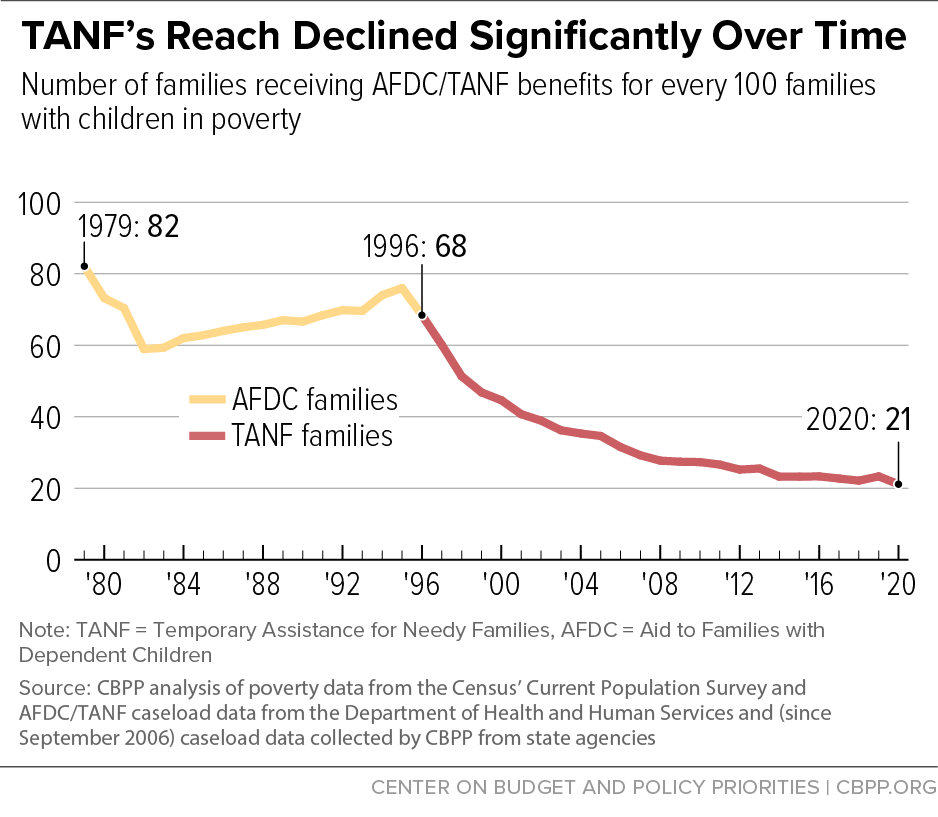
Cutting income assistance to families with the lowest incomes. Some of the nation’s lowest-income families may lose cash assistance needed for necessities such as rent, utilities, and school supplies, as well as access to important services and supports such as child care, if Congress cuts funding for the Temporary Assistance for Needy Families (TANF) program. TANF funding has already lost half of its value due to inflation because funding has not been increased since the program was established in 1996. Further cuts will further erode TANF’s already very limited reach in helping America’s neediest families. Only about 1 in 5 families with incomes below the poverty line receive cash assistance from the program.

Every state receives federal TANF funds as a block grant, and additional “contingency funds” go to some states that meet specified levels of unemployment or Supplemental Nutritional Assistance Program participation and spend more state funds than required under the basic TANF block grant. Any cuts to the block grant or the contingency funds will weaken TANF’s ability to reach low-income families or provide more adequate benefits.
Taking away TANF assistance from people who can’t meet rigid work requirements. More low-income families will have basic income assistance taken away if TANF’s existing work requirements, which Congress tightened in 2023, are made even more stringent. TANF recipients must already show that they comply with work requirements, which focus on documenting enrollment in a narrow set of work activities and not on promoting positive long-term employment outcomes for families. As with other programs, these work requirements act more as a barrier to benefits than a path to employment.
Making work requirements harsher and more inflexible will further cut the number of families TANF assists, a number that has already dropped precipitously since the program’s start.
Slashing SSI benefits to families with disabled children. Some of America’s most vulnerable families and children would be harmed by cutting Supplemental Security Income (SSI) benefits for low-income children with disabilities. SSI provides monthly benefits to low-income seniors and people with disabilities, including children with conditions such as Down syndrome, cerebral palsy, autism, intellectual disability, and blindness. SSI has very strict eligibility criteria for children with disabilities; less than 2 percent of all children and just 11 percent of children with special health care needs receive benefits.
Cutting children’s SSI benefits if another member of the family also receives SSI would harm hundreds of thousands of families, pushing many into, or further into, poverty. Families caring for children with disabilities, especially those with more than one disabled child, are not only more likely than other families to be poor, they also face more material hardships, such as struggling to buy food, being forced out of their homes, or having their electricity shut off.
Eliminating flexible funding that states use to provide social services. Up to 20 million people, including at-risk children, elderly people, and individuals with disabilities, could lose or have reduced access to services if Congress eliminates the Social Services Block Grant (SSBG). This block grant gives states flexible funding to provide services, such as child protective services, foster care, child care, services for disabled people, and assistance for elderly people, including Meals on Wheels.
States direct SSBG funding where the need is greatest. Many concentrate funds on child welfare services, such as West Virginia, which spent 88 percent of its SSBG dollars for that purpose in 2022. Some focus more on child care (where California spent 35 percent of its SSBG), and others on vulnerable adults and elderly people (where Texas directed 36 percent of its SSBG). Similar to TANF, SSBG funding has lost roughly half of its value due to inflation, with no funding increase in over 30 years.
Alternative Path Could Help More Families by Improving Programs
The extreme agenda represented by proposals like these, which would make millions of people worse off while extending and expanding tax breaks for wealthy households and businesses, is the wrong direction for our nation. TANF needs to be improved, not cut. This should include requiring that more TANF funds go to providing basic assistance to needy families and measuring states’ performance based on positive employment and well-being outcomes for families.
SSI also should be strengthened and updated, such as by increasing — for the first time in decades — how much families can have in earnings and savings while remaining eligible. SSBG can also be improved by improving evaluation of the program’s spending. In all cases, policymakers should focus on improving assistance and services to vulnerable people, not cutting the aid that helps them meet their basic needs.