MÁS ALLÁ DE LOS NÚMEROS
Congress, States Have Eroded TANF Programs for 30 Years, Leaving Families With Inadequate Cash Assistance
As Temporary Assistance for Needy Families (TANF) marks its 30th anniversary, we’ve warned how we risk repeating lessons hard-learned from the program’s failures. Namely, TANF’s rules require taking assistance away from people who don’t meet a harsh work requirement, and the 2025 Republican reconciliation law newly applies or expands a similar requirement to other programs that provide people with vital economic and health assistance. But TANF deserves a look in its own right: it’s the main program that provides cash support for families with the lowest incomes, and it has failed to provide that support to many families who need it and to move families to economic security.
Here are several ways in which TANF has failed: it reaches far fewer families living in poverty than at the start of the program; benefits are low and have lost inflation-adjusted value; states spend less on cash assistance for families and more on other, often unrelated, state budget areas; and more than two-thirds of Black children live in states with the weakest TANF programs. As we discuss elsewhere, TANF serves few non-employed single mothers and fails to connect those who may need additional support to sustainable employment.
Everyone should have what they need to provide for themselves and their families, and adequate supports when they don’t, so that every child gets what they need to stay healthy, grow, and learn. Cash assistance is essential to helping families afford their basic needs when they experience poverty or face a crisis that could lead to economic hardship. But TANF’s designers saddled this cash program with punitive policies based on racist narratives about Black mothers and a block grant structure that means funds diminish each year due to inflation and those diminished funds can be used far and wide in the state budget for purposes other than basic income assistance. These policies have made it increasingly difficult for families to meet the high cost of basic needs.
TANF reaches fewer families experiencing poverty than at its start.
There has been a dramatic decline in families receiving assistance, even during periods of high poverty. That’s in large part because Congress structured TANF to give states significant control over, and encouragement to limit, their cash programs. It established a fixed block grant that incentivizes states to spend less on cash assistance; a five-year federal time limit to receive cash assistance, prompting some states to adopt even shorter time limits; and harsh policies that allow states to take away cash assistance from people who can’t meet work requirements or other constraints.
TANF participation fell as a result of these harsh work requirements, time limits, funding constraints, and additional, state-driven access barriers that made it hard for families to apply for and be approved for benefits. In 2023, 4.7 million U.S. families with children were living in poverty, but fewer than 1 million received TANF cash assistance. The “TANF-to-poverty ratio” (TPR) shows that for every 100 families in poverty, only 21 received TANF cash assistance in 2023, down from 68 families in 1996. If TANF had the same reach in 2023 that its predecessor, Aid to Families with Dependent Children (AFDC), did in 1996, it would have helped about 2.4 million more families nationwide that year.
Benefit levels are low and have lost value over the past 30 years.
For those families who receive TANF, the program's monthly cash benefits are far too low to help them meet all their basic needs. Despite increases this year in states like Colorado, Maine, New Hampshire, and North Dakota, the maximum TANF benefit for a family of three in every state was at or below 60 percent of the poverty line. Benefits are at or below 20 percent of the poverty line in 19 states. (The poverty line for a family of three is about $2,277 a month.)
TANF benefit levels were inadequate in most states at the start of the program, and most states have let their benefits erode further. That’s especially true recently, when spikes in inflation mean that TANF benefits are doing even less to cover a family’s basic needs. In 43 states, the real (inflation-adjusted) value of TANF cash benefits has fallen since 1996. Thirteen states have either cut or failed to increase benefit levels since 1996, and these states’ benefit levels have lost nearly 53 percent or more of their value to inflation. In 30 states, benefit increases were insufficient to keep pace with inflation, leading to an average 25 percent loss in value across these states.
The block grant is worth half of what it was at TANF’s start; states spend little on cash assistance.
Under TANF, the federal government gives states a fixed block grant totaling $16.5 billion each year. This amount has not increased since 1996. When accounting for inflation, it’s now worth less than half of its original value. (States are also required to sustain a certain level of their own spending, called maintenance of effort or MOE, which totals $10 to $11 billion per year.)
In fiscal year 2024, states spent less than one-fourth of their combined federal and state TANF dollars on basic cash assistance for families with children. At TANF’s start, 71 percent of federal and state TANF spending went to providing cash benefits to families with children. When TANF participation declined dramatically, many states did not expand eligibility or reinvest the resources into more adequate cash supports for the remaining families. For example, states did not examine the access barriers and other policies that were driving down the share of families eligible for help or increase grants enough to keep pace with inflation. Instead, they diverted resources away from TANF cash assistance to fund other programs and services.
More than two-thirds of Black children live in states with the weakest TANF programs.
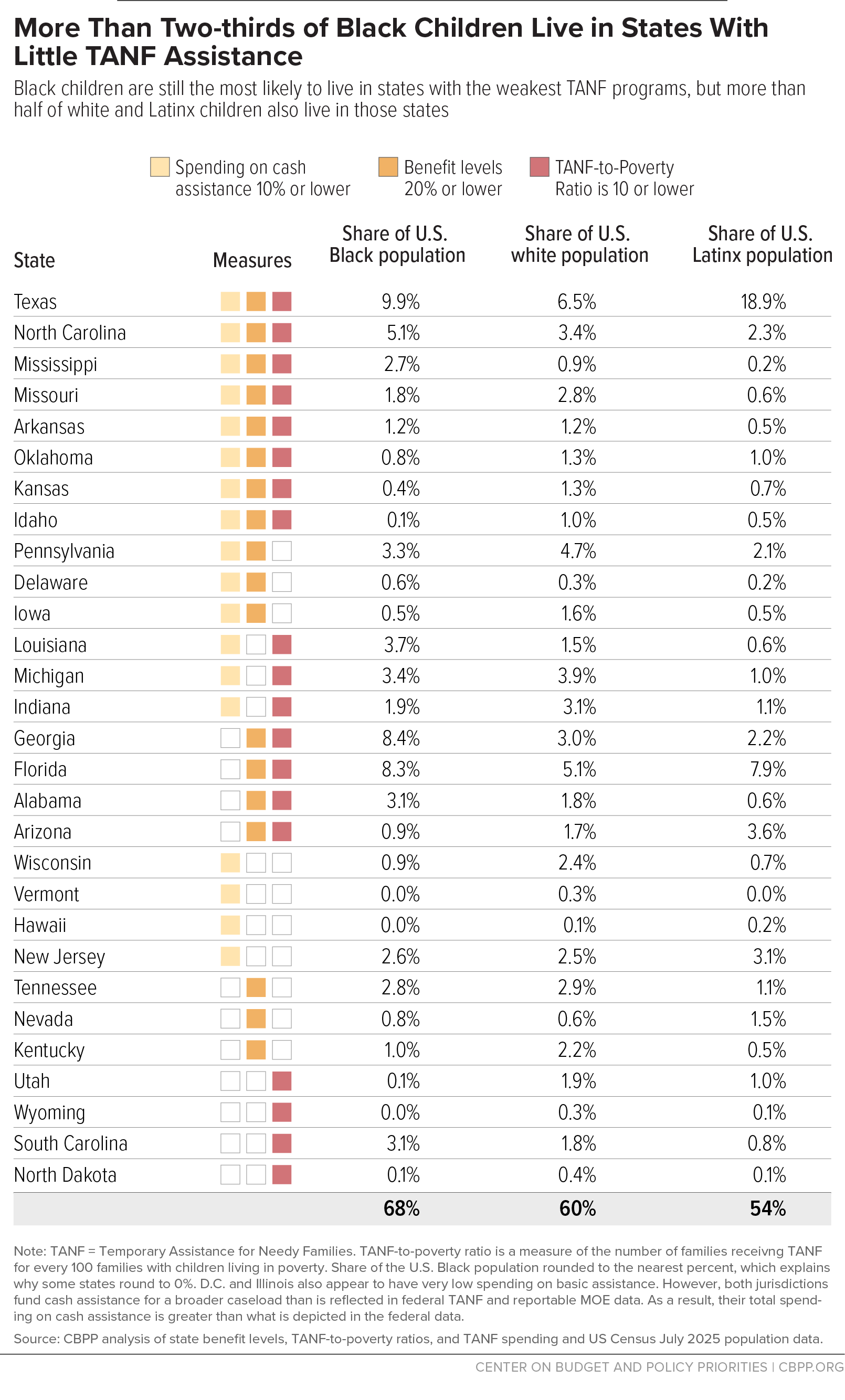
In the history of cash assistance dating back generations, states, especially in the South, created policies that targeted Black mothers to minimize their access to cash support. While states across the country have eroded their TANF programs, recent studies have shown that states with higher shares of Black residents have more punitive and less generous TANF policies and tend to spend less on basic cash assistance. Today, about 68 percent of Black children, 60 percent of white children, and 54 percent of Latinx children live in states with the lowest TANF-to-poverty ratios, the lowest benefit levels, and/or the lowest spending on cash assistance as a share of total TANF-related spending. (See table.) At the same time, children of color are more likely to need cash assistance, which their families may not be able to access. In 2023, the latest year for which we have corrections for the underreporting of key benefits, deep poverty rates for Black and Latinx children continued to be at least twice as high as for white children in 2023.
TANF has moved steadily away from providing cash assistance to families experiencing poverty. These outcomes are the result of congressional and state leaders’ policy choices, and they demonstrate why meaningful TANF reform must focus on rebuilding a stronger, more equitable cash assistance program.