

Thirty Years of Evidence Show TANF Policies Reduced Access to Cash Assistance, Deepened Poverty, and Did Not Promote Stable Employment
Accessible cash assistance is essential for families to afford the basics and create stability that makes long-term opportunity possible. Temporary Assistance for Needy Families (TANF) is the only federal program that funds direct cash assistance to families with children and very low incomes. However, TANF’s block grant structure to states, federal policies that take away cash assistance if a parent doesn’t meet a harsh work requirement, and broad flexibility for states to use TANF funds for a range of purposes other than cash assistance have left many families experiencing poverty without a way to afford their basic needs.
Last year’s harmful Republican reconciliation law imported TANF’s model of conditioning assistance on meeting a harsh work requirement to Medicaid for the first time, and expanded existing work requirements to include parents and older adults in SNAP. But, far from being a model program, TANF needs improvement. Doubling down on work requirements will not result in better outcomes for families — and especially not for children whose families don’t have enough money or other resources to afford housing, food, and health care.
Research has given us more than 30 years of evidence on the effects of TANF and TANF-like policies that reduce access to and the adequacy of cash assistance and take away assistance if a family can’t meet harsh work requirements. Those data show that:
1. TANF reaches fewer families, leaving them without cash assistance and without secure employment.
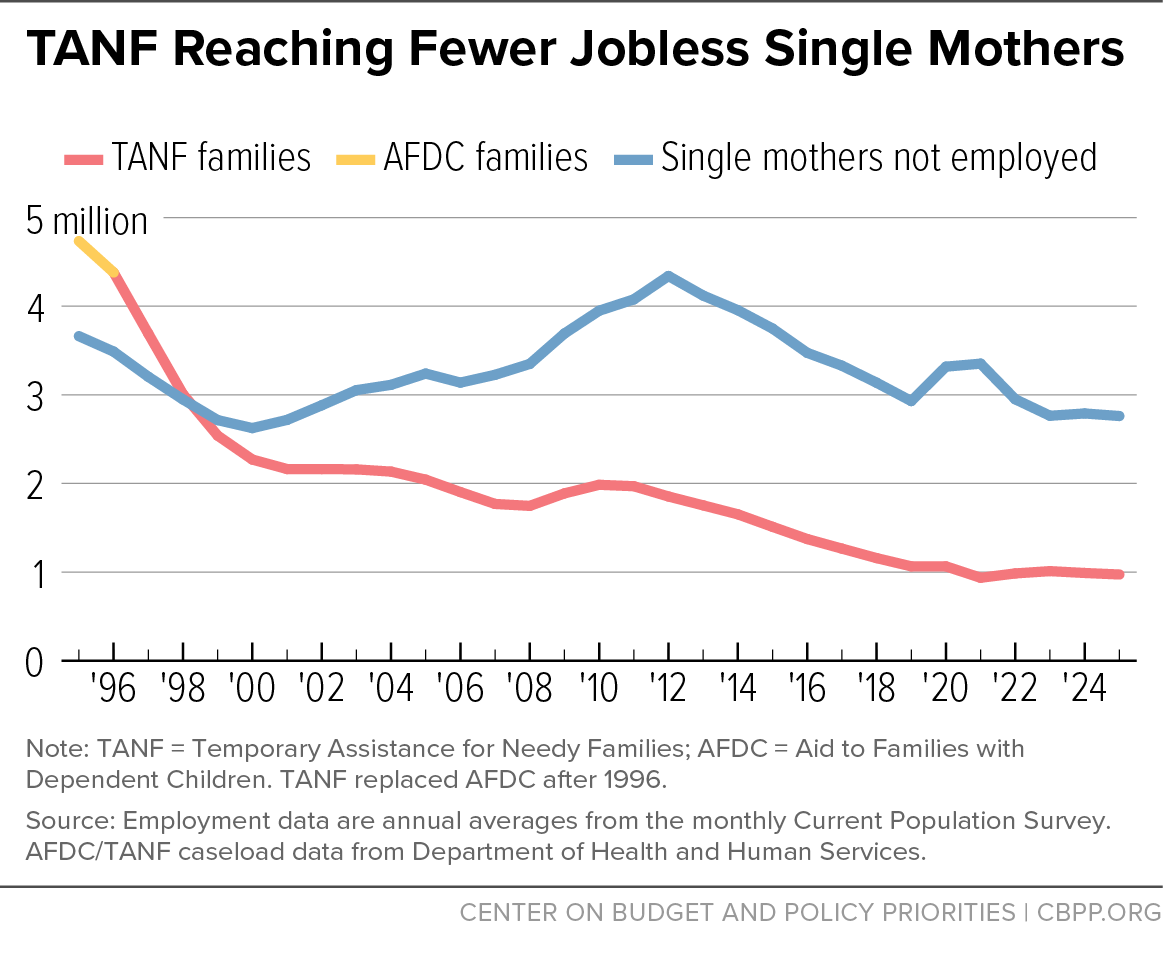
After the enactment of the 1996 law that created TANF, the number of families participating in TANF fell much faster than the employment of single mothers rose. This left millions of families with neither cash assistance nor secure employment. In 2025, 2.8 million single mothers did not work for pay, yet slightly fewer than 1 million families received TANF at some point during that same year. (See Figure 1.) This suggests that many non-working single mothers may not have access to the employment opportunities and work supports that TANF is supposed to provide.
In 1996, by contrast, the number of families receiving Aid to Families with Dependent Children (AFDC, the cash assistance program that TANF replaced) exceeded the number of non-working single mothers. TANF and AFDC both serve (or served) families that include a working parent, some two-parent families, and some single-father families; however, most of the families served are single-mother families where the mother is out of work, often temporarily. Thus, comparing the number of families receiving TANF and the number of single mothers who don’t have a job helps demonstrate that many very low-income families with children aren’t getting help. (If we instead compared just the number of families receiving TANF or AFDC who are single mothers without jobs to the number of jobless single mothers, the gap would be even larger.)

2. TANF work requirements do not promote economic security or stable employment.
Using longitudinal Census data from the Survey of Income and Program Participation over the 1996 to 2007 period, the early period of TANF implementation, researchers find that TANF’s stringent time limits and rules that take away benefits for not meeting a work requirement failed to substantially improve recipients’ income and financial well-being, even when they find increases in employment.[1]
This mirrors evidence from an array of rigorous evaluations of TANF-like work requirements that pre-dated TANF.[2] These evaluations show that employment gains among recipients subject to work requirements were limited and faded over time. Stable employment among recipients subject to work requirements proved the exception, not the norm.
These findings are also consistent with more recent evidence from SNAP provisions that take food assistance away from people who can’t meet a work requirement — requirements that until recently applied only to people without children — and evidence from state experiments with similar requirements in Medicaid.[3]
3. Rigorous research experiments show that cash assistance work requirements caused a rise in deep poverty.
In the 1990s, large randomized controlled trials, the gold standard of research, offered scientific evidence that AFDC/TANF work requirements caused a rise in deep poverty for recipient families.[4] (Deep poverty was defined as earnings plus government assistance below one-half of the federal poverty line, or about $16,000 for a two-adult two-child family in 2024 dollars.)
The study examined 11 pilot programs — local forerunners of TANF’s work requirements — in which one group of families had to meet a work requirement to be eligible for cash assistance while another group of families did not have to meet a work requirement. The study found that deep poverty rates rose by a statistically significant amount in six of the 11 pilot programs. (See Figure 2.)

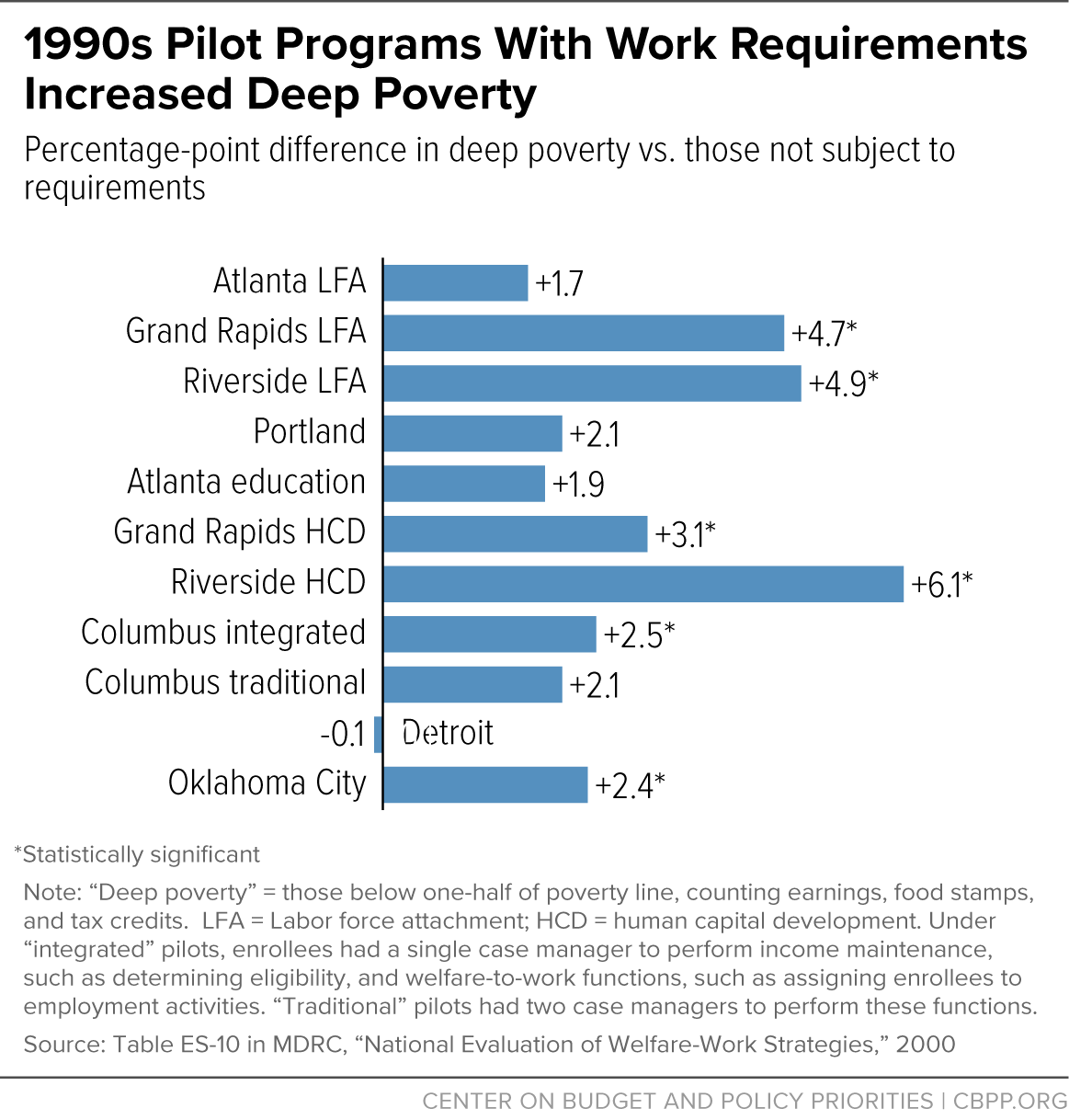
The findings also showed that work requirements can raise deep poverty even while, in some cases, increasing employment and reducing the share of participants below the poverty line. In eight of the 11 pilots, work requirements increased employment in the first two years. Averaging across all sites, the 11 programs reduced poverty by an average of 2.1 percentage points but raised deep poverty by 2.9 percentage points.
This pattern suggests that the programs raised the stakes for families with very low incomes, pushing some to find more work and perhaps move above the poverty line, while letting other families — or the same families in months in which they were less fortunate — fall into deeper financial hardship when they did not find work or their earnings were especially low.
Consistent with that interpretation, the programs tended to increase the share of parents with jobs in any given three-month period but also the share with neither earnings nor assistance. This pattern of deep poverty increasing even while overall poverty falls can also be observed in Census survey data corrected for underreporting of key benefits.[5]
The data from the 11 pilot programs also showed that some of the employment gains were temporary.[6] Over time, work steadily increased among recipients not subject to work requirements, substantially closing the employment gap between the two groups. By the fifth year (the last year any of the studies examined), the impacts of the early years had eroded in each of the programs for which longer-term data are available. In five of the eight programs that initially produced a significant increase in employment rates, by the fifth year the program recipients not subject to the work requirements were just as likely — or more likely — to work than the program recipients subject to work requirements.
4. Deep poverty rose in TANF’s first decade among children most affected by TANF’s policy changes.
Between 1995 and 2005, TANF’s first decade, deep poverty rose from 5.4 percent to 7.4 percent among children in single-mother families, whom the replacement of AFDC with TANF most affected.[7] (These calculations use corrections for underreporting of key government benefits in survey data.) The period between 1995 to 2005 is most suitable for examining the 1996 law’s effects on deep poverty: it extends from the year before the law’s enactment until ten years later, when its major changes had mostly played out, and before significant changes in other basic needs programs began blunting the 1996 law’s negative impact on deep poverty. While other policies have helped reduce the harm to very low-income families, millions of children live in families experiencing severe hardship. In 2023 some 5 million children lived in families with cash income below half the poverty line and an estimated 1.5 million children lived in families whose total income, including near-cash and tax-based benefits like SNAP and the Earned Income Tax Credit, was below half the poverty line. A stronger TANF program could reduce this level of hardship.
5. More Black and Latino children experienced deep poverty in TANF’s first decade.
Black and Latino children experienced a higher increase in deep poverty than white children between 1995 and 2005.[8] Black families were at particular risk of deep poverty when federal lawmakers weakened cash assistance, in part because historical and ongoing discrimination, public and private, has limited opportunity for Black families, including in housing, education, and employment.[9] Deep poverty rates for Black and Latino children continued to be at least twice as high as for white children in 2023, the latest year that we have corrections for the underreporting of key benefits.
Studies have also shown that, all else being equal, states with a higher percentage of Black residents have more punitive and less generous TANF policies, and those states tend to spend less on basic cash assistance.[10] Black and other TANF participants of color are also significantly more likely to be sanctioned than white TANF participants.[11]
The 1996 law also imposed immigration-related restrictions on cash and other federal basic needs programs for people who recently arrived in the U.S. or who lack a documented status.[12] This contributed to the increase in the number of Latino children experiencing deep poverty.
Over the last two decades, deep poverty rates have declined for Black and Latino children due to the strengthening of other economic security programs and an improving economy. But racial and ethnic differences in the percentage of children experiencing deep poverty remain high, and the harmful 2025 Republican reconciliation law will increase inequities by cutting funding for basic needs programs and by taking away access to public benefit programs for certain people granted humanitarian-related immigration status.
End Notes
[1] Julia Shu-Huah Wang, “State TANF Time Limit and Work Sanction Stringencies and Long-Term Trajectories of Welfare Use, Labor Supply, and Income,” Journal of Family and Economic Issues, Vol. 42, October 2021, https://link.springer.com/article/10.1007/s10834-020-09714-8.
[2] LaDonna Pavetti, “Work Requirements Don’t Cut Poverty, Evidence Shows,” CBPP, June 7, 2016, https://www.cbpp.org/research/poverty-and-inequality/work-requirements-dont-cut-poverty-evidence-shows.
[3] LaDonna Pavetti et al., “Expanding Work Requirements Would Make It Harder for People to Meet Basic Needs,” CBPP, March 15, 2023, https://www.cbpp.org/research/poverty-and-inequality/expanding-work-requirements-would-make-it-harder-for-people-to-meet#_ftnref38; Jennifer Wagner and Jessica Schubel, “States’ Experiences Confirm Harmful Effects of Medicaid Work Requirements,” CBPP, updated November 18, 2020, https://www.cbpp.org/research/health/states-experiences-confirm-harmful-effects-of-medicaid-work-requirements.
[4] Arloc Sherman, “Work Requirements for Cash Assistance Fueled Rise in Deep Poverty,” CBPP, November 13, 2018, https://www.cbpp.org/blog/work-requirements-for-cash-assistance-fueled-rise-in-deep-poverty.
[5] Danilo Trisi and Matt Saenz, “Deep Poverty Among Children Rose in TANF’s First Decade, Then Fell as Other Programs Strengthened,” CBPP, February 27, 2020, https://www.cbpp.org/research/poverty-and-inequality/deep-poverty-among-children-rose-in-tanfs-first-decade-then-fell-0.
[6] See “Work Requirements for Cash Assistance Fueled Rise in Deep Poverty,” in Sherman.
[7] See “Deep Poverty Increased Among Black and Latino Children in TANF’s First Decade,” in Trisi and Saenz.
[8] Ibid.
[9] Richard Rothstein, “The Color of Law,” Liveright, 2017; Rucker C. Johnson, “Long-run Impacts of School Desegregation & School Quality on Adult Attainments,” NBER, January 2011, https://www.nber.org/system/files/working_papers/w16664/w16664.pdf; and Marianne Bertrand and Sendhil Mullainathan, “Are Emily and Greg More Employable than Lakisha and Jamal? A Field Experiment on Labor Market Discrimination,” NBER, July 2003, https://www.nber.org/papers/w9873.
[10] Heather Hahn et al., “Why Does Cash Welfare Depend on Where You Live?” Urban Institute, June 2017, https://www.urban.org/sites/default/files/publication/90761/tanf_cash_welfare_final2_1.pdf; Zach Parolin, “Welfare Money Is Paying for a Lot of Things Besides Welfare,” The Atlantic, June 13, 2019, https://www.theatlantic.com/ideas/archive/2019/06/through-welfare-states-are-widening-racial-divide/591559/.
[11] LaDonna Pavetti, “TANF Studies Show Work Requirement Proposals for Other Programs Would Harm Millions, Do Little to Increase Work,” CBPP, November 13, 2018, https://www.cbpp.org/research/family-income-support/tanf-studies-show-work-requirement-proposals-for-other-programs.
[12] Ben Harrington, “PRWORA’s Restrictions on Noncitizen Eligibility for Federal Public Benefits: Legal Issues,” CRS, September 3, 2020, https://crsreports.congress.gov/product/pdf/R/R46510.