

Trump Policies Would Worsen Homelessness, Attack Basic Freedoms of People Who Can’t Afford Rent
In a nation as wealthy and innovative as ours, no one should be forced to sleep in a park, in a car, or in shelters. But today, millions of people don’t have enough income to cover high housing costs and 3 in 4 households eligible for rental assistance don’t receive it due to chronic underfunding; as a result, hundreds of thousands of people are pushed into homelessness and many more must choose between paying rent and buying food or medications. While President Trump promised to make housing and the cost of living more affordable, the Administration is advancing a set of policies that would make housing less affordable and then punish people for the predictable result, including pressuring states and localities to incarcerate unhoused people and promoting detention-like camps.
This double whammy would cause more people to become homeless, undermine people’s basic human rights, and drain local resources. It would affect people of all racial and ethnic backgrounds, but disproportionately harm people of color – especially Black and Indigenous people — as they disproportionately experience homelessness due to generations of discriminatory policies and practices.[2] The Administration is promoting policies that:
- cut rental assistance, which helps people afford housing;
- cut Medicaid, a key source of funding for services that can help people find and keep homes;
- pressure communities to abandon evidence-based approaches to homelessness in favor of outdated, less-effective models; and
- pressure states and cities to fine, arrest, jail, or institutionalize people who sleep outside because they have nowhere else safe to go, worsening inequities and access to housing and health care.[3]
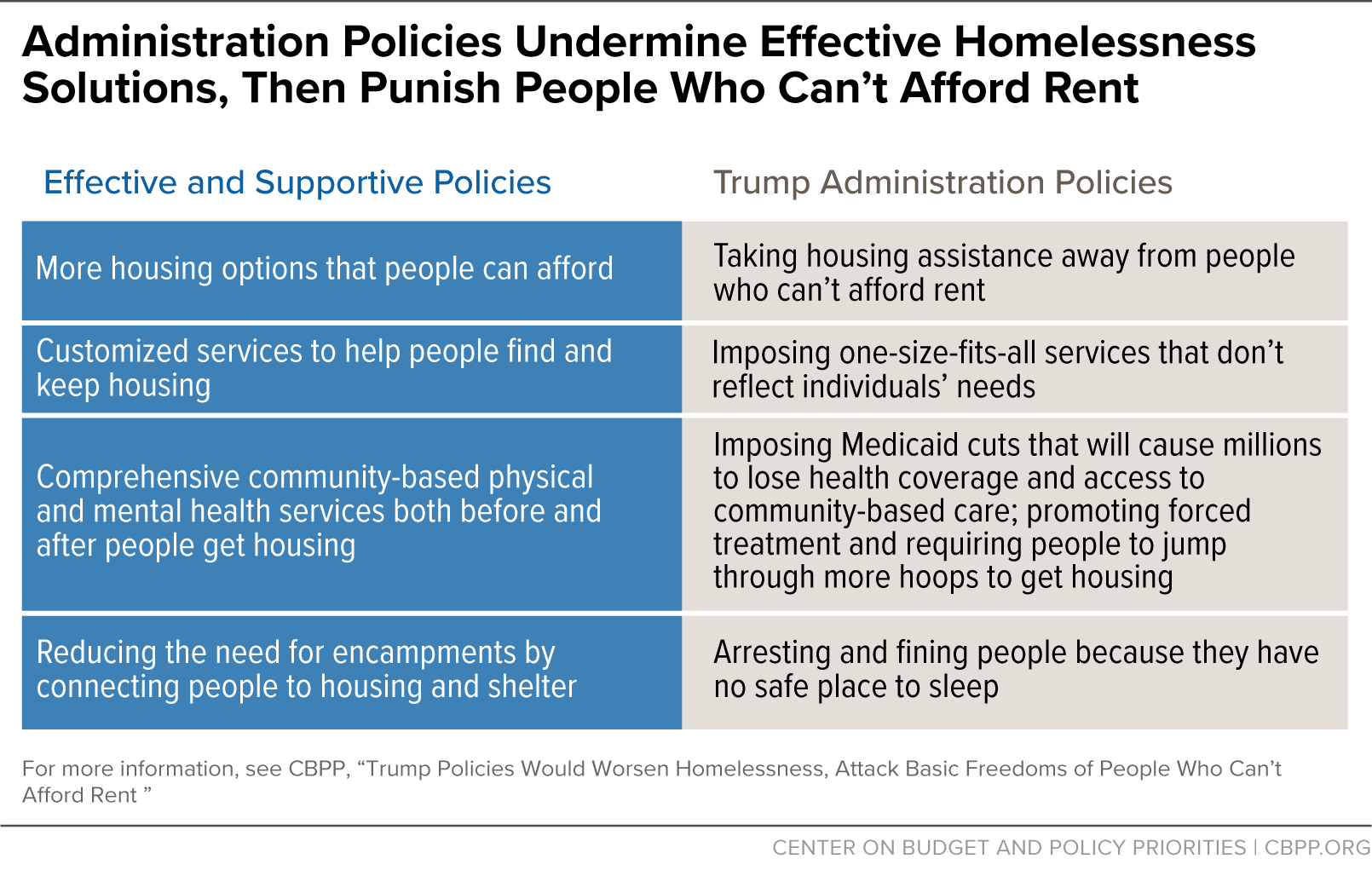
The Administration’s approach is at odds with evidence-based solutions — namely, low-barrier affordable housing and customized, community-based services — that are proven to help ensure people have consistent access to safe, stable housing. (See Figure 1.)
Congress, states, and localities should reject proposals for funding cuts and pressure to abandon proven solutions to homelessness and housing insecurity. Congress took important, but only partial, steps in the 2026 housing funding bill by rejecting the Administration’s proposed deep cuts to housing assistance and ordering the Administration to begin releasing critical homelessness funding it had withheld from providers. But Congress needs to do much more to reduce homelessness, including expanding rental assistance to help more people and prohibiting the Administration from imposing harmful policies and undermining effective solutions.

Ultimately, ensuring that everyone who needs rental assistance can get it is critical to preventing and solving homelessness.[4] While that will take new federal resources and time to achieve, state and local governments should not resort to counterproductive policies in the meantime. State and local policymakers can mitigate the impact of harmful federal policies and make investments that advance housing security for people in their communities. For example, they can:
- invest in permanent housing to counterbalance the Administration’s cuts and ensure people in interim housing are not forced back onto the street;[5]
- protect existing revenues and raise additional funds to backfill for steep federal cuts to Medicaid and food assistance and invest in effective housing solutions;[6]
- invest in dignified interim housing options that help more people safely get off the street, while rejecting calls to fine and arrest people who have no place to live. (See text box “Improved Sheltering Options Should Accompany Affordable Housing and Supportive Services Investments”);[7]
- adopt policies that protect unhoused people’s rights[8] and provide outreach and support to people who must remain outside because they can’t afford rent, such as access to water, food, sanitation supplies, bathrooms, and storage for medications and other belongings; and[9]
- protect the data privacy of unhoused people to prevent the federal government and others from abusing their data for purposes unrelated to helping people find and keep housing, such as to target people on the basis of their immigration status. Failing to protect people’s privacy will make many people more fearful of accepting help, including to move off the streets and into shelters.[10]
Policymakers Can Solve Homelessness by Scaling Up Rental Assistance and Supportive Services
The evidence is clear. The most effective way to solve homelessness is by expanding access to low-barrier rental assistance and community-based supportive services.[11] Policymakers should also provide dignified interim housing and shelter options while scaling up these long-term solutions. (See text box “Improved Sheltering Options Should Accompany Affordable Housing and Supportive Services Investments.”)
Federal rental assistance, such as housing vouchers, covers the gap between what people can afford to pay towards housing costs (around 30 percent of their income, according to a widely used standard) and the actual cost of rent and remains available as long as a participant needs help to afford housing. A rigorous, large-scale evaluation of multiple strategies found that Housing Choice Vouchers were much more effective than time-limited assistance at helping unhoused families with children find and keep stable housing.[12]
A robust body of research — including randomized controlled trials and systematic reviews — shows that providing voluntary and individualized supportive services alongside affordable housing consistently does more to reduce homelessness and improve housing stability than older models that deny housing to anyone who doesn’t accept one-size-fits-all services.[13] This is true for a wide range of people, including people with substance use and mental health conditions.[14]
Outdated models create high barriers to housing, reserving it only for people who can comply with rigid rules, such as sobriety, strict curfews, taking medications, and other prescriptive services requirements. People who can’t meet those requirements are left to languish on the streets or in shelters — the very problem the Administration purports to want to solve. Moreover, because high-barrier models are typically time limited, even those who can secure housing still face an abrupt end to assistance whether or not they can afford rent on their own, putting them at risk of returning to homelessness.
For over a decade, the strong results of low-barrier rental assistance and supportive services in addressing homelessness generated bipartisan support for the approach among both federal policymakers and many state and local officials. Investments in this approach helped cut veteran homelessness in half.[15] Homelessness among other groups also fell, but only modestly because investments in rental assistance and services fell far short of what was needed. Progress in reducing overall homelessness started to reverse in 2017 as a deepening housing affordability crisis caused more people to lose their homes than the underfunded rental assistance and homelessness response systems could move into stable housing.[16]
Policymakers should adequately fund solutions that work instead of disinvesting from them in favor of less effective approaches that exclude many people, as the Trump Administration and others are proposing.[17]
Gutting Funding for Effective Solutions Would Increase Hardship and Homelessness
The Administration is pushing for deep cuts to already underfunded housing and health care services and harmful policy changes, which together would leave more people without stable homes and strain local resources. These executive actions and proposed cuts would force more people into homelessness, in direct conflict with the Administration’s stated goal of reducing the number of people living on the streets.[18]
Shifting Homelessness Funding From Proven Solutions to Expensive and Failed Strategies
The President’s 2026 and 2027 budgets proposed eliminating the Continuum of Care (CoC) program — HUD’s main homelessness program that funds communities’ long-term solutions to homelessness. While Congress has so far declined to adopt that proposal, HUD used executive action to gut CoC funding for permanent housing for people experiencing homelessness, which would take housing assistance away from over 170,000 formerly homeless people in 2026 if fully implemented.
Currently, 87 percent of the CoC program funding supports permanent housing, but HUD’s most recent funding notice (which provides a new set of requirements and limitations on how grantees can use CoC funds) caps the share at 30 percent moving forward.[19] Few individuals and families who lose their housing assistance would be likely to secure new forms of assistance before experiencing serious consequences like eviction or being forced back onto the streets or into cars or shelters, undermining the Administration’s stated goal of reducing the number of people sleeping on the streets.[20]
CoC grantees are local and state nonprofits and governments that coordinate local and regional homelessness response systems. (A separate program — Emergency Solutions Grants — funds emergency shelter and provides funds to states and localities via a formula). Because of HUD’s sudden demand to upend how the CoC funds can be spent, all grantees have faced uncertainty about future funding and many have experienced funding delays. As a result, some have had to shut down or limit services such as not accepting new referrals to fill open housing units.
Consistent with the July 2025 executive order,[21] HUD is using the funding notice to make other sweeping changes in CoC grants.[22] For instance, HUD is trying to redirect CoC funding to outdated, less-effective housing models that cut off assistance after set periods and withhold or terminate housing if people cannot meet rigid rules (such as sobriety requirements and prescriptive services). (HUD is also threatening to deny funding altogether to projects that take (or previously took) certain steps to ensure programs work for everyone, including people of color, transgender and nonbinary people, and people with substance use disorders.[23]
In December, a federal court issued a preliminary injunction banning HUD from carrying out the new notice while the case moves forward. In February, Congress passed legislation directing HUD to immediately renew some CoC grants (those expiring in the first quarter of calendar year 2026, that is January-March 2026) for another 12 months under their current terms and funding levels. The legislation also establishes deadlines for HUD’s awards for CoC grants expiring later. HUD conceded it must non-competitively renew second-quarter grants (those expiring between April-June 2026) because it cannot meet Congress’s deadline.[24] It is possible the same will be true for the remaining grants, in part because of the ongoing litigation seeking to prevent HUD from implementing the notice.[25] Those grantees continue to face uncertainty in the meantime.[26]
Even if all CoC grantees have their current grants renewed for 12 months, HUD is likely to continue pushing these harmful CoC policy changes in the next funding cycle.[27] HUD must start the next CoC grant competition by June of this year; that process will determine what funds communities will receive in calendar year 2027. The February legislation protects roughly half of 2027 CoC funds from HUD’s most aggressive changes, but HUD could still try to take housing assistance away from tens of thousands of formerly unhoused people in 2027 and end or slash funding for a large number of projects.
Cutting Rental Assistance Funding and Access
The President and some congressional Republicans sought deep cuts to rental assistance in 2026, including a proposal in the President’s fiscal year 2026 budget for a cut of more than 40 percent to federal rental assistance. That would have caused millions of people to lose needed assistance. A funding bill passed by the House Appropriations Committee would have reduced the number of people with housing vouchers by more than 400,000. Ultimately Congress provided enough funding to prevent large-scale loss of vouchers in 2026, but the President’s 2027 budget proposal would cut the number of households who get help from that program.[28]
In addition, the final 2026 appropriations law cut funding for public housing by nearly $500 million (6 percent) relative to 2025 levels. The federal government has long provided inadequate funding to maintain and renovate public housing, and this latest cut increases the risk that public housing developments will deteriorate to the point where they are no longer habitable. This would displace current tenants and reduce the number of affordable units available to people experiencing or at risk of homelessness.
The Administration is also taking executive actions to make it harder for people to access assistance and to take assistance away from people who need it to pay rent and avoid homelessness.
The most far-reaching of these is a regulation proposed by HUD that would let state and local housing agencies and private owners of subsidized housing impose rigid time limits of as short as two years on rental assistance recipients and take assistance away from people who cannot meet harsh work requirements.[30] The proposed time limits would put households with as many as 3 million people — half of them children — at risk of losing assistance, even though most couldn’t afford housing on their own.[31] They would also diminish the role of rental assistance in resolving and preventing homelessness moving forward, as time-limited assistance is much less effective at helping unhoused families find and keep stable housing than assistance available as long as needed.[32]
The proposed regulations would also allow agencies to take rental assistance away from people who cannot meet harsh work requirements. Research in other programs shows that work requirements create burdensome red tape and inflict hardship, including for people who meet the requirements or should be exempt, such as workers, caregivers, and disabled people — all while doing little to improve employment opportunities or outcomes. [33] People who lost assistance due to work requirements would be at heightened risk of eviction and homelessness, undermining the Administration’s goal of reducing unsheltered homelessness.
Cutting Health Coverage and Food Assistance
The harmful Republican megabill enacted in July 2025 will cut Medicaid by more than $900 billion over the decade, the largest cut in the program’s history.[34] Three in four households with rental assistance include a person who receives health coverage through Medicaid or a related program.[35] The megabill’s Medicaid cuts are expected to cause millions of people to lose coverage over the next several years, undermining access to services — including physical health, mental health, and substance use care — that help people stay housed and out of isolating and expensive institutions like nursing homes. In addition, some states faced with budget pressures due to the federal Medicaid cuts might elect to reduce access to home- and community-based services that help people with disabilities successfully live in the community, including many formerly unhoused people.[36]
The Republican megabillI will also take food assistance away from unhoused people. The law applies the Supplemental Nutrition Assistance Program (SNAP) work requirement to people experiencing homelessness, who were previously exempt.[37] Unless they can document 20 hours per week of work or participation in a narrow set of work activities or prove they qualify for one of the remaining exemptions, such as having a disability or living with a child under 14, unhoused individuals now can only receive SNAP for three months in a three-year period.[38]
Administration Policies Push Unhoused People From Public View and Take Away Basic Freedoms
Even as it cuts support for effective solutions to homelessness, the Administration is pressuring states and communities to push people who lose their homes into jail or other “long-term institutional settings” that limit people’s choices and freedom of movement.[39] In other words, the Administration is advancing policies that remove unhoused people from visible public spaces without addressing their lack of housing.
These harmful policies affect a diverse group of people, but people of color and people with disabilities face higher risks because they disproportionately experience homelessness and over-policing due to generations of discriminatory policies and practices.[40]
Administration policies that undermine unhoused people’s safety and freedom include:
Pressuring state and local officials to arrest, displace, and fine unhoused people with nowhere safe to go. Consistent with the July 2025 executive order,[42] HUD’s new CoC policies (which are currently paused but likely to resurface in the next funding cycle, as noted above) could redistribute funding to benefit communities that displace unhoused people and charge them with crimes despite strong evidence that those policies worsen homelessness. For example, criminal records and debt from unpaid fines make it harder to find housing because landlords often deny rentals to people with criminal records or poor credit.[43] Communities that prioritize non-punitive strategies — such as resolving encampments by providing people with housing and using mental health professionals instead of police for crisis response in situations where this is likely to be more effective — would likely lose out on funding.[44]
Separately, HUD only allowed jurisdictions to apply for a $75 million supportive housing grant program if they arrest and fine people for using substances or sleeping outside — even if people have nowhere else safe to go.[45] A federal court has temporarily halted HUD from awarding grants under those terms while a legal challenge moves forward. In another example, the Department of Justice is prioritizing grant funding for states and localities that fine and arrest people experiencing homelessness.[46]
Escalating the use of federal agents to forcibly displace unhoused people from encampments without providing a safe place to stay. Encampment raids do nothing to reduce the number of people forced to live on the streets and instead disrupt people’s connections to outreach workers and other services, and cause people to lose identification documents they need to find housing and employment, and medications and blankets they need to survive. Raids also push people into more isolated and dangerous locations and make unhoused people hesitant to call emergency services when they need help and have additional health and safety consequences.[47]
One particularly large federal raid of unhoused people in May 2025 forced more than 100 Oregonians out of a national forest with no plan for connecting them to housing.[48] Shelter beds in the area were reportedly already at capacity. Some encampment residents explained they lived in the forest because they had been forced to move on from other areas and will now move to yet another encampment — a cycle with no end in sight. And in August, Federal Bureau of Investigation agents and D.C. police officers operating under federal orders evicted many unhoused people from where they lived in D.C. under threat of arrest, destroying many people’s belongings and leaving them with nowhere safe to go.[49] Homeless outreach providers reported losing contact with many unhoused people following the D.C. raids.
In addition, U.S. Immigration and Customs Enforcement (ICE) has conducted immigration raids targeting people living in homeless shelters, including in Los Angeles, San Diego, and Chicago.[50] These actions can make unhoused people who are (or may be perceived as being) immigrants fearful of seeking shelter and services.
Pressuring states and communities to push more people with disabilities — especially mental health or substance use conditions — into rigid programs and forced institutional treatment.[51] In addition to the aforementioned CoC policies, the departments of Health and Human Services, Veterans Affairs, and Justice have issued grant competitions or other policy changes that undermine support for evidence-based, low-barrier housing programs.[52] As explained earlier, pairing voluntary and individualized supportive services with affordable housing is highly effective at achieving housing stability among a wide array of people — including among people with mental health or substance use conditions.[53] And it enables people who are not yet in treatment to obtain stable housing that can provide a foundation for addressing other life challenges, unlike the outdated models promoted by the Administration that require people to jump through hoops to access and keep housing.
Forced inpatient treatment isolates and harms people who would be better served by options that allow them to receive care and support in their homes.[54] Forced inpatient substance use treatment may also increase risk of overdose when people leave treatment, likely in part because they can lose tolerance for substances while in a controlled environment.[55] These policies also undermine decades of efforts by states and communities to reduce reliance on institutional settings and increase access to more cost-effective community-based options like Assertive Community Treatment for people with mental health conditions.[56] Filling up or further expanding state institutions like psychiatric hospitals would balloon state costs and siphon funding away from services people need to transition back into the community.
Administration Policies Could Pave the Way for Homeless Detention Camps
The Administration has also explored the creation of large-scale, government-run facilities that would restrict movement and isolate people from community services. During the presidential campaign, President Trump called for forcing unhoused people into “tent cities” on “large parcels of inexpensive land.”[57] In the spring of 2025, Justice Department officials brainstormed ways to push unhoused people “away from the public square and into a more concentrated space,” eliminating their freedom of movement.[58] While no one should have to live outside, the solution is housing and dignified shelter options, not warehousing people in isolated locations. (See text box “Improved Sheltering Options Should Accompany Affordable Housing and Supportive Services Investments.”) Forcibly removing people experiencing homelessness from public view does nothing to ensure everyone can afford a place to live.
If left unchecked, the Administration’s homelessness policies could pave the way for massive government-run detention camps that deprive large numbers of people of basic freedom, put them at risk of abuse, and waste state and local public safety and social service resources that could support genuine measures to improve public safety and solve homelessness.[59] Such strategies harken back to painful chapters of our nation’s history. (See text box, “Homelessness Policies Centered on Seclusion and Control Echo Dark Chapters of Nation’s History.”) They also parallel the Administration’s plan to hold tens of thousands of immigrants in industrial warehouses across the country as part of its effort to round up, detain, and quickly deport — often without due process — people who are immigrants or suspected of being immigrants.[60] People in immigration detention facilities report being subjected to violence and unsafe conditions, including extreme heat, sexual assault, inadequate and unsafe food and water, rampant illness with inadequate access to health care, crowded cells, lack of basic hygiene supplies, and more.[61]
While many state and local officials have rejected punitive homelessness policies in recent years, others have approved them, and some are unfortunately following the Administration’s lead.[62] In many communities, people experiencing unsheltered homelessness are already being pushed out of sight and subjected to surveillance by cameras or other means, under threat of arrest.[63]
In Utah, Governor Spencer Cox and some legislative leaders are championing an effort to relocate and isolate upwards of 1,300 unhoused people in a large facility on the outskirts of Salt Lake City, including up to 400 beds for people court-ordered into inpatient mental health treatment.[64] The congregate facilities would employ high-barrier models that deny people housing unless they work or have completed treatment and force people back onto the streets if they experience a relapse or other setback. Many would be at risk of being sent to jail, since the proposal is premised on aggressive enforcement of anti-camping bans and laws that punish unhoused people. State leaders are proposing to redirect millions of dollars of federal homelessness grants to help fund the facility.
A HUD spokesperson said they were “encouraged” by Utah’s planned direction, signaling that HUD may be receptive to such funding requests.[65] While state legislators have not yet approved funding to construct the $75 million facility, lawmakers are investing new state funds and shifting existing millions of dollars currently used for low-barrier shelter services to high-barrier shelter and compulsory services in line with the Governor’s proposal.[66] Unhoused Utahans need and deserve safe shelter from the elements. But this plan would likely exclude some people from shelter and make it harder for many people to achieve the ultimate solution to homelessness — permanent housing.
At a minimum, these and similar approaches subject people to intense fear and uncertainty and limit people’s most basic freedoms, under threat of arrest, merely because they can’t afford a home. If these policies were fully implemented, such facilities for unhoused people would bear key hallmarks of detention: exclusion from public space and severe restriction of freedom of movement.
Policymakers Should Reject Trump Approach, Embrace Proven Solutions
Policymakers at all levels should find ways to mitigate the Administration’s counterproductive approach to homelessness while working to expand access to the low-barrier rental assistance and services people want and need. In the meantime, state and local policymakers should mitigate the harm of the Administration’s policies. They can:
- Invest in permanent housing to counterbalance the Administration’s cuts and ensure people in interim housing are not forced back onto the street.[68] At least 34 states made new or expanded investments to make housing more affordable or address homelessness in their most recently enacted budgets.[69] And at least five states have established new rental assistance programs since 2023, including Maine, Maryland, Minnesota, New York, and Oregon.[70]
- Protect existing revenues and raise additional funds to backfill for steep federal cuts to Medicaid and food assistance and invest in effective housing solutions.[71] Voters’ approval of recent ballot measures in places like Rhode Island, St. Louis, and Los Angeles signals strong public support for raising new revenue for affordable housing and homelessness programs.[72]
- Invest in dignified interim housing options that help more people safely get off the street, while rejecting calls to fine and arrest people who have no place to live.[73]
- Adopt policies that protect unhoused people’s rights[74] and provide outreach and support to people who must remain outside because they can’t afford rent, such as access to water, food, sanitation supplies, bathrooms, and storage for medications and other belongings.[75]
- Protect the data privacy of unhoused people to prevent the federal government and others from abusing their data for purposes unrelated to helping people find and keep housing, such as to target people on the basis of their immigration status. Failing to protect people’s privacy may make many people more fearful of accepting help, including moving off the streets and into shelters.
End Notes
[1] Franziska Wild and Madi Koesler, “Two months after the federal takeover began, here’s how some homeless D.C. residents are doing,” Street Sense Media, October 8, 2025, https://streetsensemedia.org/article/two-months-after-the-federal-takeover-began-these-homeless-d-c-residents-are-still-in-hiding/.
[2] National Alliance to End Homelessness, “Racial Disparities in Homelessness Persist: A Data Snapshot,” October 10, 2023, https://endhomelessness.org/resources/sharable-graphics/racial-disparities-in-homelessness-persist-a-data-snapshot/; Susan J. Popkin et al., “People with Disabilities Living in the US Face Urgent Barriers to Housing,” Urban Institute, October 21, 2022, https://www.urban.org/research/publication/people-disabilities-living-us-face-urgent-barriers-housing; Wendy Sawyer, “Visualizing the Racial Disparities in Mass Incarceration,” Prison Policy Initiative, July 27, 2020, https://www.prisonpolicy.org/blog/2020/07/27/disparities/.
[3] Nicole DuBois, Claire Herbert, and E. Mae Sowards, “Criminalizing Homelessness Worsens the Crisis, Research Shows,” National Alliance to End Homelessness, February 2025, https://endhomelessness.org/wp-content/uploads/2025/02/CriminalizingWorsensTheCrisis_NAEH_2-4-25.pdf.
[4] Sonya Acosta, “Three Principles for a Rental Assistance Guarantee,” CBPP, October 2, 2024, https://www.cbpp.org/research/housing/three-principles-for-a-rental-assistance-guarantee. Increasing housing supply alone is not enough because millions of people will lack sufficient income to afford rent even if we build enough homes to address the supply shortfall. Peggy Bailey and Jim Parrott, “Our Response to the Housing Crisis Must Include Rental Assistance, Not Just More Supply,” CBPP, May 1, 2025, https://www.cbpp.org/blog/our-response-to-the-housing-crisis-must-include-rental-assistance-not-just-more-supply.
[5] See, for example, Mari Castaldi and Urvi Patel, “States Should Fund Rental Assistance as a Frontline Strategy to Address the Housing Affordability Crisis,” CBPP, August 6, 2025, https://www.cbpp.org/research/housing/states-should-fund-rental-assistance-as-a-frontline-strategy-to-address-the; Framework for an Equitable Homelessness Response, “State and Local Policy Levers to Prevent and Address Homelessness,” October 2024, https://housingequityframework.org/policy-levers.
[6] Urvi Patel, “States Should Pursue New Revenue Options to Expand Access and Prevent Cuts to Affordable Housing and Homelessness Solutions,” CBPP, January 12, 2026, https://www.cbpp.org/research/housing/states-should-pursue-new-revenue-options-to-expand-access-and-prevent-cuts-to; Wesley Tharpe, “States Must Prioritize Revenue to Support People and Communities in Wake of Harmful Republican Megabill, CBPP, November 17, 2025, https://www.cbpp.org/blog/states-must-prioritize-revenue-to-support-people-and-communities-in-wake-of-harmful-republican.
[7] See Matthew Doherty et al., “Reimagining Interim Housing: Stages and Action Areas for Transforming Approaches to Sheltering People Experiencing Homelessness,” Framework for an Equitable Homelessness Response, December 2022, https://endhomelessness.org/wp-content/uploads/2022/12/DOC__ReimaginingInterimHousing_StagesActionAreas_FINAL.pdf.
[8] Several states have introduced legislation that would prevent, halt, or reverse punitive laws targeting unhoused people. Housing Not Handcuffs, “Tracking the Criminalization of Homelessness,” updated 2025, https://housingnothandcuffs.org/emergent-threats-homelessness-criminalization/.
[9] National Alliance to End Homelessness, “Interim Strategies For Responding To Unsheltered Homelessness,” December 17, 2024, https://endhomelessness.org/resources/toolkits-and-training-materials/interim-strategies-for-responding-to-unsheltered-homelessness/.
[10] The Trump Administration has been making unprecedented moves to collect and use sensitive personal data. See, for example, Jude Joffe-Block, “The Trump Administration is Making an Unprecedented Reach for Data Held by States,” National Public Radio, June 24, 2025, https://www.npr.org/2025/06/24/nx-s1-5423604/trump-doge-data-states.
[11] Anna Bailey, Peggy Bailey, and Erik Gartland, “Policymakers Can Solve Homelessness by Scaling Up Proven Solutions: Rental Assistance and Supportive Services,” CBPP, updated February 27, 2025, https://www.cbpp.org/research/housing/policymakers-can-solve-homelessness-by-scaling-up-proven-solutions-rental.
[12] Daniel Gubits et al., “Family Options Study: 3-Year Impacts of Housing and Services Interventions for Homeless Families,” prepared for the Department of Housing and Urban Development, October 2016, https://www.huduser.gov/portal/sites/default/files/pdf/Family-Options-Study-Full-Report.pdf.
[13] E.g., Andrew J. Baxter et al., “Effects of Housing First approaches on health and wellbeing of adults who are homeless or at risk of homelessness: systematic review and meta-analysis of randomized controlled trials,” Epidemiol Community Health, 2019, https://jech.bmj.com/content/jech/73/5/379.full.pdf; Yinan Peng et al., “Permanent Supportive Housing with Housing First to Reduce Homelessness and Promote Health among Homeless Populations with Disability: A Community Guide Systematic Review,” National Library of Medicine, September 2020, https://www.ncbi.nlm.nih.gov/pmc/articles/PMC8513528/.
[14] Numerous studies find well over 80 percent of participants remain housed. For example, see Yinan Peng et al., “Permanent Supportive Housing with Housing First to Reduce Homelessness and Promote Health among Homeless Populations with Disability: A Community Guide Systematic Review,” Journal of Public Health Management and Practice, September 2020, https://pmc.ncbi.nlm.nih.gov/articles/PMC8513528/; Sam Tsembereis and Rhonda Eisenberg, “Pathways to Housing: Supported Housing for Street-Dwelling Homeless Individuals With Psychiatric Disabilities,” Psychiatric Services, April 1, 2000, https://psychiatryonline.org/doi/10.1176/appi.ps.51.4.487; Sam Tsemberis, Leyla Gulcur, Maria Nakae, “Housing First, Consumer Choice, and Harm Reduction for Homeless Individuals With a Dual Diagnosis,” American Journal of Public Health, April 2004, https://pmc.ncbi.nlm.nih.gov/articles/PMC1448313/.
[15] William N. Evans et al., “Housing and Urban Development-Veterans Affairs Supportive Housing Vouchers and Veterans’ Homelessness, 2007-2017,” American Journal of Public Health, Vol. 109, No. 10, October 2019, https://ajph.aphapublications.org/doi/10.2105/AJPH.2019.305231; Center on Budget and Policy Priorities, “Homelessness Among Veterans Fell as Targeted Voucher Program Expanded,” February 27, 2025, https://www.cbpp.org/research/housing/policymakers-can-solve-homelessness-by-scaling-up-proven-solutions-rental.
[16] An average of 908,530 people entered homelessness each year between 2017 and 2020, exceeding the average of 900,895 who exited, according to HUD data. United States Interagency Council on Homelessness, “All In: The Federal Strategic Plan to Prevent and End Homelessness,” December 2022, https://www.usich.gov/sites/default/files/document/All_In.pdf.
[17] Anna Bailey, Peggy Bailey, and Erik Gartland, “Policymakers Can Solve Homelessness by Scaling Up Proven Solutions: Rental Assistance and Supportive Services,” CBPP, updated February 27, 2025, https://www.cbpp.org/research/housing/policymakers-can-solve-homelessness-by-scaling-up-proven-solutions-rental.
[18] The Trump Administration has repeatedly referenced the number of people experiencing unsheltered homelessness in support of its policy changes. For example, see Donald J. Trump, “Ending Crime and Disorder on America’s Streets,” July 24, 2025, https://www.whitehouse.gov/presidential-actions/2025/07/ending-crime-and-disorder-on-americas-streets/; U.S. Department of Housing and Urban Development, “Press Release: HUD Secretary Scott Turner Applauds President Trump’s Action on Homelessness,” July 25, 2025, https://www.hud.gov/news/hud-no-25-109.
[19] Katherine Hapgood, “Trump administration policy change makes deep cuts to homeless permanent housing program,” Politico, November 13, 2025, https://www.politico.com/news/2025/11/13/trump-cuts-homeless-housing-program-00650758.
[20] People losing permanent housing subsidies are categorically ineligible for the short-term assistance the Administration is proposing to fund in its place unless or until people return to homelessness. In addition, it will take communities time to stand up new high-barrier, temporary housing programs, creating a lag between the end of existing CoC-funded permanent housing programs and new temporary housing coming online. And as noted elsewhere, other forms of rental assistance, like Housing Choice Vouchers, remain scarce.
[21] Anna Bailey, “Executive Order Calls on Federal Agencies to Abandon Effective Homelessness Solutions and Promote Fear and Punishment,” CBPP, July 24, 2025, https://www.cbpp.org/research/federal-budget/executive-action-watch?item=30206.
[22] In addition to the scale of the changes, other major challenges for communities — which face unprecedented uncertainty about whether HUD will slash their biggest federal source of homelessness funding — are that many were given just weeks to prepare for these abrupt changes, and many will endure long funding gaps. CoC grantees are on different funding timelines; some begin to run out of funding in January. Sonya Acosta, “Congress Must Act to Prevent Cuts That Would Leave Hundreds of Thousands at High Risk of Homelessness,” CBPP, December 17, 2025, https://www.cbpp.org/blog/congress-must-act-to-prevent-cuts-that-would-leave-hundreds-of-thousands-at-high-risk-of.
[23] For instance, HUD’s new CoC funding notice reserves the right to reject funding for projects that acknowledge genders outside of the Administration’s preferred “gender binary.” A federal court has temporarily halted HUD from enforcing grant agreements that contain similar prohibitions while legal challenges move forward. ACLU Rhode Island, “Federal Court Blocks Trump-Vance Administration’s Unlawful Restrictions on Health and Housing Grants,” October 10, 2025, https://www.riaclu.org/news/federal-court-blocks-trump-vance-administrations-unlawful-restrictions-on-health-and-housing-grants/.
[24] The Administration said HUD “will not be able to process applications and renewals prior to the April 1 second-quarter deadline” required by the Consolidated Appropriations Act, 2026 State of Washington et al. v. Department of Housing and Urban Development, 25-v-626-MSM-AEM (D.R.I., February 17, 2026), https://storage.courtlistener.com/recap/gov.uscourts.rid.60977/gov.uscourts.rid.60977.74.0_1.pdf.
[25] HUD must noncompetitively renew CoC grants expiring in the second quarter of 2026 if HUD has not issued grant awards by April. And July is HUD’s deadline for issuing awards for the remaining grants expiring in 2026. On April 1, a federal appellate court denied HUD’s request to end the preliminary injunction while the federal district court continues to consider the merits of the case. National Alliance to End Homelessness, “Appeals Court Rejects Latest Trump-Vance Administration Attack on Funding for Solutions to Homelessness,” April 1, 2026, https://endhomelessness.org/media/news-releases/appeals-court-rejects-latest-trump-vance-administration-attack-on-funding-for-solutions-to-homelessness/?utm_source=Master+Email+List&utm_campaign=f1f8a8123b-EMAIL_CAMPAIGN_2026_04_01_06_45&utm_medium=email&utm_term=0_-f1f8a8123b-270229449.
[26] “Defendants’ Combined Emergency Motion for a Stay of the Preliminary Injunction Pending Appeal,” State of Washington et al. v. Department of Housing and Urban Development, 25-v-626-MSM-AEM (D.R.I., March 3, 2026), https://www.courtlistener.com/docket/71978322/79/national-alliance-to-end-homelessness-v-united-states-department-of/.
[27] In the face of litigation, HUD has stated that it “fully stands by the fundamental reforms” it included in the CoC competition. Jason DeParle, “Trump Administration Withdraws Plan to Overhaul Homeless Aid,” New York Times, December 9, 2025, https://www.nytimes.com/2025/12/09/us/politics/trump-homeless-aid-hud.html.
[28] The President’s fiscal year 2027 budget proposal would prevent housing agencies from issuing any housing vouchers to families who don’t currently have them (with very narrow exceptions).
[29] Gabriel Zakaib, “Thirty years after he applied for one, a federal voucher changed his life,” Street Sense Media, January 29, 2025, https://streetsensemedia.org/article/thirty-years-after-he-applied-for-one-a-federal-voucher-changed-his-life/ .
[30] Jesse Coburn, “Millions Could Lose Housing Aid Under Trump Plan,” ProPublica, September 20, 2025, https://www.propublica.org/article/trump-housing-reforms-aid-hud-immigration-homelessness.
[31] Will Fischer and Erik Gartland, “Rental Assistance Time Limits Would Place More Than 3 Million People — Half of Them Children — at Risk of Eviction and Homelessness,” CBPP, July 18, 2025, https://www.cbpp.org/research/housing/rental-assistance-time-limits-would-place-more-than-3-million-people-half-of-them.
[32] Daniel Gubits et al., “Family Options Study: 3-Year Impacts of Housing and Services Interventions for Homeless Families,” prepared for the Department of Housing and Urban Development, October 2016, https://www.huduser.gov/portal/sites/default/files/pdf/Family-Options-Study-Full-Report.pdf
[33] LaDonna Pavetti et al., “Expanding Work Requirements Would Make It Harder for People to Meet Basic Needs,” CBPP, March 15, 2023, https://www.cbpp.org/research/poverty-and-inequality/expanding-work-requirements-would-make-it-harder-for-people-to-meet.
[34] CBPP, “By the Numbers: Harmful Republican Megabill Will Take Health Coverage Away From Millions of People and Raise Families’ Costs,” updated August 27, 2025, https://www.cbpp.org/research/health/by-the-numbers-harmful-republican-megabill-will-take-health-coverage-away-from; Samantha Jacoby, “House Republican Tax Bill Extends — and Expands — Costly Tax Breaks for the Wealthy,” CBPP, June 4, 2025, https://www.cbpp.org/blog/house-republican-tax-bill-extends-and-expands-costly-tax-breaks-for-the-wealthy.
[35] CBPP analysis of 2023 Survey of Income and Program Participation (SIPP) data; see https://www.cbpp.org/media/upcoming-cuts-put-majority-of-rental-assistance-recipients-at-risk-of-losing-health-care-and.
[36] Allie Gardner, “Medicaid Cuts Would Reduce Access to Health Care for Entire Communities,” CBPP, May 6, 2025, https://www.cbpp.org/blog/medicaid-cuts-would-reduce-access-to-health-care-for-entire-communities.
[37] Katie Bergh and Dottie Rosenbaum, “Many Low-Income People Will Soon Begin to Lose Food Assistance Under Republican Megabill,” CBPP, September 10, 2025, https://www.cbpp.org/research/food-assistance/many-low-income-people-will-soon-begin-to-lose-food-assistance-under.
[38] There are limited exemptions from the work requirement, including for individuals who are pregnant, determined to be unfit for work, in a treatment program, or eligible college students.
[39] An executive order refers to the goal of “Shifting homeless individuals into long-term institutional settings.” Executive Office of the President, “Executive Order 14321: Ending Crime and Disorder on America’s Street,” July 24, 2025, https://www.federalregister.gov/documents/2025/07/29/2025-14391/ending-crime-and-disorder-on-americas-streets; Bailey.
[40] National Alliance to End Homelessness, “Racial Disparities”; Susan J. Popkin et al., “People with Disabilities Living in the US Face Urgent Barriers to Housing,” Urban Institute, October 21, 2022, https://www.urban.org/research/publication/people-disabilities-living-us-face-urgent-barriers-housing; Wendy Sawyer, “Visualizing the Racial Disparities in Mass Incarceration,” Prison Policy Initiative, July 27, 2020, https://www.prisonpolicy.org/blog/2020/07/27/disparities/.
[41] Associated Press, “Homeless Camp in Oregon National Forest to be Cleared,” May 1, 2025, https://www.8newsnow.com/news/national-news/ap-homeless-camp-in-oregon-national-forest-to-be-cleared/.
[42] Bailey.
[43] DuBois, Herbert, and Sowards. People face other barriers to housing and economic stability due to unpaid finds, such as suspended drivers licenses. Aravind Buddupalli et al., “How Fines and Fees Impact Family Well-Being,” Fines and Fees Justice Center, August 14, 2024, https://finesandfeesjusticecenter.org/articles/how-fines-and-fees-impact-family-well-being/.
[44] For example, see Vera Institute, “Behavioral Health Crisis Alternatives: Shifting from Policy to Community Response,” November 2020, https://www.vera.org/behavioral-health-crisis-alternatives.
[45] Grants.gov, “Continuum of Care Builds (CoC Builds),” U.S. Department of Housing and Urban Development, September 5, 2025, https://www.grants.gov/search-results-detail/360486.
[46] “Priority consideration will be given… to applicants in states and units of local government that actively… enforce prohibitions on urban camping and loitering.” Bureau of Justice Affairs, “BJA FY25 Public Safety and Mental Health Initiative,” Department of Justice, February 19, 2026, https://bja.ojp.gov/funding/opportunities/o-bja-2025-172486.
[47] National Health Care for the Homeless Council, “Impact of Encampment Sweeps on People Experiencing Homelessness,” December 2022, https://nhchc.org/wp-content/uploads/2022/12/NHCHC-encampment-sweeps-issue-brief-12-22.pdf. Unhoused people forced to move encampments may experience much higher rates of overdose than those not displaced, due to reasons such as replacing prescription medication lost during removal with street drugs and losing touch with trusted suppliers. National Association of County & City Health Officials, “The Public Health Impacts of Encampment ‘Sweeps,’” July 2025, https://www.naccho.org/uploads/downloadable-resources/FINAL-ES-Brief-Combined-7.28.2025.pdf.
[48] Rukmini Callimachi, “Sweep of Homeless Camp in Oregon Said to Be ‘Largest in Recent History,’” New York Times, May 3, 2025, https://www.nytimes.com/2025/05/01/realestate/oregon-homeless-encampment-removal.html; Cynthia Griffith, “Pushed Out, Not Housed: Oregon’s Largest Forest Eviction Displaces 150 People,” Invisible People, June 6, 2025, https://invisiblepeople.tv/pushed-out-not-housed-oregons-largest-forest-eviction-displaces-150-people/
[49] D.C. police were acting under a federal order during a temporary federal takeover of the city’s police department. Annemarie Cuccia and Franziska Wild, “’We’re just trying to live:’ The first two weeks of Trump’s crackdown on visible homelessness in D.C.,” Street Sense Media, August 27, 2025, https://streetsensemedia.org/article/were-just-trying-to-live-the-first-two-weeks-of-trumps-crackdown-on-visible-homelessness-in-d-c/; Annemarie Cuccia, Madi Koesler, and Franziska Wild, “Homeless people scatter after recent federal and local encampment closures, but many are still living outside,” Street Sense Media, September 10, 2025, https://streetsensemedia.org/article/homeless-people-scatter-after-recent-federal-and-local-encampment-closures-but-many-are-still-living-outside/.
[50] Alicia Victoria Lozano, “ICE targets Los Angeles homeless shelter,” NBC News, July 26, 2025, https://www.nbcnews.com/news/us-news/ice-targets-los-angeles-homeless-shelter-rcna220597; Kasey Chronis, “ICE detains 4 people outside Chicago homeless shelter, officials say,” Fox 32 Chicago, October 1, 2025, https://www.fox32chicago.com/news/bronzeville-feds-shelter-arrests.
[51] Such policies are reflected in the President’s July 24 executive order and the aforementioned CoC FY 25 NOFO and Builds competitions. They are also reflected in the Department of Health and Human Services’ announcement –which was subsequently reversed — to abruptly cancel upwards of $2 billion in grants for mental health and substance use services.
[52] For example, multiple Substance Abuse and Mental Health Services Administration (SAMHSA) funding notices explicitly prohibited awards from supporting “housing first,” the colloquial name for low-barrier housing that provides rental assistance and voluntary supportive services: SAMHSA, “FY 2026 Cooperative Agreement for 988 Suicide & Crisis Lifeline Administrator,” January 13, 2026, https://www.samhsa.gov/grants/grant-announcements/fg-26-001; SAMHSA, “Assisted Outpatient Treatment Program,” March 6, 2026, https://www.samhsa.gov/sites/default/files/grants/pdf/fy-2026-aot-sm-26-001.pdf#%5B%7B%22num%22%3A92%2C%22gen%22%3A0%7D%2C%7B%22name%22%3A%22XYZ%22%7D%2C70%2C720%2C0%5D. In another example, the Justice Department is expanding the Veterans Affairs Department’s authority to initiate guardianship proceedings that could be used to force veterans – including unhoused veterans – into institutional settings. Ellen Barry and Jason DeParle, “V.A. Begins Drive to Put Some Homeless Veterans Into Guardianship,” New York Times, March 11, 2026, https://www.nytimes.com/2026/03/11/us/politics/veterans-homeless-guardianship-trump.html; and The Department of Justice.
[53] See, for example, Cris M. Sullivan et al., “Impact of the Domestic Violence Housing First Model on Survivors’ Safety and Housing Stability: Six Month Findings,” Journal of Family Violence, Vol. 38, March 22, 2022, https://link.springer.com/article/10.1007/s10896-022-00381-x; Timothy E. Chung et al., “Housing First for older homeless adults with mental illness: a subgroup analysis of the At Home/Chez Soi randomized controlled trial,” International Journal of Geriatric Psychiatry, Vol. 33, No. 1, January 2018, https://pubmed.ncbi.nlm.nih.gov/28206715/; Seema L. Clifasefi et al., “Exposure to Project-Based Housing First is Associated with Reduced Jail Time and Bookings,” International Journal of Drug Policy, Vol. 24, No. 4, July 2013, https://www.sciencedirect.com/science/article/abs/pii/S0955395912001533?via%3Dihub; Jocelyn Fontaine et al., “Supportive Housing for Returning Prisoners: Outcomes and Impacts of the Returning Home-Ohio Pilot Project,” Urban Institute, August 2012, https://www.urban.org/sites/default/files/publication/25716/412632-Supportive-Housing-for-Returning-Prisoners-Outcomes-and-Impacts-of-the-Returning-Home-Ohio-Pilot-Project.PDF.
[54] Sofia Martinaki et al., “Psychiatric Admission as a Risk Factor for Posttraumatic Stress Disorder,” National Library of Medicine, November 2021, https://pubmed.ncbi.nlm.nih.gov/34455217/.
[55] Anders Ledberg & Therese Reitan, “Increased Risk of Death Immediately After Discharge From Compulsory Care for Substance Abuse,” Drug and Alcohol Dependence, July 2022, https://pubmed.ncbi.nlm.nih.gov/35617775/; Claudia Rafful et al,. “Increased Non-Fatal Overdose Risk Associated with Involuntary Drug Treatment in a Longitudinal Study with People Who Inject Drugs,” Addiction Journal, June 2018, https://pmc.ncbi.nlm.nih.gov/articles/PMC5938130/.
[56] The share of Medicaid spending on long-term services and supports going to home- and community-based services (rather than institutional care) rose from just 12 percent in 1988 to 59 percent in 2019. Caitlin Murray et al., “Medicaid Long Term Services and Supports Annual Expenditures Report: Federal Fiscal Year 2019,” Mathematica, December 9, 2021, https://www.medicaid.gov/medicaid/long-term-services-supports/downloads/ltssexpenditures2019.pdf. An assertive Community Treatment improves mental illness symptoms, functioning and wellbeing among people with severe mental health conditions. Nordén, Malm & Norlander, “Resource Group Assertive Community Treatment (RACT) as a Tool of Empowerment for Clients with Severe Mental Illness: A Meta-Analysis,” Clinical Practice & Epidemiology in Mental Health, November 16, 2012, https://pmc.ncbi.nlm.nih.gov/articles/PMC3502888/. Assertive Community Treatment for people with severe mental illness is effective at reduce psychiatric hospitalization, contributing to its cost-effectiveness. Salkever et al., “Assertive Community Treatment for People with Severe Mental Illness: The Effect on Hospital Use and Costs,” Health Services Research, June 1999, https://pmc.ncbi.nlm.nih.gov/articles/instance/1089024/pdf/hsresearch00018-0134.pdf. Werb et al., “Evidence does not, on the whole, suggest improved outcomes related to compulsory [substance use] treatment, with some studies suggesting potential harms,” International Journal of Drug Policy, Vol. 28, February 2016, https://www.sciencedirect.com/science/article/abs/pii/S0955395915003588?via%3Dihub.
[57] Angela Hart, “Trump Turns Homelessness Response Away from Housing, Toward Forced Treatment,” CBS News, March 26, 2025, https://www.cbsnews.com/news/trump-homelessness-response-forced-treatment/; National Public Radio, “How Trump’s D.C. Takeover Criminalizes Homelessness,” August 20, 2025, https://www.npr.org/transcripts/nx-s1-5502655.
[58] Perry Stein and Tom Jackman, “Justice Dept. Examines Homeless Encampments, Options for the Mentally Ill,” Washington Post, April 26, 2026, https://www.washingtonpost.com/national-security/2025/04/26/homelessness-justice-department-trump/.
[59] For example, resources could instead go to effective strategies such as civilian crisis response programs to handle mental health or addiction calls and permanent supportive housing. Kelsey Byrkman, “Mobile Crisis Teams for Adults with Complex Needs,” Center for Health Care Strategies, January 2025, https://www.chcs.org/resource/mobile-crisis-teams-for-adults-with-complex-needs/; Ehren Dohler et al., “Supportive Housing Helps Vulnerable People Live and Thrive in the Community,” CBPP, May 31, 2016, https://www.cbpp.org/research/housing/supportive-housing-helps-vulnerable-people-live-and-thrive-in-the-community.
[60] Lauren-Brook Eisen, “How ICE’s Budget Boom Is Changing Immigration Detention,” Brennan Center for Justice, February 24, 2026, https://www.brennancenter.org/our-work/research-reports/how-ices-budget-boom-changing-immigration-detention; Vera Institute, “Weaponizing the System: One Year of Trump’s Attacks on Due Process,” January 20, 2026, https://www.vera.org/explainers/weaponizing-the-system-one-year-of-trumps-attacks-on-due-process; Douglas MacMillan and Jonathan O'Connell, “ICE documents reveal plan to hold 80,000 immigrants in warehouses,” Washington Post, December 24, 2025, https://www.washingtonpost.com/business/2025/12/24/ice-immigrants-detention-warehouses-deportation-trump/.
[61] Haddy Gassama, “Detained Immigrants Detail Physical Abuse and Inhumane Conditions at Largest Immigration Detention Center in the U.S.,” January 26, 2026, https://www.aclu.org/news/immigrants-rights/detained-immigrants-detail-physical-abuse-and-inhumane-conditions-at-largest-immigration-detention-center-in-the-u-s.
[62] Housing Not Handcuffs, “Tracking the Criminalization of Homelessness,” updated 2025, https://housingnothandcuffs.org/emergent-threats-homelessness-criminalization/.
[63] See, for example, “Yoav Gonen, “Subway Surveillance Cameras Turned Toward the Homeless,” The City, October 3, 2019, https://www.thecity.nyc/2019/10/03/subway-surveillance-cameras-turned-toward-the-homeless/; Tori Apodaca, “Sacramento County to use drones to track homeless people on probation,” MSN, June 4, 2025, https://www.msn.com/en-us/money/smallbusiness/sacramento-county-to-use-drones-to-track-homeless-people-on-probation/ar-AA1G6T9d?ocid=sms.
[64] Katie McKeller, “Utah Homeless Board Proposes ‘Initial Framework’ to Respond to Trump’s Executive Order,” Utah News Dispatch, October 2, 2025, https://utahnewsdispatch.com/2025/10/02/utah-homeless-board-proposes-initial-framework-to-respond-to-trumps-executive-order/; Utah State Legislature, “Utah’s Action Plan to Address Homelessness: Aligning with the ‘Ending Crime and Disorder’ Executive Order,” Health and Human Services Interim Committee hearing, September 16, 2025, https://le.utah.gov/interim/2025/pdf/00003578.pdf; Utah Housing Coalition, “Utah Housing Coalition Shares Community Concerns on Utah’s ‘Action Plan to Address Homelessness’ Aligned with the ‘Ending Crime and Disorder’ Executive Order,” September 30, 2025, https://utahnewsdispatch.com/wp-content/uploads/2025/10/Press-Release-Utahs-Action-Plan-to-Address-Homelessness-1.docx.pdf.
[65] In addition, the chair of the state Homeless Services Board in charge of advising the state on the proposal said they “got very positive signals” after presenting the plan to federal officials. Ellen Barry and Jason DeParle, “In Utah, Trump’s Vision for Homelessness Begins to Take Shape,” New York Times, October 29, 2025, https://www.nytimes.com/2025/10/29/us/politics/utah-trump-homeless-campus.html.
[66] State officials estimate it will cost $75 million to construct the facility and more than $30 million a year to operate it. Katie McKellar, “Utah Gov. Cox Proposes Millions for Homeless Campus While also Hoping for Federal Funds,” Utah News Dispatch, December 3, 2025, https://utahnewsdispatch.com/2025/12/03/utah-gov-cox-proposes-millions-for-homeless-campus/#:~:text=The%20campus%20%E2%80%94%20which%20state%20officials,which%20largely%20hinges%20on%20funding; Ben Winslow, “2026 Utah Legislature on Homelessness,” Fox 13, March 7, 2026, https://www.fox13now.com/news/politics/2026-utah-legislature-on-homelessness; Brigham Tomco, “Utah Lawmakers Plan to Fund Governor’s Homelessness Overhaul — if Cities, Counties Pay Up,” Desert News, March 2, 2026, https://www.deseret.com/politics/2026/03/02/utah-governor-gets-funding-from-legislature-to-overhaul-utah-homeless-policy/; Hugo Rikard-Bell, “Preliminary Budget Signals ‘Vote of Confidence’ for Utah’s Homelessness Approach,” KUER, March 1, 2026, https://www.kuer.org/politics-government/2026-03-01/preliminary-budget-signals-vote-of-confidence-for-utahs-homelessness-approach.
[67] Jesse Bedayn, “60,000 Americans to lose their rental assistance and risk eviction unless Congress acts,” Associated Press, April 21, 2025, https://apnews.com/article/trump-congress-housing-voucher-assistance-funding-cuts-26f9a716af6731e3c6445015488bab3a.
[68] See, for example, Castaldi and Patel; Framework for an Equitable Homelessness Response.
[69] Mari Castaldi and Nikhe Braimah, “State and Local Leaders Should Sustain and Expand Investments in Housing Affordability and Stability in Their Budgets,” CBPP, December 17, 2025, https://www.cbpp.org/blog/state-and-local-leaders-should-sustain-and-expand-investments-in-housing-affordability-and.
[70] Castaldi and Patel.
[71] Urvi Patel, “States Should Pursue New Revenue Options to Expand Access and Prevent Cuts to Affordable Housing and Homelessness Solutions,” CBPP, January 12, 2026, https://www.cbpp.org/research/housing/states-should-pursue-new-revenue-options-to-expand-access-and-prevent-cuts-to; Wesley Tharpe, “States Must Prioritize Revenue to Support People and Communities in Wake of Harmful Republican Megabill, CBPP, November 17, 2025, https://www.cbpp.org/blog/states-must-prioritize-revenue-to-support-people-and-communities-in-wake-of-harmful-republican.
[72] Urvi Patel, “States Should Pursue New Revenue Options to Expand Access and Prevent Cuts to Affordable Housing and Homelessness Solutions,” CBPP, January 12, 2026, https://www.cbpp.org/research/housing/states-should-pursue-new-revenue-options-to-expand-access-and-prevent-cuts-to; NLIHC, “Voters Approve Housing and Homelessness Ballot Measures across the Country on Election Day,” November 12, 2024, https://nlihc.org/resource/voters-approve-housing-and-homelessness-ballot-measures-across-country-election-day.
[73] See Doherty et al.
[74] Several states have introduced legislation that would prevent, halt, or reverse punitive laws targeting unhoused people. Housing Not Handcuffs, “Tracking the Criminalization of Homelessness,” updated 2025, https://housingnothandcuffs.org/emergent-threats-homelessness-criminalization/.
[75] National Alliance to End Homelessness, “Interim Strategies.”