

Tight 2026 Non-Defense Funding Rejects Trump’s Proposed Deep Cuts, But Congress Will Need to Continue to Guard Against Administration Abuses
With appropriations for fiscal year 2026 largely completed (only funding for the Department of Homeland Security is outstanding), members of Congress are starting to turn their attention to appropriations for 2027. This paper analyzes 2026 non-defense appropriations, identifying challenges and deficiencies that policymakers should address when crafting 2027 bills.
Two of the core issues that shaped the debates around 2026 appropriations for non-defense programs will carry over into the 2027 process.
Securing enough funding for a range of important non-defense public services, core government functions, and investments that meet our nation’s needs. These needs include supporting the well-being of all U.S. residents (such as by investing in medical research and a clean and safe environment) and providing targeted support for people who face challenges affording the basics (for example, through rental assistance for families with low incomes; aid to school districts to provide an inclusive, quality education for students from low-income families and students with disabilities; and nutrition assistance for new and expecting parents and young children). Health care for veterans is the largest program in this category, representing almost one-sixth of the total.
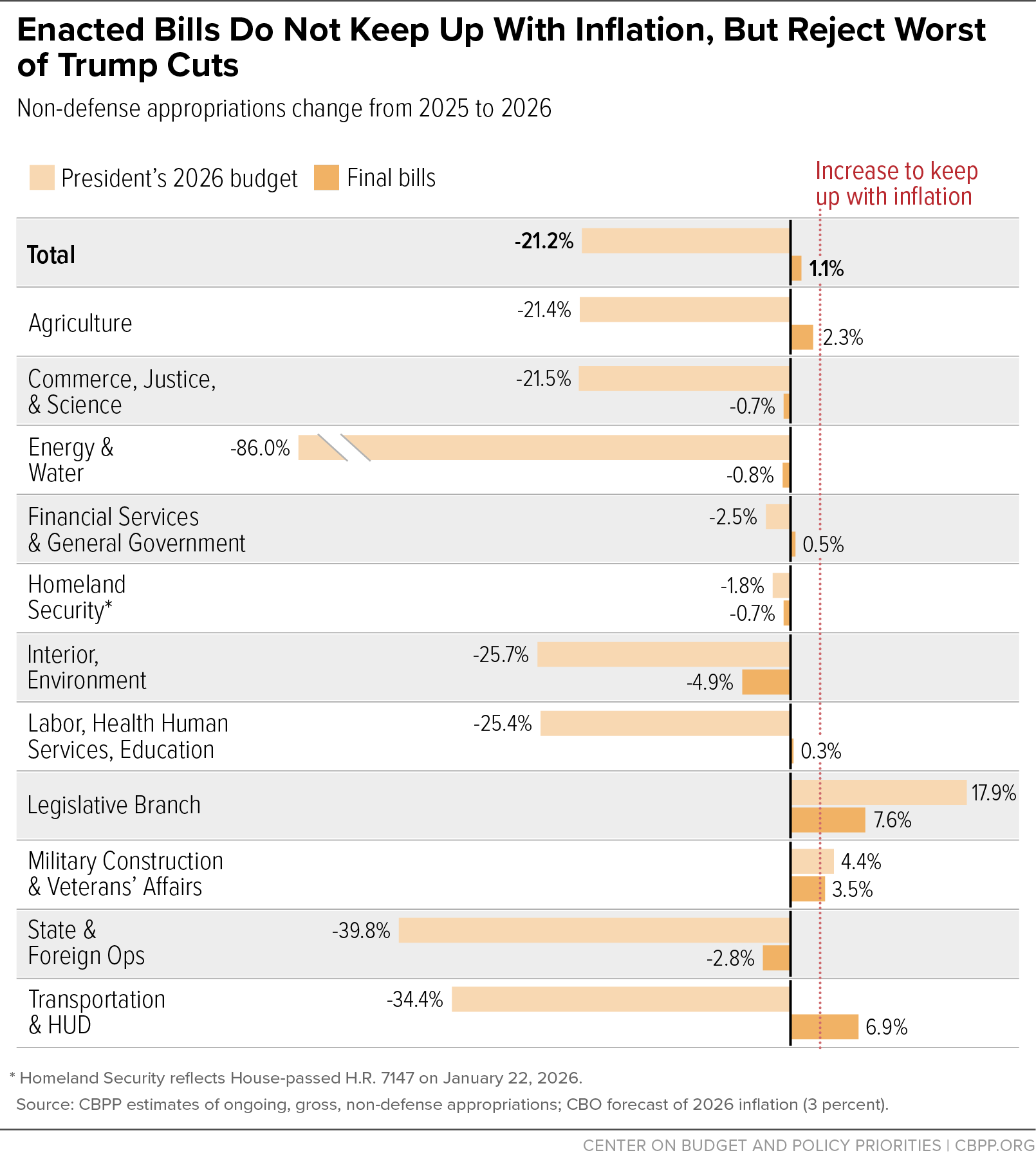
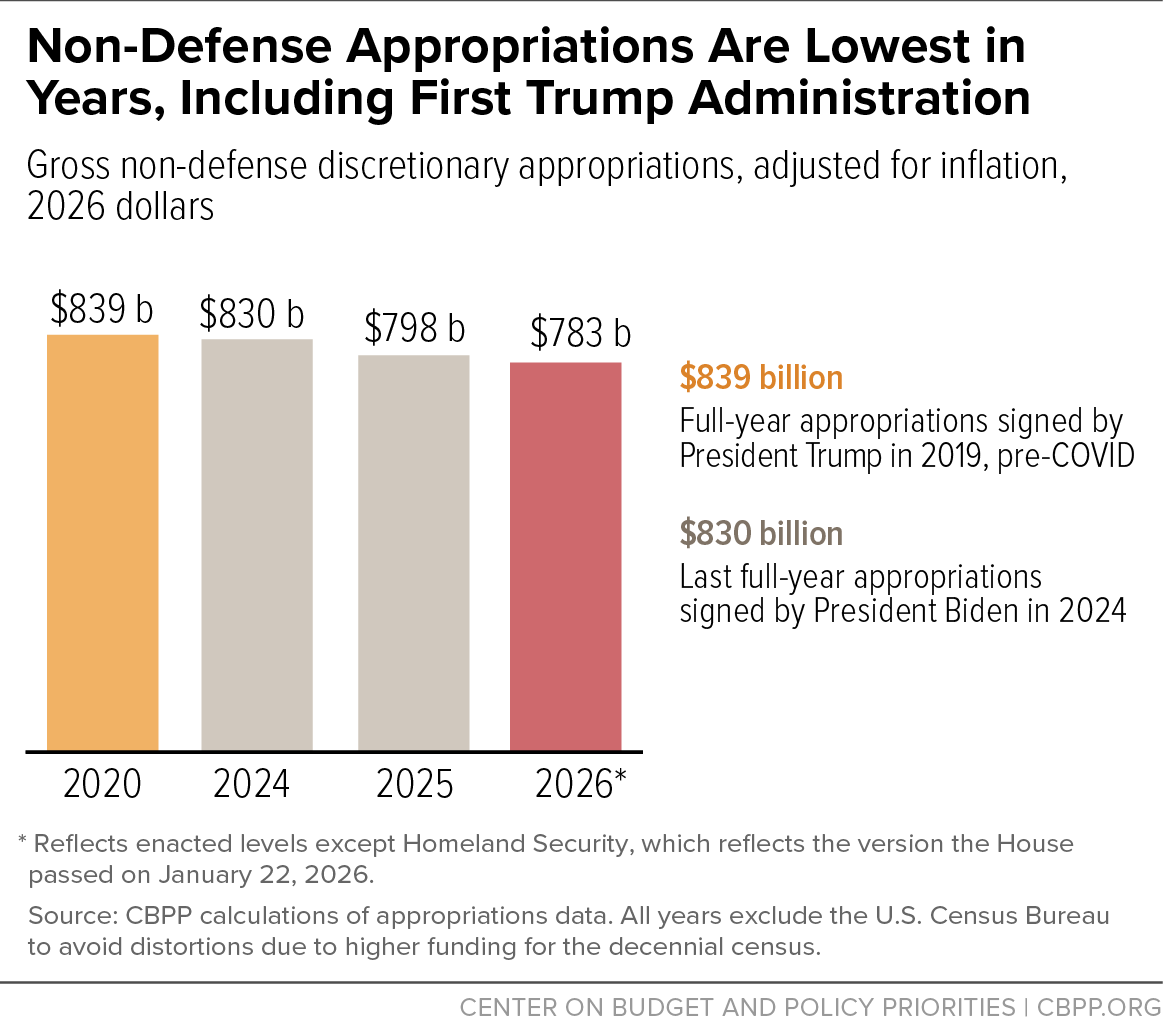
While the Trump Administration proposed massive cuts to non-defense appropriations for 2026 — a 21 percent reduction relative to the 2025 level — Congress largely rejected them. Nevertheless, Congress’s 2026 funding for these non-defense programs is not adequate. The 2026 level is only modestly above the 2025 level, but less than what is needed to keep pace with inflation — after adjusting for inflation, it is nearly 2 percent below the 2025 level. Moreover, the inflation-adjusted 2026 level for non-defense appropriations is 7 percent below the 2020 level, the last appropriation bills that President Trump signed during his first term (and the funding levels were set before the pandemic began). As a nation, we are devoting roughly 1 percent less of our resources (GDP) to these non-defense public services and investments than we were in 2010, the last year before this part of the budget faced steep cuts followed by constrained funding levels.
Ensuring the Trump Administration implements appropriations laws as Congress intended. Since taking office, the Trump Administration has engaged in aggressive — and often illegal — actions, including slashing federal personnel, reorganizing or shuttering agencies, and withholding funds and otherwise interfering with agencies carrying out their statutory responsibilities — all without congressional approval.
In response, Congress attempted to include guardrails aimed at stopping the Administration from ignoring congressional intent in the enacted 2026 appropriations bills. However, the guardrails Congress ultimately secured tend to be narrowly targeted and applicable only to specific agencies. Their effectiveness remains unclear, given ongoing Administration abuses, and will be critical to examine as the year unfolds.[1]
Looking toward 2027 appropriations, the House and Senate Appropriations Committees have set schedules for developing bills. And press reports indicate that the Trump Administration plans to release its 2027 budget proposal soon.[2] The arrival of the President’s budget is typically a key step in launching the annual appropriations process, allowing the appropriations committees to interrogate the Administration’s proposals. But the process will not be completed by the start of the fiscal year. The chances of any full-year appropriations bills being enacted before the mid-term elections are slim, and final action on appropriations bills will likely happen in either a lame duck session at the end of the year or in the new year after the newly elected Congress arrives.
Non-Defense Discretionary Programs Fund Critical National Priorities, Yet Funding Has Been Constrained
The discretionary portion of the federal budget — the part of the budget where Congress has the legal authority (discretion) to decide funding levels each year through the annual appropriations process — funds many critical national priorities.[3] The largest is national defense, but areas outside of defense include education, public health and medical research, economic security, economic development, and transportation, among others. Programs such as Social Security and Medicare are called mandatory programs; the laws that determine their funding are developed outside of the annual appropriations process.[4]
In this analysis, we focus on the ongoing funding provided for programs to accomplish their core missions, but not funding provided outside of regular appropriations.[5] For instance, the Defense and Homeland Security departments received significant additional funding outside the appropriations process in the Republican tax and budget megabill enacted last July. Similarly, a growing share of veterans’ medical care is now funded outside of appropriations through the Toxic Exposures Fund. In addition, Congress provides specifically designated funds for some programs to meet unforeseen, emergency needs. All of this funding is outside this analysis. Finally, the totals in this analysis exclude the Census Bureau to avoid distortions when comparing across years that include the higher funding for the decennial census.[6]
Funding provided for non-defense discretionary programs in 2026 totaled $783 billion. Because the Homeland Security bill has not yet been enacted, the total incorporates the funding levels in the Homeland Security bill that the House passed on January 22, which reflected a bipartisan House-Senate compromise.[7] This 2026 level is 1.1 percent above the 2025 level.[8] But even that modest increase is somewhat deceiving, since it does not take into account inflation (3.0 percent), which erodes the purchasing power of appropriations. After adjusting for inflation, the 2026 level is 1.8 percent below the 2025 level.
The enacted funding for 2026 non-defense discretionary programs stands in sharp contrast to the Trump Administration’s budget request, which called for a 21 percent cut, even before considering the effects of inflation. The enacted funding instead hews closely to the 2025 level for most bills. (See Figure 1.)
Only three appropriations laws received increases above the inflation rate, and the increase in funding for the departments of Transportation and Housing and Urban Development (HUD) was not a program expansion — it was primarily to accommodate the rising cost of rents so that rental assistance could continue serving the same number of families, which is still only 1 in every 4 eligible households.
Looking over a longer period shows that funding for non-defense discretionary programs has been quite constrained. Since 2010, non-defense discretionary spending has mostly been trending downward when measured as a share of the economy, declining to 2.5 percent in 2026 — or nearly one-third lower than in 2010. That means as a nation we are devoting about 1 percent of GDP less (or about $370 billion) than if we had funded these non-defense programs and investments at the same percentage of GDP this year that we did a decade and a half ago.[9]

Much of the decline over this period occurred as a result of the limits imposed by the 2011 Budget Control Act. But even when it expired after the first Trump Administration, pressure on these programs has continued. Despite claims from conservatives that there was significant growth in non-defense discretionary funding during the Biden Administration, increases were primarily needed to accommodate higher inflation. In addition, the 2023 Fiscal Responsibility Act put strict limits on this funding.[10] As a result, after adjusting for inflation, funding for non-defense discretionary programs in 2024, the last appropriations bills that President Biden signed, was 1 percent, or $9 billion, lower than in 2020, the last appropriations bills that President Trump signed during his first term. And Congress and the President continued to squeeze funding in 2025 and 2026, after adjusting for inflation. (See Figure 2.)

When viewed in the context of an extended period of austerity in this part of the budget, it is not surprising that 2026 funding levels fall far short of our nation’s needs. The specific challenges that inadequate funding poses for particular programs are discussed in more detail below.
It is worth noting that the funding levels provided in the 2026 bills were accompanied by some offsetting savings, some of which will not be available for 2027 bills. These 2026 offsets include, for instance, a rescission of $11.7 billion of Internal Revenue Service funding provided in the Inflation Reduction Act[11] and $2 billion of balances from COVID relief funding, but those pots of funding have now largely been used up. This could make the task of providing adequate funding for important services and investments in people and communities more challenging in the coming year.
2026 Appropriations Reject President’s Deep Budget Cuts, Include Some Guardrails Against Executive Abuses
In the final 2026 appropriations bills, Congress largely rejected the deep program cuts proposed in the President’s budget. Congress also rejected many of the President’s proposals to eliminate, reorganize, or radically reshape programs or agencies. However, last year the Administration pursued deep cuts in personnel and changes in agency operations without congressional endorsement, as the enacted 2025 appropriations largely continued funding for the programs and services in place before President Trump took office. This left lawmakers concerned about how the Administration may choose to implement the 2026 funding directives. Given these concerns, Congress enacted some guardrails against the Administration’s pattern of abuse and overreach, including those described below.
Targeted Guardrails in 2026 Appropriations Acts
The 2026 appropriations include a range of approaches intended to limit the Administration’s ongoing efforts to withhold, impound, or rescind funding. When Senator Patty Murray and Representative Rosa DeLauro, the senior Democrats on the Senate and House Appropriations Committees, proposed a short-term funding bill in September, they included numerous government-wide guardrails.[12] In the face of the Trump Administration’s fierce resistance to safeguards aimed at restricting their malfeasance, these provisions were not included in final 2026 appropriations laws. The final measures do include various provisions designed to curb at least some of the Administration’s abuses, typically in more targeted, agency-specific ways. Congress included provisions that aim to:
- Prevent the redirection of funds away from critical programs. Congress added more detailed programmatic funding levels across numerous accounts into the funding laws to guard against the Administration’s moves to support its own priorities by unilaterally shifting resources away from programs and projects Congress intended to fund. Many of these funding details were previously provided as non-binding directives that past administrations generally adhered to, but they will now be legally binding. Congress took this action in nearly 60 budget accounts across 12 departments and agencies.[13] By putting these directives into law, Congress is making it harder for the Administration to ignore Congress’s instruction on how to use these funds.
- Ensure that intended recipients get their funds on time. The Trump Administration attempted to illegally withhold tens of billions of dollars provided by Congress in 2025 appropriations for critical investments in afterschool care, scientific and medical research, and hazard mitigation, primarily as a strategy for harming grantees or programs it dislikes.[14] To restrain the Administration from withholding funds in particular areas, Congress included new provisions in some 2026 bills that spell out deadlines for delivering funds.[15] In most cases, these provisions seek to ensure that programs continue to operate the way they have traditionally operated for years or decades, without the uncertainty created by the Trump Administration as to when lawfully provided funds will be made available to recipients.
- Block additional changes to federally supported research. The National Institutes of Health (NIH), the National Science Foundation, and the Department of Energy each announced new policies in 2025 to sharply reduce the cap on the share of funding that can be used for indirect expenses by institutes of higher education performing federally funded research. These new polices would have disrupted the operations of universities across the country.[16] While these policies were challenged in court, Congress also included provisions in 2026 appropriations to prevent the Administration from changing how it funds research.[17] Additionally, seeing that Congress was poised to reject on a bipartisan basis the Administration’s severe proposed cuts to NIH, the Administration changed how it structured NIH grants for 2025, supporting fewer research projects in the near-term by increasing the share of funding committed to new projects’ needs in future years. In response, Congress limited the Administration from increasing the share of funds that could go to such future-year commitments in 2026 relative to 2025.
- Require certain agencies are staffed to meet their mission. Ignoring available resources and bypassing Congress, the Administration engaged in the largest one-year reduction in the civilian federal workforce since the drawdown after World War II, damaging the ability of the government to provide the services and programs that communities and families need and use.[18] Congress stopped short of prohibiting future reductions, but it put in place measures at a few departments, like Health and Human Services, Labor, and Education, explicitly reinforcing the existing requirement to maintain staffing levels sufficient for meeting their statutory and operational responsibilities. Additionally, after HUD proposed a reorganization of field offices that would leave 34 states without a local HUD office, Congress took steps to strengthen requirements in place before HUD can pursue office closures. The degree to which these provisions will constrain the Administration is particularly unclear.
- Prevent disruption to grants supporting people experiencing homelessness. In late 2025, weeks before existing grants began expiring, the Administration attempted to fundamentally alter the Continuum of Care (CoC) program, which supports people experiencing homelessness, by imposing funding restrictions that would cause over 170,000 formerly unhoused people to lose their housing. To limit funding gaps, Congress responded by requiring automatic renewal of CoC grants expiring in the first quarter of 2026 (January through March) and establishing a clear timeline for when grants must go out for the remainder of the year. Congress also required HUD to start the next CoC grant competition by June of this year; that process will determine what funds communities will receive in 2027. While the legislation protects roughly half of the 2027 CoC resources from HUD’s most harmful policy changes, HUD could still try to take housing assistance away from tens of thousands of formerly unhoused people in 2027.
- Improve transparency into grant and contract terminations. In 2025, the Trump Administration would frequently decline to make clear what grants or contracts it was terminating and why, making it difficult for the public to know the scale of actions being taken by the Administration, or for Congress to provide effective oversight. To help address this lack of transparency, Congress added new notification requirements for certain agencies before terminating grants or awards, including requiring them to report the extent of such terminations and the reasons behind the terminations, supporting some degree of congressional review and accountability.[19] The degree to which these increased transparency provisions will be effective in helping to constrain the Administration is unclear.
Programs Funded at Increased Levels to Continue Serving All Current Participants
For some programs, Congress provided increased funding for 2026, rejecting the deep cuts proposed by the Administration. But the increases did not represent program expansions —they were just enough to continue serving all current participants.
Nutrition assistance for new and expecting parents and young children. Congress appropriated $8.2 billion for the Special Supplemental Nutrition Program for Women, Infants, and Children (WIC), an increase above the 2025 level. This level maintained a nearly 30-year bipartisan commitment to provide enough funding to serve all eligible families who seek support from WIC, which provides nutritious foods, nutrition education, breastfeeding support, and referrals to health care and social services for millions of low-income families. The President’s budget had proposed cutting WIC funding overall and slashing the science-based fruit and vegetable benefit[20] by 62 to 75 percent for more than 5 million participants.
Support for low-income families to pay rent. Both Housing Choice Vouchers and Section 8 Project-Based Rental Assistance, the two largest federal rental assistance programs, received a funding increase to keep pace with rising housing costs and prevent deep cuts in the number of households receiving assistance. Congress appropriated $38 billion for housing vouchers, an increase of $2.4 billion (7 percent) over 2025 levels, and $18.5 billion for Project-Based Rental Assistance, an increase of $1.7 billion (10 percent) over 2025 levels. Congress also rejected the President’s budget proposal to replace existing rental assistance programs with a new state-based formula grant that would have provided 43 percent less funding for these programs.
Unfortunately, the final appropriations law cut funding for public housing, the third largest rental assistance program, by nearly $500 million (6 percent) relative to 2025 levels. This continues a long trend of lawmakers disinvesting from public housing, further limiting resources to meet residents’ needs or preserve this critical source of affordable housing.
Rental assistance helps families afford housing and avoid homelessness and housing instability. By limiting housing costs, rental assistance leaves families with more resources to meet other basic needs, such as food, health care, and transportation. While the current funding level prevents households from losing assistance, it is still far from what is necessary to meet demand, since only about a quarter of those eligible for assistance receive it, given limited funding. As a result, eligible families typically must wait years to receive rental assistance.
Programs Funded at Last Year’s Level, But Administration Interference a Concern in Numerous Cases
Congress funded most programs in 2026 close to the 2025 level, sometimes a little above (although generally not enough to keep up with inflation) and sometimes a little below. For many programs, this follows multiple years of constrained funding — levels that too often fail to meet need. In addition, in a number of areas, the Administration has tried to withhold enacted funding or interfere with the implementation of a program. The Administration’s actions have, in many cases, been successfully challenged in court. In some of these areas, Congress added guardrails.
Home energy assistance for low-income households. Congress appropriated $4 billion for the Low Income Home Energy Assistance Program (LIHEAP), which provides heating and cooling assistance to 6 million low-income households to help prevent utility shutoffs. In providing this funding, which reflects a small $20 million (0.5 percent) increase over 2025 funding, Congress rejected the President’s proposal to eliminate the program completely — something he also proposed during his first term. But even with this increase, the funding is still far from what is necessary to support all eligible households, as the program currently aids only one-sixth of those eligible. Moreover, the Administration eliminated the dedicated office in the Department of Health and Human Services (HHS) that previously administered LIHEAP, leaving it unclear who at HHS is overseeing the program.[21]
Subsidies to help low-income families afford child care. Congress provided $8.8 billion for the Child Care and Development Block Grant, an $85 million (1 percent) increase over the 2025 level. The President’s budget called for flat funding. This modest increase is far from the investment needed to meet the nation’s child care needs. Only about 1 in 7 of those eligible for child care subsidies under federal rules receive them.[22] In January, the Administration used unsubstantiated accusations of fraud as a pretext to freeze child care funding in five states led by Democratic governors, an action that has been blocked by a federal judge while the legality of the freeze is argued in court.[23]
Early childhood education for low-income children through Head Start. Congress provided $12.4 billion for Head Start, an increase of $85 million (less than 1 percent) over 2025 funding. The President’s budget proposed flat funding, after a backlash over leaked documents that showed the Administration planned to eliminate the program. This modest increase follows several years of flat or nearly flat funding, which means funding has been declining in inflation-adjusted terms.
Funding already falls far short of what is needed to support all eligible children — only 1 in 4 eligible children are currently enrolled.[24] In January, a federal court temporarily paused the Administration’s efforts to lay off large numbers of federal staff, close regional offices supporting the Head Start program, and prevent Head Start providers from engaging in diversity, equity, inclusion, and accessibility activities. This followed court action last year that prevented the Administration from excluding children from the program on the basis of immigration status.
Preserving public health institutions and funding. The Centers for Disease Control (CDC) received $9.1 billion from Congress, a very slight 0.2 percent decrease. (These figures include $1.5 billion for the Prevention and Public Health Fund, which is classified as mandatory.) Congress rejected the President’s budget proposal, which called for dramatically cutting CDC funding by about 40 percent; reorganizing some of the centers within the CDC, including moving some functions into a new “Administration for a Healthy America;” and eliminating the Prevention and Public Health Fund, an important source of funding for states, localities, and tribal communities. In February, a federal court temporarily blocked the Administration from terminating $600 million in CDC public health grants already awarded to state and local health departments and other recipients to help support essential public health infrastructure in four states led by Democratic governors.
Program Areas Harmed by Administration’s Extraordinary Federal Workforce Cuts
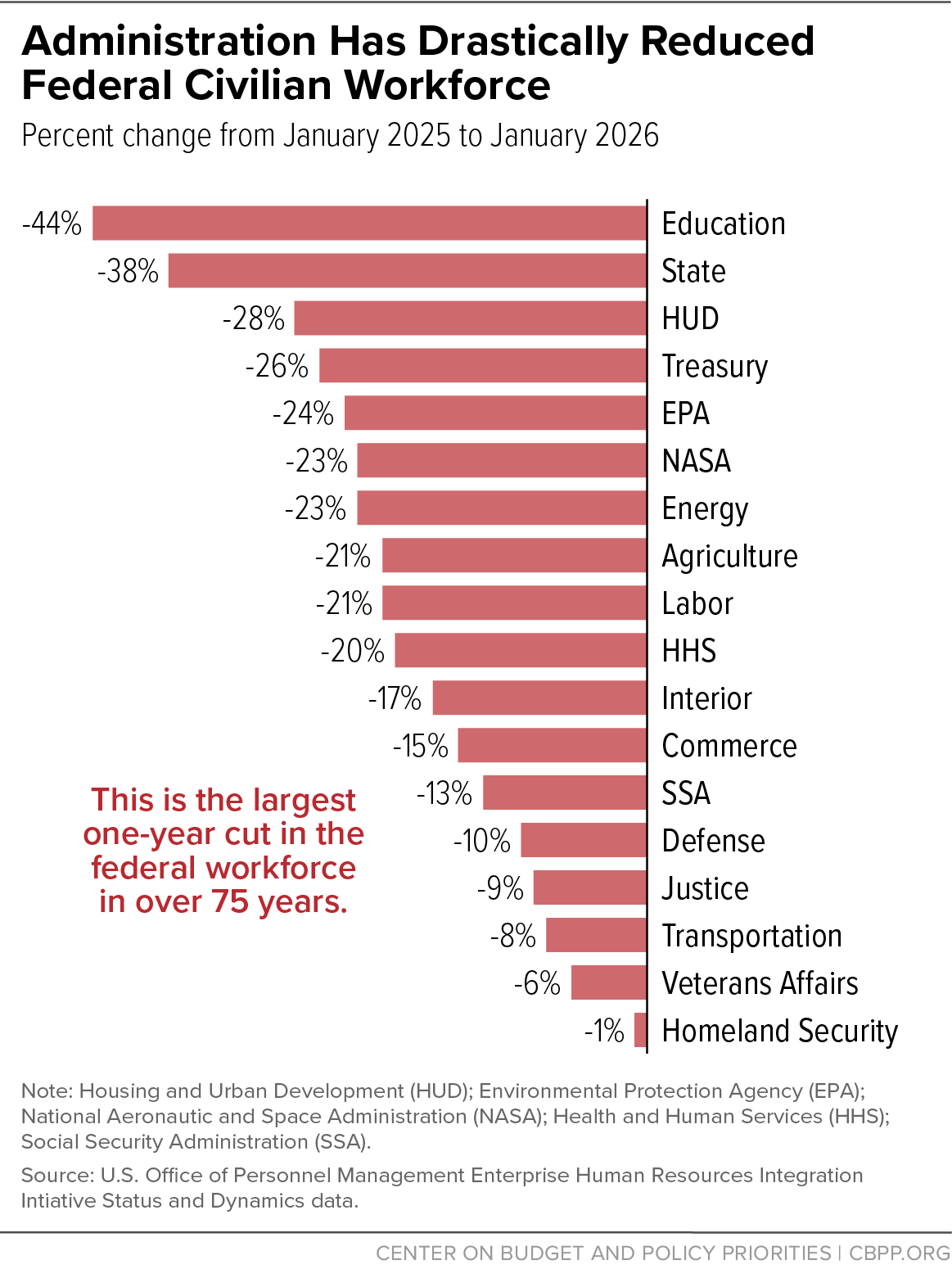
In many areas, the President’s 2026 budget proposed not only deep funding cuts but also deep cuts in federal non-defense civilian personnel. Yet before Congress approved any of those personnel cuts, the Administration unilaterally pushed forward with sharp reductions in federal personnel — resulting in the largest one-year cut in the federal workforce in over 75 years.[25] (See Figure 3.)
The Administration cut federal personnel even though Congress had provided funding for 2025 that largely continued the programs and services in place before President Trump took office, as well as the personnel needed to carry them out. The Administration generally did not accompany this severe retrenchment in federal capacity with any clear plan on how to maintain the programs and services these workers administer. In fact, the Administration ended up cutting significantly more federal employees over the course of 2025 than it proposed in its 2026 budget.[26] In the final 2026 appropriations bills, Congress largely rejected the President’s proposed funding cuts and raised concerns in various bills about the need to maintain staffing at levels that allow agencies to meet their missions (as also discussed above in the section on guardrails).
Funding for K-12 and higher education programs flat as Trump Administration seeks to dismantle Education Department. Congress largely flat-funded federal K-12 education programs, including support for schools serving students from families with low incomes (Title I) and students with disabilities (Individuals with Disabilities Education Act or IDEA), and programs that support tutoring, school safety, and professional development for teachers. It also flat-funded Pell Grants, keeping the maximum grant award at $7,395 for the third consecutive year.[27] Congress rejected the President’s budget proposals to block-grant K-12 programs outside Title I and IDEA and to cut funding by more than two-thirds, as well as to cut the maximum Pell Grant award by nearly one-quarter.
Congress also included legislative language to block the Administration from ignoring congressional directives for supporting higher education programs, responding to the Trump Administration’s reallocation of nearly $2 billion in higher education funding in the final days of 2025. Congress incorporated specific funding amounts from the 2026 report into the 2026 law to protect congressional prerogatives and preserve funding for specific education activities. In addition, Congress included language that requires the immediate award of Title I, IDEA, and other grant funding to states, after the Administration tried to withhold some K-12 funds, including for afterschool programs, in the summer of 2025 before being challenged in court.[28]

At the same time, the Administration is trying to dismantle the Education Department. It has cut staff by over 40 percent and, despite lacking legal authority, has transferred the funding Congress appropriated for the Education Department to the Departments of Labor, Interior, State, Treasury, and Health and Human Services to carry out the Education Department’s programs. The Administration announced interagency agreements as recently as February and March.
Social Security Administration (SSA) staffing craters. Congress provided a very slight increase for SSA customer service, about $50 million (0.4 percent). The President had proposed a freeze. But the Administration has reduced staffing at SSA by roughly 7,500 from January 2025 to January 2026, a 13 percent loss, the largest one-year decline ever. These staff reductions come on top of more than a decade of underfunding and staff declines, despite a growing number of Social Security beneficiaries.
Key customer-serving positions were hit hard, with the loss of over 3,000 staff who assist people visiting field offices or calling SSA’s national 800 number for assistance. SSA’s leadership has shifted thousands of its remaining workers to try to fill the gap in services, but this has only exacerbated short-staffing in other critical functions. The result has been a degradation of services for those who most need support from SSA, creating challenges that will be difficult to turn around quickly without major changes.[29] Congress raised concerns about SSA staff levels and their impact on services in the report accompanying the appropriation law, asking for monthly updates on staffing.
Counterproductive cuts to IRS funding continue. Congress cut regular funding for the IRS by $1.1 billion (9 percent), including cutting over $400 million from tax enforcement and over $900 million from technology and operations support. These cuts are on top of Congress rescinding $11.7 billion in mandatory IRS funding that had been provided by the Inflation Reduction Act. As challenging as these funding levels will be for IRS operations, Congress’s cut is not as severe as the $2.5 billion (20 percent) cut proposed in the President’s budget.
The Administration has already taken dramatic steps to undermine the agency, firing or encouraging resignations from 27,500 IRS staff in 2025, a 27 percent reduction.[30] These cuts come on top of years of underfunding and understaffing that leave the IRS hamstrung in carrying out its mission to serve taxpayers and enforce the nation’s tax laws, particularly the agency’s capacity to root out tax evasion by high-income and wealthy households.[31]
Administration seeks to gut the Environmental Protection Agency (EPA). The EPA is responsible for protecting our environment and public health by administering environmental laws and developing regulations that ensure the safety of our nation’s air, land, and water; providing funding to states to carry out their delegated responsibilities under federal environmental laws; funding governments, nonprofits, and other institutions to further environmental protection and research; and ensuring that industries comply with pollution and chemical safety standards.
Congress cut funding for the EPA by 3 percent, or $319 million, a much smaller cut than the President’s proposal to slash funding for the EPA by over half, nearly $5 billion. The Administration is openly hostile to the mission of the EPA, cutting 4,000 EPA staff (24 percent) between January 2025 and January 2026, and withholding billions from clean energy and environmental health projects previously appropriated by Congress through the Greenhouse Gas Reduction Fund and other programs from the Inflation Reduction Act. Multiple lawsuits challenging these funding freezes are still working their way through federal court.[32]
Programs Supporting Non-Defense Research and Development Spared Deep Cuts
The Administration proposed deep cuts in federal non-defense research and development (R&D), even though high-quality analysis has shown that R&D investments have boosted long-term economic growth and our standard of living.[33] Moreover, the Administration severely (and often illegally) disrupted the grantmaking process.[34] The Administration often asserted it was aligning the grants with its policy priorities while in reality making politically motivated decisions.
In 2026 appropriations bills, Congress largely rejected these cuts and, in some cases, included legislative language to limit further abuses by the Administration (see further discussion above in the guardrails section on federally funded research).
Funding for scientific and medical research institutions. Congress provided $8.8 billion for the National Science Foundation, a cut of $310 million (more than 3 percent). Congress sharply rejected the President’s budget’s call for a massive cut of over 55 percent. However, the Administration reduced NSF staff by nearly a third over its first year in office.[35] NSF supports research and education in non-medical fields. These investments account for about 25 percent of federal support to U.S. colleges and universities for basic research.[36]
Congress provided $47.3 billion for the National Institutes of Health, an increase of about 1 percent over the 2025 level. This is a firm rejection of the President’s budget proposal to cut funding for NIH by about 40 percent. Congress also rejected the President’s proposal to reorganize NIH by consolidating the 19 existing institutes and centers into nine, including shifting one to the proposed “Administration for a Healthy America.” Predictable, consistent funding for medical research is essential to long-term advances in health care. However, the Administration reduced NIH staffing by more than 21 percent between January 2025 and January 2026.[37]
Funding for the office dedicated to renewable energy development. Congress provided $3.1 billion for the Energy Department’s Office of Energy Efficiency and Renewable Energy (EERE), a 10 percent cut. EERE administers programs that support research, development, and deployment of technologies to transition the country to a reliable, secure, resilient, and clean energy system. The President’s budget, in contrast, proposed cutting these programs by $2.5 billion or almost 75 percent.
Conclusion
The 2027 appropriations process will be about more than just setting funding levels for important programs serving people and communities across the country. Congress will need to closely monitor Administration compliance with the new requirements enacted as part of 2026 appropriations as well as identify other areas where the Administration may be evading congressional intent and abusing its executive powers. For 2027, Congress should build on guardrails that are successfully achieving their goals and consider additional government-wide measures to address Administration abuses.
End Notes
[1] Sam Berger and Devin O’Connor, “The Trump Administration Is Engaging in Increasingly Blatant Efforts to Misuse Federal Funds to Coerce and Punish,” CBPP, January 27, 2026, https://www.cbpp.org/blog/the-trump-administration-is-engaging-in-increasingly-blatant-efforts-to-misuse-federal-funds; CBPP, “Trump Administration Continues Its Illegal Weaponization of Federal Funds With Cuts to Public Health Funding,” March 12, 2026, https://www.cbpp.org/research/federal-budget/executive-action-watch?item=30496; Emily Badger and Alicia Parlapiano, “Trump Funding Lawsuits,” The New York Times, March 3, 2026, https://www.nytimes.com/interactive/2026/03/03/upshot/trump-funding-lawsuits.html.
[2] Brendan Duke, “Five Questions to Ask in Trump’s 2027 Budget,” CBPP, March 24, 2026, https://www.cbpp.org/research/federal-budget/five-questions-to-ask-in-trumps-2027-budget.
[3] CBPP, “Policy Basics: Non-Defense Discretionary Programs,” updated December 16, 2025, https://www.cbpp.org/research/federal-budget/non-defense-discretionary-programs.
[4] While some mandatory programs are funded by annual appropriations, their actual costs are determined by the mandates in their authorizing legislation, not by the funding levels in the appropriations bills.
[5] In this analysis, all dollar figures for non-defense discretionary funding represent a topline total that best shows regular, ongoing funding. For a more detailed discussion of topline calculations, see CBPP, “How CBPP Analyzes Non-Defense Discretionary Funding,” April 9, 2026, https://www.cbpp.org/research/federal-budget/how-cbpp-analyzes-non-defense-discretionary-funding.
[6] For instance, there was significantly higher funding for the Census Bureau in 2010 and 2020, years when a decennial census was conducted.
[7] The bipartisan House-Senate compromise preceded the fatal shooting of Alex Pretti in Minneapolis by federal immigration officers. Rather than passing the compromise bill, Congress continued current funding for Homeland Security only through February 13. That funding subsequently lapsed, and negotiations over Homeland Security immigration operations had not yet been resolved as of the time of this publication.
[8] The 2025 level includes the $7.9 billion rescission of 2025 funds that was part of the rescission package enacted on July 24, 2025 (P.L. 119-28).
[9] Over much of this period, funding for veterans’ health care — which today represents almost one-sixth of non-defense discretionary funding — grew steadily, further squeezing other non-defense programs.
[10] Richard Kogan, “Debt Ceiling Deal Squeezes Non-Defense Appropriations Even With Agreed-Upon Adjustments,” CBPP, June 2, 2023, https://www.cbpp.org/research/federal-budget/debt-ceiling-deal-squeezes-non-defense-appropriations-even-with-agreed-upon.
[11] Congressional Budget Office (CBO) estimates that this rescission of IRS funding would reduce revenue by $38.6 billion over the 2026-2035 period.
[12] Sam Berger and Devin O’Connor, “New Proposal Shows Congress Can Enact Guardrails to Ensure a Deal Is a Deal for 2026 Funding,” CBPP, September 25, 2025, https://www.cbpp.org/research/federal-budget/new-proposal-shows-congress-can-enact-guardrails-to-ensure-a-deal-is-a-deal.
[13] Broken out by appropriations bill, this includes 26 programs within the Labor, Health and Human Services, and Education appropriations bill, 13 within the Interior and Environment bill, seven within the Transportation, Housing, and Urban Development bill, and five within the Commerce, Justice, and Science bill.
[14] Sam Berger and Devin O’Connor, “The Trump Administration Is Engaging in Increasingly Blatant Efforts to Misuse Federal Funds to Coerce and Punish,” CBPP, January 27, 2026, https://www.cbpp.org/blog/the-trump-administration-is-engaging-in-increasingly-blatant-efforts-to-misuse-federal-funds.
[15] Examples include provisions requiring: the Low Income Home Energy Assistance Program, which provides grants to help families pay their heating and cooling bills, to award 90 percent of its grant funding by November 1; the Child Care and Development Block Grant, which assists families with low-income afford childcare, to provide quarterly distributions; the Legal Services Corporation, which provides free or low-cost legal services to families with low-income, to make annual lump-sum payments; and formula-based education awards that assist states and school districts to be made immediately.
[16] Ben Unglesbee, “‘Self-Inflicted Wound’: Widespread Alarm as Trump Administration Slashes NIH Funding,” Higher Ed Dive, February 11, 2025, https://www.highereddive.com/news/nih-indirect-cost-rate-cap-funding-cut-ags-lawsuit/739735/.
[17] The Commerce, Justice, Science (Section 542) and Energy and Water (Section 313) appropriations prevent changes in indirect cost rates for research funding from the rate in place in fiscal year 2024, prohibiting renegotiation aimed at reducing research support to certain universities and ensuring some measure of funding stability.
[18] Kiran Rachamallu and Devin O’Connor, “Administration’s Radical Personnel Cuts Bypassed Congress and Lacked Transparency, Obscuring Impact on Public Services,” CBPP, January 15, 2026, https://www.cbpp.org/research/federal-budget/administrations-radical-personnel-cuts-bypassed-congress-and-lacked.
[19] For example, see the requirements included in section 524 of the Labor, Health and Human Services, and Education and sections 185 and 220 of the Transportation and Housing and Urban Development appropriations bills.
[20] CBPP, “Trump Budget Would Slash WIC Fruit and Vegetable Benefits for Millions,” June 3, 2025, https://www.cbpp.org/blog/trump-budget-would-slash-wic-fruit-and-vegetable-benefits-for-millions.
[21] Brendan Duke et al., “2026 Appropriations Must Protect Against Further Partisan Cuts and Illegal Withholding of Funds,” CBPP, September 4, 2025,https://www.cbpp.org/research/federal-budget/2026-appropriations-must-protect-against-further-partisan-cuts-and-illegal https://www.cbpp.org/research/federal-budget/2026-appropriations-must-protect-against-further-partisan-cuts-and-illegal.
[22] U.S. Government Accountability Office, “Child Care: Subsidy Eligibility and Use and State Waiver Requests Related to New Program Requirements,” January 30, 2025, https://www.gao.gov/products/gao-25-107754.
[23] Nick Gwyn, “Trump Administration’s Five-State Funding Freeze Is Unlawful, Harmful, and a Major Threat to People in Every State,” CBPP, January 23, 2026, https://www.cbpp.org/research/federal-budget/trump-administrations-five-state-funding-freeze-is-unlawful-harmful-and-a.
[24] First Five Years Fund, “2025 Child Care and Early Learning State Fact Sheets,” https://www.ffyf.org/2025-state-fact-sheets/.
[25] Kiran Rachamallu and Devin O’Connor, “Administration’s Radical Personnel Cuts Bypassed Congress and Lacked Transparency, Obscuring Impact on Public Services,” CBPP, January 15, 2026, https://www.cbpp.org/research/federal-budget/administrations-radical-personnel-cuts-bypassed-congress-and-lacked.
[26] Rachamallu and O’Connor, op. cit.
[27] After enactment of Pell Grant funding for 2026, CBO alerted lawmakers of a $5.5 billion shortfall in the program, which will grow to $16.9 billion in 2027.
[28] Brendan Duke et al. 2025.
[29] Kathleen Romig and Devin O’Connor, “Trump Administration Personnel Policies Harming Social Security Customer Service, Risk Lasting Damage,” CBPP, March 23, 2026, https://www.cbpp.org/research/social-security/trump-administration-personnel-policies-harming-social-security-customer.
[30] Taxpayer Advocate Service, “National Taxpayer Advocate Annual Report to Congress: 2025,” January 26, 2026, https://www.taxpayeradvocate.irs.gov/reports/2025-annual-report-to-congress/full-report/.
[31] Chuck Marr, “IRS Reform Bill Is Good Start That Falls Short of Modernization,” Bloomberg Tax, March 10, 2026, https://news.bloombergtax.com/tax-insights-and-commentary/irs-reform-bill-is-good-start-that-falls-short-of-modernization.
[32] Claire Brown, “Billions in Climate Grants, Frozen for a Year, Are Back in Court,” New York Times, February 26, 2026, https://www.nytimes.com/2026/02/24/climate/billions-in-climate-grants-frozen-for-a-year-are-back-in-court.html.
[33] Chuck Marr and Josephine Cureton, “Administration’s Proposed Cuts to Non-Defense R&D Pose Long-Term Risk to Rising Living Standards,” CBPP, October 6, 2025, https://www.cbpp.org/research/federal-budget/administrations-proposed-cuts-to-non-defense-rd-pose-long-term-risk-to.
[34] Cristin Dorgelo and Jacob Leibenluft, “DOGE Interference in Federal Grantmaking Adds Burden, Uncertainty, and Risk,” CBPP, May 28, 2025, https://www.cbpp.org/research/federal-budget/doge-interference-in-federal-grantmaking-adds-burden-uncertainty-and-risk.
[35] OPM, “Release 1.4.0 Notes,” March 4, 2026, https://data.opm.gov/info-and-help/release-notes.
[36] U.S. National Science Foundation, “About NSF,” https://www.nsf.gov/about#:~:text=We%20fulfill%20our%20mission%20chiefly,advancements%20for%20the%20American%20people.
[37] OPM, op. cit.