

Five Questions to Ask in Trump’s 2027 Budget
The Trump Administration is expected to release a budget proposal for 2027 in late March or early April. If it follows the pattern of his time in office so far or that of his previous budgets, it will lack solutions to address people’s affordability challenges and actually make life less affordable for people with low and moderate incomes — the very group that struggles the most with affordability. This is despite President Trump winning the 2024 election with a promise to address higher costs and affordability challenges.
And like his first-term budgets it may include various gimmicks to hide the fiscal cost of many of its priorities, like its reportedly astronomical ask for defense spending, which may be in addition to supplemental funding the Administration may request for the war in Iran. And the budget proposal will also likely lay the groundwork for further attacks on people who are immigrants. U.S. Immigration and Customs Enforcement’s (ICE) anti-immigrant campaign is first and foremost brutal, but is also expensive, and the Administration may seek to renew the four-year funding provided in the July budget and tax megabill.
Here are five questions we will be looking to answer when the budget is released:
- Does the budget offer real solutions to make health care, groceries, rent, child care, and other essentials more affordable? The Administration’s actions so far have increased costs for households by letting enhancements to premium tax credits expire, enacting the largest cuts to food assistance and health coverage in history, and enacting regressive tariffs. Its budget last year proposed cutting assistance for people paying rent and support for households to pay electricity bills.
- Does the budget repair the damage the Administration has done to core government functions, or does it propose further damage? In its budget last year, the Administration proposed an enormous reduction in the part of the budget (known as non-defense discretionary) that funds certain core government activities, from paying Social Security benefits and collecting taxes to scientific research and gathering essential economic data. While Congress largely rejected these proposals, the Administration sought to use executive actions to try to shutter whole agencies, gut the federal workforce, and attack key surveys, and at times it has succeeded.
- Does the budget propose even more tax cuts that will worsen our fiscal trajectory and heighten calls for cuts to critical public services, including programs that help families with low or moderate incomes afford the basics? The Administration enacted enormous cuts to health care and food assistance to offset a portion of the cost of extending the expiring 2017 tax cuts and a host of new temporary tax cuts. It may extend the temporary tax cuts enacted last year and could propose further tax cuts — revenue losses that it may seek to offset with further cuts to essential public services.
- Does the budget set up more attacks on people who are immigrants? The Trump Administration has engaged in a particularly brutal campaign targeting immigrants — both those with and without lawful status — with punitive and cruel policies. The budget may signal its next steps on anti-immigrant policies.
- Does the budget rely on gimmicks to claim fiscal responsibility? The budget may seek to hide the cost of previous and new tax cuts and large increases in defense spending with overly rosy economic assumptions, unrealistic continued cuts to non-defense discretionary spending, inflated tariff revenue projections, wildly overstated savings from anti-fraud, and other sleights of hand.
To be sure, the large majority of the proposals in the President’s budget will not be enacted this year. But the President’s budget remains significant, as it reflects the Administration’s vision for America and could influence congressional Republican budgeting choices. Project 2025 served as a roadmap for the Trump Administration when it first took office, and it has gone about implementing significant pieces of this agenda. Similarly, this year’s budget may also map out the types of policies that the Administration will seek to implement during its remaining years in office with the various tools at its disposal, including executive actions and regulatory changes, as well as through legislation.[1]
The Trump Administration may decide not to provide direct answers to these questions — its budget last year was a “skinny budget” that only provided its requested fiscal year 2026 funding levels for the roughly one-quarter of the budget that is subject to annual appropriations. A full budget would contain proposals around annual appropriations beyond fiscal 2027 as well as tax proposals and proposals for programs like Medicare and Medicaid. The Administration may well decide not to provide these key budget details normally included in the President’s budget. That would reflect a missed opportunity to educate lawmakers and the American people about its plans around several important fiscal issues anticipated over the ten-year period covered by the budget. One is how the Administration would address the projected depletion of Social Security’s retirement fund reserve in 2032, while keeping the President’s promise not to cut benefits.
If this year’s budget is broadly similar to the policies it has pursued so far and in its previous budgets, it will be a budget that would, if ultimately adopted, result in more poverty, more people lacking health insurance, and greater disparities in income, wealth, and opportunity.
1.) Does the budget offer real solutions to make health care, groceries, rent, and other essentials more affordable?
As detailed below, the Trump Administration has cut or sought to cut an array of programs that make the basics more affordable for low- and moderate-income people. The budget may double down on this approach. In particular, the Administration has suggested that it may embrace a wide-ranging (and highly misleading) definition of fraud that it will use as cover to cut benefits to people who are legally entitled to them. It has used the same pretext for its violent anti-immigrant campaign.
Health
In his State of the Union address, President Trump said he is “confronting one of the biggest rip-offs of our times, the crushing cost of health care,” but failed to lay out any real solutions for making health care more affordable in his remarks. We expect his budget proposal will be more of the same.
The President claimed that he “took prescription drugs, a very big part of health care” from the “highest price in the world to the lowest” through his TrumpRx.gov website. But the discounted drugs are designed for cash-paying, uninsured patients instead of the 85 percent of people in the U.S. with prescription drug coverage.[2] Purchasing prescription drugs through insurance will generally remain cheaper than whatever discounts from the list price people can receive on TrumpRx. And for uninsured patients — even if they happen to use one of the just 43 prescription drugs listed on the TrumpRx website[3] — paying in some cases hundreds of dollars a month after discounts is still unaffordable. What they really need is affordable health coverage. Moreover, many of the drugs that are listed were already available for discounts elsewhere.[4] Thus any prescription drug proposals and claims made in the budget should be carefully scrutinized.
A real step toward making health care affordable would be reviving the enhancements to premium tax credits (PTCs) that expired at the end of last year, after President Trump and congressional Republicans refused to extend them. The PTC enhancements reduced the average enrollee’s premium by 53 percent and helped drive record enrollment gains by making health coverage more affordable.[5] The Congressional Budget Office (CBO) estimates that 4 million people will lose marketplace coverage and become uninsured due to the expiration of the PTC enhancements, with millions more paying much higher premiums or shifting to skimpier coverage with lower premiums but generally far higher deductibles.[6]
Another real step toward affordable care would be reversing the megabill’s cuts to Medicaid and Affordable Care Act (ACA) coverage that it used to help finance tax cuts tilted toward the wealthiest. That law cut Medicaid — the country’s second largest health care program — by more than $900 billion over the decade (17 percent by 2034) and the ACA marketplace by more than $200 billion, which will result in roughly 10 million people losing health coverage in 2034, according to CBO. One of the principal methods the megabill uses to achieve these cuts is creating several new layers of red tape designed to remove people from coverage, such as a work requirement and more burdensome renewal steps. The megabill also requires states to charge Medicaid expansion enrollees with incomes just above the poverty line ($16,000 a year for an individual) new cost-sharing charges for many services when they go to the doctor, which will directly raise many people’s out-of-pocket health care costs.
Groceries
A key question is how the Administration plans to make groceries more affordable for people who struggle to afford them. The Trump Administration has already made them more expensive for low-income families by cutting $187 billion in food assistance through SNAP over the decade, the largest cut in the program’s history. The megabill used these cuts to cover about 4 percent of the cost of its tax cuts, whose benefits again are heavily tilted to people with high incomes. The megabill’s SNAP cuts come from slashing billions in federal funding for states’ SNAP programs, thereby forcing high and volatile costs onto states, which could even lead some states to end their SNAP programs entirely. The federal cuts also come from taking food assistance away from millions of people — including families with children aged 14 and up, older adults, and veterans — by expanding harsh, ineffective, and red tape-laden work requirements.
A real agenda focused on grocery affordability would reverse these cuts and strengthen federal investments in SNAP. But it is possible the Administration will propose additional cuts to food assistance programs like it has in the past. For instance, Trump’s previous budget included a $1.3 billion cut in the fruit and vegetable component of food benefits provided by the Special Supplemental Nutrition Program for Women, Infants, and Children, or WIC. This cut would have slashed the fruit and vegetable benefit by 62 percent to 75 percent for 5.2 million participants — new and expecting parents, toddlers, and preschoolers. Congress rightly rejected this cut in last year’s appropriations process and hopefully would do so again.[7]
Housing
Trump’s budget last year not only failed to provide concrete policies to help low-income people pay rent, but would have made housing far less affordable for millions. The budget proposed replacing existing rental assistance programs, including public housing and housing vouchers, with a new state-based formula grant that would receive 43 percent less funding in its first year, even as the cost of housing and the number of families struggling to afford rent have risen in recent years.[8] Congress did not act on this proposal, but the 2027 budget may again propose deep cuts and radical changes to rental assistance programs.
It is unclear if the new budget will also repeat a proposed legislative change from the 2026 budget that would have cut off rental assistance after two years even if participants still can’t afford rent on their own, putting over 3 million people at risk of eviction and homelessness.[9] On March 2, the Administration proposed a rule allowing state and local housing agencies and private subsidized housing agencies to impose time limits and policies taking away assistance from people who can’t meet rigid work requirements.
Utility Bills
Household utility bills — including energy — are another large expense for families with incomes in the bottom half of the income distribution, taking up 11 percent of their incomes in 2023. With energy costs rising even before the war in the Middle East, an important question is whether the forthcoming President’s budget will call for providing additional funding for the Low Income Home Energy Assistance Program (LIHEAP), which provides heating and cooling assistance to 6 million low-income households to help prevent utility shutoffs, or whether, like last year, it will call to eliminate the energy assistance provided by the program. The President also attempted to zero out LIHEAP in his first term. The budget could also include further cuts to tax credits or other investments designed to promote clean energy and reduce costs, on top of similar cuts made in last year’s megabill, which are already projected to increase household energy bills by $280 annually, or 13 percent.[10]
2.) Does the budget repair the damage to core government functions or does it propose further damage?
Since taking office, the Trump Administration has broadly engaged in a campaign to undermine core government functions. Parts of the budget may reveal whether the Administration plans to continue taking damaging actions, back off of them, or begin to repair the damage. The budget may provide clues on the funding and staffing levels the Administration is seeking for different agencies, which is one signal of its approach to core government functions.
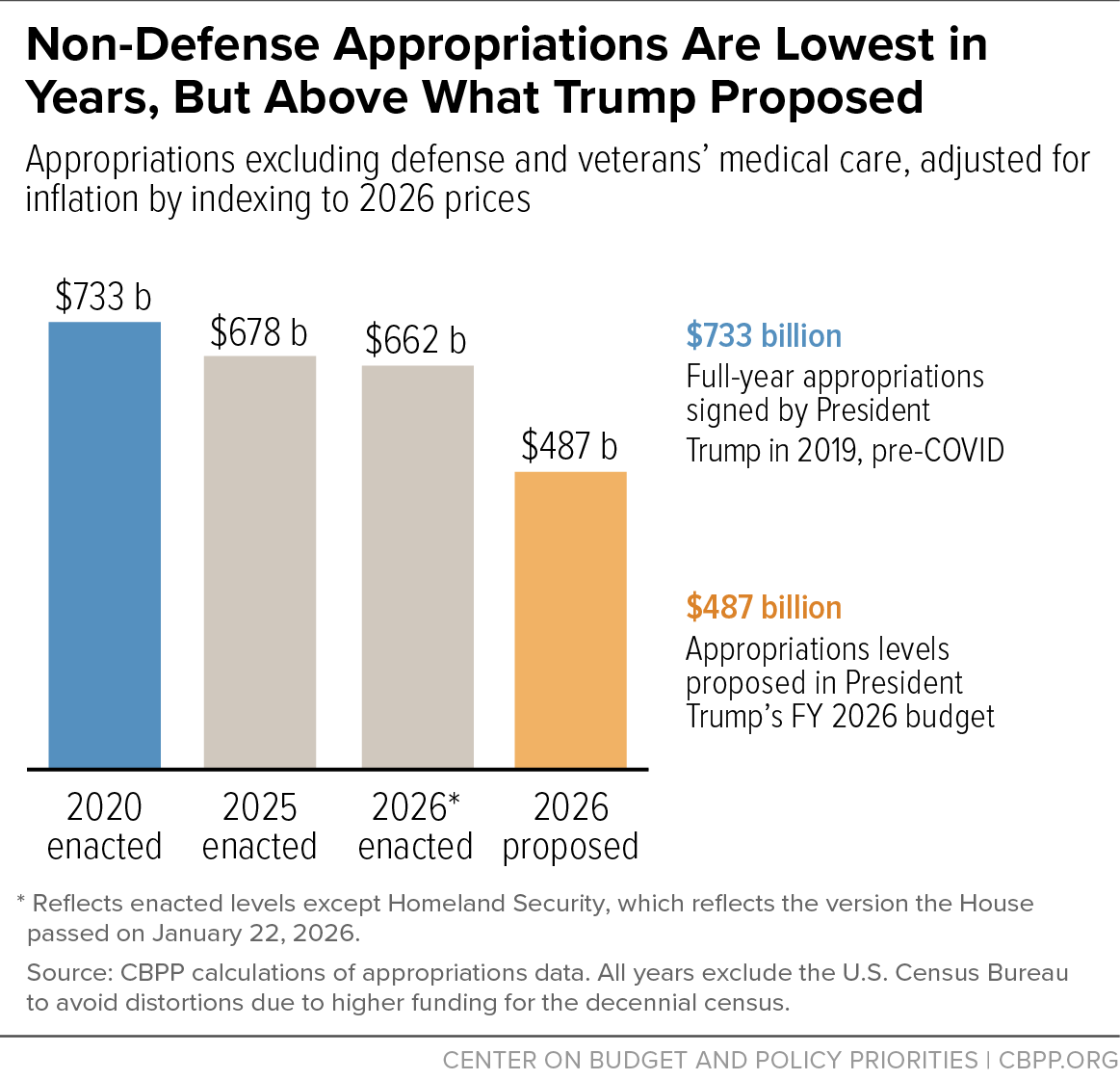
A central question is the funding level the Trump Administration proposes for non-defense discretionary programs. This portion of the budget covers health care for veterans, scientific research, aid to school districts for students with disabilities or students from families with low incomes, research on cures for cancer, and more. Such funding has been constrained for more than a decade, including since President Trump’s first term. Last year, Trump’s budget proposal called for fiscal year 2026 non-defense funding outside of veterans’ health that was 28 percent below the previous year’s level, after adjusting for inflation. (See Figure 1.) Fortunately, members of both parties rejected this approach and enacted a budget that funded non-defense (outside of veterans) only slightly below last year’s inflation-adjusted level.
Last year, the Trump Administration attempted to close or partially dismantle certain federal agencies without congressional approval. For example, the Administration proposed the complete elimination of the Department of Education in its budget, which Congress rejected on a bipartisan basis. But it took action on its own to begin dismantling the agency piece by piece by transferring a number of its core functions to other federal agencies without the expertise and staff to handle them. Similarly, the Administration has tried to unilaterally shutter the Consumer Financial Protection Bureau (CFPB), which helps people with credit reporting errors, predatory lending practices, discrimination, and other problems with banks and lenders. Though federal courts have at least temporarily blocked the elimination of CFPB, the Administration is still keeping the agency from carrying out many of its core consumer protection functions.

More generally, the Administration has radically reduced the federal workforce through buy-out offers that led many to leave federal service (often under the threat of layoff), mass layoffs, and attrition. The Office of Personnel and Management (OPM) has released data showing that these actions by the Administration cut the number of federal employees by nearly 230,000 — roughly 10 percent of the civilian federal workforce — in 2025. These cuts have been concentrated in certain agencies that serve people in a variety of ways, including the following:
- The Social Security Administration (SSA) lost 7,500 staff from January 2025 to January 2026, putting SSA employment at its lowest level since 1967, even as the number of people who receive Social Security benefits continues to rise. The changes at SSA have led to considerable frustration for people facing long delays or other challenges in getting the assistance they need.
- The IRS lost 27,500 employees from January 2025 to January 2026. The IRS had ramped up its staffing during the Biden Administration to improve customer service for households and businesses filing their taxes, modernize IRS systems, and expand enforcement efforts to ensure more of the taxes that are owed are paid.
- The Department of Veterans Affairs lost 30,000 staff between January 2025 and January 2026, a significant number of them veterans. The agency is dedicated to running programs and services that benefit veterans and their families, including providing care through nearly 1,400 health care facilities.
Federal statistics also face various threats, including chronic underinvestment, uncertainty, overt and unprecedented politicization, and the potential for further cuts in the Trump budget proposal. All of these threaten the accuracy and availability of vital federal data and weaken public trust in official statistics. One key example is last year’s announcement by the U.S. Department of Agriculture (USDA) that it was defunding the annual survey on food security, beginning with 2025 data collection. This survey is the most detailed look at people who struggle to afford food, and would have been a primary data source for understanding the impacts of cuts to food assistance in the megabill.
3.) Does the budget propose even more tax cuts that will worsen our fiscal trajectory and heighten calls for cuts to critical public services, including programs that help families with low or moderate incomes afford the basics?
The Republican megabill passed last summer includes $4.5 trillion in tax cuts: both the extension of the expiring 2017 tax cuts and several new ones. The megabill made all of the expiring 2017 tax cuts permanent, but many of its new tax cuts expire after 2028 or 2029. That includes the higher limit on the amount of state and local taxes (SALT) that high-income households can deduct as well as new exemptions of tipped and overtime pay from income taxes.
The Trump budget may include the extension of these tax cuts. Some of them, like the higher SALT cap and faster tax write-offs for new factories, will mostly benefit high-income households. Others, like exemptions for tipped and overtime income, have been sold as helping low- and middle-income people. But these poorly designed, narrow tax breaks do not help most workers. For example, fewer than 5 percent of workers in low-paying jobs receive any tips, and about a third of tipped workers earn too little to pay federal income taxes and so won’t benefit from the new tax break.[11] As a result, well over 97 percent of low-paid workers will receive no benefit from extending this provision and many of them will be hurt by other policies around nutrition assistance and health care.
Another key question is whether the budget includes new tax cuts alongside extending those now slated to expire in the next few years. For example, the House version of the megabill would have increased the deduction for income from pass-throughs, a type of business owned overwhelmingly by wealthy households. And the Trump Administration has reportedly explored ideas for cutting taxes on capital gains, which are similarly skewed.
Along similar lines, we can expect the Administration to assume trillions in tariff revenue in the coming years even in the aftermath of the Supreme Court’s decision striking down more than half of them. The Trump Administration has made clear that it will continue to pursue this economically destructive and regressive revenue source through alternative authorities.[12] The continued use of these taxes that have pushed up prices directly undermines the Administration’s argument that it is trying to make life more affordable.[13]
4.) Does the budget set up more harsh attacks on people who are immigrants?
The Trump Administration has engaged in a particularly brutal campaign targeting people who are immigrants — both those with and without a lawful immigration status — with punitive and cruel policies. The budget may signal its next steps on immigration.
A centerpiece of the Trump Administration’s immigration policy is the aggressive and indiscriminate immigration enforcement it has stood up since taking office, which is separating families; harming and indeed killing immigrants and others the Administration is sweeping up in its harsh policies and practices; and inflicting violence on entire communities. The megabill contained more than $170 billion in additional funding for immigration detention and border enforcement, and the Administration has acted swiftly to use those funds to more than double the number of ICE agents and expand detention capacity to historic levels.[14]
Key questions for the President’s budget include how quickly the Administration plans to spend the megabill funding and whether it proposes renewing it after it runs out, in an attempt to turn its anti-immigrant regime into a lasting feature of life in our nation. Also looming over the budget is the current fight in Congress regarding funding for the Department of Homeland Security (DHS), which has resulted in a partial government shutdown as the Trump Administration and congressional Republicans refuse to consider changes to DHS’s harsh enforcement tactics following the murder of U.S. citizens by federal agents in Minneapolis.
The Administration has also taken measures to attack lawful immigration, which may be reflected in the budget. The President’s budget last year proposed zeroing out all funding for humanitarian application processing to U.S. Citizenship and Immigration Services (USCIS), and final appropriations for fiscal year 2026 reflected this cut. Although USCIS’s budget is primarily funded by application fees, Congress has historically appropriated funds for certain refugee and asylum processing, and the President may propose zeroing out this funding again in the forthcoming budget.
The budget may also use unsubstantiated claims of fraud to promote further cuts to benefits for immigrants with lawful immigration status, building on those enacted in the megabill last year. Federal laws have long barred people without a documented immigration status (as well as many people with lawful immigration statuses) from accessing Medicaid, ACA marketplace subsidies, SNAP, and other basic needs programs, even as immigrants support these programs through the taxes they pay. The Republican megabill takes away health coverage through Medicaid, CHIP, and Medicare and food assistance through SNAP from many people living in the U.S. lawfully — including refugees, asylees, and victims of sex and labor trafficking who don’t yet have lawful permanent resident status — creating a new, far narrower group who will remain eligible.
5.) Does the budget rely on gimmicks to claim fiscal responsibility?
The long-term budget outlook has gotten worse since Trump took office, primarily because of the cost of making the 2017 tax cuts permanent. For example, CBO now projects that the 2035 deficit will amount to 6.6 percent of GDP — higher than the already-too-high 6.1 percent of GDP it projected one year ago.
Nevertheless, one can expect that the Administration will try to assert that its budget plans — reflecting the tax cuts it made permanent, any that it seeks to extend, and any new ones — are “fiscally responsible.” Similarly, the Administration is reportedly seeking to increase the defense budget to $1.5 trillion, which would be a $600 billion or 66 percent increase over 2026 levels.[15] This comes after receiving a $150 billion increase in multi-year defense funding that it is spending more quickly than it anticipated. These reports preceded the onset of the war with Iran and new reports of a potential $200 billion supplemental appropriations package to fund it.[16] How all of these pieces fit together is unclear, but they all point to a significant proposed increase in defense spending.
The question is what gimmicks the Administration will use to show how the budget achieves a healthy fiscal trajectory in the face of tax cuts and large increases to defense if it does provide details beyond its funding request for 2027.
One way it may make its budget appear fiscally responsible is assuming much more rapid economic growth than CBO or private-sector forecasters do, using a tactic it employed in budgets during its first term. A report from the White House Council of Economic Advisors last year projected that the combination of the Administration’s tax, regulation, and energy policies would result in $4.1 trillion in lower deficits because of faster economic growth.[17] Looking under the hood, this appears to rely on an assumption that Trump policies will increase the annual growth rate by 0.9 percent, resulting in an economy that is 8 percent larger after nine years. This is highly unlikely. CBO, for example, estimates that just the megabill — to say nothing of other policies from the Trump Administration — will increase the annual growth rate by 0.08 percent, or about one-tenth as much.[18]
Another gimmick the Administration has signaled it may use is wildly overstated savings from reducing fraud. President Trump in his State of the Union Address said “we’re able to find enough of that fraud — we will actually have a balanced budget overnight.” Fraud in any program is unacceptable, and so is weaponizing claims of fraud to vilify people who are immigrants and to withhold funding from Democratic-led states, as the Administration has done.[19] And it is impossible to find the $1.9 trillion in savings that would balance the budget in fiscal year 2027 through legitimate anti-fraud measures. In fact, the Trump Administration claimed it would root out significant fraud last year through Elon Musk’s DOGE initiative, which is widely seen to have failed to find any meaningful savings whatsoever. It will be important to scrutinize proposals framed as “fraud fighting” and evaluate the real-world impact that proposed changes could have on the important services government programs deliver to help people meet basic needs, not to mention when in tandem with the Administration’s claims of fraud as a pretext for violence.
Yet another possible gimmick the Administration could pursue if it provides details beyond a single-year appropriations request is assuming that Congress will not only accept the historically low 2027 non-defense discretionary spending target likely to be included in the President’s budget, but that it will continue new, deeper cuts to appropriations each year included in the budget after that. Budgets during the President’s first term routinely used this strategy to predict unrealistic savings: his fiscal 2019 budget, for example, proposed a 42 percent cut in non-defense appropriations between 2017 and 2028 after adjusting for inflation.[20]
A new gimmick to look for is the amount of tariff revenue the Administration assumes. While the Supreme Court struck down its use of a tariff authority in February, the Administration has made clear that it will use a temporary authority to replace much of that revenue while it begins the investigations necessary to enact a longer-term replacement. The budget could assume implausible levels of tariff revenue, especially given the legal questions around using other tariff authorities to replicate the sweep of the authority the Supreme Court struck down.[21]
End Notes
[1] CBPP Staff, “A Record of Historic Harm in the First Year of Trump’s Second Term,” January 14, 2026, https://www.cbpp.org/research/federal-budget/a-record-of-historic-harm-in-the-first-year-of-trumps-second-term.
[2] Sean D. Sullivan and Ryan N. Hansen, "TrumpRx has a fundamental flaw," STAT, February 5, 2026, https://www.statnews.com/2026/02/05/trumprx-prescription-drug-costs-flaws/.
[3] Kaye Pestaina, Michelle Long, and Justin Lo, “TrumpRx: What’s the Value for Customers?” KFF, February 24, 2026, https://www.kff.org/patient-consumer-protections/trumprx-whats-the-value-for-customers/#39023a44-5926-4dfa-915f-53c846e52956.
[4] Ibid.
[5] Gideon Lukens and Elizabeth Zhang, “Health Insurance Premium Spikes Imminent as Tax Credit Enhancements Set to Expire,” CBPP, November 3, 2025, https://www.cbpp.org/research/health/health-insurance-premium-spikes-imminent-as-tax-credit-enhancements-set-to-expire.
[6] CBO, “The Estimated Effects of Enacting Selected Health Coverage Policies on the Federal Budget and on the Number of People With Health Insurance,” September 18, 2025, https://www.cbo.gov/system/files/2025-09/61734-Health.pdf.
[7] Elisabet Eppes, “Trump Budget Would Slash WIC Fruit and Vegetable Benefits for Millions,” CBPP, June 3, 2025, https://www.cbpp.org/blog/trump-budget-would-slash-wic-fruit-and-vegetable-benefits-for-millions.
[8] Sonya Acosta and Mohammed Akel, “Unless Congress Acts, 59,000 Additional Households at Risk of Homelessness,” CBPP, June 23, 2025, https://www.cbpp.org/blog/unless-congress-acts-59000-additional-households-at-risk-of-homelessness
[9] Will Fischer and Erik Gartland, “Rental Assistance Time Limits Would Place More Than 3 Million People — Half of Them Children — at Risk of Eviction and Homelessness,” July 18, 2025, https://www.cbpp.org/research/housing/rental-assistance-time-limits-would-place-more-than-3-million-people-half-of-them#:~:text=A%20proposal%20by%20the%20Trump,risk%20of%20eviction%20and%20homelessness.
[10] Jesse Jenkins, Jamil Farbes, and Ben Haley, “Impacts of the One Big Beautiful Bill on the US Energy Transition,” Princeton University ZERO Lab, July 3, 2025, https://zenodo.org/records/15801701.
[11] Ernie Tedeschi, “The ‘No Tax on Tips Act’: Background on Tipped Workers,” Yale Budget Lab, June 24, 2024, https://budgetlab.yale.edu/news/240624/no-tax-tips-act-background-tipped-workers.
[12] Samantha Jacoby, “Policymakers Should Raise Corporate Tax Rates as Alternative to Harmful and Regressive Tariffs,” CBPP, March 18, 2026, https://www.cbpp.org/research/federal-tax/policymakers-should-raise-corporate-tax-rates-as-alternative-to-harmful-and.
[13] Sasha Rogelberg, "Goldman Sachs says U.S. consumers are stuck with higher prices even after Supreme Court ruling opens door to $180 billion in tariff refunds," Fortune, February 23, 2026, https://fortune.com/2026/02/23/goldman-sachs-us-consumers-higher-prices-tariff-inflation-supreme-court-refunds-scott-bessent/.
[14] Department of Homeland Security, “ICE Announces Historic 120% Manpower Increase, Thanks to Recruitment Campaign that Brought in 12,000 Officers and Agents,” January 3, 2026, https://www.dhs.gov/news/2026/01/03/ice-announces-historic-120-manpower-increase-thanks-recruitment-campaign-brought; American Immigration Council, “Immigration Detention Expansion in Trump’s Second Term,” January 14, 2026, https://www.americanimmigrationcouncil.org/report/immigration-detention/.
[15] Costas Pitas and Andrea Shalal, "Trump calls for $1.5 trillion military budget in 2027, up from $901 bln in 2026," Reuters, January 8, 2026, https://www.reuters.com/world/us/trump-says-us-military-budget-2027-should-be-15-trillion-2026-01-07/.
[16] Noah Robertson, Jeff Stein, and Riley Beggin, “Pentagon seeks more than $200 billion in budget request for Iran war," Washington Post, March 18, 2026, https://www.washingtonpost.com/national-security/2026/03/18/iran-cost-budget-pentagon/.
[17] White House Council of Economic Advisers, “The One Big Beautiful Bill: Legislation for Historic Prosperity and Deficit Reduction,” June 2025, https://www.whitehouse.gov/wp-content/uploads/2025/03/The-One-Big-Beautiful-Bill-Legislation-for-Historic-Prosperity-and-Deficit-Reduction-1.pdf.
[18] CBO, "The Budget and Economic Outlook: 2026 to 2036," February 2026, https://www.cbo.gov/publication/62105.
[19] Allison Orris, “Federal Government’s Attacks on Medicaid Are a Pretext to Weaken the Program and Punish Particular States,” CBPP, March 4, 2026, https://www.cbpp.org/blog/federal-governments-attacks-on-medicaid-are-a-pretext-to-weaken-the-program-and-punish.
[20] David Reich, “Trump Budget Would Cut Non-Defense Programs Deeply in 2019 and Beyond,” CBPP, February 14, 2025, https://www.cbpp.org/research/federal-budget/trump-budget-would-cut-non-defense-programs-deeply-in-2019-and-beyond.
[21] Peter E. Harrell, "Are Trump’s ‘Fallback’ Tariffs Legal?" Lawfare, February 25, 2026, https://www.lawfaremedia.org/article/are-trump-s--fallback--tariffs-legal.