

House Republican 2027 Funding Bills Fall Far Short of What Is Needed to Help Families, Support Core Services
Congress is in the midst of determining funding levels for the 2027 fiscal year for the roughly one-fourth of the federal budget set by annual appropriations. The House Appropriations Committee has approved all 12 appropriations bills, largely along party lines.[1] (The Senate Appropriations Committee has yet to consider any bills.) Together, the House bills would cut 2026 non-defense appropriations by 6.0 percent after adjusting for inflation.[2] While the proposed cuts are smaller than the proposed 13 percent cut in the President’s 2027 budget, the House bills still slash a variety of important programs and fall far short of what is required for a range of important non-defense public services, core government functions, and investments that meet our nation’s needs.
Although fiscal year 2027 begins on October 1, Congress is unlikely to finalize all the bills until late 2026 or early 2027. (The House has already passed a continuing resolution that extends funding until early December 2026;[3] the Senate is expected to take up its version soon.) Lawmakers should use this time to develop stronger bills — ones that help address the serious affordability challenges facing families and improve essential government functions. They should also include robust, government-wide guardrails to protect federal funding from the Trump Administration’s damaging interference and abuses.
House Bills Cut Non-Defense Discretionary Programs Below Already Constrained Levels
This analysis focuses on the discretionary portion of the federal budget, which funds many critical national priorities through the annual appropriations process. The largest is national defense, and important non-defense areas include rental assistance and other economic security programs, economic development, public and veterans’ health, education, medical and scientific research, and transportation. Programs such as Social Security, Medicare, and Medicaid are called mandatory programs; the laws that determine their funding are developed outside the annual appropriations process but their federal administrative costs are funded through discretionary appropriations.
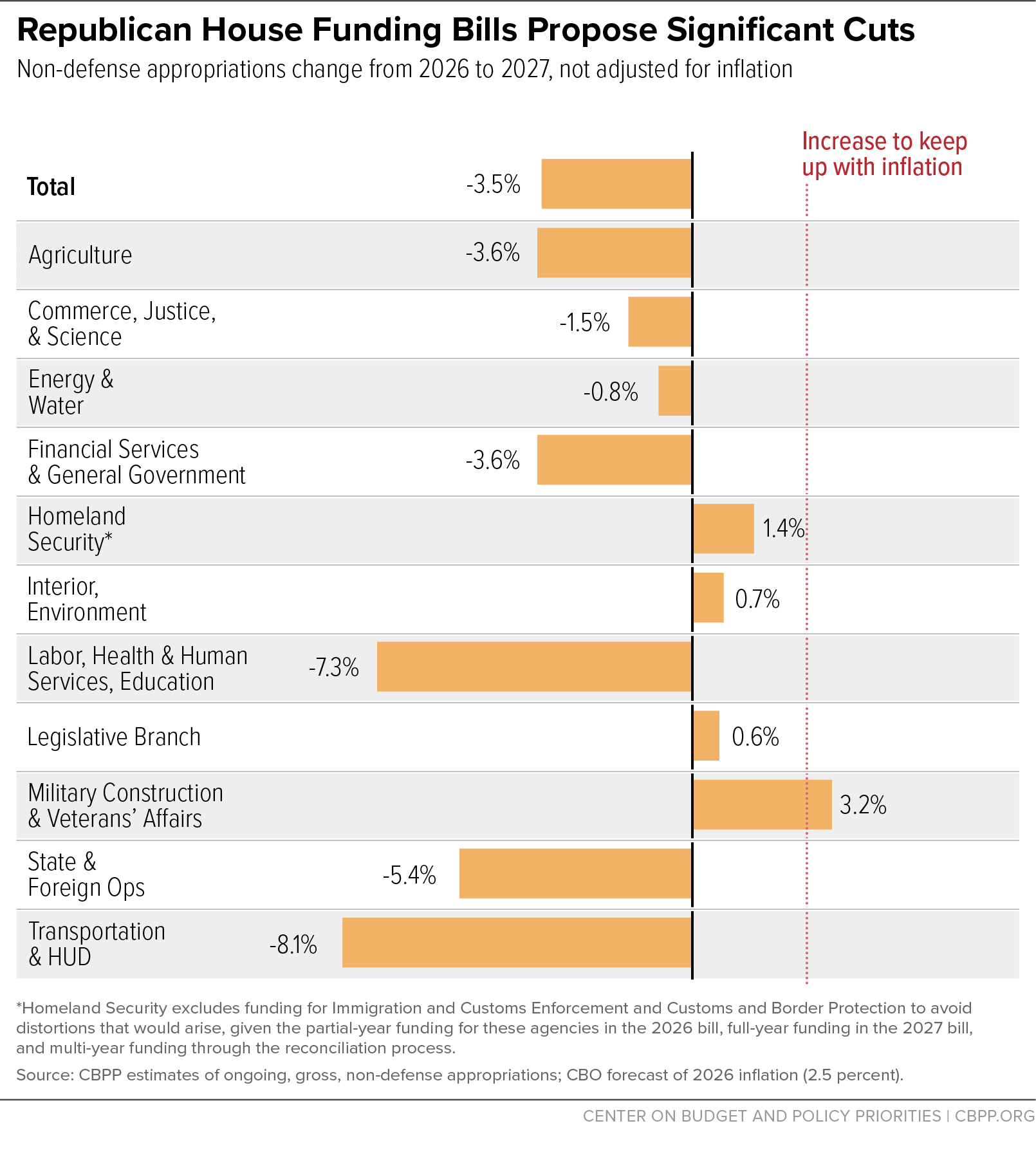
Analyzing discretionary funding for 2027 is complicated by the unusual way in which Congress has recently handled funding for Immigration and Customs Enforcement (ICE) and Customs and Border Protection (CBP). The 2026 Homeland Security appropriations law funded ICE and CBP only through April 30, 2026. Congressional Republicans provided additional funding for ICE and CBP through reconciliation legislation enacted in June, intending to fund these agencies through the end of the Trump Administration.[4] On the same day the House passed the reconciliation bill, the House Appropriations Committee reported its 2027 Homeland Security bill, which included regular full-year appropriations for both agencies. While Homeland Security Subcommittee Chair Mark Amodei indicated during markup that lawmakers did not intend to double-fund the agencies, it remains unclear how Congress will handle ICE and CBP appropriations for 2027.[5] Given this uncertainty and unusual treatment, we have removed ICE and CBP funding from all our totals so as not to distort comparisons of non-defense discretionary funding across years. Beyond these adjustments for ICE and CBP funding, we made other technical adjustments in line with our past analyses.[6]
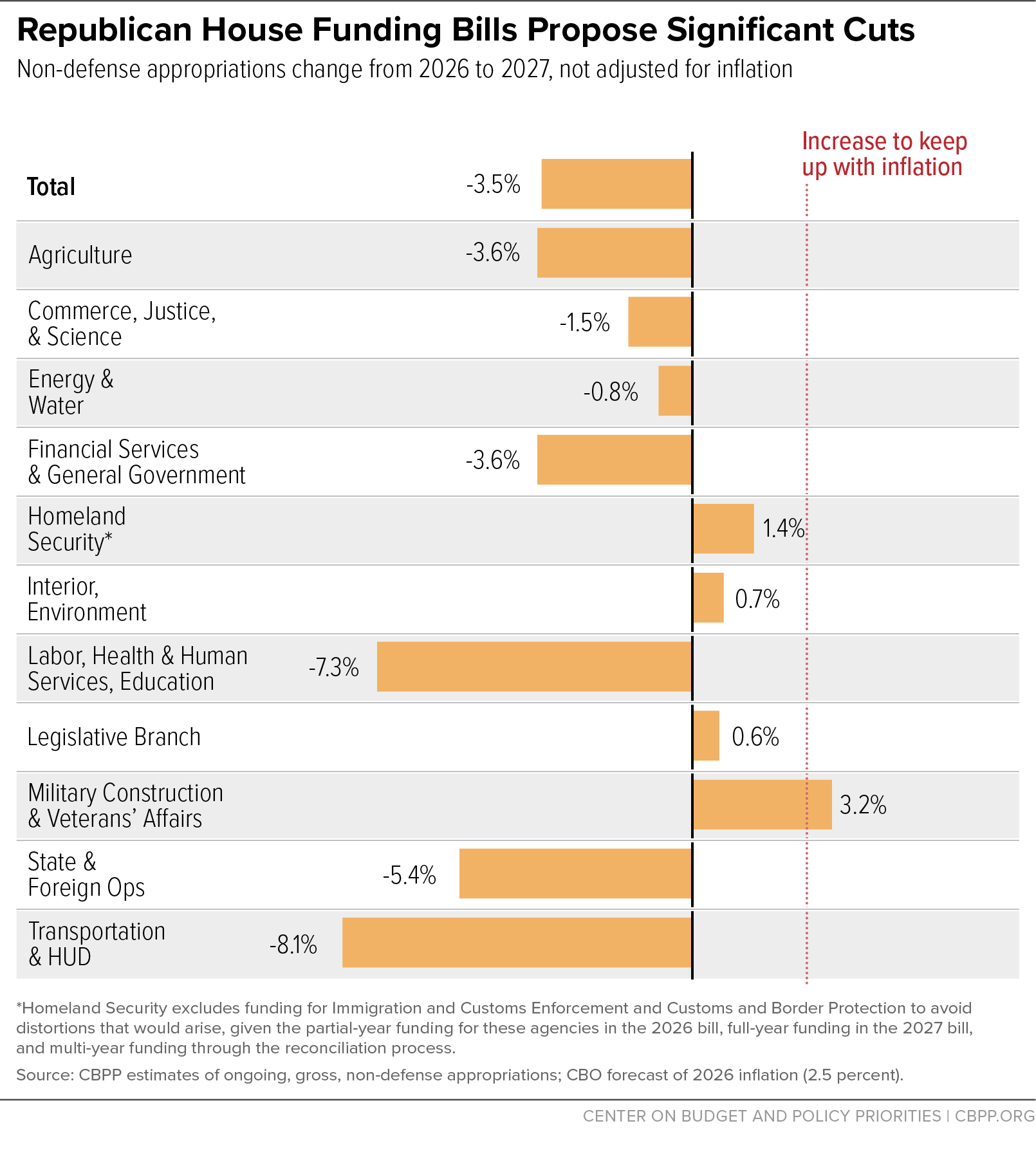
As adjusted, the House bills provide $729 billion for non-defense discretionary programs in 2027. The House level is $26 billion (3.5 percent) below the 2026 enacted level, a 6.0 percent cut after adjusting for inflation. The biggest cuts, in both dollar and percentage terms, are in the Labor, Health and Human Services, and Education bill and the Transportation and Housing and Urban Development (HUD) bill. (See Figure 1.) These two bills fund some of the largest programs that help children and families with low incomes meet basic needs, including support with rent, utilities, and public education.

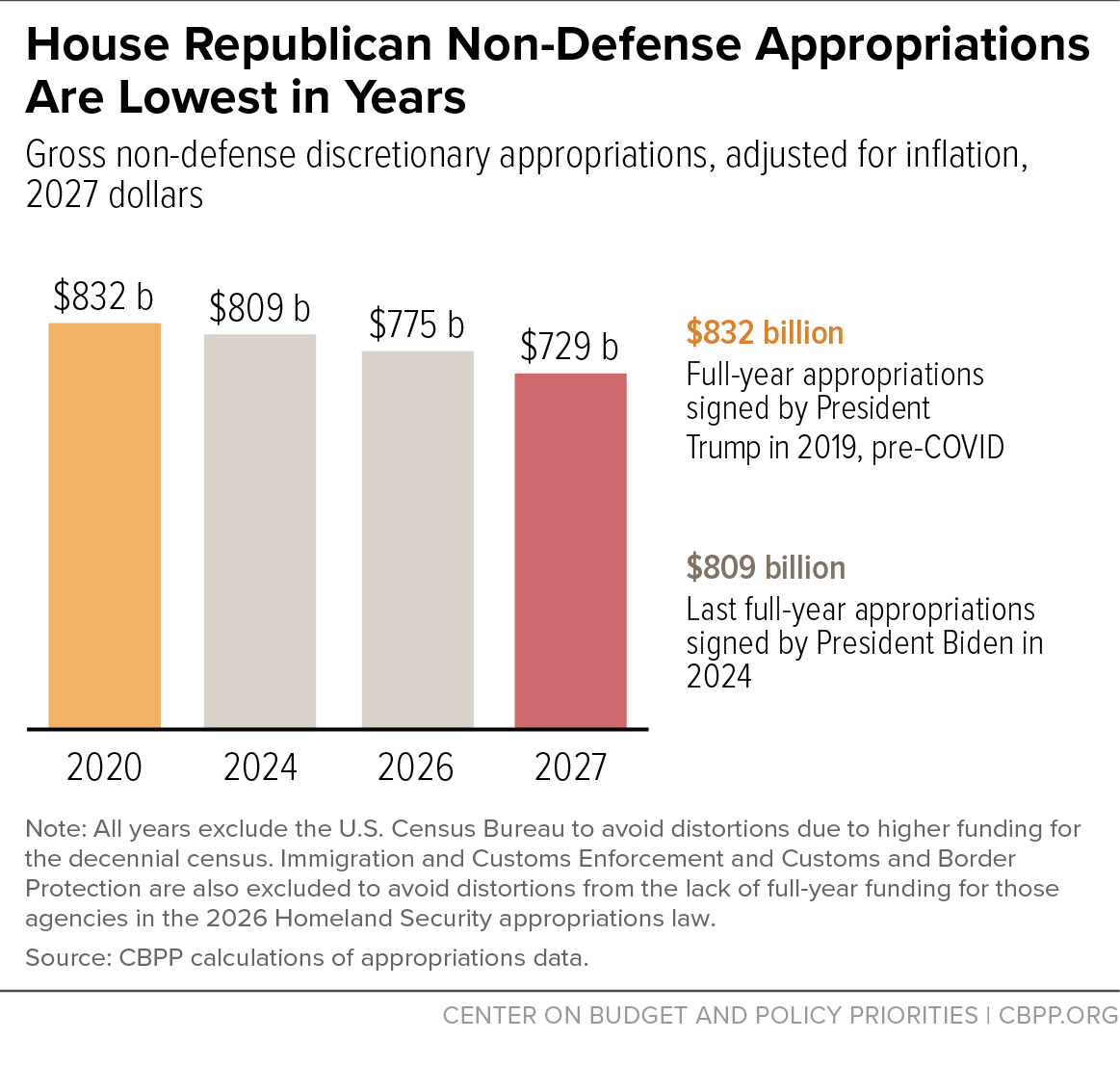
Looking over a longer period shows that funding for non-defense discretionary programs has been quite constrained. The 2027 level proposed by House Republicans is the lowest in recent years — 12.5 percent lower, after adjusting for inflation, than 2020, the last full-year appropriations bills that President Trump signed (in 2019) during his first term. While conservatives criticized the increases in non-defense discretionary funding during the Biden Administration, those increases were primarily needed to cover higher inflation, and the 2023 Fiscal Responsibility Act put strict limits on this funding. After adjusting for inflation, non-defense discretionary funding actually fell by 2.9 percent between 2020 and 2024, the last appropriations bills that President Biden signed. (See Figure 2.)
House Bills Underfund Many Critical Programs
The 2027 House Republican bills would diminish support for children and families with low or moderate incomes, hinder our ability to respond to environmental challenges, and create challenges in administering core government services and functions. For example, the bills:
- Cut K-12 education. The House bill covering the Department of Education cuts the office that oversees elementary and secondary education programs by 19 percent ($5.4 billion). Most significantly, it cuts Title I, the main support for schools serving students from families with low incomes, by 10 percent ($1.9 billion). The bill also cuts funding for tutoring programs, afterschool programs, and programs that help students learn English as a second language.
- Deeply cut clean energy and environmental protection. The House Interior bill cuts funding for the Environmental Protection Agency by 20 percent ($1.8 billion). It also cuts funding for the Office of Critical Minerals and Energy Innovation (formerly the Office of Energy Efficiency and Renewable Energy) by 34 percent ($1.1 billion). This office supports research, development, and deployment of technologies to transition the country to a reliable, secure, resilient, and clean energy system.
- Take away nutrition assistance for new and expecting parents and young children. The House Agriculture bill cuts new funding for the Special Supplemental Nutrition Program for Women, Infants, and Children (WIC) by 2 percent ($200 million). This cut would risk forcing WIC to turn away eligible families for the first time in three decades, at a time when grocery costs have risen and families are facing the impacts of the 2025 Republican reconciliation law’s harmful cuts to SNAP and Medicaid. In addition, the bill would take away over $141 million in fruit and vegetable benefits from nearly 5.4 million toddlers, preschoolers, and pregnant and postpartum WIC participants.[7]
- Reduce rental assistance for families with low incomes. The House bill covering HUD cuts funding for the Housing Choice Voucher program, the largest federal rental assistance program, by 1 percent ($360 million). The program requires annual funding increases to cover rising rents and continue helping the same number of families. The House bill’s inadequate funding would mean that about 350,000 fewer people would receive assistance. Another 45,000 families could lose assistance because the bill fails to address a funding cliff for the Emergency Housing Voucher program.[8] Only 1 in 4 low-income households who need rental assistance receive it due to inadequate funding, and there are long waiting lists for assistance. The House bill also cuts funding for public housing by 15 percent ($1.3 billion), continuing a long trend of cuts.
- Continue to hamstring enforcement of the nation’s tax laws. The House Financial Services bill cuts funding for the Internal Revenue Service by 9 percent ($950 million) and the IRS enforcement budget specifically by 28 percent ($1.4 billion). This is on top of continued, deep staffing cuts that have diminished the agency’s ability to provide effective customer service and properly audit high-income taxpayers; overall IRS staffing fell by over a quarter from January 2025 to May 2026.[9] While Congress provided $80 billion in mandatory, multi-year funding in the 2022 Inflation Reduction Act to support badly needed improvements in IRS operations, including updating decades-old computer systems, lawmakers later rescinded $53 billion of it and less than $10 billion remains. The next few years will also impose additional demands on the IRS as it attempts to implement the complex new tax cuts in the 2025 Republican reconciliation law.
- Fail to improve customer service capacity at the Social Security Administration (SSA). The House bill that funds SSA would keep customer service funding for the agency unchanged. This freeze continues Congress’s trend of failing to adjust funding to keep up with inflation, much less the rising number of retirees. Indeed, the Administration reduced staffing at SSA by roughly 9,000 workers (15 percent) from January 2025 to May 2026.[10] Continued lack of investment in the agency has resulted in a degradation of service for the people who most need support from SSA.
- Weaken the nation’s competitive advantage by slashing scientific research. The House Commerce, Justice, and Science bill cuts funding for the National Science Foundation by 20 percent ($1.8 billion). Those funds support scientific research, technology development, and science, technology, engineering, and math education outside of the medical field and are crucial for universities.
- Fail to invest in key low-income support programs amid increasing affordability challenges. The House bill that funds Head Start, the Child Care and Development Block Grants, and the Low-Income Home Energy Assistance Program (LIHEAP) provide funding levels equal to 2026 across all three programs. These programs need much more robust increases in order to adequately serve all eligible participants: only about 1 in 7 of those eligible for child care subsidies under federal rules receive them,[11] and only 1 in 6 of those eligible for LIHEAP receive help paying utility bills.[12] These programs have been flat or close to flat funded since 2024, even with rising prices and the challenges families face affording critical services such as child care and utilities.
House Bills Do Nothing to Address Administration Interference in Federal Funding
The Trump Administration has engaged in aggressive — and often illegal — actions such as slashing federal personnel even when Congress has adequately funded personnel costs, reorganizing or shuttering agencies, and withholding funds and otherwise interfering with agencies carrying out their statutory responsibilities — all without congressional approval and frequently in direct contradiction to federal law. In 2026 Congress enacted some targeted guardrails aimed at protecting specific programs from this interference. But Congress neglected to include more robust government-wide guardrails that would have protected public funding more broadly.[13] (See Figure 3.)
The 2027 House Republican bills lack these needed protections entirely, inviting further interference even as the Administration has continued to undermine Congress’s power of the purse. Recent examples include cancelling teen pregnancy prevention grants based on vague claims of “changes” in Administration priorities, attaching unrelated policy requirements to eligibility for federal anti-terrorism funds, making disaster assistance decisions on a partisan basis, and proposing to require every group seeking to receive or administer federal funding to certify that they will comply with the Administration’s legally controversial and overbroad executive orders related to immigration and diversity, equity, and inclusion, among other certifications.[14] These actions have made federal funding less reliable for grantees and more vulnerable to corruption and partisanship.
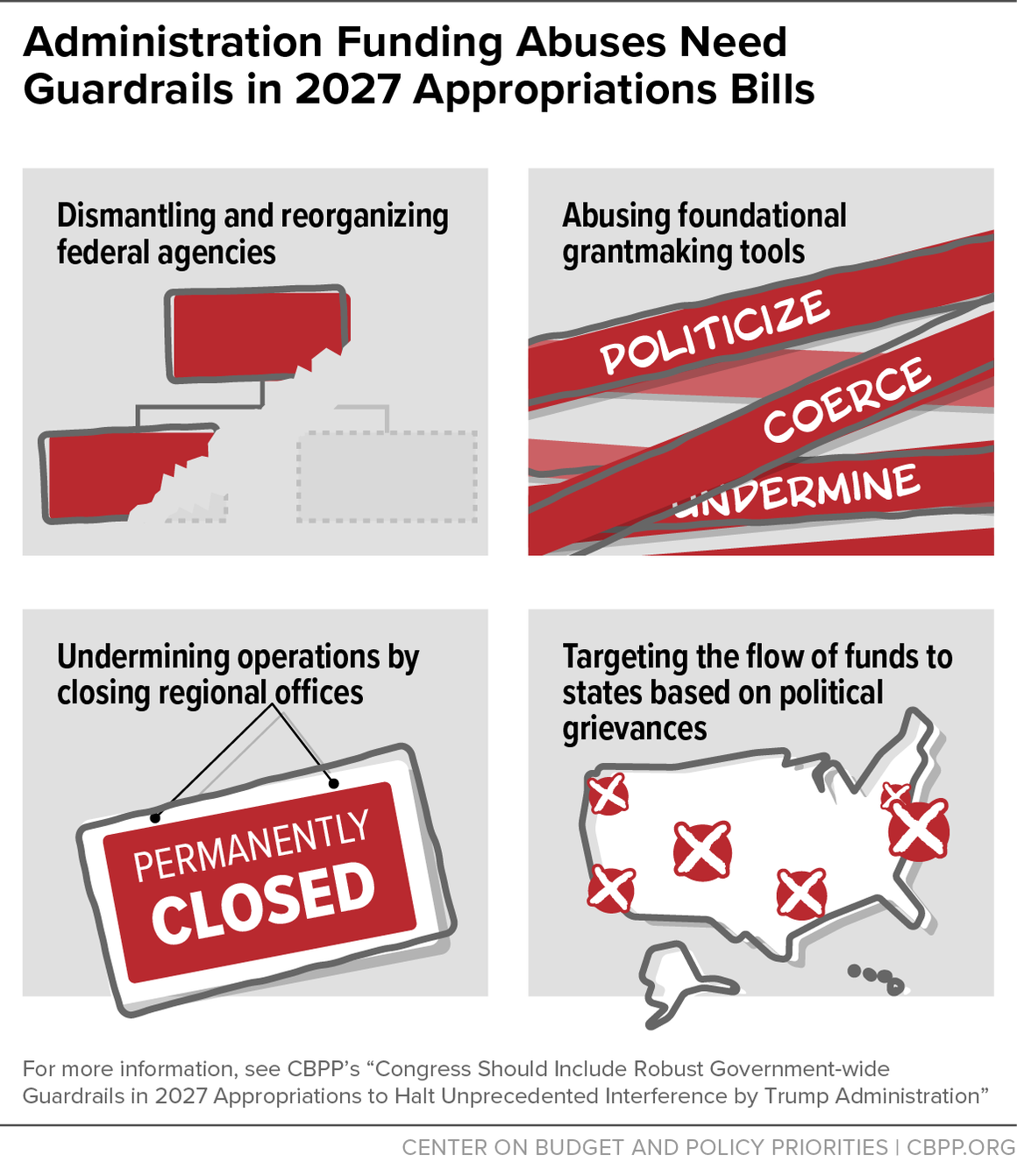
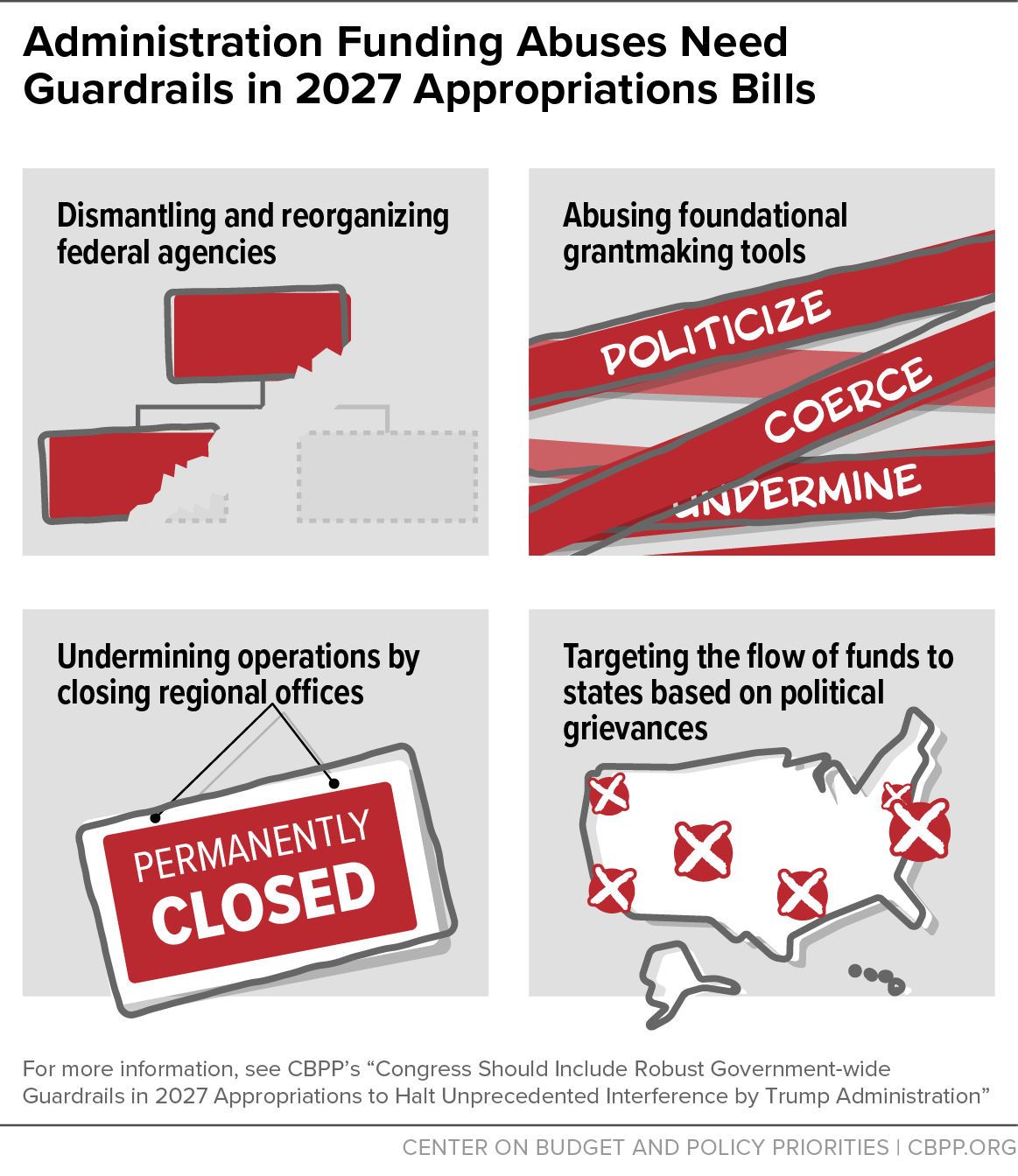
Congress needs to include guardrails in 2027 appropriations to prevent the continuation of damaging actions such as:
Abusing foundational grantmaking systems and processes. Since its first days, the Administration has upended every stage of the federal grantmaking process. That effort began with an unprecedented (albeit short-lived) government-wide grant freeze, followed by a set of presidential directives, ad hoc cancellations, and delays seeking to politicize and weaponize the grantmaking process.
In May the Office of Management and Budget proposed a rule to operationalize and enforce the Administration’s politicized approach to grantmaking across federal agencies.[15] The rule would effectively replace competitive, merit-based processes with purely political ones and place all grantees under constant threat of penalty or termination, introducing an enormous risk of capriciousness, abuse, and corruption.[16] These changes would also put grantees, including hospitals, child care providers, universities, and state and local governments, in a challenging position where unreliable funding would hinder their ability to effectively deliver services and carry out investments.
- Blocking federal funds to states based on political differences. One of the most blatantly illegal attempts in this area occurred earlier this year when the Administration restricted five Democratic-led states from fully drawing down the funding Congress had provided for three programs supporting people with low incomes: Temporary Assistance for Needy Families, the Social Services Block Grant, and the Child Care and Development Fund.[17] After a federal judge temporarily blocked this effort, the Administration abandoned it in an apparent effort to avoid further investigation into its actions as part of the legal process.[18] Similarly, the Trump Administration has admitted in federal court to cancelling clean energy grants in particular states based on how those states voted in the 2024 election, in violation of the Constitution’s guarantee of equal protection of the laws.[19] The Administration continues to seek ways to freeze or block federal funding to states based on political differences; these illegal freezes can have serious impacts on residents relying on these critical programs.
- Dismantling and reorganizing federal agencies. The Administration has begun a unilateral and illegal process of transferring Department of Education functions to other departments and agencies.[20] This creates confusion and complications for school districts and borrowers. It also creates potential programmatic issues, given these agencies’ lack of familiarity with established Department of Education programs.
- Undermining operations by closing regional offices. Across several agencies, including the U.S. Forest Service and other components within the Agriculture Department, the Administration has unilaterally announced the closure or relocation of offices and research facilities. These plans risk eliminating decades of experience by forcing hundreds of scientists and other federal employees to choose between an unplanned move and leaving the agency.[21]
As Congress continues to work through the appropriations process, the Senate should reject the low funding levels proposed in the House bills and instead provide meaningful increases for key programs where this is justified by need. The Senate should also push for Congress to include in the final bills robust, government-wide guardrails to protect the federal funding Congress enacts into law.
End Notes
[1] The full House has approved three of these bills: those funding the Agriculture Department, the State Department and foreign operations, and military construction and the Department of Veterans Affairs.
[2] As discussed in more detail later in the paper, we make various adjustments to the non-defense totals to ensure consistency across years, including an adjustment to account for the recent funding treatment of certain Department of Homeland Security agencies.
[3] The House passed H.R. 9770, “Making continuing appropriations for fiscal year 2027, and for other purposes,” on July 21, 2026, https://www.congress.gov/bill/119th-congress/house-bill/9770/all-actions.
[4] P.L. 119-98, The Secure America Act, also known as “reconciliation 2.0.” Reconciliation is a fast-track process that avoids a filibuster in the Senate. The bill provided $69.5 billion for ICE and CPB available through fiscal year 2029.
[5] House Appropriations Committee, “Amodei Remarks at FY27 Homeland Security Bill Full Committee Markup,” June 10, 2026, https://appropriations.house.gov/news/remarks/amodei-remarks-fy27-homeland-security-bill-full-committee-markup-prepared-delivery.
[6] CBPP, “How CBPP Analyzes Non-Defense Discretionary Funding,” April 9, 2026, https://www.cbpp.org/research/federal-budget/how-cbpp-analyzes-non-defense-discretionary-funding.
[7] Elisabet Eppes and Luis Nuñez, “House Agriculture Bill Underfunds WIC, Cuts Fruit and Vegetable Benefit, and Fails to Make Virtual Services Permanent,” CBPP, April 22, 2026, https://www.cbpp.org/blog/house-agriculture-bill-underfunds-wic-cuts-fruit-and-vegetable-benefit-and-fails-to-make.
[8] Sonya Acosta, “Congress Should Support Rental Assistance in 2027 to Prevent Increased Homelessness and Evictions,” CBPP, May 13, 2026, https://www.cbpp.org/blog/congress-should-support-rental-assistance-in-2027-to-prevent-increased-homelessness-and.
[9] CBPP analysis of Office of Personnel Management headcount data as of May 2026.
[10] Ibid.
[11] U.S. Government Accountability Office, “Child Care: Subsidy Eligibility and Use and State Waiver Requests Related to New Program Requirements,” January 30, 2025, https://www.gao.gov/products/gao-25-107754.
[12] Ivan Penn, “Heating Costs Expected to Rise 9.2% This Winter,” New York Times, December 17, 2025, https://www.nytimes.com/2025/12/17/business/energy-environment/winter-heating-costs-increase.html.
[13] Joel Friedman et al., “Tight 2026 Non-Defense Funding Rejects Trump’s Proposed Deep Cuts, But Congress Will Need to Continue to Guard Against Administration Abuses,” CBPP, revised April 9, 2026, https://www.cbpp.org/research/federal-budget/tight-2026-non-defense-funding-rejects-trumps-proposed-deep-cuts-but.
[14] Thomas Frank, “Trump Denies Disaster Aid for 4 Democratic-Led States,” Politico, July 8, 2026, https://www.politico.com/news/2026/07/08/donald-trump-denies-disaster-aid-democratic-states-00989418; Jan Hoffman, “Government Overhauls Teen Pregnancy Program to Focus on Marriage and Starting Families,” New York Times, July 22, 2026, https://www.nytimes.com/2026/07/22/us/politics/teen-pregnancy-prevention-trump.html; Sonali Master, “Congress Should Include Robust Government-Wide Guardrails in 2027 Appropriations to Halt Unprecedented Interference by Trump Administration,” CBPP, May 18, 2026, https://www.cbpp.org/blog/congress-should-include-robust-government-wide-guardrails-in-2027-appropriations-to-halt; Reed Shaw, “No, Trump Can’t Withhold Anti-Terrorism Funds to Pressure States to Change Their Election Rules,” Just Security, July 23, 2026, https://www.justsecurity.org/148665/trump-cant-withhold-antiterrorism-funds/.
[15] Jacob Leibenluft, Devin O’Connor, and Sam Berger, “The Trump Administration Seeks to End Nonpartisan Grantmaking,” CBPP, June 17, 2026, https://www.cbpp.org/research/federal-budget/the-trump-administration-seeks-to-end-nonpartisan-grantmaking.
[16] Ibid.
[17] Nick Gwyn, “Trump Administration’s Five-State Funding Freeze Is Unlawful, Harmful, and a Major Threat to People in Every State,” CBPP, January 23, 2026,” https://www.cbpp.org/research/federal-budget/trump-administrations-five-state-funding-freeze-is-unlawful-harmful-and-a.
[18] Minho Kim, “Health Dept. Rescinds Freeze on $10 Billion for 5 Democratic States,” New York Times, July 14, 2026, https://www.nytimes.com/2026/07/13/us/politics/trump-health-dept-funding-freeze-democratic-states.html?smid=nytcore-ios-share.
[19] Tony Romm and Brad Plumer, “Trump Administration Admits Canceling Grants to States That Did Not Vote for Him,” New York Times, July 24, 2026, https://www.nytimes.com/2026/07/24/business/trump-state-grants-canceled.html.
[20] Michael C. Bender, “Student Loan Office to Leave the Education Department,” New York Times, March 19, 2026, https://www.nytimes.com/2026/03/19/us/politics/student-loan-office-education-department.html; Arthur Jones II, “Department of Education Moving Special Education and Civil Rights Responsibilities,” ABC News, June 16, 2026, https://abcnews.com/Politics/department-education-taking-major-step-dismantling-sources/story?id=133927816.
[21] Tyler Spence, Eric Katz, and Natalie Alms, “USDA Workers Don’t Plan to Stay on the Job as Offices Relocate,” NOTUS, July 22, 2026, https://www.notus.org/agencies/usda-mandatory-office-relocation.