MÁS ALLÁ DE LOS NÚMEROS
Congress Should Include Robust Government-wide Guardrails in 2027 Appropriations to Halt Unprecedented Interference by Trump Administration
The brazenness and impact of the Trump Administration’s unprecedented interference with federal funding have grown in recent months, making it critical for Congress to include government-wide, robust guardrails in its appropriations bills for 2027.
The Administration has repeatedly ignored the law and congressional intent reflected in bipartisan appropriations bills. Recognizing the seriousness of these attacks on federal spending power, Democratic House and Senate appropriators in 2025 proposed significant guardrails to limit Administration abuses. While they were unable to get bipartisan support for these broader protections, Congress did include some targeted protections in the 2026 appropriations bills.
That the Trump Administration continues to interfere with federal funding should not dissuade Congress from taking action. If anything, that only makes strengthening guardrails and making them government-wide more critical, especially when the Administration may newly target programs it hasn’t yet interfered with.
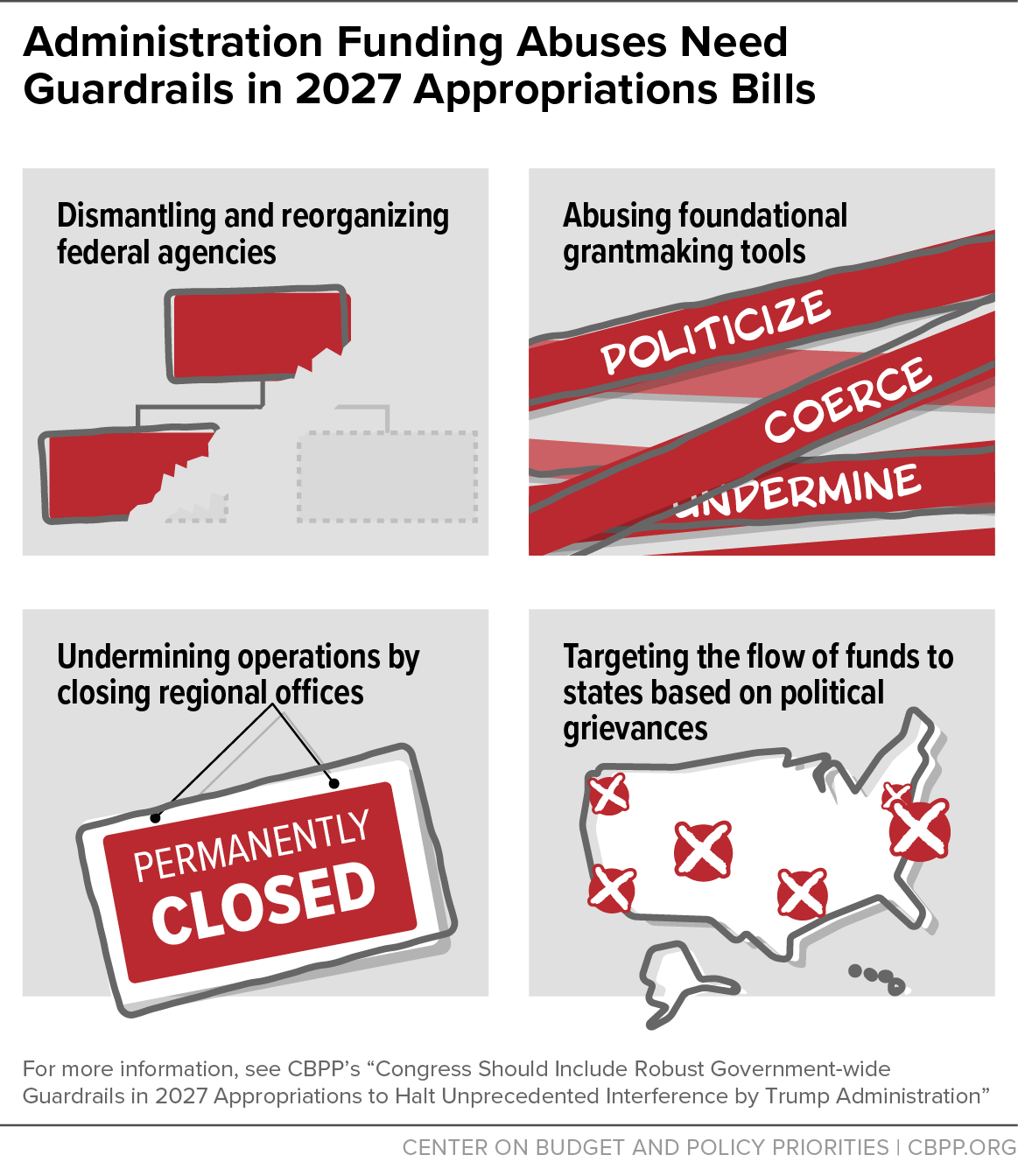
Below are four examples of the Administration’s funding abuses that will require more robust guardrails from Congress to safeguard federal funding in 2027 appropriations bills.
Abusing foundational grantmaking systems and processes. The Trump Administration has attempted to undermine and politicize grantmaking through SAM.gov (the System for Award Management). More than 200,000 federal award recipients, including nonprofits, private contractors, and states, use this platform to do business with the federal government.
In January 2026, the General Services Administration proposed adding coercive new requirements to the SAM.gov annual certification process for all groups that seek to receive or administer federal funding, such as by applying for federal grants or bidding on federal contracts. SAM users would have to certify that they will comply with the Trump Administration’s legally controversial and overbroad executive orders related to immigration and diversity, equity, and inclusion (DEI), among other certifications. These changes, which would impose broad and poorly defined requirements on awardees, could expose funding recipients to enforcement actions based on ill-defined terms. This raises the real possibility that the threat of enforcement could be used to coerce funding recipients to accede to unrelated Administration demands in a range of circumstances. It could also lead some entities to decline to do business with the federal government.
Dismantling and reorganizing federal agencies. Starting last year, the Trump Administration unilaterally and without legal authority announced that it was transferring certain core programmatic functions from the Education Department to other departments and agencies. Through a series of interagency agreements, the Trump Administration is now in the process of moving functions ranging from college financial aid to oversight of critical K-12 programs to the departments of Labor, State, the Interior, Health and Human Services, and of the Treasury.
These agreements attempt to circumvent the role of Congress by allowing the Executive Branch to determine, regardless of the law, which agencies operate specific programs. Also, states and school districts that run these programs now face confusion and complications, including questions about where to raise concerns or get support. Moreover, the agencies taking on these responsibilities have no experience operating the programs, which could lead to further program management issues.
As it seeks to unilaterally dismantle the Education Department, the Administration has radically slashed its staff by 40 percent — an abuse of Congress’ continued decisions to fund the agency and its programs.
Undermining operations by closing regional offices. In April of this year, the U.S. Forest Service announced that it was closing nearly three-quarters of its research facilities as part of a consolidation plan undertaken with no congressional involvement, which would also involve relocating the agency’s headquarters staff to Salt Lake City from Washington, D.C. Closing research stations will affect ongoing research and data collection, which provide valuable information on environmental changes over time, including insights that will impact future efforts to address wildfires.
The Agriculture Department is also relocating a significant number of employees from the Food and Nutrition Service, Food Safety Inspection Service, Economic Research Service, and National Institute of Food and Agriculture, despite Congress making clear it did not want the Administration to undertake unilateral relocations. These plans risk eliminating decades of experience, as hundreds of scientists and other federal employees involved will have to choose between an unplanned move and leaving the agency. In the future, Congress should include enforceable prohibitions to prevent actions like these with which it disagrees, rather than using language that limits recourse if or when the Administration ignores it.
Targeting the flow of federal funds to states based on political grievances. Earlier this year, the Trump Administration engaged in one of its most blatant attempts at illegally restricting the flow of federal funds, sending a letter to five Democratic-led states stating that they were being placed into a “restricted drawdown” for three programs that support people with low incomes: Temporary Assistance for Needy Families, the Social Services Block Grant, and the Child Care and Development Block Grant. While the supposed reason was concerns over fraud, the Administration provided no evidence to substantiate such claims. A federal judge quickly but temporarily blocked the broad funding freeze. This is one in a series of efforts by the Trump Administration to threaten funding to states it perceives as political opponents, regardless of the serious impacts on state residents who count on these critical programs.
The Trump Administration’s actions in recent months have made clear that it is not backing off from its attacks on federal funding. In the face of these widespread abuses, and the very real likelihood of further abuses during this year, it is incumbent on Congress to enact even stronger, government-wide guardrails in next year’s appropriations.