

2025 Budget Impacts: House Bill Would Cut Assistance for Children, Raise Costs for Families
House Republicans’ budget reconciliation legislation would cut assistance that helps children in families with low incomes get enough to eat, see a doctor when they are sick, and in other ways meet their basic needs and thrive. This assistance matters for children's health, success in school, future earnings, and other outcomes. The House’s so-called “Big Beautiful Bill” is anything but beautiful; it would cause widespread harm by making massive cuts to Medicaid, Affordable Care Act marketplace coverage, and SNAP, which would raise costs and make it much harder for people to afford the high cost of groceries and health care.
Cutting Children’s Food Assistance
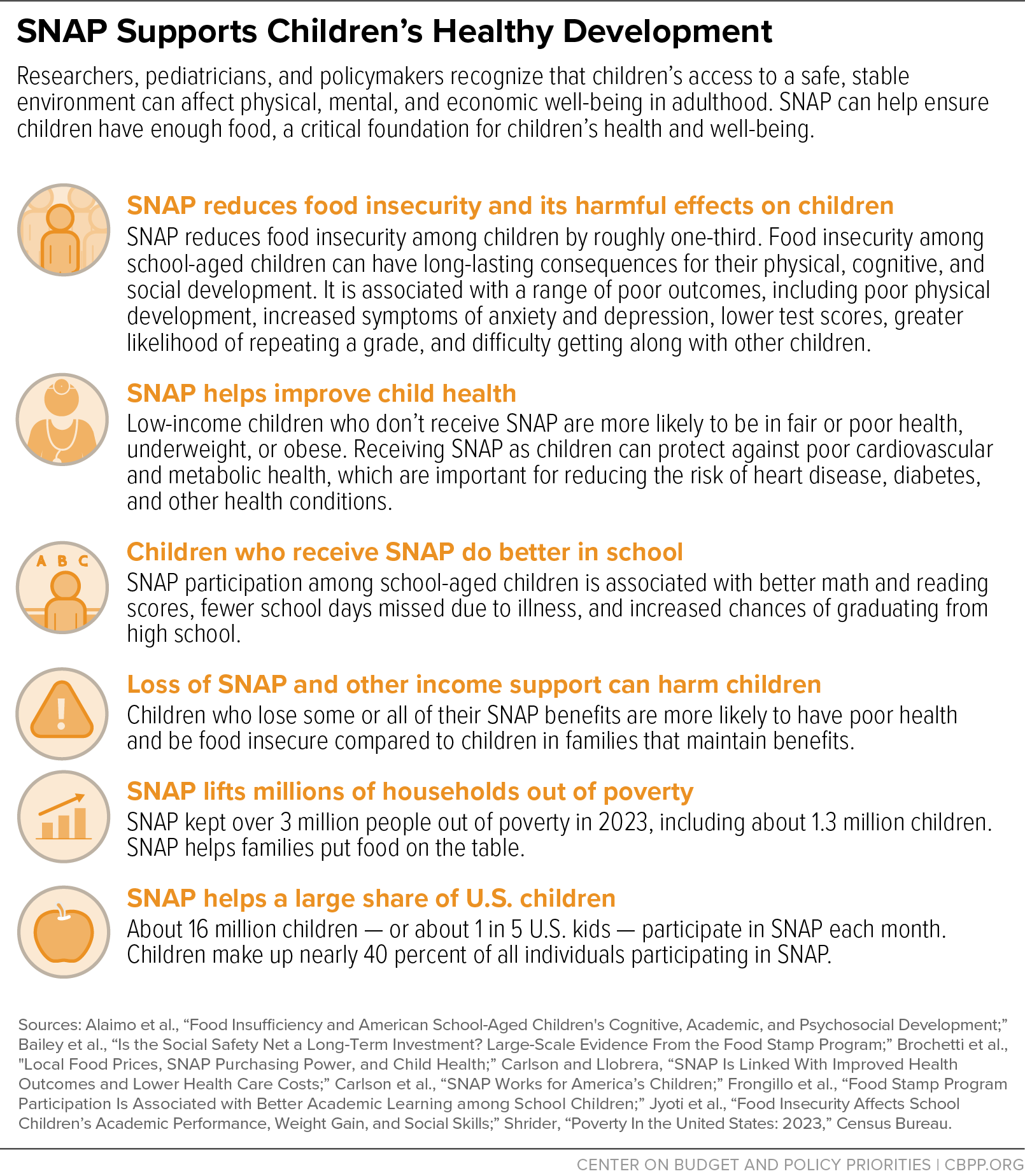
The House Republican reconciliation bill would cut the Supplemental Nutrition Assistance Program (SNAP) by the largest amount in its history, nearly $300 billion through 2034, according to the Congressional Budget Office (CBO). SNAP provides basic food assistance to 1 of every 5 children in the U.S. CBPP estimates that more than 2 million children will see food assistance to their families cut substantially or terminated, based on CBO estimates of the impacts of the bill’s SNAP provisions (other than those preventing future benefit increases, which will affect all SNAP recipients).
Cutting SNAP benefits for children whose parents don’t meet rigid work requirements. Under current SNAP rules, adults without children in their homes are limited to three months of benefits out of every three years if they can’t document they are either meeting a 20-hour-per-week work requirement or are exempt. The House Republican bill would expand this harsh restriction to parents of children over the age of 6 and to older adults aged 55-64, while essentially eliminating waivers for areas with poor economic conditions.
CBO estimates that expanding the work requirement would cut SNAP by $92 billion through 2034 and take food assistance away entirely from 3.2 million adults in a typical month, including 800,000 parents of school-aged children. When these adults are cut off SNAP, their entire households receive less in food benefits. Roughly 1 million children would see their food benefits cut substantially as a result. Additionally, experience has shown that work requirements in income-support programs can harm school outcomes for older children, causing a one-third increase in suspensions and expulsions in one program and reducing by 18 percent children's chances of excelling academically in another.
Forcing deep SNAP benefit cuts by radically altering the program’s funding structure. SNAP benefit costs have been fully federally funded for the entire 50-year history of SNAP in its modern form. The House reconciliation bill would fundamentally alter this structure by requiring states to pay for between 5 and 25 percent of benefit costs. If a state can’t make up for these massive federal cuts with tax increases or spending cuts elsewhere in its budget, it would have to cut its SNAP program (such as cutting eligibility or benefits or making it harder for people to enroll) or it could opt out of the program altogether. CBO estimates that states would cut or terminate benefits for about 1.3 million people, including children, in an average month due to this cost shift. The cuts to nutritional assistance could be far larger if more states than CBO projects deeply cut or terminate SNAP, and the risk of such cuts would rise during recessions, when state budgets are even more stretched.
Making it harder for children to get school meals. When school-aged children are cut off SNAP as a result of federal funding cuts and cost-shifts to states, they also lose automatic enrollment in free school meals and summer EBT. As a result, this bill would also cut federal spending on school lunches and breakfasts by $700 million, CBO estimates, impacting some 420,000 children in an average month.
Ending food assistance for children lawfully in the country. The House bill would eliminate all SNAP assistance for up to 250,000 people, including about 50,000 children, who are legally residing in the U.S. Many of these individuals are refugees and people granted asylum who have proven they have fled violence and persecution.

Increasing red tape, cutting food assistance for families. The House Republican bill would cut SNAP benefits by about $100 a month for households in which roughly 500,000 children live. This outcome would result from the bill curtailing a paperwork simplification for calculating utility expenses for many households.
Denying Tax Credits to Millions of Children
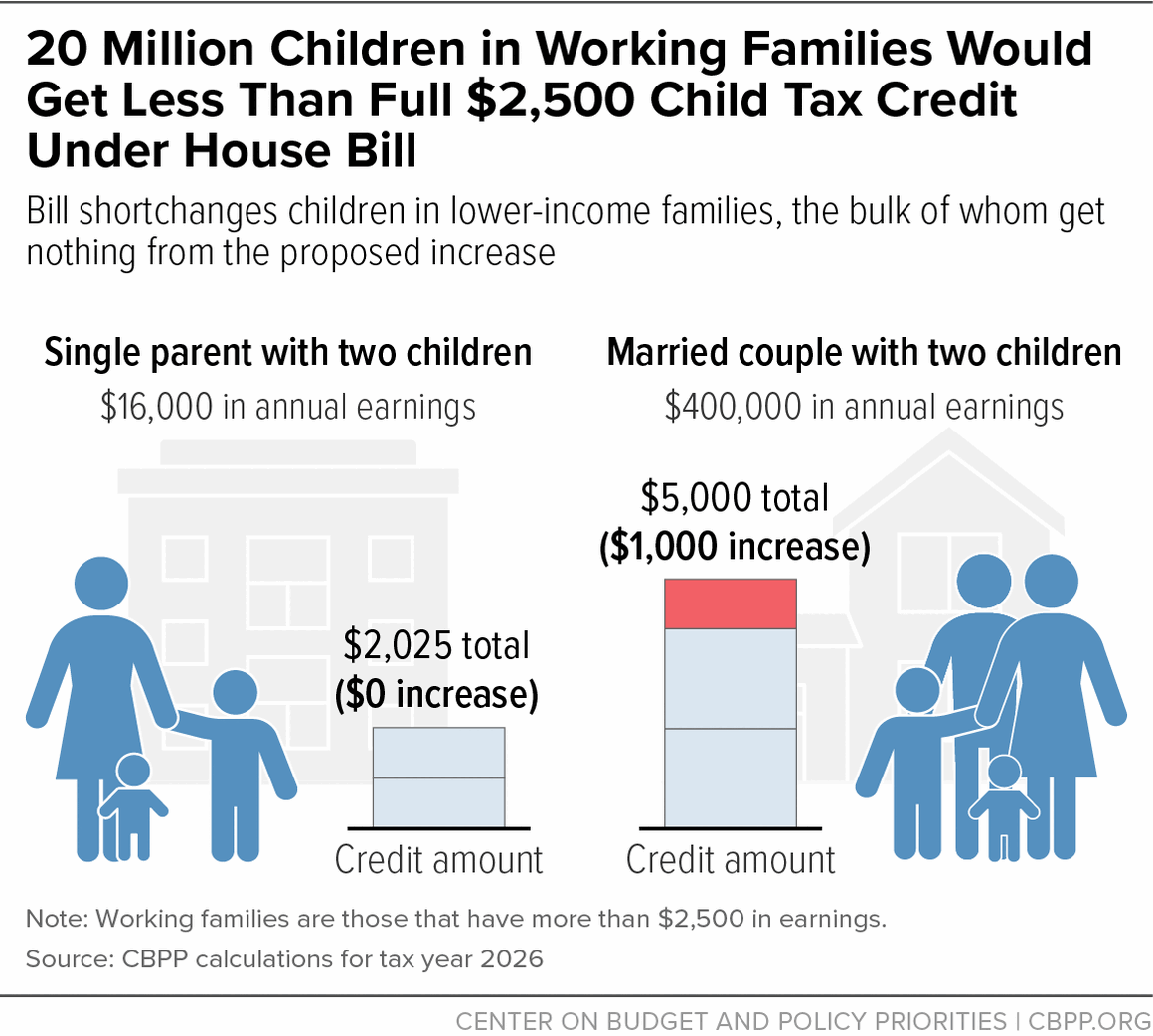
Blocking children of low- and moderate-income workers from receiving the full expansion of the Child Tax Credit. The House reconciliation bill would block as many as 20 million children in working families from receiving the full $2,500 Child Tax Credit included in the legislation because their parents don’t earn enough. For example, under the bill, a single parent with two children earning $16,000 a year as a home health aide would get no additional credit, while a married couple with two children earning $400,000 a year would receive an extra $1,000.

Taking away the Child Tax Credit from U.S. citizen children. The House bill would strip an estimated 4.5 million children who are U.S. citizens or lawful permanent residents of eligibility for the Child Tax Credit if their parents (both parents in a married couple family) don’t have a Social Security number (even if one parent is a citizen), according to estimates by the Center for Migration Studies.
Imposing red tape hurdles for children getting the EITC. The House bill would require all families with children claiming the Earned Income Tax Credit to first “pre-certify” their children whom they claim for the credit each year, which would likely ensnare more than 17 million working families who would have to learn about and comply with the new requirement, with some likely falling through the cracks.
Cutting Health Care Coverage and Raising Costs for Families
Medicaid provides health coverage to 2 in 5 children. By cutting Medicaid, the Children’s Health Insurance Program (CHIP) and ACA marketplaces by about $1 trillion, the House Republican bill could lead states to make large cuts in eligibility or benefits that would leave many families with children with higher costs and less health care.
Increasing red tape and imposing higher costs for families with children. The House Republicans’ bill includes provisions that will add burdens, reduce coverage, and raise costs for families with children. For example, by blocking implementation of a rule that simplifies the enrollment process for Medicaid and CHIP, the bill would reinstate barriers that make it harder for eligible children to access Medicaid and CHIP coverage. In the marketplaces, eliminating automatic yearly renewals and slashing enrollment periods will mean more families lose coverage.
Terminating and raising costs for coverage in the ACA marketplace. CBO estimates 4.2 million people will be uninsured in 2034 because House Republicans have not extended enhanced premium tax credits (PTC) that are set to expire at the end of 2025. In addition, this decision will mean nearly everyone who remains in the marketplaces will have to pay higher premiums. For example, the typical family of four with income of $65,000 will pay $2,400 more per year to keep their marketplace coverage without the PTC enhancements.
The bill also would take away marketplace financial assistance from most categories of lawfully present immigrants, including those who are children, such as refugees, people granted asylum, special immigrant juveniles who have been abused, abandoned or neglected by a parent, and DACA recipients who were brought to this country as children.
Taking Medicaid away from people who don’t meet work requirements. The single biggest Medicaid cut in dollar terms in the House Republicans’ bill is an extreme provision that would take away coverage from low-income adults enrolled in the Medicaid expansion group who can’t document meeting rigid work requirements or show they qualify for an exemption. Parents and pregnant adults will likely be among those who would lose coverage, even though the legislation includes them on a list of exemptions. Evidence from brief experiences with work requirements in Medicaid shows much of the coverage loss would occur among people who work or should qualify for an exemption but, nevertheless, lose coverage due to red tape. If low-income parents have to spend more on health care, they will have less money for rent and food for the entire household, and losing coverage can also impact parents’ health, making it harder for them to care for their children.