MÁS ALLÁ DE LOS NÚMEROS
An Overview of Trump Administration and Congressional Republicans’ Anti-Affordability Measures
In a nation as wealthy as ours, everyone should be able to afford to meet their basic needs – they should be able to buy enough food to feed their families, have a safe and affordable place to live, and go to the doctor and buy medication if they’re sick. Indeed, President Trump won the 2024 election with a promise to address people’s costs and make life more affordable.
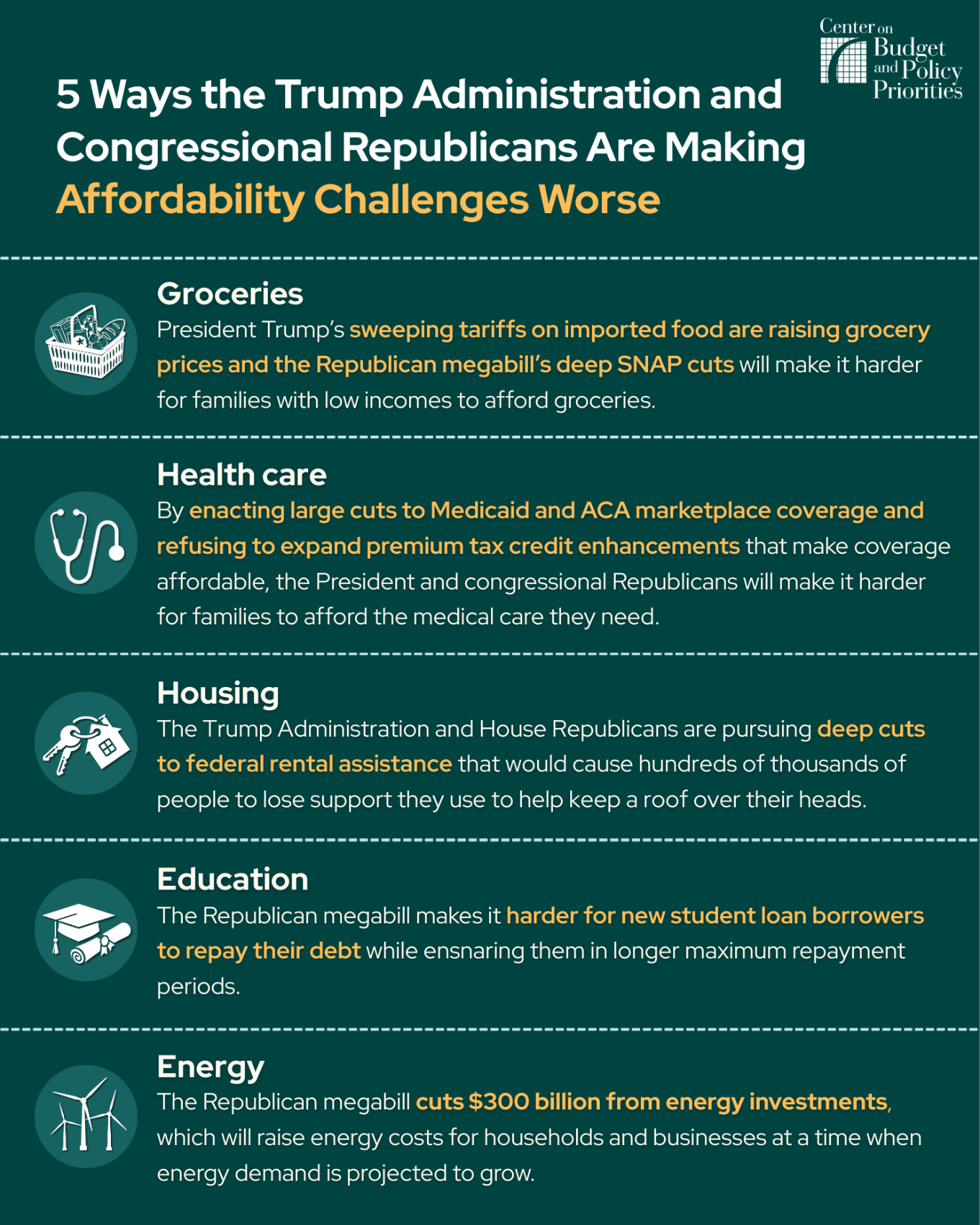
But, as we outline in a new report, a look at the Trump Administration’s policy choices and priorities demonstrate that the Administration and congressional Republicans have taken action after action that has or will raise the cost of:
- Groceries. Trump has imposed sweeping tariffs on imported food that are raising grocery prices, while enacting the largest cuts to SNAP in history through a deeply harmful Republican megabill that will make affording groceries harder for families with low incomes.
- Health care. The megabill’s large cuts to Medicaid and to Affordable Care Act (ACA) marketplace coverage will make it harder for families to afford the medical care they need. Moreover, the President and congressional Republicans have refused to renew the premium tax credit enhancements that help millions of people afford health care coverage. Together, these policy decisions will result in an estimated 15 million people losing health coverage, many of whom won’t be able to afford care they need.
- Housing. The Trump Administration and House Republicans are pursuing deep cuts to federal rental assistance in annual appropriations bills. If enacted, these cuts will cause hundreds of thousands of people to lose support they use to help keep a roof over their heads. Moreover, sweeping tariffs on home construction inputs will add $30 billion to the annual cost of residential investment, reducing housing supply and affordability for renters as well as prospective home buyers.
- Education. The Republican megabill makes it harder for new student loan borrowers to repay their debt while ensnaring them in longer maximum repayment periods, especially if they have low incomes. For the first time, new borrowers with the lowest incomes — many of them in poverty and many of whom did not complete a degree program — will have to make payments before they can afford it. And both the Trump Administration and House Republican budget proposals would make college less affordable — and encourage debt accumulation — through cuts to federal work study and the elimination of programs providing financial aid to students with low income and child care to parents attending college.
- Energy. The megabill cuts more than $300 billion from energy investments, which will raise energy costs for households and businesses at a time when energy demand is projected to grow. One study estimates that households will face a 13 percent increase ($280 per year) in their energy bills by 2035 as a result of these cuts. Moreover, President Trump has proposed eliminating the Low Income Home Energy Assistance Program (LIHEAP), which provides assistance to 6 million low-income households to help them pay their energy bills and prevent utility shutoffs.
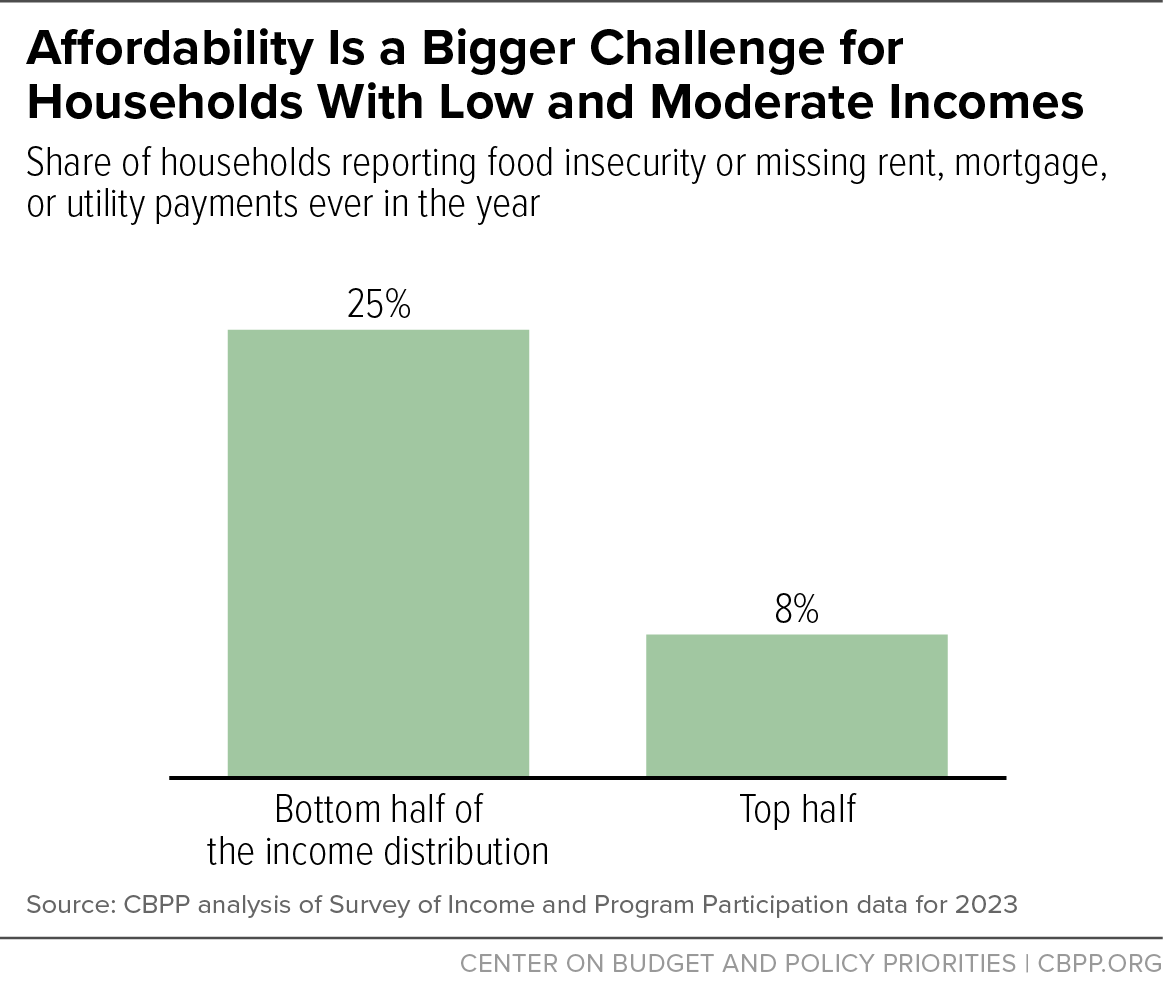
People with low and moderate incomes especially will grapple with the costs of these harmful policy choices. Fully 25 percent of households in the bottom of half of the income distribution report experiencing food insecurity or not being able to pay their rent, mortgage, or utility bill compared to 8 percent of households in the top half. (See chart.)
Households with incomes in the bottom half of the distribution (less than $70,000 in 2023) spend almost 90 percent of their incomes on basic items: utilities, groceries, health care, transportation, and shelter. (This is based on the Consumer Expenditure Survey, which has a different income cutoff than the Survey of Income Program Participation used in the chart above.) And to help afford those basics, many need assistance, such as Medicaid, SNAP, or LIHEAP, that the Administration has put on the chopping block. Moreover, families affected by cuts in these areas receive the fewest benefits, if any at all, from the megabill’s tax cuts. That includes the bill’s Child Tax Credit expansion, which gave short shrift to 19 million children in families with low and moderate incomes.
Policy efforts to reverse course and actually improve affordability should focus on people with low and moderate incomes, who already struggle the most to afford the basics and have suffered the most from the Trump Administration’s harmful policies. This effort would start with repealing or abandoning the anti-affordability policies the Administration has pursued, and also using tried and true tools — such as extending the enhanced ACA tax credits, expanding rental assistance, and making the full Child Tax Credit available to children in families with lower incomes.