

Trump Administration Personnel Policies Harming Social Security Customer Service, Risk Lasting Damage
The Trump Administration deliberately caused the loss of an unprecedented number of workers from the Social Security Administration (SSA) in its first year in office, reducing staffing by roughly 7,500 employees (13 percent) from January 2025 to January 2026.[1] New data from the Office of Personnel Management (OPM) reveal more about how the resulting short-staffing of critical functions is degrading service for the largely older, bereaved, and severely disabled people who most rely on SSA and creating challenges that will be difficult to turn around without major changes. (See Figure 1.)
The loss of thousands of employees hit key customer service positions hard, including a drop of more than 3,000 staff who assist visitors to SSA field offices and callers to SSA’s national 800 number. SSA leadership responded by shifting thousands of remaining workers to new roles to help fill the gap the Administration had created. But redistributing the too-few remaining workers to roles where they have little or no experience risks ameliorating one service delivery problem by exacerbating others.
SSA has also pared back the performance metrics it had previously shared publicly each month, such as how long callers to the 800 number must wait on hold or for a call back or how long applicants must wait for an in-person appointment. This loss of transparency may hide from public view critical challenges now facing the agency.
One area of SSA operations affected by both staffing losses and reduced transparency is the large and growing backlog of hearings for people appealing SSA’s denial of their application for disability benefits. The number of cases pending rose by more than 73,000 from January 2025 to February 2026, threatening harm for some of the most vulnerable people SSA serves.
Having forced out thousands of experienced employees while blocking virtually all new hiring, SSA now has fewer senior career leaders and fewer early-career staff than at any point in over two decades. These losses mean the Administration’s personnel policy will likely affect service to the public for a long time to come.

SSA already faced customer service challenges when the Trump Administration took office, as years of underfunding had forced the agency to serve the growing number of beneficiaries with fewer staff.[2] The Administration’s personnel policies have made things far worse. While SSA Commissioner Frank Bisignano has promised that SSA will partly compensate for cuts in staffing through improved efficiency, he has yet to explain how it will do so, and the reality is the agency will need to begin hiring significant numbers of new employees now to avoid even greater deterioration in service. The Administration also needs to publish detailed plans for addressing its customer service challenges to help restore confidence in the agency and hold it accountable for delivering on those promises.
Rapid Staffing Losses Hit Critical Customer Service Supports
In its first 12 months, the Administration pushed out more than 7,500 SSA workers without considering their individual performance or the roles they filled, causing SSA’s largest one-year staffing reduction on record and compromising its ability to reliably serve seniors, bereaved families, and people with disabilities.[3] By January 2026, SSA had fewer employees than at any time since 1967, when the agency was not yet responsible for administering Supplemental Security Income (SSI) and served 52 million fewer beneficiaries.
The Administration launched this rapid staff exodus, which led over 3,500 SSA employees to leave within the first 100 days, with a combination of incentives and invective aimed at SSA staff.[4] But the Administration lacked a clear plan for how SSA would meet its mission after the loss of so many workers, which created large gapsin customer service — at call centers, local offices, and other critical areas — that continued throughout the year.
More than half of the losses in the Administration’s first year occurred in three positions that are crucial for ensuring that applicants and beneficiaries get the service they need, including:
- Nearly 1,800 social insurance specialists, who help people apply for Social Security and SSI benefits and process applications.
- Nearly 1,300 contact representatives, who provide assistance and fulfill requests for visitors to local SSA offices or callers to SSA’s 800 number.
- More than 1,100 information technology workers, who maintain the technology systems that allow other staff to receive and process applications and ensure that benefits are delivered.
As thousands of staff abruptly left key roles, SSA service reached a crisis point in the spring of 2025.[5] News reports described lines snaking out the doors of local offices, website crashes, and callers waiting up to two or three hours to get help on SSA’s 800 number if they got through at all.[6] In May 2025, the last month for which SSA posted detailed customer-focused performance metrics, callers had to wait about an hour and 45 minutes on hold or for a call back, fewer than half of callers eventually got through to a representative, and most retirees and survivors waited more than 28 days for an appointment.[7]
In response, SSA’s leadership focused intensively, and with some success, on shortening the time that callers to SSA’s national 800 number spend waiting on hold. They reassigned 1,000 field office staff to the phone lines beginning in July 2025, boosting the number of call center agents by 25 percent, and subsequently reassigned additional staff from across the agency to aid the effort.[8] But the progress has not been as dramatic as they have claimed, with SSA’s inspector general finding that average total waits on the phone ranged from 45 minutes to two hours in 2025.[9] (See text box, “Relying on Misleading Phone Metric Overstates Customer Service Improvements.”)
Moreover, the reduction in phone answer times doesn’t necessarily mean callers are ultimately getting the help they need faster.[10] Many of the reassigned staff have no experience directly serving the public and may not have expertise in SSA program rules relevant to answering calls. Yet they receive only a few hours of training for their new role before interacting with callers, so they may not be prepared to address all of the difficult issues they may encounter.[11]
Also, the reduction in phone answer times has come at the expense of other work that serves the public. Even as waits on the 800 number improved, other retirees, disabled workers, and bereaved families who need help from local offices are facing delays, with thousands fewer workers available to take appointments or follow through on requests. While SSA doesn’t publish data on staffing by field office, 40 states and Washington, D.C. each saw a decline of more than 10 percent in the overall number of SSA staff in the state between January 2025 and January 2026.[12] In fact, some offices have been so short-staffed that they have been forced to close their doors to people seeking in-person service, sometimes for hours and sometimes for weeks or even months.[13]
In addition, recent reporting and research reveal unprecedented challenges in getting needed help from SSA. The Washington Post reported in December 2025 that record backlogs at SSA are delaying service, appointments take longer to get, and new service restrictions make it harder for people to get help.[14] Widows and children who have lost parents face some of the longest delays, with months-long waits to receive benefits while many struggle to pay bills, food, and rent.[15] And a study based on interviews with dozens of organizations working with disability applicants found applicants faced problems that included calls that were dropped or answered by people who couldn’t provide help, difficulties accessing walk-in services or making appointments in local offices, and applications that “take longer, are denied more often, with more errors along the way.”[16]
To help address especially severe understaffing at certain local field offices, SSA leadership is spreading incoming work across field offices to take advantage of where workers may have the most capacity. This is a worthwhile initiative if managed carefully and supported with the right systems improvements, but a source of potential errors, delays, or frustration if not well executed.[17] Likewise, with hundreds fewer processing center staff, responding to claims and other requests may take longer; getting through to agents on the 800 number is less beneficial if more callers hear that their claims and other requests have been held up because the workers who would have fulfilled them are now answering phones.[18]
Elimination of Key Customer Service Metrics May Be Hiding Further Problems
In the summer of 2025, amid bad press on its worsening performance, SSA stopped publicly releasing regular monthly updates of many customer-focused service metrics.[19] SSA restored some of those measures over time but has not restored certain key metrics. For example, SSA no longer shares how long callers wait on hold or for a call back on the 800 number, how long it takes applicants to get an appointment, or how many unfulfilled requests languish in the processing backlog.
Thus, we cannot know how well SSA’s efforts to cope with its significant staffing losses are working, or how people who rely on SSA are being affected. But when Commissioner Bisignano released a set of metrics on a one-time basis in response to pressure from Congress, they contained worrying signs. As of August 2025, more than half of retirees and survivors waited over a month for an appointment to apply for benefits. Callers to the 800 number waited over an hour to reach an agent, whether they chose to wait on hold or opted for a call back — much longer than the “average speed of answer” the Commissioner often cites in public.[20]
In addition, the Washington Post’s reporting in December found continuing large backlogs and delays in people receiving needed help from SSA. Local offices had over 12 million transactions — such as claims, name changes, and address updates — that workers hadn’t yet processed for waiting customers. Meanwhile, the agency’s centralized processing centers had 6 million other pending transactions.[21]
Staffing Losses May Be Contributing to Growing Backlog of Disability Hearings
Staff cuts appear to be contributing to the rapid growth in the backlog of disability appeals. The number of disability hearings awaiting resolution has jumped by 24 percent just in the past year.
Between January 2025 and January 2026, SSA lost 13 percent of its administrative law judges (ALJs). The largest one-year drop on record, it led to the fewest ALJs employed by SSA in at least 20 years. SSA also lost hundreds of attorneys and paralegals in 2025, many of whom help ALJs prepare for hearings and write decisions.
ALJs play a critical role in ensuring fair access to disability benefits, deciding on the outcomes of appeals after applicants for such benefits are initially denied by SSA. ALJs help ensure that claimants’ applications are treated fairly and impartially based on the eligibility rules. More than one-third of initially denied applicants request an appeal.[22]
Such appeals are even more important if applicants are concerned that they may not get a fair decision from an overstretched and understaffed SSA.[23] Even in the best of times, lengthy waits for appeals cause hardships for applicants who are unable to work because of their disability but are still awaiting a decision on their benefits.
The number of disability hearings awaiting resolution rose by more than 73,000 from January 2025 to February 2026, to nearly 344,000.[24] After years of progress in reducing record backlogs (including during the first Trump Administration), 2025 was the first fiscal year since 2016 in which the number of people awaiting decisions on their appeals increased. (See Figure 2.) The loss of judges needed to decide these appeals will make it even more difficult for SSA to shrink the growing backlog.
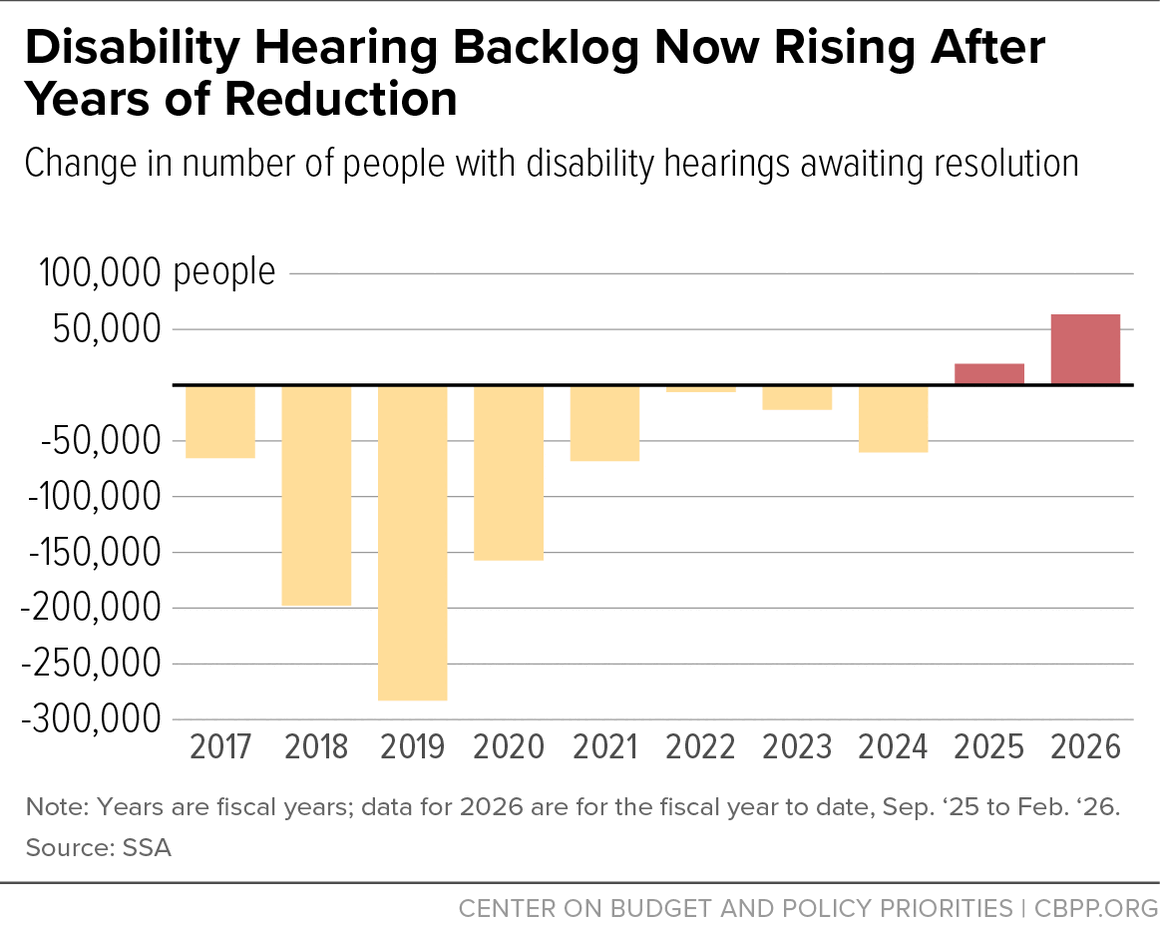
Adding to these problems, SSA abruptly stopped publishing more detailed monthly hearings data for the first time in years in September 2025. Restoring transparency on appeals is vital: continued increases in the backlog would mean some of the most vulnerable people that SSA serves — people with severe, potentially work-limiting disabilities who are waiting to begin receiving financial support — are suffering as a result of SSA’s personnel policies. This is particularly ominous given the major problems that SSA had with appeals backlogs a decade ago. Backlogs ultimately reached a record high, and SSA was only able to get them under control with significant congressional oversight and dedicated funding.[25]
Current Problems Will Likely Have Lasting Consequences
The large, rapid, and haphazard loss of staff last year will likely hamper SSA’s performance for years to come. The Administration chased away an unprecedented level of expertise and experience from the agency, including more than a third of its nonpartisan career senior executives.[26] SSA lost more than twice as many senior executives in 2025 as in any other year on record.
While pushing out a historic number of workers, the Administration has also blocked SSA from replacing nearly any of them. (See Figure 3.) The agency hired fewer than 100 employees in all of 2025 — the lowest number on record and less than 2 percent of hiring in an average year.


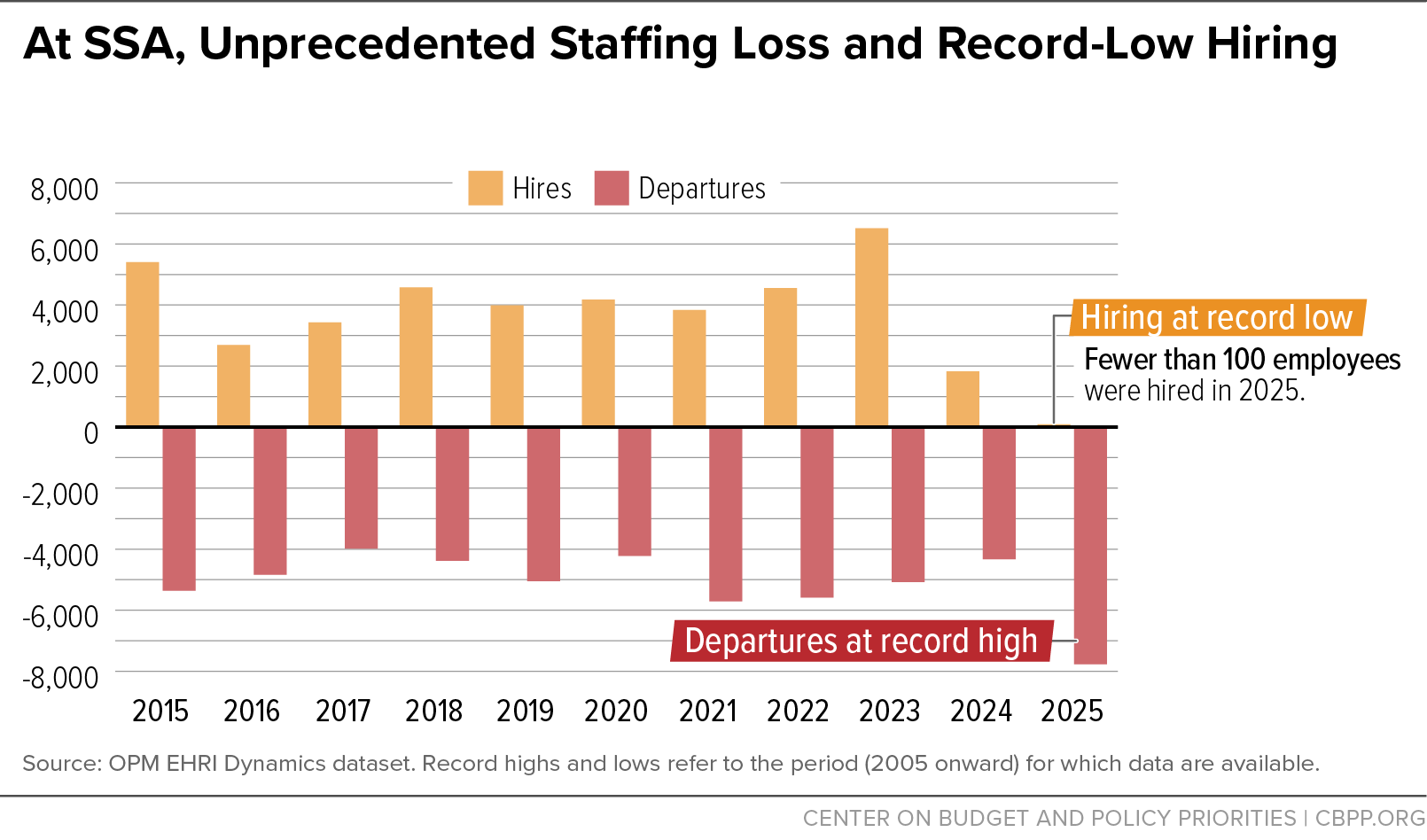
The cuts and failure to hire combined to strip the agency of its pipeline of early-career workers training to assist the public when longer-tenured workers leave. At the beginning of 2026, fewer than 850 of SSA’s 50,000 employees were in their first two years of federal service and fewer than 7,800 were in their first five years — both easily the lowest figures on record going back over 20 years. This means SSA will be particularly vulnerable as more employees continue to leave, because the Administration is failing to invest in training their replacements. It typically takes two years for a new claims representative or disability examiner to acquire the technical knowledge necessary to handle a large workload encompassing a range of complex issues.
Failing to hire will particularly hurt the parts of SSA that typically experience the highest turnover, such as call centers and local offices. However, as of March 1, 2026, SSA was publicly recruiting for only eight roles at the entire agency, all in information technology. Reporting suggests that SSA aims to “increase its workforce by 1,000 employees” this year, including at least 700 customer service representatives, but it is not clear whether the agency plans to merely hire 1,000 employees or to increase staffing by 1,000 even accounting for further departures.[27] After all, in a typical year about 5,000 workers leave SSA (but are often replaced by new hires). SSA needs to begin hiring significant numbers of new employees now to avoid even greater deterioration in service.
When SSA begins to hire in earnest, it will face new challenges, like the Administration’s politicization of hiring and firing government-wide. Agency heads, along with a committee of political appointees, must personally approve every job listing before posting, as well as every selection before hiring.[28] All applicants must answer essay questions about how they will further the President’s agenda — even if their day-to-day role is apolitical and focused on serving the public, like answering questions about SSA services, processing benefit applications, or supporting SSA’s technology needs. It also may be more difficult to recruit employees to federal service following the Administration’s mass firings and denigration of federal workers, and with so many remaining workers carrying the workload of departed colleagues.[29] SSA scored the lowest on employee satisfaction and engagement of any large agency in the Partnership for Public Service’s Public Service Viewpoint Survey, which was designed to replace the annual federal personnel survey that OPM cancelled in 2025.[30]
Greater Transparency Essential to Hold SSA Accountable
When President Trump resumed office in 2025, SSA was already straining to deliver for those who rely on it. Years of constrained administrative budgets had caused SSA staffing to gradually fall by roughly 7,300 employees over the preceding decade. For reasons it never fully articulated, the Administration chose to reduce SSA’s workforce by another 7,500 employees in a single year without regard for their roles or responsibilities. Predictably, this created unprecedented disruption at SSA and raised serious concerns about the agency’s ability to reliably deliver services and benefits to the public.
Given the significant staffing gaps the workforce cuts created in critical functions, SSA is under strong pressure to increase the productivity of its remaining staff quickly. But reassignments, sprints, and shortened training (along with ongoing restrictions on hiring) will not deliver the sustained and lasting improvements SSA needs. Pushing staff to rush through tasks can undermine accuracy and quality, unfairly keeping people from receiving benefits they are entitled to or creating additional headaches for SSA in the future, such as payment errors or lengthy and expensive appeals.
Laudably, SSA is looking to leverage technological improvements or workflow efficiencies to offset some of the lost capacity. But such initiatives will require careful planning and thoughtful implementation, and the Administration’s choice to radically cut staff first and implement improvements second raises serious questions about its judgment and ability to execute these efforts. Public trust in SSA has also been seriously damaged over the past year by DOGE chaos and weaponization of the agency, fake fraud claims, politicization of agency communications, data leaks, and other problems.[31]
Commissioner Bisignano has frequently stated that he wants SSA to be a “digital first” agency; leaked documents show SSA aims to cut the number of people it serves in its field offices in half in 2026.[32] But he has provided few specifics on how he plans to achieve that goal, and what improvements the public should expect to see and when. In fact, SSA’s performance plan for 2026 listed “TBD” for many of its most important customer service goals and targets.
The Administration owes Congress and the public a concrete explanation of SSA’s planned path forward and transparent measures and benchmarks to hold the agency accountable in making progress toward those goals, such as:
- Publishing SSA’s annual personnel plan, which the agency was required to submit to OPM and the Office of Management and Budget at the end of 2025. SSA should make that document public, along with a clear and detailed plan for future staffing at SSA.
Publishing monthly reports on staffing at each field office and in other critical positions across the agency. OPM has made welcome improvements in the transparency with which it reports on federal personnel across government. SSA should build on that effort by releasing its own staffing figures.
If SSA plans to make do with fewer front-line staff or reduced support for those directly assisting the public, it should make clear how it intends to do so and what tradeoffs in service are to be expected. This is especially important given that the loss of experienced personnel could have lasting consequences for the quality of SSA services.
- Restoring the detailed monthly customer service metrics and hearings statistics SSA ceased posting last year, and publishing clear targets and timelines for any improvements SSA says it plans to pursue.
Such steps will be critical to help SSA begin to earn back the public’s trust and to provide the transparency needed to hold the Administration accountable for the direction it has taken the agency.
End Notes
[1] According to OPM data, SSA’s headcount declined from 57,384 in January 2025 to 49,880 in January 2026. See OPM, “Federal Workforce Data,” https://data.opm.gov/.
[2] Paul Van de Water, “SSA Budget Will Worsen Customer Service Crisis, But Investment in 2025 Could Fund Turnaround,” CBPP, April 12, 2024, https://www.cbpp.org/blog/ssa-budget-will-worsen-customer-service-crisis-but-investment-in-2025-could-fund-turnaround.
[3] The largest previous one-year decline was approximately 6,334 SSA employees (roughly 8 percent) between 1986 and 1987. Among full-time staff, the gap between the two periods was even greater. The number of full-time staff declined by 6,942 (12 percent) between January 2025 and January 2026, compared to 4,433 (6 percent) in 1986-87). See William Morton, “Social Security Administration (SSA) Staffing Levels: Data Brief,” Congressional Research Service, September 29, 2025, https://www.congress.gov/crs_external_products/R/PDF/R48725/R48725.4.pdf.
[4] SSA, “Social Security Announces Workforce and Organization Plans,” February 28, 2025, https://www.ssa.gov/news/en/press/releases/2025-02-28.html; SSA, “Social Security Announces Options to its Workforce,” February 27, 2025, https://www.ssa.gov/news/en/press/releases/2025-02-27.html; Alex Gangitano, “Musk dominates, disparages federal workers at first Trump Cabinet meeting,” The Hill, February 26, 2025, https://thehill.com/homenews/administration/5165273-elizabeth-musk-trump-cabinet/; PBS News, “Trump says ‘many’ of fired federal workers ‘didn’t come to work’ and are ‘being weeded out,’” March 24, 2025, https://www.pbs.org/newshour/politics/watch-trump-says-many-of-fired-federal-workers-didnt-come-to-work-and-are-being-weeded-out; James Politi, “Russell Vought: the man on a ‘divine mission’ to traumatise US bureaucrats,” Financial Times, February 10, 2025, https://www.ft.com/content/2a41b1bd-dd63-4c48-933f-b3000e30e17a.
[5] Lisa Rein and Hannah Natanson, “Long waits, floods of calls, web crashes: Social Security is breaking down,” Washington Post, March 25, 2025, https://www.washingtonpost.com/politics/2025/03/25/social-security-phones-doge-cuts/; Jack Healy et al., “‘Just a Mess’: Staff Cuts, Rushed Changes and Anxiety at Social Security,” New York Times, April 8, 2025, https://www.nytimes.com/2025/04/08/us/social-security-trump.html.
[6] Healy et al., op. cit.
[7] SSA, “Social Security performance,” as archived on May 23, 2025, by Internet Archive, https://web.archive.org/web/20250523091534/https://www.ssa.gov/ssa-performance.
[8] SSA’s Office of the Inspector General found that this influx of personnel, aided by the adoption of a more modern phone platform in 2024, helped get calls answered faster. Reporting suggests that SSA reassigned an additional 500 employees from field offices in December 2025; 800 from processing claims and other requests in January 2026; and additional staff who worked on digital services, disability adjudication, and other areas in February 2026. See: SSA Office of the Inspector General, “Social Security Administration’s Telephone Metrics,” December 2025, https://oig.ssa.gov/assets/uploads/032517.pdf; Natalie Alms and Eric Katz, “Social Security is directing employees who normally process benefits to answer phones instead,” Government Executive, February 9, 2026, https://www.govexec.com/workforce/2026/02/social-security-directing-employees-who-normally-process-benefits-answer-phones-instead/411253/.
[9] Meryl Kornfield and Lisa Rein, “Under Trump, the government’s watchdogs are losing their independence,” Washington Post, March 19, 2026, https://www.washingtonpost.com/politics/2026/03/19/inspector-general-independence-trump/.
[10] Rachel Siegel, Meryl Kornfield, and Hannah Natanson, “The Trump administration is moving staff into jobs they know nothing about,” Washington Post, September 4, 2025, https://www.washingtonpost.com/business/2025/09/04/federal-government-job-changes/.
[11] Eric Katz, “‘Suicide is only one option': Social Security staff newly assigned to phone duties raise concerns over training,” Government Executive, February 13, 2026, https://www.govexec.com/management/2026/02/suicide-only-one-option-social-security-staff-newly-assigned-phone-duties-raise-concerns-over-training/411429/. Hastily retrained employees, thousands of whom are now answering the phones, often start out able to help with only the most basic questions they receive.
[12] OPM, op. cit. This figure mirrors findings in a recent Center for American Progress analysis: Molly Westin Williams, “The Social Security Administration Is Bleeding Staff,” January 30, 2026, https://www.americanprogress.org/article/the-social-security-administration-is-bleeding-staff/.
[13] Lisa Rein, Meryl Kornfield, and Hannah Natanson, “How Social Security has gotten worse under Trump,” Washington Post, December 30, 2025, https://www.washingtonpost.com/politics/2025/12/29/trump-social-security-cuts-customer-service/; SSA, “Closures or Delays Affecting In-Person Service,” https://www.ssa.gov/agency/emergency.
[14] Rein, Kornfield, and Natanson, op. cit.
[15] Chabeli Carrazana, “Widows are waiting months for the benefits meant to help them after loss,” March 18, 2026, https://19thnews.org/2026/03/widows-social-security-survivor-benefits/.
[16] Katie Savin, Callie Freitag, and Matthew Borus, “’In the last year, it’s gotten a lot worse’: A Qualitative Investigation of Barriers to Disability Benefits in 2025,” Disability Rights Education & Defense Fund, March 2, 2026, https://dredf.org/ssa-barriers-2025/.
[17] Jessica Hall, “Social Security is making a change that could disrupt service for millions of Americans,” MarketWatch, January 24, 2026, https://www.morningstar.com/news/marketwatch/20260124187/social-security-is-making-a-change-that-could-disrupt-service-for-millions-of-americans.
[18] Eric Katz and Natalie Alms, “Social Security is directing employees who normally process benefits to answer phones instead,” NextGov/FCW, February 6, 2026, https://www.nextgov.com/people/2026/02/social-security-directing-employees-who-normally-process-benefits-answer-phones-instead/411256/.
[19] Meryl Kornfield and Hannah Natanson, “Social Security stops reporting call wait times and other metrics,” Washington Post, June 20, 2025, https://www.washingtonpost.com/politics/2025/06/20/social-security-wait-times-cuts/.
[20] For the data provided by Commissioner Bisignano, see https://static.foxnews.com/foxnews.com/content/uploads/2025/09/crosscheck-of-ssa-public-metrics-for-sen-warren-091625.pdf. See also Senator Elizabeth Warren, “Disappearing Data: Social Security Administration’s Removal of Key Performance Metrics from the Agency’s Website,” September 5, 2025, https://www.warren.senate.gov/imo/media/doc/warren_report_letter_to_commissioner_bisignano_re_report_on_data_removal.pdf.
[21] Rein, Kornfield, and Natanson, op. cit.
[22] National Organization of Social Security Claimants’ Representatives, “Daily Dose of Data from SSA,” February 26, 2025, https://nosscr.org/article/daily-dose-of-data-from-ssa-2-25/.
[23] Jack Smalligan, “The SSA Says It’s Reduced the Disability Claims Backlog. Fewer New Claims and a Higher Denial Rate Could Be Driving the Reduction,” Urban Institute, September 12, 2025, https://www.urban.org/urban-wire/ssa-says-its-reduced-disability-claims-backlog-fewer-new-claims-and-higher-denial-rate.
[24] SSA, “Social Security performance,” op. cit. In January 2025 there were 270,949 hearings pending.
[25] SSA Office of the Inspector General, “The Social Security Administration’s Efforts to Eliminate the Hearings Backlog,” September 2015, https://oig-files.ssa.gov/audits/full/A-12-15-15005.pdf.
[26] SSA collectively lost over 96,000 years of past federal service from its workforce.
[27] Emily Davies and Meryl Kornfield, “After slashing federal jobs, Trump administration ramps up hiring,” Washington Post, March 9, 2026, https://www.washingtonpost.com/politics/2026/03/09/trump-hiring-federal-workers/.
[28] Drew Friedman, “Political appointees to be more involved in recruitment decisions as federal hiring freeze continues,” Federal News Network, October 15, 2025, https://federalnewsnetwork.com/hiring-retention/2025/10/political-appointees-to-be-more-involved-in-recruitment-decisions-as-federal-hiring-freeze-continues/.
[29] Ana Altchek, “Federal jobs aren’t so hot anymore for recent grads,” Business Insider, April 26, 2025, https://www.businessinsider.com/interest-in-government-jobs-not-what-it-was-last-year-2025-4.
[30] Partnership for Public Service, “Federal Public Service in Peril: A Report Card on the Trump Administration’s Management of Our Government,” March 19, 2026, https://bestplacestowork.org/.
[31] Devin O’Connor, “Social Security Stability Remains at Risk,” CBPP, March 31, 2025, https://www.cbpp.org/blog/social-security-stability-remains-at-risk; Josephine Cureton and Kathleen Romig, “Contrary to Administration’s Misleading Claims, New Senior Deduction Doesn’t Help Low- and Middle-Income Seniors, Does Deplete Social Security Trust Funds,” CBPP, July 28, 2025, https://www.cbpp.org/blog/contrary-to-administrations-misleading-claims-new-senior-deduction-doesnt-help-low-and-middle.
[32] Natalie Alms, “Social Security wants about 15 million fewer visits in its field offices,” NextGov/FCW, December 1, 2025, https://www.nextgov.com/digital-government/2025/12/social-security-wants-about-15-million-fewer-visits-its-field-offices/409850/.