

Congress Needs to Address the Trump Administration Turmoil at the Social Security Administration
Years of underfunding have forced the Social Security Administration (SSA) to serve the growing number of beneficiaries with fewer staff, creating customer service woes that the Trump Administration has deepened through unprecedented cuts in SSA staff this year — far beyond what SSA’s constrained 2025 budget required. The results include unacceptably long waits for appointments, answers to beneficiaries’ questions, and payment of initial benefits.[1] But the Republican-controlled Congress has remained complacent even as Administration actions harm services to lawmakers’ own constituents.
The President’s 2026 budget request — which reveals new details on the breadth of the turmoil the Administration has unleashed this year — should be a wake-up call. To raise customer service to acceptable levels, Congress must not only provide SSA with sufficient funding but also forcefully push back against the Administration’s current mismanagement of its existing resources. The recent revelation by an agency whistleblower of “serious data security lapses” by DOGE officials that have placed the sensitive data of hundreds of millions of people at grave risk — in violation of agency protocols and federal law — is just the latest evidence of mismanagement at SSA.[2] Otherwise, the problems facing the nation’s retirees, people with disabilities, and bereaved families who rely on Social Security will only worsen.
Trump Chaos Deepened SSA’s Service Challenges, Raising Stakes of 2026 Funding Debate

In a normal year, Congress would assess SSA’s ability to serve the public by evaluating whether the President’s budget proposal provides sufficient funds to meet people’s needs. But this year’s request cannot be viewed in isolation from the Administration’s deep staff cuts, new restrictions on SSA services, reduced transparency, and potentially dangerous mismanagement of SSA data and systems that have already occurred — and will continue in the absence of meaningful intervention.[3]
So far, Republicans in Congress have gone along with the Administration’s damaging choices at SSA, even though Congress provided SSA with a budget in 2025 that in no way required the severe cuts in staffing or disruptions in service the Trump Administration pursued. Congressional Republicans have failed to act even as the Administration implemented a 94 percent cut to the SSA office that helps them assist their constituents, answers their questions, and helps them develop Social Security legislation — and even as their Democratic colleagues raised the alarm in July and the agency failed to respond to the questions in their letter.[4]
The Administration’s 2026 budget proposes to extend a harmful freeze on SSA’s customer service budget for a third straight year; a freeze would amount to a real cut in SSA resources after accounting for increasing costs.[5] This would lock in a customer service budget roughly one-quarter lower than 15 years ago — even as the number of Social Security beneficiaries has grown by nearly 17 million.[6] (See Figure 1.) The budget details which critical functions will be most affected by the unprecedented staff cuts the Administration imposed in 2025.
Congress has not taken action to address the serious challenges at SSA. The 2026 funding bill released by House Republican appropriators essentially matches the President’s request for the agency. While the Senate Appropriations Committee-approved funding bill acknowledges that “there are significant service delivery challenges at SSA that are impacting critical services that millions of Americans count on,” neither its proposed funding levels — a 1 percent increase over 2025 — nor its instructions to the agency would significantly improve the situation.[7] The Senate bill also fails to include enforceable measures requiring SSA to reverse deep staff cuts, lift restrictions on services, improve transparency, or secure the sensitive data of hundreds of millions of Americans.
Trump Budget Reveals New Details on Critical Staffing Losses Affecting Service
The Administration’s ill-considered SSA staffing cuts are one of the clearest examples of its mismanagement of the agency. The Administration’s SSA budget documents for 2026 detail the breadth and depth of these reductions.[8] Figure 2 compares staffing in 2024, before President Trump was inaugurated, with the Administration’s requested staffing levels for 2026.
Normally, Presidents send their budget proposals to Congress, which then accepts, rejects, or amends them as part of the appropriations process. Yet already this year, the Administration has largely implemented its proposed personnel cuts at SSA. Thus, its budget proposal is more of an indication of what the Administration has been doing since it took office, rather than what it plans to do in the coming year. As a result, in 2026, SSA will have the staffing levels that the Administration has proposed, before Congress has even acted.


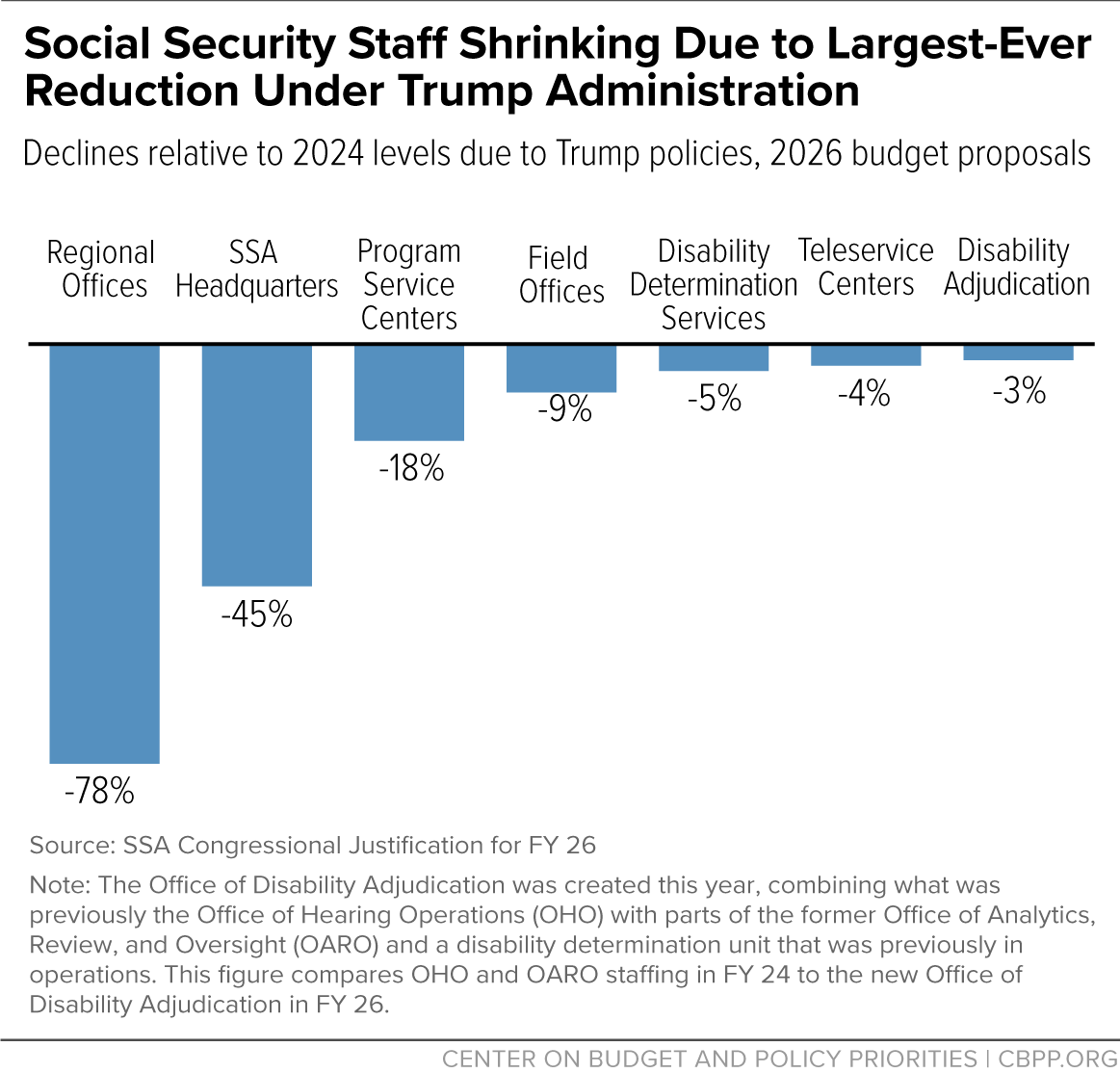
Under the Trump Administration in 2025:
- SSA regional office staff have been mostly eliminated, robbing front-line staff of key supports. These offices provided daily support to their colleagues in the field by answering complex policy questions and troubleshooting system problems. Eliminating these positions leaves customers waiting longer for the benefits they need. As a result of the deep cuts to date, front-line staff are already struggling to resolve the most difficult cases.
- SSA’s headquarters staff have been cut nearly in half, threatening the systems SSA needs to serve the public. For example, the agency’s technology staff maintain the complex web of systems that allow other SSA employees to take claims, make decisions, and ensure that benefits are delivered. These staff also repair and replace broken equipment, so cuts mean long delays getting and maintaining the tools frontline staff need to do their jobs and serve those who rely on Social Security. Cuts in technology staff have already triggered more frequent and longer-lasting system outages and threaten system stability and security.
- SSA has fewer staff on the front lines, causing worse outcomes for the public. The Administration’s deep staff cuts didn’t spare field office and call center staff, even after the agency’s hasty reassignment of thousands of staff into new roles intended to mitigate these losses. As a result, SSA will have fewer and less experienced staff on the front lines serving the public — and with significantly less support from their colleagues in headquarters and regional offices.[9] (Notably, SSA recently reshuffled front-line staff from field offices to phones amid widespread complaints from beneficiaries unable to get through the agency. See box, “Recent Phone Service Improvements Demonstrate the Importance of Sufficient Staffing.”)
SSA has many fewer staff doing important behind-the-scenes work. The Administration is also reducing staffing in SSA’s program service centers, which process some of the agency’s most complex work. Delays often mean that beneficiaries don’t get the benefits they are owed or receive overpayments that continue to accrue over many months. Processing backlogs reached record highs this year, forcing beneficiaries to wait for their checks to begin after winning an appeal or wait for their Medicare benefits to be reinstated after their coverage was interrupted.
As for other areas of SSA operations, disability determination services workers — state employees funded by SSA who are largely responsible for collecting medical evidence and processing initial applications for disability benefits — were not subject to the DOGE efforts earlier this year to push out SSA staff. But they remain under an SSA-imposed hiring freeze and their numbers are expected to drop by 5 percent due to attrition. They face smaller workloads as disability applications continue a 15-year decline, primarily due to the baby boom generation moving from its peak disability years to its peak retirement years. As a result, SSA has been able to continue making modest progress in reducing wait times and backlogs for new applications from record highs, even with reduced staffing, though the remaining backlogs remain deeply unacceptable.[10]
SSA’s disability adjudication unit was spared deep cuts. However, the number of administrative law judges on duty has dropped 14 percent since the end of fiscal year 2024, even as the number of disability appeals continues to rise as the large backlog of cases from the initial stage work their way through the appeals process.[11] As a result, the hearings backlog for denied applicants who appeal is rising.
Beneficiaries Suffer When Congress Fails to Act
Inadequate staffing at SSA directly harms the retirees, people with disabilities, and bereaved families the agency is responsible for serving. Because there aren’t enough workers in SSA’s local offices, applicants wait over a month on average for an appointment. Because there aren’t enough people answering the agency’s 800 number, most callers wait over two hours on average for an answer, as of early August. (SSA recently deleted both of these statistics from its “Social Security performance” site.) Because there aren’t enough disability examiners, applicants wait eight months for an initial decision on their eligibility for disability benefits, with an additional seven-month wait for those who appeal.[12] And because there aren’t enough staff to do behind-the-scenes processing, the start of benefit payments is sometimes delayed, and overpayments balloon for months or even years before being detected — at times reaching tens of thousands of dollars.[13]
To make lasting improvements to customer service, congressional appropriators should apply the lesson SSA demonstrated by staffing up its call centers: when there are more staff ready and able to serve the public, the nation’s older, disabled, and grieving people get better service. Investing in sufficient SSA staffing will mean quicker appointments, shorter phone calls, faster processing, and fewer errors. To deliver these improvements, SSA will need to reverse the harmful Trump Administration approach, which has damaged the agency’s reliability and functioning. And SSA will need sufficient funding, in 2026 and beyond, to provide the level of customer service that beneficiaries deserve.
End Notes
[1] Kathleen Romig and Devin O’Connor, “Reassignment Won’t Fix the Largest-Ever Social Security Staffing Cut,” CBPP, June 23, 2025, https://www.cbpp.org/research/social-security/reassignment-wont-fix-the-largest-ever-social-security-staffing-cut.
[2] Dana L. Gold and Andrea Meza, “Protected Whistleblower Disclosure of Charles Borges Regarding Violation of Laws, Rules & Regulations, Abuse of Authority, Gross Mismanagement, and Substantial and Specific Threat to Public Health and Safety at the Social Security Administration,” Government Accountability Project, August 26, 2025, https://whistleblower.org/wp-content/uploads/2025/08/08-26-2025-Borges-Disclosure-Sanitized.pdf.
[3] Jacob Leibenluft, Devin O’Connor, and Kathleen Romig, “Trump Administration, DOGE Activities Risk SSA Operations and Security of Personal Data,” CBPP, April 1, 2025, https://www.cbpp.org/research/social-security/trump-administration-doge-activities-risk-ssa-operations-and-security-of.
[4] Sean Michael Newhouse, “Social Security office that helps members of Congress assist their constituents slashed by up to 94%,” Government Executive, September 9, 2025, https://www.govexec.com/workforce/2025/09/social-security-office-helps-members-congress-assist-their-constituents-slashed-94/407997/.
[5] While the President’s budget would increase SSA’s dedicated program integrity funding by 26 percent or nearly $500 million, these funds can only be used to reevaluate beneficiaries’ medical and financial eligibility for benefits, not for customer service.
[6] SSA, “Covered Workers and Beneficiaries — 2024 OASDI Trustees Report,” https://www.ssa.gov/oact/TR/2024/lr4b3.html.
[7] Senate Appropriations Committee, FY 2026 LHHS Senate Report, July 31, 2025, https://www.appropriations.senate.gov/imo/media/doc/fy26_lhhs_senate_report.pdf.
[8] SSA, “Justification of Estimates for Appropriations Committees for Fiscal Year 2026,” May 30, 2025, https://www.ssa.gov/budget/assets/materials/2026/FY26-JEAC.pdf.
[9] Romig and O’Connor.
[10] See “People With Disabilities May Face Particular Harm” in Leibenluft, O’Connor, and Romig, https://www.cbpp.org/research/social-security/trump-administration-doge-activities-risk-ssa-operations-and-security-of#people-with-disabilities-may-face-cbpp-anchor.
[11] Charles T. Hall, “OHO Caseload Report,” Social Security News, August 9, 2025, https://socsecnews.blogspot.com/2025/08/oho-caseload-report.html.
[12] SSA, “Social Security Administration (SSA) Monthly Data for Combined Title II Disability and Title XVI Blind and Disabled Average Processing Time,” updated July 29, 2025, https://www.ssa.gov/data/Combined-Disability-Processing-Time.html.
[13] Darius Tahir, “At Social Security, These Are the Days of the Living Dead,” KFF Health News, May 6, 2025, https://kffhealthnews.org/news/article/social-security-administration-beneficiaries-marked-dead-ssn-numbers-delays/; David Hilzenrath and Jodie Fleischer, “Social Security Overpays Billions to People, Many on Disability. Then It Demands the Money Back,” KFF Health News and Cox Media Group, September 15, 2023, https://kffhealthnews.org/news/article/social-security-overpayments-investigation/.