

Where Does Federal Tax Revenue Come From?
The three main sources of federal tax revenue are individual income taxes, payroll taxes, and corporate income taxes. Other sources of tax revenue include excise taxes, customs duties (including tariffs), the estate tax, and other taxes and fees.
In fiscal year 2025, the federal government spent $7.0 trillion on the services it provides, such as national defense, health care programs such as Medicare and Medicaid, Social Security benefits for the elderly and disabled, and investments in infrastructure and education, in addition to interest on the debt (see our related Policy Basics: Where Do Our Federal Tax Dollars Go?). Federal revenue financed $5.2 trillion of that $7.0 trillion. Net borrowing financed the remaining amount, i.e., the deficit ($1.8 trillion).

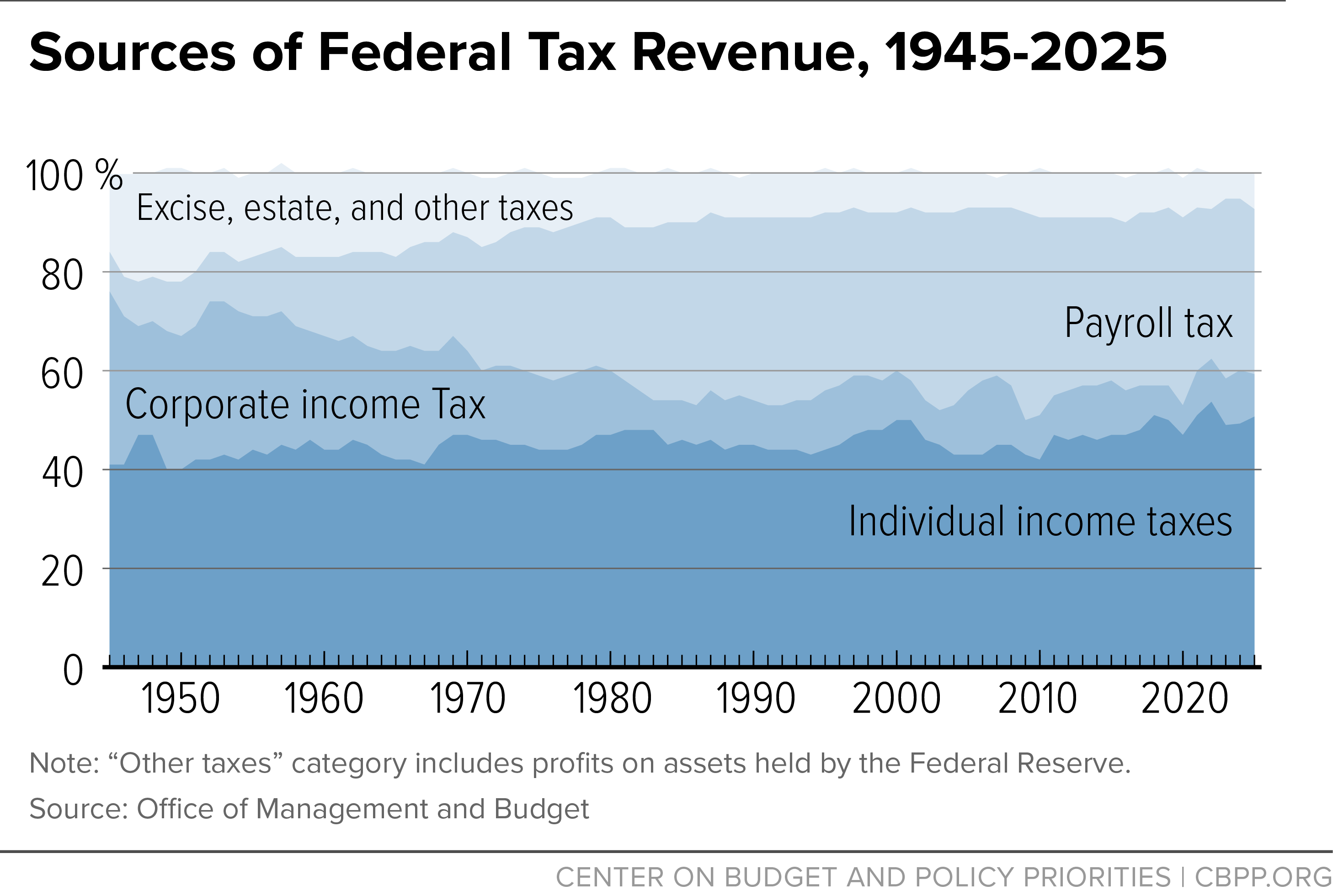
Roughly half of all federal revenue (51 percent) comes from individual income taxes. The income tax is generally progressive: households with higher incomes generally pay a larger share of their income in income taxes than households with lower incomes do.
A third of revenue comes from payroll taxes, which are assessed on the wage or salary paychecks of almost all workers and are used to fund Social Security, Medicare Hospital Insurance, and unemployment insurance. By law, employers and employees split most of the cost of payroll taxes, but research has shown that employers pass their portion of the cost on to workers in the form of lower wages.
Payroll taxes are regressive: they collect a higher percentage of the total earnings of lower-income workers than of higher-income ones. Even though the government collects more income tax revenue than payroll tax revenue, more than four-fifths of taxpayers pay more in payroll taxes than in income taxes. Only the remaining fifth of households with the highest incomes pay more in income taxes.
However, if one looks at the overall effect of Social Security, Medicare, and unemployment insurance — the benefits they provide as well as the taxes they collect — these programs are progressive. (See our related Policy Basics: Top Ten Facts About Social Security and Policy Basics: Federal Payroll Taxes.)
Even though the government collects more income tax revenue than payroll tax revenue, more than 4 in 5 taxpayers pay more in payroll taxes, less in income taxes. Only the fifth of households with the highest income pay more in income taxes.
Corporate income taxes make up about 9 percent of federal revenue, down from an average of roughly 20–25 percent in the 1950s and 1960s and about 10–12 percent in the early 2000s. As a share of the economy, corporate receipts have fallen to just over 1 percent of Gross Domestic Product (GDP), the lowest level since World War II. This decline reflects both the rise of pass-through business income and tax policy changes that have led to lower corporate tax revenues, even as profits have risen.

Effective corporate tax rates have declined over time because of accelerated depreciation and increased profit shifting to low-tax jurisdictions. The 2017 tax law reinforced this long-term trend by permanently reducing the statutory corporate rate from 35 percent to 21 percent, marking the largest corporate tax cut in U.S. history. The Republican megabill enacted in July 2025 continued in the same direction, adding roughly $700 billion in additional corporate tax reductions over the next decade and leaving corporate receipts about a full percentage point of GDP below pre-2017 levels.
The remaining 7 percent comes from excise taxes, estate taxes, customs duties (including tariffs), and other revenue sources. Excise taxes are collected on the sale of certain goods (e.g., fuel, alcohol, and tobacco); they are intended to raise revenue and, in some cases, discourage consumption of the taxed product. These made up about 2 percent of federal receipts in 2025.
The estate tax is a tax on assets, such as cash, real estate, or stock, that are transferred from deceased persons to their heirs. Because the first $30 million of a married couple’s estate was exempt from the estate tax in 2025, and due to other special exemptions from the estate tax, only about 1 of every 1,000 estates will owe any estate tax. Because it affects only those who are most able to pay, the estate tax is the most progressive component of the tax code. Estate tax revenue made up 0.6 percent of total federal receipts in 2025.
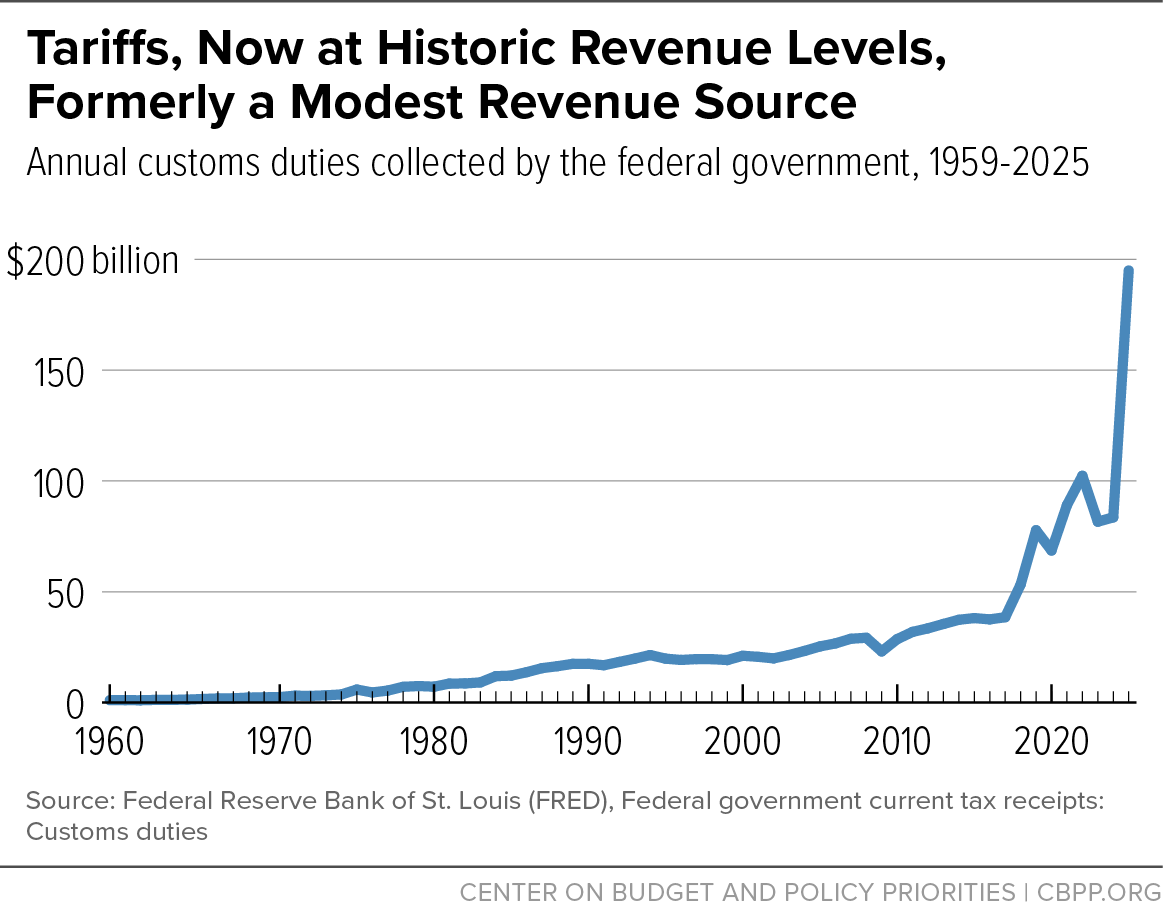
Customs duties, including tariffs, represent a small share (less than 4 percent) of federal revenues and are levies applied to imported goods. Tariffs were the primary source of federal revenue through the late 19th century, largely because they were easier to collect than internal taxes and could be administered at a limited number of ports. As the federal tax system expanded in the 20th century with the introduction of the federal income tax and the growth of payroll taxes, tariffs declined sharply in fiscal importance.
Congress has historically been the branch responsible for implementing tariffs, but over time that role has shifted towards the executive branch. In 2025, President Trump enacted a sweeping array of tariffs as a means of both influencing foreign policy and raising revenue to justify costly domestic policies, such as the skewed 2025 megabill.

Because tariffs are levied on imported goods, they tend to raise the prices of affected products for consumers. As a result, tariffs generally impose a disproportionate burden on lower- and middle-income households relative to income taxes. In this respect, tariffs resemble excise taxes but lack the stability and predictability of broader consumption taxes. Many iterations of President Trump’s tariffs have only been used as a threatening tool or have been struck down in courts, which creates confusion for both businesses and consumers. In addition to being regressive, revenues from customs duties are volatile and closely tied to economic and trade conditions. Periods of economic slowdown or changes in tariff policy can cause customs revenues to fluctuate from year to year. Even during periods when tariff rates are raised and collections increase, customs duties generate relatively little revenue compared with broad-based taxes, such as income or payroll taxes.
The small remainder of federal revenue comes from various sources such as some regulatory fees and custom duties.
While the federal tax code has both progressive and regressive components, it is progressive overall. Households with incomes in the bottom 60 percent will pay an average of 9 percent of their incomes in federal taxes in 2026, the Tax Policy Center estimates, while households with incomes in the top 1 percent will pay 31 percent, on average. This progressivity modestly reduces the income and wealth gaps between the top and bottom of the income distribution.
It also reduces racial disparities in income and wealth, but federal tax policies could do more to advance racial equity and counter centuries of racist actions by policymakers and the private sector that have hampered economic opportunity for people of color. Black and Latino households, for example, are overrepresented among households with incomes in the bottom 60 percent and dramatically underrepresented in households with incomes in the top 1 percent.
Over recent decades, the share of federal revenue coming from individual income plus payroll taxes has grown, while the share coming from corporate taxes and other revenue sources has fallen. The Great Recession — one of the worst economic downturns since the Great Depression — and the policies enacted to combat it, including temporary tax cuts, depressed federal revenue below the typical levels of recent decades. Revenue fell from 18.0 percent of gross domestic product in 2007 (the last fiscal year before the recession) to 14.6 percent in 2009 and 2010. Revenue recovered with the economy, exceeding 17 percent of GDP from 2014 through 2017, but dropped to 16.3 percent of GDP by 2019 — well below the prior 50-year average of 17.3 percent of GDP — largely due to the enactment of the 2017 tax law. In 2025, federal revenue recovered to the historical average of 17.3 percent of GDP. However, federal debt held by the public has risen from about 25 percent of GDP to about 100 percent of GDP over the last five decades, so a revenue level consistent with the historical average is no longer sufficient to fund federal programs.
Recent federal tax cuts have further weakened the nation’s revenue base and explain why today’s revenue levels fall short of what is needed to fund federal commitments. The major tax cuts enacted in the early 2000s, followed by extensions of those provisions and the significant tax cuts enacted in the 2017 tax law, pushed revenues well below their earlier levels relative to the size of the economy.


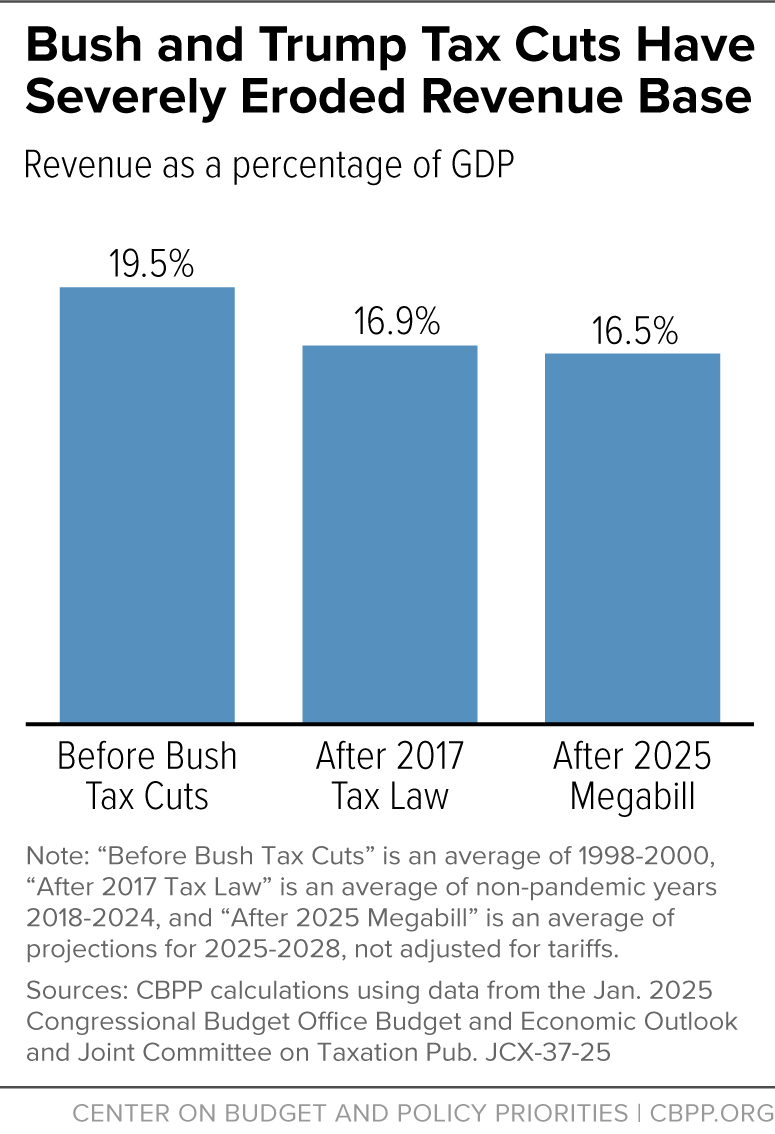
The 2025 Republican megabill will worsen this pattern by combining substantial program cuts with even larger tax reductions, further widening the gap between what the government collects and what it needs to meet current and growing demands. Lower revenue levels make it harder to support an aging population and to sustain core commitments such as Social Security, Medicare, and Medicaid long-term care. They also limit the federal government’s ability to address long-standing underinvestment in areas such as housing, climate resilience, child care, and poverty reduction. Without stronger revenues, policymakers will continue to face difficult choices that could undermine both current services and future economic potential.