

Rental Assistance Time Limits Would Place More Than 3 Million People — Half of Them Children — at Risk of Eviction and Homelessness
A proposal by the Trump Administration to cut off rental assistance after two years even if participants still can’t afford rent on their own would put over 3 million people, more than half of them children, at risk of eviction and homelessness. Most of these people are in households that include someone who works but doesn’t earn enough to afford the rent. Everyone should have a safe, stable, affordable place to live. Expanding rental assistance would bring us closer to this goal, while imposing arbitrary limits that take assistance away from people who need help paying the rent would take us in the wrong direction.
The proposal is part of a plan in the Administration’s 2026 budget to consolidate five rental assistance programs — Housing Choice Vouchers, Public Housing, Section 8 Project-Based Rental Assistance, Section 202 Housing for the Elderly, and Section 811 Housing for Persons with Disabilities — into a block grant to states with sharply reduced funding. There is no indication so far that Congress will consider the block grant proposal this year, but the Department of Housing and Urban Development (HUD) is reportedly planning to propose a regulation allowing or requiring housing agencies and subsidized owners to impose rental assistance time limits and policies that take rental assistance away from people who cannot meet rigid work requirements. This likely would face legal challenges, since HUD does not appear to have the authority to take these steps without congressional approval.[1]
In addition, congressional Republicans are seeking to advance other harmful policy proposals that would cause many people who are struggling to afford housing to be left without rental assistance and that include giving HUD clear authority to allow policies that take assistance away from people who reach arbitrary time limits.
First, on July 17, the House Appropriations Committee approved a 2026 HUD funding bill that cuts public housing funding and fails to increase voucher funding to keep pace with rising rents. These inadequate funding levels would leave hundreds of thousands of people without vouchers and would force sharp cutbacks to public housing maintenance and repairs that would put the health and safety of public housing residents at risk.
The appropriations bill would also give HUD sweeping authority to allow state and local agencies to change the amount of rent voucher holders and public housing residents are required to pay, with no limit on how much families could be charged. This would allow agencies not only to sharply raise rents, but also to impose time limits on assistance, since they could adopt a policy raising a family’s rent after two years by so much that the family would no longer receive any help to afford housing.
Second, as soon as this month the Senate Banking Committee could consider the Renewing Opportunity in the American Dream (ROAD) to Housing Act, a bill proposed by Chairman Tim Scott that would expand the Moving to Work (MTW) demonstration to cover most or all of the 3,600 state and local housing agencies that administer vouchers and public housing. MTW, which currently includes just 139 of those agencies, allows HUD to permit participating agencies to shift funds away from housing vouchers in ways that result in many fewer families receiving rental assistance and to impose time limits, work requirements, and sharp rent increases in the voucher and public housing programs.
The proposed expansion would allow these harmful policies to be extended to affect many more people than they do today. In addition, MTW permits HUD to put in place block grant funding formulas for vouchers that, if they were extended to cover most or all of the voucher program, would increase the likelihood that voucher funding would be cut sharply in the future.[2]
In addition, a separate Administration proposal would sharply cut homelessness assistance funding and effectively place new time limits on rental assistance funded through homelessness assistance programs. That proposal would end funding for the Continuums of Care (CoC) program, which is used in part to fund permanent supportive housing for hundreds of thousands of people with disabilities who were experiencing homelessness.[3] The main remaining homelessness assistance program, Emergency Solutions Grants, generally cannot be used for rental assistance unless it is subject to a time limit. Ending the CoC program would eliminate or disrupt assistance for people living in CoC-funded permanent supportive assistance, likely forcing many back onto the streets or into shelters. The House Appropriations bill does not include this change, but it fails to increase funding for homelessness assistance programs enough to fully address rising program costs or to expand access to the assistance and services they provide.
Time Limit Proposal Would Especially Hurt People of Color, Children

The five rental assistance programs covered by the Administration’s time limit proposal help about 9 million people with low incomes afford stable housing.[4] Today, families can receive federal rental assistance for as long as they need it to help them afford market rent. The majority of participants exit assistance within five years (including seniors and people with disabilities, who tend to receive assistance for longer periods than other participants).[5]
Under the Administration’s proposal, any household that does not include a senior or a person with a disability would lose their assistance after two years. The proposal does not specify when the time limit would take effect, but if it were in effect today it would take assistance away from 3.3 million people across the country.[6] (See Table 1 for state data.) People of all races and ethnicities would lose assistance, but due to a long history of discrimination in housing and other areas the impact would fall disproportionately on Black and Latino people.
The harm from the Administration’s time limit plan would be especially severe for the 1.7 million children in families who would lose rental assistance if this policy were in effect today. The benefits of rental assistance for children go well beyond the near-term benefits of reducing homelessness and housing instability, research shows. Children whose families were randomly assigned to receive rental assistance have been found to be less likely than those in unassisted families in a control group to be placed in foster care or to experience behavioral and sleep problems and more likely to exhibit prosocial behaviors like offering to help others and treating younger children kindly.[7] Young children whose families use vouchers to move to low-poverty neighborhoods are more likely to attend college and earn more as adults, with the benefit growing the longer they remain in their new neighborhood.[8]
These benefits would be cut short under the Administration’s plan, which would uproot children from their homes, schools, and child care, causing stress and disruption that could have long-term consequences for their education, labor market outcomes, and mental and physical health.
Time Limit Proposal Ignores Realities of Job, Rental Markets
Placing a rigid time limit on rental assistance ignores the realities of the housing and labor markets people with low incomes face. Rents are simply too high for many people — including most low-paid workers — to afford. Fewer than half of all workers earn wages that would be high enough to afford rent for a modest one-bedroom home if they worked 40 hours a week.[9]
Of the 3.3 million people who would lose assistance under the proposed time limit, 2 million are in families where at least one person has a job. (See Figure 1.) Many of those who are not employed have health limitations or caregiving obligations for young children or other family members that make it difficult for them to work. These circumstances won’t change simply because a family reaches an arbitrary time limit.
Most families who would be cut off by time limits won’t be able to afford rent without assistance, putting them at risk of eviction and homelessness. Workers in these families would miss shifts as they struggle to relocate their belongings and care for their children in the midst of displacement, and many would be unable to hold onto their jobs without a stable place to call home.
The Administration has claimed that it wants more rental assistance recipients to work, but its proposal would do the opposite, pulling the rug out from under workers who depend on rental assistance to help them hold their lives together. Policymakers seeking to support work could do so most effectively by expanding rental assistance and taking a range of other steps — such as expanding access to affordable child care and scaling up proven training programs — that focus on helping people find and keep jobs and adequately support their families.[10]


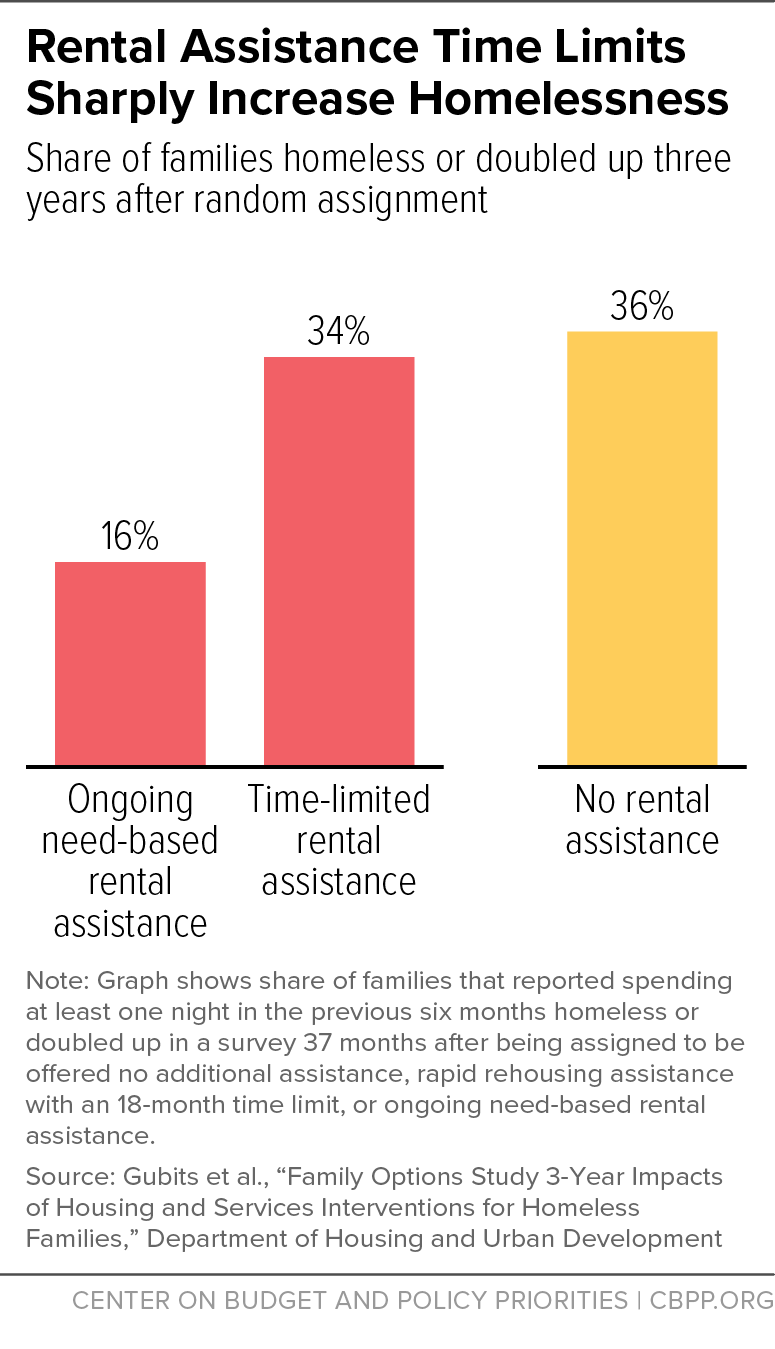
Rigorous research shows that placing time limits on rental assistance causes people to become homeless. For example, one study compared outcomes over three years for families with children experiencing homelessness who were randomly assigned to be offered ongoing need-based rental assistance with those for people who were offered assistance limited to 18 months. Initial outcomes were similar across the two groups, but by the third year the share of families who were homeless or doubled up among those offered time-limited assistance was about twice as high as among those offered rental assistance without time limits — and essentially the same as among a third group who were not offered any added assistance at all.[11] (See Figure 2.)
Time limits would also place added burdens on agencies administering rental assistance and owners of subsidized housing developments, who would be compelled to take on the task of cutting off stably housed families every two years. Abruptly ending assistance could also reduce the number of private landlords who are willing to rent to voucher holders, since the dependable payments vouchers provide are the most important reason many landlords accept them. This would narrow the choices available to voucher holders, particularly in lower-poverty neighborhoods.
Today fewer than 1 in 4 eligible households receive rental assistance and there are long waiting lists almost everywhere. Some proponents of time limits argue that it therefore makes sense to ration rental assistance by taking it away after two years. But shifting assistance from one household to another would leave the same number of people in need without assistance, and it would mean that no one would receive the most important benefit rental assistance provides: a stable home.
In a nation as wealthy as ours, we don’t need to make struggling families play musical chairs with an inadequate number of subsidies. Policymakers should reject proposals to take rental assistance away from people who reach arbitrary time limits and instead provide more resources to extend this effective assistance to everyone who needs it.
| TABLE 1 | |||
|---|---|---|---|
Estimated Number of People Who Would Lose Rental Assistance Under Proposed 2-Year Time Limit | |||
| All Households | Working Households* | ||
| State | People | Children | People |
| Alabama | 77,700 | 44,400 | 43,400 |
| Alaska | 4,000 | 2,100 | 2,800 |
| Arizona | 31,500 | 17,400 | 18,600 |
| Arkansas | 24,800 | 13,900 | 13,100 |
| California | 306,800 | 137,800 | 192,200 |
| Colorado | 40,600 | 21,600 | 24,000 |
| Connecticut | 57,100 | 25,900 | 37,300 |
| Delaware | 9,900 | 5,500 | 6,300 |
| District of Columbia | 16,000 | 6,700 | 7,500 |
| Florida | 149,700 | 80,200 | 92,800 |
| Georgia | 116,500 | 64,500 | 68,500 |
| Hawai’i | 19,800 | 10,300 | 15,400 |
| Idaho | 5,400 | 3,100 | 3,600 |
| Illinois | 153,400 | 73,400 | 84,500 |
| Indiana | 50,000 | 28,000 | 25,200 |
| Iowa | 16,500 | 9,500 | 10,000 |
| Kansas | 13,400 | 7,400 | 7,200 |
| Kentucky | 50,700 | 27,000 | 26,100 |
| Louisiana | 71,700 | 39,200 | 40,500 |
| Maine | 10,500 | 5,500 | 6,500 |
| Maryland | 69,500 | 34,000 | 42,300 |
| Massachusetts | 115,000 | 51,100 | 79,500 |
| Michigan | 83,200 | 46,400 | 42,700 |
| Minnesota | 58,900 | 32,600 | 41,300 |
| Mississippi | 51,800 | 28,900 | 27,600 |
| Missouri | 54,700 | 30,700 | 28,500 |
| Montana | 5,600 | 2,900 | 3,500 |
| Nebraska | 14,200 | 8,000 | 9,600 |
| Nevada | 18,700 | 10,100 | 10,600 |
| New Hampshire | 7,400 | 3,800 | 5,100 |
| New Jersey | 109,500 | 51,500 | 75,100 |
| New Mexico | 13,100 | 7,100 | 8,000 |
| New York | 343,600 | 148,100 | 246,500 |
| North Carolina | 93,100 | 51,700 | 51,600 |
| North Dakota | 4,600 | 2,600 | 2,800 |
| Ohio | 152,100 | 84,500 | 70,800 |
| Oklahoma | 32,300 | 18,400 | 15,400 |
| Oregon | 28,500 | 14,400 | 15,800 |
| Pennsylvania | 120,200 | 61,700 | 68,500 |
| Rhode Island | 16,100 | 7,700 | 10,500 |
| South Carolina | 56,000 | 32,200 | 29,900 |
| South Dakota | 5,400 | 3,100 | 3,100 |
| Tennessee | 76,100 | 43,200 | 36,600 |
| Texas | 239,800 | 134,600 | 147,500 |
| Utah | 9,600 | 5,400 | 6,200 |
| Vermont | 5,800 | 3,100 | 3,400 |
| Virginia | 79,300 | 41,700 | 48,000 |
| Washington | 56,300 | 28,300 | 35,500 |
| West Virginia | 16,400 | 8,100 | 8,700 |
| Wisconsin | 31,700 | 17,500 | 19,000 |
| Wyoming | 1,800 | 1,000 | 1,000 |
| Guam | 8,200 | 4,800 | 6,100 |
| Northern Mariana Islands | 1,300 | 700 | 500 |
| Puerto Rico | 111,100 | 48,900 | 44,600 |
| U.S. Virgin Islands | 5,500 | 2,900 | 3,500 |
| Total U.S. | 3,322,000 | 1,695,300 | 1,974,700 |
* Working Households = households with at least one member reporting wage income Note: Figures are rounded to the nearest hundred and may not sum to totals due to rounding. Includes households receiving Housing Choice Vouchers, Project-Based Rental Assistance, and Public Housing that do not include a senior or person with a disability. Length of stay determined by calculating the total months between the household’s admission date and January 1, 2025. Source: CBPP analysis of 2024 HUD administrative data | |||
End Notes
[1] Jennifer Ludden, “The Trump Administration Is Working on a Plan for Time Limits on Rental Aid,” National Public Radio, June 4, 2025, https://www.npr.org/2025/06/04/nx-s1-5422410/housing-rent-assistance-time-limits-work-requirements-hud.
[2] Will Fischer, “Expanding HUD’s ‘Moving to Work’ Authority Would Harm People Struggling to Afford Housing and Pave Way for Deep Cuts,” CBPP, June 2, 2025, https://www.cbpp.org/research/housing/expanding-huds-moving-to-work-authority-would-harm-people-struggling-to-afford.
[3] Joy Moses and Daniel Soucy, “Visualizing the Impacts of the President’s FY2026 Budget: Returns to Homelessness and Major Setbacks Could Be Ahead,” National Alliance to End Homelessness, June 3, 2025, https://endhomelessness.org/resources/research-and-analysis/visualizing-the-impacts-of-the-presidents-fy2026-budget-returns-to-homelessness-and-major-setbacks-could-be-ahead/#2d87d555-82d1-475e-881b-ef923b497752.
[4] CBPP, “Policy Basics: Federal Rental Assistance,” September 30, 2024, https://www.cbpp.org/research/housing/federal-rental-assistance.
[5] Andrew J. Greenlee and Kirk McClure, “Participant, Transition, and Length of Stay in Federal Housing Assistance Program,” Cityscape: A Journal of Policy Development and Research, Vol. 26, No. 2, 2024, p 48, https://www.huduser.gov/portal/periodicals/cityscape/vol26num2/ch2.pdf.
[6] CBPP analysis of HUD data.
[7] Gubits et al., 2016.
[8] Raj Chetty, Nathaniel Hendren, and Lawrence Katz, “The Effects of Exposure to Better Neighborhoods on Children: New Evidence from the Moving to Opportunity Experiment,” American Economic Review, April 2016, pp. 855-902, https://pubs.aeaweb.org/doi/pdfplus/10.1257/aer.20150572.
[9] National Low-Income Housing Coalition, “Out of Reach: The High Cost of Housing,” 2024, p 2, https://nlihc.org/oor.
[10] Nick Gwyn, “We Can Support Work by Helping People, Not Hurting Them,” CBPP, June 11, 2025, https://www.cbpp.org/research/income-security/we-can-support-work-by-helping-people-not-hurting-them
[11] Daniel Gubits et al., “Family Options Study: 3-Year Impacts of Housing and Services Interventions for Homeless Families,” prepared for the Department of Housing and Urban Development, October 2016, https://www.huduser.gov/portal/sites/default/files/pdf/Family-Options-Study-Full-Report.pdf.