

Five Ways HUD’s Continuum of Care Funding Notices Would Undermine Effective Homelessness Solutions If Lawmakers Don’t Act
Federal homelessness funds should be used to support the most effective solutions that help people afford housing: evidence-based, low-barrier rental assistance and community-based supportive services.[1] Instead, the Department of Housing and Urban Development (HUD) has repeatedly sought to cut funding for those solutions and take housing assistance away from 100,000 or more formerly homeless people.[2] Specifically, HUD is trying to unilaterally reshape the federal government’s largest homelessness assistance program, known as the Continuum of Care (CoC) Program, to reduce funding for proven solutions and reallocate those resources for less effective, punitive methods.[3] A federal court struck down HUD’s first attempt to reduce and reallocate CoC funding through its November 2025 funding notice.[4] A legal challenge to HUD’s more recent June 2026 notice is underway. However, an appellate court has allowed HUD to move forward with gathering and reviewing applications submitted in September while the lawsuit moves forward.[5] This continues chaos and funding uncertainty and disrupts service delivery. As before, Congress should take action to restore order, including by requiring HUD to renew existing grants and preventing HUD from causing more turmoil in the future.
The Trump Administration’s efforts to upend the CoC program are part of its coordinated nationwide strategy to take away funding for proven solutions to homelessness and to fine, arrest, and otherwise punish people for not having enough money to afford a safe place to stay.[6] The CoC grant program funds local and state nonprofit and government-run entities, also known as Continuums of Care or CoCs, that coordinate local and regional homelessness response systems. When combined, the Administration’s policies would leave more people without stable homes, push unhoused people from public view without housing them, and take away basic freedoms. (See Figure 1.)

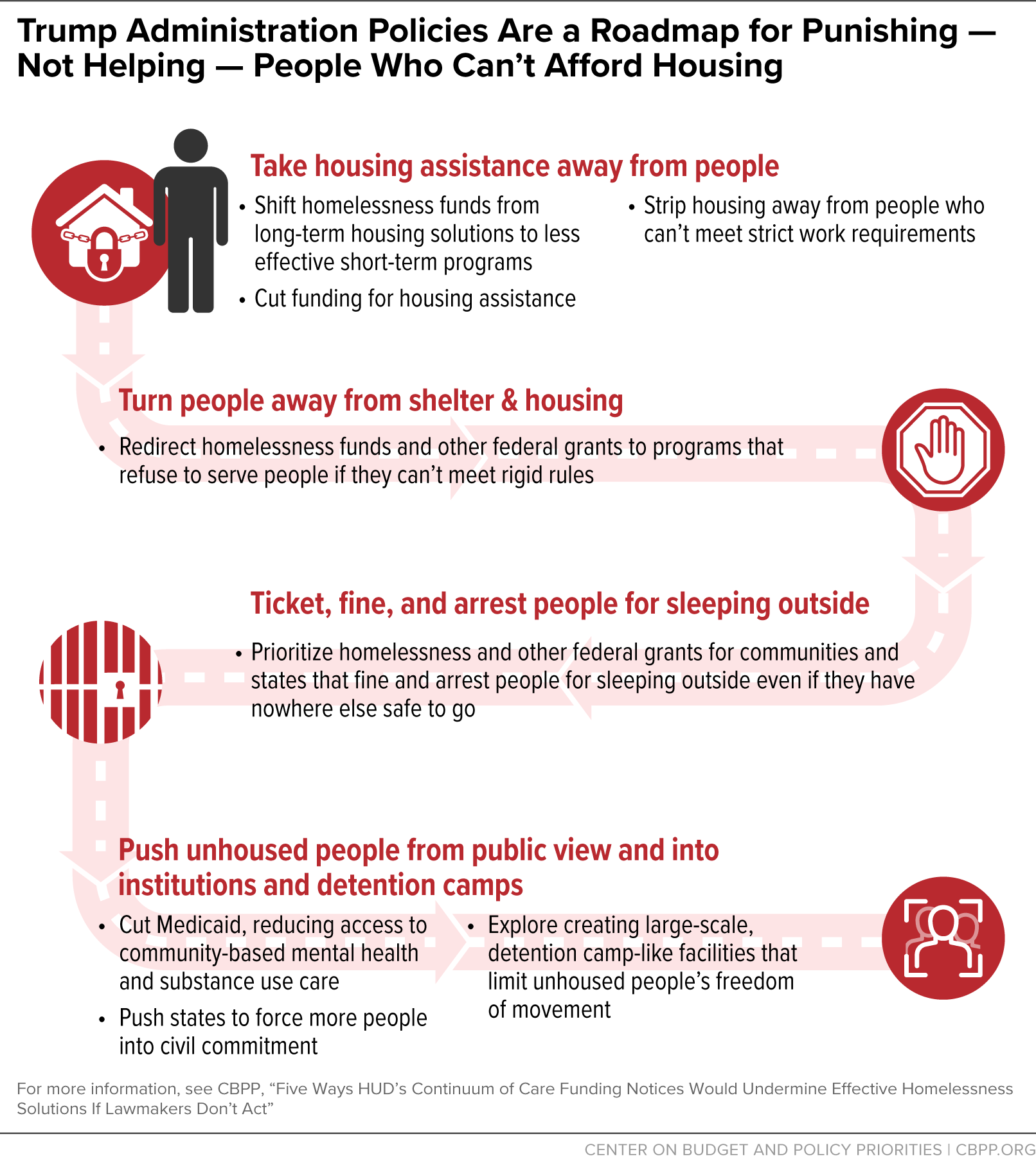
Since 2025, the Trump Administration has sought legislative action to altogether eliminate the competitive CoC grant program and shift most CoC program funds from stable housing to short-term assistance and shelter. (See timeline.) Congress has so far rejected these proposals, which would eliminate housing assistance for hundreds of thousands of formerly homeless people. Instead, Congress increased funding for the CoC grant program and other housing solutions like rental assistance.
Unfortunately, the Administration continues to try to bypass Congress and act unilaterally to implement harmful policies.
Congress now has another opportunity to protect this assistance as it negotiates final FY2027 funding legislation by:
- Blocking HUD from making these and similar harmful changes to the CoC program;
- Ensuring communities have continuity of funding; and
- Rejecting cuts to other rental assistance and housing programs that are critical to addressing homelessness.[7]
Ultimately, to solve homelessness, lawmakers should expand access to rental assistance and effective supportive services proven to help people afford and maintain stable housing.
Timeline of Trump Administration Efforts to Shift Continuum of Care Funding Away From Proven Homelessness Solutions
May 2025
President Trump’s budget proposal calls for eliminating HUD’s keystone homelessness Continuum of Care (CoC) program and shifting much of its funds from supporting stable housing to solely supporting temporary strategies.
July 2025
President Trump issues an executive order directing federal agencies to pressure states to fine and arrest people sleeping outside, force more people with mental health conditions into civil commitment, and defund effective homelessness solutions and life-saving substance use harm reduction services.
November 2025
HUD issues a funding notice to rescind previously announced CoC awards for 2026 and to require communities to reapply under new rules. The notice comes less than two months before the end of the year instead of the typical several months to allow time for the application process. The notice severely caps CoC funding for long-term housing assistance at 30 percent (compared to 90 percent in past HUD practice). An estimated 170,000+ formerly homeless people would lose housing assistance.
December 2025
Federal court temporarily blocks HUD’s November notice from taking effect while the case moves forward.
December 2025
HUD withdraws and reissues the November funding notice with minor changes while legal challenges to both the November and December versions of the notice move forward.
January 2026
Some communities begin to run out of CoC funds from the prior year after HUD rescinds original funding awards and starts a new application process. Many providers are forced to stop accepting new referrals or pause services, with more communities impacted each month.
February 2026
Congress passes funding legislation directing HUD to immediately renew CoC grants expiring in January-March 2026 for another 12 months, and to do the same for 2026 grants expiring later in the year if HUD did not lawfully issue awards by certain deadlines. Congress includes a provision requiring HUD to fund at least 60 percent of each CoC’s renewal needs in 2027.
April 2026
The President’s budget proposal again calls for eliminating the Continuum of Care program and shifting much of its funding from stable housing to solely fund temporary strategies.
June 2026
Federal court rules that HUD’s November 2025 funding notice (including the changes HUD made to it in December) was unlawful.
June 2026
HUD pivots to focus on next year’s funding and issues a new funding notice for 2027 CoC grants that would take housing assistance away from at least 97,000 formerly homeless people. HUD appeared to cut as much stable housing assistance as possible within the limits that Congress set in February.
August 2026
Federal court rules that HUD failed to follow the required process before issuing its funding notice for 2027 CoC grants and prohibits HUD from implementing it. HUD appeals the decision.
September 2026
Federal appeals court rules that HUD can proceed with the June funding notice application process while the lawsuit continues in the district court. HUD requires CoCs to submit applications under the June notice by September 30.
October - December 2026
Communities endure continued funding uncertainty while a federal court considers further arguments in a legal challenge to HUD’s June funding notice and HUD reviews applications and prepares to issue CoC awards under its June funding notice. HUD is required by law to award 2027 grants for next year by December 1, 2026. HUD usually takes 4-6 months to process applications but has less than 3 months between the application and award deadlines.
Without action by HUD, the courts, or Congress by December 1, communities will face additional funding instability after months of uncertainty.
HUD’s Funding Notices Would Worsen Homelessness
Here are five ways the policies HUD has sought to impose through its CoC funding notices would harm people and why Congress must act.
HUD’s policies would take housing assistance away from 100,000 or more people, putting them at severe risk of returning to homelessness.
HUD’s June 2026 notice would deny communities the funding they need to maintain housing assistance for at least 97,000 formerly homeless people — most of whom have disabilities — in 49 states, Washington, D.C., and Puerto Rico. (See table.) Without CoC housing assistance, most of those people and families would be left with no help affording high housing costs. They would very likely face serious consequences like eviction or being forced back onto the streets or into cars or shelters. Even more people would have been at risk of losing their housing assistance without a requirement Congress enacted in February that HUD fund at least 60 percent of CoCs’ renewal needs for next year.
In prior years, and through administrations of both parties, HUD consistently prioritized CoC funding to renew existing programs that help people experiencing homelessness achieve housing stability. Most of those existing programs provide supportive housing for people with disabilities, pairing housing assistance with robust, individualized supportive services. Research shows this approach is highly effective at helping a wide range of people keep stable housing, including people with mental health and substance use conditions.[8]
But HUD’s June funding notice would shift over $1 billion away from funding used to renew successful existing programs to instead prioritize programs that are much less effective at achieving long-term housing stability. The less effective programs offer only short-term assistance and deny housing to people who cannot meet rigid requirements, such as complete abstinence from alcohol and drugs and participation in 20 hours a week of services. This leaves people who can’t comply with inflexible rules to languish on the streets or in shelters.[9]
HUD’s cuts to stable housing would have a domino effect, leaving far fewer paths to housing stability for people experiencing homelessness.
The impact of the cuts in the notices would ripple beyond the people who would lose housing assistance in a given year. Entire housing projects and organizations could close their doors, thwarting years of local efforts to prioritize housing stability and expand supportive housing supply. It would likely take providers several months to set up the new, less effective programs HUD is seeking to fund instead, creating a lag between when existing programs close and new ones start accepting referrals. During that time, more people would be stuck in shelters and on the streets. The loss of stable housing options would threaten to undermine the recent progress many communities have made in reducing homelessness, reduce pathways for people to exit temporary shelter and housing settings, and result in higher rates of homelessness for years to come.[10]
HUD would pressure communities to adopt costly policies that make it harder for people to access stable housing.
HUD’s June 2026 funding notice (like its November 2025 notice) aggressively prioritizes funding for communities that arrest, displace, and fine unhoused people for living outside even if they have nowhere else safe to go — policies promoted by the Trump Administration in a July 2025 executive order. These policies lead to criminal records and debt from unpaid fines that make it harder for unhoused people to find housing. Landlords often deny rentals to people with criminal records or poor credit.[11] Policies that punish unhoused people drain local public safety resources without yielding good outcomes. Federal agencies should discourage — not invite — such counterproductive policies.[12]
HUD would shift tens of millions of dollars away from communities with some of the highest rates of homelessness.
Every community needs more funding for rental assistance and supportive services. Yet HUD’s June 2026 funding notice would shift CoC funding away from the very communities facing the highest rates of homelessness. HUD established a new, complex set of criteria to allocate nearly one-third of the more than $4 billion available in the funding notice. The new criteria cap how much funding any given CoC can receive from that pot of funds at a level that is well below the share many of the largest CoCs received in recent years. The cap will cause some of the nation’s largest CoCs to receive tens of millions of dollars less in overall CoC funding even if they score well on HUD’s new application. According to the National Alliance to End Homelessness, the communities that would lose funds have double the rate of homelessness as the national average.[13]
HUD’s funding notices create turmoil and uncertainty for CoCs and their communities.
HUD’s recent funding notices have made it extremely difficult for CoCs and their grantees to plan, including estimating staffing needs, making commitments to landlords and community partners, and estimating funding needs from state and local governments to supplement federal funds. Communities could not reliably estimate the total funding they would receive under the notices because much of the CoC funds would be awarded based on a new, complex set of criteria.
Moreover, HUD expanded the list of reasons it could outright deny projects to include vague and subjective factors. For instance, the June 2026 notice would enable HUD to reject projects based on their supposed “Ability to promote self-sufficiency” and any “History of illegal discrimination.” HUD defined “self-sufficiency” to mean people do not need any assistance to afford housing and other basic needs. This is an outcome that depends on factors outside of CoCs’ and providers’ control, particularly since many jobs don’t pay enough for a person to afford typical rents, food, and child care without assistance, even if they work full time. And the Administration has repeatedly and inaccurately asserted that practices widely used to promote fair housing and prevent discrimination, many of which HUD actively promoted in the past, constitute “illegal discrimination.”[14]
The chaos of the last year and a half has disrupted homelessness services in many communities, causing some providers to stop accepting new referrals or close programs entirely. CoCs, homelessness services providers, and people experiencing homelessness across the country have endured turmoil since before HUD issued the November 2025 notice. Now, HUD is moving forward with the application process for its June 2026 notice while a legal challenge is pending. People are confused and it is unclear if or when communities will get the funding they need. Meanwhile, HUD is preparing to embed these same harmful policies in future funding notices.[15] Congress should relieve communities of further uncertainty. At a minimum, Congress should direct HUD to swiftly and noncompetitively renew funding for another 12 months for CoC grants that will expire in 2027.
| TABLE 1 | ||||
|---|---|---|---|---|
People Will Lose Housing Assistance and Communities Will Lose Permanent Housing Funding in Nearly Every State and Territory Under Recent Continuum of Care Funding Notices | ||||
| Loss of Housing and Funding Under the November 2025 Notice | Loss of Housing and Funding Under the June 2026 Notice | |||
| State or Territory | People Losing Assistance | Loss in Dollars for Permanent Housing | People Losing Assistance | Loss in Dollars for Permanent Housing |
| Alabama | 720 | $9,632,000 | 350 | $5,016,000 |
| Alaska | 260 | $3,036,000 | 100 | $1,354,000 |
| Arizona | 3,160 | $43,726,000 | 1,800 | $24,984,000 |
| Arkansas | 420 | $2,319,000 | 50 | $406,000 |
| California | 26,950 | $409,608,000 | 14,940 | $237,704,000 |
| Colorado | 2,200 | $25,525,000 | 1,210 | $14,702,000 |
| Connecticut | 3,740 | $56,741,000 | 2,080 | $35,420,000 |
| Delaware | 620 | $7,473,000 | 360 | $4,353,000 |
| District of Columbia | 1,490 | $22,361,000 | 850 | $12,631,000 |
| Florida | 6,830 | $91,379,000 | 3,970 | $57,276,000 |
| Georgia | 3,990 | $43,568,000 | 2,370 | $26,829,000 |
| Hawai’i | 760 | $10,326,000 | 370 | $5,106,000 |
| Idaho | 440 | $4,387,000 | 220 | $2,103,000 |
| Illinois | 9,360 | $106,088,000 | 5,110 | $60,327,000 |
| Indiana | 2,710 | $23,955,000 | 1,540 | $14,835,000 |
| Iowa | 1,310 | $9,055,000 | 730 | $5,484,000 |
| Kansas | 840 | $4,838,000 | 450 | $2,859,000 |
| Kentucky | 2,530 | $24,321,000 | 1,290 | $13,149,000 |
| Louisiana | 4,580 | $53,776,000 | 2,610 | $31,813,000 |
| Maine | 1,130 | $14,046,000 | 650 | $8,990,000 |
| Maryland | 3,780 | $48,600,000 | 2,080 | $27,165,000 |
| Massachusetts | 4,820 | $77,366,000 | 2,680 | $47,424,000 |
| Michigan | 6,000 | $59,382,000 | 3,160 | $33,068,000 |
| Minnesota | 3,930 | $26,595,000 | 2,100 | $14,967,000 |
| Mississippi | 400 | $4,317,000 | 180 | $1,978,000 |
| Missouri | 3,170 | $32,837,000 | 1,740 | $18,712,000 |
| Montana | 370 | $3,586,000 | 180 | $1,975,000 |
| Nebraska | 1,300 | $10,970,000 | 690 | $6,140,000 |
| Nevada | 930 | $13,198,000 | 440 | $6,581,000 |
| New Hampshire | 410 | $6,474,000 | 180 | $3,210,000 |
| New Jersey | 2,440 | $37,641,000 | 1,340 | $22,413,000 |
| New Mexico | 990 | $9,707,000 | 560 | $5,941,000 |
| New York | 15,390 | $200,589,000 | 8,730 | $129,017,000 |
| North Carolina | 2,860 | $24,599,000 | 1,700 | $17,276,000 |
| North Dakota | 150 | $1,009,000 | 20 | $179,000 |
| Ohio | 13,230 | $106,312,000 | 7,480 | $64,567,000 |
| Oklahoma | 1,200 | $9,678,000 | 610 | $5,172,000 |
| Oregon | 3,210 | $39,718,000 | 1,770 | $22,013,000 |
| Pennsylvania | 9,240 | $102,111,000 | 5,150 | $59,335,000 |
| Rhode Island | 830 | $9,589,000 | 440 | $5,370,000 |
| South Carolina | 1,050 | $11,758,000 | 600 | $7,023,000 |
| South Dakota | 260 | $1,403,000 | 100 | $572,000 |
| Tennessee | 2,700 | $22,667,000 | 1,480 | $12,027,000 |
| Texas | 9,680 | $114,564,000 | 5,620 | $67,116,000 |
| Utah | 1,000 | $10,321,000 | 600 | $6,356,000 |
| Vermont | 320 | $3,877,000 | 150 | $1,894,000 |
| Virginia | 2,020 | $28,126,000 | 1,130 | $16,380,000 |
| Washington | 5,500 | $68,916,000 | 2,910 | $37,230,000 |
| West Virginia | 860 | $7,086,000 | 440 | $3,618,000 |
| Wisconsin | 2,380 | $27,597,000 | 1,290 | $15,442,000 |
| Wyoming | 0 | $0 | 0 | $0 |
| Guam | 60 | $730,000 | 30 | $356,000 |
| Puerto Rico | 1,380 | $15,919,000 | 590 | $6,952,000 |
| U.S. Virgin Islands | 4 | $44,000 | 0 | $0 |
| Total U.S. | 175,880 | $2,103,448,000 | 97,160 | $1,232,810,000 |
Note: “Housing Assistance” = Permanent Supportive Housing and Rapid Re-Housing programs. Projected loss in funding estimates are rounded to the nearest thousand and people projected to lose housing assistance estimates are rounded to the nearest ten unless the total amount is in single digits; figures may not sum to totals due to rounding. These projections are likely an undercount. For more details on the methodology, see the sources cited below. Sources: National Alliance to End Homelessness, “State and Local Impacts of HUD’s Housing Cuts: Data Visualization,” November 25, 2025, https://endhomelessness.org/resources/research-and-analysis/housingcuts/; National Alliance to End Homelessness, “Changes to HUD Policy Threaten Effort to End Homelessness: At Least 97,000 People Could Lose Housing,” June 2, 2026, https://endhomelessness.org/resources/hud-policy-changes-threaten-efforts-to-end-homelessness/. | ||||
End Notes
[1] Anna Bailey, Peggy Bailey, and Erik Gartland, “Policymakers Can Solve Homelessness by Scaling Up Proven Solutions: Rental Assistance and Supportive Services,” CBPP, updated February 27, 2025, https://www.cbpp.org/research/housing/policymakers-can-solve-homelessness-by-scaling-up-proven-solutions-rental.
[2] Homelessness Research Institute, “Changes to HUD Policy Threaten Efforts to End Homelessness: At Least 97,000 People Could Lose Housing,” National Alliance to End Homelessness, June 2, 2026, https://endhomelessness.org/resources/hud-policy-changes-threaten-efforts-to-end-homelessness/; Homelessness Research Institute, “State and Local Impacts of HUD’s Housing Cuts: Data Visualization,” National Alliance to End Homelessness, November 25, 2025.
[3] A robust body of research — including randomized controlled trials and systematic reviews — shows that providing voluntary and individualized supportive services alongside affordable housing consistently does more to reduce homelessness and improve housing stability than older models that deny housing to anyone who doesn’t accept one-size-fits-all services. See, e.g., Andrew J. Baxter et al., “Effects of Housing First approaches on health and well-being of adults who are homeless or at risk of homelessness: systematic review and meta-analysis of randomized controlled trials,” Epidemiol Community Health, 2019, https://jech.bmj.com/content/jech/73/5/379.full.pdf; Yinan Peng et al., “Permanent Supportive Housing with Housing First to Reduce Homelessness and Promote Health among Homeless Populations with Disability: A Community Guide Systematic Review,” National Library of Medicine, September 2020, https://www.ncbi.nlm.nih.gov/pmc/articles/PMC8513528/.
[4] Democracy Forward, “Court Sides With Coalition Challenging Latest Efforts to Politicize Homelessness Funding Grants,” August 7, 2026, https://democracyforward.org/news/press-releases/court-sides-with-coalition-challenging-latest-efforts-to-politicize-homelessness-funding-grants/.
[5] National Alliance to End Homelessness v. United States Department of Housing and Urban Development, 1:26-cv-00436, (D.R.I. Sep 16, 2026) ECF No. 40, available at USCA Order – #40 in National Alliance to End Homelessness v. United States Department of Housing and Urban Development (D.R.I., 1:26-cv-00436) – CourtListener.com.
[6] Anna Bailey, “Trump Policies Would Worsen Homelessness, Attack Basic Freedoms of People Who Can’t Afford Rent,” CBPP, April 8, 2026, https://www.cbpp.org/research/housing/trump-policies-would-worsen-homelessness-attack-basic-freedoms-of-people-who-cant.
[7] Sonya Acosta, “Congress Should Support Rental Assistance in 2027 to Prevent Increased Homelessness and Evictions,” CBPP, May 13, 2026, https://www.cbpp.org/blog/congress-should-support-rental-assistance-in-2027-to-prevent-increased-homelessness-and.
[8] Bailey, Bailey, and Gartland.
[9] HUD’s June 2026 notice would shift over $1 billion away from permanent housing and its November 2025 notice would shift over $2 billion. Homelessness Research Institute, “Changes to HUD Policy Threaten Efforts to End Homelessness: At Least 97,000 People Could Lose Housing,” National Alliance to End Homelessness, June 2, 2026, https://endhomelessness.org/resources/hud-policy-changes-threaten-efforts-to-end-homelessness/; Homelessness Research Institute, “State and Local Impacts of HUD’s Housing Cuts: Data Visualization,” National Alliance to End Homelessness, November 25, 2025.
[10] Daniel Soucy and Joy Moses, “Top 5 Immediate Takeaways from HUD’s Primary Annual Report on Homelessness,” National Alliance to End Homelessness, June 2, 2026, https://endhomelessness.org/resources/top-5-immediate-takeaways-from-huds-primary-annual-report-on-homelessness/.
[11] Nicole DuBois, Claire Herbert, and E. Mae Sowards, "Criminalizing Homelessness Worsens the Crisis, Research Shows,” National Alliance to End Homelessness, 2025, https://endhomelessness.org/wp-content/uploads/2025/02/CriminalizingWorsensTheCrisis_NAEH_2-4-25.pdf.
[12] Ibid.
[13] Homelessness Research Institute, 2026.
[14] Thomas Silverstein, “HUD Scolds Boston and Minneapolis for Doing What It Says It Wants Done,” Shelterforce, January 30, 2026, https://shelterforce.org/2026/01/30/hud-scolds-boston-and-minneapolis-for-doing-what-it-says-it-wants-done/.
[15] In striking down HUD’s June 2026 funding notice, the federal court held that HUD had failed to follow the notice-and-comment process required by the laws governing the CoC program before incentivizing CoCs to adopt policies and programs not already prioritized in the statute. HUD has since issued a notice for public comment on its inaccurate assertions that its preferred homelessness policies are supported by research and evidence, which it intends to use to justify its “future CoC funding opportunities” and decisions. U.S. Department of Housing and Urban Development, “Notice of Research Justifying Additional Incentives for Certain Activities To Reduce Homelessness,” Federal Register (FR-6628-N-01), September 11, 2026, https://www.federalregister.gov/documents/2026/09/11/2026-18555/notice-of-research-justifying-additional-incentives-for-certain-activities-to-reduce-homelessness.