

Addressing the Housing Affordability Crisis Requires Increasing Housing Supply and Expanding Rental Assistance
Everyone should have access to a stable, affordable home, but for millions of people this goal lies out of reach due to high housing costs. While building more homes must be a central component of efforts to address the housing affordability crisis, by itself it won’t reduce housing costs enough to bring them within reach for people with low incomes, who struggle the most to afford housing. Achieving a real solution will also require expanding rental assistance.
Rents and home prices have risen rapidly in recent years, squeezing family budgets up and down the income scale. High housing costs pose especially difficult burdens for people with very low incomes, who frequently spend half or more of their income on housing. Many families have little left over for other necessities after paying for housing and are one setback away from eviction and homelessness.
The recent surge in housing costs was driven in substantial part by deep housing shortages that persist in many areas. But large numbers of people struggled to afford housing even before this surge, and addressing housing shortages is only part of the solution. Most households with incomes around or below the poverty line ($27,320 for a three-person household in 2026) — a group that includes large numbers of workers in low-paying jobs, seniors, people with disabilities, and others — can’t afford rents sufficient even to cover the ongoing costs of operating rental housing, such as maintenance, utilities, and insurance. No matter how many units are built or how much construction costs are subsidized, this won’t be enough to enable owners to reduce rents below the break-even amount needed to cover their operating costs.
Housing vouchers and other rental assistance close the gap between the cost of housing and what households can afford. Rental assistance has proven highly effective at enabling people with very low incomes to afford stable housing. But only 1 in 4 low-income households who need rental assistance receive it due to inadequate funding, and there are long waiting lists for assistance. Policymakers should expand rental assistance toward the goal of guaranteeing it for everyone in need.
Added rental assistance will be more efficient and impactful if we also build more homes, since increased supply can reduce costs and expand housing choices for assisted households along with other renters and homebuyers. But policymakers should not wait for a supply expansion to be completed before extending rental assistance to many more people — and there is no need to wait, since tens of millions of people need help now to afford their current home.
Policymakers should act simultaneously to increase housing supply and expand rental assistance as part of a comprehensive strategy that includes other key measures, such as strengthening tenant rights and improving the homelessness response system. Taken together, these steps can ease growth in rents and home prices for everyone while sharply reducing severe hardship among people with low incomes.
More Homes Needed to Make Room for All, Slow Cost Increases
Housing is the largest expenditure in the average family’s budget, and rapid growth in rents and home purchase prices has made it harder for people across the country to afford housing.[2] Housing costs have outpaced overall inflation for most of the last decade, with a particularly sharp spike from late 2020 to late 2022, when rents increased by 24 percent[3] and median home prices by 31 percent.[4] The growth rate has since slowed, but housing costs remain near record levels as a share of household income.[5]
Supply Increases Can Reduce Cost Pressures
A shortage of homes has been a central factor driving up rents and home prices. Estimates of the size of the shortage vary, with one finding that as of early 2025, 2 million additional units were needed to balance supply and demand.[6] The shortage has eased over time; the national rental vacancy rate rose from 5.6 percent in early 2022 — the lowest in several decades — to 7.3 percent in the first quarter of 2026.[7] But vacancy rates vary considerably across the nation, and some regions, including several of the largest metropolitan areas, still face major housing shortages.
Building more homes can restrain housing inflation and, under some circumstances, push rents and home prices down to some degree.[8] For example, after a surge in construction, mid-market rents in Austin, Texas, fell by 11 percent between September 2022 and September 2025, reversing over one-third of the 29 percent increase in the two years before that.[9]
Policymakers Should Take Action to Address Housing Shortages
Policymakers should act aggressively to promote supply increases in places that need more homes. Perhaps most importantly, state and local governments should use their broad authority over zoning and permitting to allow more construction — particularly of multifamily and small single-family homes, which are more likely to be affordable to middle- and low-income households. But the federal government can also play a key role, for example by:
- subsidizing affordable housing development;
- streamlining federal regulations in cases where they unnecessarily impede construction;
- supporting and incentivizing improvements to state and local housing policies; and
- funding research into innovative construction practices with the potential to reduce costs.[10]
In 2025, Congress passed an expansion of the Low-Income Housing Tax Credit (LIHTC), the largest federal affordable housing development program; the expansion is expected to subsidize 1.2 million added units during the first ten years.[11] Congress is also considering a major bipartisan housing bill with numerous additional measures intended to support supply. This bill, the 21st Century ROAD to Housing Act, would, for example, ease certain financial regulations that have restricted bank investments in affordable housing and streamline environmental requirements that have slowed housing development.[12]
Policymakers should build on these efforts, including by reversing harmful Trump Administration actions that make it harder to build housing. Many of the workers who build the nation’s housing are immigrants, so the Administration’s violent, sweeping immigration detention and deportation dragnet is worsening already substantial shortages of construction labor, in addition to harming people and communities around the county.[13] Also, the Administration’s tariffs have driven up the cost of imported building supplies, from lumber to electrical components.[14]
Building Alone Won’t Solve Housing Affordability Crisis
Expanding supply alone, however, can’t solve the housing affordability crisis. It will rarely reduce housing costs to levels that are affordable to people with incomes around or below the poverty line, who are by far the most likely to struggle to afford housing.
Housing-Related Hardship Concentrated Among Lowest-Income People
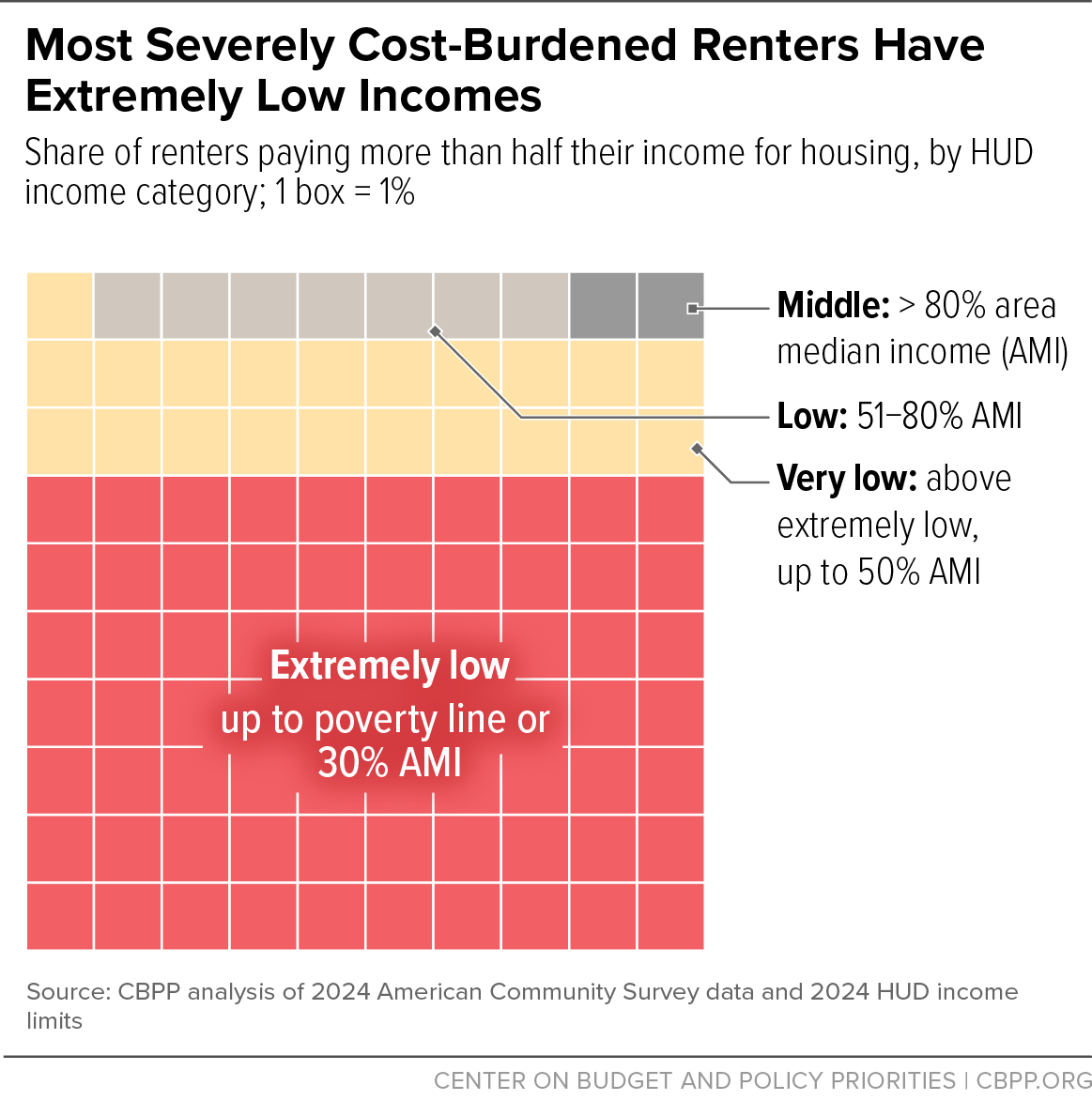
In 2024, 25 million people lived in households that paid more than 50 percent of their income for rent, far above the 30 percent of income that is considered affordable under a benchmark widely used by government programs and the private sector.

More than 70 percent of them — 17 million people — were in what the Department of Housing and Urban Development (HUD) terms “extremely low-income” households, meaning those with income below the federal poverty line or 30 percent of the local median, whichever is higher. (See Figure 1.)[15] This group includes people of all races and ethnicities, but because of a long history of discrimination in housing, employment, and other areas, they are disproportionately likely to be Black, Latino, or Native American. A large majority of extremely low-income renter households are headed by a low-paid worker, a senior, or a person with a disability. (See Figure 2.)[16]
It is not surprising that many working families struggle to afford housing. Median wages in 17 of the 25 most common occupations in the United States — such as retail sales workers, building cleaners, nursing aides, and administrative assistants — are too low to enable a full-time worker to afford typical rents even for a one-bedroom unit.[17]

For people with extremely low incomes, unaffordable housing costs can cause hardship far more severe than that faced by middle-income households. High housing costs often leave them with little money for anything else, forcing them to accumulate debt or divert funds from food, medicine, or other basic needs to pay the rent. Close to 1 million renter households live in homes with severely substandard conditions (such as a lack of reliable heat, electricity, or plumbing), frequently because they can’t afford safer, healthier homes.[18]
Many low-income renters are one setback away — a car breakdown, reduction in work hours, or administrative snafu that delays a Social Security check — from falling behind on their rent and incurring late fees that make it even harder to make ends meet. Millions of people are displaced from their homes each year, including about 4 million annually who are formally evicted.[19] An estimated 4.3 million people with low incomes live doubled up in overcrowded conditions,[20] arrangements that are often unstable and sometimes unsafe. More than 740,000 people had no home as of HUD’s most recent available single-night count of national homelessness, conducted in January 2025.[21]
Supply-Side Policies Can’t Make Rents Affordable to Lowest-Income People
The problems described above all stem from the large gap between typical market rents and the amount that households with the lowest incomes can afford. In 2024, the median extremely low-income renter household had an annual income of $12,300, enough to afford $308 per month (30 percent of their income) in rent. But the median rent nationally was close to five times higher, at $1,487 per month. As a result, even unusually large supply-driven rent reductions (like the 11 percent decline in Austin noted earlier) won’t come close to enabling households at this income level to afford typical market rents.
Development subsidies such as LIHTC that help cover construction costs can reduce rents, but they rarely make housing affordable to the lowest-income households unless the household also receives a voucher or other assistance to help them pay the rent. LIHTC allows rents to be set as high as 30 percent of the income of a household whose income is 60 percent of the area median, meaning an extremely low-income household would have to pay up to twice what they can actually afford for that “affordable” unit. Only about 3 percent of LIHTC units are rented at an affordable cost to households with incomes below 30 percent of the area median who do not have rental assistance.[22]
One reason it is so difficult for supply-focused strategies to make housing affordable to the lowest-income households is that most such households don’t have enough income to afford rents sufficient to cover the ongoing costs of operating rental housing, such as maintenance, utilities, and insurance — even before including any return on investment for the owner or payments on debt incurred to build or purchase the building. The median rental unit in a 2024 industry survey had a monthly operating cost of $665, almost double the $308 that the median extremely low-income household could afford.[23] (See Figure 3.)

No matter how many units are built or how much construction costs are subsidized, this won’t be enough to enable owners to reduce rents below the break-even amount needed to cover their operating costs. And consequently, it won’t be enough to make rents affordable to millions of people in extremely low-income households.

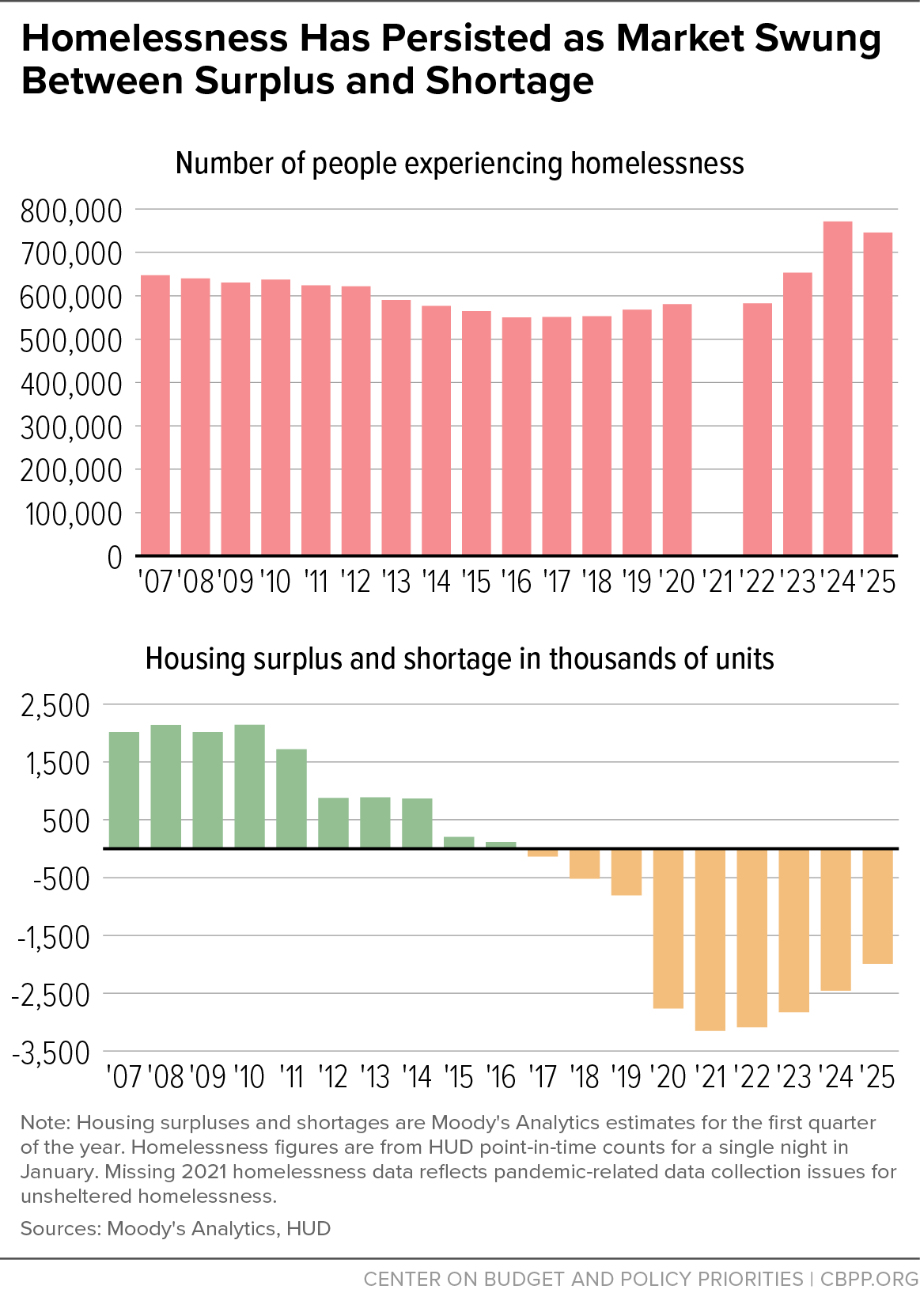
This helps explain why high levels of housing-related hardship have persisted for decades even as the housing market has swung between shortages and surpluses. (See Figure 4.) The number of people experiencing homelessness has never fallen below 550,000 since HUD began its annual count in 2007, and it exceeded 620,000 from 2007 to 2011 even though vacancy rates were at or near all-time highs.[24] Similarly, the number of very low-income renter households with what HUD terms “worst-case needs,” meaning they paid over half their income for housing or lived in severely substandard homes, peaked at 8.53 million in 2021 but was nearly the same — 8.48 million — as far back as 2011.[25]
In short, if large numbers of people lack the resources to pay rent that’s sufficient to cover the cost of operating and maintaining housing, adding more units alone could make only a modest dent in problems like eviction and homelessness. Solving the affordable housing crisis will also require ensuring that everyone has the means to afford housing.
Expanding Rental Assistance Would Sharply Cut Homelessness and Hardship
Rental assistance programs such as housing vouchers help people with low incomes afford housing by covering the gap between the rent for a modest housing unit and 30 percent of the family’s income. A large body of rigorous research shows that housing vouchers are highly effective at reducing homelessness, housing instability, overcrowding, and exposure to substandard housing.[26] (See Figure 5.)

Moreover, because a stable home is so foundational to people’s well-being, the benefits of rental assistance spill over into other aspects of a family’s life. Studies have found that rental assistance reduces foster care placements, domestic violence, hypertension among adults, sleep problems among children, and the frequency with which students must move from one school to another.[27] And, when housing vouchers enable families with young children to move to lower-poverty neighborhoods, they sharply increase the chances those children will go to college, as well as their average earnings as adults.[28]
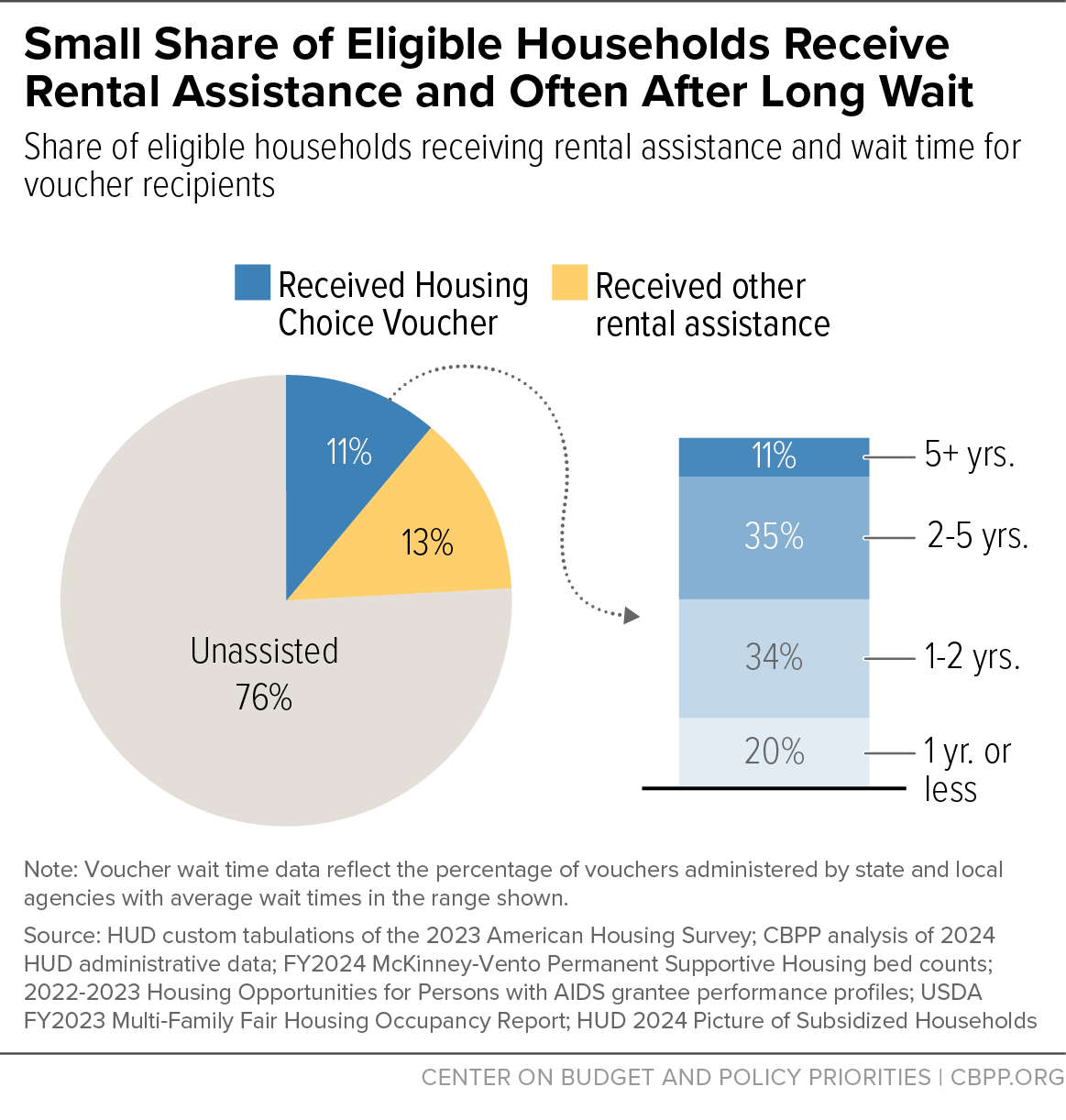
Despite these striking benefits, only 1 in 4 low-income households who need rental assistance receive it because assistance is capped by the amount of funding Congress appropriates each year. Most people seeking help to address pressing housing needs are consequently turned away or placed on years-long waiting lists. (See Figure 6.) In contrast, other major programs that help people with low incomes cover basic needs, such as Medicaid and the Supplemental Nutrition Assistance Program (SNAP), make assistance available to all eligible households.

Recent federal measures seeking to address the housing affordability crisis have emphasized supply rather than addressing the need for more rental assistance. While Congress enacted a large expansion of LIHTC in 2025, there has been no comparable expansion of rental assistance in recent years. Instead, tight funding caused the number of families receiving assistance to decline in 2025, and the Trump Administration and some congressional Republicans have sought deep cuts in rental assistance.[29] In addition, the 21st Century ROAD to Housing bill under consideration in Congress includes major policy changes designed to increase supply, but only modest reforms to the main federal rental assistance programs.
Solving the housing affordability crisis will require expanding rental assistance and ultimately guaranteeing it to everyone in need. Moving toward a rental assistance guarantee would have a transformational impact, ensuring that every family and individual can afford to meet their basic need for housing. Based on the research described above, a guarantee could be expected to sharply increase the number of children who are able to grow up in a stable home and cause rates of homelessness, eviction, and overcrowding to plummet.
Rental Assistance Expansion Should Phase in Over Time
These outcomes couldn’t be achieved overnight. Policymakers should phase in a rental assistance expansion to give government administrative systems and local rental markets time to adapt, starting by extending assistance to the lowest-income portion of the eligible population. Guaranteeing rental assistance will likely require transitioning rental assistance from a “discretionary” program, where funding is set each year by Congress, to a “mandatory” program that adjusts automatically to serve all eligible households who apply (the approach used for Medicaid and SNAP).[30]
In addition, reforms will be needed to make rental assistance easier to use. For example, Congress should consider streamlining the voucher program’s administrative requirements, such as easing inspection requirements when the risk of severe quality problems is low.[31] Congress should also fund a national demonstration to test providing assistance directly to tenants rather than to owners. Promising local research suggests this approach could further reduce administrative burdens and make it easier for families to use the assistance given some landlords’ reluctance to accept vouchers.[32]
Expansions of Rental Assistance, Housing Supply Can Occur Together
Policymakers should expand rental assistance at the same time they enact measures to increase the supply of homes, as the two core elements of a comprehensive housing policy that makes housing more affordable for everyone.
Some observers have expressed concern that expanding rental assistance could drive up rents by adding to demand when the supply of housing is constrained. The best research indicates, however, that voucher expansions to date have had little overall impact on market rents.[33] This result is consistent with the effects predicted by economists who have carefully assessed the role of rental assistance in housing markets.[34] It appears to stem from several factors:
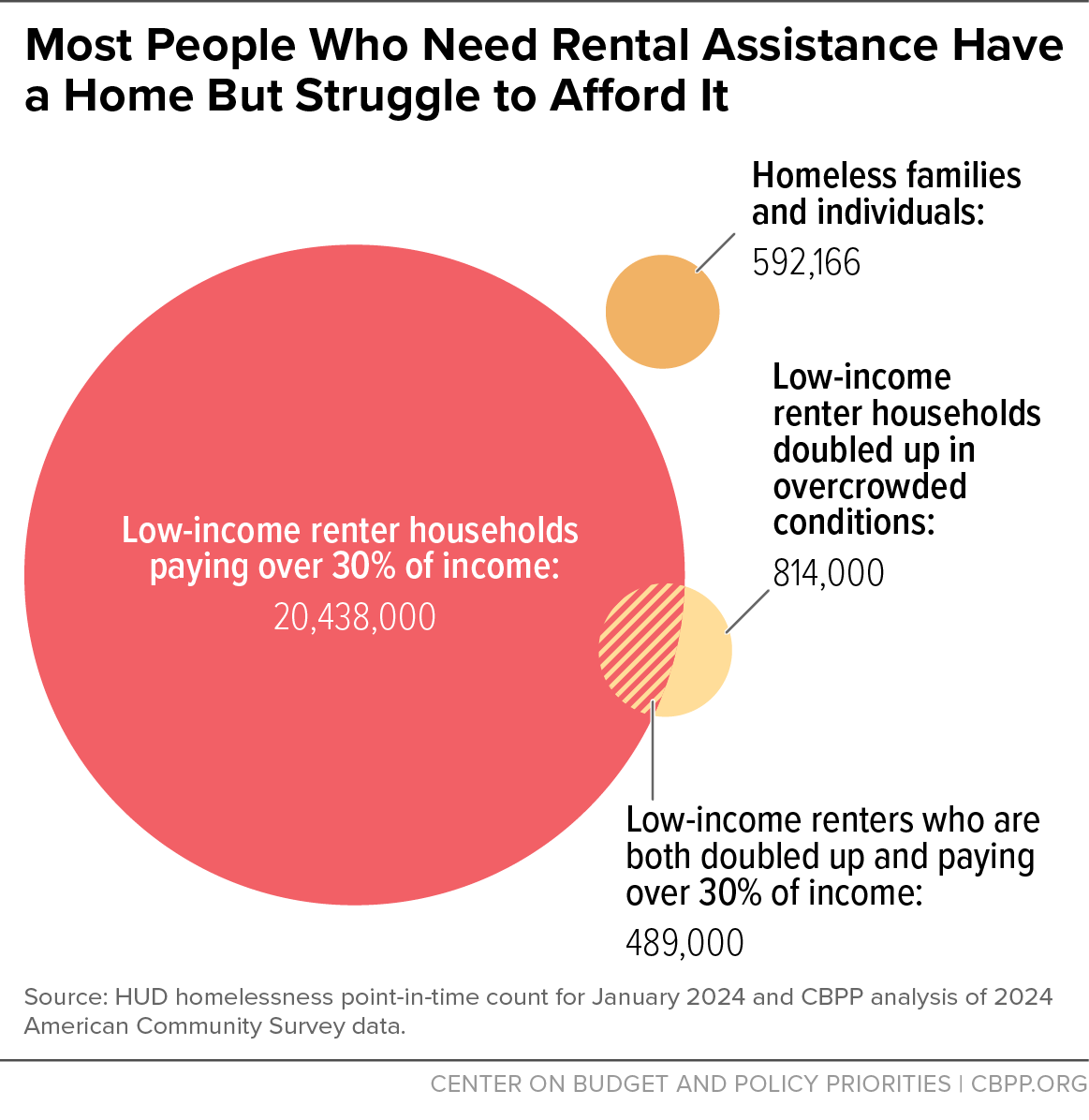
- Most people who receive vouchers, as well as most unassisted households who need rental assistance, already have homes but pay high shares of their income for rent. (See Figure 7.) Thus, they use rental assistance either to afford their current home or move to a different home that’s more suitable — neither of which adds to the number of units demanded in the market.




- Enabling people who would otherwise be homeless or doubled up to afford rent would create demand for more units, but rental markets have some capacity to absorb those added households just as they absorb other new renters. This is especially true outside the most constrained markets. In 2025, 62 of the 75 largest metropolitan areas had rental vacancy rates above 5 percent. Even in markets where it’s relatively difficult to build housing, new households do not simply bid up rents for a fixed number of units; owners of land and buildings still respond to added demand by making more units available than they otherwise would — just at a lower rate than in less supply-constrained markets.[35]
- The voucher program has administrative controls designed to keep vouchers from paying above-market rents that might contribute to inflation. Voucher subsidies are capped based on “fair market rents” estimated annually by HUD for units of a particular size in each metropolitan area and rural county. Also, housing agencies perform an additional “rent reasonableness” check to verify that rents paid by vouchers do not exceed those charged for similar units in the local market.[36]
To be sure, expanding rental assistance toward a guarantee would increase demand to some degree and put some upward pressure on rents, at least in tight markets. There is no way to enable the millions of people in the United States who sleep each night in tents, cars, motels, shelters, on the street, or doubled up in someone else’s home to have stable housing without creating more households and more occupied units. But that is necessary if we are to solve our housing crisis and achieve the broadly shared goal of reducing homelessness and housing instability.
Any market impacts of a rental assistance expansion can be eased by phasing in the expansion alongside strong measures to expand supply like those discussed above. But the evidence suggests there is no need to wait for those measures to be completed before beginning to extend rental assistance to more people.
Other Steps Also Needed to Help Address Affordability Challenges
Expanding housing supply and providing rental assistance to ensure that everyone can afford a place to live are essential components of solving our housing affordability crisis, but policymakers should also take steps in important related areas, such as:
- Tenant rights. Addressing the precarious housing status of many renters requires not only helping them to afford rent, but also strengthening eviction safeguards, housing quality and habitability requirements, and other key tenant rights and protections.
- Homelessness response system. Solving homelessness will require investments and program reforms at the federal, state, and local levels to provide expanded supportive services, emergency homelessness prevention assistance, and improved shelter and interim housing options alongside additional rental assistance.
- Homeownership support. Rental assistance can help renters build savings for a down payment, and housing vouchers can also be used for ongoing homeownership costs under some circumstances. And building more housing (particularly smaller, single-family homes) will help more renters transition to homeownership. But expanding access to homeownership for people with low and moderate incomes — and closing the large gap in homeownership rates between Black and white households created by redlining and other discriminatory policies — will also require other measures, such as targeted down payment assistance or mortgages with reduced down payment requirements.
Together with expansions of rental assistance and the housing supply, reforms in these areas can move the nation toward the goal of enabling every person to have access to a safe, stable, affordable home that meets their needs.
End Notes
[1] Mohammed Akel and Erik Gartland provided data analysis for this report.
[2] Bureau of Labor Statistics, “Table 1110. Deciles of income before taxes: Annual expenditure means, shares, standard errors, and relative standard errors, Consumer Expenditure Surveys, 2024,” https://www.bls.gov/cex/tables/calendar-year/mean-item-share-average-standard-error/cu-income-deciles-before-taxes-2024.xlsx.
[3] Zillow Observed Rent Index, https://www.zillow.com/research/data/?msockid=343d8789922e63bf22df936d937c6218, accessed May 26, 2026. The index reflects the average of rents for units in the 35th to 65th rent percentile among units listed for rent in the area, weighted to reflect the area’s overall rental stock.
[4] Median sales price of houses sold for the United States, HUD and U.S. Census Bureau data via FRED, Federal Reserve Bank of St. Louis, https://fred.stlouisfed.org/series/MSPUS.
[5] Joint Center for Housing Studies, “America’s Rental Housing 2026,” https://www.jchs.harvard.edu/americas-rental-housing-2026; Peyton Whitney, “Home Prices Surge to Five Times Median Income, Nearing Historic Highs,” Joint Center for Housing Studies, October 6, 2025, https://www.jchs.harvard.edu/blog/home-prices-surge-five-times-median-income-nearing-historic-highs.
[6] Cristian deRitis et al., “Bringing the Housing Shortage Into Sharper Focus,” Moody’s Analytics, July 2025, https://www.urban.org/sites/default/files/2025-07/Bringing-Housing-Shortage-Into-Sharper-Focus.pdf.
[7] U.S. Census Bureau, Housing Vacancies and Homeownership Survey, https://www.census.gov/housing/hvs/data/histtab1.xlsx.
[8] Vicki Been, Ingrid Gould Ellen, and Katherine M. O’Regan, “Supply Skepticism Revisited,” Housing Policy Debate, Vol. 35, Issue 1, November 13, 2024, https://papers.ssrn.com/sol3/papers.cfm?abstract_id=4629628.
[9] Austin market data from Zillow Observed Rent Index, accessed May 26, 2026.
[10] Jared Bernstein et al., “Build, Baby, Build: A Plan to Lower Housing Costs for All,” Center for American Progress, November 17, 2025, https://www.americanprogress.org/article/build-baby-build-a-plan-to-lower-housing-costs-for-all/.
[11] Peter Lawrence, “Final Reconciliation Bill Permanently Expands LIHTC, NMTC and OZ Incentive; but Does Not Include HTC Provisions,” Novogradac, July 3, 2025, https://www.novoco.com/notes-from-novogradac/final-reconciliation-bill-permanently-expands-lihtc-nmtc-and-oz-incentive-but-does-not-include-htc-provisions.
[12] Emma Waters, Rebecca Orbach, and Kristen Klurfield, “What’s in the House Amendment to the 21st Century ROAD to Housing Act?” Bipartisan Policy Center, May 20, 2026, https://bipartisanpolicy.org/issue-brief/whats-in-the-house-amendment-to-the-21st-century-road-to-housing-act/.
[13] Association of General Contractors, “New Survey Finds Construction Workforce Shortages Are Leading Cause Of Project Delays As Immigration Enforcement Affects Nearly 1/3 Of Firms,” September 23, 2025, https://news.agc.org/workforce-development/workforce-shortages-delay-projects/; Dee DePass, “Twin Cities Immigration Crackdown Delays Home Construction, Slows Real Estate Market,” Minnesota Star Tribune, February 9, 2026, https://www.startribune.com/ice-immigration-crackdown-minneapolis-delaying-construction-new-home-builders-real-estate/601575566.
[14] Corey Husak, Natalie Baker, and Mimla Wardak, “Trump Administration Tariffs Could Result in 450,000 Fewer New Homes Through 2030,” Center for American Progress, December 16, 2025, https://www.americanprogress.org/article/trump-administration-tariffs-could-result-in-450000-fewer-new-homes-through-2030/; National Association of Home Builders, “How Tariffs Impact the Home Building Industry,” https://www.nahb.org/advocacy/top-priorities/building-materials-trade-policy/how-tariffs-impact-home-building, accessed May 22, 2026.
[15] CBPP analysis of Census Bureau American Community Survey data.
[16] Dan Emmanuel et al., “The Gap : A Shortage of Affordable Homes,” National Low-Income Housing Coalition, March 2026, https://nlihc.org/sites/default/files/gap/2026/gap-report_2026_english.pdf.
[17] National Low Income Housing Coalition, “Out of Reach: The High Cost of Housing,” 2025, https://nlihc.org/sites/default/files/oor/2025_OOR_FullReport.pdf.
[18] Department of Housing and Urban Development (HUD), “Worst Case Needs: 2025 Report to Congress,” July 2025, p 93, https://www.huduser.gov/portal/publications/Worst-Case-Housing-Needs-2025-Report-to-Congress.html.
[19] Nick Graetz et al., “Who is Evicted in America,” Eviction Lab, October 3, 2023, https://evictionlab.org/who-is-evicted-in-america/.
[20] CBPP analysis of Census Bureau American Community Survey data.
[21] HUD, “The 2025 Annual Homelessness Assessment Report (AHAR) to Congress,” Part 1, May 2026, https://www.huduser.gov/portal/sites/default/files/pdf/2025-AHAR-Part-1.pdf.
[22] Dan Emmanuel and Andrew Aurand, “The Role of Vouchers in the Low Income Housing Tax Credit Program,” Cityscape, Vol. 26, No. 2, 2024, https://www.huduser.gov/portal/periodicals/cityscape/vol26num2/article11.html.
[23] See Erioreoluwa Bajomo, “From Momentum to Management: Navigating Elevated Costs in a Constrained Operating Environment,” National Apartment Association, December 22, 2025, https://naahq.org/news/momentum-management-navigating-elevated-costs-constrained-operating-environment. Operating costs include items such as maintenance, repairs, administration, utilities, taxes, and insurance. They do not include costs associated with building the unit, buying the land, major renovations, or debt service on loans taken out to cover those capital costs.
[24] HUD, “2024 Annual Homelessness Assessment Report,” Exhibit 1-1, p 2; Census Bureau Housing Vacancy and Homeownership Survey. While the homelessness response system mitigates homelessness, it cannot make up for the significant shortage of rental assistance to enable people to afford housing. Overall homelessness declined by 15 percent between 2007 and 2016, a period when the federal government and communities increasingly committed to rehousing people experiencing homelessness using rental assistance and voluntary supportive services and the inventory of permanent housing slots in the homelessness response system steadily grew. But local and regional homelessness response systems only had — and continue to have — sufficient resources to serve a fraction of people experiencing homelessness. Anna Bailey, Peggy Bailey, and Erik Gartland, “Policymakers Can Solve Homelessness by Scaling Up Proven Solutions: Rental Assistance and Supportive Services,” CBPP, updated February 27, 2025, https://www.cbpp.org/research/housing/policymakers-can-solve-homelessness-by-scaling-up-proven-solutions-rental.
[25] HUD, “Worst Case Needs.”
[26] Daniel Gubits et al., “Family Options Study: 3-Year Impacts of Housing and Services Interventions for Homeless Families,” HUD, October 2016, https://www.huduser.gov/portal/sites/default/files/pdf/Family-Options-Study-Full-Report.pdf; Sandra Newman et al., “Experimental Evidence Shows That Housing Vouchers Produce Measurable Benefits, Including Parental Stress Reduction,” Health Affairs, February 5, 2024, https://www.healthaffairs.org/doi/10.1377/hlthaff.2023.01020; Michele Wood, Jennifer Turnham, and Gregory Mills, “Housing Affordability and Family Well-Being: Results from the Housing Voucher Evaluation,” Housing Policy Debate, Vol. 19, No. 2, January 2008, https://www.researchgate.net/publication/252968087_Housing_Affordability_and_Family_Well-Being_Results_from_the_Housing_Voucher_Evaluation.
[27] Gubits et al.; Newman et al.
[28] Raj Chetty, Nathaniel Hendren, and Lawrence Katz, “The Effects of Exposure to Better Neighborhoods on Children: New Evidence from the Moving to Opportunity Experiment,” American Economic Review, April 2016, pp. 855-902. (This study was first released in 2015, see http://www.equality-of-opportunity.org/images/mto_paper.pdf.)
[29] Sonya Acosta, “Congress Should Support Rental Assistance in 2027 to Prevent Increased Homelessness and Evictions,” CBPP, May 13, 2026, https://www.cbpp.org/blog/congress-should-support-rental-assistance-in-2027-to-prevent-increased-homelessness-and.
[30] Sonya Acosta, “Three Principles for a Rental Assistance Guarantee,” CBPP, October 2, 2024, https://www.cbpp.org/research/housing/three-principles-for-a-rental-assistance-guarantee.
[31] Will Fischer, “Making Rental Assistance Work Better for People Struggling to Afford Housing,” CBPP, April 11, 2024, https://www.cbpp.org/blog/making-rental-assistance-work-better-for-people-struggling-to-afford-housing.
[32] Will Fischer, “Direct Rental Assistance Should Be Tested Through Local Pilots and a National Demonstration,” CBPP, January 22, 2024, https://www.cbpp.org/blog/direct-rental-assistance-should-be-tested-through-local-pilots-and-a-national-demonstration; Vincent Reina et al., “PHL+ Housing Security Outcomes After Two Years,” The Housing Initiative at Penn, August 2025, https://www.housinginitiative.org/phlhousing-housing-outcomes-at-two-years.html.
[33] Michael D. Eriksen and Amanda Ross, “Housing Vouchers and the Price of Rental Housing,” American Economic Journal: Economic Policy, Vol. 7, No. 3, August 2015.
[34] See, for example, Jerome Rothenberg et al., “The Maze of Urban Housing Markets: Theory, Evidence and Practice,” University of Chicago Press, 1991, pp. 293-305.
[35] Albert Saiz, “The Geographic Determinants of Housing Supply,” Quarterly Journal of Economics, Vol. 125, No. 3, August 2010. Along with building more units, owners may target a larger share of units as rentals, repair deteriorated units that would have become uninhabitable, build accessory dwelling units, or convert a garage or a basement into an apartment.
[36] For additional discussion of these factors and the capacity of rental markets to absorb vouchers, see Will Fischer, “Can Rental Markets Absorb a Major Voucher Expansion?” Cityscape, Vol. 26, No. 2, 2024, https://www.huduser.gov/portal/periodicals/cityscape/vol26num2/article13.html.