

State Efforts to Take Medicaid Health Coverage Away From People Likely to Resurface in 2025
Everyone, regardless of income, needs health care to survive and thrive, and most Americans agree that health care is a fundamental right.[1] Yet over the past two years, legislators in more than a dozen states attempted to take health coverage away from people with low incomes by cutting Medicaid. While most anti-Medicaid proposals did not become law and many currently could not be implemented because they violate federal rules, similar proposals are expected to resurface in the coming years at both the state and federal levels, particularly in light of the November election results.[2]
The Trump Administration is expected to look much more favorably on state measures to cut Medicaid. Policymakers in some states are likely to seek more, and more extreme, anti-Medicaid proposals, with a much greater risk that they will receive the needed federal approval. It is also possible that federal legislation will make it easier for states to enact some particularly harmful state policy changes without the need for explicit federal approval. The anti-Medicaid proposals described in this paper could leave many people without coverage and increase health care costs for many more. For these reasons, it’s important to critically examine the strategies of the anti-Medicaid movement at the state level and the false and damaging myths it perpetuates about the program and the people who rely on it.[3]
Perhaps because Medicaid has strong public support,[4] Medicaid opponents often avoid framing their proposals as cuts or acknowledging the proposals’ ultimate, harmful impact: taking away health coverage. Instead, they claim that their proposals are necessary because state resources are scarce, often ignoring the impact of costly tax cuts many states have enacted in the past few years that have drained state revenues. And, they set up a false choice between investing in Medicaid and investing in other state priorities. They also falsely claim that Medicaid is error-ridden and refer to some Medicaid enrollees — especially adults without children, who receive coverage through the Affordable Care Act’s (ACA) Medicaid expansion — as less deserving of coverage than other people. (See Figure 1.)
With this set of narratives as a backdrop, Medicaid critics — aided by national right-wing organizations such as the Foundation for Government Accountability (FGA) — have pushed a set of deeply harmful proposals to significantly complicate the enrollment process (such as harsh work requirement policies that take Medicaid from people by dramatically increasing red-tape barriers to health coverage), institute time limits and enrollment caps, and eliminate, scale back, or prevent the expansion of Medicaid to adults with low incomes.
Whatever their packaging, these ideas ultimately would take health coverage away from people with low incomes and roll back the nation’s progress toward universal, affordable health coverage and toward shrinking racial and ethnic inequities in coverage. Medicaid is disproportionately a source of coverage for people of color who, due to historical and ongoing racism and discrimination, are more likely to have lower incomes and less access to health benefits through their jobs.

False Claims Create Climate for Anti-Medicaid Policies
To make cutting Medicaid appear to be an imperative, supporters of Medicaid cuts often argue that state budgets are tight, Medicaid costs are too high, and the program is badly run and rife with fraud. Some of the loudest calls for harmful Medicaid policies come from right-wing organizations such as the FGA, Americans for Prosperity, American Legislative Exchange Council, and Paragon Health Institute. These organizations often partner with state lawmakers[5] to push model legislation[6] that ranges from making large numbers of adults with low incomes ineligible for Medicaid coverage by completely eliminating Medicaid expansion[7] to making it more difficult for eligible people to apply for or retain coverage.
A recent example of attacks on Medicaid is an FGA video in which a Montana lawmaker says the state spends “an enormous amount” on Medicaid, which “squeezes out” other priorities such as education.[8] In truth, Medicaid has consistently accounted for approximately 13 percent of Montana’s state general fund spending, even after the state’s expansion of Medicaid in 2015.[9] This is consistent across the nation: Medicaid spending as a share of state spending has remained stable in the U.S. over the past decade, fluctuating between 14 and 16 percent of state-funded expenditures from 2014 to 2023 even as 40 states have expanded Medicaid to adults with low incomes.[10] (See Figure 2.) Indeed, adopting the ACA Medicaid expansion actually had a net positive impact on many state budgets.[11] Studies have found that expansion was associated with no significant reductions in state spending on education, transportation, or other state services.[12]

In some states, critics have voiced concerns about Medicaid costs even as the state enacts costly tax cuts that primarily benefit corporations and high-income households, threatening the state’s ability to continue funding crucial programs like Medicaid. Twenty-six states cut their personal or corporate income tax rates between 2021 and 2023 — including 13 that did so more than once.[13] The cost of those tax cuts is expected to grow from $16 billion in 2024 to $29 billion in 2028, which will increasingly weaken state resources in coming years.[14] Thus, it will be critical to hold state policymakers accountable to ensure Medicaid and other economic and health security programs — which are highly successful at reducing poverty[15] and play an essential role in narrowing the wide economic divides in the U.S. — are not unfairly blamed for future budgetary woes.
Another false claim about Medicaid is the statement from Americans for Prosperity that “Medicaid expansion would deny care to the most vulnerable Kansans, who already rely the most on Medicaid for care.”[16] It is well documented that extending coverage to adults via Medicaid expansion also helps groups traditionally eligible for Medicaid, such as children, people with disabilities, and seniors. For example, studies have found that extending Medicaid coverage to parents has a “welcome mat” effect on children’s coverage because parents are likelier to sign up their eligible children when the whole family can get coverage.[17] Also, many people with disabilities don’t qualify for traditional Medicaid on the basis of their disability because of the strict standards for federal disability benefits, but in expansion states, more people with disabilities and chronic conditions can qualify for Medicaid based on their income.[18]
Often, Medicaid critics call for eligibility restrictions and additional verification requirements in the name of “program integrity” and claim that fraud is rampant in Medicaid, citing the program’s improper payment rate as though it measured how many people received coverage or services for which they weren’t eligible. In reality, improper payments do not equate to fraud and are not necessarily evidence that ineligible people are getting benefits;[19] they largely reflect procedural mistakes made during the eligibility determination process. The Centers for Medicare & Medicaid Services (CMS) reported that in 2023, 82 percent of Medicaid improper payments occurred because of insufficient documentation and noted that this usually results from a missed administrative step by providers or states.[20] Additional burdensome verification requirements, which are often proposed as a way to improve program integrity, impose more steps on already overworked state eligibility workers and thus are likely to increase, not decrease, improper payment rates.
Demonizing Medicaid Enrollees Sometimes Used to Justify Cuts
Medicaid enrollees themselves can also become a target. Some Medicaid critics tout program cuts as a way to reduce “long-term government dependency,”[21] despite the reality that most low-paid workers in the U.S., while performing essential jobs, are not offered employer-based health care coverage.[22]
The ACA’s Medicaid expansion and the low-income adults it helps are common targets of harmful and false rhetoric, with enrollees depicted as less deserving of coverage than other populations even though they, too, need access to coverage. Legislation proposed in West Virginia in 2024 stated that restricting Medicaid expansion was necessary to “save resources for the truly needy,” referring to Medicaid’s traditionally covered populations.[23] Testifying in Idaho, an FGA staffer said restrictions on Medicaid are necessary to prevent “able-bodied” individuals from skipping to the “front of the line,”[24] despite the fact that Medicaid has no line: Medicaid is an entitlement, meaning that all people who meet the eligibility criteria can enroll.
The truth is that all people should have access to health care — adults with low incomes included — and there are more than enough resources in this wealthy country to ensure that all people can get the health care they need.
Efforts to Cut Medicaid Often Follow Large Tax Cuts for the Wealthy
The specific narratives used to justify Medicaid cuts differ by state. Below are several recent examples of how state policymakers exaggerate — and at times manufacture — fears about Medicaid budget and spending growth to push for Medicaid cuts after enacting large tax cuts.
In Idaho, a 2024 proposal threatened coverage for more than 98,000 Idahoans[25] by calling for repeal of Medicaid expansion unless the state implemented a series of harmful policies, such as enrollment caps, unnecessary and harsh work requirements, and a long list of changes that would add red tape to the program (see next section).[26]
Proponents framed the bill as a “rescue mission for a program on an unsustainable path,”[27] arguing that Medicaid costs “keep going up” and are to blame for pressures on spending areas like education.[28] But the actual spending and enrollment data tell a different story. As of September 2023, after Idaho completed the “unwinding” of pandemic-era coverage protections, Medicaid enrollment had fallen below pre-pandemic levels. In fact, enrollment was at its lowest level since Idaho expanded Medicaid in January 2020.[29] And state Medicaid expenditures in Idaho have remained relatively stable as a share of total state expenditures over the last decade, including the pandemic.[30]
Nevertheless, some legislators pushed for cuts to the program even while enacting income and property tax cuts tilted toward the wealthy, which are far more expensive than the state’s cost of Medicaid expansion coverage. Idaho policymakers have cut the state’s personal income tax rate four times since 2021, at an estimated combined cost of about $600 million per year in lost revenue.[31] Meanwhile, the state spent just under $119 million on its Medicaid expansion program in 2023.[32]
In Utah, legislation proposed in 2024 included a series of alarming Medicaid cuts — including shutting down enrollment altogether — in the event of an ill-defined “Medicaid shortfall.”[33] While the bill was presented as a contingency plan that would take effect only in a “doomsday scenario,” it was designed to be easily triggered, including by the predictable decrease in federal matching funds flowing to the state following the pandemic.[34] In fact, these cuts were designed to take effect even if Utah’s Medicaid Expansion Fund finished fiscal year 2024 in the black, as it was forecast to do, with a positive balance of $420 million in 2024.[35] In other words, regardless of whether Medicaid was financially sound, it could still be put on the chopping block, even while the state has approved multiple rounds of expensive tax cuts in recent years.[36]
In West Virginia, the legislature failed to fully meet Medicaid’s budget needs during its 2024 regular session for fear that fully funding it would lead to unsustainable expenditures down the line.[37] The shortfall, however, resulted not from new spending demands but instead from the need for the state to return to pre-pandemic spending levels after the pandemic-era increases in federal matching funds phased out as planned. Those temporary federal increases masked the state’s Medicaid funding gap, which was caused by years of program underfunding by the legislature.[38] West Virginia ultimately funded Medicaid in a special session, but not for the full fiscal year.[39]
The proposed Medicaid cuts in West Virginia, supposedly based on budgetary concerns, came on the heels of some of the largest tax cuts in the country, which primarily benefit the wealthy. The sweeping personal income tax cut West Virginia policymakers enacted in 2023, and further tax cuts they enacted in 2024, together will likely cost more than $900 million annually starting in 2025, and potentially more over time.[40] The top 20 percent of households will receive nearly $2 out of every $3 in tax cuts.[41]
New Requirements, Limits on Program Access Would Take Away Coverage
In 2024, as in recent years, state policymakers used messages of scarcity and criticism of Medicaid and its enrollees to push proposals that would reduce access to the program. Often, the proposals were more subtle and complex than a simple funding cut. But making it harder for people to enroll in and keep Medicaid coverage by adding red tape, imposing enrollment caps or time limits, or starving Medicaid agencies of resources needed to run the program is a cut by another name. (See Figure 3.) Such changes would lower enrollment, reduce investment in people’s health care, and leave more people uninsured.
Policies that increase red tape not only jeopardize coverage but also cost people with low incomes significant extra effort, time, and money as they work to navigate the eligibility and enrollment system. These administrative burdens fuel inequity, resulting in a regressive system that imposes greater burdens on the lowest-income people compared to those with higher incomes.[42]


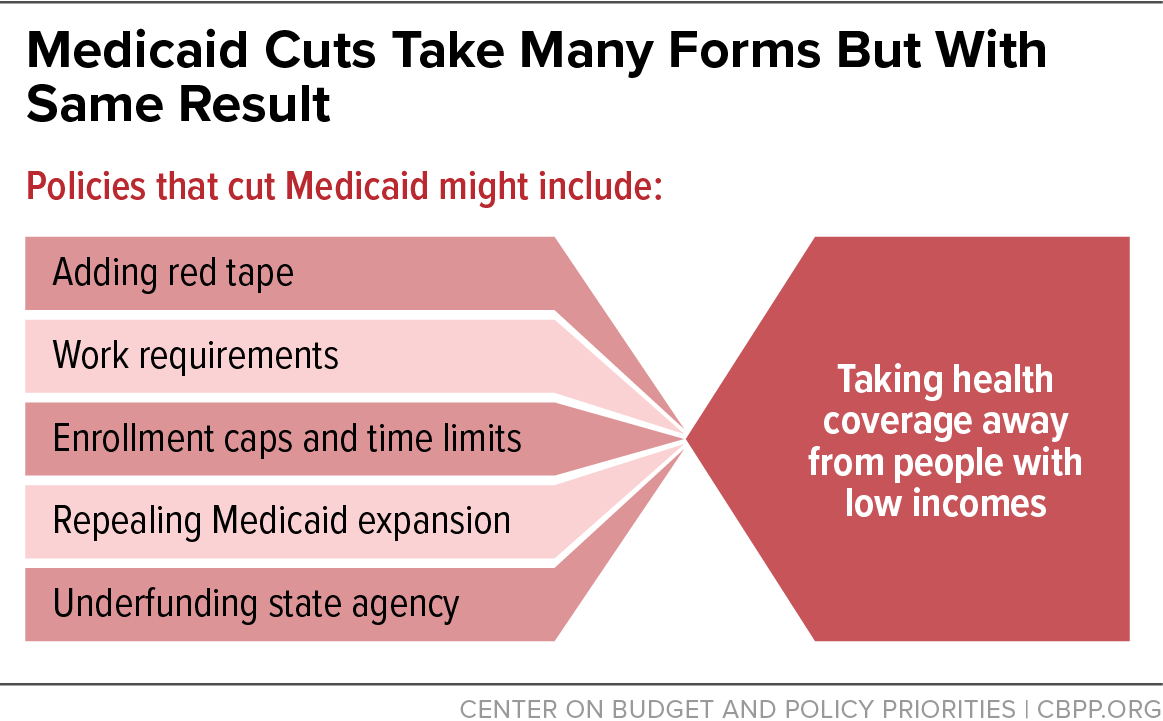
Recent proposals to cut Medicaid include increasing red tape barriers to enroll and renew coverage; imposing harsh and unnecessary work requirements that take away coverage; and imposing enrollment caps, time limits, and lock-out periods.
Increasing Red Tape So It Takes People and State Agencies More Time and Hassle to Enroll And Renew Coverage
The Idaho bill discussed above would have repealed Medicaid expansion unless the state imposed a series of access-limiting policies for Medicaid expansion enrollees.[43] Several of these policies directly conflict with existing federal Medicaid requirements. The bill would have:
- eliminated ex parte renewals, under which state agencies are required to attempt to renew people’s coverage with information they already have on hand instead of asking enrollees for redundant information;
- banned the use of pre-populated forms, which agencies are required to use when eligibility cannot be renewed on an ex parte basis to reduce the time enrollees need to spend completing their paperwork; and
- required people to renew their coverage two or even four times a year, even though federal regulations specify that renewals may occur no more than once every 12 months.[44]
The West Virginia[45] bill referenced above similarly sought to ban the use of pre-populated forms and ex parte renewals and require people to renew their coverage more frequently. The bill also would have restricted hospitals’ ability to conduct presumptive eligibility determinations, which help hospitals reduce uncompensated care by quickly verifying a patient’s eligibility for Medicaid.
In 2023 Ohio,[46] West Virginia,[47] and Wisconsin[48] considered bills similar to the Idaho and West Virginia measures. None of these proposals passed state legislatures, and most of them could not be implemented today in any event because of current CMS rules. However, given the incoming Administration, these policies — which represent an obvious attempt to make Medicaid less efficient in order to save money by providing health coverage to fewer people — will likely resurface at the state level and with a much greater chance of receiving federal approval from the Trump Administration. It is also possible that the incoming Congress could pass legislation to make CMS approval of some or all of these proposals unnecessary.[49]
Anti-Medicaid policymakers have also reduced the efficiency of Medicaid’s eligibility system by underfunding it. Most state agencies report understaffing issues, and many experience increased call center wait times and delayed application processing times as a result.[50] Further underfunding state agencies would exacerbate these issues and make it harder for people to apply and renew their coverage. During unwinding, for example, Montana experienced high procedural disenrollment rates and long call center wait times — lingering effects of the state’s Medicaid budget cuts back in 2017.[51]
Imposing Work Requirement Policies That Take Medicaid Away From People by Increasing Red Tape
Work requirements in Medicaid are a clear example of how adding red tape leads to extensive coverage losses. Yet many states are considering them and, following the election, will have a greater likelihood of securing federal approval to implement them. In 2024, bills in Idaho,[52] Mississippi,[53] South Dakota,[54] and Kansas[55] all sought to implement work requirements, following similar attempts in 2023 in Iowa,[56] Montana,[57] and Ohio.[58]
Some proposals sought to make work requirements a condition of the state’s adoption of the Medicaid expansion. For example, in Mississippi — one of ten states that have not yet expanded Medicaid — the Senate passed a bill that would newly provide Medicaid to low-income adults only if they could document and report 120 hours of work every month.[59] The South Dakota legislature took a different route, passing a joint resolution to put a constitutional amendment on the ballot to allow the state to impose work requirements,[60] should CMS ever permit them. The measure was approved in November with support from 56 percent of voters, opening the door for work requirements in South Dakota.[61]
Today, all state-level work requirement proposals require states to submit waiver requests to CMS. While the Biden Administration has not approved any such requests, the incoming Trump Administration is expected to approve them, as the first Trump Administration did, although legal challenges could follow. It is also possible that a Republican Congress will make work requirements a state option (meaning a state could adopt them without needing a waiver) or even mandatory. This is an alarming prospect given the evidence about the harm they would inflict.
Work requirements are promoted as a way to “encourage work,”[62] but extensive evidence shows they do nothing to increase employment. However, they are very effective at taking coverage away from people because they increase administrative burdens on people trying to access coverage.[63] Every addition of paperwork to the eligibility process increases the risk that a person will miss requests for additional information, returned paperwork will sit at the agency for months due to processing backlogs, or their paperwork will be lost by the agency.[64]
When Arkansas attempted to implement work requirements in 2018, thousands of people, including people with disabilities, lost coverage due to excessive red tape despite meeting the new requirements.[65] More recently, Georgia’s Pathways to Coverage program, restricted to people who can document that they work at least 80 hours a month, enrolled just 4,231 people in its first year[66] — despite the state’s heavy spending on administrative and advertising costs.[67] Enrollment is just a fraction of the state’s 100,000-person prediction and an even tinier fraction of the 192,000 uninsured Georgians who fall in the Medicaid coverage gap, most of whom are in working families.[68]
While the Trump Administration approved several state waiver requests to impose work requirements in Medicaid, multiple courts struck down the policy, and the Biden Administration ultimately withdrew states’ authority to implement work requirements.[69] As of today, Georgia is the only state that a federal judge allowed to implement work requirements, arguing that the program would give people new options for coverage rather than take it away.[70] However, the above data show that work requirements produce little benefit. Georgia thus should not be a model for other non-expansion states looking to increase access to coverage for their residents.
Imposing Enrollment Caps, Time Limits, and Lock-Out Periods
Another way opponents attempt to restrict access to Medicaid is by limiting the amount of time enrollees can receive coverage or the number of people who can enroll. The 2024 Idaho bill, for example, sought to impose an enrollment cap and a 36-month lifetime limit on adults in the Medicaid expansion eligibility group. (So did Idaho’s 2023 iteration of the bill.)[71] This would have led tens of thousands of people with low incomes to lose coverage, most of whom have no other affordable coverage option.
Policies such as these are not currently allowed under federal law due to Medicaid’s entitlement nature, which requires states to cover all eligible applicants, but the threat of these sorts of changes has risen considerably due to the election of a Republican President and Congress in November. Recent Republican Medicaid proposals include policies such as capped funding and a reduction in federal matching rates. Any such change would significantly alter Medicaid’s financing structure and result in far less federal funding for states, and would likely be paired with loosening standards that would allow states to limit enrollment, eligibility, and benefits in order to cut spending.[72]
States have also proposed locking people out of coverage for up to a year if they seek Medicaid after disenrolling from other forms of health coverage or fail to report changes in their circumstances that could impact their Medicaid eligibility. West Virginia’s 2024 bill, for example, included six-month lock-out periods for people who fail to immediately report changes in their income or other circumstances; Mississippi’s 2024 bill would have imposed a 12-month lockout for people applying for Medicaid after voluntarily disenrolling from employer or private coverage.
While federal regulations already require people to report changes in circumstance that might affect their eligibility for Medicaid, these state proposals would go a step further by imposing lockouts, in contravention of current federal rules. If implemented (which would require CMS approval), these proposals would lead to extensive coverage loss due to the nature of low-paying work, which typically includes fluctuating hours, no paid sick leave, and unaffordable employer-sponsored insurance options.
All People Need Access to Health Care
Taking health care coverage away from people does not eliminate their need for it. It simply prevents people from getting the care they need — care that is often lifesaving, from cancer treatment to management of chronic diseases like diabetes and depression. Taking health care coverage away from people perpetuates poverty, widens income inequality, shifts costs to health care providers and taxpayers, and costs many lives. While recent approaches to undermining Medicaid differ, what ties them together is the erroneous belief that some people do not deserve access to health coverage and, by extension, the opportunity to live a healthy and dignified life.
Moving forward — especially given the new landscape ushered in by the November elections and Republicans’ stated plans to cut Medicaid — policymakers must recognize when proposals claiming to “improve program integrity,” “track down fraud,” “encourage work,” or protect limited funds for the “most needy” would, in reality, increase people’s health care costs and take health coverage away from those with low incomes, thus adding to the economic concerns many voters expressed in the election.[73] Health care advocates and other stakeholders can push back by exposing attempts to cut Medicaid and other health care benefits for people while providing ever-growing tax cuts to the wealthy. And, perhaps most importantly, we as a nation should reject the argument of “deservingness” that underlies so many attacks on Medicaid and replace it with a new vision where all people, no matter their race, income, gender, or circumstance, can survive and thrive.
End Notes
[1] Eric Schneider et al., “Health Care in America,” Commonwealth Fund, December 5, 2019, https://www.commonwealthfund.org/publications/fund-reports/2019/dec/health-care-america#:~:text=Further%2C%20a%20majority%20of%20the,%25%20believe%20treatment%20is%20equal.
[2] Allison Orris and Claire Heyison, “Republican Health Coverage Proposals Would Increase Number of Uninsured, Raise People’s Costs,” CBPP, November 27, 2024, https://www.cbpp.org/research/health/republican-health-coverage-proposals-would-increase-number-of-uninsured-raise.
[3] Allison Orris and Gideon Lukens, “Medicaid Threats in the Upcoming Congress,” CBPP, updated December 13, 2024, https://www.cbpp.org/research/health/medicaid-threats-in-the-upcoming-congress; Orris and Heyison, op. cit.
[4] KFF, “5 Charts About Public Opinion on Medicaid,” March 30, 2023, https://www.kff.org/medicaid/poll-finding/5-charts-about-public-opinion-on-medicaid/.
[5] In a February 2024 hearing, Idaho Representative Jordan Redman introduced HB 419 alongside Scott Centorino of the FGA. Rep. Redman ceded the majority of his time to Mr. Centorino to discuss the bill. See Idaho House Health and Welfare Committee meeting, February 1, 2024, https://legislature.idaho.gov/sessioninfo/2024/standingcommittees/HHEA/.
[6] See American Legislative Exchange Council, “Self-Sufficiency in Medicaid Act,” September 9, 2017, https://alec.org/model-policy/self-sufficiency-in-medicaid-act-2/; Foundation for Government Accountability, “Hope, Opportunity, and Prosperity for Everyone (HOPE) Act,” 2017, https://thefga.org/wp-content/uploads/2017/01/Welfare-Reform-Bill-2017.pdf.
[7] Katheryn Houghton, “In Montana, Conservative Groups See Chance To Kill Medicaid Expansion,” KFF, October 31, 2024, https://kffhealthnews.org/MTkzNTI3Mw.
[8] Foundation for Government Accountability, “Dr. Jane Gillette: Squeezing out Montana Priorities,” January 10, 2024, https://thefga.org/video/dr-jane-gillette-squeezing-out-montana-priorities/#progress-0.
[9] Montana Healthcare Foundation, “2024 Medicaid in Montana,” April 2024, https://mthf.org/wp-content/uploads/2024-Medicaid-in-Montana-Annual-Report_FINAL-2.pdf.
[10] CBPP analysis of National Association of State Budget Officers historical state spending data, available at https://www.nasbo.org/reports-data/historical-data. Medicaid as a share of total expenditures fluctuated between 27 and 29 percent over this period.
[11] Laura Harker and Breanna Sharer, “Medicaid Expansion: Frequently Asked Questions,” CBPP, updated June 14, 2024, https://www.cbpp.org/research/health/medicaid-expansion-frequently-asked-questions-0. Medicaid expansion permits states to cover adults with incomes up to 138 percent of the federal poverty level ($20,780 for an individual or $35,630 for a family of three in 2024). Prior to this taking effect in 2014, many low-income adults did not qualify for any affordable health coverage. See also Bryce Ward, “The Impact of Medicaid Expansion on States’ Budgets,” Commonwealth Fund, May 5, 2020, https://www.commonwealthfund.org/publications/issue-briefs/2020/may/impact-medicaid-expansion-states-budgets.
[12] Madeline Guth, Rachel Garfield, and Robin Rudowitz, “The Effects of Medicaid Expansion under the ACA: Studies from January 2014 to January 2020,” KFF, March 17, 2020, https://www.kff.org/report-section/the-effects-of-medicaid-expansion-under-the-aca-updated-findings-from-a-literature-review-report/.
[13] Wesley Tharpe, “States’ Recent Tax-Cut Spree Creates Big Risks for Families and Communities,” CBPP, November 30, 2023, https://www.cbpp.org/research/state-budget-and-tax/states-recent-tax-cut-spree-creates-big-risks-for-families-and.
[14] See Tharpe, Figure 3.
[15] Danilo Trisi and Matt Saenz, “Economic Security Programs Reduce Overall Poverty, Racial and Ethnic Inequities,” CBPP, updated July 1, 2021, https://www.cbpp.org/research/poverty-and-inequality/more-than-4-in-10-children-in-renter-households-face-food-andor.
[16] Elizabeth Patton, “Op-Ed: Medicaid expansion would hurt vulnerable Kansas patients,” The Center Square, December 13, 2023, https://www.thecentersquare.com/kansas/article_53d05190-9a06-11ee-ae73-0b6a457942e2.html.
[17] Adam Searing and Aubrianna Osorio, “How Covering Adults Through Medicaid Expansion Helps Children,” Georgetown University Center for Children and Families, November 2024, https://ccf.georgetown.edu/wp-content/uploads/2024/11/Medicaid-expansion-v2-2.pdf.
[18] Laura Harker, “Medicaid Expansion Helps Newly Eligible Adults and Groups Traditionally Eligible for Medicaid,” CBPP, June 3, 2024, https://www.cbpp.org/research/health/medicaid-expansion-helps-newly-eligible-adults-and-groups-traditionally-eligible.
[19] Jessica Schubel, “Medicaid Improper Payment Rates Don’t Signal Fraud or Abuse,” CBPP, November 19, 2020, https://www.cbpp.org/blog/medicaid-improper-payment-rates-dont-signal-fraud-or-abuse.
[20] According to CMS, “[Improper] payments typically involve situations where a state or provider missed an administrative step and do not necessarily indicate fraud or abuse.” CMS, “Fiscal Year 2023 Improper Payments Fact Sheet,” November 15, 2023, https://www.cms.gov/newsroom/fact-sheets/fiscal-year-2023-improper-payments-fact-sheet.
[21] Idaho House Health and Welfare Committee meeting minutes, February 1, 2024, https://legislature.idaho.gov/wp-content/uploads/sessioninfo/2024/standingcommittees/240201_hhea_0800AM-Minutes.pdf.
[22] Only 45 percent of workers with wages in the bottom 25 percent of wages for their occupation have access to employer-sponsored coverage. Bureau of Labor Statistics, “Employee Benefits in the United States – March 2024,” Table 2, September 19, 2024, https://www.bls.gov/news.release/pdf/ebs2.pdf. See also Gary Claxton and Matthew Rae, “What are the recent trends in employer-based health coverage?” KFF, December 22, 2023, https://www.healthsystemtracker.org/chart-collection/trends-in-employer-based-health-coverage/.
[23] West Virginia HB 5557, 2024, https://www.wvlegislature.gov/Bill_Status/bills_text.cfm?billdoc=hb5557%20intr.htm&yr=2024&sesstype=RS&i=5557.
[24] Scott Centorino at the February 1, 2024, meeting of the Idaho House Health and Welfare Committee, 7:50 mark, https://legislature.idaho.gov/sessioninfo/2024/standingcommittees/HHEA/.
[25] CMS, average monthly enrollment data for January to March 2024, https://www.medicaid.gov/medicaid/national-medicaid-chip-program-information/medicaid-chip-enrollment-data/medicaid-enrollment-data-collected-through-mbes/index.html.
[26] Idaho HB 419, 2024, https://legislature.idaho.gov/wp-content/uploads/sessioninfo/2024/legislation/H0419.pdf.
[27] Idaho House Health and Welfare Committee, meeting minutes, February 1, 2024.
[28] Kyle Pfannenstiel, “Idaho might require Medicaid expansion population to work through new policy proposal,” Idaho Capital Sun, January 9, 2024, https://idahocapitalsun.com/2024/01/09/idaho-might-require-medicaid-expansion-population-to-work-through-new-policy-proposal/.
[29] KFF, “Total Monthly Medicaid & CHIP Enrollment and Pre-ACA Enrollment,” 2024, https://www.kff.org/affordable-care-act/state-indicator/total-monthly-medicaid-and-chip-enrollment/?currentTimeframe=0&sortModel=%7B%22colId%22:%22Location%22,%22sort%22:%22asc%22%7D.
[30] In Idaho, Medicaid fluctuated between 12 and 16 percent of total state-funded spending both before and after 2020. CBPP analysis of data from the National Association of State Budget Officers, “2024 State Expenditure Report,” https://higherlogicdownload.s3.amazonaws.com/NASBO/9d2d2db1-c943-4f1b-b750-0fca152d64c2/UploadedImages/SER%20Archive/2024_SER/2024_State_Expenditure_Report_S.pdf.
[31] The state also adopted other revenue reductions during that same span, such as sizable property tax reductions and one-time income tax rebates. See May Roberts, “House Bill 521 Further Cuts the Income Tax, Disproportionately Benefiting Wealthy Idahoans,” Idaho Center for Fiscal Policy, February 19, 2024, https://idahofiscal.org/house-bill-521-further-cuts-the-income-tax-disproportionately-benefiting-wealthy-idahoans/; May Roberts, “Understanding 2023 Property Tax Relief,” Idaho Center for Fiscal Policy, May 5, 2023, https://idahofiscal.org/understanding-2023-property-tax-relief/.
[32] CBPP analysis of CMS 2023 Idaho Medicaid expenditure data, available at https://data.medicaid.gov/dataset/00505e90-f8ac-5921-b12f-5e23ba7ffcf3.
[33] Utah HB 463, 2024, https://le.utah.gov/~2024/bills/hbillint/HB0463S01.pdf.
[34] Katie McKellar, “Medicaid ‘doomsday’ bill threatens vital services for vulnerable Utahns, advocates say,” Standard-Examiner, February 22, 2024, https://www.standard.net/news/government/2024/feb/22/medicaid-doomsday-bill-threatens-vital-services-for-vulnerable-utahns-advocates-say/.
[35] In November 2023 the legislature forecast the fund would have positive balances of $420 million in FY2024 and $538 million in FY2025. Utah State Legislature, “Medicaid Consensus Forecasting,” November 27, 2023, https://le.utah.gov/interim/2023/pdf/00004980.pdf.
[36] Income tax cuts enacted from 2021-2023 are already costing Utah about $600 million in lost revenue each year; an additional rate cut approved in 2024 adds an estimated $167 million in annual losses to that total. See Tharpe, Appendix 2; Katie McKellar, “Utah Legislature approves $167 million income tax cut largely benefitting high earners,” Utah News Dispatch, February 29, 2024, https://utahnewsdispatch.com/2024/02/29/utah-legislature-income-tax-cut/.
[37] Brad McElhinny, “State would increase a tax to address Medicaid gap, and Senate Finance chairman questions future effects,” MetroNews, January 29, 2024, https://wvmetronews.com/2024/01/29/state-would-increase-a-tax-to-address-medicaid-gap-and-senate-finance-chairman-questions-future-effects/. See also Sean O’Leary, Rhonda Rogombé, and Kelly Allen, “Final 2025 Budget Makes Deep Cuts to Medicaid; Fails to Meet Important Needs,” West Virginia Center on Budget & Policy, March 2024, https://wvpolicy.org/wp-content/uploads/2024/03/fiscal-year-2025-budget-analysis.pdf.
[38] West Virginia Center on Budget & Policy, “West Virginia Medicaid Program Costs Already Well-Contained; Bolstering Family Well-being, Provider Sustainability, and State Economy,” February 2024, https://wvpolicy.org/wp-content/uploads/2024/09/medicaid-spending-memo-Feb-13.pdf.
[39] Steven Allen Adams, “West Virginia Senate Deals Quickly With Special Session Bills,” Intelligencer, May 20, 2024, https://www.theintelligencer.net/news/top-headlines/2024/05/west-virginia-senate-deals-quickly-with-special-session-bills/.
[40] The 2023 tax cuts reduced income tax rates by 21.25 percent, while the 2024 cuts equate to another 2 percent reduction, totaling over $900 million in lost tax revenue by fiscal year 2026. See Lori Kersey, “Justice ceremonially signs bill cutting West Virginia income tax,” West Virginia Watch, October 31, 2024, https://westvirginiawatch.com/2024/10/31/justice-ceremonially-signs-bill-cutting-west-virginia-income-tax/; and CBPP, “West Virginia Struggling to Afford School Security Upgrades, Other Essential Needs in Wake of Tax Cuts,” November 25, 2024, https://www.cbpp.org/research/state-budget-and-tax/tracking-the-fallout-from-state-tax-cuts#series_item_29431.
[41] John Raby, “West Virginia tax cut digs deep into budget surplus,” Associated Press, March 7, 2023, https://apnews.com/article/west-virginia-governor-signs-income-tax-cut-c7241a913e449d0e3c749166b116d960. See also CBPP, “West Virginia Temporarily Averts Medicaid Crisis, But Income Tax Cuts Threaten Future Funding,”, May 30, 2024, https://www.cbpp.org/research/state-budget-and-tax/tracking-the-fallout-from-state-tax-cuts#series_item_29022.
[42] Office of Management and Budget, “Study to Identify Methods to Assess Equity: Report to the President,” July 2021, https://www.whitehouse.gov/wp-content/uploads/2021/08/OMB-Report-on-E013985-Implementation_508-Compliant-Secure-v1.1.pdf; Suzanne Wikle et al., “States Can Reduce Medicaid’s Administrative Burdens to Advance Health and Racial Equity,” CBPP and CLASP, July 19, 2022, https://www.cbpp.org/research/health/states-can-reduce-medicaids-administrative-burdens-to-advance-health-and-racial.
[43] Idaho HB 419, 2024.
[44] Current federal regulations limit renewal frequency for the MAGI Medicaid population (children, parents, and expansion adults, whose eligibility is based on their modified adjusted gross income or MAGI) to no more than once every 12 months. Current regulations limits renewals for the non-MAGI Medicaid population (older adults and people with disabilities) to no more than once every six months, but renewal requirements for most of the non-MAGI population will match those for the MAGI population beginning in June 2027. See 42 CFR §435.916 (a), available at https://www.ecfr.gov/current/title-42/section-435.916 and Centers for Medicare & Medicaid Services, “Medicaid Program: Streamlining the Medicaid, Children’s Health Insurance Program, and Basic Health Program Application, Eligibility Determination, Enrollment, and Renewal Processes,” Section B (1), April 2, 2024, https://www.federalregister.gov/d/2024-06566.
[45] West Virginia HB 5557, §9-4F-5 and §9-4F-6.
[46] Ohio Legislative Service Commission, “Comparison Document,” June 15, 2023, https://www.lsc.ohio.gov/assets/legislation/135/hb33/ps/files/hb33-comparison-document-differences-only-as-passed-by-the-senate-135th-general-assembly.pdf.
[47] West Virginia HB 3485, 2023, https://www.wvlegislature.gov/Bill_Status/bills_text.cfm?billdoc=hb3485%20intr.htm&yr=2023&sesstype=RS&i=3485.
[48] Wisconsin A B 148, 2023, https://docs.legis.wisconsin.gov/2023/related/proposals/ab148.pdf.
[49] Orris and Lukens, op. cit.
[50] Rachana Pradhan, “A staffing crisis is causing a monthslong wait for Medicaid, and it could get worse,” NPR, April 4, 2022, https://www.npr.org/sections/health-shots/2022/04/04/1089753555/medicaid-labor-crisis; Justin Schweitzer, “How To Address the Administrative Burdens of Accessing the Safety Net,” Center for American Progress, May 5, 2022, https://www.americanprogress.org/article/how-to-address-the-administrative-burdens-of-accessing-the-safety-net/.
[51] Jackie Semmens, “Lessons Learned From The Medicaid Unwinding,” Montana Budget and Policy Center, February 15, 2024, https://montanabudget.org/post/lessons-learned.
[52] Idaho HB 419, Section 1(b), 2024.
[53] Mississippi HB 1725, 2024, https://billstatus.ls.state.ms.us/documents/2024/pdf/HB/1700-1799/HB1725IN.pdf.
[54] South Dakota Senate Joint Resolution 501, 2024, https://sdlegislature.gov/Session/Bill/24592/266755.
[55] Kansas HB 2556, New Sec. 3. (a), 2024, https://www.kslegislature.gov/li/b2023_24/measures/documents/hb2556_00_0000.pdf.
[56] Iowa House File 613, 2023, https://www.legis.iowa.gov/legislation/BillBook?ga=90&ba=HF%20613.
[57] Montana SB 465, 2023, https://legiscan.com/MT/text/SB465/2023.
[58] Ohio Legislative Service Commission.
[59] Michael Goldberg, “Mississippi Senate passes trimmed Medicaid expansion and sends bill back to the House,” Associated Press, March 28, 2024, https://apnews.com/article/mississippi-medicaid-expansion-senate-f1490637ea0a41bbc9d49c68a04f594c.
[60] Prior to the joint resolution, South Dakota’s constitution prohibited the state from imposing “greater or additional burdens or restrictions on eligibility or enrollment standards, methodologies, or practices” on any Medicaid enrollees eligible under expansion than on any other Medicaid enrollees. The authorized constitutional amendment changes this language to allow work requirements as an exception to existing restrictions. See South Dakota Constitution, Article XXI §10, https://sdlegislature.gov/api/Statutes/0N.html?all=true.
[61] Vanessa Carlson Bender, “Amendment F passes: Medicaid work requirements can now be enforced in South Dakota,” Argus Leader, November 6, 2024, https://www.argusleader.com/story/news/politics/2024/11/06/south-dakota-election-results-2024-amendment-4-medicaid-work-requirement/75892084007/.
[62] West Virginia HB 5557, 2024.
[63] Sherry Glied and Dong Ding, “Medicaid Work Requirements Wouldn’t Increase Employment and Could Imperil Future Labor Market Participation,” Commonwealth Fund, May 24, 2023, https://www.commonwealthfund.org/blog/2023/medicaid-work-requirements-wouldnt-increase-employment-and-could-imperil-future-labor. See also Benjamin Sommers et al., “Medicaid Work Requirements In Arkansas: Two-Year Impacts On Coverage, Employment, And Affordability Of Care,” Health Affairs, September 2020, https://www.healthaffairs.org/doi/full/10.1377/hlthaff.2020.00538; Phillip Swagel, Letter to Rep. Frank Pallone, Congressional Budget Office, April 26, 2023, https://www.cbo.gov/system/files/2023-04/59109-Pallone.pdf.
[64] CBPP, “Unwinding Watch,” July 31, 2024, https://www.cbpp.org/research/health/unwinding-watch-tracking-medicaid-coverage-as-pandemic-protections-end?item=29162.
[65] Laura Harker, “Pain But No Gain: Arkansas’ Failed Medicaid Work-Reporting Requirements Should Not Be a Model,” CBPP, August 8, 2023, https://www.cbpp.org/research/health/pain-but-no-gain-arkansas-failed-medicaid-work-reporting-requirements-should-not-be.
[66] Leah Chan, “Georgia’s Pathways to Coverage Program: The First Year in Review,” Georgia Budget and Policy Institute, October 29, 2024, https://gbpi.org/georgias-pathways-to-coverage-program-the-first-year-in-review/; MaryBeth Musumeci, Elizabeth Leiser, and Megan Douglas, “Few Georgians Are Enrolled in the State’s Medicaid Work Requirement Program,” Commonwealth Fund, September 11, 2024, https://www.commonwealthfund.org/blog/2024/few-georgians-are-enrolled-states-medicaid-work-requirement-program.
[67] Joan Alker, “Georgia’s Much Vaunted Medicaid Waiver ‘Pathways to Coverage’ Has Turned Into ‘Pathways to Profit’ for Consultants,” Georgetown CCF, October 30, 2024, https://ccf.georgetown.edu/2024/10/30/georgias-much-vaunted-medicaid-waiver-pathways-to-coverage-has-turned-into-pathways-to-profit-for-consultants/.
[68] Laura Harker, “6 Months Into Georgia Pathways Program, Over 400,000 People Still Lack Health Coverage; Expanding Medicaid Would Improve Access for Low-Income Georgians,” CBPP, January 25, 2024, https://www.cbpp.org/blog/6-months-into-georgia-pathways-program-over-400000-people-still-lack-health-coverage-expanding; CBPP, “The Medicaid Coverage Gap in Georgia,” April 3, 2024, https://www.cbpp.org/sites/default/files/4-3-24health-factsheet-ga.pdf.
[69] Madeline Guth and MaryBeth Musumeci, “An Overview of Medicaid Work Requirements: What Happened Under the Trump and Biden Administrations?” KFF, May 3, 2022, https://www.kff.org/medicaid/issue-brief/an-overview-of-medicaid-work-requirements-what-happened-under-the-trump-and-biden-administrations/.
[70] Leonardo Cuello, “Judiciary Gone Rogue: Federal Judge Overreaches in Georgia Medicaid Waiver Case,” Georgetown Center for Children and Families, September 12, 2022, https://ccf.georgetown.edu/2022/09/12/judiciary-gone-rogue-federal-judge-overreaches-in-georgia-medicaid-waiver-case/.
[71] Idaho HB 366, 2023, https://legislature.idaho.gov/sessioninfo/billbookmark/?yr=2023&bn=H0366.
[72] Orris and Lukens, op. cit.; and Orris and Heyison, op. cit.
[73] Drew Altman, “Lessons From the Election About Voters and Health,” KFF, November 26, 2024, https://www.kff.org/from-drew-altman/lessons-from-the-election-about-voters-and-health/.