

Nearly 3 Million Uninsured Adults Would Gain a Path to Medicaid Coverage if Their States Adopted ACA Medicaid Expansion
As part of the Affordable Care Act’s (ACA’s) Medicaid expansion, 40 states and Washington, D.C. have extended Medicaid eligibility to adults with incomes up to 138 percent of the federal poverty level (FPL), or about $22,000 for an individual. In these states, Medicaid expansion has substantially expanded access to affordable health coverage for millions of people, helping to drive the uninsured rate to record lows. Nevertheless, congressional Republicans and President Trump enacted unprecedented and harmful changes to the Medicaid expansion in last year’s reconciliation law, including a work requirement and more frequent eligibility redeterminations.[1]
Despite the changes in the Republican reconciliation law, Medicaid expansion remains a critical source of coverage for people with low incomes, many of whom lack access to affordable health coverage through other sources. In the ten remaining non-expansion states, an estimated 2.7 million uninsured adults could become eligible for Medicaid under the expansion, according to CBPP analysis of 2024 data.[2] Non-expansion states should provide these adults with a path to low-cost comprehensive health coverage by adopting Medicaid expansion.
Adopting Medicaid Expansion Would Help Diverse Group of People in Non-Expansion States
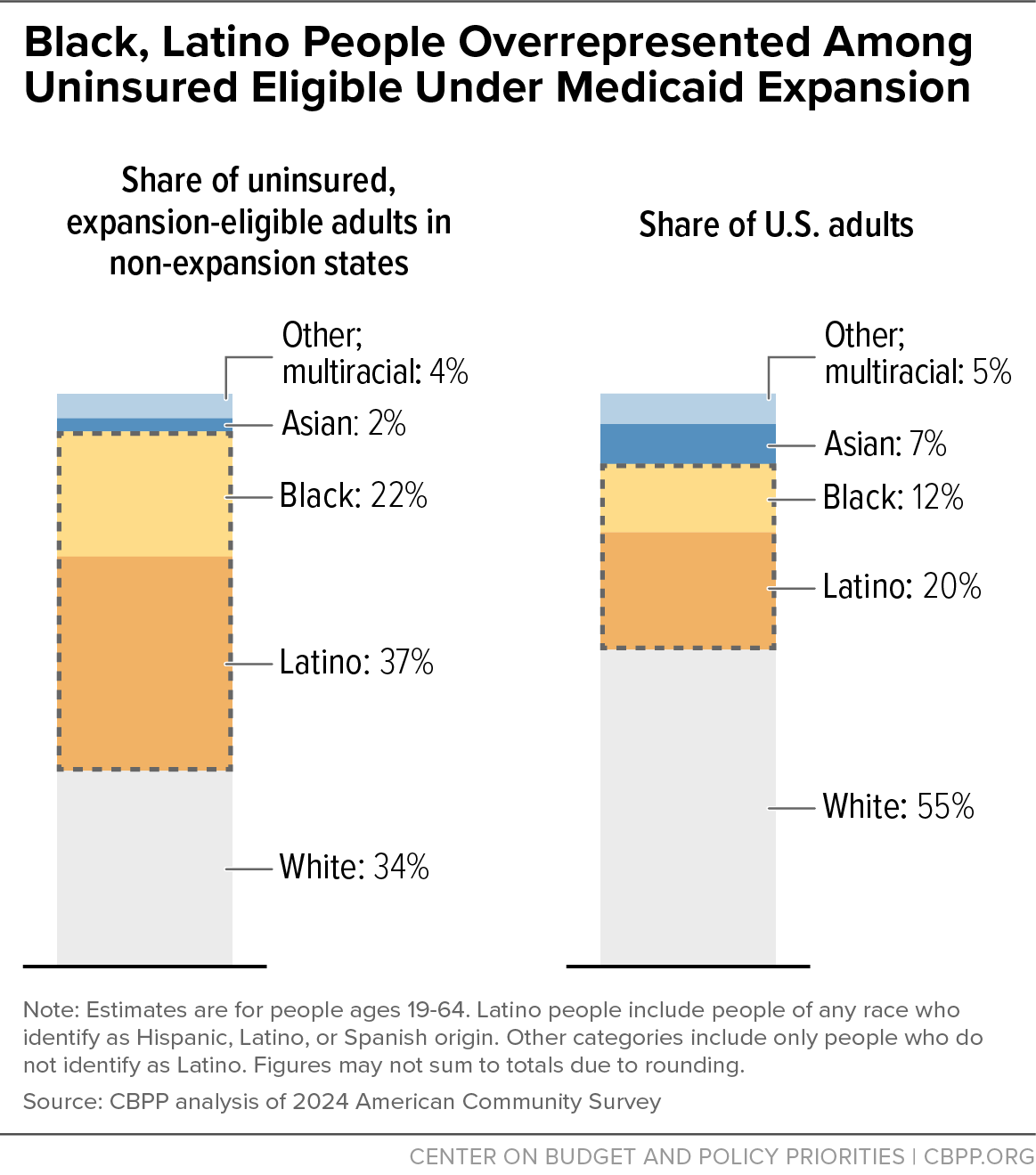
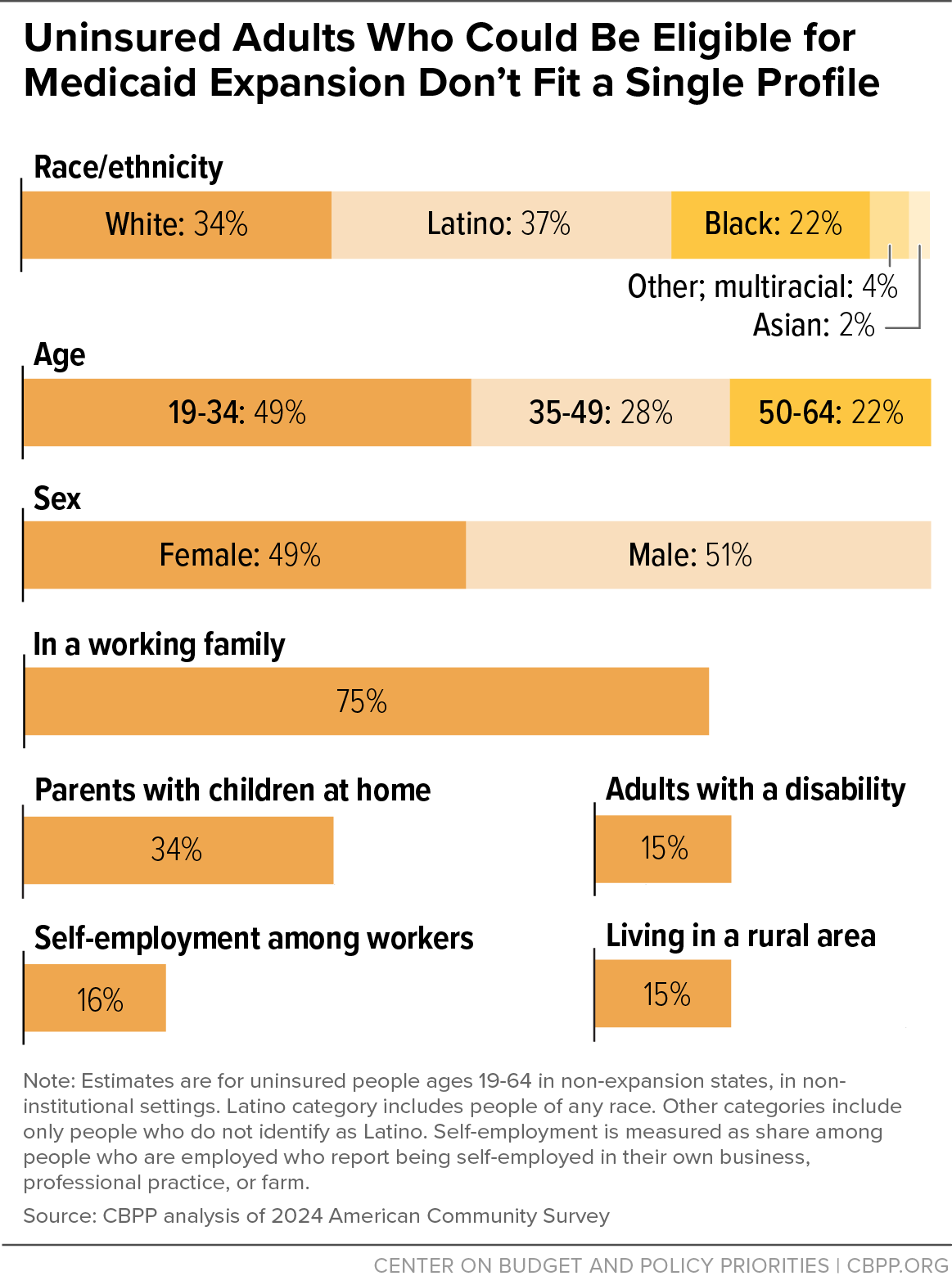
Uninsured adults who could become newly eligible for Medicaid if their states adopted expansion are racially and ethnically diverse: 66 percent are people of color, compared to 45 percent of the total U.S. population. (See Figure 1.) About 3 in 4 uninsured adults in the expansion-eligible population live in working families, and 1 in 3 are parents caring for children. They are disproportionately likely to be self-employed and to have a disability. About 16 percent of uninsured adults who could become eligible under Medicaid expansion are employed in their own business, professional practice, or farm, compared to 9 percent of other working adults. Some 15 percent have a disability, compared to 11 percent of other adults. And 15 percent of expansion-eligible uninsured adults live in rural areas. (See Figure 2.)

Adopting Medicaid expansion would:
- improve people’s health and save lives;
- reduce medical debt and increase people’s financial security;
- reduce racial and ethnic disparities in health coverage;
- provide a source of coverage to workers in low paying jobs who lack access to coverage through an employer and their families;
- improve coverage and access to care for children whose parents newly gain coverage; and
- allow people with disabilities to obtain Medicaid coverage based on their income without having to meet strict Supplemental Security Income eligibility criteria.[3]
While the Republican reconciliation law adds limitations on Medicaid financing and provider payment options for expansion states, adopting Medicaid expansion will still provide benefits to state budgets and providers.[4]The federal government pays 90 percent of the costs of coverage through expansion. And studies show that Medicaid expansion has produced savings in other areas of state budgets that have largely offset the remaining 10 percent of the costs that states have to cover.[5] This includes savings in other parts of Medicaid, savings in other state programs serving uninsured populations, increased state revenues, and reductions in uncompensated care. Medicaid expansion has also reduced the cost of providing uncompensated care for providers.[6] Rural hospitals have been especially likely to benefit from expansion, as they tend to have thin operating margins and higher uncompensated care costs.[7]

Those Who Could Become Eligible for Medicaid Expansion Include Adults in the Coverage Gap and Adults Currently Eligible for Premium Tax Credits
Of the 2.7 million uninsured adults who could become eligible for Medicaid if their states adopted expansion, nearly 1.6 million fall in the Medicaid “coverage gap,” with no path to affordable health coverage.[8] (See Table 1.) They have incomes below the federal poverty level — too low to qualify for financial help in the ACA marketplaces — yet they don’t qualify for Medicaid because their states have not adopted the expansion. In non-expansion states, the median Medicaid income eligibility limit for parents is just 34 percent of the FPL (around $9,000 for a family of three).[9] And adults without children are generally ineligible for Medicaid on the basis of income, no matter how low their incomes are.
| TABLE 1 | |||
|---|---|---|---|
Uninsured Adults Who Could Become Eligible for Medicaid if Their States Adopted Expansion, by Current Eligibility for Coverage, 2024 | |||
| Currently in Coverage Gap | Currently Eligible for PTCs for Marketplace Coverage | Total Medicaid Expansion Eligible | |
| Total, non-expansion states | 1,556,000 | 1,188,000 | 2,744,000 |
| Alabama | 92,000 | 63,000 | 155,000 |
| Florida | 304,000 | 247,000 | 551,000 |
| Georgia | 209,000 | 138,000 | 347,000 |
| Kansas | 33,000 | 27,000 | 60,000 |
| Mississippi | 59,000 | 42,000 | 101,000 |
| South Carolina | 67,000 | 61,000 | 128,000 |
| Tennessee | 91,000 | 84,000 | 174,000 |
| Texas | 693,000 | 497,000 | 1,190,000 |
| Wisconsin* | 0 | 21,000 | 21,000 |
| Wyoming | 8,000 | 8,000 | 16,000 |
* Wisconsin extends Medicaid eligibility to adults up to 100 percent of the poverty level through a waiver. Therefore, Wisconsin has no coverage gap population. Note: Estimates are for uninsured people, ages 19-64, in non-institutional settings, not including the population without a documented immigration status in the U.S. See Appendix II for more details. Figures may not sum to totals due to rounding. Source: CBPP estimates based on the 2024 American Community Survey | |||
The other 1.2 million uninsured adults who could become eligible for Medicaid expansion have incomes between 100 and 138 percent of the FPL. (See Table 1.) They are currently eligible for premium tax credits (PTCs) for marketplace coverage but are not enrolled.[10] Of note, this number is based on data from 2024 and has likely risen since, due to the expiration of enhancements to the PTCs.
The PTC enhancements were enacted in 2021 and made marketplace coverage far more affordable and spurred record enrollment, especially for people with incomes between 100 and 138 percent of the FPL in non-expansion states. This group gained access to $0 premium plans with cost-sharing reductions.[11] In 2025, 6.2 million people with incomes between 100 and 138 percent of the FPL signed up for marketplace coverage in non-expansion states.[12] However, Congress failed to extend the enhancements, so they expired at the end of 2025. As a result, people with incomes between 100 and 138 percent of the FPL must now pay 2.1 percent of their income for a benchmark plan with cost-sharing reductions. For an individual making $20,000, that’s an annual premium increase from $0 to $420. These premium costs will put coverage out of reach for many low-income families who are struggling to make ends meet and have been relying on $0 premium plans to afford their health coverage.
Without the PTC enhancements, many more adults with incomes between 100 and 138 percent of the FPL will become uninsured in non-expansion states. The Urban Institute projects that the expiration of the enhancements will lead to an additional 3.1 million people dropping marketplace coverage and becoming uninsured in non-expansion states (representing nearly two-thirds of the national increase), with the greatest coverage losses occurring among adults with low incomes.[13] And those remaining in marketplace coverage are facing much higher costs.
If their states adopt Medicaid expansion, adults with incomes between 100 and 138 percent of the FPL (between around $16,000 and $22,000 for an individual) who are currently enrolled in marketplace coverage would gain access to Medicaid and no longer qualify for marketplace premium tax credits. While people will now have to meet a work requirement (or prove they are exempt) to enroll in coverage through Medicaid expansion, Medicaid has no premiums and generally provides more comprehensive coverage with lower out-of-pocket costs than marketplace plans.[14]
The expiration of the PTC enhancements makes it even more important that states expand Medicaid. Medicaid expansion would provide adults facing unaffordable premiums and out-of-pocket payments for marketplace coverage, along with adults who remain in the coverage gap, with a path to low-cost, comprehensive coverage.
Appendix I: Characteristics of Uninsured Adults Who Could Become Eligible for Medicaid if Their States Adopted Expansion
| Appendix TABLE 1 | ||||||
|---|---|---|---|---|---|---|
Uninsured Adults Who Could Become Eligible for Medicaid if Their States Adopted Expansion, by Sex and Age, 2024 | ||||||
| Total | Female | Male | 19 to 34 | 35 to 49 | 50 to 64 | |
| Total, non-expansion states | 2,744,000 | 1,338,000 | 1,406,000 | 1,355,000 | 781,000 | 609,000 |
| Alabama | 155,000 | 74,000 | 81,000 | 72,000 | 47,000 | 36,000 |
| Florida | 551,000 | 260,000 | 291,000 | 244,000 | 163,000 | 144,000 |
| Georgia | 347,000 | 175,000 | 172,000 | 173,000 | 93,000 | 81,000 |
| Kansas | 60,000 | 29,000 | 31,000 | 33,000 | 16,000 | 11,000 |
| Mississippi | 101,000 | 48,000 | 54,000 | 53,000 | 25,000 | 23,000 |
| South Carolina | 128,000 | 55,000 | 74,000 | 63,000 | 34,000 | 32,000 |
| Tennessee | 174,000 | 82,000 | 93,000 | 86,000 | 44,000 | 44,000 |
| Texas | 1,190,000 | 601,000 | 589,000 | 613,000 | 348,000 | 230,000 |
| Wisconsin | 21,000 | 9,000 | 12,000 | 10,000 | 6,000 | 5,000 |
| Wyoming | 16,000 | 6,000 | 10,000 | 9,000 | 4,000 | 3,000 |
Note: Estimates are for uninsured people, ages 19-64, in non-institutional settings, not including the population without a documented immigration status in the U.S. See Appendix II for more details. Figures may not sum to totals due to rounding. Source: CBPP estimates based on the 2024 American Community Survey | ||||||
| Appendix TABLE 2 | ||||||
|---|---|---|---|---|---|---|
Uninsured Adults Who Could Become Eligible for Medicaid if Their States Adopted Expansion, by Race/Ethnicity, 2024 | ||||||
| Total | Asian | Black | Latino | Other/Multiracial | White | |
| Total, non-expansion states | 1,556,000 | 63,000 | 600,000 | 1,026,000 | 89,000 | 937,000 |
| Alabama | 155,000 | * | 49,000 | 19,000 | * | 77,000 |
| Florida | 551,000 | 13,000 | 116,000 | 194,000 | 25,000 | 202,000 |
| Georgia | 347,000 | 9,000 | 141,000 | 56,000 | 18,000 | 123,000 |
| Kansas | 60,000 | * | * | 15,000 | 5,000 | 35,000 |
| Mississippi | 101,000 | * | 47,000 | 8,000 | * | 41,000 |
| South Carolina | 128,000 | * | 43,000 | 15,000 | * | 61,000 |
| Tennessee | 174,000 | * | 41,000 | 16,000 | * | 105,000 |
| Texas | 1,190,000 | 32,000 | 156,000 | 694,000 | 36,000 | 271,000 |
| Wisconsin | 21,000 | * | * | * | * | 12,000 |
| Wyoming | 16,000 | * | * | * | 3,000 | 11,000 |
* Reliable estimates are not available due to sample size limitations. Note: Estimates are for uninsured people, ages 19-64, in non-institutional settings, not including the population without a documented immigration status in the U.S. Latino category includes people of any race. Other categories include only people who identify as a single race and not Latino. See Appendix II for more details. Figures may not sum to totals due to rounding. Source: CBPP estimates based on the 2024 American Community Survey | ||||||
| Appendix TABLE 3 | |||||
|---|---|---|---|---|---|
Uninsured Adults Who Could Become Eligible for Medicaid if Their States Adopted Expansion, by Work, Family, Disability Status, Residency in Rural Areas, 2024 | |||||
| In Working Families | Self-Employed | Parent Caregivers | Adults With Disabilities | Rural Residents | |
| Total, non-expansion states | 2,068,000 | 220,000 | 940,000 | 412,000 | 414,000 |
| Alabama | 104,000 | 12,000 | 47,000 | 27,000 | 39,000 |
| Florida | 404,000 | 51,000 | 182,000 | 77,000 | 24,000 |
| Georgia | 255,000 | 27,000 | 103,000 | 55,000 | 77,000 |
| Kansas | 44,000 | 4,000 | 16,000 | 13,000 | 19,000 |
| Mississippi | 72,000 | 8,000 | 30,000 | 20,000 | 54,000 |
| South Carolina | 94,000 | 7,000 | 33,000 | 25,000 | 24,000 |
| Tennessee | 119,000 | 11,000 | 32,000 | 31,000 | 45,000 |
| Texas | 946,000 | 98,000 | 483,000 | 160,000 | 115,000 |
| Wisconsin | 18,000 | * | 8,000 | * | 6,000 |
| Wyoming | 13,000 | * | 6,000 | * | 12,000 |
* Reliable estimates are not available due to sample size limitations. Note: Estimates are for uninsured people, ages 19-64, in non-institutional settings, not including the population without a documented immigration status in the U.S. See Appendix II for more details. Figures may not sum to totals due to rounding. Source: CBPP estimates based on the 2024 American Community Survey | |||||
Appendix II: Data and Methods
We use the Census Bureau’s 2024 American Community Survey (ACS), combined with state Medicaid eligibility rules for 2024, to estimate the expansion-eligible population in the ten states that have not enacted the ACA’s Medicaid expansion. The expansion-eligible population is defined as uninsured adults ages 19-64 with incomes below 138 percent of the FPL and who are ineligible for Medicaid because their states did not adopt the expansion. This includes parents whose incomes are above the parent eligibility limits and adults without children who wouldn’t be eligible at any income level. Uninsured adults with income below 100 percent of the FPL are ineligible for premium tax credits for marketplace coverage and therefore fall into the coverage gap population.[15]
These estimates do not incorporate the impact of the new Medicaid work requirement. While the work requirement will affect eligibility, most of the reduction in coverage will be among people who should be eligible because they are working or meet an exemption, but who get caught up in the administrative burden of documenting eligibility.
Medicaid and the marketplace have different rules for defining income and family units for the purposes of gaining coverage. These categories of income and family units (known as “health insurance units,” or HIUs) are not directly available in the ACS data and must be estimated. To assess income eligibility, we group individuals into two types of HIUs: Medicaid HIUs and marketplace HIUs. For each type of HIU, we apply each program’s rules for counting modified adjusted gross income for the purposes of eligibility. Our methodology for grouping into HIUs and counting income is based on ACS data and assumptions regarding family relationships, household composition, and tax filing rules and behavior.
Our Medicaid expansion eligibility estimates do not include populations that are already eligible for Medicaid or would not be eligible even if their states expanded. For example, we impute immigration status, broadly following methods used by KFF.[16] We develop a model predicting lawful immigration status using the second wave of the 2008 Survey of Income and Program Participation. Based on this model, we generate ten statistical imputations in the ACS, controlling to 2023 Center for Migration Studies estimates of the population without a lawful immigration status and estimated undercounts in the ACS.[17] We do not include the estimated population without a lawful immigration status in our Medicaid expansion eligibility estimates because under existing rules, this group would not gain Medicaid eligibility if their states adopted the expansion.
We define people as having a disability if they meet at least one of the six categories as defined by the Census Bureau: blind or with serious difficulty seeing; deaf or with serious difficulty hearing; serious cognitive difficulty; ambulatory difficulty (i.e., difficulty with a basic physical activity, such as walking or reaching); difficulty with self-care, such as dressing or bathing; or difficulty doing basic activities outside the home alone. We identify people living in rural areas using a crosswalk of Public Use Microdata Areas in the Census to metropolitan statistical areas.[18]
End Notes
[1] Last year’s reconciliation law (Public Law 119-21) adds unprecedented red tape to the expansion that will make it harder for people to enroll and stay enrolled in Medicaid. Beginning in 2027, applicants will have to meet a work requirement by documenting that they are working (or participating in another qualifying activity) at least 80 hours a month or that they have an allowable exemption. Expansion enrollees will also have to prove their eligibility every six months to stay covered, instead of annually. These two provisions will cause some 6 million people to become uninsured (not accounting for interactions between the provisions), according to the Congressional Budget Office, with many people who should be eligible being denied coverage due to administrative burdens. CBPP, “By the Numbers: Harmful Republican Megabill Will Take Health Coverage Away From Millions of People and Raise Families’ Costs,” updated August 27, 2025, https://www.cbpp.org/research/health/by-the-numbers-harmful-republican-megabill-will-take-health-coverage-away-from.
[2] These estimates do not incorporate the impact of the work requirement provision in the reconciliation law. The work requirement impacts eligibility for the small subset of people in the expansion population who do not work or engage in other qualifying activities for the requisite hours, or who do not meet standards for an exemption. But the bulk of the work requirement’s coverage losses will likely come from the additional red tape it imposes. Many of those who will be denied coverage should in fact be eligible because they are working or meet an exemption, but they will get caught up in the administrative burden of documenting eligibility.
[3] Laura Harker and Breanna Sharer, “Medicaid Expansion: Frequently Asked Questions,” CBPP, updated June 14, 2024, https://www.cbpp.org/research/health/medicaid-expansion-frequently-asked-questions-0; Gideon Lukens and Laura Harker, “Closing Medicaid Coverage Gap Would Help Diverse Groups and Reduce Inequities,” CBPP, updated July 15, 2024, https://www.cbpp.org/research/health/closing-medicaid-coverage-gap-would-help-diverse-groups-and-reduce-inequities.
[4] Specifically, the Republican reconciliation law places additional restrictions on provider taxes and state-directed payments for expansion states compared to non-expansion states. For more detail, see Edwin Park and Sabrina Corlette, “Medicaid, CHIP, and Affordable Care Act Marketplace Cuts and Other Health Provisions in the Budget Reconciliation Law, Explained,” Georgetown University Center for Children and Families, July 22, 2025, https://ccf.georgetown.edu/2025/07/22/medicaid-chip-and-affordable-care-act-marketplace-cuts-and-other-health-provisions-in-the-budget-reconciliation-law-explained/.
[5] Bryce Ward, “The Impact of Medicaid Expansion on States’ Budgets,” The Commonwealth Fund, May 5, 2020, https://www.commonwealthfund.org/publications/issue-briefs/2020/may/impact-medicaid-expansion-states-budgets.
[6] Meghana Ammula and Madeline Guth, “What Does the Recent Literature Say About Medicaid Expansion?: Economic Impacts of Providers,” KFF, January 18, 2023, https://www.kff.org/affordable-care-act/what-does-the-recent-literature-say-about-medicaid-expansion-economic-impacts-on-providers/.
[7] Emmaline Keesee et al., “Uncompensated Care is Highest for Rural Hospitals, Particularly in Non-Expansion States,” Medical Care Research and Review, November 18, 2023, https://journals.sagepub.com/doi/10.1177/10775587231211366; American Hospital Association, “Medicaid Coverage Supports Rural Patients, Hospitals, and Communities,” June 5, 2025, https://www.aha.org/fact-sheets/2025-06-05-medicaid-coverage-supports-rural-patients-hospitals-and-communities.
[8] Although it is a non-expansion state, Wisconsin extends Medicaid eligibility to adults up to 100 percent of the poverty level through a waiver. Therefore, Wisconsin has no coverage gap population.
[9] KFF, “Medicaid Income Eligibility Limits for Adults as a Percent of the Federal Poverty Level,” https://www.kff.org/affordable-care-act/state-indicator/medicaid-income-eligibility-limits-for-adults-as-a-percent-of-the-federal-poverty-level.
[10] Some may be ineligible for premium tax credits because they have an offer of employer-sponsored coverage that is considered affordable. However, this number is likely small because many people working in low-paying occupations do not have an offer of employer-sponsored coverage through their job. KFF, “2025 Employer Health Benefits Survey,” October 22, 2025, https://www.kff.org/health-costs/2025-employer-health-benefits-survey/.
[11] Nicole Rapfogel, “People With Low Incomes May Lose $0 Premium Plans — a Lifeline — Unless Congress Acts,” CBPP, September 29, 2025, https://www.cbpp.org/blog/people-with-low-incomes-may-lose-0-premium-plans-a-lifeline-unless-congress-acts.
[12] Centers for Medicare & Medicaid Services, “2025 Marketplace Open Enrollment Period Public Use Files,” May 2, 2025, https://www.cms.gov/data-research/statistics-trends-reports/marketplace-products/2025-marketplace-open-enrollment-period-public-use-files.
[13] Matthew Buettgens et al., “4.8 Million People Will Lose coverage in 2026 If Enhanced Premium Tax Credits Expire,” Urban Institute, September 17, 2025, https://www.urban.org/research/publication/48-million-people-will-lose-coverage-2026-if-enhanced-premium-tax-credits.
[14] Starting October 1, 2028, the Republican reconciliation law requires states to charge Medicaid expansion enrollees with incomes over 100 percent of poverty new cost-sharing fees of up to $35 for many health care services. However, individual charges could be much lower, and total out-of-pocket costs remain capped at 5 percent of family income. For many people, those costs would likely still fall below total out-of-pocket costs in marketplace plans with the highest tier of cost-sharing reductions. These plans have an average maximum out-of-pocket limit of almost $2,000 for an individual. For an analysis of the Medicaid cost-sharing provision, see Jennifer Tolbert and Priya Chidambaram, “Cost Sharing Requirements Could Have Implications for Medicaid Expansion Enrollees With Higher Health Care Needs,” KFF, June 27, 2025, https://www.kff.org/medicaid/cost-sharing-requirements-could-have-implications-for-medicaid-expansion-enrollees-with-higher-health-care-needs/. For a chart on cost-sharing features of marketplace plans, see Jennifer Sullivan, “How to Evaluate Proposals to Address Expiring Premium Tax Credit Enhancements,” CBPP, December 4, 2025, https://www.cbpp.org/blog/how-to-evaluate-proposals-to-address-expiring-premium-tax-credit-enhancements.
[15] Although it is a non-expansion state, Wisconsin extends Medicaid eligibility to adults up to 100 percent of the poverty level through a waiver. Therefore, Wisconsin has no coverage gap population. And while Georgia provides Medicaid to certain low-income adults who meet work requirements through a waiver program, enrollment was only 15,000 after over two years — well below the 240,000 uninsured people estimated to be eligible. Therefore, we do not consider eligibility for this program in our estimates of the coverage gap. Georgia Pathways, Data Tracker enrollment as of February 28, 2026, https://www.georgiapathways.org/data-tracker.
[16] KFF, “Kaiser Family Foundation ACA Eligibility Analysis, Technical Appendix B: Immigration Status Imputation,” October 2015, https://files.kff.org/attachment/technical-appendix-b-new-estimates-of-eligibility-for-aca-coverage-among-the-uninsured.
[17] Center for Migration Studies, “Estimates of Undocumented and Eligible-to-Naturalize Populations by State,” http://data.cmsny.org/state.html; Bryan Baker and Robert Warren, “Estimates of the Unauthorized Immigrant Population Residing in the United States: January 2018–January 2022,” U.S. Department of Homeland Security, April 2024, https://ohss.dhs.gov/sites/default/files/2024-06/2024_0418_ohss_estimates-of-the-unauthorized-immigrant-population-residing-in-the-united-states-january-2018%25E2%2580%2593january-2022.pdf
[18] Missouri Census Data Center, “Geocorr 2022: Geographic Correspondence Engine,” version 1.8, revised October 2022, https://mcdc.missouri.edu/applications/geocorr2022.html. We use geographic crosswalks of 2020 population and consider any area outside of a metropolitan statistical area to be rural.