Medicaid Work Requirements Will Harm Low-Paid Workers
Health coverage for 9.7 million to 14.4 million people could be at risk if lawmakers cut Medicaid by imposing unnecessary and burdensome work requirements on the Medicaid expansion population, as legislation passed by House Republicans would do. Medicaid is a critical source of coverage for workers in low-paying jobs, which often don’t offer health benefits. Low-paid workers also experience more frequent job losses and less stable hours, putting them especially at risk of losing health coverage due to a work requirement. Even those who would technically meet (or be exempt from) the requirement could still lose health coverage if they get tripped up by the paperwork needed to prove it.
Georgia’s current Medicaid work requirement has blocked many low-income working adults from getting health coverage while raising administrative costs and heaping more strain on already overburdened state agencies. And Arkansas’ failed work requirement in 2018 resulted in 1 in 4 enrollees losing coverage in the first seven months — with only a small share regaining coverage the next year.
Many Workers With Unstable or Seasonal Jobs Will Lose Coverage
Many Medicaid enrollees work in industries in which both employment and hours are volatile, sometimes on a week-to-week basis. The industries that employ the most adult working-age Medicaid enrollees include education, health and social services (e.g., hospitals, child care facilities, and schools), retail, and food service (see chart).

Workers with the lowest incomes report much greater instability in hours than higher income workers. For example, most food service and retail workers have less than two weeks’ notice of their schedule.
A work requirement would set many working Medicaid enrollees up to lose coverage. This includes seasonal workers who, due to the nature of their work, would likely not meet the hours required each month. CBPP analysis of 2019 survey data finds that among those who worked, 43 percent would have failed to meet an 80-hour work requirement in at least one month. Even among those who worked at least 1,000 hours over the course of the year — averaging about 80 hours per month — 25 percent would have failed the requirement in at least one month.
Other Workers Will Lose Coverage Due to Red Tape

Even people who do work the required number of hours could lose health coverage due to complex paperwork requirements and other reporting burdens, including:
- having to repeatedly submit paystubs, timesheets, and other documents (from one or multiple employers);
- facing long wait times to get through to a caseworker, or having to take time off to visit an eligibility office; or
- difficulty navigating online portals, especially for people without computers.
Workers Will Have a Harder Time Staying Healthy, Maintaining Employment
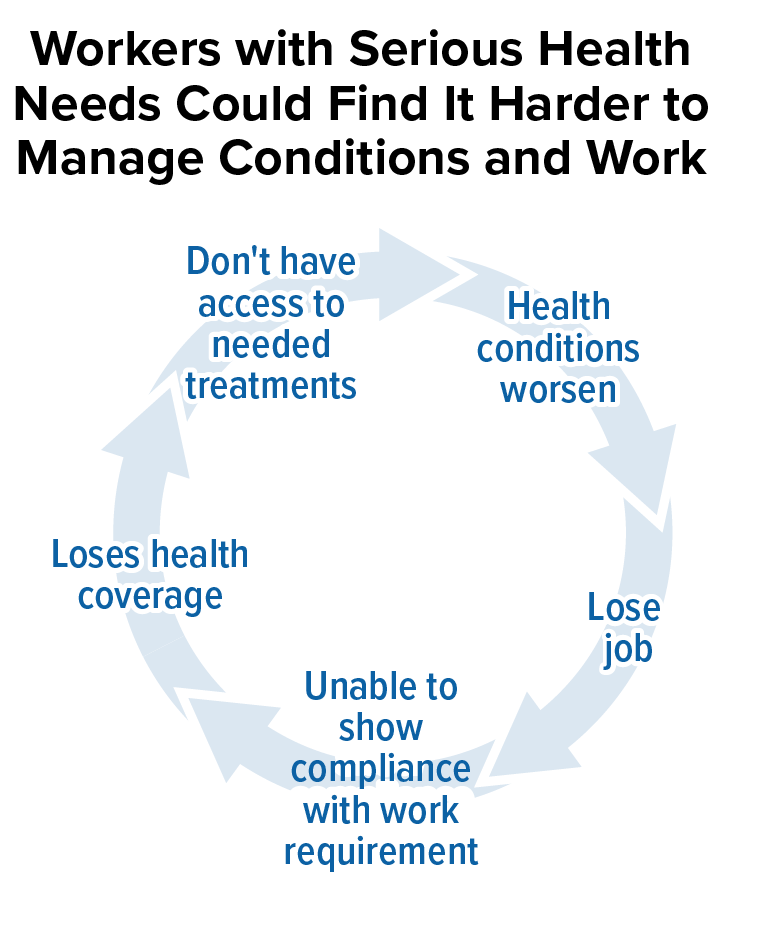
Working Medicaid enrollees have high rates of serious health needs, even though they’re generally healthier than non-working enrollees. Medicaid allows people to better manage their conditions and thus maintain employment, and coverage losses or interruptions will especially harm those with serious health needs. Research shows that losing access to medications and other treatment can lead to serious deterioration in health, increased emergency room visits and hospitalizations, and higher health care costs, all of which disrupt people’s ability to work.
Among workers who gained coverage through Medicaid expansion in Ohio and Michigan, most reported that gaining coverage made them better at their jobs or made it easier for them to keep working.
Work Requirements Are Burdensome and Counterproductive
Ninety percent of adult Medicaid enrollees are already working or would be exempt from a work requirement (see chart below), making it unnecessary to add red tape through a one-size-fits-all requirement. Further, Medicaid work requirements do not increase employment, and the Congressional Budget Office found that a previous House proposal in 2023 would likely have led to coverage loss with “no change in employment or hours worked.”
Instead, work requirements strip health coverage from people with low incomes — most of whom are already meeting or exempt from the requirements — leading to gaps in care that damage their health and financial security and make it harder to find or keep a job. Work requirements are rooted in false stereotypes that ignore the reality that everyone needs health coverage to thrive.