

Congress Must Enact Strong Guardrails for 2027 in Spending Bills to Rein in Administration Abuses
For the past two years, the Trump Administration has escalated its flagrant abuses of its funding authority to undermine Congress’s constitutional power of the purse. It has unilaterally impounded funding approved by Congress, ignored congressional directives in funding laws, hollowed out agencies and programs that provide critical services communities depend on, and taken steps to dangerously politicize the federal grantmaking process. As Congress moves to provide final appropriations for fiscal year 2027, it is essential to include clear, robust, enforceable, government-wide guardrails to limit the Administration’s abuses of federal funding.
Given the sharp rebuke delivered by voters to the Administration in the midterm elections over its corruption and abuses of power, the 2027 funding bills present an opportunity for Congress to take meaningful steps to address these issues.
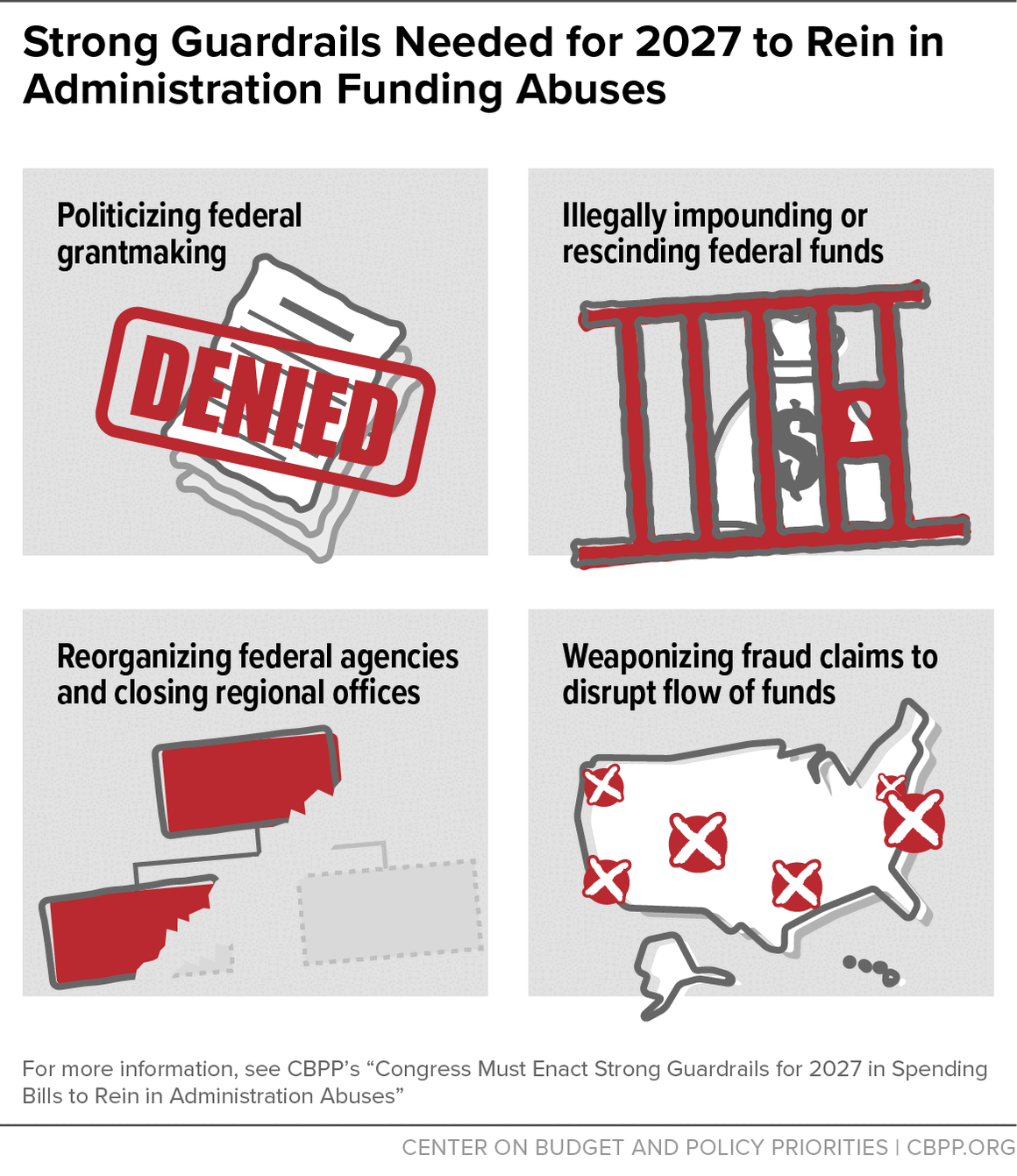
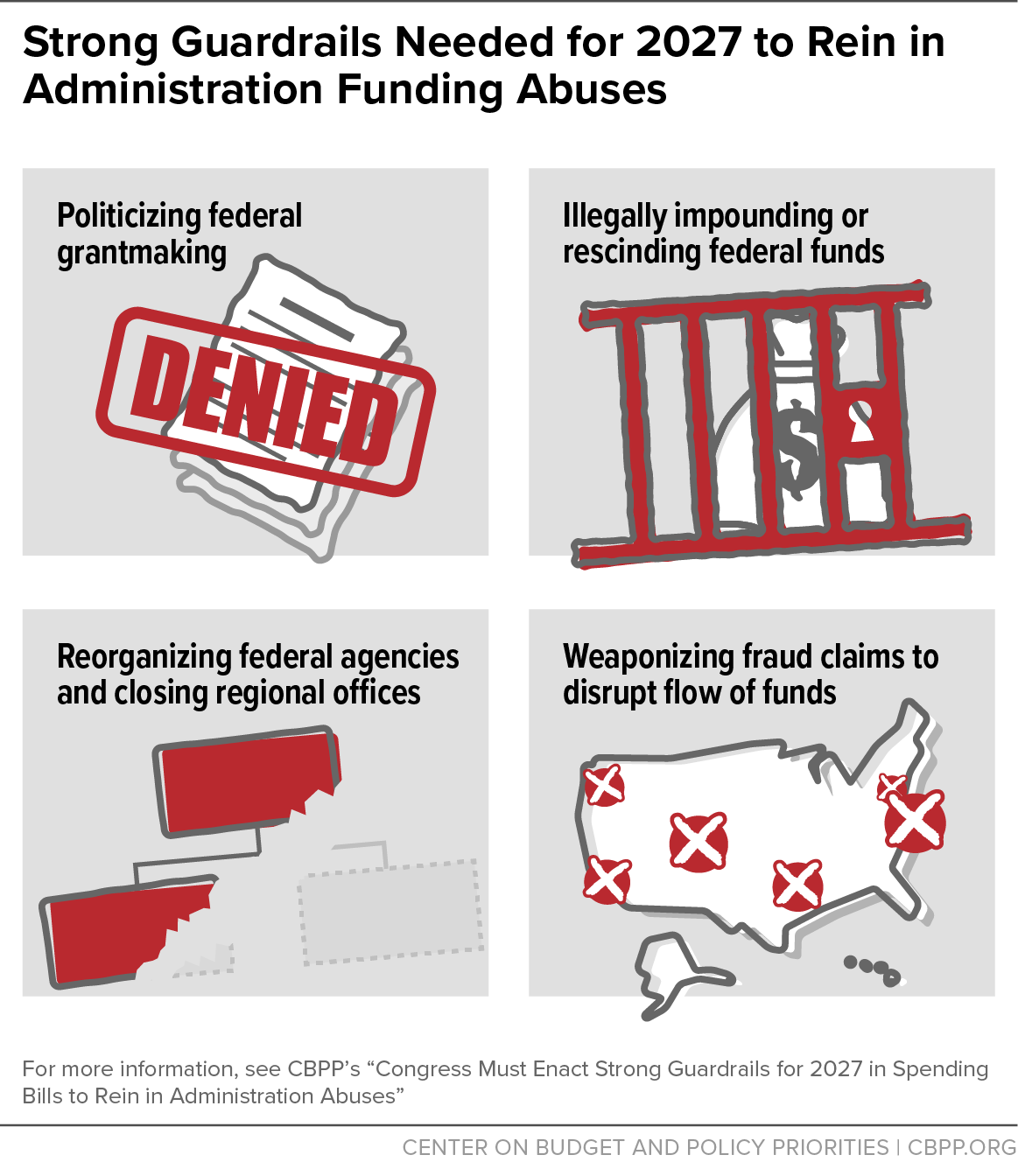
This brief paper sets forth the broad-based guardrails that are most important for limiting illegal abuses of the funding power across government to ensure that Congress’s directives, funding decisions, and authority are respected. Those guardrails would aim to:
- stop efforts to politicize federal grantmaking;
- ensure federal funds are not illegally impounded or rescinded;
- limit reorganizations or relocations intended to undermine federal agencies; and
- prevent the use of spurious fraud claims to justify withholding funding from perceived political opponents.
The Administration has also taken many troubling actions targeting specific government programs that would significantly change the impact of congressionally provided funding. For example, it has proposed regulations that would reduce the quality of services provided by Head Start and radically change the information collected by the Census. While this report does not discuss the full range of such problematic changes, Congress should address important policy issues like these in final appropriations as well.
2026 Appropriations Show Need for Clear, Enforceable, Government-Wide Protections
In providing final appropriations for fiscal year 2027, Congress should heed lessons from the 2026 appropriations process. Last year, Democratic House and Senate appropriators put forward legislation that included significant guardrails addressing many of the Administration’s funding abuses, but they could not secure sufficient Republican support to enact these, or similar, protections.[1] Instead, despite the tools available to them, Congress moved forward with only a limited set of targeted protections for specific programs, some transparency measures, and non-binding expressions of concern about Administration actions. For example, Congress included provisions requiring grant funding for a few specific programs to be sent out by a date certain, requiring transparency around Administration actions to terminate funding in specific programs, and directing certain agencies to maintain sufficient staff to carry out statutory responsibilities.
Overall, these measures have failed to prevent the Administration from escalating its funding abuses over the past year. While some had an impact on specific programs at times, they did not prevent the Administration from engaging in significant abuses in other areas to which these provisions did not apply. Moreover, where provisions lacked enforcement mechanisms or were only non-binding exhortations in report language, the Administration frequently ignored them.
Guardrails remain a critical tool to protect Congress’s power of the purse against the Administration’s actions. The lesson from the past year, however, is that guardrails are only effective when they are clear, in statutory language (not in non-binding report language, which was often sufficient in past administrations), and enforceable. They also should be government-wide to the greatest extent possible, given the Administration’s track record of seeking to abuse its power wherever its efforts are unchecked. Even when the Administration seeks to illegally ignore appropriations guardrails, making them both clear and enforceable will aid litigants in stopping the Administration in court. Beyond specific guardrails, these appropriations bills in general should be written in ways that reduce executive branch discretion over how funding is allocated, including by not relying on non-binding report language.
Essential Guardrails in Four Critical Areas
In establishing robust guardrails that protect against Administration abuses of funding power, lawmakers should prioritize guardrails that address the most widespread and harmful Administration abuses. These guardrails should:
Prevent the politicization of grantmaking. The Administration has sought to undermine and politicize the grantmaking process, which affects billions of dollars flowing to states, localities, and institutions to support scientific research, public safety, and other key community functions.
The most significant such effort is a recent proposed rule from the Office of Management and Budget (OMB) that would politicize both how grants recipients are selected and when their grants can be cancelled.[2] It would pose significant threats to scientific funding, public health and safety programs, and communities served by federal grant funding across the nation. Pushback to the proposed rule was widespread, and Congress included a provision in the temporary spending measure for fiscal year 2027 that prevents the rule from going into effect through December 11, 2026.
In the short term, Congress must at least extend this prohibition for the duration of any continuing resolution. But to address the issue permanently, Congress will need to ban finalization of the rule and any similar agency efforts in 2027 appropriations legislation.
The Administration has also proposed adding coercive new requirements to the SAM.gov (System for Award Management) annual certification processes. These changes would — without any legal basis or authorization — require more than 200,000 federal award recipients to certify compliance with the Administration’s legally controversial and overly broad executive orders related to immigration and diversity, equity, and inclusion (DEI), among other areas.[3] Congress should also prohibit the implementation of this or any similar proposal.
In addition, the Administration has used the grantmaking process to target perceived political opponents and coerce grant recipients to take unrelated policy actions. For example, when a political ally of the President was convicted and jailed for election machine tampering in Colorado, the President publicly threatened consequences for the state if it did not release her. Following her conviction, the White House sent a non-public directive to federal agencies to “prioritize Colorado for the purposes of ensuring grants and federal support are in line with administration priorities.”[4] Shortly thereafter, the Department of Transportation announced it was cancelling over $100 million in grant projects in Colorado.[5] Congress should establish significant penalties for political appointees who engage in such coercive abuse of federal grantmaking authority.
Stop illegal impoundments, including pocket rescissions. The Administration continues to ignore spending laws by withholding federal funds.[6] Among many egregious and illegal impoundments, the Administration has, for the second fiscal year in a row, declared that it is unilaterally causing funds to expire at the end of the fiscal year, which it terms a “pocket rescission.”[7] The Government Accountability Office, members of Congress from both parties, and the courts have all agreed the Administration’s actions are illegal.
There are a range of steps Congress can take to prevent these illegal pocket rescissions. They include proposals put forward by the Democratic leaders of the appropriations committees in 2025 that would turn off the Administration’s ability to send late-year rescission requests, which the Administration claims — without legal basis — justifies their impoundment of funds.
In addition, Congress should take steps to prevent impoundments beyond the Administration’s illegal pocket rescissions by requiring that the Administration meet key funding milestones, including deadlines for making funds available for obligation, for running funding competitions, and for making awards. This would build on and expand the scope of the targeted requirements enacted in 2026 appropriations. Congress could also take steps to make it easier to challenge the illegal withholding of funds in court.
Block destructive agency reorganizations and staff relocations. The Administration continues to ignore congressional directives (some in law but many in non-binding report language) in its efforts to hinder or harm programs it disfavors by restructuring federal agencies, closing offices or facilities, and seeking to punitively relocate federal personnel. Many of these efforts have targeted programs or offices that the Administration sought to cut funding for, but had its efforts rebuffed by Congress.
For example, the Administration has illegally transferred certain functions from the Education Department to other departments and agencies through an abuse of interagency agreements. The Administration has also taken unilateral actions to move offices and staff to undermine programs despite ongoing congressional support.[8] The U.S. Forest Service, for example, has announced plans to close three-quarters of its research facilities and relocate its headquarters staff to Salt Lake City. This would likely cause significant numbers of experienced staff to leave federal service, undermining the agency’s capacity to deliver on the tasks Congress requires it to undertake.[9]
Congress should take further action to unwind the specific efforts the Administration has announced or undertaken by mandating, in statutory language, that various programs and duties be located in specific agencies or that those agencies not relocate offices or staff. Congress can also prevent similar abuses in the future by making the appropriations bills themselves far more prescriptive and limiting how interagency agreements can be used.
Prevent the weaponization of fraud claims to withhold funding. The Administration continues to rely on unsubstantiated claims of fraud as a pretext for withholding funding from disfavored states and other grantees for unrelated political reasons. For example, in January 2026, OMB sent a letter to five Democratic-led states freezing funding for programs that support people with low incomes, alleging that it had “serious concerns about widespread fraud.”[10] However, OMB provided no evidence supporting its claims and a federal judge later blocked the action, finding that the Administration had acted contrary to law.
Congress should take steps to limit the Administration’s ability to abuse these authorities to inappropriately target fund recipients and delay critical funding. Such steps could include providing clearer standards to invoke these authorities, opportunities for funding delays to be more easily challenged in a timely manner, and clear penalties for abusing these authorities.
End Notes
[1] Sam Berger and Devin O’Connor, “New Proposal Shows Congress Can Enact Guardrails to Ensure a Deal Is a Deal for 2026 Funding,” CBPP, September 25, 2025, https://www.cbpp.org/research/federal-budget/new-proposal-shows-congress-can-enact-guardrails-to-ensure-a-deal-is-a-deal.
[2] Sam Berger, Jacob Leibenluft, and Devin O’Connor, “Congress Should Block OMB Grantmaking Rule Permanently to Rein In Administration Abuses,” CBPP, September 30, 2026, https://www.cbpp.org/research/governance/congress-should-block-omb-grantmaking-rule-permanently-to-rein-in.
[3] General Services Administration, “Information Collection; System for Award Management Registration Requirements for Financial Assistance Recipients,” Federal Register, January 28, 2026, https://www.federalregister.gov/documents/2026/01/28/2026-01676/information-collection-system-for-award-management-registration-requirements-for-financial.
[4] Reis Thebault, “Colorado Was Targeted as Trump Fumed Over Election Denier, Email Shows,” New York Times, updated August 18, 2026, https://www.nytimes.com/2026/08/14/us/colorado-trump-tina-peters.html.
[5] Jesse Paul and Taylor Dolven, “Trump administration cancels $109M in environmentally focused transportation grants for Colorado,” Colorado Sun, December 16, 2025, https://coloradosun.com/2025/12/16/trump-administration-cuts-transportation-grants-colorado/.
[6] David Super and Sam Berger, “‘Pocket Rescissions’ Are Illegal,” CBPP, July 30, 2025, https://www.cbpp.org/research/federal-budget/pocket-rescissions-are-illegal.
[7] Sam Berger, Jacob Leibenluft, and Devin O’Connor, “Administration Again Illegally Impounds Federal Funds,” CBPP, October 7, 2026, https://www.cbpp.org/research/governance/administration-again-illegally-impounds-federal-funds.
[8] U.S. Department of Education, “Returning Education to the States,” https://www.ed.gov/about/initiatives/returning-education-states.
[9] Eric Niiler, “Forest Service Will Close Research Stations That Study Wildfire Risk,” New York Times, April 3, 2026, https://www.nytimes.com/2026/04/03/climate/forest-service-research-stations.html.
[10] Nick Gwyn, “Trump Administration’s Five-State Funding Freeze Is Unlawful, Harmful, and a Major Threat to People in Every State,” CBPP, January 23, 2026, https://www.cbpp.org/research/federal-budget/trump-administrations-five-state-funding-freeze-is-unlawful-harmful-and-a.