

Who Are the Parents and Caregivers of School-Aged Children at Increased Risk of Hunger Under House Republican Bill?
The House Republicans’ reconciliation bill now before the Senate would cut SNAP by nearly $300 billion through 2034, a roughly 30 percent reduction and by far the largest cut to SNAP in history. One of the harshest cuts expands SNAP’s already severe work requirements to include, for the first time, parents and caregivers of children over the age of 6. These red-tape-laden and ineffective work requirements don’t align with the realities of low-paying work, people’s caregiving responsibilities, and their ability to work. Most SNAP participants who can work for pay already do so or are temporarily between jobs, and work requirements penalize workers for the volatile hours that characterize low-paying jobs.[1]
More than 3 million adults who care for more than 4 million children aged 7 through 17 would be at risk of losing their food assistance.[2] This puts millions of parents, grandparents, caregivers, and the children they take care of at risk of hunger and food insecurity. The experience of food insecurity among school-aged children can have long-lasting consequences for their physical, cognitive, and social development. It is associated with a range of poor outcomes, including poor physical development, increased symptoms of anxiety and depression, lower test scores, greater likelihood of repeating a grade, and difficulty getting along with other children.[3]
Adults subject to the requirements would only be able to receive food benefits for three months in a three-year period unless they show compliance with a 20-hour-per-week work requirement or prove they qualify for an exemption, such as having a disability.
Example: A mother with two children works as many hours as she can get in a retail store while her children are in school, but her employer does not provide paid leave. One of her children has acute asthma, which results in them staying home from school frequently. The mother will have difficulty meeting the 20-hour-a-week requirement, even if her employer allows her the flexibility to miss shifts. The mother would lose eligibility for SNAP, taking away her food assistance and her ability to feed her children.
Expanded Work Requirement Would Harm Primarily Women Caregivers of All Races
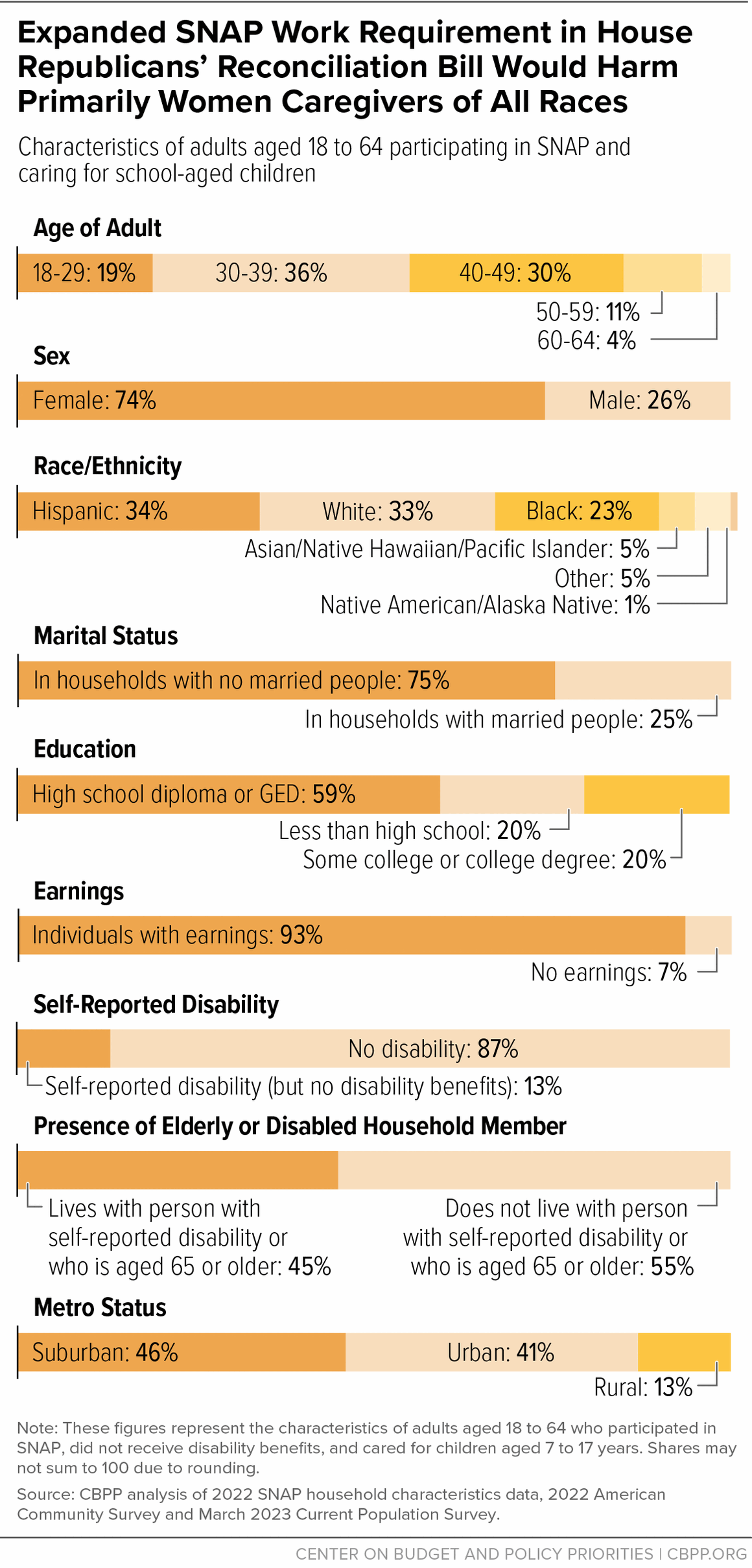
The adults caring for school-aged children who are at risk of losing food assistance are a diverse group (see Figure 1). Nearly three-quarters (74 percent) of these adults are women and 45 percent are 40 years old or older. Nearly half a million are aged 50 through 64. About two-thirds are Hispanic (34 percent) or white (33 percent), while 23 percent are Black, 5 percent are Asian, Native Hawaiian, or Pacific Islander, 1 percent are American Indian, and 5 percent are more than one race. Three-quarters (75 percent) of the adults are in households with no married people. Among those who reported their education, nearly four in five (79 percent) had a high school diploma/GED or less. They live in all areas of the country; among those for whom data on metropolitan status are available, about 46 percent live in suburban areas, another 41 percent in urban areas, and 13 percent in rural areas.
About 15 percent, or nearly half a million, are aged 50 through 64 and may be particularly vulnerable to losing benefits under a work requirement because they are more likely to face age-related discrimination in the labor market, they may no longer be able to do the same types of jobs that they performed when they were younger, and they more frequently experience work-limiting health conditions but are unable to secure an exemption. Some may be grandparents or other older relatives caring for children they may not have expected to have in their homes. Without help affording groceries, these families may face real challenges caring for these children, even raising the risk of children needing to leave their relatives’ care and go to foster care.
Example: A 60-year-old grandmother is caring for her two grandsons because the children’s parents are unable to. The grandmother worked as a housecleaner but is not physically able to do that demanding job any longer. If the grandmother can’t meet the work requirement or prove she qualifies for a disability exemption, the family’s food assistance will be cut dramatically. Without help buying groceries, the grandmother may not be able to continue to care for her grandsons, increasing the risk that they will need to enter foster care.
About 13 percent of all parents (and other caretakers) aged 18 to 64 report having a disability even though they don’t qualify or receive disability benefits such as SSI. This means that roughly 400,000 of the 3.1 million parents, grandparents, and other caregivers at risk could have a work-limiting health condition and would need to be properly screened to secure an exemption, adding an administrative burden for both low-income families and state agencies. Research shows that many people who lose SNAP under the current work requirement are working or should have qualified for an exemption, but the bureaucratic red tape makes documenting their employment or proving their exemption too difficult.[4]
These parents or grandparents may have significant caregiving responsibilities for others in their household that would make it challenging to meet the 20-hour requirement. Nearly half of these adults (45 percent) live with someone who is 65 years or older or who reported having a disability.
Example: A family has two children in school. Both parents work until the mother develops cancer and can no longer work given her medical treatment. The family cannot afford a home health aide, so the father stops working to care for his wife. The state agency has been overwhelmed with the additional administrative burden of screening households newly subject to the work requirement and does not review the family’s case properly. The agency fails to identify the father as being exempt from the work requirement because he is caring for his sick wife, resulting in the father losing eligibility and cutting the family’s food assistance dramatically.
Most SNAP Participants With School-Aged Children Already Work
Most SNAP participants who can work for pay already do so or are temporarily between jobs. Census data show that more than 9 in 10 (91 percent of) households with a non-disabled adult aged 18 to 64 with school-aged children (7 to 17 years old) who reported receiving SNAP at some point in 2023 had earnings during that year.
But these individuals remain at significant risk of being cut off SNAP. Many SNAP participants work in unstable, low-paying jobs that have unpredictable hours and no benefits such as paid sick leave. The volatility of these jobs means that workers are more frequently unemployed and may struggle to consistently document 20 hours-per-week of work, increasing the risk that they are cut off SNAP by the three-month time limit. Other workers who meet the 20-hour requirement may lose their food assistance if the systems for documenting those hours fail or are too difficult for people to navigate.
Example: A mother with a 10-year-old son works filling packages at a warehouse. The company is seeing lower sales as the economy weakens and finds that it needs fewer workers. The mother gets laid off and applies for SNAP to help her afford food. A year earlier she had also needed SNAP while she was out of work before getting the warehouse job and so only has one more month of SNAP she can receive before needing to meet the work requirement. Finding a job is tough because unemployment is rising. She is looking for work diligently but can’t find a job. She fails to meet the work requirement and exhausted her three month time limit for SNAP receipt, her SNAP benefit is cut off, and food assistance to her family plummets from $536 to $292 per month, or just $4.87 per person per day.
These harsh work requirements already apply to adults aged 18 to 54 who don’t have children, and the evidence based on the experience of this group is clear — these requirements don’t do anything to raise employment rates.[5] But they do result in many people losing food benefits they need, deepening poverty and increasing hardship.
People turn to SNAP to help make ends meet when they experience an economic shock, like job loss, or personal circumstances that result in financial instability, like a divorce or death in the family. A recent study found that within a year, SNAP recipients are more likely to be employed and have higher earnings than they would have had without help from SNAP.[6]
SNAP is our nation’s most effective tool to reduce hunger and food insecurity among our most vulnerable neighbors, and this assistance matters for improving children’s health and well-being well into adulthood.
Notes on Methods
The estimates in Figure 1 are calculated using 2022 SNAP Quality Control (QC) data, 2022 American Community Survey (ACS) data, and March 2023 Current Population Survey (CPS) data. The distributions by race/ethnicity, earnings, self-reported disability, and presence of an elderly or disabled person are calculated using ACS data, while those by metro status are calculated using CPS data. All other distributions are calculated using QC data. The shares of adults in households with school-aged children by education and metro status exclude the survey respondents who did not provide data on these items. “Earnings” refers to the income that the individuals earned through wages, salary as an employee, and/or through self-employment over the past 12 months.
One prevalent definition of individuals with disabilities in national surveys is those who self-report having a disability in at least one of six core areas: hearing, seeing, cognitive, ambulatory, self-care, and/or independent living. SNAP’s definition of disability, for purposes of receiving special consideration within the program, is narrower and does not cover all individuals who may have these disabilities.
Instead, SNAP considers a person disabled if they receive at least one of several types of disability payments.[7] Accordingly, the SNAP QC survey does not ask directly about disabilities. In Figure 1, the estimates from QC data of adult SNAP recipients without disabilities are based on adults who do not receive Supplemental Security Income (SSI), Social Security (if under 65 years old), veterans’ benefits or workers’ compensation, or who are not exempted from work registration due to having a disability.
Similarly, the CPS does not ask directly about disability.[8] In Figure 1, the estimates from CPS data are based on adults who do not receive SSI, Social Security income (if under 65 years old), workers’ compensation, or veterans’ disability income. The ACS asks directly about disability in the above-mentioned six core areas, along with disability benefit receipt.[9] To match the definition of disability in the CPS and QC in Figure 1, the estimates from ACS data are based on adults who do not receive SSI, veterans' benefits, or Social Security (if under 65). The exceptions are the estimates on self-reported disability, which indicate the share of adults who do not receive disability benefits yet report having a disability in any of the above-mentioned six core areas.
End Notes
[1] Elizabeth Ananat, Anna Gassman-Pines, and Olivia Howard, “Work Requirements Penalize Workers in Volatile Occupations,” Brookings Institution, May 22, 2025, https://www.brookings.edu/articles/work-requirements-penalize-workers-in-volatile-occupations.
[2] Katie Bergh, Catlin Nchako, and Luis Nuñez, “Expanded Work Requirements in House Republican Bill Would Take Away Food Assistance From Millions: State and Congressional District Estimates,” CBPP, May 13, 2025, https://www.cbpp.org/research/food-assistance/expanded-work-requirements-in-house-republican-bill-would-take-away-food.
[3] CBPP, “2025 Budget Impacts: House Bill Would Cut Assistance for Children, Raise Costs for Families,” June 6, 2025, https://www.cbpp.org/research/federal-budget/2025-budget-impacts-house-bill-would-cut-assistance-for-children-raise; Diana Jyoti, Edward Frongillo, and Sonya Jones, “Food Insecurity Affects School Children’s Academic Performance, Weight Gain, and Social Skills,” Journal of Nutrition, Vol. 135, Issue 12, December 2005, https://doi.org/10.1093/jn/135.12.2831; Katherine Alaimo, Christine Olson, and Edward Frongillo, “Food Insufficiency and American School-Aged Children's Cognitive, Academic, and Psychosocial Development,” Pediatrics, Vol. 108, Issue 1, July 2001, https://doi.org/10.1542/peds.108.1.44; David Whitsett, Martin Sherman, and Beth Kotchick, “Household Food Insecurity in Early Adolescence and Risk of Subsequent Behavior Problems: Does a Connection Persist Over Time?” Journal of Pediatric Psychology, Vol. 44, Issue 4, November 2018, https://doi.org/10.1093/jpepsy/jsy088.
[4] Erin Brantley, Drishti Pillai, and Leighton Ku, “Association of Work Requirements With Supplemental Nutrition Assistance Program Participation by Race/Ethnicity and Disability Status, 2013-2017,” JAMA Network Open, Vol. 3, No. 6, June 2020, https://jamanetwork.com/journals/jamanetworkopen/fullarticle/2767673.
[5] Lauren Bauer and Chloe N. East, “A primer on SNAP work requirements,” The Hamilton Project, April 2025, https://www.hamiltonproject.org/publication/paper/a-primer-on-snap-work-requirements. See also Ladonna Pavetti et al., “Expanding Work Requirements Would Make It Harder for People to Meet Basic Needs,” CBPP, March 15, 2023, https://www.cbpp.org/research/poverty-and-inequality/expanding-work-requirements-would-make-it-harder-for-people-to-meet.
[6] Jason Cook and Chloe East, “The Effect of Means-Tested Transfers on Work: Evidence From Quasi-Randomly Assigned SNAP Caseworkers,” National Bureau of Economic Research, May 2025, https://www.nber.org/system/files/working_papers/w31307/w31307.pdf.
[7] U.S. Department of Agriculture, “SNAP Special Rules for the Elderly or Disabled,” updated June 2, 2025, https://www.fns.usda.gov/snap/eligibility/elderly-disabled-special-rules.
[8] U.S. Census Bureau, “How Disability Data are Collected from the Current Population Survey,” last revised November 25, 2024, https://www.census.gov/topics/health/disability/guidance/data-collection-cps.html.
[9] U.S. Census Bureau, “How Disability Data are Collected from the American Community Survey,” last revised November 21, 2021, https://www.census.gov/topics/health/disability/guidance/data-collection-acs.html.